Yes, federal firearm rights can sometimes be restored—but applying for “gun rights restoration” is not always the correct first step.
A person denied by NICS because of an inaccurate record does not need the same remedy as someone subject to a valid federal felony prohibition. Repeated background-check delays may call for a Voluntary Appeal File and UPIN. A federal conviction may support a presidential pardon or an application under 18 U.S.C. § 925(c). A state conviction may require state relief, federal analysis, or both.
Choosing the wrong process can waste time and money without removing the actual prohibition. In some cases, filing a premature § 925(c) application can produce a denial that makes a later application more difficult.
National Security Law Firm helps clients identify why they are prohibited or being denied and determine which legal remedy is capable of addressing the problem.
Our nationwide federal firearms lawyers handle:
- Federal firearm rights restoration under § 925(c);
- NICS denials and challenges;
- VAF and UPIN applications;
- FBI firearm-record corrections;
- Presidential pardons;
- Federal and state restoration analysis;
- Mental-health prohibitions;
- Domestic-violence prohibitions;
- Military and veterans’ firearm matters; and
- Other federal firearm restrictions.
The practice is led by former United States Attorney Dak Kees, who understands how federal authorities investigate records, evaluate adverse information, assess rehabilitation, and exercise discretion in consequential matters.
The question is not simply whether you can get your gun rights back. The question is which law took them away—and which legal process can restore them.
Book a Free, Confidential Consultation
Start by Determining Why You Are Prohibited or Being Denied
Before selecting a remedy, determine whether a valid firearm prohibition exists and what caused it.
Federal firearm restrictions can arise from:
- A felony conviction;
- Fugitive status;
- Unlawful use of or addiction to a controlled substance;
- A qualifying mental-health adjudication or commitment;
- Certain immigration statuses;
- A dishonorable discharge;
- Renunciation of United States citizenship;
- A qualifying domestic-violence protection order;
- A misdemeanor crime of domestic violence; or
- Another restriction imposed by federal law.
A firearm transaction may also be denied or delayed because of:
- Mistaken identity;
- A similar name or date of birth;
- An arrest with no reported final disposition;
- An offense classified incorrectly;
- An expunged or vacated record that was not updated;
- Conflicting state and federal records;
- Incomplete military or mental-health information; or
- A restoration order that NICS did not receive.
These are different problems requiring different solutions.
Our federal firearm prohibition lawyers help clients identify the source of the restriction and determine whether the record is accurate before recommending a restoration application, appeal, pardon, or other proceeding.
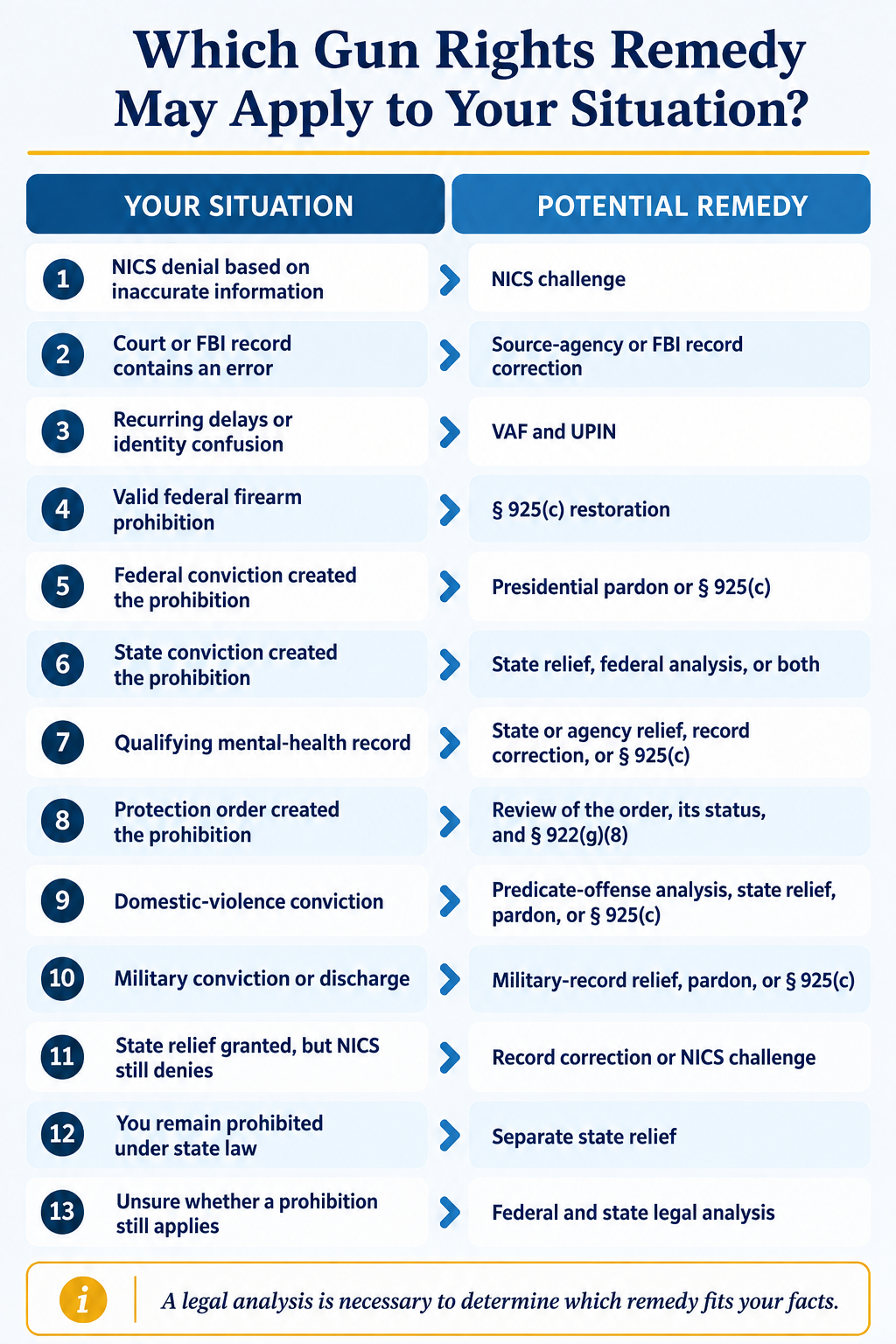
Which Gun Rights Remedy May Apply to Your Situation?
The following chart provides a starting point:
Remedy One: Challenge an Incorrect NICS Denial
A NICS challenge is appropriate when the denial is wrong or based on inaccurate, incomplete, or outdated information.
The FBI allows a person with a denied transaction to request the reason for the denial and submit a challenge. A challenge may:
- Identify the federal prohibiting category applied by NICS;
- Identify the court, agency, or repository holding the relevant record;
- Permit the person to submit fingerprints or supporting documents;
- Prompt additional FBI research; and
- Result in the denial being sustained, overturned, or left unresolved.
A NICS challenge is not firearm rights restoration. It argues that the person is not legally prohibited or that the information supporting the denial is inaccurate or no longer applicable.
Our NICS appeal lawyers help clients obtain the reason for the denial, identify the relevant record, collect supporting documentation, and pursue the appropriate challenge.
NICS denial challenges generally begin at $2,500, depending on the scope and complexity of the matter.
Remedy Two: Correct an Inaccurate FBI or Source-Agency Record
Sometimes the FBI cannot correct a NICS problem because the error originated with another agency.
The source may be:
- A criminal court;
- State police;
- A state criminal-history repository;
- A local law-enforcement agency;
- A mental-health reporting authority;
- A military component; or
- Another government record custodian.
Common errors include:
- An arrest listed without a final disposition;
- Charges still shown as pending;
- A conviction reported under the wrong statute;
- An expungement or vacatur not transmitted;
- Incorrect identity information;
- Another person’s record;
- An incomplete restoration order; or
- Conflicting state and federal criminal histories.
The appropriate strategy may require obtaining the official record, correcting it with the originating agency, and then providing the corrected information to the FBI or NICS.
Our FBI firearm record correction lawyers help clients identify the source of the error, secure certified records, pursue correction, and coordinate that work with a NICS challenge when necessary.
Our procedural guide also explains how to challenge an inaccurate FBI Identity History Summary.
Remedy Three: Apply for a Voluntary Appeal File and UPIN
A Voluntary Appeal File may help individuals who experience repeated NICS delays or denials because the FBI repeatedly encounters identity or record questions.
If the FBI approves the VAF application, it issues a Unique Personal Identification Number, commonly called a UPIN. The individual may provide the UPIN during future firearm transactions so NICS can access the information retained in the Voluntary Appeal File.
A VAF and UPIN may be useful when:
- You have a common name;
- Your identifying information resembles another person’s;
- You previously received an erroneous denial;
- A record repeatedly requires additional research;
- You experience recurring delays; or
- Supporting documentation must be associated with your identity.
A UPIN does not:
- Restore firearm rights;
- Remove a conviction;
- Override a federal or state prohibition;
- Guarantee an immediate background-check response; or
- Guarantee that a future transaction will proceed.
Our VAF and UPIN lawyers help clients determine whether the process fits the problem, prepare the application, submit fingerprints and supporting records, and address recurring identity issues.
NSLF has also handled a matter in which the firm corrected a mistaken-identity firearm problem and helped the client obtain a UPIN. Prior results depend on their individual facts and do not guarantee a similar outcome.
Remedy Four: Apply for Federal Firearm Rights Restoration Under § 925(c)
Section 925(c) provides a potential remedy for individuals who are subject to a valid federal firearm disability.
The applicant must establish to the Attorney General’s satisfaction that the circumstances surrounding the disability, together with the applicant’s record and reputation, demonstrate that:
- The applicant is not likely to act in a manner dangerous to public safety; and
- Granting relief would not be contrary to the public interest.
This is a discretionary federal process—not a conventional appeal and not an automatic restoration after a particular number of years.
DOJ may examine:
- The offense and underlying conduct;
- The complete criminal history;
- Arrests and dismissed charges;
- Sentence completion;
- Compliance with supervision;
- Subsequent conduct;
- Mental-health and substance-use information;
- Protection orders;
- Military records;
- Community reputation;
- Rehabilitation evidence;
- Sworn character references; and
- The completeness and credibility of the application.
Our federal firearm rights restoration lawyers represent clients nationwide in § 925(c) matters, including eligibility analysis, records collection, evidence development, reference preparation, filing, and post-submission representation.
NSLF charges a $5,000 flat fee for most § 925(c) matters. Certain complex applications require a $7,500 flat fee. Government fees and third-party expenses are separate.
Experience Developed Before the Public Portal Opened
National Security Law Firm began preparing and submitting federal firearm rights restoration matters more than a year before DOJ finalized its rule and opened the public application portal.
That early work gave our attorneys practical experience evaluating eligibility, reconstructing historical records, developing rehabilitation evidence, preparing character references, adapting pending matters to an evolving federal process, and communicating with the Office of the Pardon Attorney, the DOJ component administering the program.
The firm continues to represent clients in pre-portal federal firearm matters as DOJ implements its formal procedures.
Learn more about why clients choose NSLF for § 925(c) representation.
Remedy Five: Seek a Presidential Pardon
A presidential pardon may be an appropriate remedy when a federal conviction created the firearm disability.
DOJ states that a full presidential pardon can remove penalties and disabilities—including a firearm disability—arising from the pardoned federal conviction.
However, a pardon may not resolve:
- A separate state conviction;
- Another federal conviction;
- A qualifying protection order;
- A mental-health-based prohibition;
- A current disqualifying status;
- A state firearm restriction; or
- An inaccurate NICS record.
A pardon also differs from § 925(c). A pardon forgives a federal offense and may remove the disabilities resulting from it. Section 925(c) grants relief from qualifying federal firearm disabilities but does not pardon or erase the underlying conviction.
Dak Kees leads NSLF’s representation in both federal firearm restoration and presidential pardon matters involving federal convictions. That allows our attorneys to compare the potential value, limitations, evidence, and consequences of each federal process.
Our guide answering whether a pardon restores firearm rights explains when additional relief may still be necessary.
Remedy Six: Pursue an Expungement, Set-Aside, Pardon or Restoration of Civil Rights
When a state conviction created the firearm disability, state relief may affect whether the conviction continues to count under federal law.
Potential state remedies include:
- Expungement;
- Set-aside or vacatur;
- Gubernatorial pardon;
- Restoration of civil rights;
- Certificate of rehabilitation; or
- A specialized firearm-rights proceeding.
But the name of the remedy does not determine its federal effect.
Federal law may consider:
- The law of the convicting jurisdiction;
- Whether the conviction was expunged or set aside;
- Whether the person was pardoned;
- Whether civil rights were restored;
- Which rights were restored;
- Whether the order retained firearm restrictions; and
- Whether another independent prohibition exists.
An expungement may clear or limit access to a record without restoring firearm rights. A state restoration order may remove a state prohibition without eliminating a federal one. A federal § 925(c) grant may remove a federal disability without authorizing possession under state law.
Our guide addressing whether an expungement restores gun rights explains why the underlying state law and order must be examined carefully.
Remedy Seven: Obtain State or Agency Mental-Health Relief
A person prohibited under 18 U.S.C. § 922(g)(4) because of a qualifying mental-health adjudication or commitment may have access to a state, territorial, or federal agency relief program.
Depending on the jurisdiction and record, the person may need to pursue that process before applying under § 925(c).
The analysis may require:
- The original petition;
- The adjudication or commitment order;
- Medical and treatment records;
- Discharge or competency findings;
- Current professional evidence;
- The requirements of the available relief program; and
- Whether NICS received updated information.
Voluntary counseling, treatment, or therapy does not automatically create a federal prohibition. The legal nature of the proceeding must be identified.
Our mental-health firearm rights restoration lawyers evaluate state and agency relief, FBI record correction, NICS issues, and potential § 925(c) representation.
Remedy Eight: Address a Domestic-Violence Conviction or Protection Order
Federal law separately regulates qualifying domestic-violence protection orders and misdemeanor crimes of domestic violence.
A protection-order prohibition may depend on:
- Whether the order remains active;
- Whether the respondent received notice;
- Whether the respondent had an opportunity to participate;
- The relationship between the parties;
- The findings made by the court; and
- The conduct prohibited by the order.
A misdemeanor domestic-violence prohibition may depend on:
- The offense of conviction;
- The required relationship;
- The elements of the offense;
- The use or attempted use of physical force;
- The threatened use of a deadly weapon;
- Restoration, expungement, or pardon; and
- The effect of state law.
A domestic-violence history may also create a ten-year or continuing presumption affecting a § 925(c) application.
Our domestic-violence gun rights restoration lawyers analyze the criminal record, protection order, underlying conduct, applicable federal prohibition, state law, and available restoration options.
Remedy Nine: Correct a Military Record or Address a Military Disability
A court-martial conviction, dishonorable discharge, military mental-health record, or other service record can produce federal firearm consequences.
Potential remedies may include:
- A discharge review;
- A board for correction of military records;
- Military appellate action;
- Correction of an inaccurate record;
- A presidential pardon;
- Mental-health relief; or
- A § 925(c) application.
The correct remedy depends on whether the military record can be corrected, whether that correction removes the federal disability, and whether another prohibition remains.
NSLF’s military and federal firearms practices work together in these matters. Our attorneys represent clients dealing with veterans’ firearm rights after court-martial convictions, military discharges, and VA-related actions.
Federal and State Gun Rights Are Not the Same
Restoring federal firearm rights does not necessarily restore state firearm rights.
A person may face:
- Only a federal prohibition;
- Only a state prohibition;
- Separate federal and state prohibitions; or
- An inaccurate record that makes a lawful person appear prohibited.
The remedy must address every applicable restriction.
For example:
- A presidential pardon cannot forgive a state conviction;
- A state pardon cannot pardon a federal conviction;
- A federal § 925(c) grant does not override state law;
- A state restoration order may not eliminate the federal effect of a conviction;
- A UPIN does not remove either prohibition; and
- Correcting NICS does not create legal rights the person does not otherwise possess.
Our guide to federal versus state gun rights restoration explains why many matters require a dual analysis.
Does Completing a Sentence Automatically Restore Gun Rights?
Usually not.
Completing incarceration, probation, parole, supervised release, restitution, or another sentence component may affect eligibility for relief, but sentence completion alone does not automatically remove a federal prohibition.
The completion date can also affect DOJ’s five-year or ten-year presumptions. A person who counts only from the conviction date may believe a waiting period has expired when DOJ calculates it differently.
Review our explanation of the five-year and ten-year waiting periods for § 925(c) restoration before assuming that the timing is appropriate.
Can I Possess a Firearm While Seeking Relief?
No. Filing an appeal, correction request, pardon petition, or restoration application does not suspend an existing firearm prohibition.
Unless another legal exception applies, a prohibited person may not possess, receive, ship, or transport firearms or ammunition until the relevant restriction has legally ended.
This includes potential constructive possession. A prohibited person may face serious exposure when a firearm is accessible in a shared home, vehicle, workplace, or other location—even if another person claims ownership.
No one should purchase, possess, or handle a firearm based solely on an assumption that rights were restored. The final order, governing law, and relevant records should be reviewed first.
How NSLF Determines the Correct Remedy
Our analysis generally includes:
- Obtaining the available federal and state criminal histories;
- Identifying every possible firearm prohibition;
- Determining whether the record is accurate;
- Reviewing the conviction, order, status, or event causing the prohibition;
- Evaluating federal and state law separately;
- Determining whether the problem is a denial, delay, error, or valid disability;
- Comparing the available remedies;
- Assessing eligibility, timing, risk, and cost;
- Identifying records and evidence required for the selected process; and
- Explaining what the representation can and cannot accomplish.
We do not recommend § 925(c) merely because DOJ has opened an application process. We do not recommend a NICS challenge when the record establishes a valid prohibition. We do not promise that state relief will resolve federal law without analyzing its actual legal effect.
The objective is to choose the process capable of solving the client’s real problem.
Why Choose National Security Law Firm?
Firearm-rights matters frequently cross practice areas. A federal conviction may implicate a pardon. A military record may require correction. A mental-health prohibition may require state relief. A NICS denial may arise from an inaccurate FBI record. State relief may leave a federal restriction unresolved.
NSLF brings those disciplines together.
Clients choose our firm because we offer:
- A federal firearms practice led by former United States Attorney Dak Kees;
- Experience preparing § 925(c) matters before the public portal opened;
- Nationwide federal representation;
- Integrated experience in NICS, FBI records, pardons, military law, mental-health prohibitions, immigration, and federal administrative matters;
- Defined scopes of representation;
- Transparent flat fees;
- Candid advice about whether a process is likely to help; and
- A 4.9-star rating across 298 Google reviews.
Learn more about why clients select NSLF for federal firearm rights restoration.
Frequently Asked Questions About Getting Gun Rights Back
Can I get my gun rights back after a felony?
Potentially. The answer depends on whether the conviction was federal or state, the offense and underlying conduct, the sentence, applicable state law, subsequent conduct, and available federal or state relief. Our guide explains the possible ways to restore federal gun rights after a felony conviction.
Can a nonviolent felon apply under § 925(c)?
Potentially, but a nonviolent label does not guarantee approval. DOJ may examine the underlying conduct, complete criminal history, sentence completion, subsequent record, rehabilitation, and reputation.
Does expungement automatically restore gun rights?
No. The effect depends on the jurisdiction, order, rights restored, restrictions retained, and federal treatment of the conviction.
Will a pardon restore my gun rights?
A full presidential pardon may remove a firearm disability arising solely from a pardoned federal conviction. Other federal or state prohibitions may remain.
Can I appeal a delayed NICS check?
The FBI’s conventional denial-challenge process applies to denied transactions, not transactions that remain delayed. Repeated delays may support a VAF/UPIN application or record review.
Does a UPIN restore gun rights?
No. A UPIN helps NICS associate you with information in the Voluntary Appeal File. It does not remove a conviction or legal prohibition.
Can I apply under § 925(c) if my records are missing?
Potentially. You may need to document diligent efforts to obtain the records and provide reliable alternative evidence. Missing records should not simply be omitted.
Do federal and state firearm rights have to be restored separately?
Sometimes. Federal and state restrictions operate independently, and relief in one system may not resolve the other.
Should I apply under § 925(c) as soon as possible?
Not necessarily. Before applying, determine whether a presumption applies, whether the waiting period has expired, whether the necessary records are available, and whether the application is factually ready.
Can a lawyer guarantee that my rights will be restored?
No. No attorney can guarantee an agency, presidential, court, or state decision.
Find Out Which Firearm Remedy Applies to You
The wrong process cannot fix the right problem.
Before paying for an application, submitting sworn information, or assuming your rights have been restored, determine:
- Why you are prohibited or being denied;
- Whether the record is accurate;
- Whether federal law, state law, or both apply;
- Whether the issue requires a challenge, correction, UPIN, pardon, restoration application, or another proceeding;
- Whether a waiting period or presumption applies;
- Whether another remedy should be pursued first; and
- What the proposed representation will actually accomplish.
National Security Law Firm can help you identify the correct path.
Our nationwide federal firearms practice is led by former United States Attorney Dak Kees and supported by attorneys experienced in the intersecting legal systems that determine whether firearm rights can be restored.
Do not start with a form. Start by identifying the legal problem the form is supposed to solve.
Book a Free, Confidential Consultation to speak directly with an attorney about your record, potential remedies, and next steps. Online booking provides immediate confirmation, and available appointment times appear in your local time zone.
Prefer to call? Call National Security Law Firm at (202) 600-4996.
LEGAL DISCLAIMER
This page provides general legal information and does not constitute legal advice. The appropriate remedy, eligibility, fee, and potential outcome depend on the individual facts, governing federal and state law, available records, and current agency procedures. Filing an application, challenge, or petition does not suspend an existing firearm prohibition or guarantee relief.
AUTHOR AND REVIEW INFORMATION
Attorney reviewer: Dak Kees, former United States Attorney
Last legally reviewed: August 2026
PRIMARY GOVERNMENT RESOURCES