
Having cash seized by CBP at an airport or border crossing is one of the most confusing and stressful experiences many travelers ever face.
In many situations, people are shocked because:
- they were never arrested
- no criminal charges were filed
- the money was lawfully earned
- they believed carrying cash was legal
- they did not realize CBP could seize the currency so quickly
What surprises many travelers is that airport and border cash seizure cases often proceed through federal administrative forfeiture systems that operate separately from criminal court proceedings.
That means CBP may pursue forfeiture even where:
- prosecutors never file charges
- the traveler disputes the allegations
- the money itself was lawfully obtained
- no criminal conviction ever occurs
Airport and Border Cash Seizures Are Increasingly Common
CBP regularly seizes currency at:
- international airports
- land border crossings
- outbound international terminals
- customs checkpoints
- secondary screening areas
Many of these cases involve allegations concerning:
- failure to report currency
- structuring
- suspicious financial activity
- bulk cash smuggling
- inconsistent explanations
- undocumented source-of-funds issues
In some situations, travelers genuinely do not realize:
- reporting requirements apply
- certain explanations may trigger scrutiny
- CBP officers may evaluate much more than the money itself
That broader institutional review is one reason why airport cash seizure cases frequently become much more complicated than people initially expect.
These Cases Often Become Credibility and Documentation Cases
Many travelers initially assume the government will simply evaluate whether the money was legal.
In practice, CBP often evaluates whether the overall record appears:
- credible
- internally consistent
- properly documented
- administratively reliable
Federal agencies frequently compare:
- inspection statements
- customs declarations
- financial records
- travel history
- electronic communications
- mitigation submissions
- later explanations
Even relatively small inconsistencies may become important if investigators believe:
- explanations evolved over time
- records conflict with prior statements
- the narrative appears reconstructed later
That is one reason why airport cash seizure cases are often heavily:
- credibility-driven
- documentation-driven
- procedure-driven
long before formal litigation ever begins.
Airport Cash Seizure Cases Often Involve More Than Currency Alone
Many people initially view the case as simply a dispute over seized cash.
In reality, airport and border seizure matters may later affect:
- immigration proceedings
- Global Entry eligibility
- TSA credentials
- security clearances
- federal employment
- contractor eligibility
- future border inspections
- broader federal investigations
Federal agencies often evaluate these matters collectively rather than in isolation.
That broader overlap is one reason why airport cash seizure strategy frequently requires a much deeper understanding of federal administrative systems than most people initially realize.
Strategic Administrative Analysis Often Matters Early
Many customs seizure matters are heavily influenced by:
- inspection statements
- procedural elections
- mitigation submissions
- documentation quality
- consistency of explanations
- administrative record-building
That is why National Security Law Firm repeatedly emphasizes:
the record controls the case.
The sections below explain:
- why CBP seizes currency at airports and borders
- how airport cash seizure cases actually work
- why many cases are won or lost early
- how federal agencies evaluate credibility and documentation
- what strategic mistakes often damage cases
- how National Security Law Firm represents clients nationwide in airport and border cash seizure matters
For broader discussion of customs forfeiture proceedings generally, visit the firm’s CBP Money Seizure Lawyers Hub page.
Why CBP Seizes Cash at Airports and Borders
Many people are shocked when CBP seizes cash during:
- international travel
- airport inspections
- border crossings
- outbound departures
- secondary screening
In many situations, individuals insist:
- the money was lawfully earned
- no criminal activity occurred
- they were never arrested
- they did not realize they had violated any rule
What surprises many travelers is that airport and border cash seizures often proceed through administrative forfeiture systems even when no criminal charges are filed.
Carrying Cash Is Not Illegal
One of the biggest misconceptions in airport currency seizure cases is that carrying large amounts of cash is automatically illegal.
It is not.
People lawfully travel with substantial amounts of currency for many legitimate reasons involving:
- business transactions
- real estate purchases
- family obligations
- international commerce
- gambling activity
- cultural preferences for cash transactions
However, once CBP encounters large amounts of currency during international travel, investigators often begin evaluating much broader concerns involving:
- reporting compliance
- source-of-funds documentation
- financial activity
- travel patterns
- credibility
- consistency of explanations
That broader institutional review is one reason why airport currency seizure cases frequently become much more complicated than travelers initially expect.
Why CBP Targets Currency
CBP and related federal agencies often associate large amounts of currency with:
- structuring
- money laundering concerns
- narcotics investigations
- tax issues
- suspicious financial activity
- bulk cash smuggling allegations
As a result, airport cash seizure cases frequently receive aggressive scrutiny even where:
- no drugs are involved
- the money was lawfully earned
- no criminal prosecution occurs
- the traveler disputes the allegations
Depending on the circumstances, investigators may evaluate:
- customs declarations
- banking records
- tax returns
- travel history
- electronic communications
- packaging of the currency
- prior border crossings
- explanations provided during inspection
That institutional review often begins immediately after the seizure occurs.
Why Airport Cash Seizures Often Become Credibility Cases
Many travelers assume the case will focus only on whether the money itself was legal.
In practice, CBP often evaluates whether the overall record appears:
- credible
- internally consistent
- properly documented
- administratively reliable
Federal agencies frequently compare:
- inspection statements
- customs declarations
- financial records
- mitigation submissions
- later explanations
Even relatively small inconsistencies may become important if investigators believe:
- explanations changed over time
- documentation conflicts with prior statements
- the narrative appears reconstructed later
That is one reason why airport cash seizure cases are often heavily:
- credibility-driven
- documentation-driven
- procedure-driven
long before formal litigation ever begins.
Airport Cash Seizure Cases Frequently Require Strategic Administrative Analysis
Many travelers initially react emotionally after CBP seizes their money.
In practice, however, these cases are often shaped much earlier through:
- procedural positioning
- mitigation strategy
- documentation quality
- credibility management
- administrative record-building
That is why National Security Law Firm repeatedly emphasizes:
the record controls the case.
Additional discussion appears in Why CBP Thinks Carrying Large Amounts of Cash Is Suspicious and Bulk Cash Smuggling Explained: What CBP Must Prove.
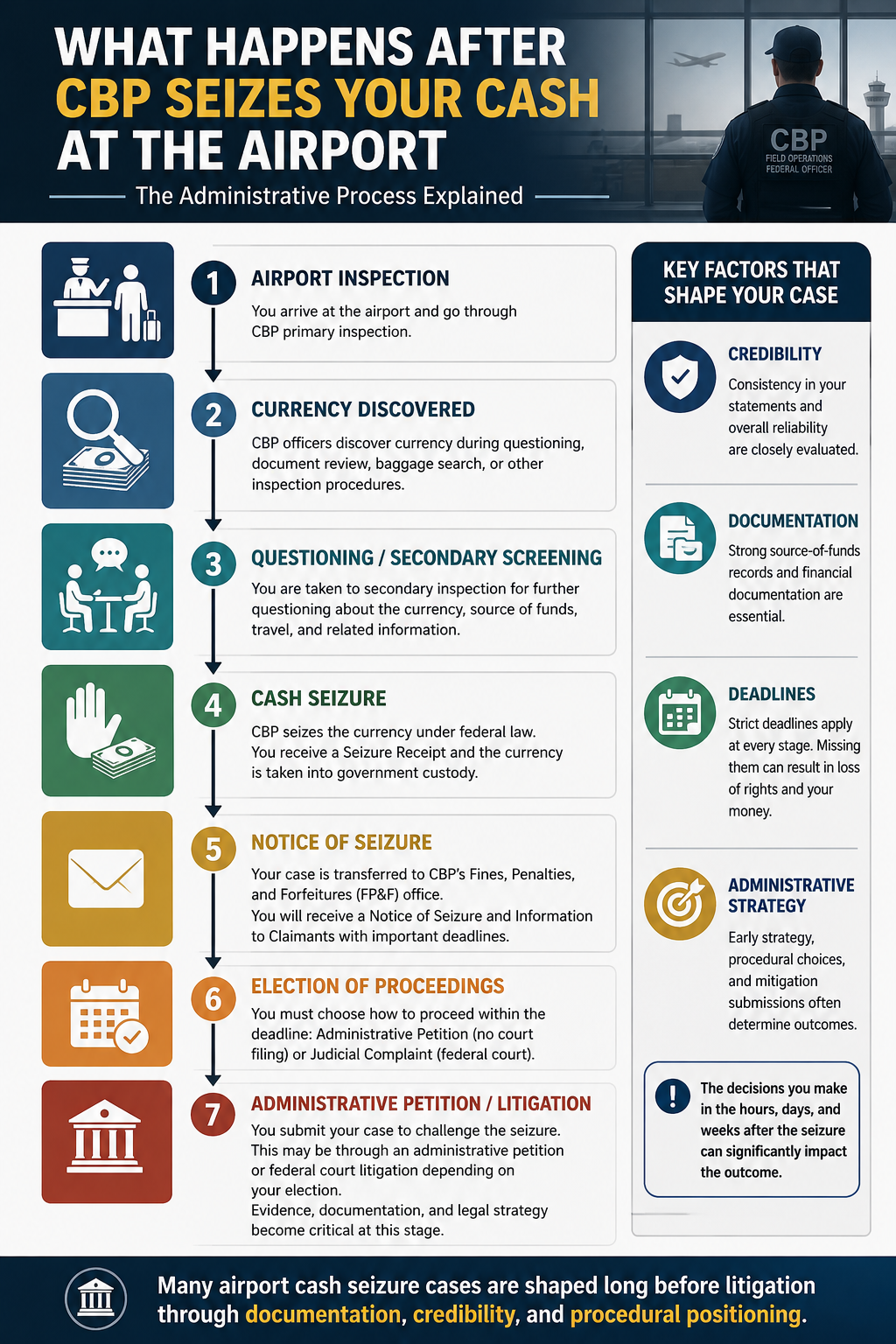
What Happens After an Airport Cash Seizure?
Many travelers assume the seizure itself is the main event.
In reality, some of the most important strategic decisions often occur in the hours, days, and weeks immediately following the seizure.
Once CBP takes possession of the currency, the matter typically enters a federal administrative forfeiture process governed by strict procedural rules and deadlines.
That process often begins moving much faster than people expect.
The Administrative Process Begins Quickly
After the seizure occurs, CBP officers generally begin documenting:
- statements made during inspection
- customs declarations
- travel information
- supporting evidence
- financial explanations
- surrounding circumstances
Depending on the allegations involved, investigators may also review:
- banking records
- tax filings
- electronic communications
- travel history
- source-of-funds documentation
- prior border activity
In many situations, federal agencies are not simply evaluating whether the money itself was lawful.
Instead, they often assess whether the overall record appears:
- credible
- internally consistent
- properly documented
- administratively reliable
That institutional review frequently begins immediately after the seizure occurs.
The Notice of Seizure Often Becomes the Most Important Early Document
After the seizure, the matter is typically transferred to CBP’s Fines, Penalties, and Forfeitures (“FP&F”) office.
At some point, the government usually issues a formal Notice of Seizure and Information to Claimants explaining:
- why the currency was seized
- what deadlines apply
- what procedural options exist
- how forfeiture proceedings may move forward
Many people mistakenly treat the notice as routine paperwork.
In practice, however, the Notice of Seizure often becomes one of the most strategically important stages of the entire case.
The procedural decisions made after receiving the notice may significantly affect:
- mitigation opportunities
- procedural leverage
- litigation posture
- settlement strategy
- broader federal consequences
Additional discussion appears in CBP Notice of Seizure Letter Explained: What To Do Next.
Why Deadlines Matter So Much
Airport cash seizure cases are heavily deadline-driven.
Many travelers are still trying to understand:
- what happened
- whether criminal charges are coming
- why the money was seized
- what their options are
when important procedural deadlines are already approaching.
Missing deadlines may:
- reduce procedural rights
- weaken leverage
- limit recovery options
- result in administrative forfeiture of the currency
That is one reason why airport cash seizure matters often require strategic analysis very early in the process.
Why Early Strategy Often Shapes the Case
Many airport currency seizure matters are ultimately shaped less by courtroom litigation and more by:
- procedural positioning
- mitigation strategy
- documentation quality
- credibility
- consistency of explanations
- administrative record-building
People frequently weaken their position by:
- overexplaining facts
- making inconsistent statements
- submitting unsupported claims
- reacting emotionally
- misunderstanding procedural options
That is why National Security Law Firm repeatedly emphasizes:
the record controls the case.
Additional discussion appears in The Record Controls the Case: Why Your First Submission Matters and Why Early Statements to CBP Can Destroy Your Case.
Why Airport Cash Seizure Cases Are Often Won or Lost Early
Many airport cash seizure cases are not ultimately decided in court.
They are often shaped much earlier through:
- inspection statements
- procedural decisions
- mitigation submissions
- documentation quality
- credibility assessments
- administrative positioning
That reality surprises many travelers because they assume the most important part of the case happens later during litigation.
In practice, however, federal agencies frequently begin evaluating the strength or weakness of the case almost immediately after the seizure occurs.
The Record Often Shapes the Outcome
One of the most important realities in airport currency seizure matters is that the administrative record developed early in the process often shapes how the government evaluates the case moving forward.
The first:
- explanations
- customs declarations
- financial records
- mitigation submissions
- procedural elections
may later influence: - settlement posture
- mitigation opportunities
- procedural leverage
- litigation strategy
- broader federal scrutiny
Federal agencies often compare:
- inspection interviews
- customs declarations
- banking records
- tax filings
- electronic communications
- later explanations
Even relatively small inconsistencies may become important if investigators believe:
- explanations evolved later
- records conflict with earlier statements
- the narrative appears reconstructed over time
That is one reason why airport cash seizure matters frequently become heavily:
- credibility-driven
- documentation-driven
- procedure-driven
long before formal litigation ever begins.
Why Contradictions Become Dangerous
Many travelers unintentionally weaken their position by assuming minor inconsistencies will not matter.
For example:
- changing explanations
- incomplete financial records
- rushed statements during inspection
- unsupported claims
- conflicting timelines
may later create broader credibility concerns.
In many situations, the government’s focus shifts from:
“Was one detail inaccurate?”
to:
“Can the overall record be trusted?”
That broader institutional evaluation often affects:
- mitigation decisions
- settlement opportunities
- procedural leverage
- overall recovery strategy
Emotional Reactions Often Hurt Cases
Airport cash seizures are highly stressful experiences.
People understandably feel pressure to:
- explain everything immediately
- defend themselves emotionally
- argue with investigators
- provide rushed documentation
- quickly “fix the problem”
In practice, however, emotional reactions often create:
- contradictory explanations
- unsupported narratives
- procedural mistakes
- documentation conflicts
- credibility problems
That is one reason why disciplined administrative strategy frequently matters much more than people initially realize.
Why Administrative Positioning Matters So Much
Many airport currency seizure matters are resolved administratively through:
- petitions for remission
- mitigation negotiations
- procedural strategy
- administrative positioning
- settlement discussions
That means the quality of the administrative record often becomes one of the most important factors influencing:
- recovery opportunities
- mitigation outcomes
- litigation posture
- broader federal consequences
In many situations, strong airport cash seizure cases share several characteristics:
- consistent explanations
- organized documentation
- credible source-of-funds evidence
- disciplined communication
- strategic procedural timing
That is why National Security Law Firm repeatedly emphasizes:
the record controls the case.
Additional discussion appears in Why Most People Lose CBP Seizure Cases Before They Even Begin and The Record Controls the Case: Why Your First Submission Matters.
How CBP Actually Evaluates Airport Currency Cases
Many travelers assume airport cash seizure cases are decided based on one simple issue:
whether the money itself was legal.
In reality, CBP and related agencies often evaluate something much broader.
In many airport currency seizure matters, federal investigators assess:
- credibility
- consistency
- financial documentation
- travel patterns
- procedural behavior
- source-of-funds evidence
- overall administrative reliability
That institutional review frequently begins immediately after the seizure occurs.
Federal Agencies Evaluate the Entire Record
Many people focus only on one isolated fact:
- the amount of money
- the declaration issue
- the airport interview
- the source of the funds
Federal agencies rarely evaluate these matters in isolation.
Instead, investigators often compare:
- inspection statements
- customs declarations
- banking records
- tax returns
- travel history
- electronic communications
- mitigation submissions
- later explanations
The government frequently evaluates whether the overall record appears:
- internally consistent
- plausible
- properly documented
- administratively credible
That broader institutional analysis often becomes one of the most important parts of the case.
Why Documentation Matters So Much
Strong documentation frequently becomes one of the most important factors in airport cash seizure matters.
Depending on the circumstances, agencies may evaluate:
- bank statements
- withdrawal records
- tax filings
- business records
- payroll records
- contracts
- inheritance records
- real estate transactions
- source-of-funds documentation
The government often looks for whether the records:
- support the explanations provided
- align with financial activity
- resolve suspicious circumstances
- strengthen mitigation arguments
Weak or inconsistent documentation may significantly affect:
- credibility assessments
- mitigation opportunities
- settlement posture
- procedural leverage
That is one reason why airport currency seizure cases often become heavily documentation-driven long before courtroom litigation ever begins.
Why Travel Patterns and Financial Activity Matter
Many travelers are surprised by how broadly federal agencies evaluate airport currency seizures.
Depending on the allegations involved, investigators may examine:
- prior international travel
- frequency of border crossings
- destinations traveled to
- cash withdrawal patterns
- banking activity
- structuring concerns
- electronic evidence
- customs declarations
In some situations, individually lawful facts may collectively appear suspicious to investigators when viewed together.
That does not necessarily mean criminal conduct occurred.
However, federal agencies often evaluate whether the overall circumstances appear administratively reliable and credible.
What Makes Cases Look Strong or Weak
Strong airport cash seizure cases often involve:
- organized documentation
- consistent explanations
- disciplined communication
- credible mitigation evidence
- strategic procedural positioning
Weak cases frequently involve:
- contradictory narratives
- unsupported claims
- incomplete records
- changing explanations
- emotional reactions
- procedural mistakes
Importantly, this does not necessarily determine whether the underlying conduct was unlawful.
However, credibility concerns often significantly influence:
- mitigation decisions
- settlement opportunities
- procedural leverage
- overall recovery strategy
Airport Currency Cases Are Often Won Through Administrative Strategy
Many travelers imagine airport seizure cases being won primarily through courtroom litigation.
In practice, however, many strong outcomes are shaped much earlier through:
- disciplined administrative positioning
- strong documentation
- mitigation strategy
- procedural timing
- credibility management
- careful record-building
That is why National Security Law Firm repeatedly emphasizes:
the record controls the case.
Additional discussion appears in How CBP Actually Decides Seizure Cases and How Credibility Affects Customs Seizure Cases.
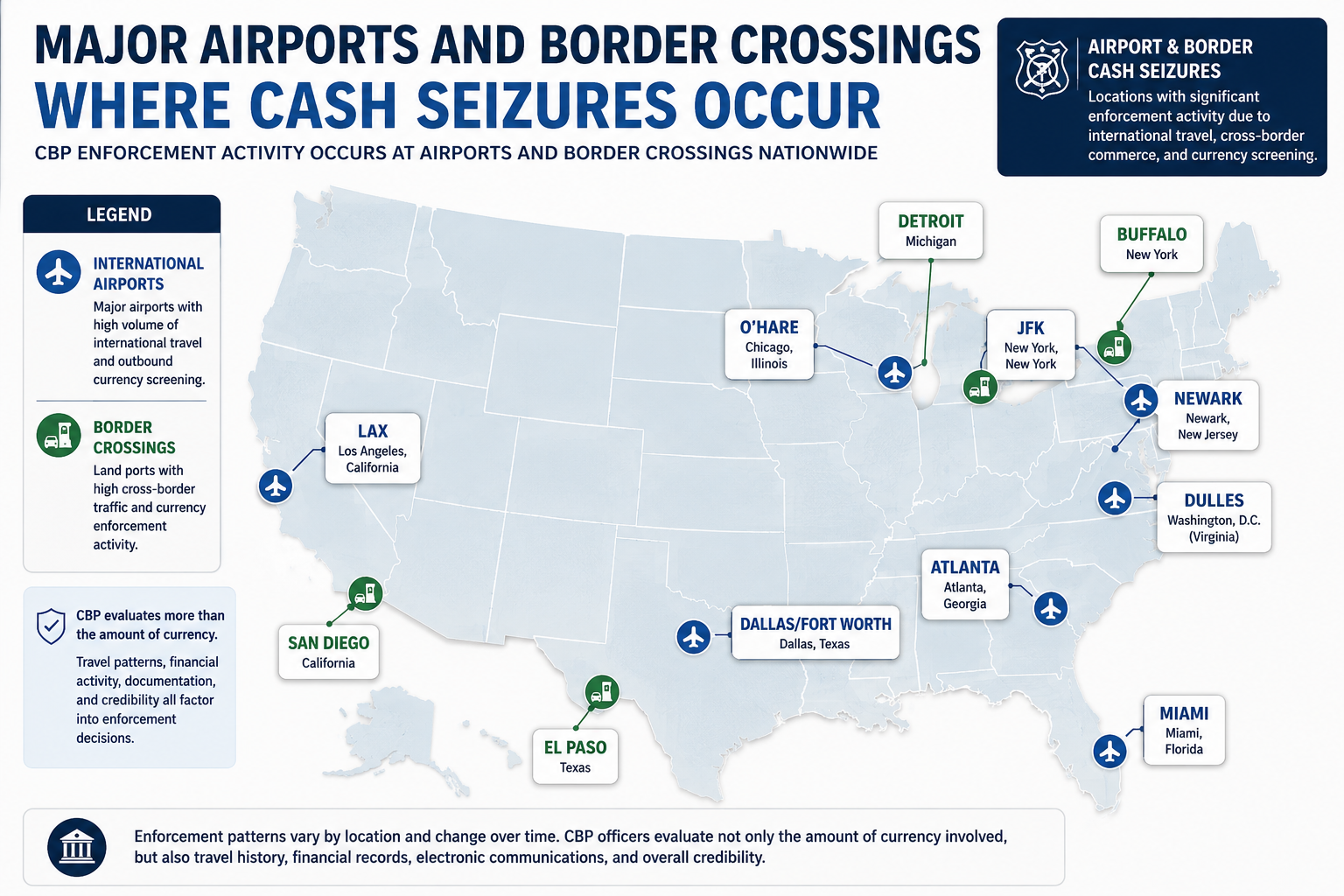
Common Airports and Border Crossings Where Cash Seizures Occur
Airport and border cash seizures occur throughout the United States, but certain international airports and border crossings receive particularly aggressive enforcement attention because of:
- international travel volume
- cross-border commerce
- outbound currency screening
- narcotics interdiction efforts
- financial enforcement priorities
- proximity to international borders
Many travelers are surprised to learn that CBP regularly conducts currency enforcement operations not only during entry into the United States, but also during outbound international departures.
In many situations, seizures occur during:
- secondary inspections
- outbound screening
- customs interviews
- baggage examinations
- border questioning
- currency reporting reviews
Major International Airports
Some of the most common airports associated with airport cash seizure cases include:
- JFK International Airport
- Miami International Airport
- Washington Dulles International Airport
- Los Angeles International Airport (LAX)
- Newark Liberty International Airport
- O’Hare International Airport
- Atlanta Hartsfield-Jackson International Airport
- Dallas/Fort Worth International Airport
These airports frequently receive heightened enforcement attention because they serve as major:
- international travel hubs
- financial transit points
- commercial gateways
- outbound international departure centers
Depending on the circumstances, CBP officers at these locations may evaluate:
- currency declarations
- source-of-funds explanations
- travel patterns
- financial documentation
- electronic evidence
- prior international travel activity
Additional discussion appears in:
- JFK Airport Cash Seizure Lawyer
- Newark Airport Cash Seizure Lawyer
- Miami Airport Cash Seizure Lawyer
- Dulles Airport Cash Seizure Lawyer
- O’Hare Airport Cash Seizure Lawyer
- Atlanta Airport Cash Seizure Lawyer
- LAX Airport Cash Seizure Lawyer
- Dallas Airport Cash Seizure Lawyer
Border Crossings and Land Ports
Cash seizures also occur frequently at land border crossings involving:
- outbound vehicle inspections
- pedestrian crossings
- commercial traffic
- cross-border travel corridors
Some of the most active border-related seizure locations include:
- San Diego
- Detroit
- El Paso
- Buffalo
These crossings often receive substantial enforcement focus because of:
- international commerce
- narcotics interdiction activity
- cross-border financial investigations
- bulk cash smuggling enforcement
Additional discussion appears in:
- San Diego Border Cash Seizure Lawyer
- Detroit Border Cash Seizure Lawyer
- El Paso Border Cash Seizure Lawyer
- Buffalo Border Cash Seizure Lawyer
Why Certain Locations Receive Heightened Enforcement
Different airports and border crossings often develop different enforcement patterns depending on:
- international travel routes
- destination countries
- volume of outbound cash movement
- narcotics enforcement priorities
- commercial shipping activity
- historical seizure trends
In many situations, federal agencies evaluate not only:
- the amount of currency involved
but also: - travel history
- frequency of crossings
- destination patterns
- financial records
- electronic communications
- procedural behavior during inspection
That broader institutional review is one reason why airport and border cash seizure matters frequently become much more strategic than travelers initially expect.
Airport and Border Cash Seizure Cases Are Federal Administrative Matters
Although seizures occur at specific airports and border crossings, the procedural framework governing these cases is generally federal.
That means airport currency seizure matters are often heavily shaped by:
- federal administrative procedures
- CBP forfeiture systems
- mitigation strategy
- procedural positioning
- credibility
- documentation quality
rather than purely local considerations.
That is one reason why National Security Law Firm represents airport and border cash seizure clients nationwide.
Why Airport Cash Seizure Cases Often Involve More Than Currency
Many travelers initially view an airport cash seizure as simply a dispute over money.
In reality, airport and border seizure matters frequently intersect with much broader federal systems involving:
- immigration
- Global Entry eligibility
- TSA credentials
- federal employment
- contractor eligibility
- security clearances
- future border scrutiny
- broader federal investigations
Federal agencies often evaluate these matters collectively rather than in isolation.
That broader institutional overlap is one of the most misunderstood aspects of airport currency seizure strategy.
Federal Agencies Often Share Information
Many people assume the seizure remains entirely inside CBP.
In practice, however, airport currency seizure matters may involve overlapping review by:
- Homeland Security Investigations
- TSA-related systems
- immigration authorities
- federal investigators
- contractor responsibility offices
- security personnel
Depending on the allegations involved, agencies may later evaluate:
- inspection statements
- customs declarations
- financial records
- mitigation submissions
- procedural cooperation
- travel history
- broader credibility concerns
That is one reason why airport currency seizure matters frequently require strategic analysis extending beyond simply recovering the seized cash.
The Seizure May Not Be the Only Risk
In many situations, the immediate forfeiture dispute is only part of the larger concern.
For example:
- inconsistent statements may later affect Global Entry eligibility
- financial allegations may create concerns during security clearance review
- airport seizure records may affect future border inspections
- broader investigations may expand beyond the seizure itself
That does not necessarily mean catastrophic consequences will follow.
However, it does mean the administrative record created during the seizure matter may later influence how other federal systems evaluate:
- credibility
- reliability
- compliance
- procedural integrity
That is one reason why disciplined administrative positioning often matters so much early in the process.
Long-Term Administrative Consequences Often Matter More Than People Expect
Many travelers focus entirely on recovering the money.
In practice, however, long-term institutional consequences may sometimes become equally important.
Depending on the circumstances, airport cash seizure matters may later affect:
- future international travel
- border screening intensity
- immigration proceedings
- federal contracting
- government employment
- security clearance eligibility
- broader federal scrutiny
Federal agencies often place substantial weight on:
- consistency of explanations
- documentation quality
- procedural cooperation
- administrative credibility
- mitigation efforts
That broader institutional evaluation frequently begins very early in the process.
Strong Airport Currency Seizure Strategy Often Requires Thinking Beyond the Seizure Itself
Many successful airport cash seizure strategies ultimately involve:
- disciplined communication
- strong documentation
- procedural timing
- mitigation positioning
- credibility management
- awareness of overlapping federal systems
- long-term administrative risk analysis
That is why National Security Law Firm repeatedly emphasizes:
the record controls the case.
Understanding the broader federal consequences of airport currency seizure matters is important because many cases are ultimately shaped not only by the forfeiture dispute itself, but also by how the administrative record may later affect future federal systems and government scrutiny.
Why National Security Law Firm Is Different in Airport Cash Seizure Cases
Many law firms approach airport cash seizure matters as isolated forfeiture disputes focused only on recovering the money.
National Security Law Firm approaches these matters differently.
In many situations, airport currency seizure cases intersect with broader federal systems involving:
- immigration
- Global Entry eligibility
- TSA credentials
- federal employment
- contractor eligibility
- security clearances
- future border scrutiny
- broader federal investigations
Federal agencies often evaluate these matters collectively rather than in isolation.
That broader institutional overlap frequently shapes how airport cash seizure matters should be strategically handled from the outset.
Strategic Federal Administrative Representation
National Security Law Firm represents clients nationwide in:
- airport cash seizures
- border currency seizures
- administrative forfeiture proceedings
- export-control matters
- federal administrative proceedings
- contractor-related matters
- overlapping federal investigations
The firm’s broader federal-systems experience informs how airport currency seizure matters are strategically evaluated from the beginning.
Rather than treating these cases as simple disputes over seized money, the firm focuses on:
- procedural positioning
- mitigation strategy
- documentation analysis
- credibility management
- administrative leverage
- long-term federal implications
That broader perspective becomes especially important where airport seizure matters intersect with:
- immigration concerns
- security clearance issues
- contractor eligibility
- broader federal scrutiny
- parallel investigations
Understanding How Federal Agencies Actually Evaluate Airport Seizure Cases
One of the biggest differences in National Security Law Firm’s approach is understanding how federal agencies often evaluate these matters institutionally rather than emotionally.
Many airport cash seizure cases are not decided solely by:
- one inspection statement
- one customs declaration
- one procedural event
- one explanation
Instead, agencies frequently evaluate whether the overall record appears:
- credible
- consistent
- properly documented
- administratively reliable
- strategically coherent
That is one reason why many airport seizure matters are ultimately shaped less by dramatic courtroom litigation and more by:
- disciplined communication
- strong documentation
- procedural timing
- mitigation positioning
- administrative record-building
That is also why National Security Law Firm repeatedly emphasizes:
the record controls the case.
More Than Just a Currency Dispute
Many airport seizure matters involve broader federal implications extending beyond the seized cash itself.
Depending on the allegations involved, these matters may later affect:
- future international travel
- Global Entry eligibility
- TSA programs
- federal employment
- contractor relationships
- security clearances
- future border inspections
- broader federal scrutiny
Federal agencies often evaluate these systems collectively rather than in isolation.
Understanding how those systems overlap is one of the major differences in National Security Law Firm’s strategic approach.
Many firms focus only on recovering the seized money.
National Security Law Firm evaluates:
- the immediate forfeiture strategy
- the quality of the administrative record
- broader federal implications
- procedural leverage
- long-term institutional risk
Nationwide Representation for Airport and Border Currency Seizures
National Security Law Firm represents travelers nationwide in airport and border currency seizure matters involving:
- airport cash seizures
- outbound currency enforcement
- border cash seizures
- structuring allegations
- bulk cash smuggling accusations
- suspicious financial activity investigations
- administrative forfeiture proceedings
If CBP seized your money during international travel, early strategic analysis may significantly affect:
- mitigation opportunities
- procedural leverage
- recovery strategy
- broader federal consequences
For broader discussion of customs forfeiture and airport currency seizure strategy generally, visit the firm’s CBP Money Seizure Lawyers Hub page.
Frequently Asked Questions About Airport and Border Cash Seizures
Why did CBP seize my cash at the airport?
Airport cash seizures often involve allegations relating to:
- failure to report currency
- structuring
- suspicious financial activity
- bulk cash smuggling
- inconsistent explanations
- undocumented source-of-funds concerns
In many situations, the government evaluates much more than simply the amount of money involved.
Federal agencies frequently assess:
- financial records
- travel patterns
- customs declarations
- procedural behavior
- overall credibility
Is carrying large amounts of cash illegal?
No.
Carrying large amounts of cash is not automatically illegal.
However, travelers transporting more than $10,000 internationally are generally required to comply with federal reporting requirements.
Failure to properly report currency may result in:
- seizure of the funds
- administrative forfeiture proceedings
- additional scrutiny
- broader federal investigation
What happens after an airport cash seizure?
After the seizure occurs, the matter typically enters a federal administrative forfeiture process through CBP’s Fines, Penalties, and Forfeitures (“FP&F”) office.
The government generally issues:
- a Notice of Seizure
- procedural deadlines
- Election of Proceedings materials
- administrative forfeiture instructions
Additional discussion appears in CBP Notice of Seizure Letter Explained: What To Do Next.
Can CBP keep my money without criminal charges?
Yes.
Many airport currency seizure matters proceed through administrative forfeiture systems separate from criminal prosecutions.
The government may pursue forfeiture even where:
- no arrest occurs
- no indictment is filed
- no criminal charges are brought
- the traveler disputes the allegations
What documents help recover seized cash?
Strong documentation often becomes critically important.
Depending on the circumstances, federal agencies may evaluate:
- bank statements
- tax returns
- withdrawal records
- payroll documentation
- business records
- contracts
- inheritance records
- source-of-funds evidence
Strong records often improve:
- mitigation opportunities
- credibility
- procedural leverage
- settlement posture
Should I talk to CBP after the seizure?
That depends heavily on:
- the allegations involved
- the procedural posture
- whether criminal exposure exists
- the quality of the documentation
- broader federal implications
Many travelers unintentionally damage their position by:
- overexplaining facts
- making inconsistent statements
- submitting unsupported claims
- reacting emotionally
Additional discussion appears in Why Early Statements to CBP Can Destroy Your Case.
What airports have the most cash seizures?
Airport cash seizures occur nationwide, but some of the most active locations include:
- JFK
- Newark
- Miami
- Dulles
- O’Hare
- Atlanta
- LAX
- Dallas/Fort Worth
Border-related currency seizures also occur frequently at:
- San Diego
- Detroit
- El Paso
- Buffalo
These locations often receive heightened enforcement attention because of:
- international travel volume
- cross-border commerce
- outbound currency enforcement priorities
Can airport cash seizures affect Global Entry or future travel?
Potentially, yes.
Depending on the allegations involved, airport currency seizure matters may later affect:
- Global Entry eligibility
- TSA programs
- future border screening
- immigration proceedings
- broader federal scrutiny
Federal agencies often evaluate these matters collectively across overlapping administrative systems.
How long do airport cash seizure cases usually take?
The timeline depends heavily on:
- the complexity of the case
- the quality of the documentation
- whether litigation becomes necessary
- whether broader investigations exist
- the procedural posture
Some administrative matters resolve within months.
Others may continue substantially longer depending on the level of federal scrutiny involved.
Do airport seizure lawyers work on contingency?
Many airport cash seizure matters are handled on contingency-fee structures.
In many situations:
- the fee ranges from approximately 15% to 20% of the recovered amount
- there is no legal fee unless a recovery is obtained
Additional discussion appears in Customs Seizure Lawyer Cost: Flat Fees, Contingency Fees, and What To Expect.
Why do airport seizure cases often become credibility cases?
Federal agencies frequently evaluate whether the overall record appears:
- internally consistent
- properly documented
- plausible
- administratively reliable
Investigators often compare:
- inspection statements
- customs declarations
- financial records
- mitigation submissions
- later explanations
That is one reason why airport cash seizure cases are often heavily:
- credibility-driven
- documentation-driven
- procedure-driven
long before courtroom litigation ever begins.
For broader discussion of airport cash seizure strategy generally, visit the firm’s How Customs Seizure Cases Are Really Won page.
Speak With a Nationwide Airport Cash Seizure Lawyer
If CBP seized your money at an airport or border crossing, the strategic decisions made early in the process may significantly affect:
- recovery opportunities
- mitigation positioning
- procedural leverage
- broader federal consequences
Many airport currency seizure matters are ultimately shaped long before courtroom litigation ever begins.
Federal agencies often evaluate:
- credibility
- consistency
- documentation quality
- mitigation efforts
- procedural cooperation
- overall administrative reliability
That is one reason why many successful airport cash seizure outcomes are driven less by dramatic courtroom arguments and more by disciplined administrative strategy developed early in the process.
Strategic Airport and Border Cash Seizure Representation Nationwide
National Security Law Firm represents travelers nationwide in:
- airport cash seizures
- border currency seizures
- outbound currency enforcement
- structuring allegations
- bulk cash smuggling accusations
- suspicious financial activity investigations
- administrative forfeiture proceedings
The firm approaches these matters strategically with a focus on:
- procedural positioning
- mitigation strategy
- administrative leverage
- documentation analysis
- credibility management
- long-term federal implications
Rather than treating airport seizure matters as isolated forfeiture disputes, National Security Law Firm evaluates how the administrative record created during the case may later affect broader federal systems and future government scrutiny.
Contingency Fee Representation for Many Airport Currency Seizure Cases
Many airport cash seizure matters are handled on contingency-fee structures.
In many situations:
- the fee ranges from approximately 15% to 20% of the recovered amount
- there is no legal fee unless a recovery is obtained
That structure allows many travelers to pursue recovery of seized funds without paying substantial upfront legal fees while the forfeiture matter remains pending.
Why Early Strategic Analysis Matters
Many airport cash seizure matters are heavily influenced by:
- inspection statements
- customs declarations
- mitigation submissions
- documentation quality
- consistency of explanations
- administrative record development
That is why National Security Law Firm repeatedly emphasizes:
the record controls the case.
In many situations, airport currency seizure matters are ultimately shaped less by courtroom litigation and more by:
- disciplined communication
- procedural timing
- mitigation positioning
- credibility assessments
- careful administrative strategy
Free Consultation for Airport and Border Cash Seizure Matters
National Security Law Firm offers nationwide representation and free consultations for airport and border cash and property seizure matters.
The fastest and easiest way to get started is through the firm’s online booking system.
In many situations, same-day consultations are available, and the process typically takes less than a minute to schedule online.
Once booked, an attorney will personally call you at the scheduled time to discuss:
- the seizure
- procedural deadlines
- recovery strategy
- documentation issues
- broader federal implications
To schedule a consultation online, visit:
Book a Free Consultation Online
You may also contact the firm directly at:
Phone: (202) 600-4996
Additional related resources:
- JFK Airport Cash Seizure Lawyer
- Newark Airport Cash Seizure Lawyer
- Miami Airport Cash Seizure Lawyer
- Dulles Airport Cash Seizure Lawyer
- O’Hare Airport Cash Seizure Lawyer
- Atlanta Airport Cash Seizure Lawyer
- LAX Airport Cash Seizure Lawyer
- Dallas Airport Cash Seizure Lawyer
- San Diego Border Cash Seizure Lawyer
- Detroit Border Cash Seizure Lawyer
- El Paso Border Cash Seizure Lawyer
- Buffalo Border Cash Seizure Lawyer