
Many people assume a customs seizure is simply a customs problem.
CBP seizes property.
The forfeiture process plays out.
The property issue gets resolved.
Life moves on.
For security clearance holders, however, the analysis is often more complicated.
A customs seizure may begin as a dispute involving:
- currency,
- imported merchandise,
- prescription medication,
- a package,
- a vehicle,
- or another form of property.
The event may later become relevant in an entirely different federal system.
That system is the security clearance process.
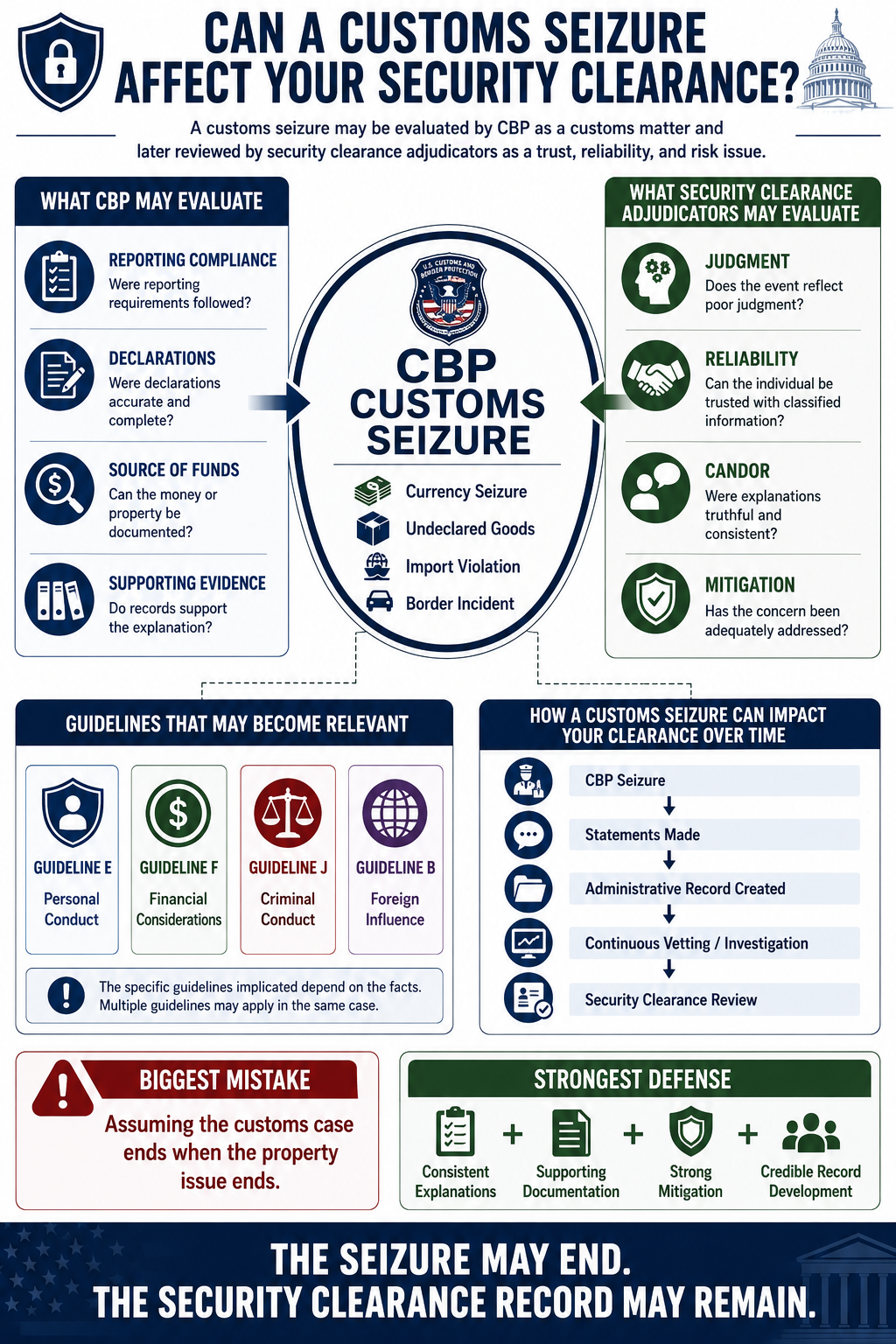
Many clearance holders are surprised to learn that a customs seizure does not have to result in criminal charges to create potential security clearance concerns.
Security clearances operate under a different framework.
The question is often not:
Was this person convicted of a crime?
The question is frequently:
Can the government continue trusting this person with access to classified information?
That distinction is critical.
It is also one of the most misunderstood aspects of customs seizure matters.
Most People Assume the Customs Case Ends When the Property Issue Ends
When property is seized, most people focus on the immediate issue.
They want to know:
- why the property was seized,
- whether it can be returned,
- what deadlines apply,
- and how the forfeiture process works.
Those are important questions.
What many people fail to consider is that federal agencies frequently evaluate the same underlying event for different purposes.
A customs seizure may generate:
- statements,
- declarations,
- petitions,
- supporting documentation,
- financial records,
- interviews,
- and administrative submissions.
Those materials frequently become part of a broader federal record.
Years later, that same record may be reviewed by:
- security clearance adjudicators,
- investigators,
- continuous vetting personnel,
- or other federal decision-makers.
This is one reason customs seizure matters often involve much more than customs law.
The property issue may end.
The federal record often remains.
How Security Clearances Are Different From Criminal Cases
One of the biggest misconceptions among clearance holders is the belief that security clearance concerns only arise when criminal charges are filed.
Security clearances generally do not operate that way.
The security clearance process is fundamentally a risk-assessment system.
The government is attempting to determine whether an individual can be trusted with access to classified information.
As a result, clearance adjudicators frequently evaluate:
- trustworthiness,
- reliability,
- judgment,
- candor,
- compliance,
- and mitigation.
These concepts often extend well beyond criminal law.
A person can avoid:
- arrest,
- prosecution,
- indictment,
- or conviction
and still face questions during a security clearance review.
This is one reason customs seizure matters deserve careful attention.
The standards being applied by CBP and the standards being applied during a clearance review are often different.
Can a Currency Seizure Affect a Security Clearance?
Potentially.
This is one of the most common concerns raised by security clearance holders after a customs seizure.
Currency seizures frequently involve issues relating to:
- reporting requirements,
- declarations,
- source-of-funds documentation,
- financial records,
- and explanations provided to federal agencies.
Depending on the facts, those issues may later become relevant during a security clearance review.
For example, adjudicators may evaluate questions involving:
- judgment,
- candor,
- reliability,
- financial responsibility,
- and mitigation.
The issue is not necessarily the seizure itself.
The issue is often how the event is documented, explained, and reflected within the broader federal record.
Many travelers assume:
No criminal charges were filed, so the issue should not matter.
Security clearance systems often evaluate a broader range of concerns.
This is one reason a currency seizure can become relevant even when no criminal prosecution occurs.
Can Other Customs Violations Affect a Security Clearance?
Yes.
Security clearance implications are not limited to currency seizures.
Depending on the circumstances, customs-related events involving:
- undeclared goods,
- import violations,
- prescription medication issues,
- customs penalties,
- agriculture violations,
- declaration problems,
- and other customs-related matters
may also become relevant.
Again, the issue is often not the specific violation itself.
The issue is how the event affects the government’s evaluation of:
- trustworthiness,
- reliability,
- judgment,
- compliance,
- and candor.
This is one reason customs-related matters often deserve more attention than many clearance holders initially realize.
A customs issue may begin as a border matter.
It may later become a security clearance issue.