
Why We Offer a Legal-Fee Refund Promise for Accepted Global Entry Appeals
Most law firms are paid regardless of the outcome. There is nothing wrong with that — legal matters are inherently uncertain, and no attorney can control what a government agency ultimately decides.
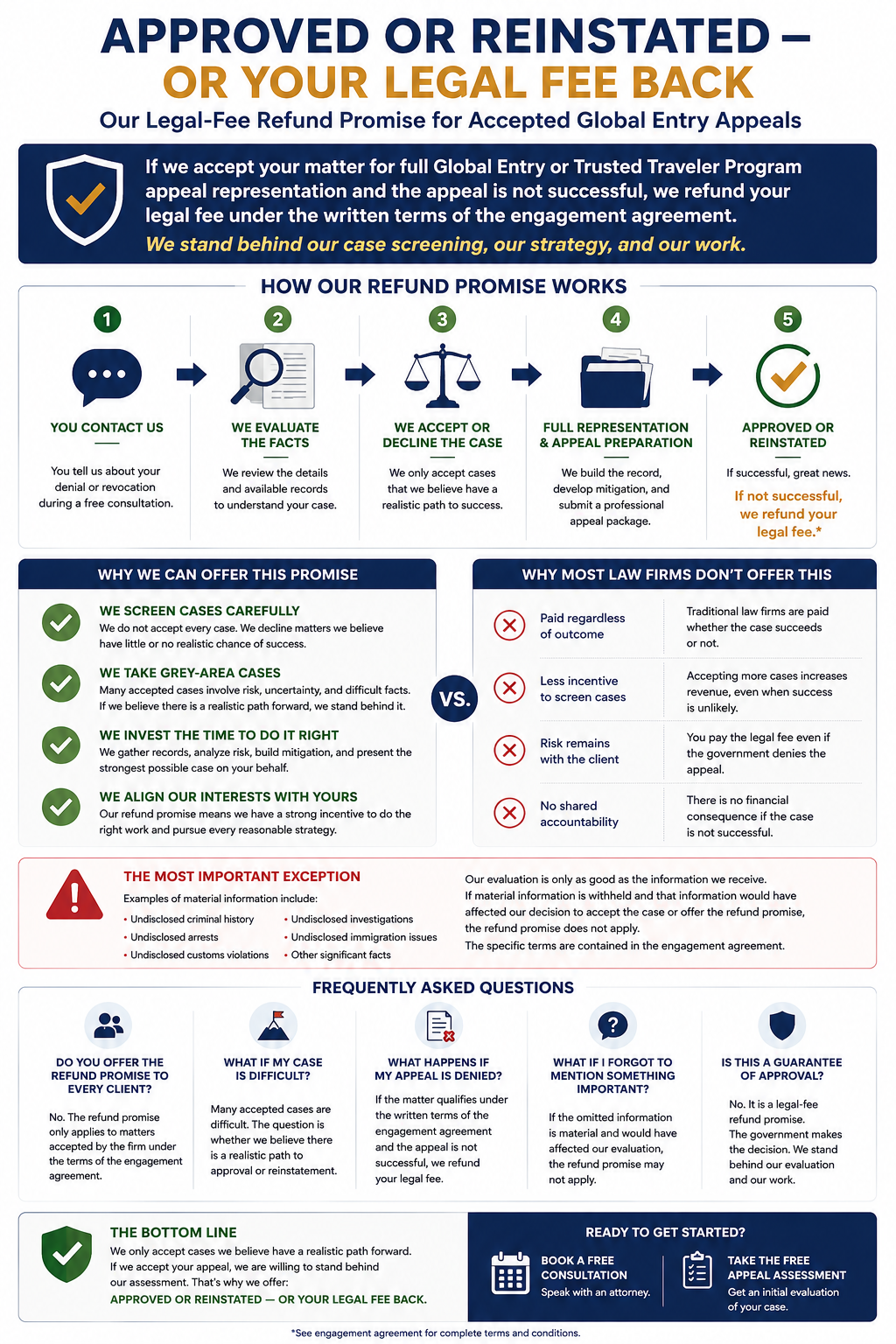
At National Security Law Firm, however, we chose a different approach for accepted . If we accept your matter for full Global Entry or Trusted Traveler Program appeal representation and the appeal is not successful, we refund your legal fee under the written terms of the engagement agreement.
We call this: Approved or Reinstated — or Your Legal Fee Back.
The promise is not based on a guarantee of government action — no attorney can guarantee that. Instead, it is based on something much simpler: we stand behind our case screening, our strategy, and our work.
|
Table of Contents
How the Refund Promise Actually Works
Many people assume the refund promise begins after they hire us. In reality, it begins before representation ever starts.
- You contact us for a consultation
- We evaluate the facts of your case
- We decide whether the matter is appropriate for representation
- If we accept the case, we perform the work necessary to develop and submit the appeal
- If the appeal is successful — fantastic. If the appeal is not successful, we refund your legal fee under the written terms of the engagement agreement
The key point is that the refund promise starts with the screening process.
The Refund Promise Is Only Possible Because We Screen Cases Carefully
One of the biggest misconceptions about this program is that we simply accept every case that contacts us and then hope for the best. That is not how we operate. In fact, one of the reasons we are able to offer this promise is because we are willing to decline cases.
Not every has a realistic path to success. Not every case should be appealed. Not every traveler benefits from hiring a lawyer. Sometimes the facts simply are not favorable. When that happens, we try to be honest about it.
Related Resource:
That honesty protects both the client and the firm.
We Do Not Only Accept Easy Cases
Many people assume: if they offer a refund promise, they must only take obvious winners. That is not true.
In fact, many accepted matters involve , , , , , , and . Many accepted cases involve uncertainty. Many involve risk. Many involve facts that other travelers would consider challenging. In fact, many of the cases we accept are precisely the cases that cause travelers the most concern because the outcome is not obvious.
The question is not: is this a perfect case? The question is: based on the available information, do we believe there is a realistic path to approval or reinstatement? If the answer is yes, we may accept the matter and extend the refund promise.
The refund promise is often most valuable in gray-area cases where the outcome is uncertain and the traveler is trying to decide whether hiring a lawyer is worth the risk.
Why We Believe This Is Fair
Many travelers contact multiple attorneys before making a decision. One concern we hear repeatedly is: how do I know the lawyer actually believes in my case? That is a reasonable concern. The refund promise helps answer that question. Because when we accept a case, we are effectively saying: based on the facts available to us, we believe there is a realistic path forward. Not a guarantee. Not certainty. But enough confidence that we are willing to stand behind our assessment.
The Most Important Exception
There is one important limitation to the refund promise. Our evaluation is only as good as the information we receive. When we evaluate a case, we rely heavily on the facts provided by the client. Those facts help us determine whether the case is likely appealable, whether a realistic path to approval exists, and whether we are willing to accept the matter under the refund program.
For that reason, the refund promise depends on complete and accurate information. Examples of information that may be material include undisclosed , undisclosed arrests, undisclosed , undisclosed government investigations, undisclosed , and other significant facts that would have changed our evaluation.
If material information is withheld and that information would have affected our decision to accept the case or offer the refund promise, the refund promise does not apply. This is not a technicality — it is simply a matter of fairness. We can only evaluate the facts we know.
Why Don’t Other Lawyers Offer This?
The honest answer is that offering a legal-fee refund promise creates financial risk for the law firm. When a case can fail for reasons outside anyone’s control — a government decision, a records problem, a difficult fact pattern — agreeing to refund the fee if it fails is a real risk.
The reason we can offer this promise is that we are willing to say no. Before we accept a case, we evaluate the facts carefully and assess whether a realistic path to approval or reinstatement exists. If we do not believe that path exists, we decline representation.
That selectivity protects both the client and the firm. It also allows us to stand behind the cases we choose to accept.
That combination — selectivity, honest evaluation, and willingness to stand behind accepted cases — is what makes the promise possible. Most firms are not willing to build that discipline into their intake process. We are.
Because we screen carefully and because we have direct financial skin in the game on every accepted case, most accepted cases result in favorable outcomes. The refund creates an incentive that operates throughout the entire engagement — not just at intake.
We have a strong incentive to do everything reasonably possible to help accepted clients succeed because unsuccessful appeals cost both the client and the firm. That alignment of interests is part of what makes this program different from a standard legal representation.
The refund is occasionally triggered — and when it is, we honor it without hesitation. The promise is not a marketing device. It is a commitment we made when we built this practice, and it reflects how we intend to operate.
Related Resource:
What the Refund Promise Does Not Mean
It Is Not a Guarantee of Government Action — we do not control CBP, we do not control the , and no attorney can honestly promise a specific government outcome.
It Is Not a Promise That Every Case Will Be Accepted — we decline some matters. If we do not believe a realistic path to approval exists, we may choose not to accept the representation.
It Is Not a Promise Regardless of Undisclosed Information — the refund promise depends on the completeness and accuracy of the information provided during the evaluation process.
It Is Not a Shortcut — we still perform the same work in every accepted appeal: , , , mitigation development, and . The refund promise does not replace the work. It reflects confidence in the work.
Frequently Asked Questions
Do You Offer the Refund Promise to Every Client?
No. The refund promise only applies to matters accepted by the firm under the terms of the engagement agreement. Not every case is accepted.
What If My Case Is Difficult?
Many accepted cases are difficult — involving , , , , and . Difficulty alone does not determine whether a case is accepted. The question is whether we believe a realistic path forward exists.
What Happens If My Appeal Is Denied?
If the matter qualifies under the written terms of the engagement agreement and the appeal is not successful, we refund the legal fee.
What If I Forgot to Mention Something Important?
The answer depends on the circumstances. If the omitted information is material and would have affected our evaluation of the case, the refund promise may not apply. This is one reason we encourage complete transparency from the very beginning.
Is This a Guarantee of Approval?
No. It is a legal-fee refund promise — there is an important difference. The government makes the decision. We stand behind our evaluation and our work.
The Refund Promise Is Not Really About Refunds
Most clients who hire us never expect to receive a refund. And that is not really the point. The refund promise exists because of what it communicates: we screen cases carefully, we do not accept every matter, we are willing to stand behind accepted cases, and we are confident enough in our evaluation process to share some of the risk.
The refund itself is simply the mechanism. The real message is confidence — confidence in our screening, confidence in our strategy, and confidence in our work.
The Bottom Line
The refund promise is not based on controlling the government’s decision. No attorney can do that. It is based on something much more straightforward: if we accept your Global Entry appeal, we are willing to stand behind our assessment of the case.
|
Related Resources: