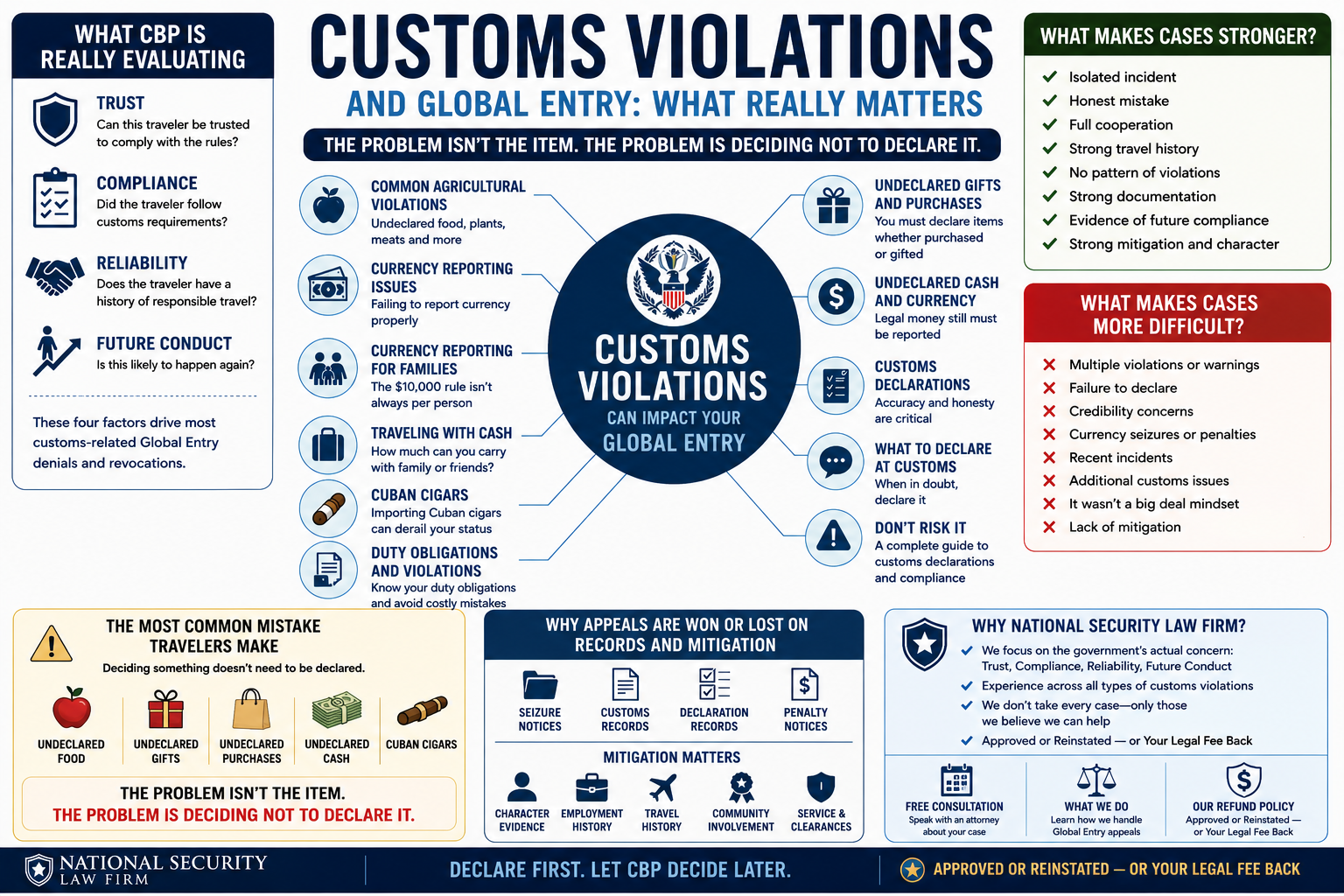
The Mistakes That Cost Travelers Their Trusted Traveler Status

One of the biggest misconceptions about Global Entry is that most denials and revocations are caused by criminal convictions. In reality, many Global Entry members lose their Trusted Traveler status because of customs and border violations — an undeclared apple, a sandwich from an international flight, a few Cuban cigars, a currency-reporting issue.

Because Global Entry is a trust-based Trusted Traveler Program under 8 CFR § 235.12, when CBP believes a traveler failed to comply with customs laws, the government’s concern often becomes: can this traveler be trusted to comply with customs requirements in the future?

Book a free consultation | Take the free appeal assessment


The Biggest Misconception About Customs Violations

Many travelers assume serious criminal conduct causes Global Entry denials, while minor customs violations result only in warnings. Unfortunately, Global Entry does not always work that way.

Returning with an undeclared luxury watch, Cuban cigars, an apple in a backpack, or a currency-reporting failure can each create Global Entry consequences. Many customs violations occur during the exact type of border interaction that Global Entry is designed to streamline — meaning CBP often views customs violations differently than other types of conduct.


Why Customs Violations Are Different Than Criminal Cases

criminal offense may have nothing to do with international travel. A customs violation occurs at the border itself. A DUI from ten years ago may have no connection to customs compliance. An undeclared item discovered by CBP occurred during the exact activity Global Entry members are expected to navigate correctly.

The government’s concern is often not what was the item? The government’s concern is often: why wasn’t it declared? That shift in perspective changes how these cases should be evaluated and appealed. What Most Lawyers Miss About Global Entry Appeals.


The Most Common Customs Violations We See

General Customs Violations
Failure to declare items, inaccurate customs declarations, customs penalties, prior border violations. Related Resource: Navigating Global Entry Denials: Overcoming Customs Violations and Securing Approval

Duty and Import Violations
Many travelers misunderstand duty obligations and declaration requirements. One of the most common mistakes: if I don’t owe duty, I don’t need to declare it. Those are often two different issues. Related Resource: Duty Obligations and Common Violations for Global Entry Members

Currency Reporting Violations
Ordinary travelers regularly encounter problems because they misunderstand the reporting requirements. Related Resources: Common Currency Reporting Issues for Global Entry Members | Currency Reporting Requirements for Families | Traveling with Cash: How Much Can You Carry When Traveling with Family or Friends?

Agricultural Violations
Fruit, vegetables, meat products, seeds, plants, flowers, and food from international flights. Many travelers lose Global Entry over items they never imagined would matter. Related Resource: Common Agricultural Violations That Can Cause Global Entry Revocation

Cuban Cigars and Restricted Imports
“I bought it legally overseas, so bringing it home must be legal.” That assumption creates problems every year. Related Resources: Cuban Cigars and Global Entry: What You Need to Know | Global Entry Denied for Cuban Cigars? Here’s What CBP Is Actually Evaluating

Customs Declaration Violations
Many customs cases ultimately come down to a single issue: Failure to Declare. Whether the item was food, cash, a gift, or a purchase, the declaration itself often becomes the government’s focus. Related Resources: Global Entry and U.S. Customs Declarations | What to Declare at Customs | Don’t Risk It: A Complete Traveler’s Guide to Customs Declarations


What CBP Is Actually Evaluating

This is the most important concept in the entire customs-violation category. Many travelers focus on the apple, the cash, the Cuban cigars, the watch, the undeclared purchase. CBP often focuses on something very different: trust, compliance, reliability, and future conduct.

The government’s concern is often not how valuable was the item? The government’s concern is often: what does this incident tell us about the traveler?


Global Entry Is a Trusted Traveler Program

Global Entry is not simply a faster line at the airport — it is a trust-based Trusted Traveler Program under 8 CFR § 235.12. Participation is based upon the government’s determination that the traveler presents a low risk and can be trusted to comply with customs and border requirements with minimal supervision. When a customs violation occurs, CBP frequently reevaluates that trust. The issue becomes: should this traveler continue receiving expedited border privileges? What Most Lawyers Miss About Global Entry Appeals.


Why the Item Often Matters Less Than the Declaration

CBP frequently focuses on: was it declared, was the traveler honest, did the traveler comply with the rules, and is there a pattern of similar conduct? This is one reason why two travelers with nearly identical violations can receive very different outcomes. What makes a good or bad Global Entry appeal case? | Global Entry and U.S. Customs Declarations.


Why Similar Violations Produce Different Results

Traveler A returns with an undeclared apple, immediately acknowledges the mistake, cooperates fully, has no prior customs issues, and has years of compliant international travel.

Traveler B returns with the same undeclared apple, has prior customs violations, has previously received warnings, provides inconsistent explanations, and has a history of declaration problems.

The item is identical. The risk picture is not. That difference often explains why outcomes vary.


The Four Questions CBP Is Often Asking

Question #1: Was This an Isolated Incident?
A single mistake often looks very different than a pattern of repeated conduct. CBP may evaluate prior customs history, prior warnings, prior customs penalties, and prior revocations. The more isolated the incident, the stronger the case often becomes. Global Entry Appeal Success Factors.

Question #2: Was the Traveler Honest?
Credibility matters. An undeclared item may create one concern — an undeclared item combined with an inaccurate explanation may create a much larger concern.

Question #3: Does the Traveler Understand the Rules Today?
Many customs violations involve misunderstandings. The strongest cases often demonstrate recognition of the mistake, understanding of the applicable rules, and commitment to future compliance. CBP is often trying to determine whether the same issue is likely to occur again.

Question #4: Why Should This Traveler Still Be Considered Low Risk?
The ultimate question is not what happened? but: why should this incident not define the traveler’s future participation in the program? The strongest appeals are usually built around answering that question. Global Entry Appeal Strategy & Winning.


The Common Thread Across All Customs Violations

Whether the issue involves foodagricultural productscashcurrency reportingCuban cigars, gifts, purchases, or customs declarations — the underlying concern is often remarkably similar: trust, compliance, reliability, and future conduct.

Understanding that framework changes how customs-related denials should be evaluated. The strongest appeals rarely focus exclusively on the item — they focus on the government’s concern. And in many customs cases, that concern has very little to do with the item itself and everything to do with what CBP believes the incident says about the traveler.


What Makes Customs Cases Stronger?

One of the most common questions travelers ask after a customs-related Global Entry denial is: do I have a good case? Every customs violation is different, every traveler is different, and every Global Entry decision is made based on the totality of the circumstances. However, certain patterns appear repeatedly. What makes a good or bad Global Entry appeal case? | Global Entry Appeal Success Factors.


Isolated Incidents Are Usually Easier Than Patterns

One customs violation often presents a different picture than multiple violations over several years. One declaration mistake may be evaluated differently than repeated declaration problems. The more isolated the conduct appears, the easier it often becomes to argue that the incident does not accurately reflect the traveler’s overall reliability.


Full Cooperation Matters

✔ Immediate cooperation, ✔ Honest responses, ✔ Compliance with instructions, ✔ Respectful interactions with CBP officers, ✔ Acceptance of responsibility. How the traveler handled the situation often becomes part of the government’s evaluation.


Strong Travel History Helps

One customs incident is often viewed differently when compared against years of compliant international travel. Overall travel history frequently matters — years of compliant international travel with no prior issues presents a very different picture than a history including several prior warnings or customs concerns.


Strong Documentation Helps

The record controls the case. Examples include customs recordspenalty notices, seizure documentation, currency reporting forms, and supporting documentation. The strongest cases are usually supported by records rather than assumptions.


Passage of Time Can Help

A customs issue from ten years ago often presents a different picture than one from six months ago. Time may help demonstrate compliance, stability, reliability, and lack of repetition — particularly when no additional incidents occurred afterward.


Evidence of Future Compliance Matters

Many customs-related appeals ultimately focus on one question: why is this unlikely to happen again? Examples: compliance since the incident, additional international travel without problems, better understanding of customs rules, changes in travel practices, and documentation showing awareness of requirements.


Honest Mistakes Are Often Easier Than Intentional Conduct

Many customs violations involve misunderstandings — misunderstanding declaration requirements, forgetting food in luggage, misunderstanding currency reporting rules, confusion regarding restricted imports. Although misunderstandings can still result in consequences, they often present a different risk picture than intentional efforts to evade customs requirements. Intent frequently becomes part of the overall analysis.


Mitigation Matters More Than Most Travelers Realize

The strongest cases often spend equal or greater attention on what happened afterward. Examples may include employment history, professional licenses, military servicesecurity clearances, community involvement, volunteer activities, character references, and strong compliance history. The customs violation explains the past. Mitigation helps explain the present. And Global Entry decisions are often heavily influenced by the present.


Strong Customs Cases Usually Share a Common Theme

✔ Isolated incident, ✔ Honest mistake, ✔ Full cooperation, ✔ Strong travel history, ✔ Strong documentation, ✔ No pattern of violations, ✔ Evidence of future compliance, ✔ Strong mitigation.

None of these factors guarantee approval. However, they frequently help demonstrate why the incident should not define the traveler’s future participation in the Trusted Traveler Program under 8 CFR § 235.12. And that is often where the strongest customs cases begin.


What Makes Customs Cases More Difficult?

Just as certain facts tend to strengthen a customs-related Global Entry appeal, other facts tend to create additional challenges. That does not mean approval is impossible — but understanding these factors can help set realistic expectations.


Multiple Customs Violations

One of the most difficult facts in any customs-related case is a pattern of repeated conduct. One undeclared food item is often evaluated differently than multiple customs violations over several years. Patterns frequently create larger trust concerns than any single violation. The government’s concern often becomes: if this has happened multiple times before, why should we believe it will not happen again?


Prior Warnings

From CBP’s perspective, a warning may demonstrate that the traveler was already informed of the rules. If a similar issue occurs afterward, the government may view the subsequent violation differently than a first-time mistake. Duty Obligations and Common Violations for Global Entry Members.


Failure to Declare

This is one of the most important issues in the entire customs category. Many travelers focus on the item itself. CBP often focuses on the declaration. Examples include undeclared food, undeclared purchases, undeclared currency, and undeclared restricted imports. The issue often becomes: why wasn’t it declared? In many cases, the declaration issue creates more concern than the item itself.


Credibility Concerns

Trust is at the center of every Global Entry case. Inconsistent explanations, changing stories, inaccurate statements, and contradictory documentation can make even relatively minor customs violations much more difficult.


Currency Seizures and Significant Penalties

Currency seizures, significant monetary penalties, and formal enforcement actions often signal that CBP viewed the underlying incident as more serious. These facts do not automatically prevent reinstatement — but they frequently require a stronger showing of mitigation and future compliance.


Additional Customs Issues

When multiple issues appear together — agricultural violations plus currency reporting issuescustoms violation plus prior criminal historyCuban cigar issue plus declaration problems — the government often evaluates the total risk picture rather than any single event.


Recent Incidents

Generally speaking, recent customs violations tend to be more difficult than older ones. Passage of time allows travelers to demonstrate compliance, stability, reliability, and no repetition. Recent incidents provide less opportunity to establish that record.


The “It Wasn’t a Big Deal” Problem

One of the strongest indicators of a difficult customs case is when the traveler continues focusing exclusively on the item rather than understanding the government’s concern. The strongest appeals usually acknowledge the issue and address why it should not define the traveler’s future participation in the program. Global Entry Appeal Strategy & Winning.


The Difference Between a Difficult Case and a Hopeless Case

These are not the same thing. Many difficult cases still have a realistic path forward. The key questions often become: what is the government actually concerned about, what records exist, what mitigation exists, what evidence can be developed, and why is future compliance likely?

Because ultimately, trust, compliance, reliability, and future conduct are often the issues CBP is evaluating when deciding whether a traveler should continue receiving Trusted Traveler privileges under 8 CFR § 235.12.


The Most Common Mistake Travelers Make

After handling a large number of customs-related Global Entry matters, there is one issue we see repeatedly: the traveler decides something does not need to be declared — not because they are trying to commit a crime, but because they simply believe it doesn’t matter or surely they don’t mean this.


It Usually Starts With Something Small

An Apple — received on an international flight, placed in a backpack, forgotten. A Sandwich — packed for later, never intended to hide. A Gift — a watch, jewelry, a souvenir. The traveler assumes I didn’t buy it, so I don’t need to declare it. Cash — the traveler believes the money is legal, therefore nothing to report. Cuban Cigars — the traveler assumes I bought them legally overseas, therefore bringing them home must be legal.

In each of these examples, the traveler focuses on the item. CBP frequently focuses on something different.


The Government’s Question Is Often Different Than the Traveler’s Question

The traveler asks: was the item really that serious? CBP often asks: why wasn’t it declared? That distinction changes everything. Because once a declaration issue exists, the focus frequently shifts toward compliance, reliability, trustworthiness, and future conduct. Global Entry and U.S. Customs Declarations.


Why Declaration Problems Matter So Much

Global Entry members are trusted travelers under 8 CFR § 235.12 — meaning CBP expects a higher level of compliance. When a declaration issue occurs, the government often evaluates: did the traveler know the rules, did the traveler follow the rules, if not why not, and is this likely to happen again? Those concerns often matter far more than the value of the item. Duty Obligations and Common Violations.


The Most Dangerous Phrase in Customs Cases

“I didn’t think I needed to declare it” — this appears in agricultural casescurrency casesduty casesCuban cigar cases, and customs declaration cases alike. Different item, same explanation. Different violation, same mistake.


The Safest Rule Is Surprisingly Simple

If there is one lesson travelers should take from this entire customs cluster, it is this: Declare First. Let CBP Decide Later. What to Declare at Customs | Don’t Risk It: A Complete Traveler’s Guide to Customs Declarations. The declaration itself is often far less problematic than the failure to declare.


Why This Matters for Global Entry Appeals

Travelers often focus entirely on the item wasn’t a big deal. The stronger question is: why should this incident not define how CBP evaluates me today? That shift in perspective frequently changes the strength of the appeal. Because the strongest appeals are rarely about convincing CBP that an apple, a cigar, a gift, or a reporting issue was insignificant — the strongest appeals are often about demonstrating that the traveler remains trustworthy, reliable, compliant, and low risk. And that is ultimately what Global Entry is designed to evaluate. Global Entry Appeal Strategy & Winning.


Why Customs Appeals Are Often Won or Lost on Records and Mitigation

One of the biggest misconceptions about customs-related Global Entry appeals is that success depends primarily on writing a persuasive explanation. In reality, many customs appeals are won or lost long before the appeal is submitted — on the records and the mitigation. CBP is often trying to answer: why should this traveler still be considered a low-risk traveler under 8 CFR § 235.12 today?


The Government Wants Documentation

Weak appeal: It was only an apple. Strong appeal: Documentation showing what happened, how the matter was handled, whether penalties were issued, and whether similar issues occurred before.

Weak appeal: The money was legal. Strong appeal: Documentation showing source of funds, reporting records, compliance history, and surrounding circumstances.

Weak appeal: I didn’t know the rule. Strong appeal: Evidence demonstrating the incident was isolated, no similar conduct occurred before or afterward, and strong overall compliance history.

The explanation matters. The evidence often matters more.


The Record Controls the Case

Depending on the violation, important records may include customs records, inspection records, declaration records, seizure notices, penalty noticescurrency reporting records, CBP correspondence, and supporting documentation. Before evaluating the strength of a case, it is often necessary to understand exactly what the record says. Global Entry Appeal Document Checklist.


Why Mitigation Often Matters More Than Travelers Expect

A traveler may have decades of international travel, no prior customs issues, strong employment history, professional licenses, military servicesecurity clearances, community involvement, and strong character references. Those facts may help answer: does this incident accurately reflect the traveler’s overall reliability? Global Entry Appeal Success Factors.


Customs Appeals Are Often Future-Focused

Many appeals become here’s why the violation wasn’t serious. CBP is often more interested in: why is this unlikely to happen again? The strongest appeals address what was learned, what changed, why future compliance is likely, why the incident was isolated, and why the traveler remains low risk.


Strong Cases Usually Tell a Complete Story

Part 1: The Facts — what happened, what does the record show?
Part 2: The Context — why did it happen, was it isolated, what surrounding circumstances existed?
Part 3: The Mitigation — why should the incident not define the traveler today?

When all three pieces work together, the appeal becomes significantly stronger. Sample Global Entry Appeal Package | What We Do in a Global Entry Appeal.


The Strongest Appeals Address the Government’s Concern

CBP often focuses on trust, compliance, reliability, and future conduct — not the apple, the cigar, the gift, the cash, or the watch. The strongest appeals are built around addressing those concerns directly. Because ultimately, that is what the government is often evaluating when deciding whether a traveler should continue receiving Trusted Traveler privileges. And that is why customs appeals are so often won or lost on records, mitigation, and evidence rather than explanations alone. Global Entry Appeal Strategy & Winning.


Why National Security Law Firm?

Many travelers approach customs-related Global Entry denials by focusing on the item — the apple, the sandwich, the cash, the gift, the Cuban cigars, the undeclared purchase. But in our experience, the strongest appeals are rarely built around the item itself — they are built around understanding the government’s concern.


We Focus on the Government’s Actual Concern

CBP already knows what the item was. The more important question is often: what concern did this incident create? An undeclared apple may create concerns about compliance. A currency-reporting issue may create concerns about reliability. A Cuban cigar violation may create concerns about customs compliance. A declaration issue may create concerns about trustworthiness. The strongest appeals address those concerns directly.

Related Resource: What Most Lawyers Miss About Global Entry Appeals


Customs Cases Are Trust Cases

Many travelers think they have an apple case, a cash case, a Cuban cigar case, or a customs declaration case. In reality, many customs-related denials are fundamentally trust cases. The government is often asking: can this traveler still be trusted to comply with customs requirements in the future? That question influences what records matter, what evidence matters, what mitigation matters, and what arguments matter. Global Entry Appeal Strategy & Winning.


Experience Matters Because Patterns Matter

We have seen cases involving agricultural violationscurrency reporting issuesduty violationscustoms declaration mistakesCuban cigars, restricted imports, undeclared purchases, seizures, and customs penalties. Every case is different — but understanding the common concerns that appear across these categories helps identify strengths and weaknesses much more quickly.


We Do Not Accept Every Case

Not every customs violation should be appealed. Not every traveler needs a lawyer. And not every case has a realistic path to approval. That approach allows us to stand behind the cases we choose to accept.

Related Resource: When We May Decline a Global Entry Case


Approved or Reinstated — or Your Legal Fee Back

For accepted Global Entry and Trusted Traveler Program appeals, we offer: Approved or Reinstated — or Your Legal Fee Back. The promise is possible because of the way we evaluate cases. We do not stand behind every case — we stand behind the cases we choose to accept. If we accept a customs-related appeal, it means we believe a realistic path forward exists.

Related Resource: Approved or Reinstated — or Your Legal Fee Back


The Difference Is Often Not the Item

The strongest customs appeals are usually built around trustcompliance, reliability, and future conduct — not the apple, the food, the cash, the cigar, or the gift. Customs-related Global Entry cases are rarely won or lost on the item alone — they are often won or lost on what the government believes the incident says about the traveler. And that is where understanding the government’s actual concern becomes critical.

Related Resources:

Book a Free Consultation | Take the Free Appeal Assessment


Frequently Asked Questions About Customs Violations and Global Entry

Can I Really Lose Global Entry Over an Apple?

Yes. Agricultural violations involving fruit, vegetables, meat products, plants, and other food items have resulted in Global Entry revocations. The issue is often not the apple itself — the issue is whether it was properly declared. Related Resource: Common Agricultural Violations That Can Cause Global Entry Revocation


Can I Lose Global Entry Over an Honest Mistake?

Yes. Many customs-related Global Entry cases involve honest mistakes — forgetting about food in luggage, misunderstanding currency reporting rules, failing to declare a gift, misunderstanding duty obligations. The fact that a mistake was unintentional does not necessarily prevent customs penalties or Global Entry consequences — however, intent may still be an important factor when evaluating the overall strength of an appeal.


Can I Lose Global Entry Over Cash?

Yes. Currency-reporting violations can create serious customs and Global Entry problems. The legality of the funds and the reporting requirements are separate issues. Related Resources: Common Currency Reporting Issues for Global Entry Members | Traveling with Cash | Currency Reporting Requirements for Families


Does the $10,000 Currency Rule Apply Per Person?

Not always. Families and groups frequently assume each traveler receives an independent $10,000 reporting threshold. In many situations, CBP may evaluate the combined amount being transported by the traveling group. This misunderstanding creates problems every year.


Can I Lose Global Entry Over Cuban Cigars?

Potentially yes. Many travelers assume I purchased them legally overseas — that does not necessarily determine whether they can legally enter the United States. Related Resources: Cuban Cigars and Global Entry | Global Entry Denied for Cuban Cigars


What If I Didn’t Know the Rule?

Lack of knowledge does not necessarily prevent a violation. Understanding customs requirements before traveling is critically important.


What If I Forgot to Declare Something?

Consequences may include customs penalties, seizure of property, secondary inspection, additional screening, and Global Entry revocation.


Can I Appeal a Global Entry Revocation Based on a Customs Violation?

Often yes. Whether an appeal is likely to succeed depends on the nature of the violation, the available records, the traveler’s history, mitigation evidence, and the government’s concern. Every case is different.


Do I Need a Lawyer?

Not always. The more uncertainty that exists, the more valuable experienced guidance often becomes. Related Resource: Do You Need a Lawyer for a Global Entry Appeal?


Customs & Border Violation Resource Center


The Bottom Line

Most customs-related Global Entry denials do not begin with criminal intent. They begin with a traveler deciding that something does not need to be declared. Declare First. Let CBP Decide Later. Because once a customs issue occurs, the conversation becomes much larger than the item itself — it becomes about trustcompliance, reliability, and future conduct under 8 CFR § 235.12.


Ready to Talk?

You do not need to know exactly why you were denied. You do not need to have every record. The consultation is simply an opportunity to evaluate the facts, identify the government’s likely concern, and determine whether a realistic path forward exists.

Related Resources:

Book a Free Consultation Online | Take the Free Appeal Assessment