
If You Don’t Understand How Adjudicators Think, You Cannot Predict the Outcome of Your Case
Security clearance decisions are not made in a courtroom.
They are made inside a federal system designed to evaluate:
-
long-term reliability
-
credibility across time
-
and whether granting access creates unacceptable risk
Most applicants focus on:
👉 what happened
Adjudicators focus on:
👉 what the record shows—and whether it supports approval
At National Security Law Firm, our attorneys include former adjudicators, administrative judges, and attorneys who have worked inside the Defense Office of Hearings and Appeals (DOHA) system.
We do not speculate about how decisions are made.
👉 We have made them.
To understand how these decisions fit within the broader framework, see the
→ Security Clearance Adjudicative Guidelines Explained
Where This Happens in the Clearance Process
Adjudicator decision-making occurs after:
-
the SF-86 is submitted
-
the investigation is completed
-
issues are identified under the Adjudicative Guidelines
At this stage, the case moves from:
👉 fact collection
to:
👉 risk evaluation
👉 For a full breakdown of how cases move through this process, see the
→ security clearance process guide
What Adjudicators Are Actually Deciding
Adjudicators are not deciding:
-
whether you are a good person
-
whether your explanation makes sense
-
whether the government was “too harsh”
They are deciding:
👉 whether granting a clearance is clearly consistent with national security
👉 Learn more about this standard:
→ What “Clearly Consistent with National Security” Really Means
How Adjudicators Actually Decide a Security Clearance Case
Security clearance cases are not decided all at once.
They are evaluated through a structured process that moves from identifying risk to determining whether approval can be justified.
Understanding this process is the key to understanding outcomes.
Step 1: Identify All Potential Risk Issues
The adjudicator begins by reviewing the investigative record and identifying concerns under the
This includes:
At this stage, the goal is not to decide the case—but to define the scope of risk.
Step 2: Evaluate the Severity of Each Issue
Next, the adjudicator evaluates:
-
how serious each issue is
-
whether it is recent or remote
-
whether it appears isolated or part of a pattern
A minor issue can become significant if it is:
-
recent
-
repeated
-
poorly explained
Step 3: Evaluate Credibility Across the Entire Record
Adjudicators compare:
-
SF-86 disclosures
-
investigator notes
-
written responses
-
testimony
They are looking for one thing:
👉 consistency
Even small inconsistencies can create doubt.
And doubt is risk.
Step 4: Apply Mitigating Conditions
At this stage, the adjudicator evaluates whether the risk has been resolved.
The key question is:
👉 Has the issue been resolved—or just explained?
Effective mitigation must show:
-
the issue is under control
-
recurrence is unlikely
-
behavior has changed over time
Step 5: Apply the Whole Person Concept
The adjudicator evaluates the entire case together using the
This means:
-
no issue is considered in isolation
-
patterns matter more than individual events
-
the total record determines the outcome
Step 6: Make a Forward-Looking Risk Determination
Finally, the adjudicator asks:
👉 “If I approve this clearance, what is the future risk?”
They consider:
-
likelihood of recurrence
-
stability of behavior
-
whether the decision would withstand future review
If approval cannot be clearly justified:
👉 denial is the safer decision
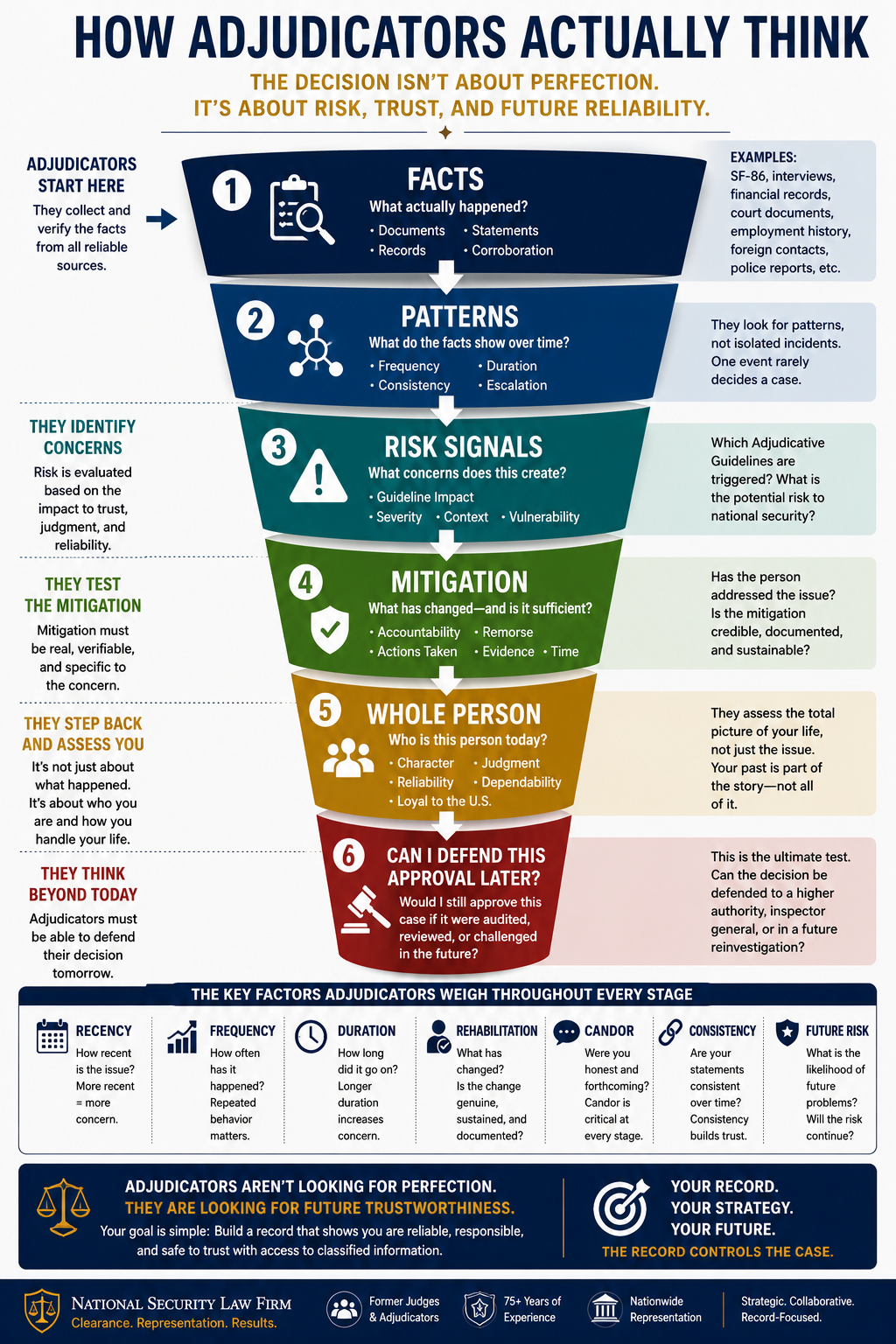
Why This Framework Matters
Most applicants evaluate their case based on what happened.
Adjudicators evaluate it based on:
-
how it was documented
-
how it evolved
-
whether it is resolved
That difference explains why outcomes often feel unpredictable.
When This Becomes a Real Problem in Your Case
Most clearance cases do not start as major problems.
They begin with:
-
small omissions
-
minor financial issues
-
isolated conduct
These become serious when:
-
the record becomes inconsistent
-
mitigation is delayed
-
explanations evolve
This is how cases turn into:
-
Statements of Reasons
-
hearings
-
appeals
Why Waiting Makes This Worse
Security clearance cases are not static.
The record is built over time through:
-
disclosures
-
interviews
-
written responses
What you say today may appear later in:
-
reinvestigations
-
Continuous Evaluation
-
promotion reviews
👉 Learn more:
→ Continuous Evaluation for Security Clearances
Why Similar Cases Get Different Results
Two people can have:
-
the same issue
-
similar facts
And receive different outcomes.
Why?
👉 Because adjudicators evaluate:
-
timing
-
consistency
-
mitigation
-
credibility
👉 Learn more:
→ Why Two Identical Security Clearance Cases Have Different Outcomes
How Adjudicators Evaluate Risk vs Rehabilitation
Adjudicators distinguish between:
Reactive Behavior
-
action taken after being caught
-
last-minute mitigation
-
incomplete efforts
Sustained Rehabilitation
-
consistent behavior over time
-
documented change
-
credible evidence
👉 The system rewards stability—not urgency
Cascading Federal Consequences
Adjudicator decisions affect more than clearance.
They can trigger:
-
federal employment discipline
-
suitability determinations
-
contractor sponsorship loss
-
Continuous Evaluation alerts
This is why clearance cases must be handled as part of a broader federal system.
Why National Security Law Firm Is Different
Security clearance cases are decided inside a federal system.
At National Security Law Firm:
-
our attorneys include former adjudicators, administrative judges, and DOHA attorneys
-
we understand how decisions are made internally
-
we apply that insight to every case
Attorney Review Board
Complex cases are reviewed through our
This mirrors how government agencies evaluate cases.
Record Control Strategy
We structure every case with long-term implications in mind:
→ The Record Controls the Case
Security Clearance Resource Hub
For a full breakdown of the system, visit the
→ Security Clearance Insiders Resource Hub
FAQs
How do adjudicators decide security clearance cases?
They evaluate risk, credibility, mitigation, and long-term reliability—not just facts.
What is the most important factor?
Consistency and credibility across the record.
Do adjudicators care about intent?
Less than whether the issue creates ongoing risk.
Can a case be won with past problems?
Yes—if the issue is mitigated and no longer creates risk.
What is the biggest mistake applicants make?
Waiting too long and allowing the record to develop incorrectly.
Pricing and Consultation
We offer transparent
→ security clearance lawyer pricing
With financing available through
Clients consistently highlight our approach in our
Speak With a Security Clearance Lawyer Before Your Case Is Decided
If your clearance is at risk, the most important question is:
👉 “How will this case be evaluated?”
We offer free consultations to help you:
-
understand your position
-
identify risks
-
determine your strategy
→ schedule a free consultation
The Record Controls the Case.