
Need a Security Clearance Lawyer? Start With How Security Clearance Cases Are Actually Decided
If you are searching for a security clearance lawyer or security clearance attorney, you are already in a federal system where outcomes are based on risk, credibility, mitigation, and how your record is built over time.
A security clearance case is not a normal lawsuit. It is not a local matter. It is not something that turns on courtroom theatrics or generic legal argument.
A security clearance lawyer operates inside a federal decision-making process where adjudicators, administrative judges, agency officials, and government reviewers are deciding whether your file can be approved, defended, or trusted later.
That is why choosing the right security clearance lawyer matters so much.
At National Security Law Firm, our security clearance lawyers represent clients nationwide in matters involving SF-86 strategy and review, security clearance investigations, subject interviews, Letters of Interrogatory, Statements of Reasons, DOHA hearings, security clearance denials and revocations, appeals, mitigation strategy, continuous vetting issues, reinstatement, and long-term record protection.
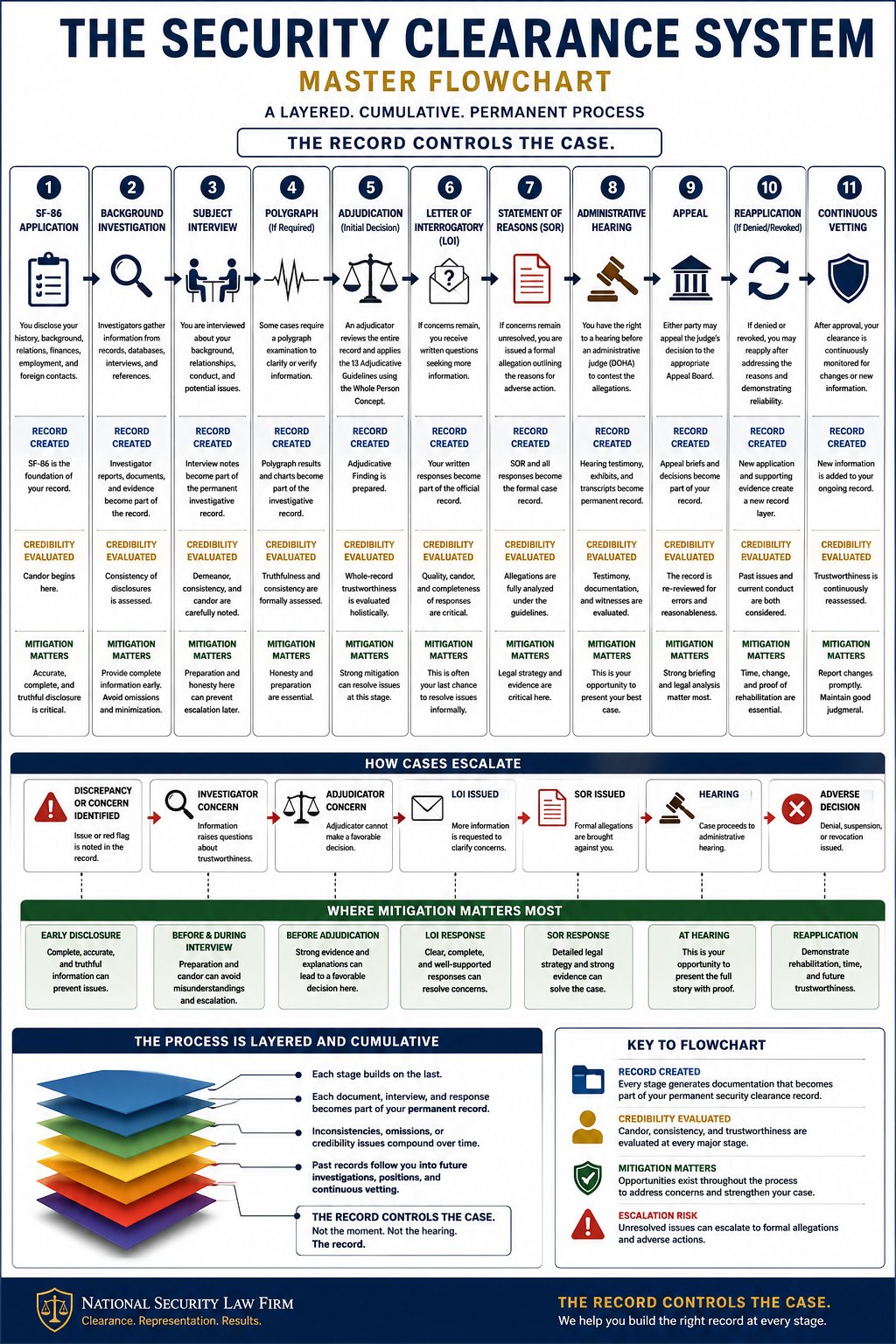
Security clearance cases are layered, cumulative, and record-driven. Every stage creates documentation that may be compared, reused, and evaluated later. That is why early strategy matters—and why the record controls the case.
You can schedule a free consultation to evaluate your case and options before your record develops further.
Clients across the country rely on National Security Law Firm for high-stakes clearance matters, as reflected in our 4.9-star Google reviews.
Our team is structurally different from the typical “security clearance lawyer” you see online.
Our attorneys include former administrative judges, former adjudicators, former DOHA attorneys, and former agency counsel.
We are also a team-based security clearance law firm, not a solo practitioner.
That matters because the government does not decide security clearance cases through one person working alone. Security clearance decisions are made through layers of review, institutional standards, and long-term record scrutiny.
That is how we are built too.
What Does a Security Clearance Lawyer Do?
A security clearance lawyer helps protect, defend, or restore your eligibility for access to classified information by shaping the record the government will use to evaluate your case.
This is not traditional legal work. In a security clearance case, the outcome does not depend on who argues best. It depends on whether your record demonstrates that granting or maintaining clearance is clearly consistent with national security.
That requires strategy, not just explanation.
A skilled security clearance lawyer does more than “tell your side of the story.” The real job is to control how your case will be read by adjudicators, investigators, and decision-makers across multiple stages.
That includes:
-
identifying the issues that actually threaten clearance approval
-
spotting credibility risks before they become part of the permanent record
-
aligning disclosures across the SF-86, interviews, LOI, SOR, and hearing stages
-
developing mitigation that works under the Adjudicative Guidelines
-
structuring responses so they remain consistent over time
-
anticipating how future reviewers will interpret the file
-
reducing the risk that a manageable issue becomes a long-term clearance problem
Security clearance cases are built, not argued.
Every submission becomes part of a record that is reviewed, compared, and reused later, including your SF-86, your subject interview statements, your LOI responses, your Statement of Reasons response, and any hearing testimony.
A security clearance lawyer is responsible for ensuring those pieces work together, not against each other.
The most important function of a security clearance lawyer is not simply responding to the government. It is controlling how the record will be interpreted.
That means asking:
-
How will this explanation read six months from now?
-
Will this statement create a contradiction later?
-
Does this mitigation actually resolve the concern, or just describe it?
-
Can an adjudicator justify approving this case based on what is written?
Two applicants with the same underlying issue can have completely different outcomes. The difference is rarely the facts alone. It is how those facts are documented, framed, and supported over time.
That is why working with a security clearance lawyer who understands how the system actually evaluates cases can materially change the result.
Because in this system:
If you are unsure how your case will be evaluated, you can schedule a free consultation to discuss your situation and next steps.
When Should You Hire a Security Clearance Lawyer?
The best time to involve a security clearance lawyer is often before the government’s concerns are formally documented.
That is not a marketing point. It is a function of how the security clearance system actually works.
In a clearance case, every stage creates a written record:
-
your SF-86
-
your subject interview statements
-
your Letter of Interrogatory responses
-
your Statement of Reasons submission
That record is not temporary. It becomes the foundation that investigators, adjudicators, and administrative judges rely on when making decisions. It also follows you into future investigations, continuous vetting, reinvestigations, and later clearance reviews.
As more information is added to your file, the record hardens. Statements are compared across time. Inconsistencies raise credibility concerns. New explanations can appear reactive or incomplete. Earlier framing of an issue often controls how it is interpreted later.
By the time a case reaches a denial, the issue is often not just what happened. It is how it has already been documented.
Many people assume they only need a lawyer after a denial. In reality, the most important stages often come earlier, when the record is still being built.
You should strongly consider working with a security clearance lawyer if:
-
you are completing an SF-86 and have potential risk factors
-
you are under investigation and concerned about what will be reported
-
you have been contacted for a subject interview and are unsure how to prepare
-
you received a Letter of Interrogatory
-
you received a Statement of Reasons
-
your clearance is at risk, suspended, or under review
-
your case involves multiple adjudicative guidelines
-
your disclosures may be inconsistent across stages
-
your job, income, or career depends on maintaining clearance
One of the most common mistakes in security clearance cases is waiting until the problem becomes formal. At that point, the record may already contain inconsistencies, key statements may be difficult to correct, and mitigation may appear reactive instead of credible.
Waiting does not just delay action. It changes the structure of the case.
A security clearance case is not something that is “fixed later.” It is something that is built over time. The earlier strategy is applied, the more control you have over how your record is created, interpreted, and ultimately decided.
Speak With a Security Clearance Lawyer Before the Record Hardens
If your clearance is at risk, or you are unsure how your situation will be evaluated, the most important step is understanding how your case will be interpreted going forward.
You can schedule a free consultation to evaluate your situation and discuss next steps before your record develops further.
Why Most Security Clearance Lawyers Get This Wrong
Most people assume that hiring a security clearance lawyer means hiring someone to explain their situation and argue their case.
That assumption is where problems begin.
Many lawyers approach security clearance cases the same way they approach criminal defense, employment disputes, or traditional litigation. They focus on telling your story, defending your actions, and making persuasive arguments.
But that is not how the security clearance process works.
Security clearance decisions are not based on who makes the best argument. They are based on how your record is evaluated under the Adjudicative Guidelines, the federal standards used to assess risk in every clearance case.
That includes critical stages such as responding to a Statement of Reasons, answering a Letter of Interrogatory, defending a security clearance denial or revocation, and preparing for a DOHA hearing.
In this system, explanation alone is not enough. In many cases, over-explaining actually makes things worse.
What matters is:
-
how information is documented
-
how risk is framed
-
how mitigation is demonstrated
-
whether your record shows long-term reliability
This is what most lawyers miss.
They focus on advocacy. Security clearance cases are not won through advocacy alone. They are won through record control.
Every statement, every document, and every response becomes part of a permanent federal record that follows you through reinvestigations, continuous vetting, future clearance reviews, and even career advancement decisions.
Once that record is created, it is extremely difficult to change.
That is why strategy matters from the very beginning, whether you are completing your SF-86, responding to a Letter of Interrogatory, or defending against a Statement of Reasons.
At National Security Law Firm, we do not treat clearance cases like isolated events. We treat them as part of a long-term federal record that must be built, defended, and protected at every stage.
Why National Security Law Firm Is Different From the Typical Security Clearance Lawyer
Most firms holding themselves out as experienced security clearance lawyers are not built the way security clearance decisions are actually made.
National Security Law Firm is.
Former Judges, Former Decision-Makers, Former DOHA Attorneys
Our security clearance team includes attorneys with real government-side experience, including former administrative judges, former adjudicators, and former DOHA attorneys, lawyers who have worked within the Defense Office of Hearings and Appeals, the federal body responsible for deciding many contested security clearance cases.
In the federal clearance system, an adjudicator is not just a reviewer. An adjudicator is the person responsible for deciding whether your security clearance is granted, denied, or revoked. They evaluate your entire record, apply the Adjudicative Guidelines, and make a national security risk determination about whether you can be trusted with classified information.
They are the decision-makers.
That experience matters because security clearance cases are won by building a record that satisfies the exact standards those decision-makers use when they grant, deny, revoke, or continue eligibility.
At National Security Law Firm, our attorneys have served in those roles. We understand not only how to advocate for you, but how your case will be evaluated, challenged, and ultimately decided inside the government.
More Than 75 Years of Security Clearance–Focused Experience
Our security clearance attorneys alone bring more than 75 years of collective experience handling clearance matters across the federal system.
This includes work involving:
-
clearance adjudications
-
Statements of Reasons
-
Letters of Interrogatory
-
DOHA hearings
-
clearance denials and revocations
That experience is not generalized. It is focused, specialized, and directly tied to how clearance decisions are actually made.
A Focused Security Clearance Practice—Not a Generalist Model
At many firms, a “security clearance lawyer” is simply one of many things that attorney does. The same lawyer may also handle federal employment disputes, military law matters, civil litigation, or even unrelated areas like family law or business disputes.
Even at larger firms, cases are often assigned to a single attorney whose practice is spread across multiple areas of law.
That structure creates a gap.
Security clearance law is not interchangeable with other practice areas. It is a specialized federal system with its own risk framework, adjudicative guidelines, and long-term record consequences.
At National Security Law Firm, our attorneys are not generalists.
Our security clearance lawyers focus on security clearance law. Our military defense attorneys focus on military law. Our federal employment attorneys focus on federal employment law.
That separation is intentional.
Because mastering how one federal system works, and how decisions are actually made inside it, requires depth, not overlap.
Backed by a Broader Federal and Military Law Firm
While our attorneys are highly specialized, they are not siloed.
National Security Law Firm brings together professionals with deep experience across military law, federal employment law, administrative litigation, FOIA requests and litigation, and high-level government decision-making.
That broader perspective matters because security clearance issues rarely exist in isolation.
A clearance problem often overlaps with a federal employment action, a security violation investigation, a disciplinary proceeding, or a record that may later be requested or reused through FOIA or continuous vetting.
If those issues are not identified early, a response that seems strong in a clearance context can unintentionally create admissions that harm a federal employment defense, lock in statements that cannot be corrected later, or trigger scrutiny in other federal systems.
This is where many firms fall short.
Even firms with multiple attorneys often assign a single lawyer to handle a clearance case in isolation, without integrating insight from related areas.
At National Security Law Firm, our structure is different. Our security clearance attorneys work within a broader institutional framework, allowing us to identify downstream consequences, coordinate strategy across related issues, and protect the record beyond the immediate clearance decision.
A clearance case is not just about getting through one decision. It is about protecting how your record will be interpreted across every decision that follows.
A Team-Based Structure That Mirrors How the Government Decides Security Clearance Cases
Security clearance decisions are not made by a single person.
They are made through a layered federal process involving investigators who gather and verify information, adjudicators who evaluate risk under the Adjudicative Guidelines, administrative judges who assess credibility and evidence at hearings, and agency officials who review and rely on the record over time.
Each role evaluates the case differently. Each applies a different lens. Each stage builds on the same record.
That structure matters because a clearance case is not just about what you say. It is about whether your record holds up across multiple decision-makers over time.
At National Security Law Firm, our structure is intentionally built to reflect that system.
Our team includes former administrative judges who have decided clearance cases, experienced litigators who prepare and defend cases at hearings, and senior clearance advisors who understand how adjudicators evaluate risk and mitigation.
These roles are not interchangeable.
They mirror the same functional perspectives used inside the federal government.
That is why our cases are not handled through a single viewpoint. They are developed, tested, and refined through our Attorney Review Board, where multiple attorneys evaluate the record, challenge assumptions, and strengthen the strategy before anything becomes part of your permanent file.
Because once that record is created, it will be relied on again and again by future decision-makers.
What Makes the Best Security Clearance Lawyer?
When people search for the best security clearance lawyer or best security clearance attorney, the question is not who has the most online visibility.
The real question is who is actually built for this system.
The best security clearance lawyer typically has:
-
security clearance law as a core, focused practice
-
government-side experience, such as working as an adjudicator, administrative judge, DOHA attorney, or agency counsel
-
deep familiarity with SF-86 issues, investigations, LOI, SOR, hearings, and appeals
-
a strong understanding of how mitigation is evaluated under the Adjudicative Guidelines
-
the ability to think beyond the current stage and protect the long-term record
-
a structure that reflects how the government evaluates cases
-
transparent pricing and clear expectations
-
the ability to explain the process accurately without oversimplifying it
Those characteristics are not about marketing. They reflect how security clearance decisions are actually made and what it takes to navigate that system effectively.
Choosing the Right Security Clearance Lawyer Matters More Than Most People Realize
Many people assume that most lawyers will approach a security clearance case in roughly the same way.
They do not.
In this field, the difference between the right lawyer and the wrong one often comes down to:
-
how the record is structured
-
how mitigation is developed
-
how credibility is preserved across stages
-
how inconsistencies are avoided before they harden into the file
-
how the case is positioned for future review
Those differences are not always obvious at the beginning. They often become clear later, when the government is evaluating the file under the Adjudicative Guidelines and deciding whether the record supports approval.
A bad fit can create damage that is not obvious at first.
The wrong security clearance lawyer may:
-
fail to identify the real issue
-
submit an explanation that sounds reasonable to a civilian audience but weak to an adjudicator
-
create inconsistencies between stages
-
overdisclose in one place and underexplain in another
-
miss the connection between clearance strategy and federal employment, military, or contractor consequences
-
write for the present moment instead of the future record
-
handle a complex case without meaningful internal review
In this field, bad lawyering does not always look dramatic.
Sometimes it looks polished.
Then the denial arrives later.
For a deeper framework on how to evaluate your options, see How to Choose a Security Clearance Lawyer: A Realistic Decision Framework.
Security Clearance Lawyer vs. General Civilian Lawyer
Not every lawyer who advertises security clearance services has actually worked inside the federal clearance system.
That distinction matters more than most people realize.
Many attorneys use phrases like “government security clearance lawyer” or “federal security clearance lawyer” in ways that suggest government experience. In some cases, that simply means the lawyer handles cases involving the government, not that they have served in roles where clearance decisions are actually made.
A general civilian lawyer may be highly skilled at advocacy. They may know how to build a narrative, argue fairness, and present a client’s story persuasively.
But security clearance cases are not decided that way.
Security clearance law is different because the question is not simply whether something happened. The question is whether the government can trust the applicant or clearance holder with classified access in light of the whole record.
These cases are decided through a structured federal process where decision-makers evaluate risk, credibility, consistency over time, and whether a record can be approved without creating future concern.
A true security clearance lawyer understands how those decisions are made because they have worked within that system.
That includes experience such as:
-
serving as an adjudicator or administrative judge
-
working within DOHA or a federal agency
-
advising on clearance eligibility and risk determinations
-
building and evaluating clearance records from the government side
This leads to a fundamentally different approach.
A general lawyer may focus on fairness, explanation, and persuasive argument.
An experienced security clearance lawyer focuses on:
-
risk framing
-
record integrity
-
adjudicative logic
-
mitigation sequencing
-
cross-stage consistency
-
future file reuse
-
federal system consequences
The difference is not stylistic.
It is structural.
| What actually matters in clearance cases | National Security Law Firm | Traditional clearance lawyer or solo practitioner | |
|---|---|---|---|
| How clearance law is treated | Clearance law is treated as a specialized discipline. Our security clearance lawyers handle clearance matters as their core practice, every day. | Clearance work is often treated as a side service or administrative issue. Some solo lawyers market themselves as “clearance lawyers” while primarily practicing unrelated areas like divorce or general litigation. | |
| Who designs the strategy | Strategy is designed by former judges, adjudicators, agency counsel, and attorneys with DOHA experience who understand how approvals are justified inside the government. | Strategy is often built by private attorneys with no government clearance background, relying on persuasion, fairness arguments, or general legal instincts. | |
| How decisions are anticipated | Cases are built around institutional defensibility—whether an approval can be justified now and defended later during audits, reinvestigations, and Continuous Evaluation. | Cases are often framed around what sounds reasonable or sympathetic, without anticipating how the file will be scrutinized later. | |
| How judgment calls are handled | High-risk decisions are reviewed through NSLF’s Attorney Review Board, so no single attorney’s blind spot controls the outcome. | One lawyer makes judgment calls alone. There is no structured internal review to catch errors before they become permanent record. | |
| Awareness of downstream consequences | Clearance strategy is coordinated internally with federal employment, military law, and FOIA considerations when the record will be reused across systems. | Downstream consequences are often discovered too late—after clearance filings trigger employment discipline, suitability issues, or retaliation exposure. | |
| How documents are written | Every submission is drafted with future reuse in mind—reinvestigations, CE alerts, promotions, and future adjudications. | Documents are often written to solve the immediate problem, without considering how the language will be reused years later. | |
| Incentives | Flat-fee, stage-based pricing encourages deliberate strategy, collaboration, and careful pacing. | Hourly billing discourages collaboration and rewards speed, not long-term record safety. |
Do I Need a Security Clearance Lawyer?
Not every person with a clearance issue needs a lawyer immediately. But many people wait too long.
You should strongly consider hiring a security clearance lawyer if:
-
you are completing an SF-86 and have real risk factors
-
you are under investigation and worried about what will be reported
-
you received a subject interview request and do not know how to prepare
-
you received a Letter of Interrogatory
-
you received a Statement of Reasons
-
your clearance was denied, suspended, or revoked
-
your case involves multiple adjudicative guidelines
-
your disclosures are inconsistent across forms, interviews, and prior submissions
-
your job, income, career, access, or professional future depends on the outcome
The more your case turns on credibility, mitigation, timing, and long-term record management, the more valuable the right security clearance lawyer becomes.
Security Clearance Process: The Key Stages a Security Clearance Lawyer Handles
A security clearance case is not a single event.
It is a multi-stage federal process where each step builds on the last, and where early decisions often shape the final outcome.
A security clearance lawyer may be involved at one stage—or across the full lifecycle of a case—but the most effective strategy accounts for how each stage connects to the next.
Below are the core stages where strategy, timing, and record development matter most.
1. What Triggers a Security Clearance Issue?
Before understanding the process, it is important to understand what actually causes security clearance problems in the first place.
Security clearance cases do not arise randomly.
They are triggered by specific categories of concern evaluated under the federal adjudicative framework, including issues such as:
- foreign contacts and foreign influence
- financial problems or unexplained debt
- personal conduct and candor concerns
- criminal conduct
- drug or alcohol use
- security violations
- and other risk factors
These concerns are not evaluated in isolation.
They are analyzed based on patterns, context, credibility, and mitigation over time.
For a deeper breakdown of what can trigger a clearance issue—and how those risks are evaluated—see our guide on what causes a security clearance denial or revocation.
2. SF-86 Review and Strategy
The SF-86 is not just paperwork.
It is the foundation of your security clearance record.
Errors, omissions, inconsistent disclosures, or poorly framed explanations can create issues that follow you throughout the life of your case.
That is why many applicants seek guidance on how to complete their form correctly the first time through a comprehensive SF-86 review lawyer and strategy approach.
3. Security Clearance Investigations
The investigation stage is where the government begins gathering and verifying information that may later drive concerns.
This includes:
- background checks
- source interviews
- financial and record review
- and fact development
Understanding how this process works—and what investigators are actually looking for—is critical. Learn more in our security clearance investigations explained resource.
4. Security Clearance Subject Interviews
A subject interview is one of the most underestimated stages in the process.
What you say—and how you say it—can shape your record in lasting ways.
Tone, precision, consistency, and framing all matter.
Preparation with a security clearance subject interview lawyer can significantly impact how your statements are later interpreted.
5. Letter of Interrogatory (LOI)
A Letter of Interrogatory (LOI) is often the first clear signal that the government has identified potential concerns.
Many people treat it as a simple questionnaire.
It is not.
Your response can become the foundation for future allegations and is often referenced in later stages of the case.
This is one of the highest-leverage points to involve a Letter of Interrogatory lawyer.
6. Statement of Reasons (SOR)
A Statement of Reasons (SOR) means the government has formally identified unresolved security concerns.
At this stage, the issue is no longer just explanation—it is mitigation under the adjudicative framework.
A strong response must:
- address the concern directly
- present credible mitigation
- and create a record that supports approval
This is where working with a Statement of Reasons lawyer becomes critical.
7. Security Clearance Hearings
Security clearance hearings—often conducted through DOHA—are not just about advocacy.
They are about:
- credibility
- consistency with the written record
- documentary discipline
- and presenting a case that can withstand scrutiny at the decision level
Preparation with a DOHA security clearance hearing lawyer focuses on building a record that holds up beyond the hearing itself.
8. Security Clearance Denials
A security clearance denial can affect:
- your current employment
- your eligibility for future clearance
- your sponsor relationship
- and your long-term career path
But not all denials are the same.
The underlying record, timing, and forum all shape what can be done next.
Understanding your options after being security clearance denied is essential to determining the right path forward.
9. Security Clearance Appeals
Appeals are highly specialized and depend heavily on what is already in the record.
Strategy at this stage is constrained by:
- the forum
- the prior submissions
- and what issues can still be addressed
Working with a security clearance appeal lawyer ensures the approach is aligned with how appellate review actually works.
10. Adjudicative Guidelines
All clearance decisions are made under the Adjudicative Guidelines, which include:
Understanding not just the text—but how these guidelines are applied in real cases—is critical.
Explore our breakdown of the security clearance adjudicative guidelines.

11. Security Clearance Mitigation Strategy
Mitigation is where many cases are won or lost.
Effective mitigation is not generic.
It must be:
- documented
- timed correctly
- tailored to the specific concern
- and structured so a reviewer can justify approval
Our security clearance mitigation strategy guide explains how this is done effectively.
12. Continuous Vetting and Continuous Evaluation
Many people assume their case is over once an issue is resolved.
In reality, clearance records can be revisited through continuous vetting and future investigations.
This means earlier statements and issues may be reviewed again later.
Learn how this works in our continuous vetting for security clearances resource.
13. Security Clearance Polygraph
Polygraph issues can affect how credibility and candor are evaluated.
Even when inconclusive or disputed, polygraph results can influence how concerns are framed within the broader record.
These cases often require careful handling by a security clearance polygraph lawyer to address both the event and its long-term impact.
What a Strong Security Clearance Case Looks Like
A strong case is not always a case with perfect facts. A strong case is one where:
-
the record is consistent
-
the problem is clearly identified
-
the mitigation is real and documented
-
the explanation matches the known facts
-
the file shows judgment, reliability, reform, and trustworthiness
-
the government can justify approval without feeling it is taking an institutional gamble
A strong security clearance lawyer helps build that kind of case.
What a Weak Security Clearance Case Looks Like
A weak case often has one or more of the following problems:
-
shifting explanations
-
incomplete disclosures
-
generic mitigation
-
contradictions between forms, interviews, and later responses
-
emotional but unstructured advocacy
-
a lawyer who does not understand how the file will be read later
-
submissions written to sound persuasive instead of institutionally safe
Many weak cases are not weak because the client is hopeless. They are weak because the record was built poorly.
Transparent Security Clearance Lawyer Pricing
One of the most common questions people have when searching for a security clearance lawyer is simple:
What does it cost?
At National Security Law Firm, we believe pricing should be clear, predictable, and aligned with how security clearance cases are actually handled.
That is why we use a flat-fee structure designed to support thoughtful strategy, collaboration, and full case development—without the pressure or unpredictability of hourly billing.
You can view a full breakdown on our security clearance lawyer pricing page, but typical ranges include:
- SF-86 review and strategy: $950
- Letter of Interrogatory (LOI) response: $3,500
- Statement of Reasons (SOR) response: $5,000 (with LOI credit where applicable)
- Hearing representation (including travel): $7,500
This structure matters.
Security clearance cases are not resolved through quick conversations or isolated filings. They require:
- careful record development
- coordination across stages
- and, in many cases, input from multiple attorneys
Flat-fee pricing allows that work to happen without the hesitation that hourly billing often creates.
It ensures that strategy is driven by what the case requires—not by how much time can be billed.
We also offer flexible payment options, including financing through Pay Later by Affirm, so clients can move forward quickly when timing matters most.
You can book your consultation today.
Free Security Clearance Consultations
Many firms charge for initial consultations.
We do not.
That decision is intentional.
Choosing a security clearance lawyer is not just about whether a firm will take your case.
It is about whether that firm is the right fit for you, your record, and the specific issues involved.
You should have the opportunity to:
- understand how your case will be evaluated
- ask detailed questions about strategy
- and assess whether the attorney you are speaking with truly understands the federal clearance system
A consultation should not feel like a transaction.
It should feel like an informed evaluation—on both sides.
At National Security Law Firm, our consultations are:
- free
- substantive
- and focused on helping you understand your position before making any decisions
This allows you to evaluate us with the same level of care that we evaluate your case.
Most firms ask you to commit before you fully understand your situation. We believe you should understand both before making that decision.
Why Clients Nationwide Choose National Security Law Firm
Clients choose National Security Law Firm because our security clearance practice is built differently.
It is aligned with how federal security clearance decisions are actually made.
That includes:
- former administrative judges, adjudicators, and DOHA attorneys—professionals who have served as the decision-makers in clearance cases
- more than 75 years of security clearance-focused experience within our clearance team
- a team-based structure, including our Attorney Review Board, where multiple attorneys review and refine strategy before anything is submitted
- a focused, niche practice model, where our security clearance lawyers handle clearance matters—not a mix of unrelated practice areas
- a structure built around record control, ensuring that every step in your case supports how your file will be evaluated now and in the future
- deep experience across intersecting federal systems, including military law and federal employment consequences
- transparent flat-fee pricing, designed to support full case development without the constraints of hourly billing
- free, substantive consultations, allowing you to evaluate your case and your options before making a decision
- nationwide representation
- a Washington, D.C.–based practice, positioned at the center of the federal system where security clearance decisions are shaped, reviewed, and implemented
- and a proven track record reflected in our 4.9-star Google reviews
Security clearance cases are not won by isolated arguments or one-time explanations.
They are resolved through a structured process where credibility, consistency, and long-term record integrity determine the outcome.
That is what our firm is built to do.
A Washington, D.C.–Based Practice with Nationwide Representation
Security clearance law is not local.
It is a federal system.
Clearance decisions are made under national standards, by federal agencies, and through processes that do not change based on where you live.
That is why location matters—but not in the way most people think.
At National Security Law Firm, we are based in Washington, D.C., at the center of the federal system where security clearance policies are developed, interpreted, and applied.
That proximity matters.
It means our work is grounded in how the system actually operates—not how it is described in theory or applied inconsistently at the local level.
But just as important is this:
We represent clients nationwide.
Because security clearance cases are federal, not geographic.
Whether you are located in California, Texas, Virginia, or overseas, your case is evaluated under the same framework:
- the Adjudicative Guidelines
- federal investigative processes
- and centralized decision-making systems
Our structure is built for that reality.
We are not a local law firm adapting to federal work.
We are a federal practice that represents clients wherever they are.
Case Outcomes & Proof
Security clearance cases are fact-specific, but outcomes leave a record.
The following case results illustrate how disciplined record control, guideline-specific mitigation, and decision-maker perspective can resolve even high-risk clearance cases without unnecessary escalation.
-
- Written Security Clearance Appeal Win: How NSLF Secured Reconsideration After a Multi-Guideline SOR
- Security Clearance SOR Win: How We Beat a Guideline K Case Without a Hearing
- Security Clearance SOR Win: Beating a High-Risk Case Involving Guidelines B, H, and J
- PSAB Reinstated Clearance Eligibility After DOHA Hearing and Indefinite Suspension
- Security Clearance Granted After Drug Use Allegations: How NSLF Built a Record a DOHA Judge Could Approve
- Security Clearance Granted Despite Foreign Influence Allegations: How NSLF Built a Record a DOHA Judge Could Approve
- Security Clearance Granted After DUI, Multiple Alcohol Arrests, and Alleged Cocaine Use
- Security Clearance Granted After Alcohol Abuse, Drug Relapse, and Criminal Conduct Allegations
- How We Corrected a False Security Clearance Record—and Forced DCSA to Update the File
- Security Clearance Granted—Despite Criminal Record, DUI History, and Psychological Concerns
- Security Clearance Granted After Years of Mental Health Treatment, Hospitalizations, and a Multi-Guideline Statement of Reasons
- Security Clearance Successfully Preserved After an NGA Statement of Reasons and Personal Appearance
These cases are not examples of luck or persuasion.
These outcomes reflect how clearance cases are actually resolved inside the system — through disciplined record control, guideline-specific mitigation, and institutional defensibility.
Security Clearance Lawyer FAQs
What does a security clearance lawyer do?
A security clearance lawyer helps protect, defend, or restore your clearance eligibility by building a record that addresses risk, credibility, consistency, and mitigation under the adjudicative framework.
What is the biggest mistake people make in security clearance cases?
The most common mistake is assuming issues can be “explained later” after the record has already been created. In reality, earlier stages often determine how a case will be evaluated. Once statements are documented, they are compared, reused, and relied on by future decision-makers. By the time a problem is formally raised, the record may already be working against the applicant.
Will Hiring a Security Clearance Lawyer Make My Case Look Worse?
This is a common concern. The answer is no—if the lawyer understands the system. Security clearance cases are not judged based on whether someone has representation. They are judged based on the record, consistency across statements, and the strength of mitigation. In many cases, the greater risk is not having representation. Without structured strategy, applicants may create inconsistencies, over-explain or under-explain key issues, or unintentionally weaken how their record is interpreted. A properly handled case does not raise concern. It improves how the record is built and evaluated.
Do I need a security clearance lawyer for an SF-86?
Not always. But if you have debt, drug use, foreign contacts, criminal history, prior omissions, mental health issues, or any issue that could later be viewed as a candor or reliability problem, early guidance can be extremely valuable.
Do I need a security clearance lawyer for an LOI?
Often, yes. An LOI response can shape the future of the case. Mistakes at this stage can become part of the permanent record and later feed directly into an SOR.
Do I need a security clearance lawyer for an SOR?
This is one of the most important stages for representation. Once a Statement of Reasons is issued, the government has formally identified unresolved concerns and the burden shifts heavily toward mitigation and credibility.
Can a security clearance lawyer help after a denial?
Yes. A security clearance lawyer can often help evaluate appeal options, record weaknesses, forum-specific strategy, future eligibility, and how to avoid repeating the same record mistakes.
Should I hire a local lawyer or a nationwide security clearance lawyer?
Security clearance law is federal, specialized, and system-driven. In most cases, niche experience and insider understanding matter far more than local geography.
Read: Why Security Clearance Law Is Not a “Local Lawyer” Problem
Does government-side experience matter in a security clearance lawyer?
Yes. It matters a great deal. Lawyers with government-side experience often understand how files are assessed from the inside, not just how to advocate from the outside.
Why does a team-based security clearance law firm matter?
Because security clearance cases are judged by a system, not a single isolated person. A team-based model helps mirror the reality of federal decision-making and can materially improve strategy quality.
What is the Attorney Review Board?
At National Security Law Firm, the Attorney Review Board is a structured internal review process where multiple attorneys evaluate major clearance cases before key submissions are made. This allows for internal challenge, refinement, and risk identification before anything becomes part of the permanent record. It mirrors how the government evaluates cases through layered review rather than a single decision-maker.
Can the wrong security clearance lawyer hurt my case?
Yes. The wrong lawyer can create inconsistencies, overcomplicate issues, miss mitigation opportunities, and build a record that becomes harder to defend later.
Can a security clearance lawyer guarantee success?
No ethical lawyer can guarantee a result in a discretionary federal security clearance case. But the right security clearance lawyer can significantly improve how the record is built, framed, and defended.
How much does a security clearance lawyer cost?
Costs vary depending on the stage and complexity of the case. National Security Law Firm offers transparent flat-fee pricing for key stages such as SF-86 review, LOI responses, SOR responses, and hearings. You can review a full breakdown here: security clearance lawyer pricing
What if I cannot afford a security clearance lawyer?
This is a common concern. In many cases, the cost of waiting can be higher than the cost of early strategy, especially if the record becomes harder to correct later. National Security Law Firm offers financing through Pay Later by Affirm to help clients move forward when timing matters.
Security Clearance Insider Resource Center
This is the central navigation hub for understanding, protecting, and defending a security clearance.
Security clearance cases follow a federal system—not a linear process. The right starting point depends on where your situation stands today.
Use the sections below to go directly to the stage or issue that matches your case.
Start Here: Understand the System First
If you are trying to understand how the security clearance system actually works before taking action, start here:
- How the Security Clearance Process Actually Works
- Security Clearance Adjudication Explained: How the Government Decides Your Case
- What Disqualifies You From a Security Clearance?
- Can You Lose Your Security Clearance?
- Security Clearance FAQs: The Most Comprehensive Guide to U.S. Security Clearances
These pages explain how risk is evaluated and how decisions are actually made.
Early-Stage Strategy (Where Most Cases Are Won or Lost)
If you are early in the process—or trying to avoid problems—start here:
- SF-86 Security Clearance Form: How to Complete It Without Triggering Risk
- Security Clearance Investigations Explained
- Security Clearance Subject Interviews: How Credibility Is Evaluated
- How the Record Gets Built Before Adjudication
These are the stages where the record is created—and where mistakes are hardest to fix later.
Escalation Stages (When the Case Becomes Active)
If your case has been formally flagged or escalated, go directly to your stage:
- Letter of Interrogatory (LOI): What It Means and How to Respond
- I Received a Letter of Interrogatory — What Should I Do Now?
- Statement of Reasons (SOR): What It Means and How to Respond
- I Received a Statement of Reasons — What Should I Do?
These are the highest-risk stages, where how you respond directly affects the outcome.
Hearings, Denials, and Appeals
If your clearance is being challenged, denied, or reviewed at a higher level:
- Security Clearance Hearings: What Happens at a DOHA Hearing
- Security Clearance Denied: The Complete Guide (2026)
- Security Clearance Denied: What Happens Next
- Security Clearance Appeals: How to Challenge a Denial or Revocation
At this stage, the focus shifts to defending and restructuring the existing record.
Risk Factors and Adjudicative Guidelines
If you are trying to understand the issue affecting your case:
- Security Clearance Adjudicative Guidelines Explained
- Can You Lose Your Security Clearance? (Risk Factors Guide)
- Lack of Candor: Why This Destroys Clearance Cases
Understanding how your issue is categorized is critical to building effective mitigation.
Strategy and Mitigation (How Cases Are Actually Won)
If your focus is how to fix or improve your case:
- Security Clearance Mitigation & Strategy: How to Win a Clearance Case
- The Whole Person Concept Explained
- How Security Clearance Adjudicators Actually Decide Cases
- Why Two Identical Cases Have Different Outcomes
These resources explain what actually persuades decision-makers—and what does not.
Long-Term Record Risk (What Happens After the Case)
If your concern is future risk or long-term impact:
- Continuous Evaluation for Security Clearances
- Security Clearance Flagged in Continuous Vetting
- The Permanent Security File: What Happens to Your Clearance Record
Even resolved issues can resurface. The record does not disappear.
Polygraph and Specialized Issues
If your case involves a polygraph or related credibility concerns:
Choosing a Security Clearance Lawyer
If you are deciding whether to hire counsel or evaluating your options:
Cost and Financing
If cost is part of your decision:
Speak With a Security Clearance Lawyer Before the Record Hardens
If your clearance is at risk, the most important question is not just what happened. The question is how your case will be interpreted by the federal system from this point forward.
At National Security Law Firm, our security clearance lawyers include former administrative judges, former adjudicators, and former DOHA attorneys. We bring more than 75 years of collective experience and a collaborative team structure that mirrors how the government actually makes security clearance decisions.
We offer free consultations so you can understand your options before the record hardens further.
The Record Controls the Case.