
The government is asking questions because something in your security-clearance record requires further explanation.
A Letter of Interrogatory does not necessarily mean your clearance will be denied or revoked. It often means the government is still deciding whether the concern can be resolved—or whether the matter should advance to a formal Statement of Reasons.
Your response may help resolve the concern. It may also become part of the record later used in an SOR, personal appearance, hearing, appeal, reinvestigation or related federal proceeding.
National Security Law Firm does more than edit your answers. We:
- Analyze what the government may be testing;
- Compare the questions with your earlier disclosures and existing record;
- Identify inconsistencies before they become credibility problems;
- Develop rebuttal and mitigation evidence;
- Investigate relevant government records;
- Prepare the written response and supporting exhibits; and
- Review the submission from investigative, adjudicative and litigation perspectives.
$3,500 Flat Fee · Attorney-Drafted LOI Response · Supporting Evidence · Government Records Investigation · Attorney Review Board
Former Federal Clearance Judge · Former Government Adjudicators · Counterintelligence Experience · Former GS-15 Intelligence Counsel · Direct Federal Hearing Experience
A deadline may already be running. Follow the instructions and deadline stated in your notice. Send us the complete LOI—including every page, attachment, and instruction—as soon as possible so we can evaluate the available time and whether an extension request may be appropriate. Deadlines for Responding to a Security Clearance LOI
Investigation · Personnel Security · Adjudication · Government Records · Hearings · Appeals
★★★★★ “Honest, Realistic Advice—No Guarantees”
“They listened to my story and gave me honest, realistic advice. They never sugarcoated the process or guaranteed a win. They simply asked me to trust them and put in the work.”
P.A., Security Clearance Client · Google Review
Security Clearance Guidance Before and After an LOI
- Security Clearance Lawyers — Main Service Overview
- SF-86 Review and Strategy
- Security Clearance Investigation Representation
- Statement of Reasons (SOR) Representation
- Security Clearance Services and Pricing
- Security Clearance Resource Center
Why the LOI Stage Matters
An LOI is more than a request to answer a few questions.
It generally means investigators or adjudicators have identified information that appears incomplete, inconsistent or potentially significant. They want additional facts before deciding whether the issue can be resolved.
The questions may involve:
- Delinquent debts or tax problems;
- Foreign relatives, contacts, travel or financial interests;
- Drug use or prescription misuse;
- Alcohol-related conduct;
- Criminal charges, arrests or other misconduct;
- Employment discipline or termination;
- Mental-health information relevant to judgment or reliability;
- Mishandling protected information;
- Misuse of government information systems;
- Outside activities or conflicting obligations;
- An omission from an SF-86 or eApp; or
- A difference between your questionnaire, interview and another record.
The government may be evaluating more than the underlying event. It may also be testing:
- Whether your answers are truthful and complete;
- Whether your explanation matches other records;
- Whether a prior omission was intentional;
- Whether you accept responsibility where appropriate;
- Whether the concern has been corrected or mitigated;
- Whether the conduct is likely to recur; and
- Whether your response demonstrates present judgment, reliability and trustworthiness.
A truthful answer can still create problems when it is based on uncertain memory, unsupported by available records or inconsistent with something the client previously said.
The objective is not to conceal unfavorable information or manufacture a perfect explanation. It is to answer truthfully, verify material facts, explain legitimate discrepancies and give the decision-maker reliable evidence.
Read more: What Is a Letter of Interrogatory in a Security Clearance Case?
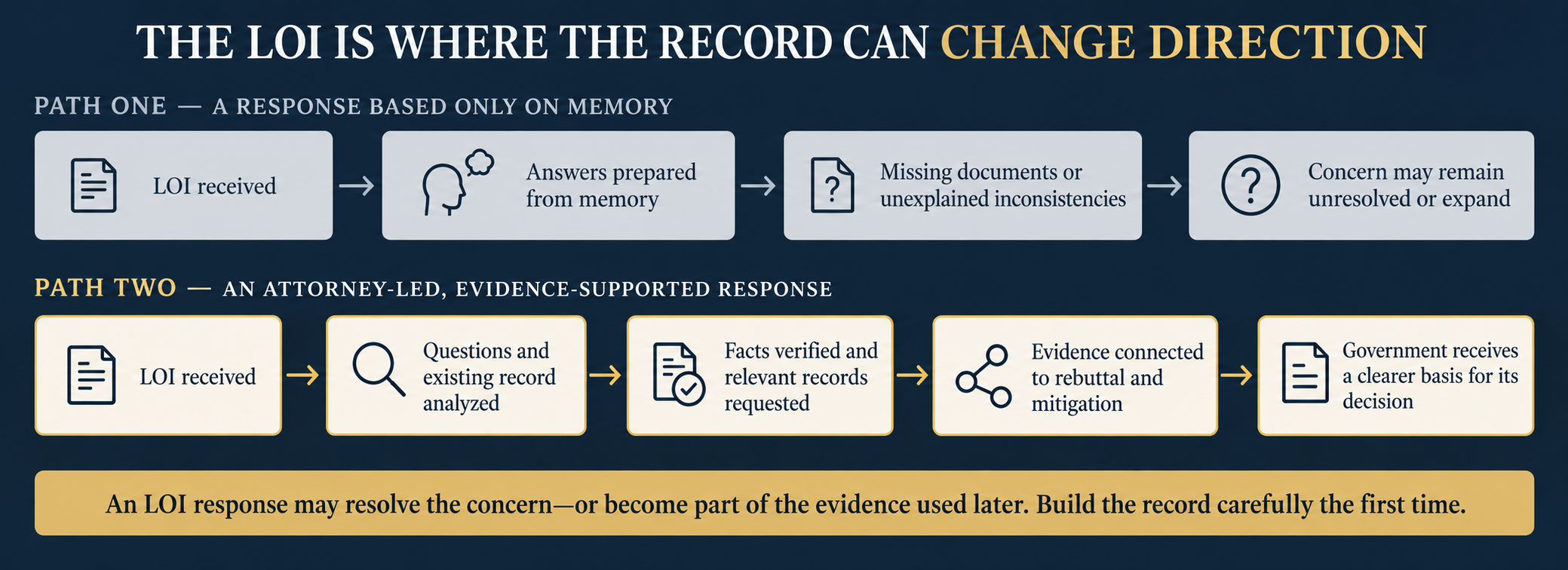
The Government Is Still Building the Record
At the LOI stage, the government may still be gathering, comparing and evaluating information.
That creates an important opportunity.
A supported response may:
- Correct an inaccurate fact;
- Resolve a misunderstanding;
- Supply information the investigator did not possess;
- Document rehabilitation or changed circumstances;
- Explain a legitimate inconsistency;
- Demonstrate candor and cooperation; or
- Give the adjudicator a defensible basis to resolve the concern favorably.
No attorney can guarantee that an LOI response will prevent further action. But problems addressed while the record is still developing may be easier to resolve than problems that have already hardened into formal SOR allegations.
Read more: What Investigators Are Actually Looking for in an LOI Response
Everything Included in the $3,500 Flat Fee
The flat fee covers an attorney-led process for preparing the covered written LOI response.
You are not hiring NSLF merely to polish a document you already wrote. You are hiring a security-clearance team to analyze the questions, reconstruct the relevant record, develop evidence, draft the response and test the final submission before it becomes part of your clearance file.
1. Immediate Notice and Deadline Review
We review:
- The complete LOI;
- Every question and attachment;
- Response instructions;
- Requested authorizations;
- The stated deadline; and
- Any documents referenced in the notice.
We identify what must be provided and whether an extension request should be considered. Extensions are never guaranteed, and the existing deadline remains controlling unless the appropriate authority grants additional time.
2. Attorney Strategy Conference
You meet with an attorney to discuss:
- The questions and underlying events;
- Your clearance and employment status;
- Your SF-86 or eApp disclosures;
- Investigative interviews and prior statements;
- Available supporting records;
- Mitigation already completed; and
- Related employment, military, criminal or administrative proceedings.
The purpose is to determine what the government may be trying to verify and what information could change its assessment.
3. Review and Reconstruction of the Existing Record
We review the materials reasonably necessary for the covered response, which may include:
- Your SF-86 or eApp;
- Prior security questionnaires;
- Self-reports and incident reports;
- Investigative interview information;
- Agency, command or security-office correspondence;
- Financial, court, employment, treatment, travel or military records; and
- Other documents directly related to the questions or potential mitigation.
We reconstruct the relevant timeline and identify missing information, factual uncertainty and potential inconsistencies.
4. Question-by-Question Risk Analysis
We identify:
- What each interrogatory asks;
- What facts must be verified;
- What adjudicative concern may be involved;
- Whether the government appears to be testing credibility;
- How one answer may affect another; and
- Whether the response could affect a related federal proceeding.
A financial, foreign-contact or drug-related question can become a separate personal-conduct concern if the answer conflicts with an earlier disclosure.
5. Rebuttal, Mitigation and Evidence Plan
Depending on the issues, relevant evidence may include:
- Payment histories, repayment agreements, tax records or financial counseling;
- Court dispositions, police records or proof of completed obligations;
- Treatment, testing, counseling or rehabilitation documentation;
- Foreign-contact, travel, citizenship, property or financial information;
- Employment, military and security-compliance records;
- Evidence of self-reporting, cooperation or changed circumstances;
- Documentation correcting an inaccurate allegation; and
- Carefully selected statements from people with relevant knowledge.
Every exhibit should prove something material. A larger submission is not necessarily a stronger submission.
6. Government Records Investigation
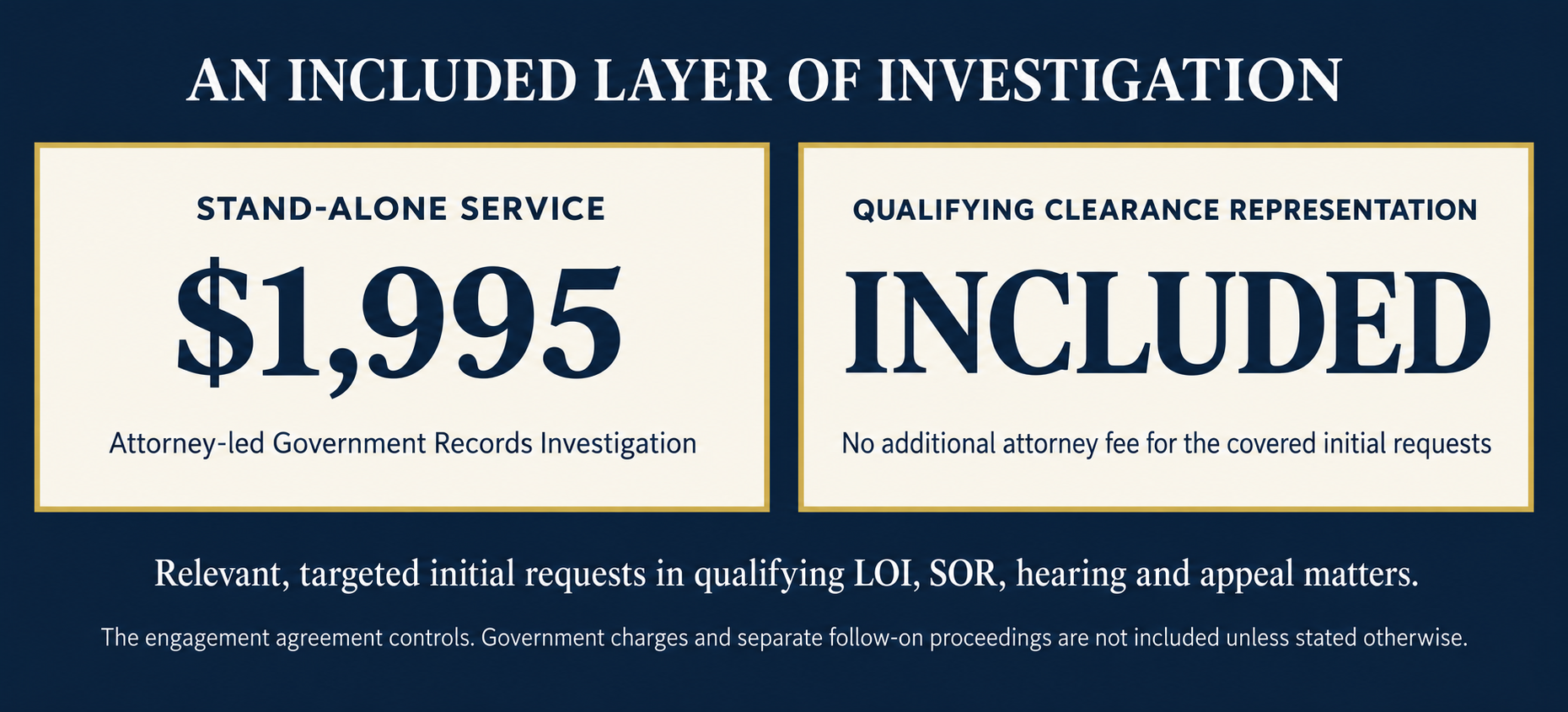
In qualifying LOI matters, NSLF prepares targeted Freedom of Information Act and Privacy Act requests for relevant government records at no additional attorney fee.
We do not use a predetermined number of generic requests. We identify the government offices and records that appear relevant to the client’s actual concern.
Learn About the NSLF Government Records Investigation
7. Attorney-Drafted Response and Supporting Package
An attorney prepares the covered response using the verified facts, available evidence and agreed strategy.
The work may include:
- Direct answers to each interrogatory;
- A supporting narrative or legal explanation when appropriate;
- Rebuttal and mitigation;
- Reconciliation of apparent inconsistencies;
- References to supporting exhibits;
- An exhibit index or organized supporting package; and
- A structure designed to make the evidence usable for the government reviewer.
8. Attorney Review Board, Client Review and Finalization
Covered LOI matters receive collaborative review through the NSLF Attorney Review Board.
The review may draw on investigative, adjudicative, national-security or litigation perspectives depending on the issues involved.
We look for:
- Unanswered questions;
- Unsupported conclusions;
- Credibility risks;
- Timeline problems;
- Evidence that contradicts the response;
- Language that could be misunderstood later; and
- Consequences extending into another government system.
You then review the draft for factual accuracy and completeness before the submission-ready package is finalized.
The LOI May Not Show the Government’s Entire Record
The LOI tells you what the government wants you to answer. It may not tell you:
- Where the information originated;
- What an investigator actually documented;
- Whether a later summary omitted favorable context;
- Whether you previously disclosed the issue;
- Which version of an event appears in another government system;
- Whether a date, amount or disposition is inaccurate; or
- What information may be used at a later stage.
Relevant information may exist in background-investigation, adjudication, military, law-enforcement, personnel-security or employing-agency records.
That information can matter in several ways.
Favorable Government Documentation
Government records may document that the client:
- Previously disclosed the issue;
- Cooperated with investigators;
- Provided a consistent explanation;
- Completed corrective action;
- Received favorable comments from a witness or supervisor; or
- Was previously found reliable despite the underlying event.
Favorable information recorded by the government may support the client’s explanation more effectively than an unsupported assertion made only after receiving an LOI.
Errors and Missing Context
The original report may differ from the summary appearing in the LOI. Records may contain the correct date, amount, disposition or sequence of events.
Finding that documentation allows counsel to identify the error precisely and support the correction with evidence.
Preparation for a Later SOR or Hearing
Records may reveal additional questions, adverse information or inconsistencies that could arise later.
Learning about those issues may give counsel time to investigate, develop evidence and prepare the client before the information becomes a surprise during an SOR, personal appearance, hearing or appeal.
Other Potential Legal Options
Records may indicate that information was improperly maintained, disclosed or used. They may also reveal an inadequate agency search or disputed withholding.
Depending on the facts, separate options may exist to seek disclosure, correction, administrative review or judicial relief. Those proceedings are not automatically included in the LOI flat fee.
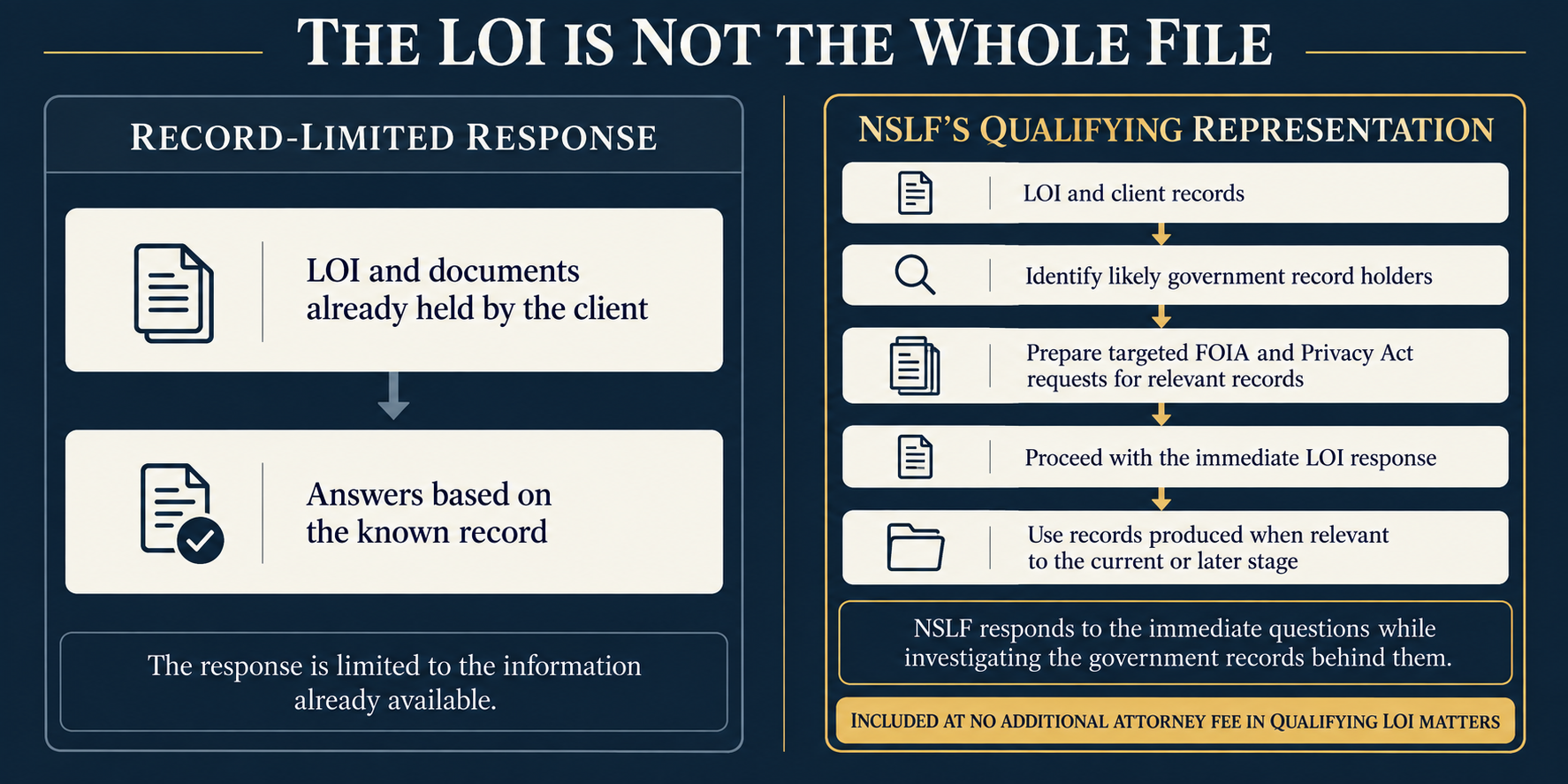
Will the Government Records Arrive Before My LOI Deadline?
They may not. Government response times vary, and the LOI deadline generally continues while a records request is pending.
The immediate response should proceed under the instructions and deadline in the notice. A pending records request should not prevent the client from preparing the strongest timely response possible from the information available.
Records received later may still become important during:
- Supplemental adjudication;
- A later investigative interview;
- A Statement of Reasons response;
- A personal appearance;
- A hearing or appeal;
- A future reinvestigation or adjudication; or
- A separate effort to correct an inaccurate government record.
The Government Evaluates the Case From Multiple Perspectives. So Does NSLF.
The government does not treat an LOI as a simple writing assignment.
Investigators develop information. Personnel-security professionals evaluate risk. Adjudicators apply the guidelines and whole-person framework. Commands and agencies evaluate mission consequences. If the case advances, counsel, judges or appellate authorities may examine the evidence and the client’s credibility.
NSLF brings those perspectives together through one coordinated legal strategy.
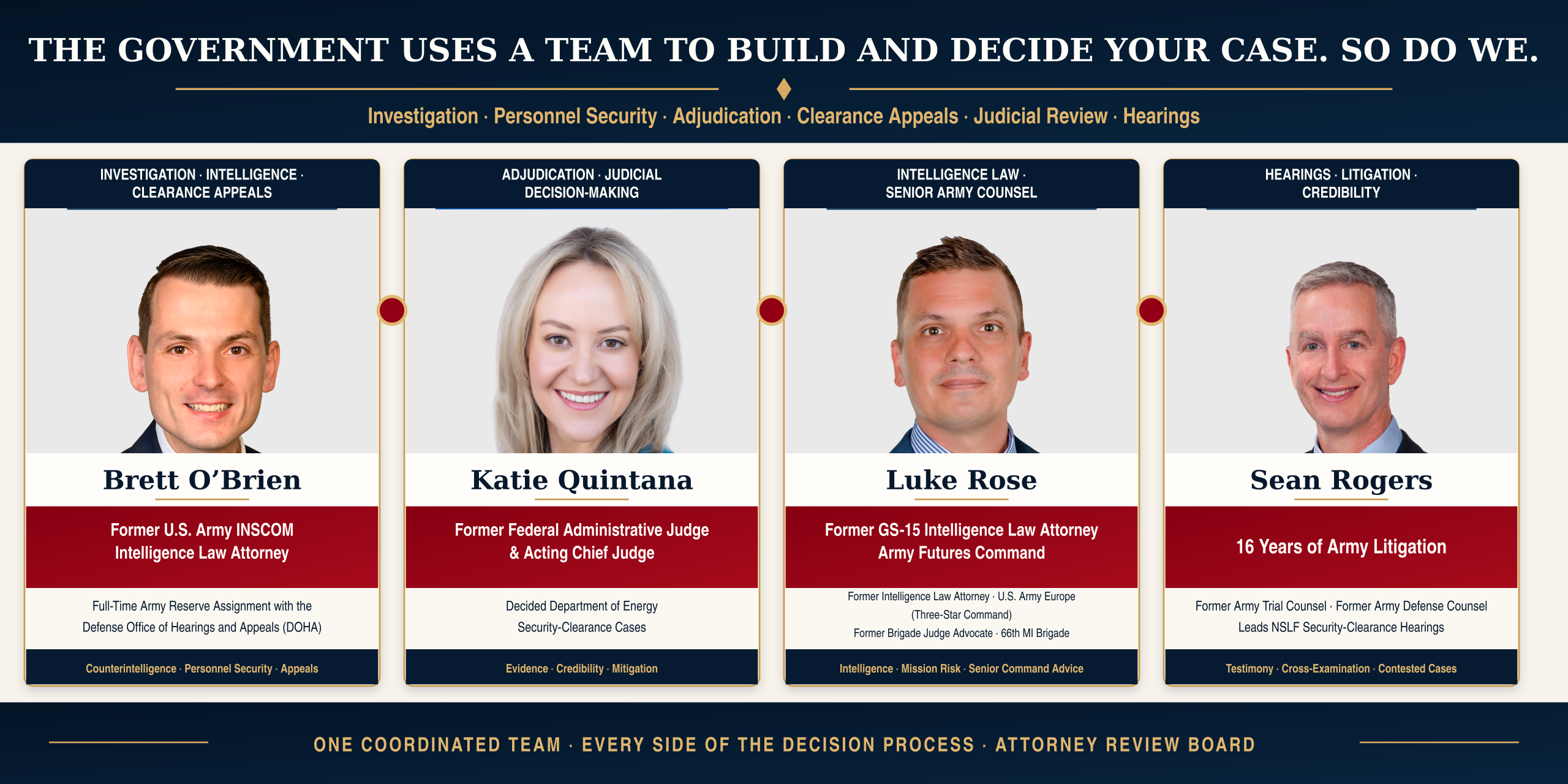
Investigation and Counterintelligence: Brett O’Brien
Brett O’Brien served as an Intelligence Law Attorney for U.S. Army Intelligence and Security Command and as the primary legal adviser for active Army counterintelligence investigations.
He also served on a full-time Army Reserve assignment with the Defense Office of Hearings and Appeals (DOHA), the Department of Defense office that conducts significant security-clearance hearings and appellate review.
Why it matters: His experience helps the team evaluate how the concern may have developed, what investigators may be testing and where the emerging record may contain gaps or unsupported assumptions.
Adjudication and Judicial Decision-Making: Katie Quintana
Katie Quintana served as a federal Administrative Judge and Acting Chief Judge deciding Department of Energy security-clearance cases. NSLF also includes former government security-clearance adjudicators.
Why it matters: The response can be tested against the questions clearance decision-makers must answer: What remains unresolved? Is the explanation credible? Does the evidence establish mitigation? What supports a favorable decision?
Intelligence Law and Command Risk: Luke Rose
Luke Rose served as a GS-15 Intelligence Law Attorney for Army Futures Command, an Intelligence Law Attorney for U.S. Army Europe and Brigade Judge Advocate for the 66th Military Intelligence Brigade.
Why it matters: His experience helps the team understand how an intelligence organization or senior command may translate personal conduct into mission, access, vulnerability or institutional risk.
Hearings and Contested Proceedings: Sean Rogers
Sean Rogers brings 16 years of Army litigation experience as both trial counsel and defense counsel. He leads NSLF’s security-clearance hearing practice.
Why it matters: A litigation perspective helps identify vague explanations, unsupported claims and credibility vulnerabilities before they become fixed in the written record.
One Lead Attorney. One Coordinated Strategy.
Your matter is led by one attorney. When the issues warrant it, that attorney can draw on additional NSLF perspectives through the Attorney Review Board.
The purpose is coordinated judgment—not unnecessary layers or a representation that every attorney personally works on every matter.
Meet the NSLF Security Clearance Team
★★★★★ “Clear, Professional and Always Timely”
“From my first consultation with Luke, communication was clear, professional, and always timely. Even before I’d signed a retainer, he generously provided helpful tips on how to draft an SOR response.”
T., Security Clearance Client · Google Review
How the LOI Representation Process Works
Step 1: Send Us the Entire LOI
Provide every page, attachment, authorization, instruction and deadline. Tell us whether you previously submitted any response or requested additional time.
Step 2: Review the Deadline and Scope
If NSLF accepts the matter and you retain the firm, we confirm the covered scope and identify immediate procedural needs.
The deadline remains controlling unless the proper authority grants additional time.
Step 3: Reconstruct the Facts and Existing Record
We review prior disclosures and available records, build the relevant timeline and identify factual uncertainty, inconsistencies and missing information.
Step 4: Develop the Evidence and Records Strategy
The attorney determines what the government appears to be evaluating, what evidence may rebut or mitigate the concern and what government records should be requested.
Step 5: Draft and Test the Response
An attorney prepares the response and supporting package. You confirm the factual accuracy, and the matter proceeds through NSLF’s review process.
Step 6: Finalize the Submission
We complete the submission-ready package and provide filing guidance consistent with the notice and engagement agreement.
The earlier we receive the complete LOI, the more time is available to verify facts, obtain documents and develop meaningful evidence.
What Can Happen After the LOI Response?
The next step depends on the agency, evidence and governing procedure.
The government may:
- Determine that the concern has been sufficiently resolved;
- Request clarification or additional documents;
- Conduct another interview;
- Continue the investigation or adjudication;
- Issue a Statement of Reasons;
- Take action affecting access or eligibility; or
- Initiate a related employment, military, suitability or disciplinary process.
An LOI response cannot guarantee that the government will close the matter. Its purpose is to provide the strongest truthful, coherent and supported record reasonably available while avoiding preventable credibility and consistency problems.
If the matter later becomes an SOR, the government may compare the new response with every answer and exhibit submitted during the LOI stage.
A $3,000 Credit if the Matter Becomes an SOR
If NSLF represents you in the LOI matter and the government later issues a Statement of Reasons, a $3,000 credit will apply toward NSLF’s $5,000 SOR response fee.
The credit recognizes that careful LOI work may preserve useful factual analysis, evidence and strategic understanding if a later response becomes necessary.
Eligibility, timing, the relationship between the matters and the precise scope are governed by the applicable engagement agreements.
Read more:
Learn About NSLF’s SOR Representation
What Triggers an LOI to Become an SOR?
LOI Representation at a Glance
| Service | Scope |
|---|---|
| Legal service | Attorney-led Letter of Interrogatory response |
| Flat fee | $3,500 |
| Initial consultation | Free |
| Geographic coverage | Nationwide and overseas matters, when accepted |
| Core deliverable | Attorney-drafted, evidence-supported, submission-ready response. |
| Government Records Investigation. | Included at no additional attorney fee in qualifying matters |
| Review structure | Attorney Review Board review for covered matters |
| Potential later credit | $3,000 may apply toward NSLF’s $5,000 SOR response fee |
| Financing | May be available through Pay Later by Affirm |
What Is Not Included?
Unless expressly included in the engagement agreement, the $3,500 LOI service does not include:
- Representation in a later SOR matter;
- Preparation for or attendance at a personal appearance or hearing;
- An appeal or reconsideration request;
- Attendance at an investigative interview;
- Private investigation or third-party witness interviews;
- Expert evaluations, reports, testing, counseling or treatment;
- Government fees and other third-party expenses;
- Administrative appeals or litigation involving records requests;
- Privacy Act amendment proceedings;
- Representation in a related employment, suitability, military, criminal or civil matter;
- Work involving a new LOI or materially expanded request; or
- A guarantee that eligibility, access or employment will be granted or retained.
Read more: How Much Does an LOI Lawyer Cost?
Frequently Asked Questions
Does an LOI Mean My Clearance Will Be Denied?
No. An LOI means the government wants additional information about one or more concerns. The response may help resolve the issue, but the outcome depends on the facts, record, evidence and decision-maker.
Read more: Can an LOI Lead to Clearance Denial?
Is an LOI the Same as a Statement of Reasons?
No. An LOI generally requests information or clarification. An SOR formally identifies security concerns that may support denial or revocation and provides a procedure for responding.
How Long Do I Have to Respond?
Follow the deadline stated in your notice. Deadlines vary. Do not rely on a general deadline found online when your actual document contains specific instructions.
Can NSLF Request an Extension?
When appropriate, NSLF can evaluate whether an extension request should be made. The government is not required to grant it. The current deadline remains effective unless the proper authority confirms an extension.
Should I Answer Every Question?
Follow the lawful instructions in your notice and answer truthfully. Counsel can help determine what each question requires and how to provide a complete response without guessing or introducing irrelevant information.
Does the $3,500 Fee Include an SOR Response?
No. The LOI and SOR are separate stages and engagements. A $3,000 credit may apply to NSLF’s $5,000 SOR response service if NSLF handled the preceding LOI.
Does the Fee Include a Hearing or Appeal?
No. Those proceedings require a separate engagement unless the written agreement expressly includes them.
Can NSLF Guarantee That the LOI Will Not Become an SOR?
No. No attorney controls the government’s investigation or decision. NSLF’s role is to develop a truthful, supported response and protect the client against avoidable record problems.
Continue Your Research
The Security Clearance Resource Center organizes NSLF’s most important information about:
- Security-clearance investigations;
- SF-86 and eApp preparation;
- Letters of Interrogatory;
- Statements of Reasons;
- Adjudicative guidelines;
- Government-records requests;
- Personal appearances and hearings;
- Appeals; and
- Continuous vetting.
The Resource Center provides general information. If you already have an LOI and an active deadline, consultation with an attorney should take priority over extended research.
Visit the Security Clearance Resource Center
Speak With an LOI Security Clearance Lawyer Before You Respond
Your LOI is the document in front of you today. The record it creates may follow your clearance and career much longer.
For a $3,500 flat fee, NSLF provides an attorney-led process to analyze the questions, reconstruct the record, develop evidence, investigate relevant government records, draft the response and complete collaborative review before finalization.
$3,500 Flat Fee · Attorney-Drafted Response · Government Records Investigation · Attorney Review Board · Nationwide Representation
Have the complete LOI available when you schedule. Tell us the exact deadline and whether you have already submitted any response.
This page provides general information and is not legal advice. Security-clearance procedures vary by agency, population and governing authority. The actual notice and current instructions applicable to the individual case control. Past results and client reviews do not guarantee a similar outcome. The precise scope of representation is governed by the signed engagement agreement. Contacting NSLF does not create an attorney-client relationship.