
The security clearance process is the federal system used to determine whether an individual can safely be trusted with access to classified information.
Although many people assume the process is simply a background check followed by a decision, the reality is more complex. Security clearance cases involve multiple stages of investigation, evaluation, and ongoing monitoring that can unfold over months or even years.
For professionals working in national security, intelligence, defense contracting, aerospace, cybersecurity, and federal government roles, clearance eligibility often determines whether they can continue working in their field at all.
When questions arise about clearance eligibility, the consequences can be immediate. Investigations may begin unexpectedly. Access may be suspended while concerns are reviewed. In more serious cases, the government may issue formal allegations that must be addressed before eligibility can be restored.
National Security Law Firm represents clients nationwide in matters involving investigations, Letters of Interrogatory (LOIs), Statements of Reasons (SORs), hearings before DOHA judges, and clearance appeals. Our team includes former administrative judges, former adjudicators, and former Defense Office of Hearings and Appeals (DOHA) attorneys who understand how clearance cases are evaluated from inside the federal system.
This guide explains how the security clearance process actually works, where problems typically arise, and how the record created during early stages of the process can influence everything that follows.
For readers who want a broader overview of the system before diving into the lifecycle below, see our Ultimate Guide to U.S. Security Clearances (2025).
What Is the Security Clearance Process?
The security clearance process is the federal system used to determine whether an individual can be trusted with access to classified information without creating a national security risk.
Although many people think of it as a simple background check, the process actually involves multiple stages of review. These typically include sponsorship or qualifying employment, disclosure forms such as the SF-86, a background investigation, subject interviews with investigators, adjudication under the Adjudicative Guidelines, and ongoing monitoring through Continuous Evaluation (CE).
Each stage builds the official record that federal decision-makers rely on when determining whether granting access to classified information is clearly consistent with national security.
Understanding how these stages fit together is the first step in navigating the clearance system effectively.
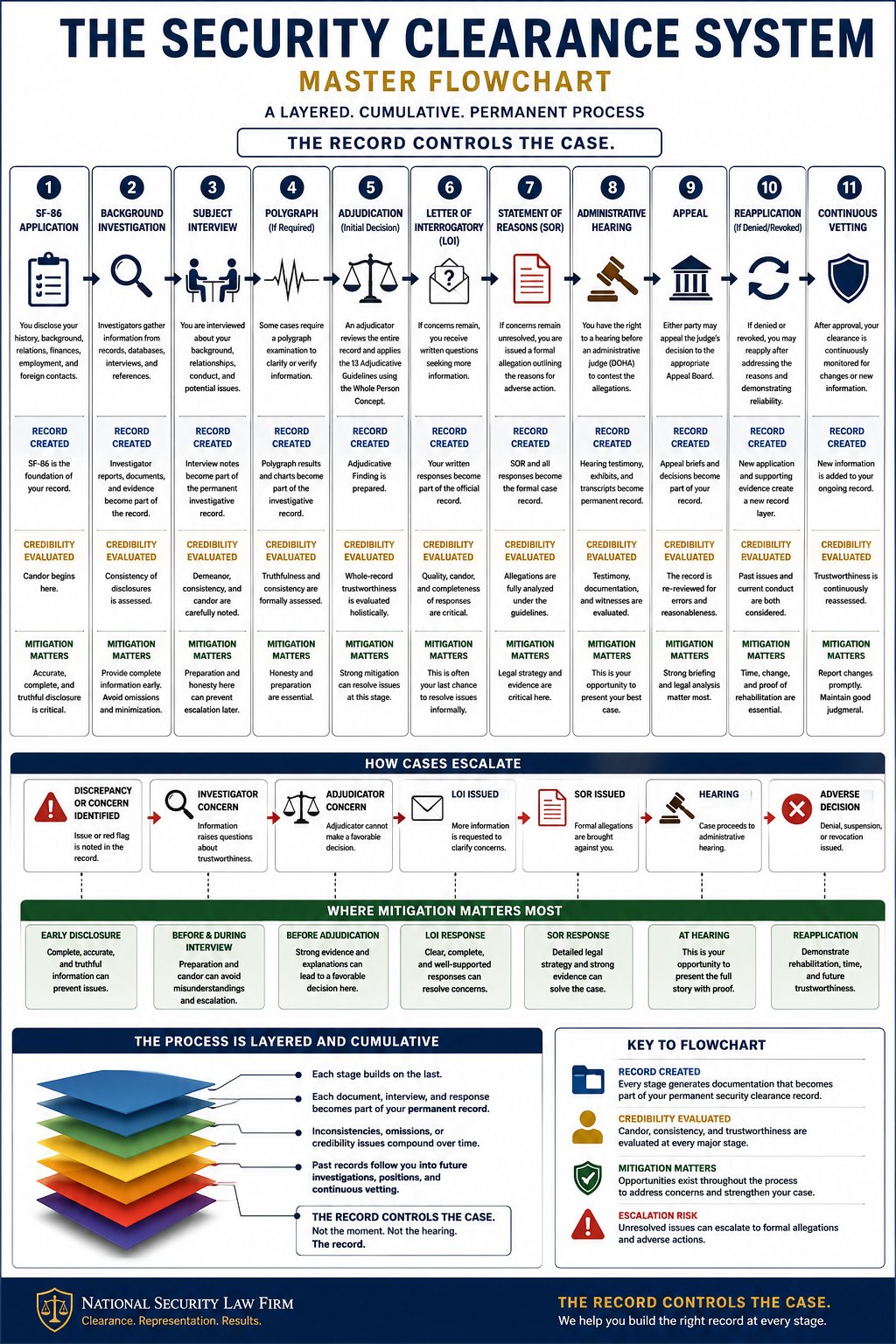
Most applicants think security clearance cases are decided by one event.
In reality, the system is layered, cumulative, and permanently record-driven.
How the Security Clearance Process Works
At a high level, the security clearance process generally includes the following stages:
-
Sponsorship or qualifying employment
-
Completion of disclosure forms such as the SF-86
-
Background investigation
-
Subject interview with investigators
-
Adjudicative review under the Adjudicative Guidelines
-
Interim clearance decisions (if applicable)
-
Final eligibility determination
However, the process does not always end there.
If concerns remain unresolved, the case may continue into additional stages such as:
-
Letters of Interrogatory (LOI)
-
Statements of Reasons (SOR)
-
administrative hearings before DOHA judges
-
security clearance appeals
Understanding where you are in this lifecycle is essential when determining what strategy may be appropriate.
If you are new to the clearance system, it may help to start with a few foundational guides that explain how the broader system works:
- Security Clearance FAQs: The Most Comprehensive Guide to U.S. Security Clearances
- What Is a Security Clearance? (And Why the Government Uses Them)
- The Ultimate Guide to U.S. Security Clearances (2025)
- Who Can Get a Security Clearance? (Eligibility Basics)
- What Are the Levels of Security Clearances?
- How to Get a Security Clearance Without Joining the Military
- Federal Background Checks vs. Security Clearances: What They Mean, What’s Different, and What Job Postings Are Really Saying
If You Are New to the Security Clearance System
For many people, the security clearance process feels unfamiliar and confusing at first. Applicants often encounter terms like interim clearance, adjudication, continuous evaluation, or Statement of Reasons without any clear explanation of how those pieces fit together.
It is completely normal to have questions at this stage. Many professionals entering the clearance system are encountering it for the first time, even if their careers now depend on understanding how it works.
If you are still orienting yourself to the system, these resources provide helpful starting points:
- How to Get a Security Clearance: The Complete Guide
- What Disqualifies You From a Security Clearance
- Security Clearance FAQs: 50 Questions First-Time Applicants Ask
- Debunking Security Clearance Myths: Separating Fact from Fiction
These guides address the most common misunderstandings about clearances, explain how the system actually works, and help clarify what matters—and what does not—when the government evaluates eligibility for access to classified information.
Starting with these resources can help you better understand the overall structure of the clearance system before diving into the detailed steps of the security clearance process outlined below.
The Complete Security Clearance Process (Start to Finish)
Getting a U.S. security clearance is not a single decision — it is a multi-stage federal investigative and adjudicative process designed to determine whether granting someone access to classified information is “clearly consistent with the national interest.”
Below is the complete lifecycle of a security clearance, from the moment someone seeks a cleared job to maintaining the clearance over time.
Stage One: You Must First Need a Clearance
A person cannot apply for a security clearance on their own.
Clearances are only initiated when a government agency or cleared contractor sponsors you because your job requires access to classified information.
Typical sponsors include:
-
U.S. Department of Defense
-
Intelligence agencies
-
Department of Energy
-
Department of State
-
Cleared defense contractors
Common cleared jobs:
-
intelligence analyst
-
engineer working on defense programs
-
military service member
-
contractor supporting classified systems
-
federal law enforcement
Key point:
The job drives the clearance — not the other way around.
Read more: Do You Need a Job Offer or Sponsor to Get a Security Clearance?
The process usually begins when:
-
you receive a conditional job offer, or
-
your current role is upgraded to require a clearance.
The employer then initiates the clearance process through the government clearance system.
For most DoD clearances, this is handled through DCSA (Defense Counterintelligence and Security Agency).
Stage Two: Disclosure Forms and the SF-86 (The Security Clearance Application)
Once the process begins, the government collects background information through disclosure forms.
The most important of these is the SF-86, the Security Clearance Application.
The SF-86 asks about the past 7–10 years of your life, including:
Personal history
-
residences
-
education
-
employment
Foreign connections
-
foreign contacts
-
foreign travel
-
dual citizenship
-
foreign financial interests
Financial issues
-
debt
-
bankruptcies
-
tax problems
Criminal history
-
arrests
-
charges
-
investigations
Substance use
-
illegal drugs
-
misuse of prescription medication
-
alcohol issues
Mental health
-
treatment history
Security issues
-
prior clearance investigations
-
misuse of classified information
References
You must list people who can verify:
-
where you lived
-
where you worked
-
your character and reliability
This document becomes the permanent investigative record.
Mistakes or omissions here are one of the most common reasons clearances are denied.
Although the form may appear routine, it often becomes the foundation of the entire clearance record.
Mistakes or inconsistencies in early disclosures can create credibility concerns later in the process.
For detailed guidance on how to approach this form, see the SF-86 Strategy Library, including:
Stage Three: Fingerprints and Background Checks
After submitting the SF-86, you will:
-
submit fingerprints
-
undergo automated database checks
These checks include:
-
FBI criminal records
-
financial records
-
immigration records
-
counterintelligence databases
-
prior clearance records
This step happens before investigators begin interviews.
Stage Four: Background Investigation
A federal investigator conducts a background investigation.
This phase can last:
-
6–12 weeks for Secret
-
3–12 months for Top Secret
Investigators verify the information in your SF-86.
They may interview:
-
you (subject interview)
-
employers
-
coworkers
-
neighbors
-
friends
-
listed references
-
former spouses
Investigators also review:
-
police records
-
court records
-
credit history
-
travel records
-
foreign contacts
The goal is to determine whether there are security risks.
The security clearance investigation process is how the government gathers facts about an applicant’s background.
They may also interview people who know the applicant, including supervisors, coworkers, neighbors, and personal references.
For a deeper explanation of how investigations work, see Security Clearance Investigations Explained: How the Background Investigation Actually Works
Stage Five: Subject Interviews
Many applicants participate in a subject interview during the investigation.
A subject interview allows investigators to clarify information in the record and explore issues such as:
• financial concerns
• foreign contacts
• criminal history
• drug or alcohol use
• discrepancies in disclosure forms
Although these interviews may feel informal, statements made during them can become part of the investigative record.
This is often where new issues are discovered or clarified.
The interview may last:
-
1–3 hours
-
sometimes longer
For a deeper look at how investigators approach these interviews, see Security Clearance Subject Interviews: What Investigators Ask and How Your Answers Are Evaluated.
Stage Six: Additional Investigation (If Needed)
If investigators identify concerns, they may conduct:
-
additional interviews
-
financial verification
-
law enforcement checks
-
foreign contact verification
Certain cases may require:
-
polygraph examinations (intelligence agencies)
-
psychological evaluations
-
expanded investigations
Stage Seven: Investigation Report Is Completed
When the investigation is finished, investigators compile a report known as the:
Report of Investigation (ROI).
This report contains:
-
interview summaries
-
documents
-
financial records
-
criminal records
-
investigator findings
The investigator does not decide whether you receive clearance.
They simply gather facts.
Stage Eight: Adjudication
Once the investigation is complete, the case moves to adjudication.
The investigation file is sent to security clearance adjudicators.
Adjudicators apply the National Security Adjudicative Guidelines.
There are 13 risk categories, including:
-
Allegiance to the United States
-
Foreign Influence
-
Foreign Preference
-
Financial Considerations
-
Drug Involvement
-
Alcohol Consumption
-
Criminal Conduct
-
Personal Conduct
-
Psychological Conditions
-
Security Violations
-
Outside Activities
-
Misuse of Information Technology
-
Sexual Behavior
Adjudicators use the “whole person concept.”
They consider:
-
severity of the issue
-
recency
-
frequency
-
evidence of rehabilitation
-
reliability and judgment
Their task is to determine whether granting clearance eligibility would create an unacceptable national security risk.
For a detailed explanation of this stage, see Security Clearance Adjudication Explained: How the Government Decides Your Case.
Stage Nine: Interim Security Clearance Decisions
In some cases, an applicant may receive interim clearance eligibility before the full investigation and adjudication process is complete.
An interim clearance allows temporary access to classified information while the investigation continues. Employers often rely on interim clearances so new employees can begin working on classified projects without waiting for the entire process to finish.
However, interim decisions are often misunderstood.
Interim access is not automatic. Many applicants do not receive it, even when they ultimately receive full clearance eligibility later.
If you want a deeper explanation of how interim decisions are made, see:
These articles explain why an interim denial does not necessarily mean the final clearance decision will also be negative.
Stage Ten: Initial Decision
At this point one of three things happens.
Clearance Granted
You are approved for access to classified information.
Additional Information Requested
You may receive:
This asks you to explain concerns before a decision is made.
If concerns remain, the government may issue a:
This formally lists the allegations against your clearance eligibility.
Stage 11: Responding to a Statement of Reasons (If Issued)
If an Statement of Reasons is issued, you typically have 20 days to respond.
Your options:
-
submit a written response
-
request a hearing before an administrative judge
You can:
-
rebut allegations
-
present mitigating evidence
-
submit character letters
-
provide financial records
-
show rehabilitation
Stage 12: Security Clearance Hearing (If Requested)
Some cases go to a security clearance hearing.
This is similar to a trial.
It may occur before:
-
DOHA administrative judges (DoD cases)
-
agency hearing boards
-
Department of Energy hearing panels
At the hearing:
-
the government presents evidence
-
you present witnesses and documents
-
attorneys argue the case
Stage 13: Judge Issues a Decision
After the hearing, the judge issues a written decision.
Possible outcomes:
-
clearance granted
-
clearance denied
-
clearance revoked
These decisions analyze the evidence under the 13 adjudicative guidelines.
Stage 14: Appeals Process
If clearance is denied, you may appeal.
For example:
DOHA cases
-
appeal to the DOHA Appeal Board
Other agencies have internal appeal processes.
Appeals typically argue:
-
legal errors
-
misapplication of guidelines
-
failure to consider evidence
Stage 15: Clearance Granted and Activated
Once granted, your clearance becomes active when you are placed in a position requiring access.
Levels include:
-
Confidential
-
Secret
-
Top Secret
Some roles require additional programs:
-
SCI (Sensitive Compartmented Information)
-
SAP (Special Access Programs)
Stage 16: Continuous Vetting
Clearance holders are monitored through Continuous Vetting (CE).
This means your records are periodically checked for:
-
arrests
-
financial issues
-
foreign travel
-
suspicious activity
Problems can trigger reinvestigations or suspension.
Stage 17: Periodic Reinvestigations
Clearances must be periodically reviewed.
Typical timelines:
| Clearance Level | Review Cycle |
|---|---|
| Secret | ~10 years |
| Top Secret | ~5 years |
However, continuous vetting is replacing periodic reinvestigations.
Stage 18: Suspension, Revocation, or Reinvestigation
If new information arises, the government may:
-
suspend clearance
-
open a new investigation
-
revoke clearance
Common triggers:
-
financial distress
-
criminal conduct
-
foreign influence
-
drug use
-
dishonesty
Stage 19: Loss of Jurisdiction (LOJ)
If you leave a cleared job while issues are pending, your case may enter:
This means the government stops processing the case until you return to a cleared position.
Stage 20: Reapplication or Reinstatement
If a clearance is denied or revoked, you may:
-
appeal
-
request reconsideration
-
reapply after a waiting period
-
seek a new investigation with another sponsor
Simplified Timeline
Typical clearance timeline
-
Job requires clearance
-
SF-86 submitted
-
Background investigation
-
Subject interview
-
Investigation report completed
-
Adjudication review
-
Clearance granted or SOR issued
-
Hearing (if requested)
-
Final decision
-
Continuous vetting while employed
Total time:
-
Secret: 2–6 months
-
Top Secret: 6–18 months
The Most Important Thing to Understand
The clearance process is not about whether someone is perfect.
It is about whether granting them access to classified information is:
“clearly consistent with the national interest.”
Adjudicators focus on:
-
honesty
-
reliability
-
judgment
-
vulnerability to coercion
Even serious issues can sometimes be mitigated if they are properly explained and documented.
Read more about the The 12 Decision Points in the Security Clearance Process: From Sponsorship to Final Decision and The 9 Failure Points in the Security Clearance Process: Where Clearance Cases Begin to Collapse
How Long the Security Clearance Process Takes
One of the most common questions applicants ask is:
“How long does the security clearance process take?”
The answer varies significantly depending on several factors, including:
• the level of clearance requested
• the complexity of the investigation
• foreign contacts
• financial or criminal issues
• agency backlog and investigative workload
Some investigations may be completed in several months. Others may take significantly longer if investigators must verify complex information or if the case raises additional questions.
For realistic expectations about timing, see:
Understanding the typical timeline can help applicants determine whether their case is progressing normally or experiencing unusual delay.
Why Security Clearance Cases Get Delayed
Delays in the security clearance process are extremely common.
Sometimes the reason is simple—investigative backlog or administrative workload. In other situations, delays may signal that adjudicators or investigators are examining a particular issue more closely.
Common causes of delay include:
• unresolved financial issues
• foreign contacts requiring verification
• missing or inconsistent disclosures
• investigative workload within the agency
• additional internal review during adjudication
If your clearance appears to be stalled, the following resources explain what may be happening:
Understanding why delays occur can help applicants determine whether patience or proactive action is the better strategy.
Continuous Evaluation: The Process Does Not End After Approval
Historically, security clearance holders were reinvestigated periodically.
Today, many agencies rely on Continuous Evaluation (CE), which monitors clearance eligibility on an ongoing basis.
Continuous Evaluation means that information related to finances, criminal activity, or other risk indicators may surface even after a clearance has already been granted.
This has changed how many professionals experience the clearance lifecycle.
Instead of a process that ends once eligibility is granted, clearance holders may face ongoing monitoring throughout their career.
For a deeper explanation of how Continuous Evaluation works, see:
Understanding CE is essential because it explains why clearance issues can surface years after someone first receives eligibility.
Movement Within the Clearance System
Many people assume that once they obtain a security clearance, it functions as a permanent credential that transfers easily between jobs.
In practice, the system is more complex.
Clearances may transfer between employers in some situations, but several factors affect how portability works, including:
• whether the new employer has an active contract requiring clearance
• how long the clearance has been inactive
• whether the clearance level is changing
• whether concerns exist in the prior investigative record
If you are changing jobs or roles, the following resources explain how movement within the system works:
- Security Clearance Portability: What Transfers — and What Quietly Follows You
- Switching Clearance Levels: From Secret to TS/SCI (What Changes and What Doesn’t)
- What Happens If You Voluntarily Give Up Your Clearance — and Whether You Can Get It Back
Understanding these dynamics can help professionals make informed decisions when considering career changes.
Employment Consequences While a Clearance Is Under Review
Another common concern during the security clearance process is how an investigation or adjudicative review may affect employment.
In some situations, individuals may continue working while the process unfolds. In others, employers may suspend access to classified systems or reassign duties until a final decision is reached.
In more serious cases, employment consequences may occur even before the clearance decision is finalized.
For a deeper explanation of this issue, see:
This topic highlights why clearance issues often intersect with federal employment law and contractor eligibility decisions.
When the Security Clearance Process Stops Being Routine
For many applicants, the clearance process remains routine and ends with a grant of eligibility.
For others, concerns arise during investigation or adjudication.
When concerns remain unresolved, the case may escalate into additional stages, including:
• Letters of Interrogatory (LOI) requesting clarification
• Statements of Reasons (SOR) formally challenging eligibility
• administrative hearings before DOHA judges
• security clearance appeals
These stages represent the transition from routine processing into formal clearance defense.
Understanding this transition is critical for anyone whose clearance eligibility is under review.
The next section of this guide explains where clearance cases most often go wrong and why certain issues trigger deeper scrutiny.
Where Security Clearance Cases Actually Go Wrong
Many applicants assume that security clearance cases become complicated only when a major problem appears—such as criminal charges, serious financial issues, or foreign intelligence concerns.
In reality, many clearance cases become difficult for much smaller reasons.
Clearance problems often emerge when:
• disclosure forms contain inconsistencies
• financial issues remain unresolved for long periods
• investigators receive conflicting explanations
• applicants unintentionally minimize or reframe past conduct
• mitigation evidence is weak or poorly documented
The clearance process is heavily record-driven. Once information enters the investigative file, it can be reviewed repeatedly throughout the process.
Statements made during the investigation may later appear in:
• Letters of Interrogatory
• Statements of Reasons
• administrative hearing records
• appeal reviews
Because of this, early decisions about how to disclose and explain issues can shape the trajectory of a case long before adjudication occurs.
Many applicants believe that a case turns negative only when the government formally challenges their clearance. In reality, the groundwork for those decisions is often laid months earlier during investigation and record development.
Understanding this dynamic helps explain why some cases escalate while others resolve quietly.
For a deeper explanation, read:
How the Government Evaluates Risk in Security Clearance Cases
Security clearance decisions are not made the same way courts decide legal disputes.
The federal government evaluates clearance eligibility through risk analysis, not simply by determining whether past conduct occurred.
Adjudicators review the investigative record to determine whether granting access to classified information would create an unacceptable national security risk.
This evaluation relies primarily on two frameworks:
• the Adjudicative Guidelines
• the whole-person concept
The guidelines identify categories of conduct that may raise security concerns, such as financial problems, foreign influence, criminal conduct, drug involvement, or honesty issues.
The whole-person concept requires decision-makers to evaluate the broader context of the case, including:
• seriousness of the conduct
• how recently it occurred
• evidence of rehabilitation
• credibility of the applicant
• likelihood the issue will recur
In other words, adjudicators are not simply asking whether something happened.
They are asking whether the record supports trusting the individual with classified information going forward.
This distinction explains why two cases involving similar facts may reach different outcomes. One record may demonstrate clear mitigation, while another may leave unresolved questions.
Why National Security Law Firm Is Different
Most explanations of the security clearance process describe the system from the outside.
National Security Law Firm understands it from the inside.
Our attorneys include professionals who have served within the federal clearance system itself, including:
• former administrative judges
• former security clearance adjudicators
• former Defense Office of Hearings and Appeals (DOHA) attorneys
• federal prosecutors
• military Judge Advocates
These are the professionals who evaluate investigative records, weigh mitigation evidence, and determine whether clearance eligibility can be approved.
That experience matters.
Security clearance cases are rarely decided through dramatic courtroom arguments. They are decided through careful evaluation of credibility, mitigation, and whether the record supports a defensible approval decision.
Lawyers who have worked inside the system understand how those decisions are actually made.
National Security Law Firm was built specifically for this environment. We are not a generalist law firm that occasionally handles clearance matters. Our practice focuses extensively on national security law, federal systems, and security clearance defense.
Our attorneys analyze cases the same way adjudicators and administrative judges do:
• evaluating the investigative record
• identifying credibility concerns
• developing mitigation evidence
• presenting a record that aligns with how the federal system evaluates risk
This institutional perspective allows us to approach security clearance cases strategically rather than reactively.
Security Clearance Resource Center
If you are navigating the clearance lifecycle, the following resources may help you understand the broader system:
• Security Clearance Main Hub
• SF-86 Strategy
• Letter of Interrogatory (LOI)
• Statement of Reasons (SOR)
• Security Clearance Hearings
• Security Clearance Appeals
• Adjudicative Guidelines
• Choosing a Security Clearance Lawyer
• Security Clearance Lawyer Cost
Frequently Asked Questions About the Security Clearance Process
How long does the security clearance process take?
The length of the security clearance process varies depending on the level of clearance requested, the complexity of the investigation, and the agency involved. Some cases may move relatively quickly when the background investigation is straightforward. Others may take significantly longer if investigators must verify complex information, review foreign contacts, or resolve questions raised during adjudication. Delays may also occur when additional clarification is required through Letters of Interrogatory or other investigative steps.
What happens during a security clearance investigation?
During a security clearance investigation, federal investigators gather information about an applicant’s background and conduct. Investigators typically review employment history, financial records, criminal history, foreign contacts, and other information relevant to national security risk. They may also interview supervisors, coworkers, neighbors, and personal references. The goal of the investigation is to build a factual record that adjudicators will later evaluate under the Adjudicative Guidelines.
What is a subject interview in the security clearance process?
A subject interview is a direct interview between the applicant and a government investigator. The investigator may ask questions about financial issues, foreign contacts, criminal history, or discrepancies in disclosure forms. Although the interview may appear informal, the information discussed becomes part of the investigative record and may later be reviewed during adjudication or hearings.
What happens after the investigation is complete?
After the background investigation is completed, the case moves to adjudication. At this stage, adjudicators review the investigative record using the National Security Adjudicative Guidelines and the whole-person concept. Their task is to determine whether granting access to classified information would create a potential national security risk.
Can you lose a security clearance during the process?
Yes. In some cases, issues discovered during investigation or adjudication may lead to additional review or adverse actions. The government may issue a Letter of Interrogatory requesting clarification or, in more serious cases, a Statement of Reasons formally explaining why clearance eligibility cannot be granted. Depending on the circumstances, the case may proceed to hearings or appeals.
What is an interim security clearance?
An interim security clearance allows temporary access to classified information while the full investigation and adjudication process is still ongoing. Interim access is not guaranteed and may be denied if investigators believe the available information does not yet support granting temporary eligibility.
Why do security clearance cases get delayed?
Security clearance delays can occur for several reasons, including investigative backlog, complex background issues, foreign contacts requiring verification, or inconsistencies in disclosure forms. Sometimes delays occur because adjudicators are reviewing a case more carefully before making a final determination.
Can a security clearance investigation affect employment?
In some situations, employment consequences may occur while the security clearance process is still ongoing. Employers may restrict access to classified systems, reassign duties, or place employees on administrative leave while clearance eligibility is under review.
What happens if concerns are discovered during adjudication?
If adjudicators believe concerns remain unresolved after reviewing the investigative record, the government may issue a Statement of Reasons (SOR) explaining why clearance eligibility cannot currently be granted. The applicant then has an opportunity to respond and present mitigation evidence addressing the concerns.
When should someone speak with a security clearance lawyer?
Many people consult a security clearance lawyer after receiving a Statement of Reasons or suspension notice. However, legal guidance may also be helpful earlier in the process when concerns arise during investigation, subject interviews, or responses to Letters of Interrogatory.
Speak With a Security Clearance Lawyer
The security clearance process ultimately determines whether the government trusts an individual with access to classified information.
If your case feels delayed, unclear, escalating, or no longer routine, this is the point to act strategically.
National Security Law Firm represents clients nationwide in matters involving investigations, interim clearance issues, Letters of Interrogatory, Statements of Reasons, hearings before DOHA judges, and security clearance appeals.
Our consultations are free, and our attorneys include former judges, adjudicators, and DOHA lawyers who understand how clearance decisions are actually made.
When the process matters, the record matters.
The Record Controls the Case.