Hiring the wrong customs seizure lawyer can create serious long-term problems in a CBP case.

Many people understandably assume all forfeiture or seizure lawyers handle these matters similarly.

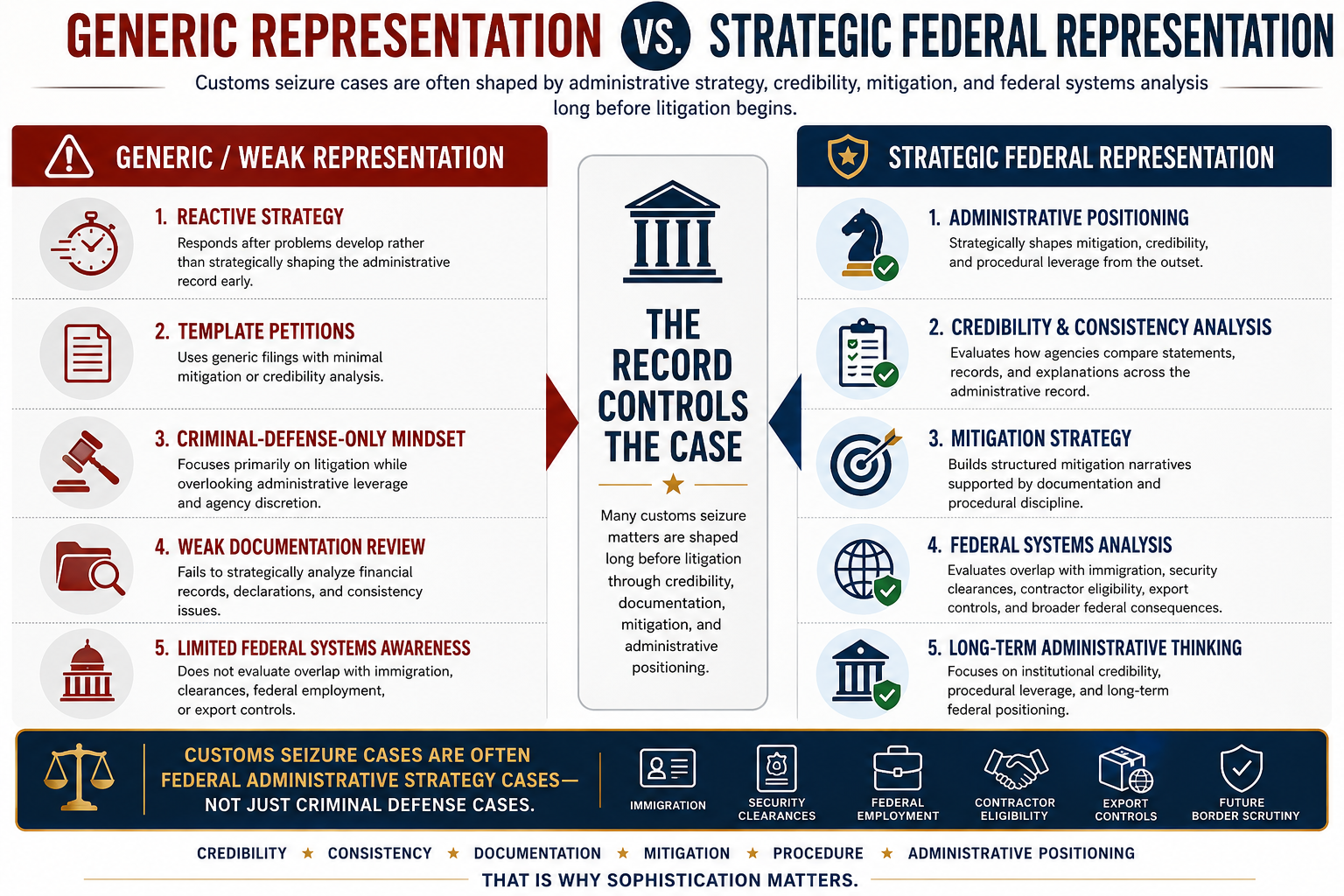
In reality, customs seizure cases often involve highly specialized federal administrative systems that operate very differently from:

  • ordinary criminal cases
  • local litigation
  • general civil disputes

That distinction matters enormously.

Many customs seizure matters are heavily shaped by:

  • credibility
  • consistency
  • documentation quality
  • mitigation strategy
  • procedural positioning
  • administrative record-building

That is one reason why weak or generic representation may substantially damage:

  • leverage
  • mitigation opportunities
  • procedural flexibility
  • broader federal positioning

long before courtroom litigation ever begins.

That is also why National Security Law Firm repeatedly emphasizes:
the record controls the case.

Additional discussion appears in Customs Seizure Lawyer Cost: Flat Fees, Contingency Fees, and What To Expect and the firm’s broader Customs Seizure Lawyer Hub.

Red Flag #1: Lawyers Who Treat the Case Like Simple Paperwork

One of the biggest warning signs is a lawyer who treats a customs seizure case as little more than:

  • filling out forms
  • submitting template petitions
  • sending generic letters
  • reacting procedurally after deadlines appear

Many customs seizure matters are not simple paperwork disputes.

In practice, they are often:

  • administrative strategy cases
  • credibility cases
  • mitigation cases
  • documentation cases

Federal agencies frequently evaluate:

  • consistency of explanations
  • quality of supporting records
  • procedural behavior
  • mitigation credibility
  • overall administrative reliability

That is one reason why generic petitions frequently create long-term strategic problems.

Weak submissions may unintentionally create:

  • contradictions
  • credibility concerns
  • procedural complications
  • broader scrutiny
  • reduced leverage

Once those issues become embedded in the administrative record, they may become substantially harder to reverse later.

Strong customs seizure representation often involves much more than simply preparing forms.

It frequently requires:

  • strategic mitigation analysis
  • credibility evaluation
  • documentation review
  • procedural positioning
  • long-term federal risk assessment

Additional discussion appears in The Record Controls the Case: Why Your First Submission Matters and How CBP Actually Decides Seizure Cases.

Red Flag #2: Lawyers Who Treat Customs Seizure Cases Like Ordinary Criminal Defense Cases

Many criminal defense lawyers are excellent litigators.

However, customs seizure matters often operate very differently from traditional criminal court proceedings.

That distinction is one of the most misunderstood aspects of customs forfeiture representation.

Many criminal defense lawyers are trained to focus primarily on:

  • suppression motions
  • trial strategy
  • criminal charges
  • courtroom litigation
  • constitutional arguments

Customs seizure matters often involve something very different.

In many situations, CBP seizure cases are heavily shaped by:

  • mitigation
  • procedural positioning
  • documentation consistency
  • administrative credibility
  • agency discretion
  • record-building

long before courtroom litigation ever begins.

That is one reason why many customs seizure matters are effectively won or lost during the administrative phase rather than at trial.

A lawyer who approaches the case only through a traditional criminal-defense lens may fail to properly analyze:

  • mitigation opportunities
  • procedural leverage
  • administrative positioning
  • documentation strategy
  • broader federal consequences

That can become especially important because customs seizure matters frequently intersect with:

  • immigration
  • export controls
  • federal employment
  • security clearances
  • contractor eligibility
  • future border scrutiny
  • broader federal investigations

Those systems often operate institutionally and administratively rather than through ordinary courtroom litigation alone.

That is one reason why administrative sophistication frequently matters more than aggressive litigation rhetoric.

Additional discussion appears in Administrative Petition vs Federal Court Litigation and Why Hiring a Customs Seizure Lawyer Early Matters.
Red Flag #3: Weak Federal Administrative Experience

Another major warning sign is representation that lacks meaningful understanding of:

  • federal administrative systems
  • overlapping federal consequences
  • long-term institutional implications

Many customs seizure matters involve far more than recovering seized money or property.

Depending on the allegations involved, these cases may later affect:

  • immigration proceedings
  • security clearances
  • Global Entry eligibility
  • federal employment
  • contractor eligibility
  • export licensing
  • future border scrutiny

Federal agencies often evaluate these systems collectively rather than in isolation.

That broader overlap is one reason why customs seizure strategy frequently requires understanding:

  • administrative credibility
  • institutional decision-making
  • procedural leverage
  • federal systems interaction
  • long-term federal risk

A lawyer who views the case narrowly as:
“just a forfeiture dispute”
may completely miss broader strategic risks and opportunities.

Additional discussion appears in Federal Agencies Share Information: Why Your CBP Case Can Affect Other Areas of Your Life.

Red Flag #4: Lawyers Who Do Not Understand How Federal Agencies Actually Evaluate Cases

One of the biggest signs of weak customs seizure representation is a lawyer who focuses almost entirely on:

  • emotional arguments
  • generalized fairness complaints
  • aggressive rhetoric
    while ignoring:
  • credibility
  • consistency
  • documentation quality
  • mitigation
  • administrative reliability

Federal agencies frequently evaluate:

  • whether records align
  • whether explanations remain consistent
  • whether mitigation appears genuine
  • whether the administrative record appears reliable

That broader institutional review often shapes:

  • mitigation opportunities
  • settlement posture
  • procedural flexibility
  • overall leverage

Many weak representations fail because they never seriously evaluate:

  • administrative credibility
  • documentation consistency
  • procedural positioning
  • agency perception

Strong customs seizure strategy often begins with understanding:
how federal agencies actually think.

Additional discussion appears in How CBP Actually Decides Seizure Cases, How Credibility Affects Customs Seizure Cases, and Why Consistency Matters in Federal Seizure Cases.

Red Flag #5: Unrealistic Guarantees and Overconfident Promises

Another major warning sign is a lawyer who:

  • guarantees recovery
  • promises an “easy win”
  • minimizes the seriousness of the case immediately
  • claims CBP “has no case” before reviewing documentation carefully

Sophisticated customs seizure strategy rarely works that way.

Many customs forfeiture matters are highly:

  • fact-specific
  • documentation-driven
  • credibility-driven
  • procedure-driven

Federal agencies frequently evaluate:

  • consistency across the record
  • mitigation credibility
  • financial documentation
  • procedural behavior
  • overall administrative reliability

That means strong strategic analysis usually begins with:

  • careful review
  • documentation assessment
  • procedural analysis
  • mitigation evaluation
  • broader federal risk analysis

not exaggerated promises.

Serious federal practitioners often avoid oversimplification because they understand how heavily these matters may depend on:

  • credibility
  • timing
  • documentation quality
  • administrative positioning
  • broader federal overlap

That institutional complexity is one reason why sophisticated customs seizure representation often sounds much more nuanced than aggressive marketing language.

Additional discussion appears in Why Most People Lose CBP Seizure Cases Before They Even Begin and How Customs Seizure Cases Are Really Won.

Red Flag #6: Poor Communication and Reactive Strategy

Many customs seizure matters move quickly.

Deadlines, procedural elections, mitigation submissions, and administrative positioning may begin affecting the case almost immediately after the seizure occurs.

That is one reason why poor communication can become a serious strategic problem.

Warning signs often include:

  • delayed responses
  • weak intake analysis
  • little discussion of strategy
  • no review of documentation
  • no procedural planning
  • reactive rather than deliberate communication

Many weak representations operate almost entirely reactively:

  • responding after problems arise
  • addressing contradictions late
  • scrambling near deadlines
  • adjusting strategy only after leverage narrows

Strong customs seizure representation often looks very different.

In many situations, sophisticated strategy involves:

  • identifying credibility concerns early
  • evaluating documentation carefully
  • anticipating agency skepticism
  • preserving procedural leverage
  • strategically building the administrative record

That is one reason why timing frequently matters much more than people initially realize.

Additional discussion appears in Why Early Statements to CBP Can Destroy Your Case and Why Hiring a Customs Seizure Lawyer Early Matters.

Red Flag #7: Hidden Pricing or Unclear Fee Structures

Another important warning sign is unclear or inconsistent pricing.

Businesses and individuals should understand:

  • whether the case is contingency-based or flat-fee
  • what work is included
  • whether litigation would involve additional fees
  • what factors may increase complexity
  • whether broader federal issues may affect scope

Many customs seizure matters involve strategic administrative work long before litigation ever becomes necessary.

A lawyer who cannot clearly explain:

  • pricing structure
  • procedural scope
  • litigation exposure
  • administrative strategy
    may also reflect broader organizational or strategic weaknesses.

Transparent pricing often reflects:

  • procedural sophistication
  • organized case management
  • strategic clarity
  • realistic expectations

That is one reason why many individuals and businesses view pricing transparency as an important trust indicator.

Additional discussion appears in Do Customs Seizure Lawyers Work on Contingency? and How Much Does It Cost To Fight a CBP Seizure?.

Red Flag #8: Lawyers Who Never Talk About Documentation, Credibility, or Mitigation

One of the clearest warning signs in customs seizure representation is a lawyer who focuses almost exclusively on:

  • litigation
  • legal threats
  • generalized arguments about fairness
    while barely discussing:
  • credibility
  • documentation
  • mitigation
  • procedural positioning
  • administrative reliability

Many customs seizure matters are heavily shaped by:

  • consistency of explanations
  • quality of supporting records
  • mitigation credibility
  • procedural behavior
  • administrative positioning

That is one reason why:

  • documentation analysis
  • mitigation strategy
  • credibility management
    often matter substantially more than people initially realize.

Strong customs seizure representation usually involves:

  • careful record analysis
  • strategic mitigation development
  • organized documentation
  • disciplined communication
  • long-term administrative positioning

rather than simply reacting aggressively after problems already enter the record.

That is also why many customs seizure matters are ultimately shaped less by courtroom litigation and more by administrative sophistication developed early in the process.

Additional discussion appears in What CBP Looks for in a Petition for Remission and How CBP Actually Decides Seizure Cases.

What Strong Customs Seizure Representation Usually Looks Like

Strong customs seizure representation often looks very different from:

  • reactive filings
  • emotional litigation strategy
  • generic petition drafting
  • one-size-fits-all forfeiture work

In many situations, sophisticated representation begins with carefully evaluating:

  • the administrative record
  • documentation quality
  • credibility concerns
  • mitigation opportunities
  • procedural leverage
  • broader federal implications

That analysis frequently shapes:

  • mitigation positioning
  • settlement posture
  • procedural flexibility
  • long-term administrative risk

before litigation ever becomes necessary.

Strong Cases Usually Begin with Administrative Discipline

Many successful customs seizure matters share several characteristics early in the process:

  • organized documentation
  • disciplined communication
  • strategic procedural timing
  • credible mitigation
  • consistency across explanations
  • careful administrative positioning

Strong cases are often built deliberately.

Weak cases are frequently reactive.

In many situations, sophisticated representation focuses heavily on:

  • avoiding contradictions
  • preserving credibility
  • strengthening mitigation
  • organizing supporting records
  • strategically controlling the administrative narrative

That is one reason why many customs seizure matters are ultimately shaped less by dramatic courtroom litigation and more by administrative sophistication developed early in the process.

Sophisticated Representation Often Focuses on Leverage

Many people assume the strongest lawyer is simply:

  • the most aggressive
  • the loudest
  • the quickest to threaten litigation

In practice, however, sophisticated federal strategy often focuses much more heavily on:

  • leverage
  • timing
  • credibility
  • procedural positioning
  • administrative flexibility

Federal agencies frequently evaluate:

  • mitigation credibility
  • procedural behavior
  • documentation quality
  • consistency of explanations
  • overall administrative reliability

That means the strongest representation often involves:

  • strategic communication
  • disciplined submissions
  • organized records
  • careful mitigation analysis
  • thoughtful procedural planning

rather than emotional escalation.

Strategic Federal Analysis Matters

Customs seizure matters often involve much more than recovering seized money or property.

Depending on the allegations involved, these cases may later affect:

  • immigration proceedings
  • Global Entry eligibility
  • security clearances
  • federal employment
  • contractor eligibility
  • export licensing
  • future border scrutiny
  • broader federal investigations

Strong customs seizure representation frequently requires understanding how those federal systems overlap.

That broader institutional perspective is one reason why customs seizure matters often require significantly more strategic analysis than ordinary forfeiture litigation alone.

Additional discussion appears in How To Choose the Best Customs Seizure Lawyer, Questions To Ask Before Hiring a Customs Seizure Lawyer, and Customs Seizure Lawyers Near Me: Why Nationwide Federal Experience Matters More.

Why National Security Law Firm Is Different

Many law firms approach customs seizure matters primarily as procedural forfeiture disputes.

National Security Law Firm approaches these matters differently.

The firm represents clients nationwide in:

  • customs seizure matters
  • administrative forfeiture proceedings
  • export-control issues
  • federal administrative proceedings
  • contractor-related matters
  • overlapping federal investigations

National Security Law Firm focuses heavily on:

  • strategic administrative positioning
  • mitigation analysis
  • credibility management
  • documentation review
  • procedural leverage
  • long-term federal implications

rather than simply reacting procedurally after the seizure occurs.

That broader federal-systems perspective becomes especially important because customs seizure matters often intersect with:

  • immigration
  • export licensing
  • federal employment
  • contractor eligibility
  • security clearances
  • future border scrutiny
  • broader investigations

The firm’s broader experience with:

  • security clearances
  • export controls
  • federal employment
  • national security systems
  • contractor-related matters
    helps inform how customs seizure cases are strategically evaluated from the outset.

That is why National Security Law Firm repeatedly emphasizes:
the record controls the case.

For broader discussion of customs forfeiture strategy generally, visit the firm’s Customs Seizure Lawyer Hub and Customs Seizure Lawyer Cost: Flat Fees, Contingency Fees, and What To Expect pages.

Frequently Asked Questions

What are the biggest red flags when hiring a customs seizure lawyer?

Some of the biggest warning signs include:

  • generic template petitions
  • unrealistic guarantees
  • weak federal administrative experience
  • poor communication
  • reactive strategy
  • hidden pricing
  • lawyers who treat customs seizure cases like ordinary criminal defense matters

Does criminal defense experience automatically qualify someone to handle customs seizure cases?

Not necessarily.

Many criminal defense lawyers are excellent litigators.

However, customs seizure matters often involve:

  • administrative forfeiture systems
  • mitigation
  • procedural positioning
  • documentation analysis
  • credibility management
  • broader federal overlap

Those issues frequently operate very differently from traditional courtroom criminal litigation.

Why does federal administrative experience matter so much?

Many customs seizure matters may later affect:

  • immigration
  • Global Entry
  • security clearances
  • federal employment
  • contractor eligibility
  • export licensing
  • broader federal investigations

Federal agencies often evaluate these systems collectively rather than in isolation.

That broader overlap frequently requires strategic federal-systems analysis rather than narrow local litigation experience alone.

Should customs seizure lawyers guarantee results?

Serious federal practitioners are usually cautious about making guarantees.

Customs seizure matters are often highly:

  • fact-specific
  • documentation-driven
  • credibility-driven
  • procedure-driven

Sophisticated strategy usually begins with:

  • careful factual review
  • documentation analysis
  • mitigation evaluation
  • procedural assessment

rather than exaggerated promises.

Why are some customs seizure lawyers much cheaper?

Not all representation involves the same level of:

  • administrative sophistication
  • mitigation analysis
  • documentation review
  • credibility evaluation
  • federal systems understanding

Low-cost representation may sometimes rely heavily on:

  • template filings
  • reactive strategy
  • minimal administrative analysis
  • limited procedural planning

Does communication really matter in customs seizure cases?

Absolutely.

Many customs seizure matters move quickly and involve strict:

  • procedural deadlines
  • mitigation timing
  • administrative positioning
  • documentation strategy

Delayed or reactive communication may significantly affect:

  • leverage
  • credibility
  • procedural flexibility
  • mitigation opportunities

Should pricing be transparent?

Strong firms usually explain:

  • fee structures
  • scope of representation
  • contingency arrangements
  • potential litigation costs
  • factors affecting complexity

Transparent pricing often reflects:

  • organizational sophistication
  • procedural clarity
  • realistic expectations

What does strong customs seizure representation usually look like?

Strong representation often involves:

  • strategic administrative positioning
  • mitigation analysis
  • credibility management
  • documentation review
  • procedural planning
  • federal systems awareness

Many strong customs seizure matters are built deliberately rather than reactively.

Why does strategy matter so much early in the process?

Many customs seizure matters are heavily influenced by:

  • first submissions
  • procedural timing
  • documentation quality
  • mitigation positioning
  • consistency of explanations

That is one reason why weak early positioning may later become difficult to reverse.

Additional discussion appears in Why Hiring a Customs Seizure Lawyer Early Matters and The Record Controls the Case: Why Your First Submission Matters.

Speak With a Nationwide Customs Seizure Lawyer

If CBP seized your money, merchandise, shipment, vehicle, package, or other property, the quality of the legal strategy may significantly affect:

  • mitigation opportunities
  • procedural leverage
  • credibility assessments
  • broader federal consequences

Many customs seizure matters are heavily influenced by:

  • documentation quality
  • mitigation strategy
  • procedural timing
  • administrative positioning
  • consistency of explanations

That is why National Security Law Firm repeatedly emphasizes:
the record controls the case.

National Security Law Firm offers nationwide representation and free consultations for customs seizure matters.

The fastest and easiest way to get started is through the firm’s online booking system.

In many situations, same-day consultations are available, and the process typically takes less than a minute to schedule online.

Once booked, an attorney will personally call you at the scheduled time to discuss:

  • the seizure
  • procedural deadlines
  • mitigation strategy
  • documentation issues
  • broader federal implications

To schedule a consultation online, visit:

Book a Free Consultation Online

You may also contact the firm directly at:
Phone: (202) 600-4996

Additional related resources: