Curious if you’re eligible for Global Entry?
Don’t guess—find out instantly!
Wondering if you can fight your Global Entry denial or revocation? Take our quick assessment to see!

How a Piece of Fruit Can Cost You Your Global Entry Membership
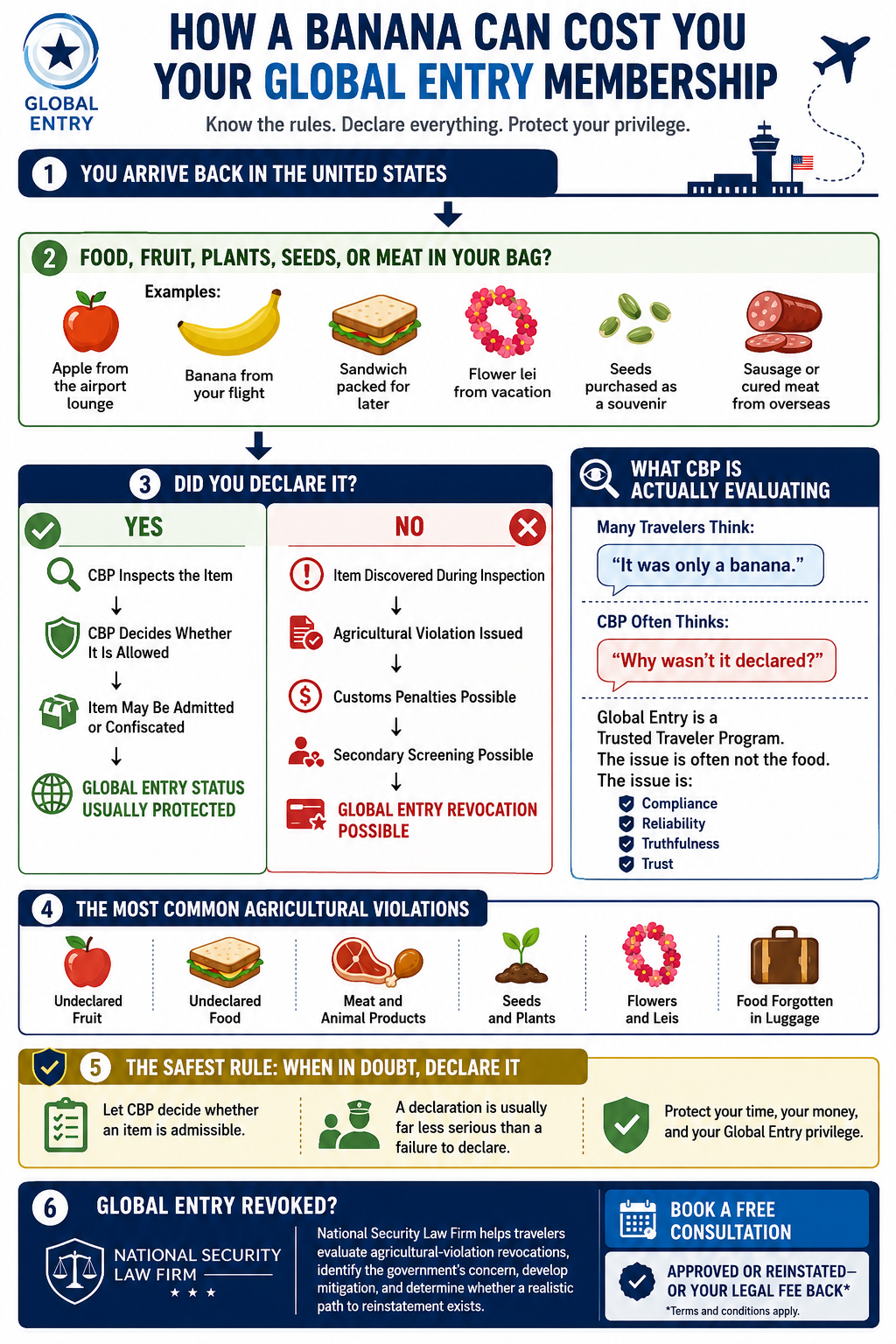
One of the most surprising things about the program is that travelers sometimes lose their membership over something as simple as an apple, banana, sandwich, flower, or package of seeds.
Agricultural violations are one of the most common reasons travelers receive . The reason is simple: is a under . When a traveler fails to comply with , often asks: can this traveler be trusted to follow customs requirements in the future?
|
Why CBP Takes Agricultural Violations So Seriously
The concern is protecting U.S. agriculture from invasive insects, plant diseases, livestock diseases, and agricultural pests. A single contaminated fruit, plant, seed, or animal product can potentially introduce pests or diseases affecting crops and livestock across the United States. That is why CBP often treats agricultural violations much more seriously than travelers expect.
The Most Common Agricultural Violations We See
Undeclared Fruit — apples, oranges, bananas, mangoes, grapes. Many travelers receive fruit during international flights and forget it is there. What appears to be a harmless oversight can quickly become a .
Undeclared Food — sandwiches, homemade food, snacks, cheese, meat products, packaged food. Lack of knowledge does not always prevent a violation. .
Meat and Animal Products — sausages, cured meats, beef, pork, and poultry products. Many countries have restrictions due to concerns about animal diseases. “It’s already cooked” or “it’s commercially packaged” does not necessarily make it admissible.
Seeds, Plants, and Flowers — seeds, cut flowers, fresh bouquets, plant cuttings, potted plants. Many travelers purchase these as gifts without realizing they may require declaration, inspection, or permits.
Agricultural Products Hidden in Luggage — fruit left in a backpack, snacks packed for children, food from an international flight. Intent is often not the issue — the failure to declare is.
The Most Common Mistake Travelers Make
Many travelers focus on the item. CBP often focuses on the declaration. A traveler may think it was only one apple — CBP may focus on why wasn’t it declared? Many are not based on the value of the item. They are based on the failure to comply with . .
Why Agricultural Violations Can Affect Global Entry
is fundamentally a . CBP is often evaluating compliance, reliability, truthfulness, and trustworthiness. The agricultural item itself is often secondary — the government’s concern is whether the traveler complied with .
What Makes Agricultural Cases Stronger?
Stronger cases often involve: ✔ Isolated incident, ✔ No prior , ✔ Honest mistake, ✔ Immediate cooperation, ✔ Full disclosure once discovered, ✔ Strong , ✔ Significant passage of time.
More difficult cases often involve: ✖ Multiple , ✖ Failure to disclose, ✖ Prior warnings, ✖ Credibility concerns, ✖ Pattern of non-compliance.
| .
Why National Security Law Firm?
The critical question is usually not was it only an apple? The critical question is: why should CBP still consider this traveler trustworthy today? Our approach focuses on identifying the government’s concern, developing , gathering , and building the strongest possible case for reinstatement. .
Related Resources:
Frequently Asked Questions
Can I Really Lose Global Entry Over Fruit? Yes. Agricultural violations are among the most common reasons travelers encounter .
What If I Forgot the Fruit Was in My Bag? Forgetting about an item does not necessarily eliminate the violation.
What Food Must Be Declared? Generally speaking, travelers should and allow CBP to determine admissibility. When in doubt: Declare It.
What About Food Given to Me on the Airplane? Food provided during a flight may still need to be declared.
Are Packaged Foods Safe to Bring Into the United States? Not always. Packaging alone does not determine whether an item is admissible.
Can I Appeal a Global Entry Revocation Based on an Agricultural Violation? Often yes. The strength of the appeal depends on the facts, records, mitigation, and overall circumstances. .
What Is the Safest Approach? The safest rule: Declare Everything. If you are unsure whether an item must be declared, declare it and allow CBP to make the determination.
The Bottom Line
Most agricultural violations are committed by ordinary travelers who misunderstood the rules. The safest approach: declare food, declare plants, declare seeds, declare agricultural products. Because once an agricultural issue occurs, the discussion often becomes much larger than the item itself — it becomes about .
|
Related Resources: