
One of the first questions many people ask after CBP seizes money, merchandise, a shipment, or other property is simple:
“How much does a customs seizure lawyer cost?”
The answer depends heavily on:
- the type of seizure involved
- whether the matter is administrative or headed toward litigation
- the amount and type of property at issue
- the complexity of the allegations
- whether broader federal consequences exist
Many people initially assume all customs seizure cases are handled the same way.
In reality, different categories of customs forfeiture matters often require very different pricing structures and strategic approaches.
Why Customs Seizure Lawyer Pricing Varies So Much
Currency seizure matters are often very different from:
- commercial import cases
- export-control matters
- vehicle seizures
- luxury goods seizures
- FDA-related imports
- business enforcement actions
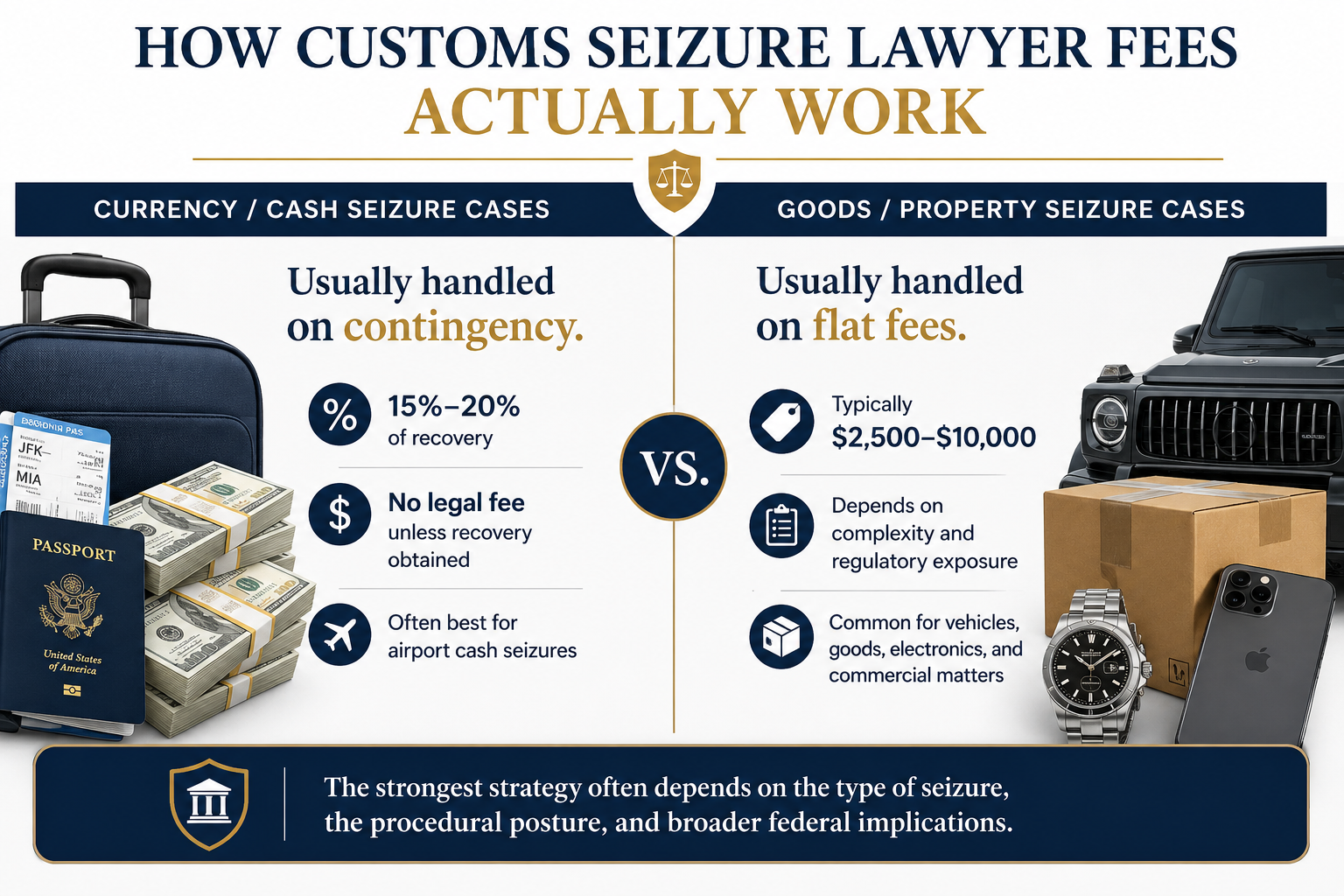
For example, many airport cash seizure matters are well-suited for contingency-fee structures because the recovery amount is relatively clear and directly tied to the seized funds.
Property and goods seizure matters, by contrast, often involve:
- extensive documentation review
- administrative petitions
- import/export analysis
- valuation disputes
- regulatory issues
- broader compliance concerns
Those matters are usually handled using flat-fee structures instead.
That distinction is one reason why customs seizure pricing can vary significantly from case to case.
Customs Seizure Cases Often Become Strategic Administrative Proceedings
Many people assume customs seizure representation primarily involves:
- filing forms
- submitting petitions
- contacting CBP
In practice, however, many customs forfeiture matters are heavily influenced by:
- procedural positioning
- mitigation strategy
- documentation quality
- credibility
- consistency of explanations
- administrative record-building
That is one reason why the quality of the early strategy often matters far more than people initially realize.
Weak administrative positioning may later create:
- credibility concerns
- procedural complications
- reduced leverage
- additional scrutiny
- broader federal consequences
That is why National Security Law Firm repeatedly emphasizes:
the record controls the case.
The Cheapest Option Is Not Always the Lowest Cost
One of the most common mistakes people make is evaluating customs seizure representation based only on the lowest quoted fee.
In many situations, weak or generic representation may create much larger long-term problems involving:
- missed deadlines
- inconsistent submissions
- weak mitigation
- procedural mistakes
- poor documentation strategy
- broader federal scrutiny
That is especially important because customs seizure matters frequently intersect with:
- immigration issues
- export controls
- federal employment
- contractor eligibility
- security clearances
- future border scrutiny
- parallel investigations
Federal agencies often evaluate these matters collectively rather than in isolation.
Strategic Federal Administrative Representation
National Security Law Firm approaches customs seizure matters strategically from the outset.
Rather than treating the case as simply a dispute over seized property, the firm focuses on:
- procedural leverage
- administrative positioning
- mitigation opportunities
- documentation analysis
- credibility management
- long-term federal implications
The sections below explain:
- how contingency fees work in currency seizure matters
- why property seizure cases are usually handled using flat fees
- what affects pricing and complexity
- whether hiring a customs seizure lawyer is worth it
- how to choose the right customs seizure lawyer
- what red flags to watch for before hiring counsel
For broader discussion of customs forfeiture strategy generally, visit the firm’s How Customs Seizure Cases Are Really Won page.
Why Customs Seizure Lawyer Pricing Varies So Much
Many people are surprised by how differently customs seizure lawyers structure fees.
In reality, customs forfeiture matters vary dramatically in:
- complexity
- procedural posture
- federal exposure
- documentation demands
- litigation risk
That is one reason why there is no true “one-size-fits-all” pricing model in customs seizure practice.
Currency Cases vs. Goods Cases
One of the biggest distinctions involves the difference between:
- currency seizure matters
and - goods or property seizure matters.
Many airport cash seizure cases are handled on contingency because:
- the recovery amount is usually identifiable
- the dispute centers directly on seized funds
- the value at issue is easier to measure
In many situations, contingency fees in currency matters typically range from approximately:
- 15% to 20% of the recovered amount
Importantly:
there is no legal fee unless a recovery is obtained.
Property and goods seizure matters often operate differently.
Cases involving:
- vehicles
- Rolex watches
- luxury goods
- electronics
- commercial shipments
- imported merchandise
- export-related property
usually require extensive administrative work and are typically handled using flat-fee structures instead.
Administrative Strategy vs. Litigation
Pricing is also heavily affected by whether the matter:
- remains administrative
- escalates into federal litigation
- involves overlapping regulatory concerns
- creates broader federal exposure
Many customs seizure matters are resolved through:
- mitigation negotiations
- administrative petitions
- procedural positioning
- compliance analysis
- negotiated resolutions
Those matters often involve extensive:
- documentation review
- mitigation development
- procedural analysis
- credibility strategy
- administrative record-building
Federal litigation may substantially increase:
- complexity
- timelines
- evidentiary disputes
- procedural exposure
- overall strategic demands
That is one reason why litigation matters are often more resource-intensive than standard administrative forfeiture proceedings.
Why Complexity Matters
Some customs seizure matters involve relatively straightforward procedural disputes.
Others may involve:
- export-control concerns
- OFAC sanctions issues
- FDA-related imports
- defense contractor exposure
- customs fraud allegations
- commercial compliance systems
- overlapping federal investigations
In those situations, the strategic demands of the case may increase substantially.
Federal agencies may evaluate:
- compliance systems
- prior import/export activity
- internal controls
- procedural cooperation
- mitigation efforts
- broader institutional credibility
That broader federal overlap often requires significantly more sophisticated administrative analysis than people initially expect.
Strong Strategy Often Saves Money Long-Term
Many people initially focus only on the upfront legal fee.
In practice, however, weak administrative strategy may later create much larger costs involving:
- penalties
- forfeiture exposure
- procedural mistakes
- broader investigations
- regulatory scrutiny
- long-term compliance consequences
That is one reason why many successful customs seizure matters are shaped less by aggressive courtroom tactics and more by:
- disciplined communication
- strong documentation
- strategic timing
- mitigation positioning
- careful administrative positioning
That is also why National Security Law Firm repeatedly emphasizes:
the record controls the case.
Additional discussion appears in How Much Does It Cost To Fight a CBP Seizure? and Do Customs Seizure Lawyers Work on Contingency?.
Contingency Fees in Currency Seizure Cases
Many airport cash seizure and currency forfeiture matters are particularly well-suited for contingency-fee representation.
That is because the dispute typically centers on a specific amount of seized currency, making the recovery amount relatively identifiable from the outset.
In many situations, contingency fees in customs currency seizure matters generally range from approximately:
- 15% to 20% of the recovered amount
Importantly:
there is no legal fee unless a recovery is obtained.
Why Contingency Fees Often Work Well in Cash Seizure Cases
Currency seizure matters frequently involve:
- airport cash seizures
- border currency seizures
- reporting allegations
- structuring concerns
- bulk cash smuggling accusations
- suspicious financial activity investigations
In many of these cases, the central issue is whether the claimant can recover all or part of the seized funds through:
- administrative petitions
- mitigation negotiations
- procedural leverage
- litigation strategy
Because the recovery amount is directly tied to the seized currency itself, contingency-fee arrangements often align naturally with the structure of the dispute.
That allows many individuals to pursue recovery without paying substantial upfront legal fees while the forfeiture matter remains pending.
What Usually Affects the Percentage
Not every currency seizure matter presents the same level of complexity or risk.
Factors that may affect the contingency structure often include:
- the amount seized
- whether criminal exposure exists
- the strength of the documentation
- structuring allegations
- bulk cash smuggling concerns
- broader federal investigations
- whether litigation may become necessary
- the procedural posture of the case
Some matters involve relatively straightforward administrative disputes.
Others may require significantly more extensive:
- documentation analysis
- mitigation development
- procedural strategy
- litigation preparation
- credibility management
That is one reason why experienced strategic evaluation early in the process often becomes critically important.
Why Administrative Strategy Still Matters in Contingency Cases
Many people mistakenly assume contingency-fee cases are simpler because payment depends on recovery.
In reality, many successful currency seizure matters require sophisticated administrative strategy involving:
- procedural positioning
- documentation quality
- mitigation evidence
- credibility
- consistency of explanations
- careful administrative record-building
Federal agencies often evaluate not simply whether the money was lawfully earned, but whether the overall record appears:
- plausible
- reliable
- internally consistent
- administratively credible
That is one reason why many strong currency seizure outcomes are shaped less by dramatic courtroom litigation and more by disciplined administrative strategy developed early in the process.
Strong Currency Seizure Representation Often Begins Early
Many airport cash seizure matters are heavily influenced by:
- inspection statements
- customs declarations
- financial records
- procedural elections
- mitigation submissions
- early communications with the government
That is why National Security Law Firm repeatedly emphasizes:
the record controls the case.
Additional discussion appears in CBP Money Seizure Lawyers Hub.
Flat Fees for Goods and Property Seizures
Customs seizure matters involving goods and property are usually structured differently from airport currency seizure cases.
Unlike cash forfeiture matters, many property seizures involve:
- extensive documentation review
- ownership disputes
- import/export analysis
- regulatory compliance issues
- valuation questions
- procedural strategy
- broader federal implications
That is one reason why goods and property seizure matters are typically handled using flat-fee structures rather than contingency arrangements.
In many situations, flat fees for customs property seizure matters generally range from approximately:
- $2,500 to $10,000
The exact fee depends heavily on the complexity of the matter and the level of strategic and administrative work involved.
Why Property Cases Often Require More Administrative Analysis
Goods and property seizure matters frequently involve far more than simply recovering the item itself.
Depending on the circumstances, the government may evaluate:
- ownership records
- invoices
- customs declarations
- import documentation
- export-control concerns
- authenticity issues
- FDA restrictions
- commercial compliance systems
- broader regulatory exposure
Cases involving:
- vehicles
- Rolex watches
- luxury goods
- electronics
- imported merchandise
- commercial shipments
- prescription medication
- export-related property
often require careful administrative positioning and documentation strategy very early in the process.
That broader complexity is one reason why flat-fee structures are often more practical in these matters.
What Usually Increases Complexity
Some property seizure matters remain relatively straightforward administrative disputes.
Others become substantially more complex because they involve:
- commercial import operations
- export-control concerns
- OFAC or BIS-related issues
- customs fraud allegations
- defense contractor exposure
- overlapping federal investigations
- substantial documentary review
- multiple agencies
In those situations, federal agencies may evaluate not only the property itself, but also:
- compliance systems
- business practices
- import/export history
- internal controls
- procedural cooperation
- broader institutional credibility
That broader federal overlap frequently increases the amount of:
- strategic analysis
- mitigation development
- procedural work
- documentation review
required to properly position the case.
Why Strong Administrative Strategy Matters
Many people initially assume property seizure matters are primarily about:
- proving ownership
- submitting receipts
- filing forms
- responding to notices
In practice, however, many customs property seizure matters are heavily influenced by:
- credibility
- consistency
- mitigation positioning
- documentation quality
- procedural timing
- administrative strategy
Weak or poorly planned submissions may later create:
- credibility concerns
- procedural complications
- broader scrutiny
- reduced leverage
- long-term federal consequences
That is one reason why many successful property seizure outcomes are shaped less by courtroom litigation and more by disciplined administrative positioning developed early in the process.
That is also why National Security Law Firm repeatedly emphasizes:
the record controls the case.
Additional discussion appears in CBP Property Seizures Hub and Import and Export Seizure Lawyers Hub.
Is Hiring a Customs Seizure Lawyer Worth It?
Many people hesitate to hire a customs seizure lawyer because they initially view the matter as:
- a paperwork problem
- a temporary delay
- a simple misunderstanding with CBP
- a dispute they can resolve themselves
In some situations, that may be true.
However, many customs seizure matters become far more strategically significant than people initially realize.
That is especially true where the case involves:
- substantial seized funds
- commercial shipments
- export-control concerns
- customs fraud allegations
- broader federal scrutiny
- overlapping investigations
- long-term business or professional consequences
The Cost of Weak Administrative Strategy
One of the most common misconceptions in customs forfeiture matters is that the case can always be “fixed later” if the initial submissions are weak.
In reality, many customs seizure matters are heavily shaped by:
- inspection statements
- procedural elections
- mitigation submissions
- documentation quality
- consistency of explanations
- administrative record-building
Weak early positioning may later create:
- credibility concerns
- procedural complications
- reduced leverage
- broader scrutiny
- long-term federal consequences
That is one reason why many customs seizure cases are effectively won or lost long before courtroom litigation ever begins.
Why Early Mistakes Become Expensive
Many individuals and businesses unintentionally weaken their position by:
- overexplaining facts
- submitting incomplete documentation
- making unsupported claims
- missing deadlines
- choosing procedural options emotionally
- failing to understand broader federal implications
What initially appears to save money by “handling it yourself” may later create significantly larger costs involving:
- forfeiture exposure
- penalties
- expanded investigations
- litigation expenses
- import/export compliance issues
- broader regulatory scrutiny
In many situations, the issue is not simply:
“How much does the lawyer cost?”
It is also:
“What happens if the administrative record becomes difficult to fix later?”
The Record Often Shapes the Outcome
Federal agencies frequently evaluate:
- credibility
- consistency
- documentation quality
- mitigation efforts
- procedural cooperation
- overall administrative reliability
That institutional review often begins very early in the process.
The first:
- explanations
- petitions
- declarations
- supporting records
- mitigation submissions
may later influence: - settlement posture
- administrative negotiations
- litigation strategy
- broader federal scrutiny
That is why National Security Law Firm repeatedly emphasizes:
the record controls the case.
Customs Seizure Matters Often Involve More Than the Seized Property
Another reason experienced legal analysis often matters is that customs seizure matters may later affect:
- immigration proceedings
- export licensing
- contractor eligibility
- federal employment
- security clearances
- future border scrutiny
- broader investigations
Federal agencies often evaluate these matters collectively rather than in isolation.
That broader overlap is one reason why customs seizure representation frequently requires significantly more strategic analysis than simply filing forms or responding to notices.
Strong Representation Often Creates Long-Term Value
Many successful customs seizure outcomes are ultimately shaped through:
- disciplined communication
- strong documentation
- strategic mitigation
- procedural positioning
- administrative leverage
- careful record-building
That is one reason why experienced customs seizure representation often creates the most value early in the process before:
- procedural leverage narrows
- contradictions enter the record
- mitigation opportunities weaken
- broader federal scrutiny expands
Additional discussion appears in The Record Controls the Case: Why Your First Submission Matters.
Why Cheap Customs Seizure Lawyers Can Cost You More
Many people searching for a customs seizure lawyer understandably focus first on price.
After all, they may already be dealing with:
- seized money
- frozen assets
- delayed shipments
- business disruption
- financial uncertainty
- mounting stress
That often creates strong pressure to choose the lowest quoted fee.
In practice, however, customs seizure matters are rarely just paperwork exercises.
Many cases are heavily shaped by:
- procedural positioning
- mitigation strategy
- credibility
- documentation quality
- administrative record-building
- broader federal implications
That is one reason why weak or generic representation may ultimately become far more expensive than it initially appears.
Not All Customs Seizure Representation Is the Same
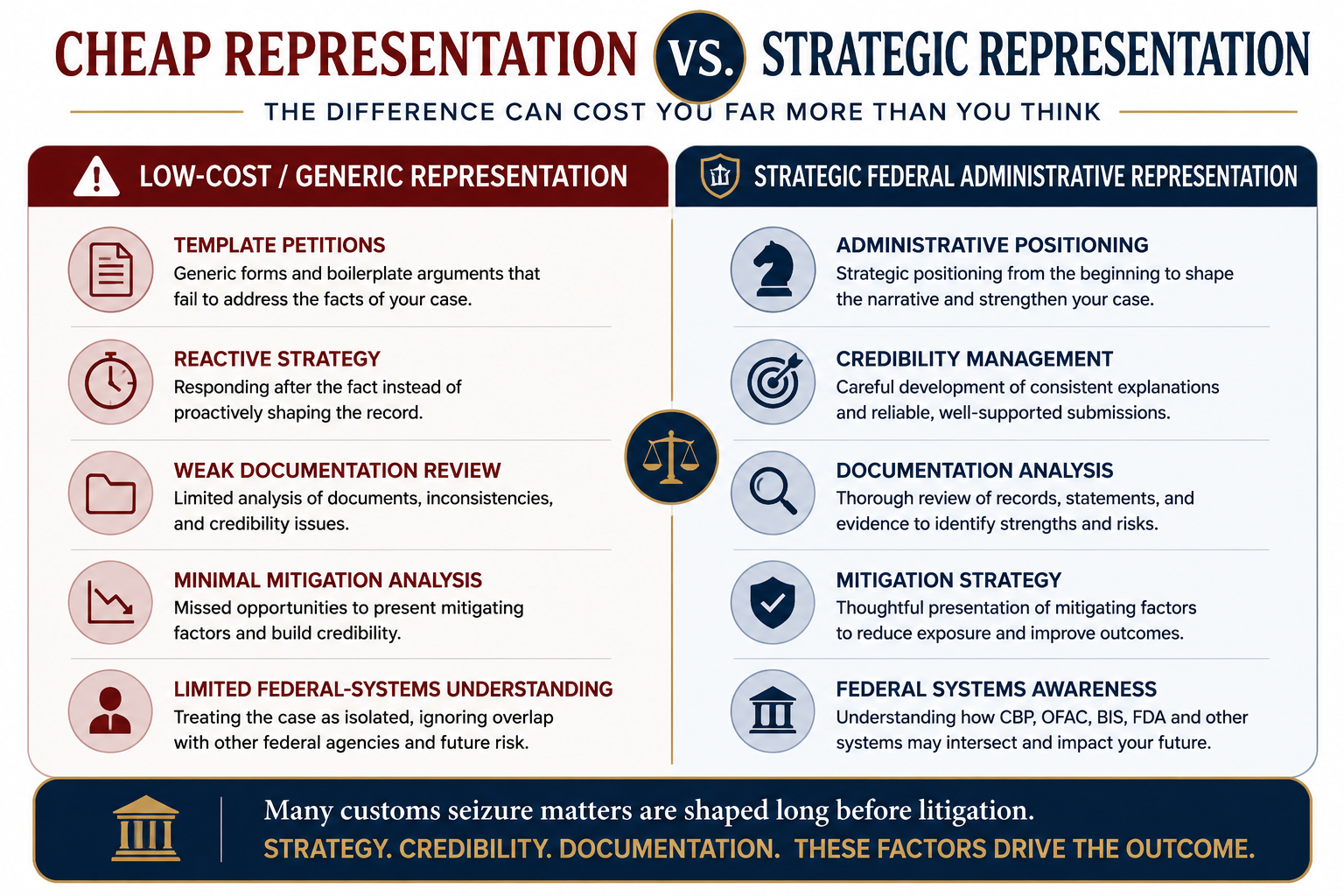
Some customs seizure lawyers primarily focus on:
- quickly filing petitions
- submitting template responses
- processing high volumes of cases
- reacting to CBP notices after the fact
In many situations, however, customs forfeiture matters require much more sophisticated analysis involving:
- federal administrative systems
- procedural leverage
- mitigation positioning
- compliance credibility
- overlapping federal consequences
- long-term institutional risk
That broader strategic analysis often becomes one of the most important differences between strong and weak representation.
The Risks of Generic Administrative Petitions
One of the biggest problems in low-cost customs seizure representation is the use of:
- generic templates
- rushed submissions
- weak documentation analysis
- inconsistent mitigation positioning
- minimal strategic review
Federal agencies often compare:
- inspection statements
- customs declarations
- financial records
- shipping documentation
- mitigation submissions
- later explanations
Weak submissions may unintentionally create:
- credibility concerns
- documentation conflicts
- procedural complications
- reduced leverage
- broader scrutiny
Once those issues become embedded in the administrative record, they may later become difficult to reverse.
That is one reason why many customs seizure cases are effectively weakened long before litigation ever begins.
Federal Systems Often Require Strategic Analysis
Many customs seizure matters involve far more than simply recovering the property itself.
Depending on the allegations involved, these cases may later affect:
- immigration matters
- export licensing
- contractor eligibility
- federal employment
- security clearances
- future border scrutiny
- broader investigations
Federal agencies often evaluate these systems collectively rather than in isolation.
That broader institutional overlap is one reason why customs seizure representation frequently requires more sophisticated federal-systems analysis than many people initially realize.
Cheap Representation May Become Expensive Later
Many people initially focus only on the upfront legal fee.
In practice, however, weak administrative positioning may later create:
- larger penalty exposure
- prolonged litigation
- expanded investigations
- import/export complications
- additional legal expenses
- long-term regulatory problems
What initially appeared “cheap” may ultimately become much more expensive if:
- the administrative record becomes damaged
- mitigation opportunities weaken
- procedural leverage narrows
- broader federal consequences emerge
Strong Customs Seizure Representation Often Begins Early
Many successful customs seizure outcomes are shaped through:
- disciplined communication
- strong documentation
- procedural timing
- mitigation strategy
- administrative leverage
- careful record-building
That is why National Security Law Firm repeatedly emphasizes:
the record controls the case.
Additional discussion appears in How CBP Actually Decides Seizure Cases.
How To Choose the Best Customs Seizure Lawyer
Many people searching for a customs seizure lawyer quickly encounter:
- “top lawyer” lists
- paid rankings
- aggressive advertising
- promises of fast results
- generic claims of experience
What most individuals and businesses actually need, however, is not simply a lawyer who handles forfeiture matters generally.
They need someone who understands how federal agencies often evaluate customs seizure cases institutionally.
That distinction matters much more than many people initially realize.
What Actually Matters in Customs Seizure Cases
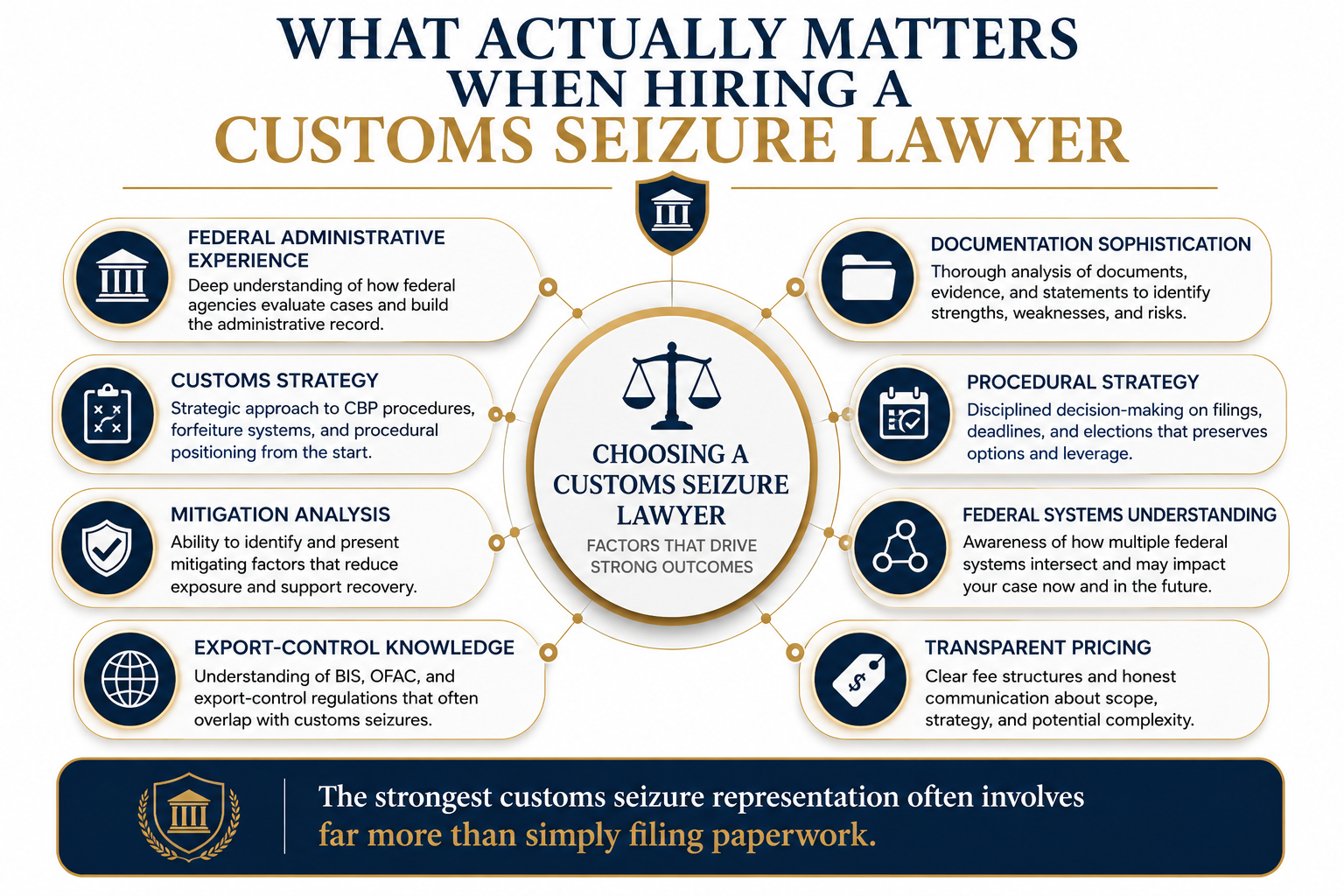
Many customs seizure matters are heavily influenced by:
- credibility
- consistency
- documentation quality
- mitigation strategy
- procedural positioning
- administrative record-building
That means the strongest customs seizure representation often involves much more than:
- filing forms
- submitting petitions
- threatening litigation
In many situations, the most important strategic work happens during:
- early administrative analysis
- procedural decision-making
- mitigation positioning
- documentation review
- credibility management
That is one reason why customs seizure matters frequently require a very different skill set than ordinary litigation or general criminal defense work.
Why Federal Administrative Experience Matters
Customs seizure cases often intersect with broader federal systems involving:
- CBP enforcement
- export controls
- FDA regulations
- contractor eligibility
- security clearances
- OFAC sanctions
- import compliance
- broader federal investigations
Federal agencies frequently evaluate these matters collectively rather than in isolation.
That is one reason why businesses and individuals often benefit from counsel who understands:
- federal administrative systems
- regulatory overlap
- institutional decision-making
- mitigation strategy
- long-term federal consequences
In many situations, the issue is not simply:
“How do we recover the property?”
It is also:
“How will this administrative record affect future federal systems later?”
Why Strategy Often Matters More Than Aggression
Many people assume the “best” customs seizure lawyer is the most aggressive one.
In reality, many successful customs seizure outcomes are shaped less by aggressive rhetoric and more by:
- disciplined communication
- procedural timing
- strong documentation
- mitigation strategy
- administrative leverage
- careful record-building
Federal agencies often respond more favorably to:
- credible submissions
- organized documentation
- consistent explanations
- thoughtful procedural strategy
than emotional or reactive approaches.
That is one reason why many customs seizure cases are effectively won through administrative sophistication rather than dramatic courtroom tactics.
What Questions Should You Ask Before Hiring a Customs Seizure Lawyer?
Businesses and individuals should often consider:
- Does the lawyer understand federal administrative systems?
- Do they regularly handle CBP forfeiture matters?
- Do they understand export-control and regulatory overlap?
- Do they explain strategy clearly?
- Are pricing structures transparent?
- Do they understand mitigation and procedural positioning?
- Can they evaluate broader federal implications?
Many customs seizure matters become significantly more complicated when:
- weak early submissions are filed
- procedural deadlines are missed
- credibility issues develop
- broader federal systems become involved unexpectedly
That is one reason why early strategic analysis often matters so much.
The “Best” Customs Seizure Lawyer Is Usually the One Who Understands the System Best
Many online rankings and “top lawyer” lists focus heavily on:
- advertising
- directories
- paid placements
- marketing visibility
In practice, however, customs seizure matters are often shaped by a lawyer’s ability to:
- understand how agencies actually evaluate cases
- strategically build the administrative record
- anticipate broader federal consequences
- manage credibility and mitigation issues
- navigate overlapping federal systems
That is why National Security Law Firm repeatedly emphasizes:
the record controls the case.
Additional discussion appears in Questions To Ask Before Hiring a Customs Seizure Lawyer.
Red Flags To Watch Out for When Hiring a Customs Seizure Lawyer
Many people searching for a customs seizure lawyer have never dealt with:
- CBP forfeiture proceedings
- federal administrative enforcement
- customs penalties
- export-control issues
- overlapping federal investigations
As a result, it is often difficult to tell the difference between:
- sophisticated federal administrative representation
and - generic forfeiture marketing.
That distinction matters much more than many people initially realize.
Unrealistic Guarantees and Overconfident Promises
One major warning sign is any lawyer who:
- guarantees results
- promises immediate recovery
- claims they “always win”
- minimizes the seriousness of the matter without reviewing the facts
Customs seizure matters are often highly fact-specific and heavily influenced by:
- documentation quality
- credibility
- procedural positioning
- mitigation strategy
- broader federal implications
No experienced federal practitioner can ethically guarantee outcomes without understanding:
- the evidence
- the administrative posture
- the government’s concerns
- the procedural history
Strong customs seizure strategy is usually built through careful analysis, not exaggerated promises.
Lawyers Who Treat the Case Like Simple Paperwork
Another major red flag is representation focused almost entirely on:
- filing forms quickly
- submitting generic petitions
- providing little strategic analysis
- minimizing the importance of administrative positioning
Many customs seizure matters are heavily shaped by:
- credibility
- consistency
- documentation quality
- procedural timing
- mitigation positioning
- administrative record-building
That is one reason why weak or generic submissions may later create:
- credibility concerns
- procedural complications
- reduced leverage
- broader scrutiny
Once those issues become embedded in the administrative record, they may become difficult to reverse later.
Lack of Federal Administrative Sophistication
Many customs seizure matters intersect with broader federal systems involving:
- export controls
- FDA enforcement
- OFAC sanctions
- contractor eligibility
- security clearances
- federal employment
- broader investigations
A lawyer who treats the case as a narrow local dispute may fail to recognize:
- overlapping federal exposure
- long-term institutional risks
- broader compliance implications
- strategic mitigation opportunities
That broader federal overlap is one reason why customs seizure matters often require much more sophisticated analysis than people initially expect.
Hidden Pricing or Vague Fee Structures
Another warning sign is unclear or inconsistent pricing.
Businesses and individuals should understand:
- whether the case is contingency-based or flat-fee
- what work is included
- whether litigation would require additional fees
- what factors may increase complexity
- whether broader federal issues may affect scope
Transparent pricing is often a sign of:
- procedural sophistication
- organized case management
- strategic clarity
- realistic expectations
Weak Communication and Reactive Strategy
Many customs seizure matters move quickly.
Missed deadlines, weak submissions, or delayed strategy may significantly affect:
- mitigation opportunities
- procedural leverage
- settlement posture
- overall recovery strategy
That is one reason why responsive communication and proactive administrative analysis often matter far more than people initially realize.
Strong customs seizure representation is usually:
- deliberate
- disciplined
- strategic
- documentation-focused
- administratively sophisticated
rather than reactive or purely emotional.
The Best Customs Seizure Lawyers Usually Understand Federal Systems
Many online “top lawyer” rankings focus primarily on:
- advertising visibility
- directory listings
- marketing placement
- general litigation experience
In practice, however, customs seizure matters are often shaped by a lawyer’s ability to:
- understand how federal agencies actually evaluate cases
- strategically build the administrative record
- manage credibility and mitigation issues
- anticipate broader federal consequences
- navigate overlapping federal systems
That is why National Security Law Firm repeatedly emphasizes:
the record controls the case.
Additional discussion appears in How To Choose the Best Customs Seizure Lawyer.
Why Nationwide Federal Experience Matters More Than Locality
Many people searching for a customs seizure lawyer instinctively type:
- “customs seizure lawyer near me”
- “CBP lawyer near me”
- “local forfeiture lawyer”
That reaction is understandable.
However, customs seizure matters are federal administrative cases governed primarily by:
- federal statutes
- federal regulations
- CBP procedures
- administrative forfeiture systems
- overlapping federal agencies
In practice, the sophistication of the federal strategy often matters far more than whether the lawyer’s office is physically located nearby.
Customs Enforcement Is Federal, Not Local
Unlike many state or local legal disputes, customs seizure matters are typically handled through national federal administrative systems.
Whether the seizure occurred:
- at an airport
- at a border crossing
- through international shipping
- at a commercial port
- during import/export enforcement
the procedural framework is generally federal.
That means the strategic issues often involve:
- CBP administrative procedures
- federal forfeiture systems
- export controls
- FDA regulations
- OFAC concerns
- federal investigative overlap
- administrative mitigation strategy
rather than local courtroom familiarity.
Why Administrative Sophistication Often Matters More
Many customs seizure matters are heavily shaped by:
- documentation quality
- procedural positioning
- mitigation strategy
- credibility
- consistency
- administrative record-building
Those issues are often far more important than:
- local advertising presence
- physical proximity
- familiarity with a particular local courthouse
In many situations, the strongest customs seizure strategy depends on understanding:
- how federal agencies evaluate cases
- how administrative records are built
- how mitigation affects outcomes
- how overlapping federal systems interact
- how broader federal consequences may develop
That institutional federal-systems perspective is one reason why many individuals and businesses choose firms with concentrated federal administrative experience rather than purely local representation.
Many Customs Seizure Matters Are Handled Remotely Anyway
A large percentage of customs seizure matters are handled through:
- administrative filings
- mitigation submissions
- procedural negotiations
- remote strategy discussions
- document-intensive review
- federal administrative communication
That means the quality of the strategy and federal administrative analysis often matters substantially more than geographic proximity.
In many situations, clients benefit more from:
- sophisticated procedural analysis
- strong administrative positioning
- federal regulatory experience
- export-control understanding
- broader federal-systems knowledge
than from simply hiring the closest available lawyer.
Why Federal Systems Experience Often Creates Long-Term Value
Many customs seizure matters may later affect:
- export licensing
- contractor eligibility
- federal employment
- security clearances
- future border scrutiny
- broader investigations
Federal agencies often evaluate these systems collectively rather than in isolation.
That broader overlap is one reason why customs seizure strategy frequently requires understanding:
- federal administrative systems
- regulatory enforcement
- institutional decision-making
- long-term federal implications
rather than focusing narrowly on one isolated seizure event.
Strong Customs Seizure Representation Is Usually Strategic, Not Geographic
Many successful customs seizure outcomes are ultimately shaped through:
- disciplined communication
- procedural timing
- strong documentation
- mitigation positioning
- administrative leverage
- careful record-building
That is why National Security Law Firm repeatedly emphasizes:
the record controls the case.
Why National Security Law Firm Is Different
Many law firms approach customs seizure matters as isolated forfeiture disputes focused primarily on:
- filing petitions
- responding to notices
- contesting seizures procedurally
National Security Law Firm approaches these matters differently.
In many situations, customs seizure cases intersect with broader federal systems involving:
- export controls
- contractor eligibility
- federal employment
- sanctions compliance
- security clearances
- FDA regulations
- import/export enforcement
- broader federal investigations
Federal agencies often evaluate these matters collectively rather than in isolation.
That broader institutional overlap frequently shapes how customs seizure matters should be strategically handled from the outset.
Strategic Federal Administrative Representation
National Security Law Firm represents clients nationwide in:
- customs seizure matters
- export-control issues
- federal administrative proceedings
- contractor-related matters
- security clearance cases
- overlapping federal investigations
The firm’s broader federal-systems experience informs how customs seizure matters are strategically evaluated from the beginning.
Rather than treating these cases as simple disputes over seized property, the firm focuses on:
- procedural positioning
- mitigation strategy
- documentation analysis
- credibility management
- administrative leverage
- long-term federal implications
That broader perspective becomes especially important where customs seizure matters intersect with:
- import/export enforcement
- federal contracting
- OFAC or BIS concerns
- FDA restrictions
- national security issues
- broader regulatory scrutiny
Transparent Pricing and Sophisticated Strategy
National Security Law Firm believes businesses and individuals should understand both:
- the legal risks involved
and - the pricing structure associated with the case.
Currency seizure matters are often handled on contingency-fee structures ranging from approximately:
- 15% to 20% of the recovered amount
Importantly:
there is no legal fee unless a recovery is obtained.
Goods and property seizure matters are generally handled using flat-fee structures typically ranging from approximately:
- $2,500 to $10,000
depending on:
- complexity
- aggravating allegations
- documentation demands
- regulatory exposure
- whether litigation may become necessary
The firm approaches these matters strategically from the beginning because many customs seizure cases are heavily influenced by:
- administrative positioning
- credibility
- procedural timing
- mitigation strategy
- documentation quality
That is why National Security Law Firm repeatedly emphasizes:
the record controls the case.
More Than Just Filing Paperwork
Many customs seizure matters are ultimately shaped less by dramatic courtroom litigation and more by:
- disciplined communication
- careful procedural decisions
- strong mitigation
- strategic administrative analysis
- long-term federal risk management
That is one reason why many individuals and businesses seek representation from firms that understand not only CBP forfeiture systems, but also the broader federal administrative landscape surrounding customs enforcement matters.
For broader discussion of customs forfeiture and CBP enforcement strategy generally, visit the firm’s Customs Seizure Lawyers Resource Hub page.
Frequently Asked Questions About Customs Seizure Lawyer Costs
How much does a customs seizure lawyer cost?
The answer depends heavily on:
- the type of seizure involved
- whether the matter involves currency or property
- the complexity of the allegations
- whether litigation may become necessary
- whether broader federal issues are implicated
In many situations:
- currency seizure matters are handled on contingency
- property and goods seizure matters are handled using flat fees
Do customs seizure lawyers work on contingency?
Many airport cash seizure and currency forfeiture matters are handled on contingency-fee structures.
In many situations:
- the fee ranges from approximately 15% to 20% of the recovered amount
- there is no legal fee unless a recovery is obtained
Additional discussion appears in Do Customs Seizure Lawyers Work on Contingency?.
What percentage do forfeiture lawyers usually take?
In many customs currency seizure matters, contingency fees typically range from approximately:
- 15% to 20% of the recovered amount
The exact percentage often depends on:
- the complexity of the matter
- the procedural posture
- whether litigation is likely
- broader federal exposure
- the amount of work required
How much does it cost to fight a CBP seizure involving property or goods?
Goods and property seizure matters are generally handled using flat-fee structures.
In many situations, fees typically range from approximately:
- $2,500 to $10,000
depending on:
- the type of property seized
- the complexity of the case
- aggravating allegations
- documentation demands
- whether broader federal issues exist
- whether litigation may become necessary
Is hiring a customs seizure lawyer worth it?
Many customs seizure matters are heavily influenced by:
- procedural positioning
- documentation quality
- mitigation strategy
- credibility
- administrative record-building
Weak or poorly planned submissions may later create:
- credibility concerns
- reduced leverage
- procedural complications
- broader federal scrutiny
That is one reason why experienced strategic analysis often matters much more than people initially realize.
Additional discussion appears in Is Hiring a Customs Seizure Lawyer Worth It?.
Why are some customs seizure lawyers much cheaper?
Not all customs seizure representation involves the same level of:
- federal administrative sophistication
- procedural strategy
- mitigation analysis
- documentation review
- broader federal-systems understanding
Some low-cost representation relies heavily on:
- generic templates
- minimal strategic analysis
- reactive filings
- limited administrative positioning
In many situations, weak early submissions may later create much larger strategic and financial problems.
Additional discussion appears in Why Cheap Customs Seizure Lawyers Can Cost You More.
Should I hire a local customs seizure lawyer?
Customs seizure matters are generally federal administrative proceedings.
In many situations, the sophistication of the federal strategy matters far more than geographic proximity.
Additional discussion appears in Customs Seizure Lawyers Near Me: Why Nationwide Federal Experience Matters More.
What questions should I ask before hiring a customs seizure lawyer?
Businesses and individuals often benefit from asking:
- Does the lawyer regularly handle CBP seizure matters?
- Do they understand federal administrative systems?
- Do they explain strategy clearly?
- Are pricing structures transparent?
- Do they understand broader federal implications?
- Do they evaluate credibility and documentation issues strategically?
Additional discussion appears in Questions To Ask Before Hiring a Customs Seizure Lawyer.
Can legal fees exceed the value of the seized property?
Sometimes, yes.
That is one reason why strategic early analysis often becomes important.
In many situations, the appropriate strategy depends on:
- the value of the property
- the procedural posture
- the strength of the documentation
- the broader federal implications
- the potential long-term consequences of the seizure
Some matters are best resolved administratively. Others may require broader strategic analysis because the case affects much more than the property itself.
What usually matters most in a customs seizure case?
Many successful customs seizure outcomes are heavily influenced by:
- strong documentation
- credibility
- consistency
- mitigation positioning
- procedural strategy
- disciplined communication
That is why National Security Law Firm repeatedly emphasizes:
the record controls the case.
Speak With a Nationwide Customs Seizure Lawyer
If CBP seized your money, merchandise, shipment, vehicle, electronics, luxury goods, or other property, the strategic decisions made early in the process may significantly affect:
- recovery opportunities
- mitigation positioning
- procedural leverage
- broader federal consequences
Many customs seizure matters are ultimately shaped long before courtroom litigation ever begins.
Federal agencies often evaluate:
- credibility
- consistency
- documentation quality
- mitigation efforts
- procedural cooperation
- administrative reliability
That is one reason why many successful customs seizure outcomes are driven less by dramatic courtroom arguments and more by disciplined administrative strategy developed early in the process.
Strategic Customs Seizure Representation Nationwide
National Security Law Firm represents clients nationwide in:
- CBP money seizures
- commercial import/export enforcement
- customs penalties
- vehicle seizures
- package seizures
- luxury goods seizures
- FDA-related import issues
- OFAC and BIS-related matters
- export-control enforcement
- administrative forfeiture proceedings
The firm approaches these matters strategically with a focus on:
- procedural positioning
- mitigation strategy
- administrative leverage
- documentation analysis
- credibility management
- long-term federal implications
Rather than treating customs seizure matters as isolated forfeiture disputes, National Security Law Firm evaluates how the administrative record created during the case may later affect broader federal systems and future government scrutiny.
Transparent Pricing for Customs Seizure Matters
Currency seizure matters are often handled on contingency-fee structures ranging from approximately:
- 15% to 20% of the recovered amount
Importantly:
there is no legal fee unless a recovery is obtained.
Goods and property seizure matters are generally handled using flat-fee structures typically ranging from approximately:
- $2,500 to $10,000
depending on:
- the complexity of the matter
- aggravating allegations
- documentation demands
- regulatory exposure
- whether broader federal issues are implicated
- whether litigation may become necessary
Why Early Strategic Analysis Matters
Many customs seizure matters are heavily influenced by:
- inspection statements
- procedural elections
- mitigation submissions
- documentation quality
- consistency of explanations
- administrative record development
That is why National Security Law Firm repeatedly emphasizes:
the record controls the case.
In many situations, customs seizure matters are ultimately shaped less by courtroom litigation and more by:
- disciplined communication
- procedural timing
- mitigation positioning
- credibility assessments
- careful administrative strategy
Free Consultation for Customs Seizure Matters
National Security Law Firm offers nationwide representation and free consultations for airport and border cash and property seizure matters.
The fastest and easiest way to get started is through the firm’s online booking system.
In many situations, same-day consultations are available, and the process typically takes less than a minute to schedule online.
Once booked, an attorney will personally call you at the scheduled time to discuss:
- the seizure
- procedural deadlines
- recovery strategy
- documentation issues
- broader federal implications
To schedule a consultation online, visit:
Book a Free Consultation Online
You may also contact the firm directly at:
Phone: (202) 600-4996
Additional related resources:
- Do Customs Seizure Lawyers Work on Contingency?
- How Much Does It Cost To Fight a CBP Seizure?
- Is Hiring a Customs Seizure Lawyer Worth It?
- How To Choose the Best Customs Seizure Lawyer
- Why Cheap Customs Seizure Lawyers Can Cost You More
- Red Flags To Watch Out for When Hiring a Customs Seizure Lawyer
- How Customs Seizure Cases Are Really Won
- Customs Seizure Lawyers Resource Hub