
Many people assume customs seizure cases are won through dramatic courtroom arguments or aggressive litigation tactics.
In reality, many CBP seizure matters are largely shaped much earlier through:
- credibility
- consistency
- documentation
- procedural positioning
- mitigation strategy
- administrative record-building
That is especially true in administrative forfeiture proceedings, where the government often evaluates the case through a broader institutional lens long before formal litigation ever begins.
Most Customs Seizure Cases Are Not Really About One Isolated Fact
Many individuals initially focus on one issue alone:
- the seized money
- the package
- the vehicle
- the declaration problem
- the shipment itself
CBP frequently evaluates something much broader.
In many situations, the government examines whether the overall record appears:
- plausible
- reliable
- internally consistent
- properly documented
- strategically coherent
That institutional review often becomes one of the most important parts of the case.
For example, agencies may compare:
- inspection statements
- customs declarations
- financial records
- shipping documentation
- electronic communications
- mitigation submissions
- later explanations
Even relatively small inconsistencies may become important if investigators believe:
- explanations evolved over time
- documentation conflicts with prior statements
- the narrative appears reconstructed later
That is one reason why many customs seizure matters become heavily credibility-driven and documentation-driven very early in the process.
The Administrative Record Often Shapes the Outcome
One of the most important realities in customs forfeiture matters is that the administrative record developed early in the process often shapes how the government evaluates the case moving forward.
The first:
- explanations
- petitions
- supporting documentation
- procedural decisions
- mitigation submissions
may later influence: - settlement posture
- mitigation opportunities
- litigation strategy
- broader federal scrutiny
- related investigations
That is why National Security Law Firm repeatedly emphasizes:
the record controls the case.
Why Many People Damage Their Own Cases Early
Many individuals unintentionally weaken their position by:
- overexplaining facts
- making unsupported claims
- changing explanations later
- submitting weak documentation
- responding emotionally rather than strategically
- missing deadlines
- misunderstanding procedural options
What initially feels like “telling the government the truth” may later create:
- credibility problems
- documentation conflicts
- procedural complications
- additional investigative scrutiny
In many situations, the strongest customs seizure cases are not won through emotional arguments alone.
They are won through:
- disciplined communication
- strong documentation
- procedural strategy
- credible mitigation
- careful administrative positioning
How Federal Agencies Actually Evaluate These Cases
One of the biggest misconceptions about customs seizure matters is that federal agencies simply decide whether they “believe” someone.
In reality, CBP and related agencies often evaluate:
- consistency across the record
- quality of documentation
- mitigation evidence
- procedural cooperation
- credibility of explanations
- compliance history
- overall administrative posture
That broader institutional evaluation is one reason why many customs seizure matters require sophisticated strategic analysis long before courtroom litigation becomes relevant.
Customs Seizure Cases Often Involve More Than Property Alone
Another major misunderstanding is that customs seizure cases affect only the seized property itself.
Depending on the allegations involved, these matters may later intersect with:
- immigration proceedings
- export licensing
- federal employment
- contractor eligibility
- security clearances
- future border scrutiny
- parallel investigations
Federal agencies often evaluate these matters collectively rather than in isolation.
That broader overlap is one reason why customs seizure strategy frequently requires a much deeper understanding of federal administrative systems than most people initially realize.
The sections below explain:
- why many customs seizure cases are lost early
- how CBP actually evaluates credibility and documentation
- why consistency matters so much
- what strong mitigation strategy looks like
- when administrative positioning matters more than litigation
- how experienced customs seizure lawyers strategically build stronger cases from the beginning
For broader discussion of customs forfeiture proceedings generally, visit the firm’s main Customs Seizure Lawyers Resource Hub page.
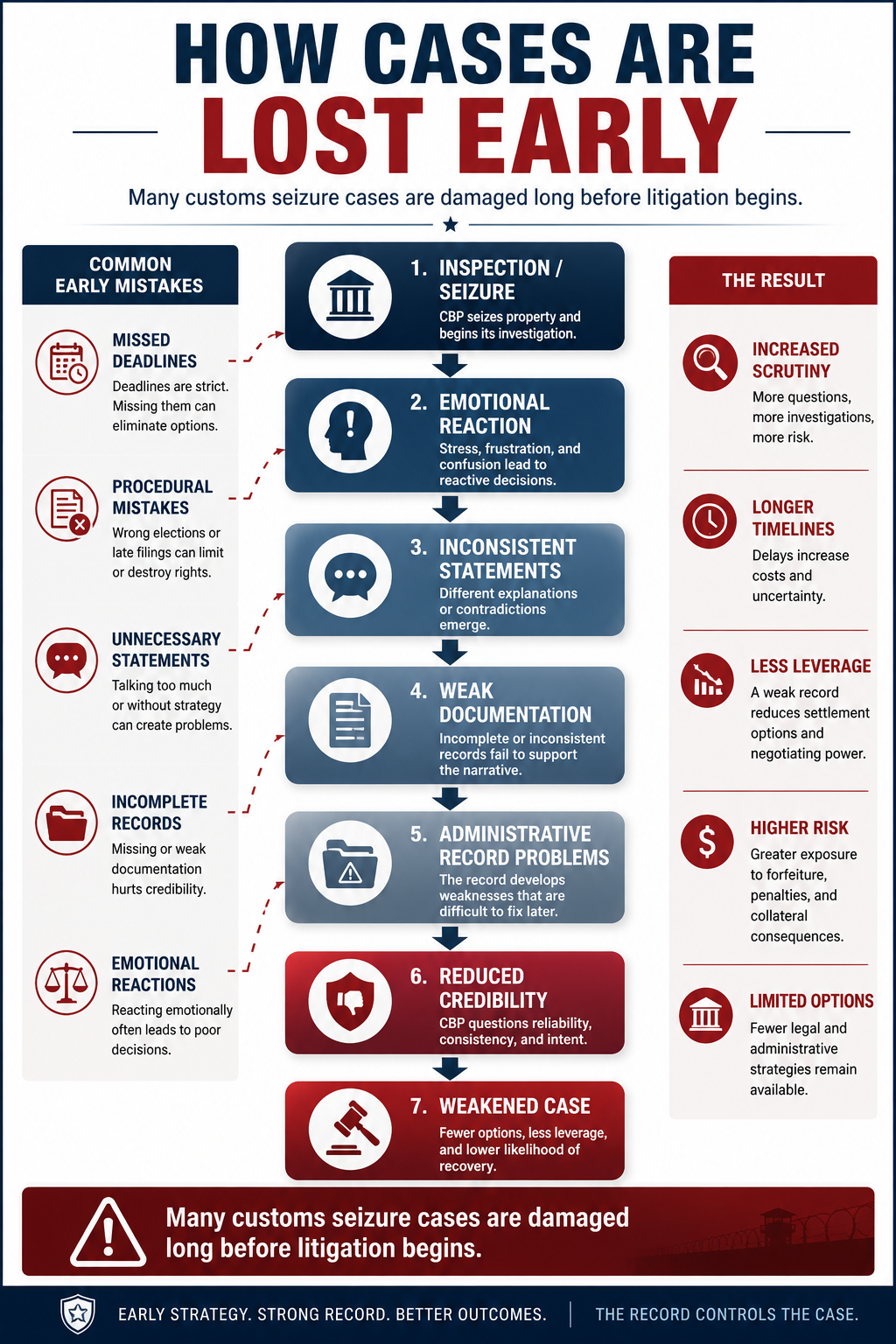
Most Customs Seizure Cases Are Lost Early
Many customs seizure cases are not lost in court.
They are lost:
- during inspections
- in early statements
- through weak documentation
- by missed deadlines
- through inconsistent explanations
- during poorly planned administrative submissions
That reality surprises many people because they assume the most important part of the case happens later during litigation.
In practice, however, federal agencies often begin forming conclusions about:
- credibility
- consistency
- compliance
- mitigation
- overall reliability
very early in the process.
Why Early Mistakes Become Difficult To Fix
One of the biggest misconceptions in customs forfeiture matters is that explanations can always be clarified later.
In reality, once statements become part of the administrative record, agencies may later compare them against:
- customs declarations
- financial records
- shipping documents
- electronic communications
- import/export records
- later petition submissions
- litigation positions
Even relatively small contradictions may become important if investigators believe:
- the explanation evolved over time
- supporting records conflict with prior statements
- details were added later to repair weaknesses in the narrative
That does not necessarily mean the underlying conduct was unlawful.
However, credibility concerns may substantially affect:
- mitigation opportunities
- settlement posture
- procedural leverage
- overall recovery strategy
The Administrative Record Begins Immediately
Many people do not realize how quickly the administrative record begins developing after:
- a seizure
- a detention
- an airport inspection
- a package hold
- a customs interview
- an import/export inquiry
The first:
- explanations
- emails
- procedural elections
- supporting documents
- mitigation submissions
often become some of the most important materials in the entire case.
That is one reason why rushed explanations and emotional reactions frequently create long-term strategic problems.
In many situations, the strongest approach is not reacting immediately.
It is carefully evaluating:
- the government’s likely concerns
- the quality of the documentation
- the procedural posture
- broader federal implications
before substantial submissions are made.
Why Federal Agencies Evaluate the Entire Story
Many individuals focus only on one isolated issue:
- the seized money
- the shipment
- the package
- the declaration discrepancy
Federal agencies often evaluate something much broader.
In many customs seizure matters, investigators assess whether the overall record appears:
- internally consistent
- plausible
- properly documented
- strategically coherent
- administratively credible
That broader institutional review often becomes one of the most important parts of the case.
It is also one of the reasons why customs seizure matters are frequently won or lost long before formal courtroom litigation ever begins.
Why Emotional Reactions Often Hurt Cases
Many customs seizure matters begin during highly stressful situations:
- airport inspections
- shipment holds
- business disruptions
- border questioning
- unexpected package seizures
People understandably feel pressure to:
- explain everything immediately
- defend themselves emotionally
- argue with investigators
- provide rushed documentation
- make procedural decisions quickly
In practice, however, emotional reactions often create:
- inconsistent explanations
- unsupported claims
- procedural mistakes
- documentation conflicts
- credibility concerns
That is one reason why disciplined administrative strategy frequently matters more than people initially realize.
Additional discussion of these issues appears in Why Most People Lose CBP Seizure Cases Before They Even Begin and Why Early Statements to CBP Can Destroy Your Case.
The Record Controls the Case
One of the most important realities in customs seizure matters is that federal agencies often evaluate the entire administrative record rather than one isolated explanation or event.
Many people assume the case will ultimately turn on whether they can later explain:
- the shipment
- the seized property
- the declaration issue
- the source of the funds
- the misunderstanding at the border
In practice, however, CBP and related agencies frequently evaluate whether the overall record appears:
- credible
- consistent
- plausible
- properly documented
- strategically coherent
That broader institutional review often shapes the case long before formal litigation ever begins.
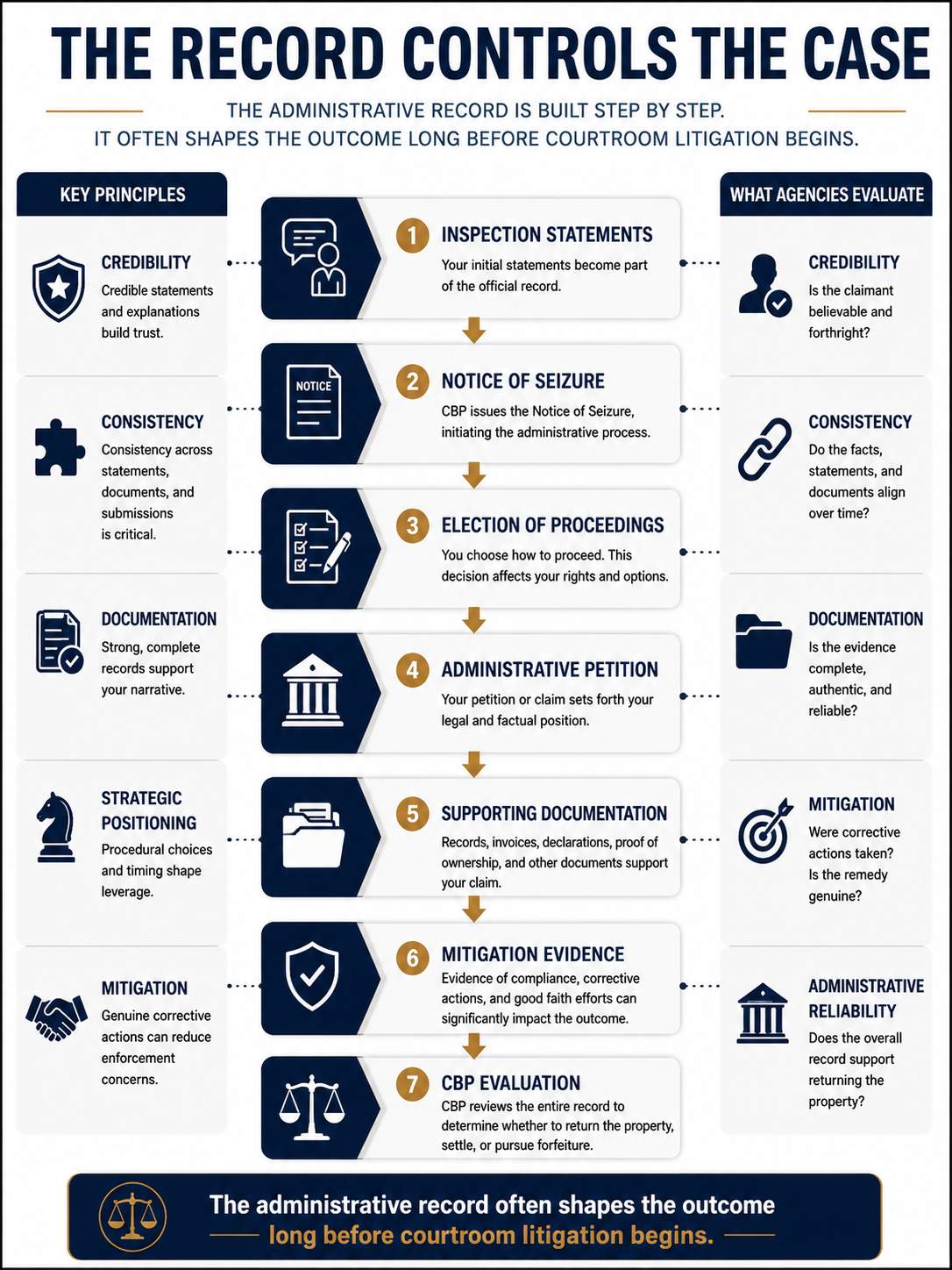
Why the First Submission Often Matters So Much
Many customs seizure matters are heavily influenced by the first:
- inspection statements
- petitions
- mitigation submissions
- procedural elections
- supporting documents
provided to the government.
Those early submissions may later influence:
- mitigation decisions
- settlement posture
- administrative review
- litigation strategy
- broader federal scrutiny
In many situations, agencies compare the first explanations against:
- financial records
- customs declarations
- shipping documentation
- electronic communications
- import/export records
- later litigation positions
Even relatively small inconsistencies may become important if investigators believe:
- explanations evolved later
- details changed over time
- records conflict with prior statements
- the narrative appears reconstructed after the seizure occurred
That is one reason why the first submission frequently becomes one of the most strategically important moments in the entire case.
Why Contradictions Become Dangerous
Federal agencies often place substantial weight on consistency.
In many customs seizure matters, investigators are not simply evaluating whether one statement appears believable in isolation.
Instead, they frequently evaluate whether:
- all explanations align across the record
- documentation supports the narrative
- procedural behavior appears credible
- mitigation efforts appear genuine
- the overall story remains consistent over time
That is why contradictions often become far more damaging than people initially realize.
For example, problems frequently arise where:
- early inspection statements conflict with later petitions
- financial records undermine source-of-funds explanations
- shipping documents contradict customs declarations
- social media or electronic evidence conflicts with mitigation claims
- later explanations appear more carefully constructed than the originals
Even where the underlying conduct was not criminal, credibility concerns may still substantially weaken:
- mitigation opportunities
- administrative negotiations
- procedural leverage
- litigation posture
Why Administrative Record-Building Is Often More Important Than Courtroom Arguments
Many people imagine customs seizure cases being won through dramatic litigation tactics.
In reality, many strong outcomes are shaped much earlier through:
- disciplined communication
- careful procedural positioning
- strong documentation
- mitigation strategy
- credible explanations
- administrative consistency
That is especially true because many customs seizure matters are resolved administratively without full courtroom litigation ever occurring.
In those situations, the quality of the administrative record often becomes one of the single most important factors influencing the outcome.
Why the Record May Affect More Than the Seizure Itself
Another important reality is that the administrative record developed during a customs seizure matter may later affect:
- immigration proceedings
- export licensing
- federal employment
- contractor eligibility
- security clearances
- future border scrutiny
- broader federal investigations
Federal agencies often evaluate credibility across multiple administrative systems.
That broader institutional overlap is one reason why strategic record-building frequently becomes one of the most important aspects of customs seizure defense.
Strong Customs Seizure Strategy Often Begins with Record Discipline
Many successful customs seizure cases ultimately have several things in common:
- consistent explanations
- strong documentation
- disciplined communication
- procedural strategy
- careful mitigation positioning
- early administrative analysis
That is why National Security Law Firm repeatedly emphasizes:
the record controls the case.
Additional discussion of these issues appears in The Record Controls the Case: Why Your First Submission Matters and How Credibility Affects Customs Seizure Cases.
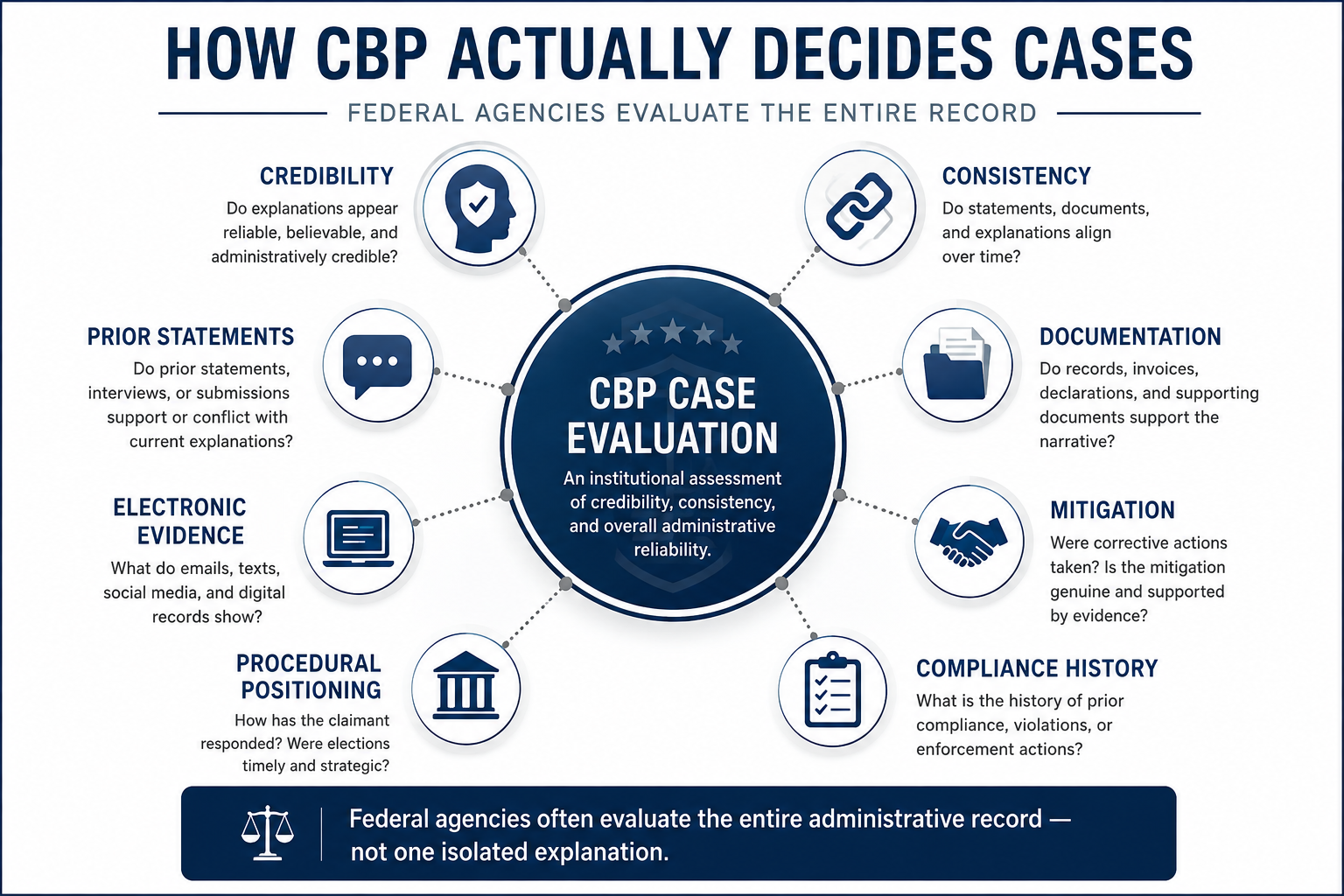
How CBP Actually Decides Seizure Cases
Many people assume CBP decides customs seizure cases based on one simple question:
“Did the person break the law?”
In reality, federal agencies often evaluate something much broader and far more nuanced.
In many customs forfeiture matters, CBP evaluates:
- credibility
- consistency
- documentation quality
- mitigation evidence
- procedural behavior
- overall administrative reliability
That institutional review frequently begins long before formal litigation ever occurs.
CBP Often Evaluates More Than One Isolated Fact
Many individuals focus on one issue alone:
- the seized money
- the shipment
- the package
- the customs declaration
- the missing paperwork
Federal agencies rarely evaluate these matters in isolation.
Instead, investigators often examine whether the overall circumstances appear:
- plausible
- internally consistent
- properly documented
- administratively credible
For example, CBP may compare:
- inspection statements
- customs declarations
- financial records
- shipping documentation
- electronic communications
- import/export records
- mitigation submissions
- later explanations
What initially appears to be a small inconsistency may become much more important if the government believes:
- explanations changed over time
- records conflict with earlier statements
- documentation appears incomplete
- the narrative evolved after the seizure occurred
Why Credibility Often Becomes Central
One of the most misunderstood aspects of customs seizure strategy is how heavily federal agencies often rely on credibility assessments.
In many situations, the government evaluates not simply whether an explanation is theoretically possible, but whether the overall record appears:
- reliable
- consistent
- supported by documentation
- administratively coherent
That is one reason why:
- unsupported narratives
- evolving explanations
- weak documentation
- emotional reactions
may substantially weaken otherwise defensible cases.
In practice, many customs seizure matters become heavily:
- credibility-driven
- documentation-driven
- procedure-driven
long before courtroom litigation becomes relevant.
What Makes Cases Look Strong or Weak
Strong customs seizure cases often share several characteristics:
- consistent explanations
- organized documentation
- credible mitigation evidence
- disciplined communication
- strategic procedural positioning
Weak cases frequently involve:
- contradictory statements
- incomplete records
- rushed submissions
- unsupported claims
- procedural mistakes
- changing narratives over time
Importantly, this does not necessarily mean the underlying conduct was criminal or intentionally deceptive.
However, federal agencies often evaluate whether the overall record appears trustworthy and administratively reliable.
That institutional perspective frequently shapes:
- mitigation decisions
- settlement posture
- administrative negotiations
- litigation strategy
- broader federal scrutiny
Why Mitigation Often Matters More Than People Expect
Many individuals assume customs seizure matters are purely adversarial.
In reality, many administrative forfeiture proceedings involve significant focus on:
- mitigation
- corrective action
- compliance efforts
- cooperation
- documentation quality
- procedural behavior
Depending on the circumstances, strong mitigation evidence may substantially affect:
- penalty exposure
- administrative resolution
- negotiation opportunities
- overall recovery strategy
That is one reason why many successful customs seizure outcomes are shaped less by emotional arguments and more by:
- careful record-building
- procedural discipline
- credible documentation
- strategic administrative positioning
Federal Agencies Often Evaluate the Entire Administrative Record
Another important reality is that CBP and related agencies often evaluate credibility across multiple administrative systems.
Depending on the allegations involved, the administrative record may later affect:
- immigration matters
- export licensing
- federal employment
- contractor eligibility
- security clearances
- future border scrutiny
- broader investigations
That broader overlap is one reason why customs seizure matters frequently require strategic analysis extending far beyond simply recovering seized property.
Customs Seizure Cases Are Often Won Through Administrative Strategy
Many people imagine customs seizure matters being won primarily through courtroom litigation.
In practice, however, many strong outcomes are shaped much earlier through:
- disciplined communication
- strong documentation
- procedural timing
- mitigation positioning
- credibility management
- careful administrative strategy
That is why National Security Law Firm repeatedly emphasizes:
the record controls the case.
Additional discussion appears in How CBP Actually Decides Seizure Cases and What CBP Looks for in a Petition for Remission.
Why Credibility and Consistency Matter So Much
Many people assume customs seizure cases are decided primarily by:
- statutes
- technical regulations
- legal arguments
- procedural rules
While those issues certainly matter, many CBP seizure cases are also heavily influenced by something far less obvious:
whether the overall record appears credible and consistent.
That institutional evaluation often becomes one of the most important aspects of the case.
Federal Agencies Compare Information Across the Entire Record
One of the biggest misconceptions in customs forfeiture matters is that agencies evaluate each statement or document in isolation.
In reality, CBP and related agencies frequently compare:
- inspection interviews
- customs declarations
- financial records
- shipping documentation
- electronic communications
- import/export records
- mitigation submissions
- later explanations
Investigators often look for whether:
- the explanations remain consistent over time
- supporting documentation aligns with prior statements
- the narrative appears plausible
- the overall record appears administratively reliable
Even relatively small inconsistencies may become important if the government believes:
- explanations evolved later
- documents conflict with earlier submissions
- details were added after the seizure occurred
- the overall story appears reconstructed over time
Why Small Contradictions Become Bigger Problems
Many people unintentionally create problems by assuming minor inconsistencies do not matter.
For example:
- an inaccurate declaration
- a rushed explanation during inspection
- inconsistent shipping records
- changing timelines
- unsupported assumptions
may later create broader credibility concerns.
In many situations, the government’s focus shifts from:
“Was one detail incorrect?”
to:
“Can the overall record be trusted?”
That broader credibility analysis often affects:
- mitigation opportunities
- administrative negotiations
- procedural leverage
- litigation posture
- future agency scrutiny
Why Emotional Reactions Often Hurt Cases
Customs seizure matters frequently begin in stressful situations:
- airport inspections
- shipment holds
- border questioning
- unexpected package seizures
- business disruptions
People understandably feel pressure to:
- explain everything immediately
- defend themselves emotionally
- argue with investigators
- provide rushed information
- quickly “fix the problem”
In practice, however, emotional reactions often create:
- contradictory explanations
- unsupported claims
- procedural mistakes
- documentation conflicts
- credibility concerns
That is one reason why disciplined communication frequently matters far more than people initially realize.
Credibility Often Shapes Mitigation
Many customs seizure matters involve substantial focus on:
- mitigation
- administrative discretion
- procedural cooperation
- corrective action
- overall credibility
In those situations, the government frequently evaluates not simply whether a violation allegedly occurred, but also:
- whether the explanations appear reliable
- whether the documentation supports the narrative
- whether the claimant appears cooperative and credible
- whether the mitigation efforts appear genuine
That institutional evaluation often begins very early in the process.
Social Media and Prior Statements May Also Matter
Many individuals do not realize that CBP and related agencies may evaluate:
- prior statements
- online activity
- business communications
- electronic evidence
- social media content
when assessing credibility and consistency.
In some situations, online statements or prior communications may conflict with:
- mitigation claims
- customs declarations
- ownership explanations
- source-of-funds narratives
- import/export documentation
That is one reason why customs seizure matters frequently require careful strategic analysis before substantial explanations or submissions are made.
Additional discussion appears in Can Social Media or Prior Statements Hurt Your CBP Case?.
Strong Customs Seizure Cases Often Reflect Administrative Credibility
Many successful customs seizure matters ultimately share several characteristics:
- consistent explanations
- disciplined communication
- strong documentation
- credible mitigation
- procedural strategy
- careful administrative positioning
That is why National Security Law Firm repeatedly emphasizes:
the record controls the case.
Understanding why credibility and consistency matter is important because many customs forfeiture matters are ultimately shaped less by dramatic courtroom arguments and more by whether federal agencies view the overall administrative record as reliable, coherent, and credible.
Administrative Strategy vs. Litigation Strategy
Many people assume the strongest customs seizure strategy is immediately “taking the government to court.”
In reality, many customs forfeiture matters are won or substantially improved through careful administrative positioning long before litigation ever becomes necessary.
That is one reason why experienced customs seizure strategy often focuses first on:
- procedural leverage
- documentation quality
- mitigation positioning
- credibility
- administrative record-building
rather than rushing directly into courtroom litigation.
Why Litigation Is Not Always the Best First Move
Federal litigation can sometimes create:
- stronger procedural protections
- broader discovery opportunities
- increased leverage
- more aggressive challenge mechanisms
However, litigation may also substantially increase:
- costs
- timelines
- evidentiary exposure
- administrative scrutiny
- broader federal risks
In many situations, businesses and individuals initially assume:
“Going to court means the case is stronger.”
In practice, however, many customs seizure matters are highly fact-specific, and litigation is not automatically the most strategically advantageous option.
The best procedural path often depends heavily on:
- the quality of the evidence
- the strength of the documentation
- whether credibility concerns exist
- the procedural posture
- the amount or value involved
- broader federal implications
Administrative Positioning Often Shapes the Outcome
Many customs seizure matters are resolved administratively through:
- mitigation negotiations
- petitions for remission
- procedural leverage
- compliance analysis
- negotiated resolutions
In those situations, the quality of the administrative strategy often becomes one of the most important factors influencing:
- recovery opportunities
- penalty exposure
- settlement posture
- mitigation outcomes
Federal agencies frequently evaluate:
- procedural cooperation
- mitigation efforts
- credibility
- documentation quality
- consistency of explanations
- overall administrative reliability
That institutional review often begins long before litigation becomes relevant.
Strategic Timing Matters
One of the most common mistakes people make is reacting emotionally immediately after the seizure occurs.
For example, individuals sometimes:
- rush into litigation out of frustration
- submit poorly planned petitions
- make procedural elections too quickly
- escalate disputes before understanding the government’s concerns
In practice, however, timing often matters tremendously.
In some situations, early administrative positioning may:
- narrow disputes
- improve credibility
- strengthen mitigation
- reduce penalty exposure
- create more favorable negotiation conditions
In others, litigation may eventually become necessary because:
- the administrative process is no longer productive
- the government’s position appears unreasonable
- broader procedural protections are needed
- evidentiary disputes become central
The strongest strategy often depends on carefully evaluating when and how leverage can best be created.
Administrative Strategy Frequently Shapes Litigation Later
Another important reality is that even when litigation eventually occurs, the administrative phase often still shapes the case significantly.
The first:
- procedural elections
- petitions
- mitigation submissions
- explanations
- supporting documents
may later influence: - judicial posture
- credibility assessments
- evidentiary disputes
- settlement opportunities
- broader agency scrutiny
That is one reason why weak administrative positioning frequently creates long-term strategic problems later in litigation.
Strong Customs Seizure Strategy Is Usually Deliberate, Not Reactive
Many successful customs seizure matters ultimately involve:
- disciplined communication
- careful timing
- strong documentation
- procedural strategy
- credible mitigation
- strategic administrative positioning
That is why National Security Law Firm repeatedly emphasizes:
the record controls the case.
Understanding the relationship between administrative strategy and litigation strategy is important because many customs forfeiture matters are ultimately shaped less by dramatic courtroom arguments and more by procedural positioning, credibility, and administrative record-building developed early in the process.
What Strong Customs Seizure Cases Usually Have in Common
Many successful customs seizure cases are not necessarily the ones with the most dramatic facts or the loudest legal arguments.
In practice, strong outcomes are often shaped by:
- disciplined administrative strategy
- credible documentation
- procedural positioning
- consistent explanations
- carefully developed mitigation
That reality surprises many people because they initially assume customs seizure cases are won primarily through aggressive courtroom litigation.
In many situations, however, the strongest cases begin with a strong administrative record.
Strong Documentation Changes Cases
One of the most important characteristics shared by many successful customs seizure matters is strong documentation.
Depending on the type of seizure involved, federal agencies may evaluate:
- financial records
- invoices
- customs declarations
- shipping records
- ownership documentation
- import/export records
- licensing materials
- compliance procedures
- source-of-funds evidence
Strong documentation often helps:
- strengthen credibility
- support mitigation arguments
- resolve inconsistencies
- reduce government skepticism
- improve negotiation posture
Weak or inconsistent records, by contrast, frequently create:
- procedural complications
- additional scrutiny
- mitigation problems
- credibility concerns
That is one reason why documentation quality often becomes one of the most important aspects of the case.
Strategic Communication Matters
Many successful customs seizure cases also involve disciplined communication from the very beginning.
In practice, strong cases often avoid:
- emotional overreactions
- unsupported claims
- inconsistent explanations
- rushed submissions
- unnecessary admissions
- changing narratives later
Instead, successful administrative positioning frequently involves:
- careful procedural timing
- consistent explanations
- strategic mitigation
- well-supported submissions
- credible documentation
Federal agencies often evaluate not simply whether a claimant disputes the seizure, but whether the overall record appears:
- reliable
- plausible
- internally consistent
- administratively credible
That broader institutional review often shapes the case long before litigation ever occurs.
Mitigation Often Matters More Than People Expect
Many individuals assume customs seizure matters are purely adversarial.
In reality, many administrative forfeiture proceedings involve substantial focus on:
- mitigation
- corrective action
- compliance improvements
- procedural cooperation
- administrative credibility
In some situations, strong mitigation positioning may substantially improve:
- settlement opportunities
- penalty exposure
- administrative resolution
- procedural leverage
That is especially true where the government believes:
- the claimant appears credible
- corrective measures were taken
- the issue appears isolated
- the documentation supports the explanation
- broader enforcement concerns are reduced
Strong Cases Usually Reflect Administrative Discipline
One of the biggest differences between strong and weak customs seizure matters is often administrative discipline.
Strong cases frequently involve:
- organized documentation
- careful procedural decisions
- credible mitigation
- consistent explanations
- strategic timing
- disciplined communication
Weak cases often involve:
- contradictory narratives
- rushed explanations
- incomplete records
- emotional reactions
- procedural mistakes
- unsupported claims
That distinction frequently becomes more important than people initially realize.
The Strongest Cases Are Often Built Early
Many customs seizure matters are ultimately shaped less by courtroom litigation and more by:
- early procedural positioning
- administrative strategy
- credibility
- consistency
- documentation quality
- mitigation evidence
That is why National Security Law Firm repeatedly emphasizes:
the record controls the case.
Additional discussion of these issues appears in What CBP Looks for in a Petition for Remission and Why Hiring a Customs Seizure Lawyer Early Matters.
Why Hiring a Customs Seizure Lawyer Early Often Matters
One of the biggest mistakes people make in customs seizure matters is waiting too long before seeking strategic legal analysis.
Many individuals initially assume:
- they can explain the situation themselves
- the issue will resolve informally
- they should wait to see how CBP responds
- hiring counsel only matters if litigation begins
In practice, however, many customs seizure cases are heavily shaped during the earliest administrative stages.
That is one reason why experienced customs seizure representation often creates the most value before:
- major submissions are made
- procedural elections are finalized
- mitigation positions become fixed
- contradictions enter the record
- deadlines begin expiring
The Earliest Stage Often Creates the Most Leverage
Many people imagine leverage being created later in court.
In reality, leverage in customs seizure matters is often shaped much earlier through:
- procedural positioning
- documentation quality
- mitigation strategy
- credibility
- administrative record-building
The first:
- inspection statements
- petitions
- procedural elections
- supporting documents
- communications with the government
may later influence: - mitigation decisions
- settlement posture
- litigation strategy
- broader federal scrutiny
That is one reason why weak early submissions frequently create long-term strategic problems that become difficult to reverse later.
Why Waiting Can Narrow Options
Many customs forfeiture matters are heavily deadline-driven.
As time passes, businesses and individuals may lose opportunities to:
- strengthen the administrative record
- strategically frame mitigation
- preserve procedural leverage
- organize supporting documentation
- avoid unnecessary admissions
- shape the government’s early perception of the case
In many situations, people unintentionally weaken their position by:
- responding emotionally
- rushing to explain everything
- submitting inconsistent records
- making unsupported claims
- misunderstanding procedural options
Once those issues become embedded in the administrative record, agencies may later compare them against:
- financial documentation
- customs declarations
- shipping records
- electronic communications
- later submissions
- litigation positions
That is one reason why early strategic discipline frequently matters far more than people initially realize.
Customs Seizure Matters Often Involve More Than the Property Itself
Another important reason early legal analysis often matters is that customs seizure cases frequently intersect with broader federal systems involving:
- immigration
- export licensing
- federal employment
- contractor eligibility
- security clearances
- future border scrutiny
- parallel investigations
Federal agencies often evaluate these matters collectively rather than in isolation.
That broader overlap is one reason why customs seizure representation frequently requires more than simply preparing forms or responding to notices.
In many situations, the strategic issue is not just:
“How do we recover the property?”
It is also:
“How will the administrative record created today affect future federal systems later?”
More Than Just Paperwork
Many people initially assume customs seizure representation primarily involves:
- filing petitions
- responding to notices
- submitting documents
In reality, strong customs seizure strategy often involves:
- procedural timing
- mitigation positioning
- credibility management
- documentation analysis
- administrative leverage
- broader federal risk evaluation
That is why National Security Law Firm repeatedly emphasizes:
the record controls the case.
Many customs forfeiture matters are ultimately shaped less by dramatic courtroom litigation and more by disciplined administrative strategy developed very early in the process.
Additional discussion of these issues appears in The Record Controls the Case: Why Your First Submission Matters and Administrative Petition vs Federal Court Litigation.
Why Customs Seizure Cases Often Involve Broader Federal Consequences
Many people initially view a customs seizure as an isolated dispute over:
- money
- merchandise
- a shipment
- a package
- a declaration issue
In reality, customs seizure matters frequently intersect with much broader federal systems.
Depending on the allegations involved, information developed during a CBP seizure matter may later affect:
- immigration proceedings
- export licensing
- federal employment
- contractor eligibility
- security clearances
- future border inspections
- procurement relationships
- parallel federal investigations
Federal agencies often evaluate these matters collectively rather than in isolation.
That broader institutional overlap is one of the most misunderstood aspects of customs seizure strategy.
Federal Agencies Often Share Information
Many people assume the customs issue stays inside CBP.
In practice, however, commercial customs matters may involve overlapping review by:
- Homeland Security Investigations
- BIS
- OFAC
- FDA
- procurement officials
- federal investigators
- contractor responsibility offices
- security personnel
Depending on the facts involved, agencies may evaluate:
- inspection statements
- customs declarations
- financial records
- import/export history
- mitigation submissions
- procedural cooperation
- compliance systems
- broader credibility concerns
That is one reason why customs seizure matters frequently require strategic analysis extending beyond simply recovering seized property.
The Seizure May Not Be the Only Risk
In many situations, the immediate seizure itself is only part of the larger concern.
For example:
- an export-control issue may later affect licensing eligibility
- customs fraud allegations may affect contractor responsibility reviews
- inconsistent explanations may create credibility concerns in later federal proceedings
- seizure-related investigations may expand into broader compliance review
That does not necessarily mean catastrophic consequences will follow.
However, it does mean the administrative record developed during the customs matter may later influence how other federal systems evaluate:
- reliability
- compliance
- credibility
- procedural integrity
That is one reason why disciplined administrative positioning often matters so much early in the process.
Long-Term Administrative Consequences Often Matter More Than People Expect
Many individuals and businesses focus entirely on the immediate seizure itself.
In practice, however, long-term institutional consequences may sometimes become equally important.
Depending on the industry and allegations involved, customs seizure matters may later affect:
- government contracting relationships
- procurement opportunities
- export permissions
- future customs scrutiny
- federal licensing
- security clearance reviews
- broader regulatory oversight
Federal systems often place significant weight on:
- administrative credibility
- consistency of explanations
- procedural cooperation
- documentation quality
- mitigation efforts
That broader institutional evaluation frequently begins very early in the process.
Strong Customs Seizure Strategy Often Requires Thinking Beyond the Immediate Dispute
Many successful customs seizure strategies ultimately involve:
- procedural discipline
- strong documentation
- careful mitigation positioning
- credibility management
- awareness of overlapping federal systems
- long-term institutional risk analysis
That is why National Security Law Firm repeatedly emphasizes:
the record controls the case.
Understanding the broader federal consequences of customs seizure matters is important because many cases are ultimately shaped not only by the immediate forfeiture dispute, but also by how the administrative record may later affect other federal systems and future government scrutiny.
Why National Security Law Firm Is Different in Customs Seizure Strategy Cases
Many law firms approach customs seizure matters as isolated forfeiture disputes focused primarily on:
- filing paperwork
- responding to notices
- challenging seizures procedurally
National Security Law Firm approaches these matters differently.
In many situations, customs seizure cases are ultimately shaped by broader federal administrative systems involving:
- credibility
- compliance
- mitigation
- procedural positioning
- long-term federal scrutiny
That institutional perspective frequently becomes one of the most important strategic advantages in the case.
Strategic Federal Administrative Representation
National Security Law Firm represents clients nationwide in:
- customs seizure matters
- export-control issues
- federal administrative proceedings
- contractor-related matters
- security clearance cases
- overlapping federal investigations
The firm’s broader federal-systems experience informs how customs seizure matters are strategically evaluated from the outset.
Rather than treating the case as simply a dispute over seized property, the firm focuses on:
- administrative positioning
- credibility management
- mitigation strategy
- documentation analysis
- procedural leverage
- long-term federal implications
That broader perspective becomes especially important where customs seizure matters intersect with:
- import/export enforcement
- federal contracting
- sanctions compliance
- national security concerns
- broader regulatory scrutiny
Understanding How Federal Agencies Actually Think
One of the biggest differences in National Security Law Firm’s approach is understanding how federal agencies often evaluate these matters institutionally rather than emotionally.
Many customs seizure cases are not decided solely by:
- one isolated statement
- one document
- one declaration issue
- one procedural event
Instead, agencies frequently evaluate whether the overall record appears:
- credible
- consistent
- properly documented
- administratively reliable
- strategically coherent
That is one reason why many customs seizure matters are ultimately shaped less by dramatic courtroom litigation and more by:
- disciplined communication
- strong documentation
- procedural timing
- mitigation positioning
- administrative record-building
That is also why National Security Law Firm repeatedly emphasizes:
the record controls the case.
More Than Just a Forfeiture Dispute
Many customs seizure matters involve broader federal implications extending beyond the immediate seizure itself.
Depending on the allegations involved, these matters may later affect:
- export licensing
- federal employment
- contractor eligibility
- security clearances
- procurement relationships
- future border scrutiny
- broader federal investigations
Federal agencies often evaluate these systems collectively rather than in isolation.
Understanding how those systems overlap is one of the major differences in National Security Law Firm’s strategic approach.
Many firms focus only on recovering the seized property.
National Security Law Firm evaluates:
- the immediate forfeiture strategy
- the quality of the administrative record
- broader federal implications
- procedural leverage
- long-term institutional risk
Nationwide Customs Seizure Representation
National Security Law Firm represents clients nationwide in customs seizure and administrative forfeiture matters involving:
- CBP money seizures
- commercial import/export enforcement
- luxury goods seizures
- vehicle seizures
- package seizures
- FDA import issues
- export-control enforcement
- OFAC and BIS-related matters
- customs penalties
- administrative forfeiture proceedings
If CBP seized your money, merchandise, shipment, vehicle, or other property, early strategic analysis may significantly affect:
- mitigation opportunities
- procedural leverage
- recovery strategy
- broader federal consequences
For broader discussion of customs forfeiture and CBP enforcement matters generally, visit the firm’s main Customs Seizure Lawyers Resource Hub page.
Frequently Asked Questions About Customs Seizure Strategy
How are customs seizure cases actually won?
Many customs seizure matters are won through:
- strong documentation
- credibility
- procedural positioning
- mitigation strategy
- disciplined communication
- careful administrative record-building
In many situations, the case is heavily shaped long before formal litigation ever begins.
That is one reason why National Security Law Firm repeatedly emphasizes:
the record controls the case.
Does credibility really matter in customs seizure cases?
Yes.
Federal agencies often evaluate whether the overall record appears:
- reliable
- internally consistent
- properly documented
- administratively credible
In many situations, credibility concerns may significantly affect:
- mitigation opportunities
- settlement posture
- procedural leverage
- broader federal scrutiny
Additional discussion appears in How Credibility Affects Customs Seizure Cases.
Can inconsistent statements hurt my case?
Absolutely.
CBP and related agencies frequently compare:
- inspection statements
- customs declarations
- financial records
- shipping documentation
- mitigation submissions
- later explanations
Even relatively small inconsistencies may become important if investigators believe explanations evolved over time or conflict with supporting documentation.
Additional discussion appears in Why Consistency Matters in Federal Seizure Cases.
What does CBP actually look for when evaluating a seizure case?
In many customs forfeiture matters, agencies evaluate:
- documentation quality
- credibility
- consistency
- mitigation evidence
- procedural cooperation
- compliance history
- administrative reliability
Federal agencies often assess the entire record rather than one isolated explanation.
Additional discussion appears in How CBP Actually Decides Seizure Cases.
Does strong documentation really make a difference?
Very often, yes.
Depending on the type of seizure involved, strong documentation may include:
- financial records
- invoices
- customs declarations
- ownership records
- shipping documentation
- compliance materials
- source-of-funds evidence
Strong records often improve:
- mitigation opportunities
- negotiation posture
- administrative credibility
- procedural leverage
Weak or inconsistent documentation frequently creates significant strategic problems.
Should I file a petition or go directly to federal court?
The best strategy depends heavily on:
- the facts of the seizure
- the quality of the evidence
- whether credibility concerns exist
- the procedural posture
- broader federal implications
In many situations, strong administrative positioning may create substantial leverage before litigation becomes necessary.
Additional discussion appears in Administrative Petition vs Federal Court Litigation.
Can social media or prior statements hurt a customs seizure case?
Potentially, yes.
Depending on the circumstances, federal agencies may evaluate:
- social media content
- electronic communications
- prior statements
- business communications
- earlier declarations
- online activity
Inconsistent online statements or prior explanations may create credibility concerns if they conflict with:
- mitigation submissions
- customs declarations
- financial documentation
- ownership explanations
Additional discussion appears in Can Social Media or Prior Statements Hurt Your CBP Case?.
Why does hiring a customs seizure lawyer early matter?
Many customs seizure matters are heavily influenced during the earliest administrative stages.
Early legal analysis may help:
- avoid harmful procedural mistakes
- improve mitigation positioning
- strengthen documentation strategy
- preserve leverage
- prevent unnecessary admissions
- evaluate broader federal consequences
Additional discussion appears in Why Hiring a Customs Seizure Lawyer Early Matters.
Can customs seizure cases affect immigration, security clearances, or federal employment?
Potentially, yes.
Depending on the allegations involved, customs seizure matters may later intersect with:
- immigration proceedings
- export licensing
- federal employment
- contractor eligibility
- security clearances
- future border scrutiny
- broader federal investigations
Federal agencies often evaluate these matters across overlapping administrative systems.
Are most customs seizure cases resolved in court?
No.
Many customs seizure matters are resolved administratively through:
- petitions for remission
- mitigation negotiations
- procedural strategy
- administrative positioning
- settlement discussions
That is one reason why the quality of the administrative record often becomes critically important long before courtroom litigation occurs.
For broader discussion of customs forfeiture and CBP enforcement matters generally, visit the firm’s main Customs Seizure Lawyers Resource Hub page.
Speak With a Nationwide Customs Seizure Lawyer
If CBP seized your money, merchandise, shipment, vehicle, package, electronics, or other property, the strategic decisions made early in the process may significantly affect:
- recovery opportunities
- mitigation positioning
- procedural leverage
- broader federal consequences
Many customs seizure matters are ultimately shaped long before courtroom litigation ever begins.
In practice, federal agencies often evaluate:
- credibility
- consistency
- documentation quality
- compliance history
- mitigation efforts
- administrative reliability
That is one reason why many strong customs seizure outcomes are driven less by dramatic litigation tactics and more by disciplined administrative strategy developed early in the process.
Strategic Customs Seizure Representation Nationwide
National Security Law Firm represents clients nationwide in customs seizure and administrative forfeiture matters involving:
- CBP money seizures
- commercial import/export enforcement
- luxury goods seizures
- package seizures
- vehicle seizures
- FDA-related import issues
- export-control enforcement
- OFAC and BIS-related matters
- customs penalties
- administrative forfeiture proceedings
The firm approaches these matters strategically with a focus on:
- administrative positioning
- mitigation strategy
- procedural leverage
- documentation analysis
- credibility management
- long-term federal risk evaluation
Rather than treating customs seizure matters as isolated forfeiture disputes, National Security Law Firm evaluates how the administrative record developed during the case may later affect broader federal systems and future government scrutiny.
Why Early Strategic Analysis Matters
Many customs seizure matters are heavily influenced by:
- inspection statements
- procedural elections
- mitigation submissions
- documentation quality
- consistency of explanations
- administrative record development
That is why National Security Law Firm repeatedly emphasizes:
the record controls the case.
In many situations, customs seizure matters are ultimately shaped less by courtroom litigation and more by:
- disciplined communication
- procedural timing
- mitigation positioning
- credibility assessments
- careful administrative strategy
Transparent Pricing for Customs Seizure Matters
Currency seizure matters are often handled on a contingency-fee basis.
In many situations:
- the fee ranges from approximately 15% to 20% of the recovered amount
- there is no legal fee unless a recovery is obtained
Property and goods seizure matters are generally handled using flat-fee structures typically ranging from approximately:
- $2,500 to $10,000
The exact fee depends on:
- the complexity of the matter
- the type of property seized
- aggravating allegations
- the amount of documentation involved
- whether broader federal issues are implicated
- whether litigation may become necessary
Free Consultation for Customs Seizure Matters
National Security Law Firm offers nationwide representation and free consultations for airport and border cash and property seizure matters.
The fastest and easiest way to get started is through the firm’s online booking system.
In many situations, same-day consultations are available, and the process typically takes less than a minute to schedule online.
Once booked, an attorney will personally call you at the scheduled time to discuss:
- the seizure
- procedural deadlines
- recovery strategy
- documentation issues
- broader federal implications
To schedule a consultation online, visit:
Book a Free Consultation Online
You may also contact the firm directly at:
Phone: (202) 600-4996
Additional related resources:
- Why Most People Lose CBP Seizure Cases Before They Even Begin
- The Record Controls the Case: Why Your First Submission Matters
- How CBP Actually Decides Seizure Cases
- Administrative Petition vs Federal Court Litigation
- How Credibility Affects Customs Seizure Cases
- Why Consistency Matters in Federal Seizure Cases
- Can Prior Statements or Social Media Hurt Your CBP Case?
- Customs Seizure Lawyers Resource Hub
- Can a Customs Seizure Affect Global Entry?
- Can a Customs Seizure Affect My Security Clearance?