
One of the most important strategic decisions in a customs seizure case is whether to:
- pursue administrative resolution
or - force the government into federal court litigation.
Many people assume litigation is automatically the stronger option.
In reality, customs seizure matters are often much more nuanced.
In many situations, the strongest strategy depends heavily on:
- the quality of the documentation
- credibility concerns
- mitigation opportunities
- procedural posture
- broader federal implications
- the government’s likely concerns
That is one reason why experienced customs seizure strategy often focuses heavily on administrative positioning long before courtroom litigation becomes relevant.
Most People Misunderstand How CBP Seizure Cases Are Actually Resolved
Many travelers and businesses initially assume customs seizure cases automatically proceed to court.
In practice, many CBP forfeiture matters are resolved administratively through:
- petitions for remission
- mitigation submissions
- procedural negotiations
- administrative strategy
- settlement discussions
After a seizure occurs, the case is typically transferred to CBP’s Fines, Penalties, and Forfeitures (“FP&F”) office.
At that point, the government often issues:
- a Notice of Seizure
- Election of Proceedings materials
- administrative deadlines
- procedural instructions
The claimant must then decide how to proceed.
That decision may significantly affect:
- leverage
- timing
- procedural protections
- negotiation posture
- broader federal consequences
Additional discussion appears in What Is a Petition for Remission or Mitigation? and Election of Proceedings Form Explained.
What Is an Administrative Petition?
An administrative petition is generally a formal submission asking the government to:
- return seized property
- mitigate forfeiture
- reduce penalties
- reconsider the seizure based on the surrounding facts and supporting evidence
Many people incorrectly view petitions as simple “request letters.”
In reality, strong petitions often involve:
- mitigation strategy
- procedural positioning
- documentation analysis
- credibility management
- careful administrative narrative development
Federal agencies frequently evaluate:
- consistency of explanations
- financial documentation
- supporting evidence
- procedural cooperation
- overall administrative reliability
That is one reason why many customs seizure matters are heavily shaped during the administrative phase.
Strong administrative positioning may sometimes:
- improve settlement opportunities
- strengthen mitigation
- reduce penalty exposure
- narrow disputes
- improve litigation posture later if litigation eventually becomes necessary
Additional discussion appears in What CBP Looks for in a Petition for Remission and The Record Controls the Case: Why Your First Submission Matters.
What Is Federal Court Litigation in a Customs Seizure Case?
Federal court litigation generally occurs when a claimant forces the government into judicial forfeiture proceedings rather than relying solely on the administrative process.
Litigation may provide:
- judicial oversight
- broader procedural protections
- discovery opportunities
- evidentiary challenges
- constitutional arguments
However, litigation also frequently increases:
- complexity
- timelines
- costs
- evidentiary exposure
- broader scrutiny
Many people mistakenly assume:
“Going to court means the case is stronger.”
In reality, litigation is simply one procedural strategy among several.
Depending on the circumstances, litigation may or may not create stronger leverage.
Additional discussion appears in Can CBP Keep Your Money Even If You Were Never Charged With a Crime?
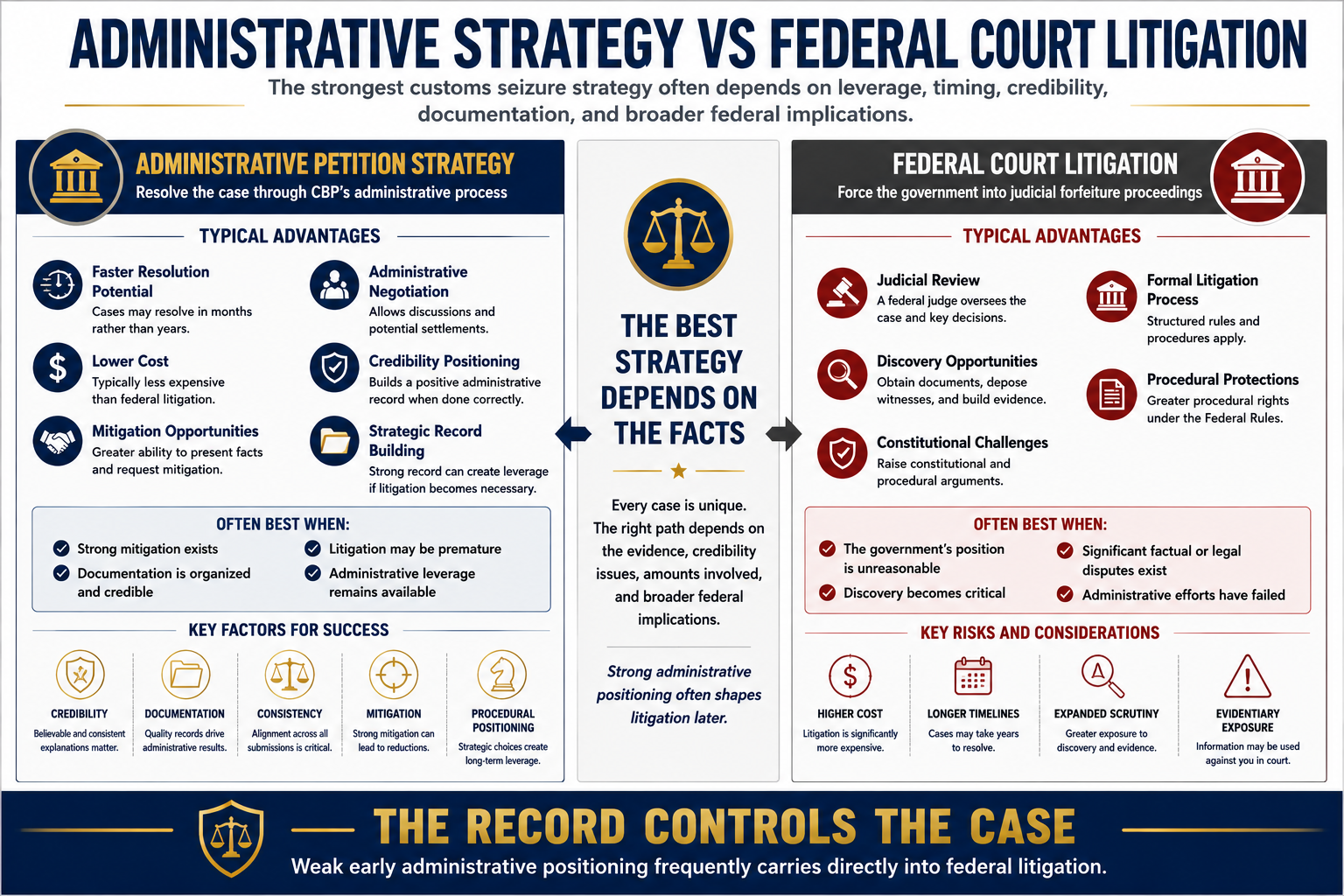
Why Litigation Is Not Always the Strongest First Move
One of the biggest misconceptions in customs forfeiture matters is that aggressive litigation automatically creates the best outcome.
In many situations, premature escalation may actually weaken:
- mitigation opportunities
- procedural flexibility
- negotiation posture
- administrative credibility
Weak administrative positioning often carries directly into litigation later.
Federal agencies frequently evaluate:
- credibility
- documentation quality
- procedural behavior
- mitigation efforts
long before courtroom litigation ever begins.
That is one reason why:
- inconsistent explanations
- weak documentation
- emotional submissions
- procedural mistakes
may later create substantial litigation problems.
In some situations, strong administrative strategy creates more leverage than immediate litigation because it allows:
- mitigation development
- organized documentation
- strategic positioning
- narrowing of disputes
- stronger credibility presentation
Additional discussion appears in Why Most People Lose CBP Seizure Cases Before They Even Begin and Why Hiring a Customs Seizure Lawyer Early Matters.
When Federal Litigation Sometimes Makes Strategic Sense
That does not mean litigation is never appropriate.
In some situations, federal litigation may become strategically important because:
- the government’s position appears unreasonable
- evidentiary disputes become central
- constitutional concerns exist
- stronger procedural protections are necessary
- discovery becomes important
- substantial money or property is involved
Litigation may sometimes create leverage where:
- the administrative process has stalled
- the government refuses reasonable mitigation
- credibility disputes become highly contested
- procedural fairness concerns arise
The key point is that litigation strategy should usually be driven by:
- the facts
- the evidence
- the procedural posture
- the broader federal implications
not simply emotion or frustration.
Additional discussion appears in How To Win a CBP Currency Seizure Case and How CBP Actually Decides Seizure Cases.
The Best Strategy Usually Depends on the Facts
There is no universal “best” procedural choice in customs seizure matters.
Some cases are strongly positioned for:
- administrative mitigation
- negotiated resolution
- procedural cooperation
- early settlement
Others may ultimately require:
- aggressive litigation
- discovery
- constitutional arguments
- judicial intervention
The strongest strategy often depends on:
- documentation quality
- credibility
- consistency
- mitigation opportunities
- financial records
- procedural timing
- broader federal exposure
Federal agencies often evaluate these matters institutionally rather than emotionally.
That is one reason why experienced customs seizure strategy frequently involves careful procedural analysis before major decisions are made.
Additional discussion appears in How Credibility Affects Customs Seizure Cases and Why Consistency Matters in Federal Seizure Cases.
Why National Security Law Firm Is Different
Many law firms approach customs seizure matters primarily as procedural forfeiture disputes.
National Security Law Firm approaches these matters differently.
The firm represents clients nationwide in:
- administrative forfeiture matters
- customs seizure litigation
- export-control issues
- federal administrative proceedings
- contractor-related matters
- overlapping federal investigations
National Security Law Firm focuses heavily on:
- administrative positioning
- procedural leverage
- mitigation strategy
- documentation analysis
- credibility management
- long-term federal implications
rather than simply reacting procedurally after the seizure occurs.
That broader federal-systems perspective becomes especially important because customs seizure matters often intersect with:
- immigration
- export licensing
- federal employment
- contractor eligibility
- security clearances
- future border scrutiny
- broader investigations
That is why National Security Law Firm repeatedly emphasizes:
the record controls the case.
For broader discussion of customs forfeiture strategy generally, visit the firm’s How Customs Seizure Cases Are Really Won page.
Frequently Asked Questions
Should I file an administrative petition or go to court?
The answer depends heavily on:
- the facts of the case
- the procedural posture
- the quality of the documentation
- credibility concerns
- mitigation opportunities
- broader federal implications
There is no universal “best” procedural choice.
What is judicial forfeiture?
Judicial forfeiture is federal court litigation involving the seizure and forfeiture of property.
It generally provides:
- judicial oversight
- procedural protections
- discovery opportunities
- evidentiary litigation
What is an administrative petition?
An administrative petition is a formal request asking the government to:
- return seized property
- mitigate forfeiture
- reduce penalties
based on supporting facts and documentation.
Is litigation stronger than an administrative petition?
Not necessarily.
In many situations, strong administrative positioning creates substantial leverage before litigation becomes necessary.
Can you win customs seizure cases administratively?
Yes.
Many customs seizure matters are resolved administratively through:
- mitigation
- settlement
- procedural negotiations
- administrative petitions
Does federal court litigation increase costs?
Often, yes.
Litigation frequently increases:
- complexity
- timelines
- evidentiary disputes
- procedural exposure
What makes a strong administrative petition?
Strong petitions often involve:
- organized documentation
- disciplined communication
- mitigation strategy
- credibility
- procedural positioning
Can weak administrative positioning hurt litigation later?
Absolutely.
Federal agencies often compare:
- inspection statements
- administrative submissions
- financial records
- mitigation explanations
- litigation positions
Weak early positioning may later create:
- credibility concerns
- procedural complications
- evidentiary problems
Does credibility matter in federal court too?
Yes.
Credibility and consistency often remain critically important throughout:
- administrative proceedings
- mitigation negotiations
- litigation
- settlement discussions
Speak With a Nationwide Customs Seizure Lawyer
If CBP seized your money, merchandise, shipment, vehicle, package, or other property, the procedural decisions made early in the process may significantly affect:
- mitigation opportunities
- litigation leverage
- credibility assessments
- broader federal consequences
Many customs seizure matters are heavily influenced by:
- procedural positioning
- documentation quality
- consistency of explanations
- mitigation strategy
- administrative record development
That is why National Security Law Firm repeatedly emphasizes:
the record controls the case.
National Security Law Firm offers nationwide representation and free consultations for customs seizure and administrative forfeiture matters.
The fastest and easiest way to get started is through the firm’s online booking system.
In many situations, same-day consultations are available, and the process typically takes less than a minute to schedule online.
Once booked, an attorney will personally call you at the scheduled time to discuss:
- the seizure
- procedural posture
- administrative strategy
- litigation considerations
- documentation issues
- broader federal implications
To schedule a consultation online, visit:
Book a Free Consultation Online
You may also contact the firm directly at:
Phone: (202) 600-4996
Additional related resources:
- Election of Proceedings Form Explained
- What Is a Petition for Remission or Mitigation?
- The Record Controls the Case: Why Your First Submission Matters
- How CBP Actually Decides Seizure Cases
- Why Hiring a Customs Seizure Lawyer Early Matters
- How Customs Seizure Cases Are Really Won
- Customs Seizure Lawyers Resource Hub