
What Guideline C Actually Means in Plain English
Guideline C is the part of the security clearance system that deals with foreign preference.
At its core, this guideline asks:
👉 Has this person acted in a way that suggests they prefer another country’s rights, protection, benefits, or obligations over those of the United States?
That sounds severe.
But in real clearance cases, Guideline C often begins with conduct that feels ordinary, practical, or harmless to the applicant.
Examples include:
- keeping or using a foreign passport
- voting in a foreign election
- serving in a foreign military before becoming a U.S. citizen
- accepting foreign government benefits
- maintaining dual citizenship
- using foreign citizenship documents
- failing to surrender or destroy a foreign passport when required or advised
Many applicants facing Guideline C concerns are not disloyal.
Many are naturalized U.S. citizens, dual citizens by birth, military members, contractors, federal employees, or professionals with family and cultural ties abroad.
They often feel blindsided because they never viewed their foreign citizenship or foreign documents as a security issue.
But adjudicators look at these facts differently.
They are not only asking:
👉 “Is this person loyal?”
They are asking:
👉 “Does this person’s conduct demonstrate a preference for a foreign country that could create doubt about judgment, reliability, or allegiance?”
That distinction matters.
Guideline C is not primarily about heritage, ethnicity, family background, or where you were born.
It is about actions.
The government is usually more concerned with what you did with foreign citizenship than the mere fact that foreign citizenship exists.
At National Security Law Firm, our security clearance lawyers include former adjudicators, former government attorneys, military lawyers, and national security insiders who understand how Guideline C is actually applied in real clearance decisions.
That insider perspective matters because the difference between a manageable foreign preference issue and a clearance denial often turns on:
- how the conduct is framed
- whether the record shows clear U.S. preference now
- whether the foreign activity was voluntary or required
- whether the issue was disclosed consistently
- and whether the adjudicator can defend approval despite the concern
In other words:
👉 the issue is not just what happened.
👉 the issue is what the record suggests about your loyalty and future reliability.
Quick Answer: Can Foreign Preference Affect Your Security Clearance?
Yes.
Guideline C can affect your security clearance if your conduct suggests a preference for a foreign country over the United States.
This may include:
- using a foreign passport after becoming a U.S. citizen
- voting in a foreign election
- serving in a foreign military
- accepting foreign government benefits
- exercising rights of foreign citizenship
- refusing to surrender or renounce foreign citizenship documents when required
But this is critical:
👉 dual citizenship alone does not automatically disqualify you from a security clearance.
Many dual citizens hold clearances.
Many naturalized citizens hold clearances.
Many applicants born abroad successfully obtain and maintain clearances.
The issue is not simply whether you have another citizenship.
The issue is:
👉 whether you have acted in a way that shows preference for that citizenship over your obligations to the United States.
That is why two applicants with dual citizenship can have very different outcomes.
One applicant may hold dual citizenship only because of birth or parentage, never use a foreign passport, fully disclose the issue, and demonstrate clear U.S. allegiance.
Another may actively use a foreign passport, vote abroad, seek foreign benefits, and inconsistently explain those actions.
Those are very different clearance records.
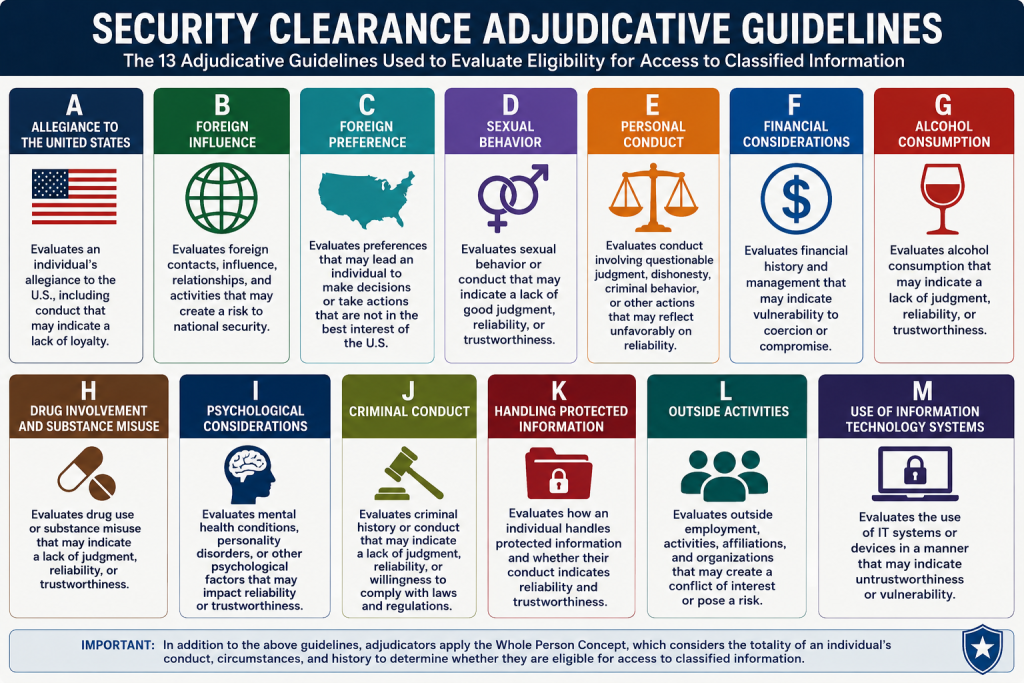
To understand how Guideline C fits into the broader decision framework, review the
👉 Security Clearance Adjudicative Guidelines
Why Guideline C Cases Feel So Personal
Guideline C cases often feel deeply personal because they can involve identity, family history, immigration background, culture, and belonging.
Applicants often think:
- “I was born with this citizenship. How can that be held against me?”
- “I only used the passport because it was easier.”
- “I voted in that election before I understood the clearance rules.”
- “My military service abroad was mandatory.”
- “I’ve always considered myself loyal to the United States.”
Those reactions are understandable.
But they can also lead applicants to respond emotionally instead of strategically.
That is dangerous.
Because adjudicators are not evaluating your emotional connection to another country.
They are evaluating:
👉 whether your actions create a record that appears inconsistent with exclusive loyalty to the United States.
That does not mean the government expects every applicant to erase their history.
It means the government wants to see that any foreign citizenship, foreign documents, or foreign obligations do not create current or future security risk.
This is why Guideline C cases are often won or lost on:
- timing
- disclosure
- intent
- remediation
- and whether foreign preference behavior has clearly stopped
Why Guideline C Is So Misunderstood
Guideline C is often confused with Guideline B.
That confusion causes real problems.
Guideline B deals with foreign influence.
That means the government is concerned that foreign people, foreign family members, foreign contacts, or foreign interests could pressure or influence you.
Guideline C deals with foreign preference.
That means the government is concerned that your own conduct may show preference for another country.
Put simply:
👉 Guideline B is usually about foreign people or interests that may influence you.
👉 Guideline C is about your actions that may suggest preference for a foreign country.
This distinction matters enormously.
For example:
Having parents who live overseas is typically a Guideline B issue.
Using a foreign passport after becoming a U.S. citizen is typically a Guideline C issue.
Failing to disclose either issue can also create a:
👉 Guideline E – Personal Conduct
problem.
This is where many cases become harder than they needed to be.
The original issue may be manageable.
But if the applicant minimizes it, hides it, inconsistently explains it, or fails to correct the record, adjudicators may begin to question credibility.
And once credibility enters the case:
👉 the burden becomes much heavier.
Why the Insider Perspective Matters in Foreign Preference Cases
Most online discussions of Guideline C focus on lists:
- foreign passport
- dual citizenship
- foreign military service
- foreign voting
- foreign benefits
That is useful, but it is not enough.
The real question is:
👉 how will an adjudicator interpret those facts?
At National Security Law Firm, we approach Guideline C cases from the perspective of the decision-maker.
Our team understands how adjudicators evaluate:
- whether conduct was voluntary or unavoidable
- whether foreign citizenship was acquired by birth or choice
- whether foreign passport use was recent or remote
- whether the applicant stopped exercising foreign citizenship rights
- whether U.S. ties outweigh foreign preference concerns
- whether the record supports a defensible approval
This is not abstract.
In a Guideline C case, an adjudicator may look at a foreign passport and ask:
👉 “Why did the applicant keep this?”
They may look at foreign voting and ask:
👉 “Why did the applicant participate in another country’s political system?”
They may look at foreign military service and ask:
👉 “Was this mandatory, historical, or voluntary?”
They may look at foreign benefits and ask:
👉 “Does this create continuing obligation or preference?”
The strongest cases do not merely answer those questions.
They build a record that makes the answers easy to approve.
What This Guide Will Help You Understand
If you are dealing with a Guideline C issue—or worried that one may arise—this guide will explain:
- what foreign preference actually means
- how Guideline C differs from foreign influence
- when dual citizenship becomes a clearance concern
- why foreign passport use is so serious
- how foreign voting, military service, and government benefits are evaluated
- what mitigation actually works
- where applicants accidentally make their cases worse
- and how successful cases are built around clarity, consistency, and defensibility
Most importantly, this guide will help you understand how the government views foreign preference from a security-risk perspective.
Because until you understand that:
👉 you may be trying to explain your identity when the government is evaluating your conduct.
That mismatch is where many cases begin to fail.
When Guideline C Actually Comes Up in Real Cases
Guideline C issues usually arise when an applicant has taken some action that appears to exercise the rights, privileges, or obligations of foreign citizenship.
Sometimes the conduct is obvious.
Sometimes the applicant genuinely does not understand why it matters.
Common triggers include the following.
Foreign Passport Possession or Use
Foreign passport issues are among the most serious and common Guideline C triggers.
The concern is strongest when an applicant uses a foreign passport after becoming a U.S. citizen.
Why?
Because a passport is not just a travel document.
To adjudicators, using a foreign passport may suggest that the applicant is invoking the protection, identity, or benefits of another sovereign government.
Applicants often explain:
👉 “It was easier.”
👉 “It avoided visa problems.”
👉 “My family told me to use it.”
👉 “I did not think it mattered.”
But those explanations may not be enough.
The government may ask:
- Why was the foreign passport maintained?
- Why was it used instead of a U.S. passport?
- Was the use recent?
- Was the use voluntary?
- Has the applicant surrendered it?
- Does the applicant understand why it created concern?
Foreign passport use is often mitigable.
But it must be handled carefully.
A casual explanation can make the issue worse.
Dual Citizenship
Dual citizenship by itself is not automatically disqualifying.
This is one of the most important points on the page.
Many people are dual citizens because of:
- birth abroad
- parents’ citizenship
- foreign nationality laws
- automatic citizenship rules
- family history
That is very different from actively seeking foreign citizenship as an adult.
Adjudicators usually care about:
- how dual citizenship was acquired
- whether the applicant exercised foreign citizenship rights
- whether the applicant used foreign documents
- whether the applicant voted in foreign elections
- whether the applicant accepted benefits from the foreign country
- whether the applicant is willing to renounce or surrender documents if required
The question is not simply:
👉 “Are you a dual citizen?”
The better question is:
👉 “Have you acted like that foreign citizenship is something you still rely on?”
Voting in Foreign Elections
Voting in a foreign election can create a serious Guideline C concern.
To many applicants, voting may feel harmless.
They may think:
- “I was allowed to vote.”
- “It was local.”
- “It was years ago.”
- “My family encouraged me.”
But adjudicators may see foreign voting differently.
Voting is an exercise of political rights.
It can suggest participation in another country’s civic system.
That does not always mean denial.
But the applicant must explain:
- when the voting occurred
- why it occurred
- whether it happened before or after U.S. citizenship
- whether it was repeated
- whether the applicant continues to participate in foreign political life
- and whether the applicant understands why the conduct matters
Foreign voting becomes especially serious when it is recent, repeated, or inconsistent with statements about exclusive U.S. allegiance.
Foreign Military Service
Foreign military service can trigger Guideline C, but context matters enormously.
Adjudicators evaluate whether the service was:
- mandatory or voluntary
- before or after U.S. citizenship
- brief or extensive
- in an allied or hostile country
- connected to sensitive roles
- accompanied by continuing obligations
- or tied to an ongoing willingness to serve another country
Mandatory service before U.S. citizenship is often easier to mitigate than voluntary service after becoming a U.S. citizen.
The key is not simply that foreign military service occurred.
The key is what that service says about present loyalty, obligation, and risk.
Foreign Government Benefits
This is one of the most overlooked Guideline C categories.
Applicants often do not realize that accepting benefits from a foreign government can raise foreign preference concerns.
Examples include:
- foreign retirement or pension benefits
- government-sponsored healthcare
- educational subsidies
- housing programs
- financial support programs
- special citizenship-based privileges
Applicants commonly think:
👉 “I paid into the system.”
Or:
👉 “This is normal in my home country.”
But adjudicators are evaluating something different.
They are asking:
👉 “Does this create continuing obligation, loyalty, or preference toward a foreign government?”
This does not mean foreign benefits automatically result in denial.
Many are mitigable.
But the issue must be:
- disclosed clearly
- explained properly
- and evaluated strategically
The more financially important the benefit becomes:
👉 the more scrutiny it may create.
Foreign Public Office or Government Service
Serving in a foreign government role is one of the more serious Guideline C issues.
This may include:
- elected office
- government employment
- advisory positions
- public-sector appointments
- political candidacy
- foreign civil service
The government evaluates whether the applicant:
- exercised allegiance obligations to another nation
- accepted duties inconsistent with exclusive U.S. loyalty
- or maintains continuing obligations abroad
Again:
👉 timing matters enormously.
Conduct that occurred long before U.S. citizenship is usually viewed differently than recent or ongoing foreign government involvement.
What the Government Is Actually Worried About
To truly understand Guideline C, you have to understand the core government concern.
The government is not trying to erase your background, culture, or heritage.
It is evaluating:
👉 whether your conduct suggests preference for another country over the United States.
That concern generally falls into several categories.
1. Divided Loyalty Concerns
This is the heart of Guideline C.
The government worries that certain actions may suggest:
- competing allegiance
- emotional preference
- political preference
- legal obligation
- or practical reliance on another country
This does not mean adjudicators believe applicants are traitors.
It means they are evaluating whether the applicant’s actions create:
👉 doubt.
And in clearance law:
👉 unresolved doubt becomes risk.
2. Symbolic Allegiance
Many Guideline C actions are viewed symbolically.
Examples include:
- voting abroad
- traveling on a foreign passport
- renewing foreign citizenship documents
- serving in a foreign military
- taking foreign oaths
Applicants often focus on intent.
They explain:
👉 “I didn’t mean anything by it.”
But adjudicators frequently focus on:
👉 what the action objectively communicates.
This is why foreign passport use is so heavily scrutinized.
A passport is not viewed merely as convenience.
It is viewed as:
👉 invocation of another country’s protection and identity.
3. Continuing Foreign Obligations
The government also evaluates whether applicants maintain:
- legal obligations
- military obligations
- political obligations
- financial dependence
- or citizenship privileges abroad
The concern is not always immediate disloyalty.
It is often:
👉 whether those obligations could create future conflict.
4. Reliability and Judgment
Many Guideline C cases ultimately become judgment cases.
Adjudicators evaluate:
- whether the applicant understood the significance of the conduct
- whether the applicant followed security guidance
- whether the applicant corrected the issue promptly
- whether the applicant was transparent
Applicants who continue exercising foreign citizenship rights after being warned often create much greater concern.
5. Credibility and Disclosure Issues
Like many guidelines, Guideline C becomes significantly more dangerous when:
- conduct is minimized
- explanations shift
- foreign activities are hidden
- or disclosures are inconsistent
This is where the case often overlaps with:
👉 Guideline E – Personal Conduct
And once credibility concerns appear:
👉 mitigation becomes much harder.
The Guideline C Statute (Full Text)
The full statutory language for Guideline C can be reviewed here:
👉 Guideline C — Foreign Preference (Full Text)
The regulation explains:
- what types of foreign preference conduct can raise concern
- how foreign citizenship rights are evaluated
- and what mitigating conditions adjudicators may consider
But reading the statute alone is not enough.
Because Guideline C cases are rarely decided based only on the conduct itself.
They are decided based on:
- context
- timing
- mitigation
- credibility
- and whether the adjudicator believes the concern has truly been resolved
That is why two applicants with similar foreign citizenship backgrounds can receive completely different outcomes.
👉 The difference is usually not the foreign citizenship itself.
👉 It is how the record is built around it.
How Adjudicators Actually Evaluate Guideline C Cases
This is where insider perspective matters most.
Adjudicators do not evaluate Guideline C cases mechanically.
They evaluate them through a risk-and-loyalty framework.
The key questions are often:
- Was the conduct voluntary?
- Was it recent?
- Does it continue?
- Did the applicant understand the significance?
- Was the issue disclosed properly?
- Does the applicant now clearly demonstrate U.S. preference?
This evaluation is much more nuanced than many applicants realize.
Intent vs. Convenience
One of the most common arguments applicants make is:
👉 “I only used the passport because it was easier.”
Convenience explanations can help—but only to a point.
Because adjudicators may still ask:
- Why was the foreign passport maintained at all?
- Why was U.S. documentation not sufficient?
- Did the applicant understand the implications?
Convenience does not automatically eliminate concern.
But it may help distinguish:
👉 practical conduct from ideological preference.
Timing Matters Enormously
Adjudicators heavily evaluate:
- whether the conduct occurred before or after U.S. citizenship
- whether it occurred before holding a clearance
- whether it has stopped
- and how recent it was
For example:
Mandatory foreign military service completed before immigration to the United States is usually viewed differently than:
👉 voluntary foreign military activity after becoming a U.S. citizen.
Likewise:
Voting abroad once years ago may be viewed differently than:
👉 repeated recent participation in foreign political systems.
Was the Conduct Corrected Promptly?
This becomes one of the most important mitigation issues.
Adjudicators often look for:
- surrender of foreign passports
- discontinuation of foreign benefits
- cessation of foreign political participation
- willingness to renounce citizenship if necessary
- compliance with agency guidance
Applicants who act proactively often fare much better than applicants who:
- argue the issue endlessly
- delay corrective action
- or minimize the significance of the conduct
What the Conduct Suggests About Future Loyalty
This is the ultimate issue in Guideline C.
The government is not only evaluating what happened in the past.
It is evaluating:
👉 what your conduct suggests about future allegiance and reliability.
That is why the strongest Guideline C cases are built around:
- clear U.S. preference
- strong U.S. ties
- transparency
- credibility
- and absence of continuing foreign preference behavior
The “Paper Risk” Problem in Guideline C Cases
This is one of the most important concepts in clearance law.
Even where the underlying conduct is manageable…
👉 the way it appears in the record can still create denial risk.
This is what we call:
👉 paper risk.
Examples include:
- vague explanations
- inconsistent timelines
- unclear passport history
- conflicting disclosures
- incomplete travel explanations
- shifting stories about foreign benefits or voting
Once the record begins to feel:
- unclear
- evasive
- or inconsistent
👉 adjudicators become uncomfortable approving the file.
That discomfort matters enormously.
Because adjudicators are constantly asking themselves:
👉 “Can I defend approving this person later?”
If the answer becomes uncertain:
👉 the case becomes much harder to win.
Why Some Guideline C Cases Feel Unfair
Many applicants become frustrated because they feel:
👉 “I was born with this citizenship.”
Or:
👉 “This is part of my family identity.”
Or:
👉 “I did not realize this would matter.”
Those reactions are understandable.
But the security clearance system is not evaluating emotional fairness.
It is evaluating:
👉 perceived national security risk.
That distinction explains why some actions that feel harmless to applicants still create major concern inside the clearance system.
The Biggest Mistake Applicants Make Under Guideline C
The biggest mistake is:
👉 treating foreign preference concerns casually.
Applicants often say:
- “It was only for convenience.”
- “It wasn’t political.”
- “I didn’t think it mattered.”
- “Everyone in my family does this.”
But to adjudicators, those statements may suggest:
👉 the applicant still does not understand why the conduct creates concern.
And if the applicant does not understand the concern:
👉 adjudicators may worry the conduct will continue.
What Strong Mitigation Actually Looks Like
Strong Guideline C mitigation usually includes:
- surrendering or destroying foreign passports
- discontinuing foreign citizenship privileges
- stopping foreign political participation
- clear, consistent explanations
- demonstrating strong U.S. ties
- showing that conduct was historical, isolated, or unavoidable
- complying with agency guidance immediately
- demonstrating understanding of the concern
Most importantly:
👉 the record must show clear preference for the United States now.
Advanced Strategy: How to Actually Beat a Guideline C Concern
Most applicants approach Guideline C emotionally.
That is understandable.
The allegations often feel deeply personal.
Applicants think:
- “I love America.”
- “I served this country.”
- “I’ve always considered myself loyal.”
- “This is just my heritage.”
But Guideline C cases are not usually won through emotional explanations.
They are won through:
👉 strategic resolution of perceived divided loyalty concerns.
That distinction is critical.
Because adjudicators are not evaluating your feelings alone.
They are evaluating:
👉 whether your conduct creates unresolved doubt about your allegiance, judgment, or reliability.
Strategy Shift #1: Stop Defending Dual Citizenship Itself
One of the biggest mistakes applicants make is arguing:
👉 “There’s nothing wrong with dual citizenship.”
Legally and morally, that may be true.
But arguing abstract fairness usually does not help the case.
Because the adjudicator is not deciding:
👉 whether dual citizenship should exist.
They are deciding:
👉 whether your actions create security concern.
Strong cases therefore focus less on defending dual citizenship philosophically…
and more on demonstrating:
👉 clear operational preference for the United States.
Strategy Shift #2: Understand the Difference Between Status and Conduct
This is one of the most important concepts in Guideline C.
Status is:
- being born with foreign citizenship
- having foreign parents
- automatically qualifying for another nationality
Conduct is:
- using a foreign passport
- voting abroad
- accepting foreign government privileges
- exercising foreign citizenship rights
Adjudicators are usually far more concerned with:
👉 conduct.
This distinction becomes extremely important in mitigation strategy.
Strategy Shift #3: Resolve Ongoing Foreign Preference Behavior
Historical conduct is usually easier to mitigate than ongoing conduct.
For example:
A foreign passport used once years ago before understanding the rules may be manageable.
A foreign passport still actively used after security warnings is much more dangerous.
Strong mitigation therefore often involves:
- surrendering foreign passports
- ending foreign political participation
- discontinuing foreign citizenship privileges
- documenting corrective action early
This demonstrates:
👉 present U.S. preference.
Strategy Shift #4: Avoid “Convenience” Overuse
Convenience explanations are common in Guideline C cases.
Applicants often say:
- “I only used the passport because travel was easier.”
- “I only voted because my family encouraged me.”
- “I only kept the passport for emergencies.”
These explanations may help in moderation.
But overusing them can backfire.
Because adjudicators may begin asking:
👉 “If U.S. citizenship was truly primary, why was foreign citizenship still actively exercised?”
Convenience alone is rarely enough.
Strong cases combine convenience explanations with:
- corrective action
- transparency
- and clear present allegiance to the U.S.
Strategy Shift #5: Build the Record Around Present Loyalty
This is one of the strongest strategic approaches in Guideline C cases.
The goal is not simply to explain past conduct.
The goal is to demonstrate:
👉 current, exclusive operational preference for the United States.
That often means emphasizing:
- U.S. military service
- federal service
- U.S.-based family life
- U.S. residence
- U.S. voting history
- U.S. financial and professional ties
- surrender of foreign documents
- and compliance with security guidance
Strong cases make the adjudicator feel:
👉 the applicant’s life is clearly anchored in the United States.
Illustrative Case Scenarios (How Guideline C Plays Out in Real Situations)
The examples below are hypothetical scenarios based on common fact patterns seen in security clearance cases. They are designed to show how adjudicators typically evaluate risk under Guideline C—not to predict outcomes in any specific case.
Scenario 1 — Dual Citizen by Birth, No Foreign Passport Use (Likely Approval)
An applicant was born with dual U.S.-Canadian citizenship through their parents.
However:
- the applicant only uses a U.S. passport
- has never voted in Canada
- has no Canadian government benefits
- fully disclosed dual citizenship
👉 Likely Outcome: Approved
Why this works:
The dual citizenship exists by status, not active foreign preference conduct.
Scenario 2 — Foreign Passport Used Repeatedly After Naturalization (Moderate to High Risk)
An applicant became a U.S. citizen but continued using a foreign passport for international travel because it was “easier.”
The conduct:
- continued for several years
- occurred after obtaining clearance eligibility
- was not corrected until after investigation began
👉 Likely Outcome: Significant scrutiny, possible denial
Why this creates concern:
Repeated voluntary use suggests ongoing exercise of foreign citizenship rights.
Scenario 3 — Mandatory Foreign Military Service Before U.S. Citizenship (Often Mitigable)
An applicant completed mandatory military service in South Korea before immigrating to the United States.
The applicant:
- later became a U.S. citizen
- has no continuing military obligations abroad
- disclosed the service fully
- demonstrates strong U.S. ties
👉 Likely Outcome: Often approved with proper mitigation
Why this works:
The conduct was historical, mandatory, and occurred before U.S. citizenship.
Scenario 4 — Voting in a Foreign Election After U.S. Citizenship (Moderate Risk)
An applicant voted in a foreign election after becoming a U.S. citizen because family members encouraged participation.
The applicant:
- initially minimized the significance
- later acknowledged the concern
- ceased all foreign political participation afterward
👉 Likely Outcome: Depends heavily on mitigation and timing
Why this creates concern:
Voting is viewed as active exercise of foreign political rights.
Scenario 5 — Refusal to Surrender Foreign Passport (High Risk)
An applicant continued maintaining a foreign passport after being advised to surrender it.
The applicant argued:
👉 “I want to keep my options open.”
👉 Likely Outcome: High risk of denial
Why this fails:
The conduct strongly suggests continuing preference for foreign citizenship protections.
Scenario 6 — Foreign Retirement Benefits With Strong U.S. Ties (Often Mitigable)
An applicant receives small retirement payments from a foreign government tied to prior overseas employment.
However:
- the payments are minimal
- the applicant’s life is entirely U.S.-centered
- there are no other foreign preference indicators
👉 Likely Outcome: Often mitigable
Why this works:
The benefits do not appear to create meaningful divided loyalty or dependence.
Scenario 7 — Foreign Passport Surrendered Early (Strong Mitigation)
An applicant realized foreign passport possession could create concern and voluntarily surrendered the passport before any investigation or SOR occurred.
👉 Likely Outcome: Strong mitigation factor
Why this works:
Proactive corrective action demonstrates understanding and present U.S. preference.
Scenario 8 — “I Didn’t Think It Mattered” Defense (Weak Mitigation)
An applicant repeatedly explains:
👉 “I didn’t realize using my foreign passport mattered.”
But:
- the conduct continued for years
- no corrective action was taken
- explanations remained vague
👉 Likely Outcome: Weak mitigation
Why this fails:
Lack of insight into the significance of the conduct creates continuing concern.
How Guideline C Foreign Preference Concerns Are Actually Mitigated
Many applicants assume that once foreign preference concerns appear, their clearance is effectively over.
That is not true.
In reality, many Guideline C cases are highly mitigable when the issue is handled strategically and the record is built correctly.
The key is understanding what adjudicators are actually evaluating:
👉 foreign passport use
👉 dual citizenship conduct
👉 foreign voting
👉 foreign military service
👉 foreign government benefits
👉 credibility
👉 and whether the applicant’s conduct still creates unresolved divided-loyalty or foreign-preference concern
Strong mitigation often involves:
- surrendering foreign passports
- ending foreign political participation
- demonstrating strong U.S. ties
- clarifying historical or mandatory foreign obligations
- correcting disclosures early
- and showing clear operational preference for the United States now
For a deeper breakdown of what actually helps—and hurts—Guideline C cases, including dual citizenship, foreign passports, foreign voting, foreign military service, and foreign government benefit issues, review:
👉 How to Mitigate a Guideline C Foreign Preference Concern
You should also review these related foreign preference and foreign influence resources:
👉 Can You Lose Your Security Clearance for Dual Citizenship?
👉 Can You Lose Your Security Clearance for Holding a Foreign Passport?
👉 Can You Lose Your Security Clearance for Voting in a Foreign Election?
👉 Can Foreign Contacts Cost You Your Clearance? (Guideline B)
👉 Can You Lose Your Security Clearance for a Foreign Spouse?
👉 Can You Get a Security Clearance With Foreign Family Members?
What Actually Gets Guideline C Cases Approved
Successful Guideline C cases usually share several characteristics:
- foreign citizenship was acquired passively or by birth
- problematic conduct stopped
- foreign passports were surrendered
- explanations remain consistent
- no ongoing exercise of foreign political rights exists
- applicant demonstrates strong U.S. allegiance and ties
- applicant understands why the conduct created concern
Most importantly:
👉 the adjudicator believes the applicant’s present loyalty and operational preference clearly favor the United States.
What Causes Denial Under Guideline C
Guideline C denials usually result from:
- ongoing foreign passport use
- continuing foreign political participation
- refusal to surrender foreign citizenship privileges
- inconsistent explanations
- minimization of the issue
- repeated exercise of foreign citizenship rights
- unresolved divided-loyalty concerns
- overlap with credibility problems
Again:
👉 the issue is often not the existence of foreign citizenship itself.
The issue is:
👉 what the applicant chose to do with it.
Where Guideline C Cases Collapse
Most Guideline C cases do not fail because the applicant was born abroad.
They fail because the issue escalates over time.
Stage 1 — Foreign Citizenship Identified
Dual citizenship or foreign ties are disclosed.
Stage 2 — Foreign Preference Conduct Discovered
Passport use, voting, benefits, or foreign obligations appear.
Stage 3 — Applicant Minimizes the Conduct
Explanations become casual, vague, or dismissive.
Stage 4 — Corrective Action Delayed
Passports remain active or conduct continues.
Stage 5 — Credibility Issues Develop
Statements shift or disclosures become inconsistent.
Stage 6 — Guideline E Overlap
The issue expands beyond foreign preference into trustworthiness concerns.
Stage 7 — SOR or Denial
The concern hardens into formal clearance action.
👉 Final outcome: denial or revocation.
How Guideline C Interacts With Other Guidelines
Guideline C rarely exists entirely alone.
It frequently overlaps with several other guidelines.
Guideline B — Foreign Influence
This is the most common overlap.
Guideline B evaluates whether foreign people or interests could influence you.
Guideline C evaluates whether your own conduct demonstrates foreign preference.
The two frequently appear together.
See:
👉 Guideline B — Foreign Influence
Guideline E — Personal Conduct
If foreign preference conduct is:
- concealed
- minimized
- inconsistently disclosed
- or dishonestly explained
the case often expands into:
👉 Guideline E — Personal Conduct
Guideline A — Allegiance to the United States
In more serious cases, adjudicators may begin evaluating broader loyalty concerns under:
👉 Guideline A — Allegiance to the United States
👉 Once multiple guidelines apply, mitigation becomes significantly harder.
How Guideline C Appears Throughout the Security Clearance Process
Guideline C issues can arise at nearly every stage of the security clearance process.
Many applicants mistakenly assume:
👉 “If I explain it once, the issue goes away.”
That is not how the system works.
Foreign preference concerns often follow the applicant throughout:
- the SF-86 process
- the background investigation
- subject interviews
- Letters of Interrogatory (LOIs)
- Statements of Reasons (SORs)
- hearings and appeals
- and even future reinvestigations or continuous vetting reviews
This is why early record control matters so much.
The SF-86 Stage
For many applicants, Guideline C issues first appear during completion of the:
👉 SF-86 Security Clearance Form
This is where applicants disclose:
- dual citizenship
- foreign passports
- foreign military service
- foreign government benefits
- foreign travel
- foreign political participation
- and related foreign preference conduct
This stage is critical because:
👉 the SF-86 becomes the foundation of the investigative record.
If the issue is:
- incompletely disclosed
- poorly explained
- minimized
- or inconsistently described
those problems often follow the applicant throughout the entire process.
The Investigation Stage
During the:
👉 security clearance investigation
investigators may verify:
- passport usage
- travel records
- citizenship status
- foreign benefits
- voting activity
- military records
- and foreign government ties
Applicants are often surprised by how thoroughly these issues are investigated.
This is especially true where:
- foreign travel is extensive
- passport records conflict
- disclosures are inconsistent
- or the foreign country is considered high-risk
The Subject Interview
The:
👉 security clearance subject interview
is one of the most important stages in Guideline C cases.
This is where investigators evaluate:
- credibility
- understanding of the issue
- emotional reactions
- willingness to comply with guidance
- and overall judgment
Applicants often unintentionally damage their cases during interviews by:
- minimizing conduct
- casually dismissing concerns
- becoming defensive
- or changing details from earlier disclosures
This is dangerous because once credibility concerns emerge:
👉 the case often expands into Guideline E territory.
The LOI Stage
If concerns remain unresolved, applicants may receive a:
👉 Letter of Interrogatory (LOI)
This stage is extremely important.
The government is usually attempting to:
- clarify foreign preference conduct
- lock in explanations
- evaluate mitigation
- and determine whether the issue is escalating
Poorly handled LOI responses often become:
👉 the blueprint for later allegations.
This is one reason strategic guidance early in the process matters so much.
The Statement of Reasons (SOR) Stage
If the government believes unresolved concerns remain, the applicant may receive a:
At this stage:
👉 the issue has hardened into a formal clearance concern.
The government is now alleging that the applicant’s conduct creates doubts about loyalty, judgment, reliability, or trustworthiness under Guideline C.
This is where:
- mitigation
- documentation
- credibility
- and strategic framing
become absolutely critical.
The Hearing and Appeal Stage
Some Guideline C cases proceed to:
- DOHA hearings
- written appeals
- or agency review boards
At this point, adjudicators and judges often focus heavily on:
- whether the applicant truly understands the significance of the conduct
- whether the foreign preference behavior has stopped
- whether mitigation is genuine
- and whether approval is defensible going forward
This is why:
👉 continuing foreign preference conduct after warnings or investigations is so dangerous.
Learn more in:
👉 Security Clearance Hearings and DOHA Appeals
What Actually Wins Guideline C Cases
Most applicants think these cases are won by proving:
👉 “I love America.”
But Guideline C cases are rarely decided that simply.
What actually wins these cases is:
👉 a record demonstrating clear, present operational preference for the United States.
That means:
- foreign preference conduct has stopped
- foreign passports are surrendered
- disclosures are complete and consistent
- the applicant demonstrates strong U.S. ties
- and the adjudicator believes the concern is unlikely to recur
This is one of the most important realities of the security clearance process:
👉 adjudicators are not deciding whether you are patriotic in the abstract.
They are deciding:
👉 whether your record clearly supports approval.
That is why:
- clarity matters
- consistency matters
- timing matters
- and corrective action matters enormously
If you want to understand how successful security clearance cases are actually built, review:
👉 How to Win a Security Clearance Case Using Proven Mitigation and Record-Control Strategies
Decision Language Explained (What These Terms Actually Mean)
Guideline C cases often contain language that feels vague or intimidating.
Understanding these phrases gives you a major strategic advantage.
“Foreign Preference”
This does not mean the government believes you are disloyal.
It means:
👉 your conduct may suggest preference for another country’s protections, benefits, or obligations.
“Exercise of Foreign Citizenship Rights”
This refers to actions such as:
- using foreign passports
- voting abroad
- receiving foreign government privileges
- or otherwise acting under foreign citizenship status
“Divided Loyalty”
This does not mean adjudicators believe you are a traitor.
It means:
👉 they are concerned your conduct creates doubt about exclusive allegiance to the United States.
“Symbolic Allegiance”
Many Guideline C actions are viewed symbolically.
The government evaluates what those actions communicate about:
- loyalty
- identity
- and preference
—not just practical intent.
“Unresolved Concern”
This phrase drives many denials.
It means:
👉 the issue exists in the record, but the adjudicator does not believe it has been fully resolved.
“Clearly Consistent With National Security”
This is the actual approval standard.
It means:
👉 the adjudicator feels comfortable defending approval if the case is reviewed later.
If that comfort does not exist:
👉 approval usually does not happen.
Frequently Asked Questions About Guideline C
Is dual citizenship automatically disqualifying?
No.
Many dual citizens successfully hold security clearances.
The issue is usually not citizenship itself, but how foreign citizenship rights are exercised.
Can I keep a foreign passport?
Possibly—but active use of a foreign passport creates significant concern.
Many agencies expect surrender or destruction of foreign passports.
Can I travel using a foreign passport?
This is one of the most common Guideline C problems.
Using a foreign passport after becoming a U.S. citizen is often viewed as strong evidence of foreign preference.
Do I have to renounce foreign citizenship?
Not always.
But in some cases, willingness to renounce citizenship—or at least surrender foreign documents—becomes an important mitigating factor.
Does mandatory foreign military service matter?
Yes—but mandatory service before becoming a U.S. citizen is usually viewed differently than voluntary or ongoing foreign military involvement.
Can foreign government benefits affect my clearance?
Yes.
Benefits may create concern if they suggest continuing obligation or preference toward another country.
Can I recover from a Guideline C issue?
Absolutely.
Many Guideline C cases are mitigable with strong strategy and proper corrective action.
Does the country involved matter?
Yes.
Country context can affect how seriously the conduct is viewed, particularly where hostile or high-risk countries are involved.
Why National Security Law Firm
Most law firms approach Guideline C cases by focusing only on dual citizenship or foreign documents themselves.
That is not enough.
At National Security Law Firm, our security clearance lawyers understand that Guideline C cases are really about:
👉 how adjudicators interpret loyalty, judgment, and operational preference inside the national security system.
Our team includes:
- former adjudicators and federal insiders
- military and national security attorneys
- attorneys experienced in high-risk clearance matters
We do not simply explain your conduct.
We build records designed to make approval:
👉 understandable
👉 defensible
👉 and strategically supportable
Complex cases are reviewed through our internal
👉 Attorney Review Board
This means:
- multiple experienced attorneys review your file
- mitigation strategies are tested before submission
- weaknesses are identified early
- and your case is evaluated through the same layered institutional lens used by the government
Most clients come to us after receiving advice focused only on explanation.
But Guideline C cases are not won through explanation alone.
👉 They are won through clarity, corrective action, consistency, and strategic record control.
You can read what clients say about working with our team in our
👉 4.9-star Google reviews
Related Statutes and Guidance
Return to the full statute list in the
👉 Security Clearance Statutes and Regulations
Or explore how these rules are applied in real cases in the
👉 Security Clearance Lawyers Resource Center
If you want to go beyond the rule itself and understand how to actually win under Guideline C—how adjudicators evaluate foreign preference, what mitigation works, and how strong cases are built—review:
👉 How to Win a Security Clearance Case Using Proven Mitigation and Record-Control Strategies
Speak With a Security Clearance Lawyer Before the Record Hardens
If Guideline C is affecting your case, the most important question is not:
👉 “Do I have dual citizenship?”
It is:
👉 “What does my conduct suggest about my present loyalty and operational preference?”
Because once these concerns are documented:
👉 they are reused
👉 re-evaluated
👉 and often expanded into broader credibility or allegiance concerns
The earlier the issue is strategically addressed, the better the chance of preventing escalation into:
- an LOI
- an SOR
- suspension
- denial
- or revocation
If you want to evaluate your situation before the record hardens against you, you can:
👉 schedule a confidential consultation with a security clearance lawyer
The Record Controls the Case.
SECURITY CLEARANCE DENIED OR REVOKED
If you are appealing a security clearance determination, it is imperative that you obtain experienced legal representation. Doing so will provide you with the best opportunity to obtain or maintain your clearance.
Click Here For a No Obligation, Always Confidential Consultation