
What Guideline D Actually Means in Plain English
Guideline D is the part of the security clearance system that deals with sexual behavior.
That phrase can sound intrusive, embarrassing, or even unfair.
Many people hear “Guideline D” and immediately think:
👉 Why is the government looking at my private life?
That reaction is understandable.
But in security clearance cases, Guideline D is not supposed to be about morality, sexual orientation, private adult relationships, or judging consensual behavior for its own sake.
At its core, Guideline D asks:
👉 Does this person’s sexual behavior create a security risk because it involves criminal conduct, poor judgment, lack of discretion, coercion, exploitation, blackmail vulnerability, or behavior that could affect reliability and trustworthiness?
That distinction matters.
The government is not supposed to deny a clearance simply because someone has a private sex life, an unconventional relationship, a sexual orientation, or consensual adult conduct that others might not understand.
The concern is whether the conduct creates risk.
Examples may include:
- illegal sexual conduct
- sexual misconduct allegations
- sexual harassment allegations
- pornography-related issues
- sexual behavior involving workplace or government systems
- hidden affairs or secret relationships that could create blackmail risk
- compulsive or high-risk sexual behavior
- sexual behavior involving coercion, exploitation, or lack of consent
- conduct involving minors or illegal material
- false or inconsistent statements about sexual conduct during the clearance process
Many applicants facing Guideline D concerns are not dangerous, disloyal, or untrustworthy.
They are often professionals, contractors, federal employees, military members, or clearance holders who made a mistake, had a private issue exposed, faced an allegation, or disclosed something during a polygraph or investigation that suddenly became a national security concern.
That is what makes these cases so stressful.
The issue may feel intensely personal.
But once it enters the clearance system, adjudicators evaluate it through a national security lens.
At National Security Law Firm, our security clearance lawyers include former adjudicators, former government attorneys, military lawyers, and national security insiders who understand how sensitive conduct is evaluated in real clearance decisions.
That insider perspective matters because the difference between a manageable Guideline D issue and a clearance denial often turns on:
- whether the conduct was legal or illegal
- whether it was consensual or coercive
- whether it was private or public
- whether it created blackmail vulnerability
- whether there was a workplace or government-system connection
- whether the applicant disclosed it truthfully
- whether the behavior is isolated or recurring
- whether the record shows current stability, discretion, and reliability
In other words:
👉 the issue is not simply what happened.
👉 the issue is what the record suggests about judgment, discretion, vulnerability, and future reliability.
Quick Answer: Can Sexual Behavior Affect Your Security Clearance?
Yes.
Sexual behavior can affect your security clearance if it raises concerns under Guideline D.
But the key is this:
👉 consensual adult sexual behavior is not automatically disqualifying.
A clearance issue usually arises when the sexual behavior involves or suggests:
- criminal conduct
- coercion or exploitation
- poor judgment
- public or workplace misconduct
- vulnerability to blackmail
- use of government systems or workplace devices
- dishonesty, concealment, or inconsistent disclosure
- compulsive or repeated high-risk behavior
This is why two people with superficially similar facts can have very different outcomes.
One person may have private, consensual conduct that is not recent, not illegal, not secret in a blackmail-relevant way, and not likely to recur.
Another person may have conduct that is ongoing, hidden, illegal, workplace-related, or inconsistently explained.
Those are very different clearance records.
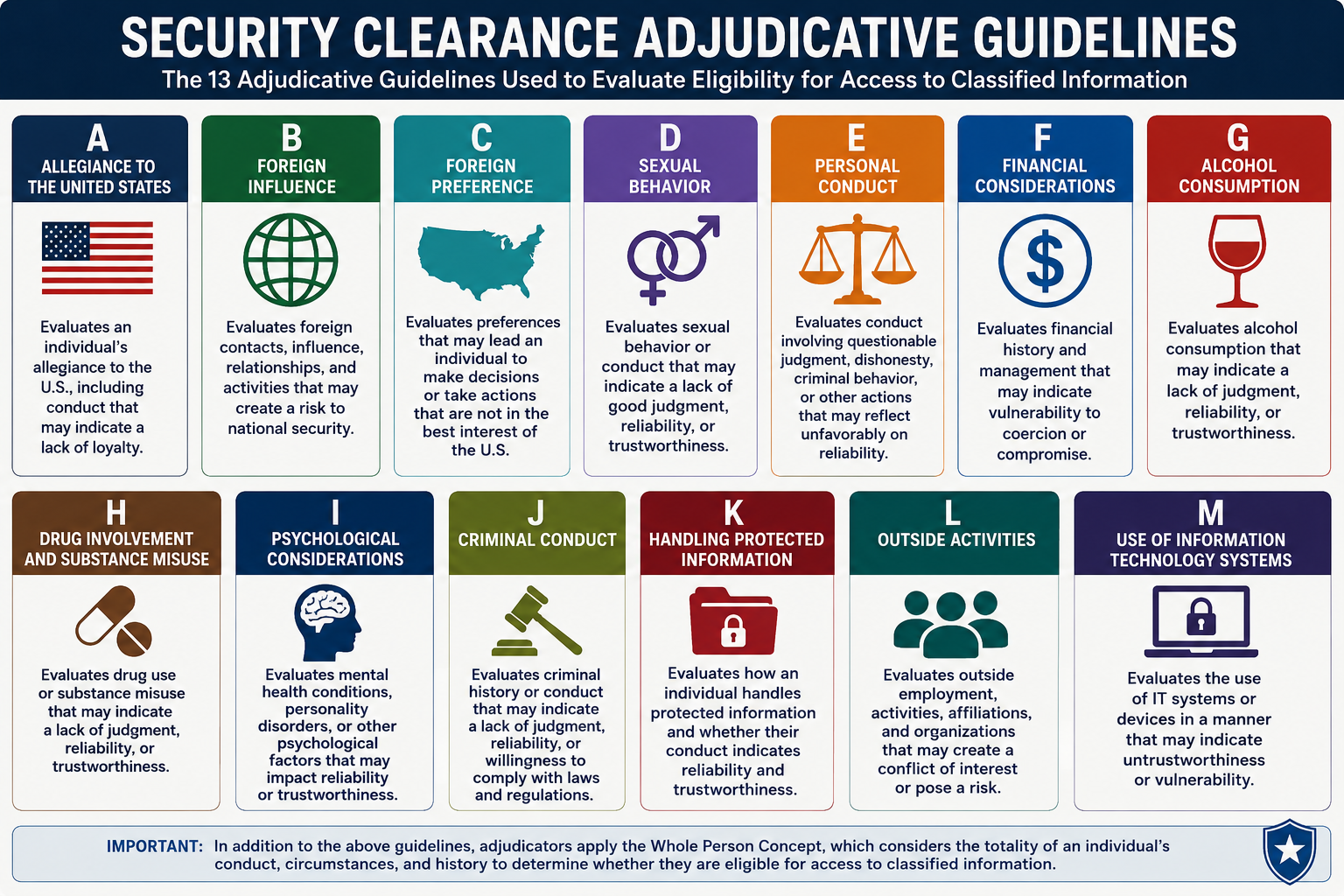
To understand how Guideline D fits into the broader clearance decision framework, review the
👉 Security Clearance Adjudicative Guidelines
Why Guideline D Cases Feel So Personal
Guideline D cases are different from many other clearance issues because they often involve shame, privacy, relationships, embarrassment, identity, marriage, family, or conduct the applicant never expected to discuss with the government.
Applicants often think:
- “This is nobody’s business.”
- “This was consensual.”
- “This happened in my private life.”
- “I was never charged.”
- “I am being judged for something personal.”
- “If my spouse, employer, or agency finds out, my life could fall apart.”
Those fears are real.
But they can also lead applicants to respond emotionally instead of strategically.
That is dangerous.
Because adjudicators are not supposed to evaluate the issue as gossip, morality, or private embarrassment.
They are evaluating:
👉 whether the behavior creates unresolved security risk.
That risk may come from:
- secrecy
- coercion
- illegality
- workplace misconduct
- poor judgment
- inability to control behavior
- vulnerability to exploitation
- or lack of candor during the process
This is why Guideline D cases are often won or lost on how the issue is framed early.
The goal is not to expose unnecessary intimate details.
The goal is to build a record that answers the security concern clearly, respectfully, and strategically.
Why Guideline D Is So Misunderstood
Guideline D is misunderstood because people often assume it is about sexual morality.
That is not the correct framework.
The clearance system is not supposed to punish applicants for:
- being LGBTQ+
- having consensual adult relationships
- engaging in lawful private behavior
- participating in consensual non-traditional relationships
- having a past sexual mistake that no longer creates risk
The actual questions are different.
Adjudicators ask:
- Was the conduct illegal?
- Was anyone coerced, exploited, or harmed?
- Was there a workplace or government-resource connection?
- Was the conduct secret in a way that creates blackmail risk?
- Was the applicant truthful when asked about it?
- Does the conduct suggest poor judgment or lack of discretion?
- Is it likely to recur?
- Has the concern been resolved?
This distinction is critical.
For example:
A private, consensual adult relationship may not create a Guideline D problem at all.
But a secret affair that creates blackmail vulnerability may become a security concern.
Viewing lawful adult pornography at home may not create a clearance issue.
But accessing pornography on a government computer may create serious concerns under Guideline D, Guideline M – Misuse of Information Technology Systems, and possibly Guideline E – Personal Conduct.
A past sexual allegation may be defensible depending on the facts.
But lying about it, minimizing it, or changing the explanation can create a separate credibility issue.
That is where many cases become harder than they needed to be.
The original issue may be manageable.
But once the record suggests concealment or lack of candor:
👉 the case becomes exponentially more difficult.
Why the Insider Perspective Matters in Sexual Behavior Clearance Cases
Most online information about Guideline D focuses on lists of sexual conduct that might create concern.
That is useful, but it is not enough.
The real question is:
👉 how will an adjudicator interpret the conduct?
At National Security Law Firm, we approach Guideline D cases from the perspective of the decision-maker.
Our team understands how adjudicators evaluate:
- whether conduct is truly security-relevant
- whether the issue creates blackmail risk
- whether the conduct reflects current judgment
- whether privacy concerns have been resolved
- whether the applicant was truthful and consistent
- whether the behavior is isolated or recurring
- whether the record supports approval despite the sensitivity of the issue
This matters because Guideline D cases are rarely won by simply saying:
👉 “It was private.”
Or:
👉 “It was consensual.”
Those facts may matter.
But adjudicators still ask:
👉 “Does the conduct create any unresolved vulnerability, reliability concern, or judgment problem?”
The strongest cases do not merely explain the sexual behavior.
They build a record that makes the security concern easier to resolve.
What This Guide Will Help You Understand
If you are dealing with a Guideline D issue—or worried that one may arise—this guide will explain:
- what sexual behavior actually means in the clearance context
- why consensual adult behavior is not automatically disqualifying
- when pornography, browser history, or online sexual activity can create clearance risk
- how blackmail vulnerability is evaluated
- why workplace sexual misconduct or sexual harassment allegations may affect clearance eligibility
- how polygraph admissions can create or expand concerns
- what mitigation actually works
- where applicants accidentally make their cases worse
- and how successful cases are built around privacy, credibility, resolution, and defensibility
Most importantly, this guide will help you understand how the government views sexual behavior from a security-risk perspective.
Because until you understand that:
👉 you may be trying to defend your private life while the government is evaluating coercion risk, judgment, and reliability.
That mismatch is where many Guideline D cases begin to fail.
When Guideline D Actually Comes Up in Real Cases
Guideline D issues usually arise when sexual conduct becomes relevant to security risk.
Sometimes the issue appears because of a criminal charge.
Sometimes it comes from a workplace allegation.
Sometimes it emerges during a polygraph, background investigation, divorce, coworker complaint, security review, or misuse-of-technology inquiry.
Common triggers include the following.
Criminal Sexual Conduct
Criminal sexual conduct is one of the most serious Guideline D categories.
This may include allegations involving:
- sexual assault
- solicitation or prostitution-related conduct
- indecent exposure
- illegal pornography
- child sexual abuse material
- non-consensual sexual conduct
- sex offenses involving minors
- public sexual acts that violate law
Even if charges are dropped, dismissed, or never filed, adjudicators may still evaluate the underlying conduct.
This surprises many applicants.
But in clearance law, the government is not limited to criminal convictions.
It may consider conduct that raises concerns about:
- judgment
- reliability
- trustworthiness
- rule-following
- vulnerability to coercion
- or risk to national security
That does not mean every allegation is true.
It does mean the issue must be addressed carefully.
A defensive, vague, or inconsistent response can make the case worse.
Sexual Harassment or Workplace Misconduct
Sexual harassment allegations can create serious clearance concerns, especially when they involve:
- abuse of authority
- repeated inappropriate conduct
- coercive behavior
- retaliation
- workplace discipline
- failure to follow workplace policies
- misuse of position or access
These cases often overlap with Guideline E – Personal Conduct because the government may evaluate not only the sexual conduct itself, but also honesty, judgment, trustworthiness, and workplace reliability.
A single allegation does not automatically mean denial.
But the applicant’s response matters enormously.
Adjudicators evaluate:
- what happened
- whether there is corroborating evidence
- whether the applicant accepts appropriate responsibility
- whether the behavior was isolated or repeated
- whether workplace trust has been restored
- whether the conduct suggests future risk
Pornography and Online Sexual Conduct
Pornography-related issues are one of the most misunderstood categories under Guideline D.
Many applicants assume:
👉 “Watching pornography is legal, so it can’t affect my clearance.”
Sometimes that is true.
Sometimes it is not.
The government is generally not evaluating lawful adult pornography viewed privately at home as a standalone moral issue.
The concern usually arises when pornography-related conduct involves:
- government systems or workplace devices
- illegal material
- compulsive behavior
- workplace disruption
- deception or concealment
- blackmail vulnerability
- or judgment problems
Examples that frequently create clearance concerns include:
- viewing pornography on government computers
- storing explicit material on workplace systems
- accessing prohibited websites at work
- pornography discovered during forensic reviews or audits
- browser history issues involving inappropriate material
- illegal pornography allegations
- repeated conduct after warnings
- pornography-related polygraph admissions
- online sexual behavior that creates vulnerability or exploitation risk
This is one reason Guideline D frequently overlaps with:
👉 Guideline M – Misuse of Information Technology Systems.
because the issue is often not merely the content itself.
It is:
👉 the misuse of government systems, poor judgment, or concealment surrounding the conduct.
Applicants also panic about highly specific online-content issues involving:
- hentai
- furry content
- animated pornography
- fetish material
- or accidental exposure to illegal content
These cases are extremely fact-specific.
Adjudicators evaluate:
- legality
- intent
- awareness
- frequency
- storage or distribution
- concealment
- and whether the material creates broader judgment or exploitation concerns
For deeper analysis of these issues, applicants should also review:
- pornography and security clearance eligibility
- pornography on government computers and IT misuse
- accidental exposure to illegal pornography
- browser history and security clearance concerns
- animated or fetish pornography concerns in clearance cases
Secret Affairs and “Double Life” Concerns
One of the most common Guideline D concerns involves hidden sexual conduct that creates blackmail vulnerability.
Examples may include:
- undisclosed affairs
- secret relationships
- hidden sexual activity
- concealed online relationships
- conduct the applicant fears would severely damage their marriage, reputation, career, or public image if exposed
The government is usually not focused on the relationship itself.
It is focused on:
👉 whether the secrecy creates leverage.
This is one of the most important concepts in Guideline D.
The issue is not necessarily:
👉 “Was the affair immoral?”
The issue is:
👉 “Could someone use this information to pressure or coerce the applicant?”
This is why two superficially similar cases may produce very different outcomes.
A private relationship that is already known to the spouse or family may create far less concern than:
👉 a hidden affair that could destroy the applicant’s career or personal life if exposed.
This distinction matters enormously.
Consensual Non-Traditional Relationships
Many applicants worry that participation in:
- BDSM
- consensual non-monogamy
- swinging
- polyamory
- fetish communities
- kink-related relationships
will automatically destroy their clearance.
That is not how the modern guidelines are supposed to operate.
Consensual adult behavior is generally not disqualifying by itself.
However, adjudicators still evaluate whether the conduct:
- is legal
- is consensual
- creates blackmail vulnerability
- reflects poor judgment
- affects reliability or workplace conduct
- or creates instability or exploitation risk
Applicants often become unnecessarily defensive in these cases.
That is a mistake.
The stronger strategy is usually:
👉 calmly distinguishing lawful, consensual adult conduct from actual security risk.
Polygraph-Related Sexual Admissions
Guideline D issues frequently arise during:
- lifestyle polygraphs
- CI polygraphs
- background interviews
- follow-up interrogatories
Applicants often disclose conduct during polygraphs that was never previously documented.
This creates several risks simultaneously:
- the conduct itself
- inconsistent prior disclosures
- panic-driven over-explaining
- minimization
- or incomplete admissions
Many applicants damage their cases at this stage by:
- volunteering unnecessary intimate details
- guessing at timelines
- changing explanations repeatedly
- or becoming defensive
This is why strategic guidance before responding to sensitive sexual-conduct inquiries matters so much.
What the Government Is Actually Worried About
To understand Guideline D, you have to stop thinking about the issue as:
👉 “sexual behavior”
and start thinking about it as:
👉 security vulnerability and judgment evaluation
That is how adjudicators approach these cases.
The government is not supposed to act as a morality police.
It is evaluating whether the conduct creates risk.
That risk generally falls into several categories.
1. Blackmail and Coercion Risk
This is one of the biggest themes in Guideline D.
Adjudicators ask:
- Is the conduct secret?
- Could exposure seriously harm the applicant?
- Would the applicant do something improper to keep it hidden?
- Could a foreign actor, coworker, former partner, or hostile party exploit the information?
This is why secrecy matters so much.
A disclosed issue often creates far less concern than:
👉 a hidden issue capable of coercive leverage.
2. Judgment Problems
Many Guideline D cases become judgment cases.
Adjudicators evaluate whether the conduct reflects:
- recklessness
- impulsiveness
- poor discretion
- inability to manage risk
- workplace unreliability
- or repeated disregard for consequences
This is especially true when conduct involves:
- workplace systems
- government devices
- criminal behavior
- or repeated policy violations
3. Criminal Conduct
Illegal sexual conduct is obviously one of the most serious categories.
This includes:
- illegal pornography
- solicitation
- sexual assault
- coercive conduct
- or behavior involving minors
These cases often overlap with:
👉 Guideline J – Criminal Conduct
and can become extremely difficult to mitigate depending on the facts.
4. Reliability and Stability
Repeated compulsive or reckless sexual behavior can raise concerns about:
- self-control
- emotional stability
- reliability under pressure
- or future judgment
This is where adjudicators may begin evaluating whether:
👉 the behavior appears isolated and resolved
or
👉 uncontrolled and ongoing.
5. Credibility and Candor
Like many security clearance issues, Guideline D often becomes much worse when applicants:
- lie
- conceal
- minimize
- or inconsistently explain conduct
This is one reason Guideline D frequently expands into:
👉 Guideline E – Personal Conduct
Once credibility concerns enter the case:
👉 the mitigation burden becomes dramatically heavier.
The Guideline D Statute (Full Text)
The full statutory language for Guideline D can be reviewed here:
👉 Guideline D — Sexual Behavior (Full Text)
The regulation explains:
- what types of conduct can raise concern
- what mitigating conditions adjudicators may consider
- and how sexual behavior is evaluated within the security clearance process
But reading the statute alone is not enough.
Because Guideline D cases are rarely decided based solely on the sexual conduct itself.
They are decided based on:
- secrecy
- coercion risk
- judgment
- credibility
- legality
- and whether the adjudicator believes the issue has been fully resolved
That is why two applicants with superficially similar conduct can receive completely different outcomes.
👉 The difference is usually not the conduct alone.
👉 It is how the record is built around the conduct.
How Adjudicators Actually Evaluate Guideline D Cases
This is where insider perspective matters most.
Adjudicators do not evaluate Guideline D mechanically.
They evaluate it through a:
👉 risk, discretion, and vulnerability framework.
The key questions are often:
- Was the conduct legal?
- Was it consensual?
- Was it private or public?
- Was anyone exploited or harmed?
- Is there blackmail vulnerability?
- Does the conduct reflect poor judgment?
- Is the behavior isolated or recurring?
- Was the applicant truthful about it?
- Does the applicant now appear stable and reliable?
This evaluation is far more nuanced than many applicants realize.
Legality Matters Enormously
Legal private conduct is usually viewed very differently than:
- illegal conduct
- exploitative conduct
- coercive conduct
- or behavior involving minors
Even where no criminal charges exist, adjudicators may still evaluate the underlying behavior itself.
This surprises many applicants.
But in clearance law:
👉 criminal acquittal does not automatically eliminate security concern.
Secrecy Matters More Than People Realize
Many Guideline D cases become dangerous because the conduct is hidden.
Adjudicators often ask:
👉 “What happens if this becomes public?”
If the answer suggests:
- severe embarrassment
- career destruction
- marital collapse
- or strong motivation to conceal the conduct
the perceived blackmail risk becomes much higher.
This is why removing secrecy often becomes part of mitigation strategy.
Government Systems and Workplace Context Matter
Sexual behavior connected to:
- workplace systems
- government devices
- government travel
- or workplace relationships
is usually treated more seriously.
Why?
Because the issue now suggests:
- misuse of resources
- workplace judgment concerns
- policy violations
- or professional unreliability
This is one reason pornography on government computers creates especially serious problems.
The “Pattern vs. Isolated Event” Analysis
Adjudicators heavily evaluate whether conduct was:
- isolated
or - recurring
A single historical lapse often looks very different than:
👉 repeated ongoing behavior.
This becomes especially important where conduct suggests compulsive or escalating patterns.
What the Conduct Suggests About Future Reliability
This is ultimately what many Guideline D cases turn on.
The government is not only evaluating:
👉 what happened in the past.
It is evaluating:
👉 what the conduct suggests about future judgment, discretion, reliability, and vulnerability.
That is why strong Guideline D mitigation is usually built around:
- stability
- transparency
- remediation
- maturity
- and removal of unresolved risk
The strongest cases make the adjudicator feel:
👉 the issue is fully understood, fully addressed, and unlikely to create future security concern.
The “Blackmail Risk” Framework
This is one of the most important concepts in Guideline D.
Many applicants think:
👉 “The conduct itself is the problem.”
Often, it is not.
The government is frequently more concerned with:
👉 whether someone could use the conduct against you.
This is why secrecy matters so much.
Adjudicators often evaluate:
- Who knows about the conduct?
- Is the applicant hiding it from a spouse or employer?
- Could exposure damage the applicant severely?
- Would the applicant feel pressure to conceal it?
- Could a foreign actor exploit it?
- Has the applicant already taken away the leverage?
This explains why some seemingly minor issues become serious.
And why some more unusual or embarrassing conduct may actually be mitigable if:
👉 there is no realistic coercion risk.
For example:
A consensual private relationship that is known to relevant parties may create little security concern.
A hidden affair that could destroy a marriage, career, or public reputation may create significant concern even if the conduct itself was not illegal.
That distinction is critical.
The “Paper Risk” Problem in Guideline D Cases
This is one of the most important concepts across all security clearance law.
Even when the underlying conduct is manageable…
👉 the way it appears in the record can still create denial risk.
This is what we call:
👉 paper risk.
Examples include:
- vague explanations
- minimizing language
- contradictory timelines
- incomplete disclosures
- emotionally defensive responses
- over-sharing intimate details that create new questions
- statements inconsistent with polygraph admissions or digital evidence
Once the record starts to feel:
- evasive
- unstable
- defensive
- or difficult to follow
👉 adjudicators become uncomfortable approving the file.
That discomfort matters enormously.
Because adjudicators constantly ask themselves:
👉 “Can I defend approving this person later?”
If the answer becomes uncertain:
👉 the case becomes much harder to win.
Why Some Guideline D Cases Feel Deeply Unfair
Many applicants become frustrated because they feel:
👉 “This was private.”
Or:
👉 “This was consensual.”
Or:
👉 “This has nothing to do with national security.”
Those reactions are understandable.
But security clearance law evaluates:
👉 vulnerability, judgment, reliability, and coercion risk.
—not simply privacy.
This distinction explains why behavior that feels personal or irrelevant to the applicant may still become a security concern inside the adjudicative process.
The government is not supposed to evaluate sexual behavior as morality.
It is evaluating whether the conduct creates:
- exploitable vulnerability
- unresolved judgment concerns
- or reliability risk
Understanding that distinction is critical to building an effective response.
The Biggest Mistake Applicants Make Under Guideline D
The biggest mistake is:
👉 panicking and over-explaining.
Because Guideline D allegations feel embarrassing, applicants often:
- volunteer excessive detail
- become emotional
- try too hard to justify themselves
- or attempt to minimize obvious concerns
All of those approaches can backfire.
The strongest Guideline D responses are usually:
- calm
- focused
- factually precise
- strategically limited
- and centered on risk resolution—not emotional defense
Another major mistake:
👉 hiding or lying about the conduct.
Many applicants think concealment will protect them.
Instead, concealment often creates:
👉 a far more dangerous Guideline E problem.
In many cases:
👉 the dishonesty becomes worse than the underlying sexual conduct itself.
What Strong Mitigation Actually Looks Like
Strong Guideline D mitigation usually includes several important themes.
The Conduct Was Legal, Consensual, and Private
This is often the foundation of mitigation.
Applicants may demonstrate that:
- the conduct involved consenting adults
- no laws were violated
- no exploitation occurred
- the conduct was private and discreet
- there was no workplace or government nexus
This helps separate:
👉 personal behavior
from
👉 actual security risk.
The Conduct Was Isolated or Historical
Adjudicators often evaluate:
- how long ago the conduct occurred
- whether it was repeated
- whether the behavior has stopped
- and whether it still reflects current judgment
Historical conduct is often easier to mitigate than ongoing conduct.
No Realistic Blackmail Risk Exists
This is one of the strongest mitigation points available.
Applicants may demonstrate:
- the issue is no longer secret
- relevant parties already know
- the conduct cannot realistically be used as leverage
- there is no foreign exploitation angle
- there is no ongoing concealment
Removing blackmail leverage significantly reduces perceived security risk.
The Applicant Demonstrates Insight and Accountability
Adjudicators look closely at whether the applicant:
- understands why the conduct raised concern
- accepts appropriate responsibility
- and demonstrates improved judgment going forward
This does not mean confessing to moral failure.
It means showing:
👉 awareness, stability, and reliability.
Treatment, Counseling, or Remediation
Where appropriate, evidence of:
- therapy
- counseling
- rehabilitation
- behavioral treatment
- or documented improvement
can be extremely helpful.
This is especially important where the conduct suggested:
- compulsive behavior
- poor impulse control
- or unresolved emotional instability
What Weak Mitigation Looks Like
Weak mitigation often sounds like:
- “It wasn’t a big deal.”
- “Everyone does this.”
- “It’s none of their business.”
- “I didn’t think it mattered.”
- “I was only joking.”
- “The investigator misunderstood.”
These explanations frequently fail because they suggest:
👉 the applicant still does not understand the security concern.
Other weak mitigation patterns include:
- inconsistent explanations
- minimizing obvious conduct
- denying documented evidence
- attacking accusers instead of addressing risk
- oversharing unnecessary intimate details
- continuing the conduct after investigation begins
- refusing counseling where clearly needed
How Guideline D Concerns Are Actually Mitigated
Many applicants assume that once a Guideline D issue appears, their clearance is effectively over.
That is not true.
In reality, many sexual behavior concerns are highly mitigable when the issue is handled strategically and the record is built correctly.
The key is understanding what adjudicators are actually evaluating:
👉 blackmail vulnerability
👉 judgment
👉 discretion
👉 credibility
👉 workplace reliability
👉 and whether the conduct still creates unresolved security concern
Strong mitigation often involves:
- eliminating secrecy or coercion risk
- demonstrating stability and reliability
- showing the conduct was isolated or historical
- counseling or treatment where appropriate
- avoiding credibility collapse during interviews or polygraphs
- and ensuring the issue is framed properly from the beginning
For a deeper breakdown of what actually helps—and hurts—Guideline D cases, including pornography-related concerns, affairs, workplace misconduct, browser-history issues, and polygraph admissions, review:
👉 How to Mitigate a Guideline D Security Clearance Concern
Advanced Strategy: How to Respond to a Guideline D Concern
The strongest Guideline D cases are not built around shame, morality, or emotional apology.
They are built around:
👉 strategic resolution of security concern.
That distinction changes everything.
Strategy Shift #1: Focus on Risk Resolution, Not Moral Defense
Many applicants instinctively try to prove:
👉 “I’m not a bad person.”
That is not the real issue.
The real issue is:
👉 whether the conduct creates unresolved national security concern.
Strong responses therefore focus on:
- blackmail risk
- reliability
- discretion
- legality
- remediation
- and future stability
—not abstract morality.
Strategy Shift #2: Remove Blackmail Vulnerability
This is one of the most powerful strategies in Guideline D.
Where appropriate, applicants may reduce leverage by:
- addressing secrecy
- resolving hidden conduct
- correcting disclosures
- ensuring there is no realistic coercive exposure remaining
The more the conduct can no longer be used against the applicant:
👉 the weaker the Guideline D concern becomes.
Strategy Shift #3: Avoid Oversharing
This is critical.
Applicants often believe:
👉 “The more detail I provide, the more credible I look.”
That is often false.
Too much detail can:
- create inconsistencies
- introduce unnecessary issues
- expand the investigation
- or make the record more confusing
Strong Guideline D responses are usually:
👉 controlled, disciplined, and strategically framed.
Strategy Shift #4: Address Workplace and Technology Overlap Carefully
Conduct involving:
- government computers
- workplace systems
- messaging apps
- browser history
- or digital records
often creates overlap with:
👉 Guideline M – Misuse of Information Technology Systems
These cases must be handled carefully because:
👉 the sexual conduct itself may become less important than the IT misuse or credibility issues surrounding it.
Strategy Shift #5: Protect Credibility at All Costs
This is one of the most important rules in Guideline D cases.
Once the applicant appears:
- dishonest
- evasive
- inconsistent
- or manipulative
the adjudicator may begin viewing the entire file differently.
That is why:
👉 credibility preservation often matters more than defending the underlying conduct itself.
Illustrative Case Scenarios (How Guideline D Plays Out in Real Situations)
The examples below are hypothetical scenarios based on common fact patterns seen in security clearance cases. They are designed to show how adjudicators typically evaluate risk under Guideline D—not to predict outcomes in any specific case.
Scenario 1 — Private Consensual Conduct With No Blackmail Risk (Likely Approval)
An applicant participates in consensual BDSM activity with their spouse.
The conduct:
- is legal
- consensual
- private
- and known to both partners
There is:
- no workplace involvement
- no secrecy creating blackmail risk
- no criminal conduct
👉 Likely Outcome: Approved
Why this works:
The conduct does not create unresolved security risk, coercion vulnerability, or reliability concerns.
Scenario 2 — Pornography on Government Computer (Moderate to High Risk)
An applicant repeatedly accesses adult websites using a government-issued computer.
The conduct:
- violates workplace policy
- occurs during work hours
- continues after warnings
👉 Likely Outcome: Significant scrutiny, possible Guideline D/M overlap
Why this creates concern:
The issue becomes judgment, policy compliance, and misuse of government systems—not merely pornography itself.
Scenario 3 — Secret Affair Creating Blackmail Vulnerability (High Risk)
An applicant engages in a hidden extramarital affair.
The relationship becomes known to another individual who threatens exposure.
👉 Likely Outcome: High blackmail-risk concern
Why this creates concern:
The secrecy creates coercive leverage and reliability concerns.
Scenario 4 — Historical Solicitation Arrest, Strong Mitigation (Potentially Mitigable)
An applicant was arrested for solicitation years earlier.
Since then:
- no repeat conduct occurred
- the applicant sought counseling
- disclosures were consistent
- strong work history exists
👉 Likely Outcome: Potentially mitigable depending on facts
Why this may work:
The issue appears historical, isolated, and unlikely to recur.
Scenario 5 — Illegal Pornography Allegation (Severe Risk)
An applicant is found in possession of illegal pornographic material during a forensic review.
👉 Likely Outcome: Severe denial risk
Why this creates concern:
This involves criminal conduct, judgment concerns, and potentially exploitation-related issues.
Scenario 6 — Sexual Harassment Allegation in the Workplace (Moderate to High Risk)
An applicant faces allegations of repeated inappropriate comments and unwanted workplace behavior toward coworkers.
The investigation reveals:
- multiple complaints
- workplace-policy violations
- poor judgment in professional settings
However:
- no criminal charges are filed
- the applicant cooperates fully
- the conduct stops immediately
- the applicant completes workplace training and counseling
👉 Likely Outcome: Depends heavily on credibility, remediation, and factual findings
Why this creates concern:
The issue implicates judgment, workplace reliability, professionalism, and trustworthiness—not just private conduct.
Scenario 7 — Polygraph Admission to Historical Conduct (Potentially Mitigable)
During a lifestyle polygraph, an applicant discloses participation in embarrassing but legal sexual behavior from years earlier.
The conduct:
- was consensual
- was private
- is no longer ongoing
- creates no realistic blackmail risk
👉 Likely Outcome: Often manageable if handled consistently
Why this may work:
The applicant was candid, the conduct is historical, and no ongoing vulnerability exists.
Scenario 8 — Browser History and Fetish Content on Personal Device (Fact-Specific)
An applicant’s browser history includes legal fetish-related material viewed on a personal device.
The conduct:
- is legal
- private
- and not connected to government systems
However, the applicant becomes defensive and evasive during questioning.
👉 Likely Outcome: Often depends more on credibility than the content itself
Why this matters:
The defensive response may create broader trustworthiness concerns.
Scenario 9 — Accidental Exposure to Illegal Material (Highly Fact-Specific)
An applicant unintentionally encounters illegal material online and immediately closes the content without downloading, storing, or distributing it.
The applicant:
- reports the issue consistently
- demonstrates no pattern of related conduct
- shows no evidence of intentional searching
👉 Likely Outcome: Highly fact-dependent, potentially mitigable
Why this may be mitigated:
Intent, immediate reaction, and absence of ongoing conduct matter enormously.
Scenario 10 — “Double Life” Conduct With Extensive Secrecy (High Risk)
An applicant maintains a hidden sexual relationship that would severely damage their career and family if exposed.
The applicant:
- actively conceals the conduct
- lies during investigation questioning
- and changes explanations multiple times
👉 Likely Outcome: Severe Guideline D and Guideline E concerns
Why this fails:
The combination of blackmail vulnerability and dishonesty creates major security concern.
What Actually Gets Guideline D Cases Approved
Successful Guideline D cases usually share several characteristics.
The conduct is often:
- legal
- consensual
- private
- isolated
- historical
- or no longer ongoing
The applicant usually demonstrates:
- honesty
- consistency
- insight into the issue
- stable judgment
- no realistic blackmail vulnerability
- and no evidence the conduct is likely to recur
Most importantly:
👉 the adjudicator believes the issue no longer creates unresolved security risk.
That is the real goal of mitigation.
Not perfection.
Not moral purity.
👉 resolution of risk.
What Causes Denial Under Guideline D
Guideline D denials usually stem from:
- illegal sexual conduct
- conduct involving minors or coercion
- repeated or compulsive high-risk behavior
- blackmail vulnerability
- workplace misconduct
- misuse of government systems
- dishonesty or concealment
- inconsistent explanations
- refusal to acknowledge the seriousness of the concern
- failure to seek remediation where clearly needed
Again:
👉 the issue is often not merely the sexual conduct itself.
The issue is:
👉 what the conduct suggests about judgment, reliability, vulnerability, and trustworthiness.
Where Guideline D Cases Collapse
Most Guideline D cases do not collapse because of the original behavior alone.
They collapse during escalation.
Stage 1 — Conduct Becomes Discoverable
A relationship, allegation, browser history issue, workplace complaint, or polygraph disclosure enters the record.
Stage 2 — Applicant Panics
The applicant reacts emotionally or defensively.
Stage 3 — Explanations Shift
Details become inconsistent or incomplete.
Stage 4 — Credibility Concerns Develop
Investigators or adjudicators begin doubting the applicant’s candor.
Stage 5 — Multiple Guidelines Trigger
The issue expands into Guideline E, M, J, or B concerns.
Stage 6 — SOR or Suspension
The issue hardens into formal clearance action.
👉 Final outcome: denial, suspension, or revocation.
How Guideline D Interacts With Other Guidelines
Guideline D rarely exists entirely alone.
It frequently overlaps with several other guidelines.
Guideline E — Personal Conduct
This is the most common overlap.
If sexual behavior is:
- hidden
- minimized
- dishonestly explained
- or inconsistently disclosed
the case often expands into:
👉 Guideline E – Personal Conduct
In many cases:
👉 the dishonesty becomes more damaging than the underlying conduct.
Guideline J — Criminal Conduct
Illegal sexual conduct may also trigger:
👉 Guideline J – Criminal Conduct
This includes issues involving:
- solicitation
- illegal pornography
- sexual assault allegations
- public sexual offenses
- or conduct involving minors
Guideline M — Misuse of Information Technology Systems
Pornography or sexual behavior involving:
- government computers
- workplace systems
- cloud storage
- messaging platforms
- browser history
- or prohibited downloads
may overlap with:
👉 Guideline M – Misuse of Information Technology Systems
Guideline B — Foreign Influence
Sexual relationships involving:
- foreign nationals
- foreign intelligence targeting
- or coercive foreign leverage
may create overlap with:
👉 Guideline B – Foreign Influence
Guideline I — Psychological Conditions
Where conduct suggests:
- compulsive behavior
- addiction
- or emotional instability
the government may also evaluate:
👉 psychological-condition concerns.
👉 Once multiple guidelines apply, mitigation becomes significantly harder.
How Guideline D Appears Throughout the Clearance Process
Guideline D concerns can arise at nearly every stage of the security clearance process.
Many applicants mistakenly assume:
👉 “If nobody was charged, it won’t matter.”
That is often incorrect.
Sexual behavior concerns may surface through:
- SF-86 disclosures
- background investigations
- workplace complaints
- law enforcement records
- polygraph admissions
- browser or device reviews
- insider-threat investigations
- coworker or ex-spouse interviews
- or social-media and digital evidence
This is why early strategy matters so much.
The SF-86 Stage
Some Guideline D issues first appear through disclosures involving:
- arrests
- criminal charges
- workplace discipline
- or counseling history
during completion of the:
👉 SF-86 Security Clearance Form
This stage matters enormously because:
👉 the SF-86 becomes the foundation of the investigative record.
If disclosures are:
- incomplete
- vague
- misleading
- or inconsistent
those problems often follow the applicant throughout the entire process.
The Investigation Stage
During the:
👉 security clearance investigation
investigators may review:
- police records
- workplace complaints
- disciplinary findings
- digital evidence
- witness interviews
- polygraph information
- or allegations from personal contacts
Applicants are often shocked by how personal and detailed these investigations can become.
The Subject Interview
The:
👉 security clearance subject interview
is one of the most dangerous stages in Guideline D cases.
This is where investigators evaluate:
- credibility
- emotional reactions
- candor
- judgment
- and whether the applicant understands the concern
Applicants often damage their cases here by:
- over-explaining
- becoming defensive
- minimizing obvious issues
- or volunteering inconsistent details
This is one reason strategic preparation matters so much.
The Polygraph Stage
Guideline D concerns frequently emerge during:
- lifestyle polygraphs
- CI polygraphs
- or follow-up examinations
Applicants often panic during these examinations and make:
- incomplete admissions
- exaggerated disclosures
- inconsistent statements
- or emotionally reactive explanations
These cases must be handled carefully because:
👉 polygraph-related disclosures often become permanent parts of the clearance record.
The LOI and SOR Stage
If concerns remain unresolved, applicants may receive:
👉 Letters of Interrogatory (LOIs)
or:
👉 Statements of Reasons (SORs)
At this point:
👉 the issue has hardened into a formal security concern.
This is where:
- mitigation
- credibility
- documentation
- and strategic framing
become absolutely critical.
The Hearing and Appeal Stage
Some Guideline D cases proceed to:
- DOHA hearings
- written appeals
- agency review boards
- or administrative hearings involving suspension or revocation
At this stage, adjudicators and judges often focus heavily on:
- whether the conduct still creates blackmail vulnerability
- whether the applicant was candid throughout the process
- whether the conduct reflects current judgment
- whether rehabilitation or remediation occurred
- and whether the adjudicator can safely defend approval going forward
This is why:
👉 continued secrecy, minimization, or ongoing conduct after investigation begins is so dangerous.
Learn more in:
👉 Security Clearance Hearings and DOHA Appeals
Related Guideline D Resources
For deeper analysis of specific Guideline D risk areas, review:
👉 Pornography, Sexual Behavior, and Your Security Clearance: Understanding the Implications
👉 Can Hentai, Furry, or Animated Pornography Affect Your Security Clearance?
👉 Can Accidental Exposure to Illegal Pornography Affect Your Security Clearance?
👉 Can Pornography on a Government Computer Cost You Your Security Clearance?
👉 Can Sexual Behavior Trigger a Security Clearance Polygraph Problem?
👉 Can Browser History Affect Your Security Clearance? Online Porn, Work Computers, and Polygraph Risk
These articles address highly specific scenarios that frequently overlap with Guideline D concerns.
What Actually Wins Security Clearance Cases Under Guideline D
Most applicants think these cases are won by proving:
👉 “I’m a good person.”
That is not how adjudicators typically approach these decisions.
What actually wins Guideline D cases is:
👉 a record demonstrating that the conduct no longer creates unresolved security concern.
That usually means:
- no realistic blackmail vulnerability exists
- the conduct was legal or has been resolved appropriately
- the behavior is not ongoing
- the applicant was truthful and consistent
- the applicant demonstrates judgment and stability
- and the adjudicator believes the concern is unlikely to recur
This is one of the most important realities of the clearance process:
👉 adjudicators are not deciding whether someone is morally perfect.
They are deciding:
👉 whether they can safely trust the applicant with access to classified information going forward.
That is why:
- credibility matters enormously
- secrecy matters enormously
- and remediation matters enormously
If you want to understand how successful security clearance cases are actually built, review:
👉 How to Win a Security Clearance Case Using Proven Mitigation and Record-Control Strategies
Decision Language Explained (What These Terms Actually Mean)
Guideline D cases often contain vague or intimidating language.
Understanding these phrases gives you a strategic advantage.
“Sexual Behavior”
This does not mean all private sexual conduct is disqualifying.
It refers to sexual behavior that may create security concerns because it involves:
- illegality
- coercion
- blackmail vulnerability
- poor judgment
- or reliability concerns
“Vulnerability to Coercion or Exploitation”
This is one of the most important Guideline D concepts.
It means:
👉 someone could potentially use the conduct to pressure, manipulate, or blackmail the applicant.
“Discretion”
Adjudicators often evaluate whether the applicant handled private conduct responsibly and carefully.
Public, reckless, or workplace-related conduct is usually viewed more harshly.
“Compulsive Sexual Behavior”
This refers to conduct that appears:
- uncontrolled
- escalating
- addictive
- or difficult for the applicant to stop
This may raise concerns about future judgment and reliability.
“Unresolved Concern”
This phrase drives many denials.
It means:
👉 the issue exists in the record, but the adjudicator does not believe it has been fully resolved.
“Clearly Consistent With National Security”
This is the actual approval standard.
It means:
👉 the adjudicator feels comfortable defending approval if the case is reviewed later.
If that comfort does not exist:
👉 approval usually does not happen.
Frequently Asked Questions About Guideline D
Can pornography affect a security clearance?
Yes—especially if it involves:
- government systems
- workplace misconduct
- illegal material
- compulsive behavior
- or credibility issues
Can sexual orientation affect a security clearance?
No.
Sexual orientation alone is not disqualifying.
The concern is usually about coercion risk, judgment, illegality, or secrecy—not orientation itself.
Can an affair affect my security clearance?
Potentially yes—particularly if the affair creates blackmail vulnerability or raises judgment concerns.
Can consensual non-monogamy affect clearance eligibility?
Consensual adult conduct is not automatically disqualifying.
However, secrecy, instability, or exploitation risk may still create concern.
Can BDSM or fetish conduct affect a clearance?
Usually only if the conduct is:
- illegal
- coercive
- secret in a blackmail-relevant way
- or connected to broader judgment concerns
Can sexual harassment allegations affect my clearance?
Yes.
Especially where allegations involve:
- workplace misconduct
- abuse of authority
- repeated inappropriate conduct
- or credibility issues
Can browser history affect a clearance?
Potentially yes—especially if it involves:
- prohibited material
- workplace systems
- illegal content
- or policy violations
Can pornography on a government computer affect my clearance?
Absolutely.
This often creates overlap with:
👉 Guideline M – Misuse of Information Technology Systems
Can a polygraph admission hurt my clearance?
Yes.
Statements made during polygraphs often become part of the permanent clearance record.
Do I have to disclose private sexual conduct?
Only when required or relevant to a security concern.
However, dishonesty or concealment during the process is often far more dangerous than the conduct itself.
Can I recover from a Guideline D issue?
Absolutely.
Many Guideline D cases are mitigable with strong strategy, honesty, remediation, and proper record control.
What if the conduct was years ago?
Historical conduct is often easier to mitigate than ongoing behavior—especially where there is strong evidence of stability and no recurrence.
What if I am embarrassed to discuss the issue?
That reaction is extremely common.
But careful, strategic handling of the issue is usually far safer than avoidance, concealment, or panic-driven explanations.
Why National Security Law Firm
Guideline D cases require more than technical legal analysis.
They require:
👉 discretion
👉 judgment
👉 strategic record control
👉 and understanding how adjudicators evaluate sensitive personal conduct inside the national security system.
At National Security Law Firm, our security clearance lawyers include:
- former adjudicators and federal insiders
- military and national security attorneys
- attorneys experienced in high-risk clearance matters involving sexual behavior allegations, blackmail concerns, workplace misconduct, and polygraph-related issues
We understand that these cases are deeply personal.
Our approach is not built around sensationalism or moral judgment.
It is built around:
👉 resolving security concern while protecting the client’s career, credibility, and dignity.
Complex cases are reviewed through our internal
👉 Attorney Review Board
This means:
- multiple experienced attorneys evaluate your record
- mitigation strategies are tested before submission
- weaknesses are identified early
- and your case is approached through the same layered institutional lens used by the government
Most clients come to us after receiving advice focused only on explanation.
But Guideline D cases are not won through emotional explanation alone.
👉 They are won through credibility, discretion, mitigation, and strategic resolution of security concern.
You can read what clients say about working with our team in our
👉 4.9-star Google reviews
Related Statutes and Guidance
Return to the full statute list in the
👉 Security Clearance Statutes and Regulations
Or explore how these rules are applied in real cases in the
👉 Security Clearance Lawyers Resource Center
If you want to go beyond the rule itself and understand how to actually win under Guideline D—how adjudicators evaluate blackmail risk, what mitigation works, and how strong cases are built—review:
👉 How to Win a Security Clearance Case Using Proven Mitigation and Record-Control Strategies
Speak With a Security Clearance Lawyer Before the Record Hardens
If Guideline D is affecting your case, the most important question is not:
👉 “Was this embarrassing?”
It is:
👉 “Does the government believe this conduct creates unresolved security risk?”
Because once these concerns are documented:
👉 they are reused
👉 re-evaluated
👉 and often expanded into broader credibility or judgment concerns
The earlier the issue is strategically addressed, the better the chance of preventing escalation into:
- an LOI
- an SOR
- suspension
- denial
- or revocation
If you want to evaluate your situation before the record hardens against you, you can:
👉 schedule a confidential consultation with a security clearance lawyer
The Record Controls the Case.
SECURITY CLEARANCE DENIED OR REVOKED
If you are appealing a security clearance determination, it is imperative that you obtain experienced legal representation. Doing so will provide you with the best opportunity to obtain or maintain your clearance.
Click Here For a No Obligation, Always Confidential Consultation