
For many applicants, the security clearance interview feels like a simple follow-up conversation.
It is not.
A security clearance interview is one of the most important stages in the federal clearance process because it is where investigators test the accuracy, completeness, and credibility of the record. What you say in that interview may later be compared against your SF-86, automated record checks, reference interviews, financial records, later written responses, and, if the case escalates, hearing testimony.
That is why many otherwise manageable clearance cases start getting worse during the interview stage.
The problem is usually not that the applicant is a bad person. The problem is that the applicant says the wrong thing in the wrong way. They guess. They minimize. They over-explain. They try to sound better than the documents. They forget that investigators are building a permanent federal record, not having an informal conversation.
Security clearance decisions happen inside a federal system. They are not ordinary employment decisions, and they are not typical legal disputes. They are national security risk determinations made by adjudicators, administrative judges, and federal security officials using the Adjudicative Guidelines, the Whole Person Concept, and long-term reliability analysis.
National Security Law Firm is built specifically for that system. The firm includes former security clearance adjudicators, former administrative judges, former Defense Office of Hearings and Appeals attorneys, and attorneys who have held security clearances themselves. That institutional background matters because interview mistakes are not judged in isolation. They are interpreted through the lens of candor, judgment, and reliability.
Readers who want broader context on investigations, adjudications, hearings, and appeals can begin with the Security Clearance Insiders Resource Hub.
Why the Security Clearance Interview Matters So Much
Applicants often think the interview is just a chance to “clear things up.”
Sometimes it is.
But it is also one of the most important credibility checkpoints in the entire process.
During the interview, the investigator is not just collecting new facts. The investigator is testing whether your verbal explanations match:
• your SF-86
• other government records
• reference interviews
• financial records
• law enforcement records
• travel and foreign contact disclosures
If your answers shift, narrow, expand, or soften what the file already shows, the government may stop focusing only on the underlying issue and start focusing on something more dangerous: whether you are fully candid.
That is why people searching for “security clearance interview mistakes” are asking the right question. Many cases are not seriously damaged by the underlying event alone. They are damaged because the applicant handles the interview poorly.
What the Investigator Is Actually Evaluating
The investigator is not looking for perfection.
The investigator is evaluating whether the information in the record is accurate and whether your explanations appear credible.
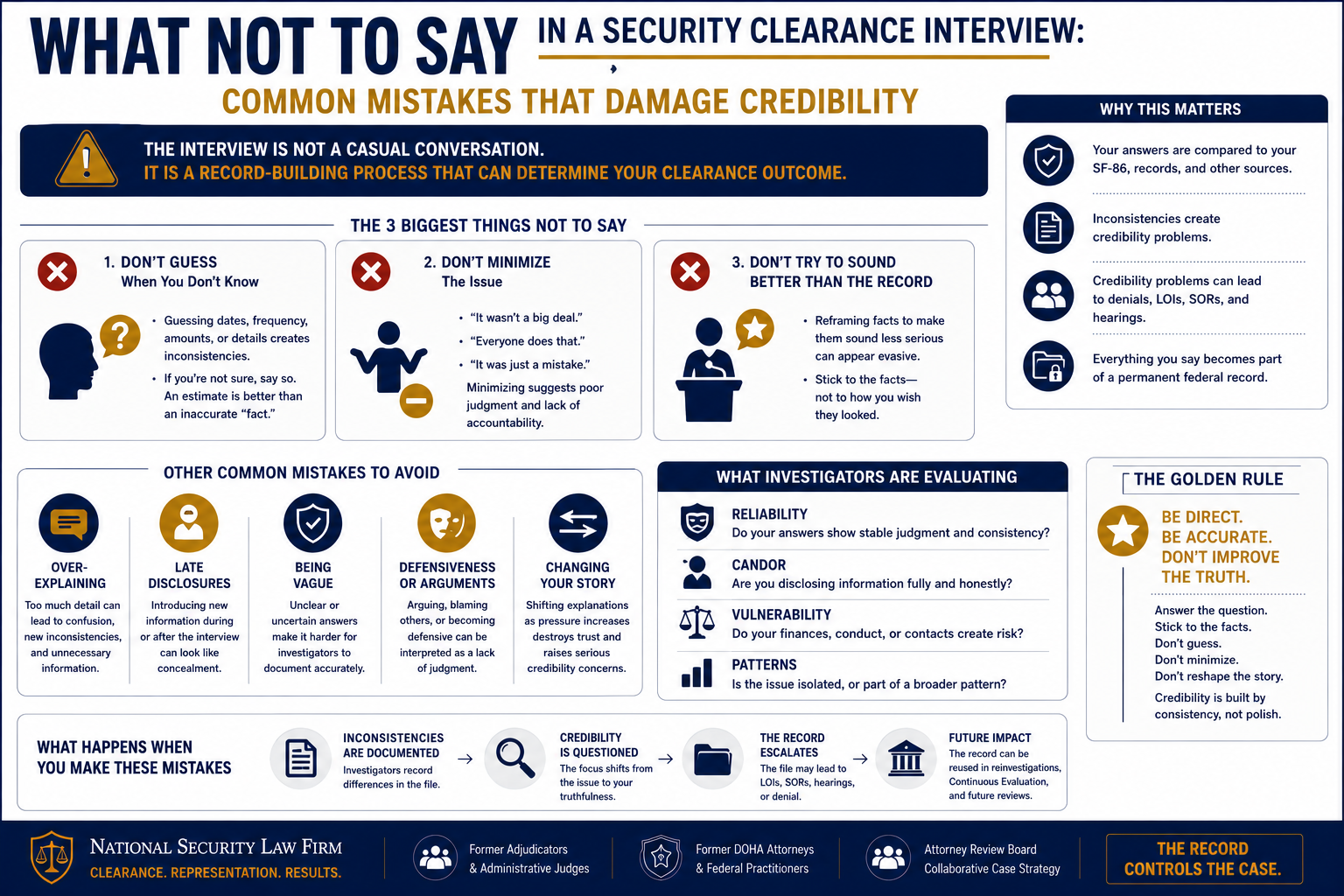
In practical terms, investigators are often looking at four things:
Reliability
Do your answers reflect stable judgment and consistency?
Candor
Are you disclosing uncomfortable facts directly, or are you trying to manage the image?
Vulnerability
Do finances, foreign contacts, misconduct, or other issues create pressure points?
Patterns
Is the issue isolated, or does the record suggest a broader trend?
That means the interview is not just about what happened. It is also about how you talk about what happened.
The Three Biggest Things Not to Say in a Security Clearance Interview
There are many ways to hurt a case during the interview, but three patterns show up over and over again.
The first is guessing.
The second is minimizing.
The third is changing your explanation as pressure increases.
These three mistakes often overlap, and when they do, the government may begin to see the issue through Guideline E — Personal Conduct, even if the original concern belonged under another guideline.
Mistake #1: Guessing When You Do Not Know
One of the worst things to say in a security clearance interview is an answer that sounds certain when it is really a guess.
Applicants do this all the time. They feel pressure to answer quickly, or they assume they are supposed to know exact dates, counts, or timelines. So they give an estimate as though it were a fact.
That creates two risks.
First, the guess may be wrong.
Second, once it is recorded, it may later conflict with another part of the file.
Common guessing problems include:
• estimating drug-use frequency too narrowly
• guessing foreign travel dates
• guessing when a relationship began or ended
• guessing how much debt existed at a certain point
• guessing whether an incident was reported or documented
A person may think, “I was just trying to be helpful.”
But an adjudicator may later read the inconsistency and think, “Why did this explanation change?”
If you do not know something with certainty, the safer and more credible approach is to say that clearly. It is better to say you are giving an estimate than to present an estimate as fact.
Mistake #2: Minimizing Misconduct
Another common mistake is minimizing the seriousness, frequency, or context of the underlying issue.
Applicants often do this because they are embarrassed, defensive, or afraid that honesty will hurt them.
So instead of saying exactly what happened, they say a safer-sounding version.
They may describe repeated drug use as experimentation. They may describe a serious foreign relationship as casual. They may describe substantial debt as temporary. They may describe criminal conduct as a misunderstanding without clearly acknowledging the actual event.
This is dangerous because many underlying problems can be mitigated.
Minimization often cannot.
A financial issue may be manageable under Guideline F — Financial Considerations if the applicant is candid and the problem is under control.
A foreign contact issue may be manageable under Guideline B — Foreign Influence if the relationship is fully disclosed and clearly explained.
A substance-related issue may be manageable under Guideline H — Drug Involvement and Substance Misuse if the applicant is direct, consistent, and credible.
But when the applicant minimizes, the issue starts becoming a credibility problem. And credibility problems tend to spread.
Mistake #3: Trying to Sound Better Than the Record
This is a subtler version of minimizing.
Sometimes applicants do not directly deny facts. Instead, they use language designed to make the facts sound less concerning.
For example:
• turning a close foreign relationship into a “social acquaintance”
• turning repeated marijuana use into “limited exposure”
• turning delinquent debt into “temporary billing confusion”
• turning a disciplinary issue into “miscommunication”
This kind of phrasing often backfires.
Investigators are trained to document facts, not absorb image management. If the record elsewhere suggests something more serious, the polished language can make the applicant appear evasive rather than careful.
That is why the interview should not be approached like a branding exercise. It is a record-building exercise.
How Interview Inconsistencies Usually Start
Inconsistencies often begin innocently.
An applicant fills out the SF-86 Strategy paperwork too quickly. Then in the interview, the investigator asks follow-up questions. The applicant realizes the issue is more detailed than they initially disclosed. They try to clarify. Then, under stress, they over-correct, soften, or narrow the answer.
A typical sequence looks like this:
SF-86 disclosure → interview explanation → later written clarification
If those versions do not line up, the government may begin treating the issue as one of deteriorating candor.
This is one reason the interview is so important. It is often where the file stops being theoretical and starts becoming concrete.
Why Investigators Document These Problems So Carefully
Investigators are not there to resolve your case in your favor. They are there to gather and preserve information.
That means when something does not line up, it tends to get documented, not smoothed out.
If you say one thing on the SF-86 and another thing in the interview, the tension between those two statements may remain in the file. Later, adjudicators may compare that discrepancy to:
• reference interviews
• law enforcement records
• financial documents
• later Letter of Interrogatory responses
• later Statement of Reasons responses
The investigator does not need to accuse you of lying for the problem to become serious. The inconsistency itself can do the damage.
How Adjudicators Interpret Interview Mistakes
Adjudicators do not usually view interview mistakes the way applicants do.
Applicants often think:
“I was nervous.”
“I was trying to simplify.”
“I forgot the exact date.”
“I did not want to make it sound worse than it was.”
Sometimes those things are true.
But adjudicators are not just reading for emotional context. They are reading for signs of reliability, candor, and judgment.
If your explanation changes as scrutiny increases, an adjudicator may conclude:
• you are selective in your disclosures
• you are willing to manage the truth
• you disclose only what seems necessary
• the file cannot be trusted at face value
That can be extremely damaging, especially because adjudicators evaluate the permanent record, not the person in the abstract.
What Not to Say in a Security Clearance Interview About Drug Use
Drug-related issues are a common place where applicants make interview mistakes.
What not to say includes things like:
“I only tried it a couple times,” if you are estimating and do not really know.
“It was not really drug use,” if the substance clearly falls within the reporting category.
“Everyone did it,” if you are trying to normalize repeated use.
“It was just social,” if the question is about your conduct, not your peer group.
A better approach is direct, stable, fact-based explanation. Adjudicators understand past misconduct better than applicants often realize. What they do not tolerate well is unstable explanation.
What Not to Say in a Security Clearance Interview About Foreign Contacts
Foreign contacts often create anxiety, and that anxiety leads to bad answers.
What not to say includes:
“We are not really close,” if later facts suggest ongoing emotional or practical closeness.
“I did not think it counted,” if the relationship was clearly significant.
“We only talk occasionally,” if records or context suggest otherwise.
“It is nothing serious,” if the relationship is romantic, dependent, or strategically important.
Foreign contact cases are already sensitive under Guideline B — Foreign Influence. The problem becomes much worse if the description of the relationship keeps changing.
What Not to Say in a Security Clearance Interview About Finances
Financial issues are another area where applicants often try to sound more stable than the documents suggest.
What not to say includes:
“It is all under control,” if collections or delinquencies are still active.
“It was just temporary,” if the problem lasted for a long period.
“I thought it was paid,” if you have no basis for that belief.
“It was a paperwork issue,” if the core problem was prolonged nonpayment.
Financial cases often turn on whether the applicant has confronted the issue responsibly. They become harder to mitigate when the applicant appears to be narrating around the truth.
What Not to Say When You Forgot Something on the SF-86
One of the most dangerous instincts is trying to quietly contain an omission instead of handling it directly.
What not to say includes:
“I guess it was not important.”
“I did not think they needed that.”
“It slipped my mind,” if the omitted fact was central or recent.
“That is basically what I meant,” if the written answer says something materially different.
If something was left off, the safest course is usually to address it directly and consistently rather than trying to fold it into a softer explanation.
The government is often more forgiving of a candid correction than of a defensive half-correction.
Why Over-Explaining Can Also Hurt You
Many applicants assume the only danger is saying too little.
That is not true.
Saying too much in a scattered, emotional, or speculative way can also create problems.
Over-explaining often leads applicants to add:
• unnecessary guesses
• inaccurate details
• self-serving interpretations
• broad assurances not grounded in facts
• statements that create new issues
A good answer is not necessarily a long answer. It is a clear, accurate, stable answer.
The Best General Rule for a Security Clearance Interview
The best general rule is this:
Be direct, be accurate, and do not try to improve the truth.
That means:
• answer the question actually asked
• do not guess when you do not know
• do not minimize
• do not exaggerate mitigation
• do not reshape the story for comfort
• do not assume sounding better is the same as being more credible
Credibility is not built by polish. It is built by consistency.
Why This Stage Is Really About Record Control
The security clearance interview matters so much because it becomes part of the permanent file.
And that file gets reused.
Statements made during the interview may later appear in reinvestigations, continuous evaluation reviews, later adjudications, hearing records, and appeals. That is why NSLF emphasizes Record Control Strategy in clearance matters. Readers can also review The Record Controls the Case: How Your File Gets Reused to see how these records can resurface years later.
The interview is not just a moment. It is a permanent entry in the federal record.
When Legal Advice Becomes Especially Important
Many people complete interviews without counsel.
But legal strategy often becomes especially important when:
• the SF-86 may contain omissions
• drug or alcohol history is more complex than first disclosed
• foreign relationships are significant or ongoing
• finances are unstable or poorly documented
• criminal history could be interpreted more seriously than expected
• the applicant has already made inconsistent statements
• an interview is likely to be followed by an LOI or SOR
At that point, the case is no longer just about answering questions. It is about managing the record before it hardens further.
Why National Security Law Firm Is Different
Security clearance cases are decided inside a federal system that depends on investigative records, credibility assessments, mitigation evidence, and long-term reliability analysis.
National Security Law Firm is built to operate in that system.
The firm includes former clearance adjudicators, former administrative judges, former DOHA attorneys, and attorneys who have held clearances themselves. That matters because these professionals understand how interview mistakes are documented, how they are later interpreted, and which inconsistencies are likely to cause the most damage.
NSLF also focuses specifically on security clearance law, national security law, federal employment law, and military law. That niche focus matters because interview-stage mistakes can also create downstream risks involving employment, suitability, and access.
Complex matters are reviewed through NSLF’s Attorney Review Board, where multiple senior attorneys evaluate strategy before key responses are made. That collaborative model mirrors how federal agencies themselves review difficult cases.
How This Fits Into Your Security Clearance Interview
Security clearance interviews are not evaluated in isolation.
They are part of a broader process where investigators assess credibility, consistency, and long-term reliability before a case ever reaches adjudication. The issues discussed in this article are often the same factors that investigators document and carry forward into the official record.
For a complete explanation of how subject interviews actually work—and how credibility is evaluated inside the federal system—see
Security Clearance Subject Interviews: How Credibility Is Evaluated and Cases Are Won or Lost
That guide explains how interview statements are interpreted, how they appear in your investigative file, and why many cases are effectively shaped before adjudicators ever review them.
Security Clearance Insiders Resource Hub Navigation
Readers who want broader guidance on the federal clearance system can use the Security Clearance Insiders Resource Hub as the central navigation point.
Related resources include:
Choosing a Security Clearance Lawyer
Security Clearance Lawyer Cost
Frequently Asked Questions
What is the biggest security clearance interview mistake?
One of the biggest mistakes is changing your explanation under pressure. Guessing, minimizing, and trying to sound better than the record often create credibility problems that become harder to fix later.
Should you guess if you do not remember exact details?
No. It is usually better to clearly identify something as an estimate than to present a guess as a fact.
Can minimizing misconduct hurt a clearance case?
Yes. Many underlying issues can be mitigated, but minimization often turns the case into a candor problem.
Do investigators decide whether you get a clearance?
No. Investigators gather and document information. Adjudicators later evaluate the completed file.
Why does the interview matter so much?
Because the interview becomes part of the permanent investigative record, and later reviewers may compare it to the SF-86, documents, and later written submissions.
What if you realize during the interview that the SF-86 was incomplete?
That can still be better than continuing an omission, but it must be handled carefully and consistently. The way the correction is made matters.
Are investigators looking for perfection?
No. They are looking for accuracy, honesty, and consistency.
Can a lawyer help before or after a clearance interview?
Yes. Legal strategy can be especially important when there are omissions, complex facts, or signs that the case may escalate beyond the basic interview stage.
Security Clearance Lawyer Pricing
National Security Law Firm offers transparent flat-fee representation in security clearance matters, including:
• SF-86 review
• LOI responses
• SOR responses
• hearing representation
Readers can review detailed security clearance lawyer pricing and available legal financing through Pay Later by Affirm.
Client Reviews for National Security Law Firm
Prospective clients can also review NSLF’s 4.9-star Google reviews to better understand how clients describe the firm’s work and communication.
Speak With a Security Clearance Lawyer About Security Clearance Interview Mistakes
If you are preparing for an investigator interview or worried that something you already said may now create credibility issues, early strategy matters.
You can schedule a free consultation to speak with a security clearance lawyer about how the interview record is likely to be interpreted and what steps may help protect your clearance eligibility.
The Record Controls the Case.