
One of the most important realities in customs seizure cases is that federal agencies often evaluate the entire administrative record rather than one isolated explanation or event.
Many people assume the case will ultimately turn on:
- whether the money was legal
- whether the merchandise was lawful
- whether they “tell their side of the story”
- what happens later in court
In practice, however, CBP and related agencies frequently evaluate whether the overall record appears:
- credible
- internally consistent
- properly documented
- administratively reliable
That broader institutional review often begins much earlier than most people realize.
In many situations, the first submission becomes one of the most strategically important moments in the entire case.
Most People Do Not Realize the Administrative Record Has Already Started
Many individuals leave an airport inspection, border interview, or customs seizure believing:
- the legal process has not really started yet
- they will explain everything later
- the important part of the case happens in court
In reality, the administrative record often begins forming immediately during:
- inspections
- customs interviews
- declaration review
- initial procedural submissions
- early communications with the government
Federal agencies frequently preserve and later compare:
- inspection statements
- customs declarations
- financial records
- shipping documents
- electronic communications
- mitigation submissions
- later explanations
That broader institutional review is one reason why many customs seizure matters are heavily shaped long before litigation ever begins.
Additional discussion appears in Why Early Statements to CBP Can Destroy Your Case and CBP Notice of Seizure Letter Explained: What To Do Next.
Why the First Submission Often Becomes the Foundation of the Entire Case
Many customs seizure matters eventually revolve around:
- administrative petitions
- mitigation submissions
- source-of-funds explanations
- ownership records
- supporting documentation
- procedural elections
What many people do not initially realize is that the government often evaluates these materials not only for substance, but also for:
- consistency
- credibility
- organization
- plausibility
- procedural reliability
In many situations, agencies compare the first submission against:
- prior statements
- financial records
- customs declarations
- electronic evidence
- later explanations
Even relatively small inconsistencies may become important if investigators believe:
- explanations evolved later
- supporting documents conflict with earlier statements
- details were added later to repair weaknesses in the narrative
That is one reason why the first submission frequently shapes:
- mitigation opportunities
- settlement posture
- administrative leverage
- litigation strategy
- broader federal scrutiny
Weak Early Submissions Frequently Create Long-Term Problems
Many people unintentionally weaken their cases by:
- overexplaining facts
- making unsupported claims
- rushing procedural decisions
- submitting incomplete documentation
- reacting emotionally
- changing explanations later
What initially feels like “helping explain the situation” may later create:
- credibility concerns
- documentation conflicts
- procedural complications
- broader scrutiny
That is especially true where:
- financial records appear inconsistent
- customs declarations conflict with later submissions
- import/export documents contain discrepancies
- electronic evidence undermines the explanation
- mitigation narratives evolve over time
In many situations, these problems become substantially harder to fix later because the government already formed impressions about:
- credibility
- consistency
- administrative reliability
That is one reason why weak early positioning often creates long-term strategic problems.
Additional discussion appears in How Credibility Affects Customs Seizure Cases and Why Consistency Matters in Federal Seizure Cases.
Federal Agencies Often Evaluate More Than One Isolated Explanation
One of the biggest misconceptions in customs seizure matters is that agencies evaluate one statement or document in isolation.
In reality, CBP and related agencies frequently assess whether the overall story appears:
- coherent
- plausible
- internally consistent
- supported by documentation
Depending on the allegations involved, investigators may evaluate:
- financial records
- travel history
- customs declarations
- import/export records
- electronic communications
- social media activity
- prior statements
- procedural behavior
That broader institutional evaluation often becomes one of the most important aspects of the case.
Federal agencies frequently ask not simply:
“Could this explanation be true?”
But:
“Does the entire administrative record support it?”
Additional discussion appears in Can Social Media or Prior Statements Hurt Your CBP Case? and How CBP Actually Decides Seizure Cases.
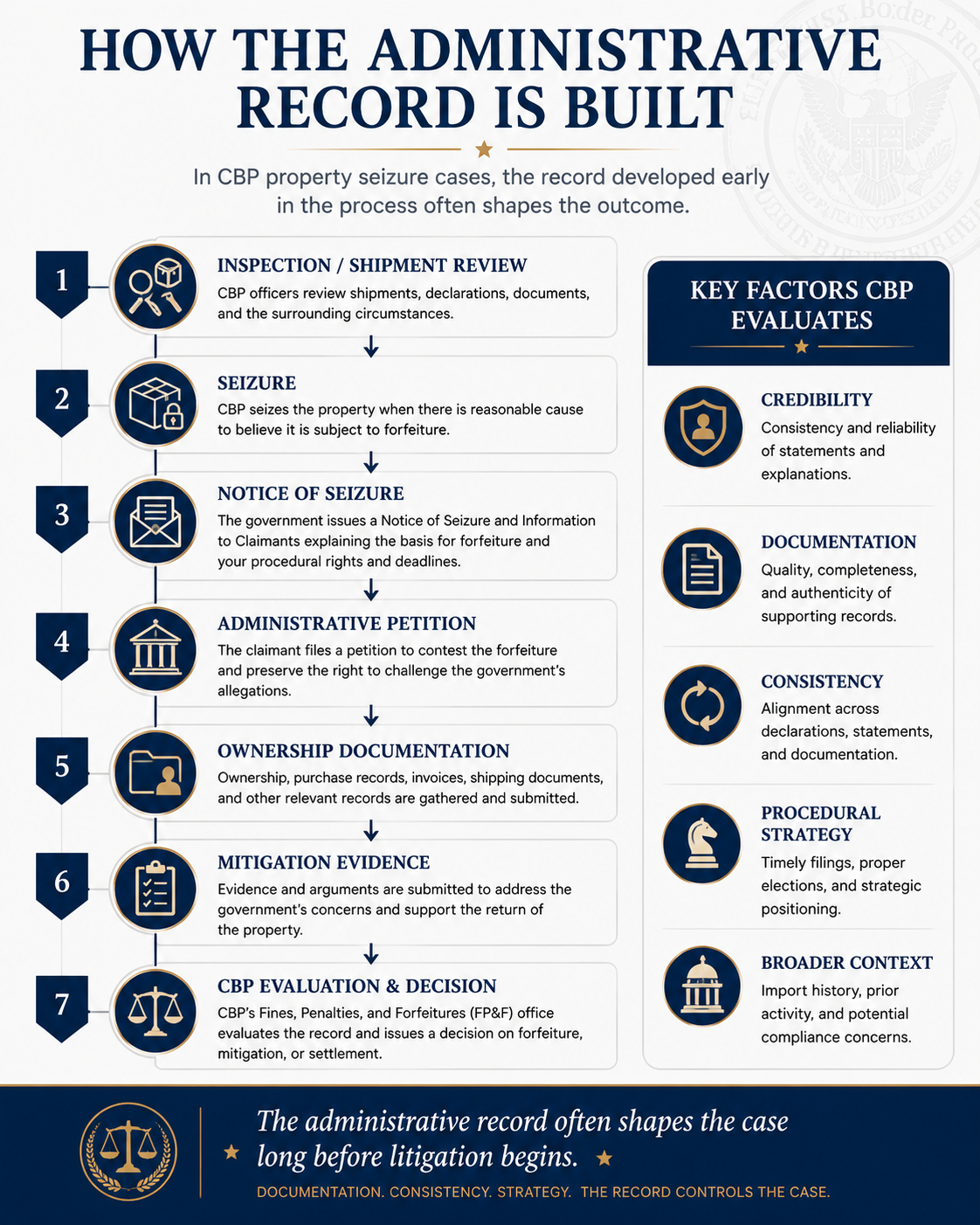
Strong Customs Seizure Cases Usually Begin with Administrative Discipline
Many successful customs seizure matters share several characteristics very early in the process:
- disciplined communication
- organized documentation
- strategic procedural timing
- credible mitigation
- consistent explanations
- careful administrative positioning
Strong cases are often built deliberately.
Weak cases are frequently reactive.
In many situations, the strongest strategy is not reacting emotionally or trying to explain everything immediately.
It is carefully evaluating:
- the government’s likely concerns
- the quality of the documentation
- procedural leverage
- broader federal implications
before major submissions are made.
That is one reason why many customs seizure matters are ultimately shaped less by dramatic courtroom litigation and more by disciplined administrative strategy developed early in the process.
Additional discussion appears in Why Hiring a Customs Seizure Lawyer Early Matters and Administrative Petition vs Federal Court Litigation.
Why National Security Law Firm Is Different
Many law firms approach customs seizure matters primarily as procedural forfeiture disputes.
National Security Law Firm approaches these matters differently.
In many situations, customs seizure cases intersect with broader federal systems involving:
- immigration
- export controls
- federal employment
- contractor eligibility
- security clearances
- future border scrutiny
- broader federal investigations
Federal agencies often evaluate these matters collectively rather than in isolation.
That broader institutional overlap frequently shapes how customs seizure matters should be strategically handled from the outset.
National Security Law Firm focuses heavily on:
- strategic administrative positioning
- mitigation analysis
- credibility management
- documentation review
- long-term federal implications
rather than simply reacting to forfeiture notices after the fact.
For broader discussion of customs forfeiture strategy generally, visit the firm’s How Customs Seizure Cases Are Really Won page.
Frequently Asked Questions
What does “the record controls the case” mean?
It means federal agencies often evaluate the entire administrative record rather than one isolated explanation or event.
That record may include:
- inspection statements
- customs declarations
- financial records
- mitigation submissions
- electronic communications
- later explanations
Why does the first submission matter so much?
The first submission often shapes how the government evaluates:
- credibility
- consistency
- mitigation
- procedural reliability
- overall administrative posture
Weak early submissions may create long-term strategic problems later.
Can inconsistent statements hurt my CBP case?
Yes.
Federal agencies frequently compare:
- inspection statements
- financial records
- customs declarations
- mitigation submissions
- later explanations
Even relatively small contradictions may create broader credibility concerns.
What documents matter most in customs seizure cases?
That depends on the type of seizure involved.
Commonly important records include:
- bank statements
- tax filings
- invoices
- shipping records
- ownership documentation
- import/export records
- source-of-funds evidence
Can I fix a bad first submission later?
Sometimes partially, but administrative record problems often become difficult to reverse once agencies have already formed impressions regarding:
- credibility
- consistency
- reliability
That is one reason why early strategic analysis often matters so much.
Does CBP compare statements over time?
Absolutely.
Federal agencies frequently compare:
- inspection interviews
- customs declarations
- mitigation submissions
- electronic communications
- financial documentation
- later litigation positions
Can social media hurt a forfeiture case?
Potentially, yes.
In some situations, social media or electronic communications may conflict with:
- mitigation claims
- customs declarations
- financial explanations
- ownership narratives
Additional discussion appears in Can Social Media or Prior Statements Hurt Your CBP Case?.
What makes a strong administrative record?
Strong customs seizure cases often involve:
- organized documentation
- disciplined communication
- strategic procedural timing
- credible mitigation
- consistent explanations
That is why National Security Law Firm repeatedly emphasizes:
the record controls the case.
Speak With a Nationwide Customs Seizure Lawyer
If CBP seized your money, merchandise, shipment, vehicle, package, or other property, the administrative record developed early in the process may significantly affect:
- mitigation opportunities
- procedural leverage
- credibility assessments
- broader federal consequences
Many customs seizure matters are heavily influenced by:
- first submissions
- procedural timing
- documentation quality
- consistency of explanations
- administrative positioning
That is why National Security Law Firm repeatedly emphasizes:
the record controls the case.
National Security Law Firm offers nationwide representation and free consultations for customs seizure matters.
The fastest and easiest way to get started is through the firm’s online booking system.
In many situations, same-day consultations are available, and the process typically takes less than a minute to schedule online.
Once booked, an attorney will personally call you at the scheduled time to discuss:
- the seizure
- procedural deadlines
- recovery strategy
- documentation issues
- broader federal implications
To schedule a consultation online, visit:
Book a Free Consultation Online
You may also contact the firm directly at:
Phone: (202) 600-4996
Additional related resources:
- Why Most People Lose CBP Seizure Cases Before They Even Begin
- Why Hiring a Customs Seizure Lawyer Early Matters
- Administrative Petition vs Federal Court Litigation
- How CBP Actually Decides Seizure Cases
- How Credibility Affects Customs Seizure Cases
- Why Consistency Matters in Federal Seizure Cases
- Can Social Media or Prior Statements Hurt Your CBP Case?
- How Customs Seizure Cases Are Really Won
- Customs Seizure Lawyers Resource Hub