
Most people assume that security clearance eligibility is based on a checklist.
- citizenship
- background
- criminal history
- finances
And while those factors matter, they do not determine eligibility on their own.
👉 Security clearance eligibility is not about meeting minimum requirements.
👉 It is about whether your record supports approval under a federal risk system.
That distinction is critical.
Security clearance decisions are made by adjudicators and administrative judges applying:
- the Adjudicative Guidelines
- the Whole Person Concept
- long-term reliability analysis
At National Security Law Firm, our attorneys include former security clearance adjudicators, administrative judges, and Defense Office of Hearings and Appeals (DOHA) attorneys. We have evaluated clearance cases from inside the system and understand what actually determines eligibility.
For a full overview of the clearance system, start with the
👉 Security Clearance Insiders Resource Hub
The Basic Security Clearance Eligibility Requirements
At a minimum, most applicants must meet several baseline requirements:
1. U.S. Citizenship
Most security clearances require U.S. citizenship.
Some limited exceptions exist, but for national security clearances:
👉 citizenship is typically required
2. Sponsorship by a Government Entity or Contractor
You cannot apply for a security clearance on your own.
You must be sponsored by:
- a federal agency
- a defense contractor
- a qualifying employer
For more on this, see:
👉 Do You Need a Job Offer or Sponsor to Get a Security Clearance?
3. Completion of the SF-86
Applicants must complete the
👉 SF-86 security clearance form
This document becomes:
👉 the foundation of your clearance record
4. Background Investigation
A background investigation reviews:
- financial history
- criminal records
- employment history
- foreign contacts
- personal conduct
See:
👉 Security Clearance Investigations Explained
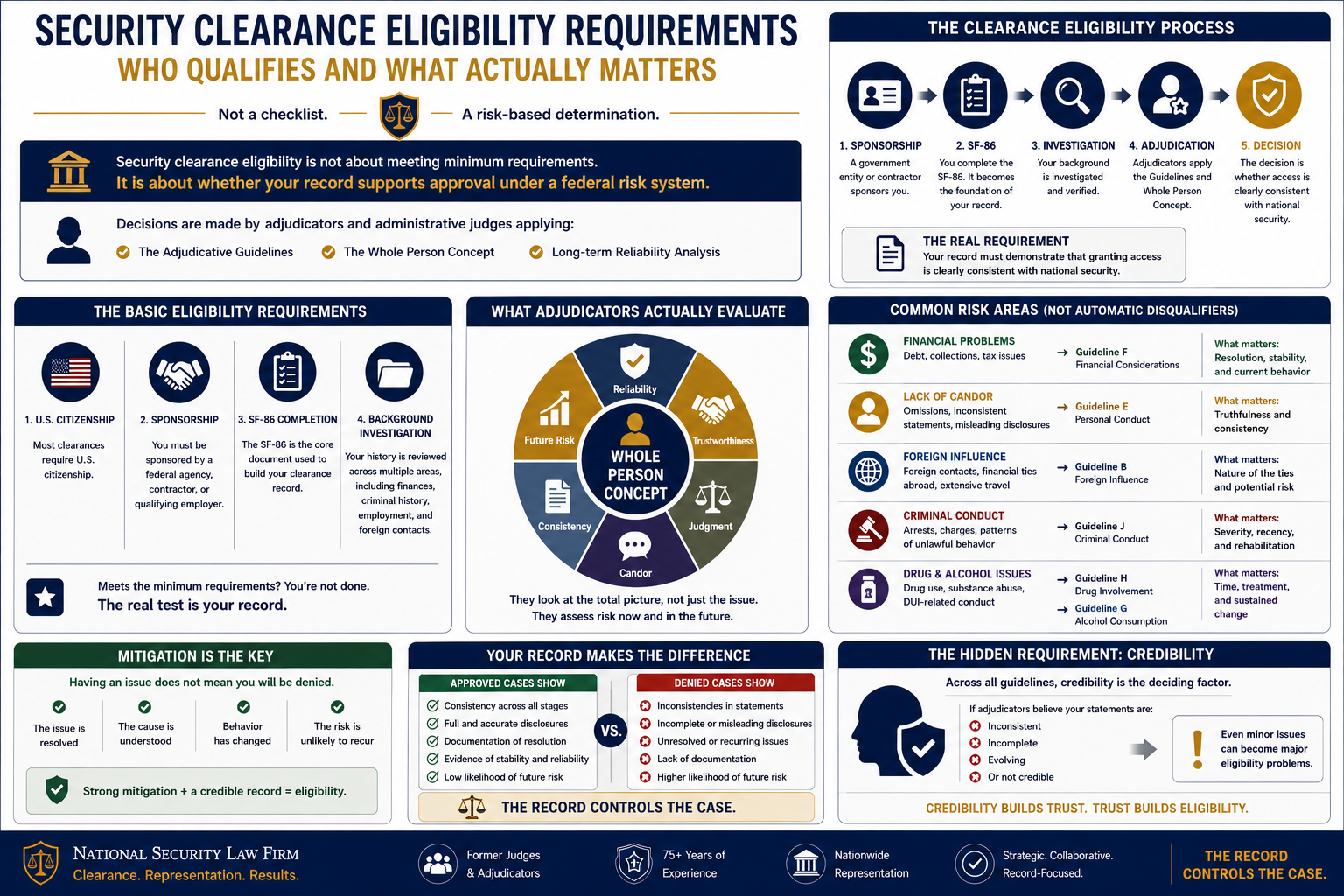
The Real Requirement: Your Record Must Support Approval
Meeting the basic requirements does not guarantee a clearance.
The real requirement is:
👉 your record must demonstrate that granting access is clearly consistent with national security
This is where most applicants misunderstand the system.
What Adjudicators Actually Evaluate
Security clearance eligibility is determined under the
👉 Adjudicative Guidelines
These include areas such as:
- financial considerations (Guideline F)
- personal conduct and candor (Guideline E)
- foreign influence (Guideline B)
- criminal conduct (Guideline J)
- drug and alcohol use (Guidelines H and G)
Each guideline evaluates:
👉 risk—not just behavior
What Can Disqualify You From a Security Clearance
Certain issues can raise concerns that affect eligibility.
Common risk areas include:
Financial Problems
- unpaid debt
- collections
- tax issues
👉 evaluated under
Guideline F — Financial Considerations
Lack of Candor
- omissions on the SF-86
- inconsistent statements
- misleading disclosures
👉 evaluated under
Guideline E — Personal Conduct
Foreign Influence
- foreign family members
- financial ties abroad
- extensive foreign travel
👉 evaluated under
Guideline B — Foreign Influence
Criminal Conduct
- arrests
- charges
- patterns of unlawful behavior
👉 evaluated under
Guideline J — Criminal Conduct
Drug and Alcohol Issues
- recent drug use
- substance abuse
- DUI-related conduct
👉 evaluated under
Guideline H — Drug Involvement
👉 Guideline G — Alcohol Consumption
Important: These Issues Do NOT Automatically Disqualify You
This is one of the most misunderstood aspects of clearance eligibility.
👉 Having an issue does not mean you will be denied
Many applicants are approved despite:
- past debt
- prior drug use
- criminal history
- foreign relationships
The deciding factor is:
👉 whether the issue is mitigated
What “Mitigation” Actually Means
Mitigation means:
- the issue is resolved
- the cause is understood
- behavior has changed
- the risk is unlikely to recur
For example:
- debt → paid or under control
- drug use → discontinued with time and stability
- criminal conduct → isolated and resolved
Why Some Applicants Are Approved and Others Are Denied
Two applicants can have similar issues but different outcomes.
The difference is:
👉 how the record is structured
Approved cases show:
- consistency
- documentation
- resolution
- stability
Denied cases show:
- inconsistency
- ambiguity
- unresolved concerns
The Hidden Requirement: Credibility
Across all guidelines, one factor dominates:
👉 credibility
If adjudicators believe:
- your statements are inconsistent
- your disclosures are incomplete
- your explanations evolve
Then even minor issues can become:
👉 major eligibility problems
How Clearance Eligibility Changes Over Time
Eligibility is not static.
It evolves based on:
- new information
- behavior over time
- Continuous Evaluation
This means:
👉 issues can improve
👉 but they can also reappear
Where Most Applicants Make Mistakes
Most mistakes happen early:
- incomplete SF-86 disclosures
- poor interview responses
- inconsistent explanations
- lack of preparation
These mistakes often create problems later in the process.
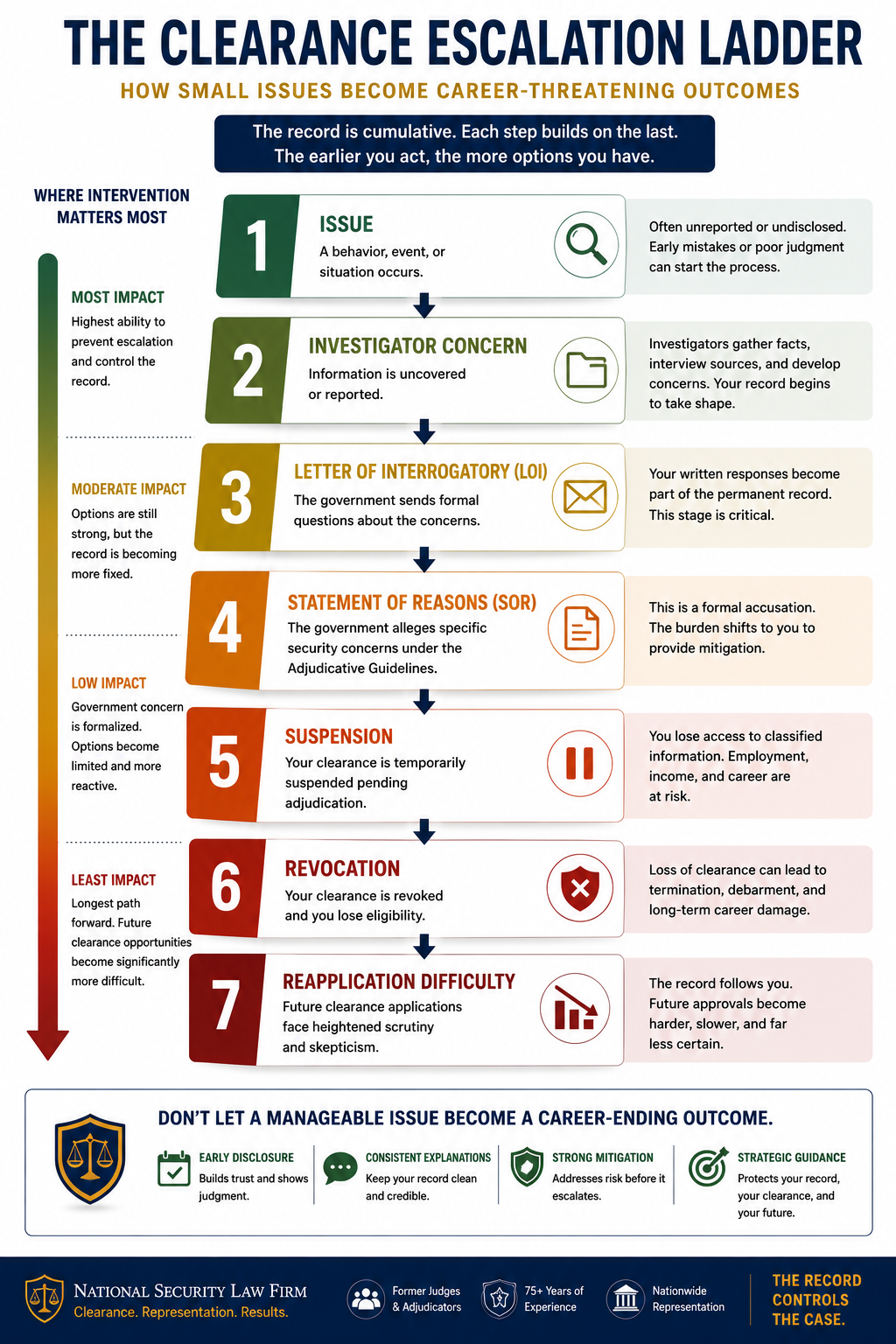
When Eligibility Issues Escalate
If concerns cannot be resolved during adjudication, the case may escalate to a:
At that point:
👉 the case becomes much more complex
Security Clearance Insiders Resource Hub Navigation
Readers who want to go deeper into the federal security clearance system can use the Security Clearance Insiders Resource Hub as the central navigation point for the firm’s security clearance library.
Key pages include:
Choosing a Security Clearance Lawyer
Security Clearance Lawyer Cost
Why National Security Law Firm Is Different
Security Clearance Cases Are Decided Inside a Federal System
These are not traditional legal cases.
They are determined by:
- records
- mitigation
- credibility
- long-term reliability
Insider Experience
Our attorneys include:
- former adjudicators
- former administrative judges
- former DOHA attorneys
Collaborative Strategy
Cases are reviewed through our
👉 Attorney Review Board
Record Control Strategy
We structure responses using
👉 record control strategy
Because:
👉 your record determines your outcome
Security Clearance Resource Navigation
Explore additional resources:
- 👉 Security Clearance Process
- 👉 SF-86 Strategy
- 👉 Security Clearance Hearings
- 👉 Security Clearance Appeals
FAQs: Security Clearance Eligibility Requirements
What are the basic requirements for a security clearance?
Citizenship, sponsorship, SF-86 submission, and a background investigation.
Can you be denied for past mistakes?
Yes—but only if those issues are not properly mitigated.
What is the biggest factor in eligibility?
Consistency and credibility across the record.
Can you get a clearance with bad credit?
Yes, if financial issues are resolved and stable.
Do all issues lead to denial?
No. Most can be mitigated with proper documentation.
Security Clearance Eligibility — Let’s Talk
If you are unsure whether you qualify for a security clearance, the key question is how your record will be evaluated.
You can
👉 schedule a free consultation
National Security Law Firm represents clients nationwide and maintains
👉 4.9-star Google reviews
Flexible payment options are available through
👉 legal financing through Pay Later by Affirm
The Record Controls the Case.