
What Guideline L Actually Means in Plain English
Guideline L is the part of the security clearance system that evaluates:
👉 outside activities that may create concern about loyalty, judgment, conflicts of interest, foreign influence exposure, or institutional reliability.
In plain English, it asks:
👉 “Can this person still be trusted to place U.S. national-security interests above outside financial, professional, organizational, or foreign interests?”
That does not mean every side business creates a clearance problem.
It does not mean outside employment is automatically prohibited.
And it does not mean nonprofit work, consulting, or foreign professional relationships always create security risk.
This is one of the most misunderstood realities of Guideline L.
The clearance system is not simply asking:
👉 “Did this person have outside activities?”
It is evaluating something broader:
👉 what the overall record suggests about future trustworthiness, disclosure reliability, institutional loyalty, and susceptibility to conflicts or outside influence going forward.
That distinction matters enormously.
Many applicants facing Guideline L concerns are not intentionally disloyal or trying to compromise national security.
They are often:
- contractors performing outside consulting
- federal employees with side businesses
- military personnel involved in nonprofit or advisory work
- applicants with undeclared foreign affiliations
- or professionals who failed to appreciate how outside activity intersects with security obligations
Common Guideline L issues include:
- outside employment
- consulting arrangements
- side businesses
- nonprofit affiliations
- advisory-board involvement
- foreign consulting
- foreign business relationships
- undisclosed outside income
- organizational memberships
- foreign travel tied to outside activity
- or failure to report outside activities properly
At National Security Law Firm, our security clearance lawyers understand that Guideline L cases are often misunderstood because applicants focus entirely on:
👉 whether the outside activity itself was legal or harmless.
But adjudicators are often evaluating something broader.
They are evaluating:
- disclosure behavior
- conflicts of interest
- foreign exposure
- institutional reliability
- willingness to comply with reporting obligations
- and whether future divided-loyalty concerns now appear manageable
This is why two applicants with similar outside activities may receive completely different outcomes.
One applicant may:
- disclose the activity proactively
- seek approval appropriately
- maintain clear separation from official duties
- cooperate fully during review
- and demonstrate strong institutional reliability afterward
Another may:
- conceal outside relationships
- minimize foreign involvement
- repeatedly change explanations
- or fail to disclose financial or organizational ties until investigators discover them
Those are not the same security-clearance file.
In Guideline L cases, the issue is rarely just:
👉 whether outside activity existed.
The issue is:
👉 what the applicant’s handling of the activity suggests about future trustworthiness, institutional reliability, disclosure discipline, and loyalty going forward.
Quick Answer: Can Outside Activities Affect Your Security Clearance?
Yes.
Outside activities can absolutely affect your security clearance.
Guideline L concerns can result in:
- clearance delay
- additional investigation
- ethics review
- foreign-influence review
- a Letter of Interrogatory (LOI)
- a Statement of Reasons (SOR)
- suspension
- denial
- or revocation
Common Guideline L issues include:
- side businesses
- outside consulting
- foreign clients
- nonprofit affiliations
- advisory-board participation
- outside employment
- foreign financial interests
- organizational involvement
- outside travel tied to organizations
- or undisclosed outside income
But this is the critical point:
👉 outside activity alone does not automatically mean clearance denial.
Many applicants with:
- consulting relationships
- side businesses
- nonprofit involvement
- or foreign professional relationships
still maintain or obtain security clearances successfully.
The issue is usually not:
👉 whether the applicant had outside activity.
The issue is:
👉 whether the overall record now creates unresolved concern about loyalty, judgment, disclosure reliability, foreign influence exposure, or future institutional trustworthiness.
That is where cases become dangerous.
To understand how Guideline L fits into the broader clearance decision framework, review the:
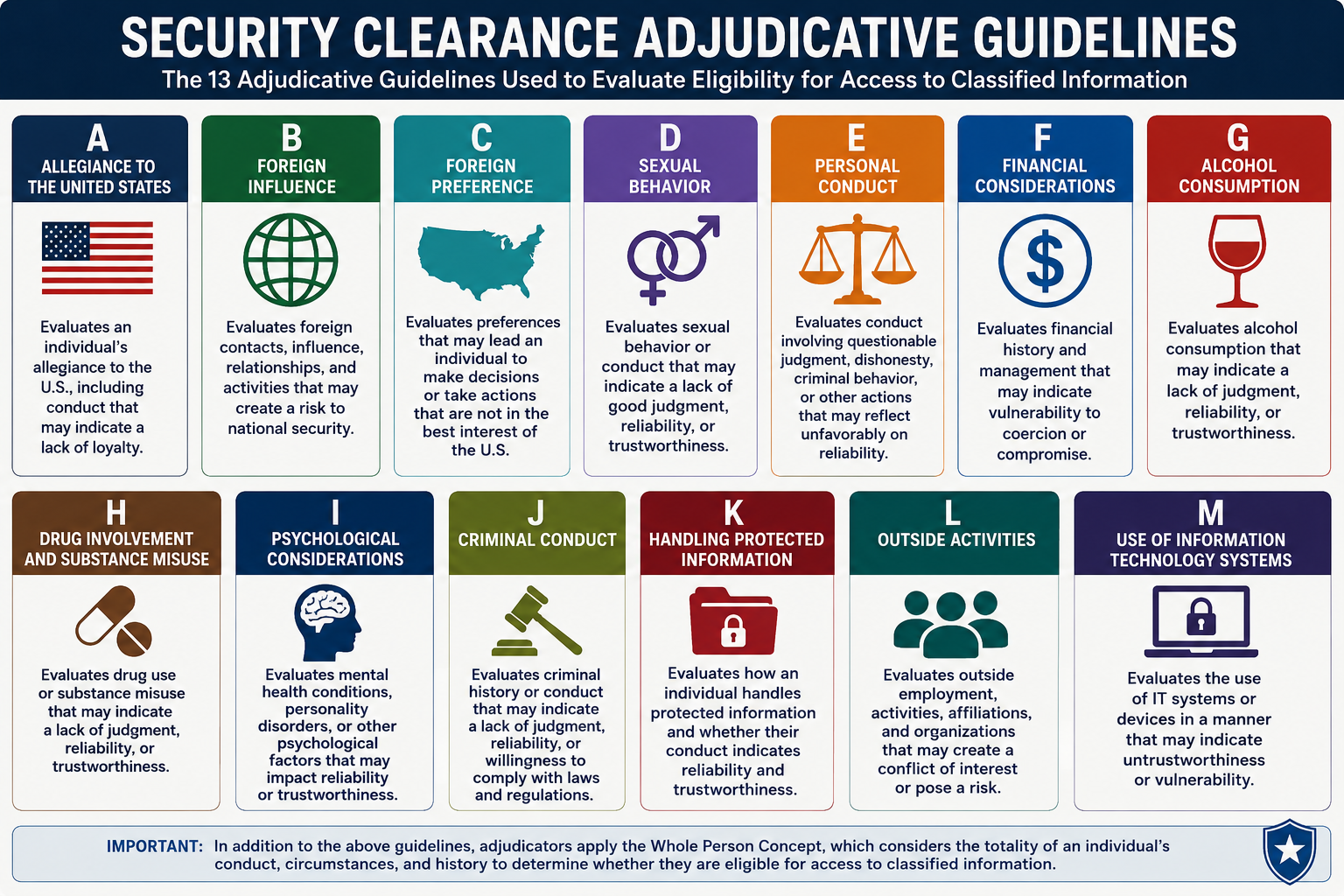
👉 Security Clearance Adjudicative Guidelines
Why Guideline L Is One of the Most Misunderstood Guidelines
Few guidelines create more confusion than Guideline L.
Applicants often assume:
- “It was on my own time.”
- “The work had nothing to do with classified information.”
- “It was only freelance consulting.”
- “I wasn’t trying to hide anything.”
- “The organization wasn’t foreign-owned.”
- “I didn’t think approval was required.”
- “The side business was private.”
- “I didn’t think the relationship mattered.”
Those assumptions often create serious strategic mistakes.
Because adjudicators are not evaluating only:
👉 whether the outside activity itself was technically allowed.
They are evaluating:
👉 whether the activity creates unresolved concern about conflicts of interest, foreign influence exposure, divided loyalties, institutional reliability, or future trustworthiness.
This distinction changes many Guideline L outcomes completely.
Especially because disclosure behavior often becomes critically important.
Applicants who:
- report outside activities proactively
- comply with approval obligations
- maintain transparency
- and stabilize the record early
often perform far better than applicants who:
- conceal outside work
- minimize foreign relationships
- use vague disclosure language
- or repeatedly revise explanations during investigation
This is one of the most important realities of Guideline L:
👉 concealment and disclosure failures often become more dangerous than the outside activity itself.
Why Guideline L Cases Feel So Frustrating
Guideline L cases often feel uniquely frustrating because many applicants genuinely believe:
👉 they were engaging in normal professional or personal activity.
Applicants frequently feel:
- confused
- blindsided
- unfairly scrutinized
- or frustrated by vague agency expectations
Especially involving:
- side businesses
- nonprofit work
- consulting
- foreign professional relationships
- or outside affiliations that seemed harmless at the time
Many applicants immediately begin thinking:
- “I didn’t know approval was required.”
- “I wasn’t trying to hide anything.”
- “The work had nothing to do with my clearance.”
- “I did this on my own time.”
- “The agency rules were unclear.”
- “This feels overly broad.”
Those reactions are understandable.
But those emotional reactions often become the beginning of the real problem.
Because adjudicators are frequently evaluating something else entirely:
👉 how the applicant handled disclosure, reporting obligations, and institutional trust responsibilities after the issue surfaced.
This is one of the most important realities of Guideline L:
👉 disclosure behavior and institutional reliability often matter more than applicants initially realize.
The strongest Guideline L cases are rarely built around emotional defensiveness.
They are usually built around:
👉 transparency, disclosure discipline, institutional reliability, and future trustworthiness.
Why the Insider Perspective Matters in Outside-Activities Cases
Most online discussions about Guideline L focus only on:
- whether outside work was technically allowed
- whether an agency policy was violated
- or whether the outside activity involved foreign organizations
That is not enough.
The harder question is:
👉 How do adjudicators actually decide whether outside activities create future security concern?
That is where insider perspective matters.
At National Security Law Firm, we approach Guideline L cases from the perspective of the decision-maker.
Our attorneys understand how adjudicators evaluate:
- disclosure behavior
- institutional reliability
- conflict-of-interest risk
- foreign influence exposure
- financial dependency
- misuse of official access
- procedural compliance
- and whether the applicant still appears trustworthy inside sensitive government environments
For example, adjudicators may ask:
- Was the activity disclosed appropriately?
- Did the applicant seek required approval?
- Was foreign influence exposure created?
- Did the activity conflict with official duties?
- Was government access or position used improperly?
- Does the applicant appear institutionally reliable now?
- Are there signs of divided loyalty?
- Can approval still be defended later if the outside relationship expands or becomes controversial?
That last question matters enormously.
Because in security-clearance cases, the issue is not only whether outside activity occurred.
The issue is whether the adjudicator still feels comfortable:
👉 trusting the applicant long-term inside sensitive national-security systems.
This is why Guideline L cases are often won or lost on:
👉 disclosure discipline, institutional trustworthiness, and future reliability after the activity becomes known.
Not just the outside activity itself.
What This Guide Will Help You Understand
If you are dealing with a Guideline L concern—or worried that one may arise—this guide will explain:
- how outside activities affect security clearances
- when side businesses become problematic
- how foreign consulting and foreign business interests are evaluated
- why disclosure obligations matter so much
- how nonprofit and organizational involvement are treated
- what adjudicators actually look for after reporting failures
- what mitigation really works
- where applicants accidentally make cases worse
- and how successful Guideline L cases are built around transparency, institutional reliability, and future trustworthiness
Most importantly, this guide will help you understand how the government evaluates outside activities from a national-security perspective.
Because until you understand that:
👉 you may be trying to defend the outside activity while the government is evaluating future loyalty, institutional reliability, and disclosure discipline.
That mismatch is where many Guideline L cases begin to fail.
When Guideline L Actually Comes Up in Real Cases
Guideline L concerns usually arise when the government believes:
👉 outside activities may create concern about loyalty, conflicts of interest, foreign influence exposure, institutional reliability, or future trustworthiness.
Sometimes the issue involves serious foreign overlap or undisclosed outside business activity.
More often, the issue begins with:
- consulting relationships
- side businesses
- nonprofit involvement
- foreign organizational ties
- outside employment
- or failure to report outside activities properly
That is why many applicants are surprised when Guideline L appears.
They often think:
👉 “The work was unrelated to my clearance.”
Or:
👉 “It was personal activity outside government hours.”
Those facts may absolutely help mitigation.
But adjudicators are evaluating something more specific:
👉 whether the overall record still creates unresolved concern about institutional reliability, disclosure discipline, or divided loyalties.
Below are some of the most common ways Guideline L appears in real security-clearance cases.
Outside Employment
Outside employment is one of the most common Guideline L issues.
Examples may include:
- secondary employment
- moonlighting
- freelance work
- consulting
- advisory services
- or private-sector side income
Applicants often mistakenly assume:
👉 “It was separate from my government work.”
That argument frequently misses the real concern entirely.
Adjudicators often evaluate:
👉 whether the outside activity creates conflicts, divided loyalties, or institutional reliability concerns.
Especially where the activity:
- overlaps with official duties
- involves foreign entities
- uses government systems
- or was not disclosed appropriately
This is one reason reporting obligations matter so much.
Side Businesses
Side businesses frequently create Guideline L concern because adjudicators may evaluate:
- outside financial dependency
- misuse of government access
- conflicts of interest
- or divided-loyalty concerns
Especially where applicants:
- fail to disclose the business
- operate the business during government hours
- use government systems or resources
- or maintain unclear separation between official and outside work
The issue is often not:
👉 whether entrepreneurship itself is prohibited.
The issue is:
👉 whether the outside business creates unresolved institutional trust concerns.
Consulting Arrangements
Consulting relationships often become dangerous where applicants:
- fail to seek approval
- conceal compensation
- work with foreign entities
- or blur boundaries between official and outside roles
Applicants often focus only on:
👉 whether the consulting itself was legal.
But adjudicators frequently evaluate something broader:
👉 whether the relationship creates conflict-of-interest, foreign influence, or loyalty concerns.
Especially where:
- the consulting overlaps with government expertise
- the applicant uses sensitive access improperly
- or outside compensation creates appearance problems
Foreign Consulting or Foreign Clients
Foreign consulting relationships often create especially serious concern because they may suggest:
👉 divided loyalties or susceptibility to foreign influence.
Examples may include:
- consulting for foreign companies
- foreign advisory roles
- overseas business relationships
- foreign nonprofit involvement
- or recurring foreign compensation
Applicants often mistakenly assume:
👉 “The relationship was professional only.”
That explanation may matter contextually.
But adjudicators often evaluate:
👉 whether the relationship creates future foreign leverage or institutional conflict concerns.
This is one reason foreign consulting relationships frequently overlap with:
👉 Guideline B — Foreign Influence
and
👉 Guideline C — Foreign Preference
Nonprofit and Organizational Involvement
Some Guideline L cases involve:
👉 nonprofit organizations, advocacy groups, or outside affiliations that create perceived institutional-risk concerns.
Examples may include:
- nonprofit board membership
- foreign-linked organizations
- outside advocacy work
- politically active organizations
- advisory boards
- or leadership roles involving foreign or sensitive interests
Applicants often assume:
👉 “It was volunteer work.”
But adjudicators may evaluate something broader:
👉 whether the activity creates divided-loyalty concerns, foreign exposure, institutional conflicts, or disclosure issues.
This does not mean nonprofit involvement is automatically dangerous.
Far from it.
The issue is usually:
👉 transparency, reporting compliance, and whether the overall record still supports future trustworthiness.
Especially where:
- foreign entities are involved
- the organization engages in politically sensitive activity
- or approval/reporting obligations existed.
Foreign Affiliations
Foreign affiliations often create heightened scrutiny under Guideline L because adjudicators may evaluate:
- influence exposure
- financial dependency
- organizational loyalty concerns
- or future vulnerability to foreign leverage
Examples may include:
- memberships in foreign organizations
- advisory work with foreign institutions
- recurring foreign compensation
- or ongoing professional alignment with foreign-connected entities
This is especially important where applicants:
- failed to disclose the relationship
- minimized the foreign overlap
- or maintained ongoing foreign dependence afterward
The issue is often not merely:
👉 whether the relationship exists.
It is:
👉 whether the relationship creates unresolved concern about institutional reliability or divided loyalties.
Outside Advisory Roles
Outside advisory positions can create Guideline L concern where they:
- overlap with official duties
- involve foreign organizations
- create conflict-of-interest concerns
- or expose the applicant to competing obligations
Examples may include:
- strategic advisory boards
- paid consulting panels
- think-tank affiliations
- foreign institutional advisory work
- or unofficial government-adjacent consulting
Applicants often underestimate how seriously these relationships may be evaluated.
Especially where:
- approval was not obtained
- foreign interests overlap
- or institutional boundaries become unclear
Use of Government Position or Resources
Some Guideline L cases become especially serious because adjudicators believe the applicant:
👉 used official position, access, or government systems improperly in connection with outside activity.
Examples may include:
- using government systems for outside business
- leveraging classified expertise improperly
- using official relationships for outside benefit
- or blending government and private activity together
These cases often create heightened concern because they may suggest:
- misuse of trust
- institutional unreliability
- poor judgment
- or inability to separate official duties from outside interests appropriately
The issue is often not simply:
👉 whether the outside activity existed.
It is:
👉 whether the applicant handled institutional boundaries responsibly.
Foreign Travel Connected to Outside Activities
Outside activities involving foreign travel often receive heightened scrutiny.
Especially where travel involves:
- foreign compensation
- foreign sponsorship
- conferences or speaking engagements
- nonprofit affiliations
- advisory work
- or recurring contact with foreign entities
Applicants often focus only on:
👉 whether the travel itself was legal.
But adjudicators frequently evaluate:
👉 whether the travel creates foreign-influence, disclosure, or divided-loyalty concerns.
This is especially important where applicants:
- failed to report travel appropriately
- concealed foreign sponsorship
- or maintained unclear organizational relationships afterward
Undisclosed Outside Income
Undisclosed compensation often becomes one of the most dangerous aspects of Guideline L cases.
Especially involving:
- foreign payments
- consulting compensation
- side-business income
- nonprofit compensation
- or undeclared financial relationships
The issue is often not only:
👉 whether the compensation was permissible.
It is:
👉 whether the applicant concealed outside financial interests or created institutional trust concerns.
This is one reason financial transparency matters enormously in Guideline L cases.
Ethics and Approval Violations
Many Guideline L concerns involve:
👉 procedural noncompliance.
Examples may include:
- failure to seek required approval
- ignoring ethics requirements
- bypassing disclosure obligations
- or continuing outside activity after agency warnings
Applicants often mistakenly believe:
👉 “I didn’t know approval was required.”
That explanation may help in some situations.
But adjudicators often evaluate something broader:
👉 whether the applicant exercised responsible judgment regarding institutional obligations.
Especially where:
- warnings existed
- policies were available
- or reporting obligations were reasonably clear
This is one reason procedural compliance becomes such an important mitigation issue later.
The Guideline L Statute (Full Text)
The full statutory language for Guideline L can be reviewed here:
👉 § 147.14 Guideline L — Outside Activities
The regulation explains:
- what outside activities raise concern
- how adjudicators evaluate conflicts and influence exposure
- and what mitigating conditions may apply
But reading the statute alone is not enough.
Because Guideline L cases are rarely decided based solely on:
👉 whether outside activity technically occurred.
They are decided based on:
- disclosure behavior
- institutional reliability
- foreign exposure
- credibility
- conflict-of-interest concerns
- and whether adjudicators believe future trustworthiness remains reliable
That is why two applicants with similar outside activities may receive completely different outcomes.
👉 The difference is often not the activity itself.
👉 It is how the overall record evolved afterward.
What the Government Is Actually Worried About
To truly understand Guideline L, you have to understand the government’s core concern.
The government is not simply trying to control applicants’ private lives.
It is evaluating:
👉 whether outside activities create future national-security risk.
That concern generally falls into several categories.
1. Divided Loyalties
This is one of the core Guideline L concerns.
Adjudicators worry that outside activities may create:
- competing obligations
- foreign alignment
- institutional conflicts
- or loyalty concerns inconsistent with sensitive national-security responsibilities
Especially involving:
- foreign organizations
- foreign compensation
- or outside interests conflicting with official duties
2. Conflict of Interest
Guideline L heavily evaluates:
👉 whether outside activity creates institutional conflict.
Examples may include:
- outside consulting overlapping with government responsibilities
- private financial interests conflicting with official duties
- or use of government position for outside advantage
The issue is often not simply:
👉 whether the applicant profited externally.
It is:
👉 whether institutional trustworthiness remains intact.
3. Foreign Influence Exposure
Many outside-activities cases overlap with:
👉 foreign influence concerns.
Especially where applicants:
- develop recurring foreign relationships
- maintain foreign business ties
- or create financial dependency connected to foreign entities
This is one reason Guideline L frequently overlaps with:
👉 Guideline B and Guideline C.
4. Disclosure Reliability
Guideline L cases often become much more dangerous because of:
👉 disclosure failures.
Adjudicators frequently evaluate whether applicants:
- concealed outside activity
- minimized foreign relationships
- avoided approval obligations
- or changed explanations repeatedly during investigation
This is one reason concealment often becomes more dangerous than the outside activity itself.
5. Institutional Trustworthiness
Ultimately, Guideline L is heavily focused on:
👉 institutional reliability.
Adjudicators often ask:
👉 “Can this applicant still be trusted to place government obligations above outside interests consistently going forward?”
That is the real issue driving many Guideline L outcomes.
How Adjudicators Actually Evaluate Guideline L Cases
This is where insider perspective matters most.
Adjudicators do not evaluate Guideline L mechanically.
They do not simply ask:
👉 “Did this person have outside activities?”
They ask:
👉 “What does this outside activity suggest about future loyalty, judgment, institutional reliability, disclosure discipline, and susceptibility to outside influence?”
That distinction is critical.
Because many Guideline L cases are not really about the outside activity itself.
They are about:
👉 whether the applicant still appears trustworthy enough for continued access to sensitive government systems and classified information.
Adjudicators often evaluate several core questions.
Was the Activity Disclosed or Concealed?
This is one of the most important issues in Guideline L.
Applicants who:
- proactively disclose outside activities
- seek required approvals
- and maintain transparent explanations afterward
often receive much more favorable treatment than applicants who:
👉 conceal relationships or minimize outside involvement until investigators uncover it.
Adjudicators frequently view proactive disclosure as evidence of:
- institutional reliability
- honesty
- and willingness to comply with security obligations
This is one reason disclosure behavior often matters more than applicants initially realize.
Did the Activity Create Foreign Influence Exposure?
Many Guideline L cases involve concerns about:
👉 foreign leverage or divided loyalties.
Adjudicators frequently evaluate:
- foreign financial relationships
- overseas business interests
- recurring foreign compensation
- foreign organizational involvement
- or dependence on foreign-connected entities
The issue is often not merely:
👉 whether the relationship existed.
It is:
👉 whether the relationship creates unresolved foreign influence concern going forward.
Did the Activity Conflict With Official Duties?
Outside activity becomes much more dangerous where adjudicators believe:
👉 institutional conflicts existed.
Examples may include:
- consulting overlapping with government work
- private financial interests conflicting with official responsibilities
- misuse of government systems or access
- or outside roles interfering with official duties
This is one reason maintaining clear separation between official duties and outside activities matters enormously.
Did the Applicant Seek Required Approval?
Many Guideline L cases involve:
👉 procedural noncompliance.
Adjudicators frequently evaluate:
- whether approvals were required
- whether the applicant sought guidance
- whether reporting obligations were ignored
- and whether the applicant demonstrated procedural discipline afterward
Applicants often weaken their cases significantly by insisting:
👉 “I didn’t think approval mattered.”
Because adjudicators may interpret that response as:
👉 poor institutional judgment or unwillingness to follow procedural obligations.
Did the Applicant Minimize the Activity?
This is where many Guideline L cases become much more dangerous.
Applicants often weaken their cases by:
- downplaying foreign overlap
- minimizing compensation
- describing organizations vaguely
- or emotionally defending outside relationships aggressively
Adjudicators frequently interpret minimization as:
👉 lack of transparency or future disclosure-risk concern.
This is one reason calm, disciplined explanations often perform much better than emotional defensiveness.
Does the Record Feel Institutionally Reliable or Unstable?
This is one of the most important insider concepts in Guideline L.
Adjudicators constantly evaluate:
👉 whether the file feels safe to approve long-term.
If the record feels:
- transparent
- institutionally disciplined
- procedurally reliable
- and professionally manageable
approval becomes much easier to defend.
But if the file feels:
- evasive
- conflicted
- foreign-influenced
- inconsistent
- or difficult to trust
approval becomes much harder.
Can Approval Be Defended?
This is one of the most important insider concepts in all security-clearance law.
Adjudicators constantly ask themselves:
👉 “Could I defend approving this applicant later if the outside relationship expands or becomes problematic?”
That question quietly drives many Guideline L outcomes.
If the file feels:
- transparent
- institutionally reliable
- low-risk
- and unlikely to create future influence concerns
approval becomes much more likely.
If the record feels:
- conflicted
- concealed
- foreign-dependent
- or difficult to trust
approval becomes much harder.
Outside Employment and Side Businesses
One of the biggest misconceptions in Guideline L is:
👉 “Outside work is always private.”
That is not necessarily true in security-clearance law.
Outside employment may create concern where it:
- overlaps with official duties
- creates conflicts of interest
- involves foreign entities
- uses government systems improperly
- or was not disclosed appropriately
Applicants often focus only on:
👉 whether the work itself was legal.
But adjudicators frequently evaluate something broader:
👉 whether the outside work creates institutional reliability or trust concerns.
This is especially important where applicants:
- concealed the activity
- failed to seek approval
- or maintained unclear boundaries between official and outside roles.
Foreign Business Interests and Foreign Consulting
Foreign business activity often creates heightened concern because adjudicators may evaluate:
- divided loyalties
- foreign leverage potential
- financial dependency
- or future influence concerns
Examples may include:
- consulting for foreign companies
- foreign advisory roles
- overseas financial interests
- foreign nonprofit work
- or recurring compensation from foreign entities
Applicants often mistakenly assume:
👉 “The relationship was professional only.”
That explanation may matter contextually.
But adjudicators often evaluate:
👉 whether the relationship creates unresolved foreign influence or institutional trust concerns.
This is one reason foreign consulting relationships frequently overlap with:
👉 Guideline B — Foreign Influence
and
👉 Guideline C — Foreign Preference
Especially where:
- disclosure failures exist
- foreign financial dependency appears significant
- or institutional boundaries become unclear.
Nonprofit, Advocacy, and Organizational Involvement
Some Guideline L cases involve:
👉 nonprofit organizations, advocacy groups, or outside affiliations that create perceived institutional-risk concerns.
Examples may include:
- nonprofit board membership
- foreign-linked organizations
- outside advocacy work
- politically active organizations
- advisory boards
- or leadership roles involving foreign or sensitive interests
Applicants often assume:
👉 “It was volunteer work.”
But adjudicators may evaluate something broader:
👉 whether the activity creates divided-loyalty concerns, foreign exposure, institutional conflicts, or disclosure issues.
This does not mean nonprofit involvement is automatically dangerous.
Far from it.
The issue is usually:
👉 transparency, reporting compliance, and whether the overall record still supports future trustworthiness.
Especially where:
- foreign entities are involved
- the organization engages in politically sensitive activity
- or approval/reporting obligations existed
Failure to Report Outside Activities
One of the fastest ways a manageable Guideline L case becomes dangerous is:
👉 failure to disclose or report outside activity appropriately.
Applicants often panic after questioning begins and start thinking:
- “I didn’t think approval was required.”
- “The work was unrelated.”
- “I wasn’t trying to hide anything.”
- “It was only occasional consulting.”
- “The organization wasn’t foreign-controlled.”
- “I thought the relationship was too minor to matter.”
Those reactions are understandable.
But they often create far more adjudicative concern than the outside activity itself.
Because once adjudicators believe an applicant:
- concealed outside work
- minimized foreign relationships
- avoided approval requirements
- or failed to disclose affiliations intentionally
the case often shifts from:
👉 outside activity concern
to:
👉 broader trustworthiness concern.
This is one of the most important realities of Guideline L:
👉 concealment frequently becomes more dangerous than the activity itself.
Adjudicators often place enormous weight on:
- whether the applicant disclosed proactively
- how consistent the explanations remained
- whether reporting obligations were understood
- and whether the applicant appeared more focused on transparency—or avoiding scrutiny
That distinction matters enormously.
The “Paper Risk” Problem in Guideline L Cases
This is one of the most important concepts in outside-activities clearance law.
Even manageable outside relationships can become dangerous when:
👉 the record itself begins feeling evasive, conflicted, or difficult to trust.
This is what we call:
👉 paper risk.
Examples include:
- inconsistent disclosure forms
- undeclared foreign interests
- vague consulting descriptions
- contradictory timelines
- emotionally defensive written responses
- misleading organizational explanations
- or records suggesting the applicant intentionally obscured outside involvement
Once the file begins to feel:
- evasive
- conflicted
- institutionally unreliable
- procedurally inconsistent
- or difficult to defend
👉 adjudicators become uncomfortable approving it.
That discomfort matters enormously.
Because adjudicators constantly ask themselves:
👉 “Can I defend approving this applicant later if the outside relationship becomes problematic?”
If the answer becomes uncertain:
👉 the case becomes much harder to win.
This is one reason disciplined disclosure, stable explanations, and institutional transparency matter so much in Guideline L cases.
What Strong Guideline L Mitigation Actually Looks Like
Strong Guideline L mitigation is not built around proving:
👉 “The outside activity wasn’t a problem.”
That strategy often fails.
The strongest cases usually focus on something much more persuasive:
👉 demonstrating transparency, institutional reliability, disclosure discipline, and future trustworthiness despite the outside activity.
Strong mitigation often includes:
- proactive disclosure
- correcting reporting deficiencies
- reducing foreign exposure where necessary
- ending problematic outside relationships
- maintaining clear separation from official duties
- stable and credible explanations
- and strong evidence supporting future institutional reliability
The issue is not whether the applicant ever engaged in outside activity.
It is:
👉 whether the overall record now supports future trustworthiness and institutional reliability.
For a deeper breakdown of what actually helps—and hurts—Guideline L cases, including foreign consulting, side businesses, disclosure failures, and conflict-of-interest concerns, review:
👉 How to Mitigate a Guideline L Outside Activities Security Clearance Concern
What Weak Guideline L Mitigation Looks Like
Weak mitigation usually shares one common theme:
👉 the applicant appears institutionally unreliable or evasive after the outside activity becomes known.
Applicants often weaken their cases by:
- minimizing foreign overlap
- concealing financial interests
- using vague disclosure language
- emotionally defending outside relationships aggressively
- changing organizational descriptions repeatedly
- or insisting approval “wasn’t necessary”
Those reactions often create more adjudicative concern than the outside activity itself.
Because adjudicators may begin seeing:
👉 unresolved trustworthiness or future disclosure-risk concerns.
This is one of the most important realities of Guideline L:
👉 disclosure behavior often matters more than the outside activity itself.
Illustrative Guideline L Case Scenarios
The examples below are hypothetical scenarios based on common fact patterns seen in security-clearance cases. They are designed to show how adjudicators typically evaluate Guideline L concerns—not to predict outcomes in any specific case.
Scenario 1 — Undisclosed Side Consulting Work (Potentially Mitigable)
An applicant performs outside consulting work without realizing approval was required but:
- discloses the issue once questioned
- terminates the consulting relationship
- and demonstrates strong institutional reliability afterward
👉 Likely Outcome: Often mitigable
Why this works:
The conduct appears rooted in misunderstanding rather than intentional concealment.
Scenario 2 — Foreign Consulting Relationship Concealed (Higher Risk)
An applicant minimizes and conceals a foreign consulting arrangement until investigators uncover financial records.
👉 Likely Outcome: Significant concern
Why this creates concern:
The concealment creates broader trustworthiness and foreign-influence concerns.
Scenario 3 — Nonprofit Board Membership Reported Properly (Often Manageable)
An applicant serves on a nonprofit board, discloses the role appropriately, and maintains clear separation from official duties.
👉 Likely Outcome: Often manageable
Why this works:
The transparency and procedural compliance strongly support institutional reliability.
Scenario 4 — Outside Work Using Government Systems (High Risk)
An applicant uses government systems and official resources for outside consulting work.
👉 Likely Outcome: Severe concern
Why this fails:
The conduct suggests misuse of position and disregard for institutional obligations.
Scenario 5 — Corrected Disclosure Before Discovery (Strong Mitigation)
An applicant realizes a reporting mistake involving outside activity and proactively corrects the disclosure before investigators identify the issue.
👉 Likely Outcome: Strong mitigation
Why this helps:
Voluntary correction strongly supports future trustworthiness.
Scenario 6 — Repeated Reporting Failures After Warnings (High Risk)
An applicant repeatedly fails to disclose outside affiliations despite prior compliance guidance.
👉 Likely Outcome: Significant concern
Why this fails:
The pattern suggests unresolved disclosure and reliability problems.
Scenario 7 — Foreign Business Investment With Transparent Reporting (Fact-Specific)
An applicant maintains a foreign financial interest but fully discloses the relationship and demonstrates no operational conflict or foreign leverage risk.
👉 Likely Outcome: Highly fact-specific
Why this may still be manageable:
Transparency and limited influence exposure significantly strengthen mitigation.
Scenario 8 — Emotional Defensiveness During Investigation (Higher Risk)
An applicant repeatedly minimizes outside affiliations and changes explanations during interviews.
👉 Likely Outcome: Elevated concern
Why this creates concern:
The response behavior itself begins undermining future trustworthiness analysis.
Scenario 9 — Informal Foreign Advisory Role With No Disclosure (High Risk)
An applicant provides unofficial advisory assistance to a foreign-linked organization without reporting the relationship or compensation involved.
👉 Likely Outcome: Significant concern
Why this fails:
The undisclosed foreign overlap creates major institutional-reliability and foreign-influence concerns.
Scenario 10 — Outside Teaching or Speaking Engagement Reported Properly (Often Mitigable)
An applicant accepts compensated speaking engagements related to their expertise but:
- reports the activity properly
- obtains required approvals
- and maintains separation from classified responsibilities
👉 Likely Outcome: Often manageable
Why this works:
The activity appears transparent, professionally controlled, and institutionally compliant.
What Actually Gets Guideline L Cases Approved
Successful Guideline L cases usually share several characteristics.
The applicant typically:
- discloses outside activities honestly
- complies with reporting obligations
- demonstrates institutional reliability
- avoids conflicting loyalties
- maintains stable and credible explanations
- and presents a record that feels transparent and professionally manageable over time
Most importantly:
👉 the adjudicator ultimately believes the applicant’s outside activities no longer create meaningful future conflict, influence, or trustworthiness concerns.
That is the real issue in Guideline L.
Not perfection.
👉 future institutional reliability, transparency, and trustworthiness.
What Causes Guideline L Denials
Guideline L denials usually stem from one core conclusion:
👉 the adjudicator believes outside activities create unresolved concern about loyalty, judgment, disclosure reliability, or institutional trustworthiness.
That concern may involve:
- concealment
- undisclosed foreign interests
- repeated reporting failures
- divided-loyalty concerns
- misuse of position
- conflicts of interest
- dishonesty
- emotionally evasive explanations
- or unresolved foreign-influence concerns
This is one of the most important realities of Guideline L:
👉 denials often occur because adjudicators lose confidence in the applicant’s institutional reliability—not simply because outside activity existed.
Where Guideline L Cases Collapse
Most Guideline L cases do not fail because of one outside activity alone.
They fail during escalation.
This is one of the most important concepts in outside-activities clearance law.
Stage 1 — Outside Activity Begins
Examples include:
- consulting work
- side businesses
- nonprofit involvement
- foreign business relationships
- outside advisory roles
- or secondary employment
At this stage:
👉 the issue may still be highly manageable.
Stage 2 — Applicant Fails to Report Properly
The applicant:
- assumes approval is unnecessary
- minimizes the relationship
- omits disclosure
- or misunderstands reporting obligations
This is where the danger often begins.
Because adjudicators may now begin evaluating:
👉 institutional reliability and disclosure discipline.
Stage 3 — Foreign or Conflict Concerns Emerge
Investigators identify:
- foreign exposure
- financial conflicts
- organizational overlap
- or outside influence concerns
Now the issue expands beyond:
👉 the outside activity itself.
The case becomes:
👉 a broader trustworthiness and loyalty analysis.
Stage 4 — The Record Becomes Inconsistent
The applicant:
- changes explanations
- revises organizational descriptions
- minimizes foreign involvement
- or creates conflicting narratives during investigation
Now the file begins feeling:
👉 institutionally unreliable and difficult to trust.
Stage 5 — Credibility Problems Develop
The applicant:
- conceals financial ties
- omits affiliations
- provides vague disclosure language
- or repeatedly changes timelines
Now the case may evolve into:
👉 a broader Guideline E credibility problem.
This is one of the most important realities of Guideline L:
👉 concealment often becomes more dangerous than the outside activity itself.
Stage 6 — The Entire File Becomes a Trustworthiness Concern
At this point, adjudicators begin questioning:
- loyalty
- institutional reliability
- future disclosure behavior
- susceptibility to influence
- and willingness to comply with security obligations consistently
This is where many Guideline L cases ultimately fail.
Stage 7 — SOR or Denial
The unresolved outside-activities concern hardens into:
- an LOI
- a Statement of Reasons
- suspension
- denial
- or revocation
👉 Final outcome: clearance loss.
How Guideline L Interacts With Other Guidelines
Guideline L frequently overlaps with several other security-clearance guidelines.
This is one reason outside-activities cases often become more complicated than applicants initially expect.
Many cases that begin as:
👉 outside-employment or organizational concerns
eventually become:
👉 broader foreign-influence, credibility, or conflict-of-interest cases.
Guideline B — Foreign Influence
This is one of the most common overlaps.
Especially involving:
- foreign consulting
- overseas business interests
- foreign organizational involvement
- foreign nonprofit relationships
- or recurring contact with foreign entities
See:
👉 Guideline B — Foreign Influence
Guideline C — Foreign Preference
Some outside activities create overlap with:
👉 foreign-preference concerns.
Especially where applicants appear:
- financially tied to foreign interests
- professionally aligned with foreign entities
- or behaviorally committed to foreign affiliations over U.S. institutional obligations
See:
👉 Guideline C — Foreign Preference
Guideline E — Personal Conduct
Many Guideline L cases become much more dangerous because of:
👉 concealment or disclosure failures.
Examples include:
- omitted outside employment
- hidden foreign consulting
- incomplete financial disclosures
- or inconsistent explanations during investigation
In many cases:
👉 the dishonesty becomes more dangerous than the outside activity itself.
See:
👉 Guideline E — Personal Conduct
Guideline F — Financial Considerations
Outside activities sometimes overlap with:
👉 financial concerns.
Especially involving:
- undisclosed income
- foreign financial dependence
- outside compensation
- conflicts involving financial pressure
- or misuse of official position for financial benefit
See:
👉 Guideline F — Financial Considerations
Guideline M — Use of Information Technology Systems
Some outside-employment cases overlap with:
👉 misuse of government systems.
Especially where applicants:
- use government devices for outside work
- misuse official systems
- transfer work improperly
- or combine outside business activity with protected systems
See:
👉 Guideline M — Use of Information Technology Systems
👉 Once multiple guidelines begin overlapping, the mitigation burden often becomes much heavier.
This is one reason early strategic handling matters enormously.
How Guideline L Appears Throughout the Clearance Process
Outside-activity concerns can emerge at nearly every stage of the security-clearance process.
Many applicants mistakenly assume:
👉 “If the activity was legal, the clearance issue disappears.”
That is not how the system works.
Guideline L concerns often follow applicants throughout:
- SF-86 disclosures
- outside-employment reporting
- ethics reviews
- foreign-affiliation review
- background investigations
- subject interviews
- financial audits
- LOIs
- SORs
- hearings
- and future reinvestigations
This is why:
👉 early stabilization of the record matters enormously.
The SF-86 and Disclosure Stage
Many Guideline L cases first appear during completion of the:
👉 SF-86 Security Clearance Form
This is where applicants may disclose:
- outside employment
- foreign affiliations
- business interests
- organizational relationships
- financial ties
- or foreign contacts related to outside activity
The SF-86 becomes:
👉 the foundation of the outside-activities investigative record.
If disclosures are:
- incomplete
- vague
- misleading
- or inconsistent
those problems often follow the applicant throughout the clearance process.
This is especially dangerous where applicants attempt to:
- minimize foreign relationships
- describe organizations vaguely
- omit side income
- or avoid disclosure of outside affiliations altogether.
The Outside Employment and Ethics Review Stage
Some Guideline L concerns initially surface during:
- agency ethics review
- outside-employment approval processes
- conflict-of-interest review
- or internal reporting requirements
Applicants are often surprised by:
- how broad reporting obligations may be
- how aggressively agencies evaluate outside affiliations
- and how minor disclosure mistakes can escalate into larger trustworthiness concerns later
This is one reason procedural compliance matters so much in Guideline L cases.
Especially where agencies conclude the applicant:
👉 should have known reporting or approval was required.
The Background Investigation Stage
During the:
👉 security clearance investigation
investigators may review:
- outside-employment records
- financial disclosures
- organizational affiliations
- consulting relationships
- foreign business interests
- and public or professional activity connected to outside work
Applicants are often shocked by:
- how broadly investigators evaluate outside relationships
- how financial records reveal undisclosed activity
- and how quickly foreign overlap concerns can escalate
This is especially important where investigators identify:
- undeclared outside income
- foreign organizational overlap
- or undisclosed business relationships.
The Subject Interview Stage
The:
👉 security clearance subject interview
is one of the most dangerous stages in many Guideline L cases.
Applicants frequently weaken their cases by:
- minimizing foreign relationships
- changing organizational descriptions
- emotionally defending side businesses aggressively
- or attempting to explain disclosure failures casually
This is where many manageable outside-activities cases begin evolving into:
👉 broader credibility concerns.
Investigators often evaluate not only:
👉 the outside activity itself
but also:
👉 whether the applicant appears transparent, institutionally reliable, and trustworthy while discussing it now.
That distinction matters enormously.
The Audit and Financial Review Stage
Many Guideline L concerns involve:
👉 financial documentation and institutional review.
Examples may include:
- tax records
- consulting payments
- foreign financial activity
- nonprofit compensation
- outside income streams
- organizational records
- or business filings
This means small inconsistencies can become highly visible later.
Especially where applicants:
- revise explanations
- omit financial ties
- or describe outside relationships differently across records
This is one reason stable disclosures matter so much in Guideline L cases.
The LOI and SOR Stages
If outside-activity concerns remain unresolved, applicants may receive:
At this stage, the government is often attempting to:
- clarify outside relationships
- evaluate disclosure reliability
- assess foreign influence exposure
- determine whether conflicts of interest remain unresolved
- and evaluate whether future trustworthiness concerns persist
Poorly handled responses often become:
👉 the blueprint for later denial.
Especially where applicants:
- become emotionally defensive
- repeatedly change organizational descriptions
- minimize outside financial interests
- or fail to appreciate institutional concerns fully
For deeper analysis, review:
👉 How to Respond to a Security Clearance Letter of Interrogatory
👉 How to Respond to a Statement of Reasons (SOR): What Adjudicators and Judges Actually Look For
Related Guideline L Resources
For deeper analysis of the most common Guideline L issues, review:
👉 How to Mitigate a Guideline L Outside Activities Security Clearance Concern
👉 Guideline B — Foreign Influence
👉 Guideline C — Foreign Preference
👉 Security Clearance Adjudicative Guidelines
👉 Security Clearance Mitigation & Strategy
How Guideline L Outside Activities Concerns Are Actually Mitigated
Many applicants assume that once outside-activity concerns arise, the clearance case is effectively over.
That is not true.
In reality, many Guideline L cases are highly mitigable when the issue is handled strategically and the record is stabilized correctly.
The key is understanding what adjudicators are actually evaluating:
👉 institutional reliability
👉 disclosure discipline
👉 foreign influence exposure
👉 conflict-of-interest risk
👉 credibility
👉 and whether future trustworthiness concerns remain manageable
Strong mitigation often involves:
- proactive disclosure
- correcting reporting deficiencies
- reducing foreign exposure where necessary
- stable and consistent explanations
- procedural compliance
- and strong evidence supporting future institutional reliability
For a deeper breakdown of what actually helps—and hurts—Guideline L cases, including foreign consulting, side businesses, disclosure failures, and conflict-of-interest concerns, review:
👉 How to Mitigate a Guideline L Outside Activities Security Clearance Concern
Frequently Asked Questions About Guideline L
Do I need to report outside employment?
Often yes.
Many agencies require disclosure or approval for:
- outside employment
- consulting
- side businesses
- advisory roles
- or compensated outside activity
Especially where foreign entities or institutional conflicts may exist.
Can side businesses affect my security clearance?
Absolutely.
Especially where the business:
- creates conflicts of interest
- overlaps with official duties
- involves foreign entities
- or was not disclosed appropriately
What if I worked with a foreign company?
Foreign consulting or business relationships can create significant Guideline L concern.
Especially where:
- compensation is involved
- foreign influence overlap exists
- or disclosure obligations were ignored
These cases often overlap with:
👉 Guideline B and Guideline C.
Can nonprofit involvement trigger Guideline L?
Yes.
Especially where organizations are:
- foreign-linked
- politically active
- financially connected to foreign interests
- or insufficiently disclosed during the clearance process
What if I didn’t know approval was required?
That may help mitigation in some cases.
But adjudicators often still evaluate:
👉 whether the applicant exercised reasonable judgment regarding disclosure and institutional obligations.
Does concealment make things worse?
Almost always.
Many manageable outside-activity cases become far more dangerous when applicants:
- conceal affiliations
- omit consulting work
- minimize foreign overlap
- or provide inconsistent explanations afterward
Can I recover after a Guideline L allegation?
Often yes.
Many applicants successfully maintain or recover their clearances when they:
- stabilize disclosures
- correct reporting deficiencies
- reduce institutional-risk concerns
- and demonstrate future trustworthiness convincingly
Why National Security Law Firm
Most law firms approach Guideline L cases as if they are simply:
👉 ethics or disclosure disputes.
That is not enough.
At National Security Law Firm, our security clearance lawyers understand that Guideline L cases are really about:
👉 institutional trustworthiness, disclosure discipline, foreign influence exposure, conflicts of interest, and whether the overall record still supports future reliability inside sensitive government environments.
Our team understands something many attorneys do not:
👉 security-clearance adjudication is not merely about whether outside activity occurred.
It is about whether the applicant still appears institutionally reliable enough for continued access to classified systems and sensitive national-security responsibilities.
We focus heavily on:
- stabilization of the record
- disclosure strategy
- foreign-overlap analysis
- credibility preservation
- and long-term institutional trustworthiness framing
Complex cases are reviewed through our internal:
This means:
- multiple experienced attorneys evaluate the file
- mitigation strategies are stress-tested before submission
- weaknesses are identified early
- and the case is approached through the same layered institutional lens used by the government itself
Many clients come to us after receiving advice focused only on:
- ethics compliance
- technical reporting issues
- or emotional defensiveness about the outside activity
But Guideline L cases are rarely won through technical explanations alone.
👉 They are won through transparency, disclosure discipline, institutional reliability, and future trustworthiness.
You can read what clients say about working with our team in our:
The Record Controls the Case.
SECURITY CLEARANCE DENIED OR REVOKED
If you are appealing a security clearance determination, it is imperative that you obtain experienced legal representation. Doing so will provide you with the best opportunity to obtain or maintain your clearance.
Click Here For a No Obligation, Always Confidential Consultation