
A TWIC background check is more than a routine employment screening.
When you apply for a Transportation Worker Identification Credential, the Transportation Security Administration conducts a federal security threat assessment to determine whether you meet the standards for unescorted access to secure areas of federally regulated maritime facilities and vessels.
Under 49 C.F.R. § 1572.21, TSA’s assessment includes:
- A fingerprint-based criminal-history records check;
- An intelligence-related check;
- Immigration-status verification;
- Review of certain mental-capacity records or determinations; and
- A final TSA adjudication.
TSA may deny or invalidate a TWIC based on a listed felony conviction, an unresolved warrant or indictment, an incomplete criminal record, immigration-status problems, certain mental-capacity conditions, or terrorism-related and other security information.
A TWIC background check does not include a TSA-administered drug test. Your employer, union, Coast Guard-regulated position, Department of Transportation program, or another authority may separately require drug testing, but that is not part of TSA’s TWIC security threat assessment.
If TSA sends you an adverse letter, do not assume that the information or legal classification is correct. You generally must initiate an appeal within 60 days after receiving an Initial Determination of Threat Assessment.
National Security Law Firm represents TWIC applicants nationwide. We have handled TWIC and Hazardous Materials Endorsement cases since 2016 and have represented applicants in hundreds of TSA credential matters.
For qualifying initial-stage appeals or waivers, our flat legal fee is $2,495. We review TSA’s notice, obtain ordinary court records, analyze the alleged disqualification, prepare the legal submission, and manage the matter through the covered TSA stage.
Schedule a free consultation or call (202) 600-4996.
What Does TSA Check for a TWIC Card?
TSA’s TWIC security threat assessment generally examines four major areas:
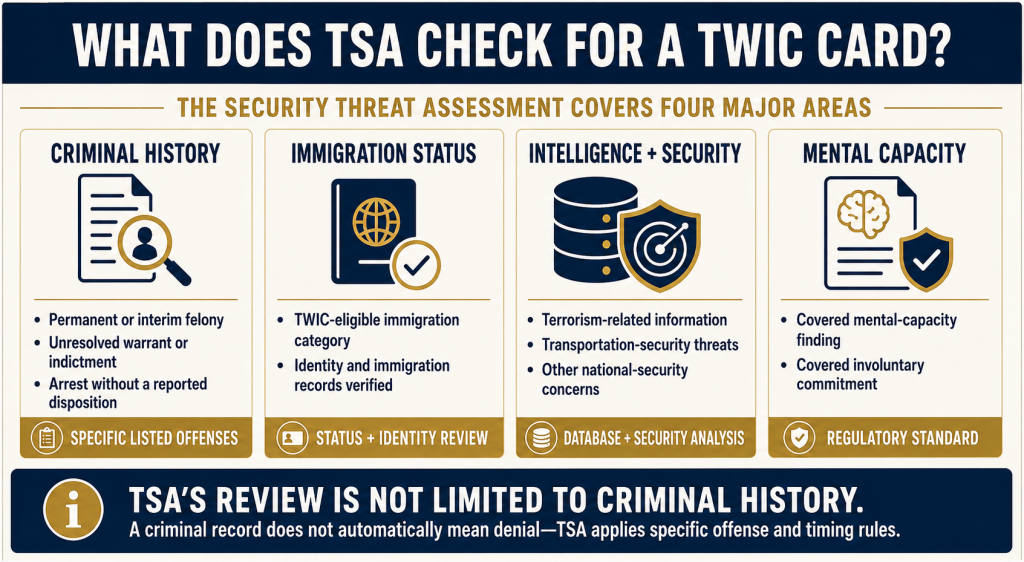
TSA’s assessment is not limited to a criminal-background report. An applicant may have no disqualifying conviction and still receive an adverse determination based on immigration, mental-capacity, identity, intelligence, or other security information.
Conversely, having a criminal record does not automatically mean TSA will deny the application. The criminal-offense regulation identifies specific felonies and provides different rules for permanent and interim offenses.
TSA’s Fingerprint-Based Criminal-History Check
TWIC applicants must submit fingerprints and the information required by TSA. TSA transmits those fingerprints to the FBI’s Criminal Justice Information Services Division and adjudicates the results under the federal TWIC regulations.
Fingerprint-based checks help TSA identify criminal records associated with the applicant, including records maintained under:
- Legal names;
- Prior names;
- Aliases;
- Different identifying information; or
- Records that may not appear in a name-based commercial background check.
The fingerprint check may report:
- Arrests;
- Charges;
- Convictions;
- Warrants;
- Indictments;
- Sentencing information;
- Incarceration information; or
- Cases without a recorded disposition.
The presence of an arrest does not automatically establish a disqualifying conviction. The problem is that FBI and state criminal-history records are sometimes incomplete.
A record may report the original felony charge without showing that:
- The prosecutor dismissed the case;
- The charge was reduced to a misdemeanor;
- The applicant was acquitted;
- The applicant completed a diversion program;
- The conviction was reversed;
- A court entered an amended judgment;
- A warrant was recalled; or
- The conviction was pardoned or qualifyingly expunged.
TSA may require the applicant to obtain official documentation clearing up the missing information.
Which Criminal Convictions Does TSA Review?
The criminal-offense standards are found in 49 C.F.R. § 1572.103.
The regulation divides the listed felonies into two categories.
Permanent Disqualifying Felonies
Permanent offenses remain disqualifying regardless of the conviction’s age. They include categories involving:
- Espionage;
- Sedition;
- Treason;
- Federal crimes of terrorism or comparable state offenses;
- Transportation security incidents;
- Improper transportation of hazardous materials;
- Explosives or explosive devices;
- Murder;
- Certain explosive or lethal-device threats;
- Certain RICO violations; and
- Designated attempts and conspiracies.
“Permanent” does not always mean “nonwaivable.” Several permanent offenses fall within TSA’s waiver authority, while a narrower group generally does not.
Interim Disqualifying Felonies
Interim offenses include specified felonies involving:
- Firearms and other weapons;
- Extortion;
- Dishonesty, fraud, or misrepresentation;
- Bribery;
- Smuggling;
- Immigration violations;
- Distribution, possession with intent to distribute, or importation of a controlled substance;
- Arson;
- Kidnapping or hostage taking;
- Rape or aggravated sexual abuse;
- Assault with intent to kill;
- Robbery;
- Fraudulent entry into a seaport;
- Certain RICO violations; and
- Attempts or conspiracies to commit interim offenses.
An interim felony is disqualifying if either:
- The conviction or finding of not guilty by reason of insanity occurred within seven years of the TWIC application; or
- The applicant was incarcerated for that offense and released within five years of the application.
Both periods must be outside their respective windows before the interim offense ceases to be disqualifying based on age.
Review our complete 2026 guide to TWIC card disqualifying offenses for the offense-by-offense classifications and waiver rules.
Does TSA Review Arrests That Did Not Result in Convictions?
Yes, the fingerprint-based record may disclose arrests. But an arrest is not automatically a disqualifying conviction.
The critical issue is often whether the criminal-history record reports the final disposition.
Under § 1572.103(d), when TSA’s fingerprint check discloses an arrest for a listed offense without indicating what happened, TSA notifies the applicant and provides instructions for clearing the disposition.
The applicant generally must provide written proof within 60 days after the service date of TSA’s notification that the arrest did not result in a conviction for the disqualifying offense.
Potential evidence includes:
- A certified final judgment;
- A dismissal or nolle prosequi order;
- A prosecutor’s certification;
- A court clerk’s certification;
- A judgment of acquittal;
- An amended charging document;
- A plea or sentencing record;
- A corrected state criminal-history report; or
- A corrected FBI Identity History Summary.
If TSA does not receive sufficient proof within the applicable period, it may determine that the applicant is disqualified.
Do not assume that TSA will independently locate a decades-old disposition. The applicant may need to obtain records from the court, prosecutor, arresting agency, state repository, corrections department, or another official source.
Does an Arrest Without a Conviction Automatically Disqualify You?
No. An arrest alone does not establish that the applicant was convicted of a disqualifying felony.
However, three separate problems may arise:
- The disposition is missing. TSA may require the applicant to prove what happened.
- A warrant remains active. A want or warrant for a listed felony can be disqualifying while unresolved.
- An indictment remains pending. A pending indictment for a listed felony can independently disqualify the applicant.
The response should address the exact problem identified by TSA rather than merely state, “I was never convicted.”
How Does TSA Treat Warrants and Indictments?
Under § 1572.103(c), an applicant who is wanted or under indictment in a civilian or military jurisdiction for a felony listed in the regulation is disqualified until:
- The want or warrant is released; or
- The indictment is dismissed.
This provision does not require a conviction.
An appeal may be appropriate if:
- The warrant belongs to another person;
- The warrant was recalled or quashed;
- The criminal case was resolved;
- The indictment was dismissed;
- The record was never updated;
- The charge is not a listed felony; or
- TSA otherwise relied on inaccurate information.
A personal statement that a case is “over” may not be enough. TSA will generally need official documentation establishing the warrant’s or indictment’s current status.
What Criminal Records Are Not Automatic TWIC Disqualifiers?
Not every unfavorable criminal record is a TWIC disqualifier.
Subject to other grounds for TSA concern, the following are not automatically disqualifying under the criminal-conviction list:
- A felony that does not fit one of TSA’s listed categories;
- A misdemeanor conviction;
- An arrest that did not result in a listed felony conviction;
- A dismissed charge;
- A nolle-prossed charge;
- An acquittal;
- A felony charge reduced to a misdemeanor;
- Simple drug possession, which is not separately listed as a disqualifying drug offense;
- Welfare fraud, which the regulation expressly excludes from its dishonesty-and-fraud category;
- Passing bad checks, which the regulation also expressly excludes;
- An interim offense outside both the seven-year conviction period and five-year release-from-incarceration period;
- A conviction overturned on appeal;
- A pardoned conviction; or
- A conviction meeting TSA’s federal definition of a qualifying expungement.
The label appearing on a background report does not necessarily establish that the offense fits TSA’s legal category.
For example:
- “Drug offense” may refer only to simple possession.
- “Assault” may not include an intent to kill.
- “Weapons charge” may have resulted in a misdemeanor conviction.
- “Fraud” may refer to an expressly excluded offense.
- A felony arrest may have ended in dismissal or acquittal.
- A conviction may belong to someone with a similar name.
The official court record and governing statute should be reviewed before assuming that an offense is disqualifying.
Applicants concerned about misdemeanor records should read Can You Get a TWIC Card With a Misdemeanor?.
Does TSA Verify Immigration Status?
Yes. Immigration-status verification is a separate component of the TWIC background check.
Under 49 C.F.R. § 1572.105, TSA checks relevant federal databases and may verify identifying information such as:
- Alien registration number;
- Social Security number;
- I-94 Arrival-Departure Form number;
- Employment authorization;
- Nonimmigrant classification;
- Lawful permanent resident status;
- Refugee or asylum status; and
- Other immigration records.
TWIC eligibility is not limited to U.S. citizens. The regulation permits several categories of noncitizens to qualify, including certain:
- Lawful permanent residents;
- Refugees;
- Persons granted asylum;
- M-1 maritime academy students;
- Compact of Free Association nonimmigrants;
- Nonimmigrants with unrestricted work authorization;
- Specifically listed nonimmigrant workers with restricted authorization; and
- Canadian and Mexican commercial drivers admitted under the applicable provision.
The eligibility rules are detailed and category-specific. A general statement that someone has “legal status” or a work permit does not necessarily resolve the TWIC analysis.
Section 1572.105 also provides that an individual in removal proceedings or subject to an order of removal is not eligible to apply for a TWIC.
Immigration records can contain mismatched names, expired document information, outdated status information, or incorrect identifiers. An applicant who receives an immigration-based Initial Determination may appeal if TSA’s information is wrong.
What Intelligence and National-Security Information Does TSA Review?
TSA conducts an intelligence-related check using domestic and international government databases.
Under § 1572.21, TSA reviews applicant information and searches databases used to determine whether the applicant meets the standards in:
- Section 1572.105, concerning immigration status;
- Section 1572.107, concerning other security analyses; and
- Section 1572.109, concerning mental capacity.
Under 49 C.F.R. § 1572.107, TSA may determine that an applicant poses a security threat based on:
- Terrorism-related activity;
- Terrorism-related associations;
- Information indicating that the applicant poses a threat to national security;
- Information indicating that the applicant poses a threat to transportation security; or
- Other information relevant to the federal security standard.
These cases can involve sensitive, law-enforcement, intelligence, classified, or otherwise protected information. TSA may be unable to disclose every underlying source or detail.
Appeals involving these “other analyses” follow procedures under 49 C.F.R. § 1515.9, rather than the ordinary criminal-record procedure in § 1515.5.
The title and stated basis of TSA’s letter therefore matter.
What Mental-Capacity Information Does TSA Review?
TSA’s mental-capacity standard is found in 49 C.F.R. § 1572.109.
The provision does not authorize TSA to disqualify someone merely for:
- Attending therapy;
- Taking prescribed medication;
- Experiencing anxiety or depression;
- Voluntarily seeking mental-health treatment; or
- Having an ordinary mental-health diagnosis.
The regulation addresses specified findings or commitments, including circumstances in which an applicant has been:
- Adjudicated as lacking mental capacity; or
- Involuntarily committed to a mental-health facility.
The precise definitions, records, and exceptions matter. The existence of a hospitalization does not necessarily establish an involuntary commitment covered by the regulation.
An appeal may be appropriate if:
- The treatment was voluntary;
- The record belongs to someone else;
- No qualifying adjudication occurred;
- The commitment information is inaccurate;
- The relevant court or agency later restored the applicant’s capacity; or
- TSA misinterpreted the medical or court record.
Certain mental-capacity conditions may also fall within TSA’s waiver procedures.
Does the TWIC Background Check Include a Drug Test?
No. TSA does not administer a drug test as part of the TWIC security threat assessment.
Applying for a TWIC ordinarily involves:
- Providing biographic information;
- Presenting identity and eligibility documents;
- Providing fingerprints;
- Having a photograph taken;
- Paying the TSA enrollment fee; and
- Undergoing TSA’s security threat assessment.
A urine, blood, hair, saliva, or other drug test is not part of TSA’s TWIC enrollment background check.
However, obtaining a TWIC does not exempt a worker from a separate drug-testing requirement.
Drug testing may be required by:
- An employer;
- A maritime facility;
- A vessel operator;
- A union;
- The U.S. Coast Guard;
- Department of Transportation safety regulations;
- A commercial driver’s employer;
- A return-to-duty program; or
- Another licensing or employment authority.
A person may therefore pass TSA’s TWIC assessment but separately fail an employer’s or regulator’s drug-testing requirement. TSA eligibility and employment eligibility are not necessarily the same thing.
A drug-related criminal conviction can also affect TWIC eligibility if the actual conviction is a listed felony involving distribution, possession with intent to distribute, or importation of a controlled substance. Simple possession is not separately listed in § 1572.103.
Does TSA Check Your Credit?
TSA’s TWIC regulations do not identify a consumer credit report or credit score as a standard component of the TWIC security threat assessment.
The core assessment involves criminal history, immigration status, intelligence and national-security information, mental-capacity provisions, and TSA’s final adjudication.
An employer may conduct a separate employment background or credit-related inquiry where permitted by law. That employer screening is not the same as TSA’s TWIC assessment.
Does TSA Check Your Employment History?
TSA collects identifying and eligibility information necessary to process the application and may review information relevant to its security analysis. However, a traditional employment-reference investigation is not the central feature of the TWIC security threat assessment.
An employer may separately verify:
- Employment history;
- CDL qualifications;
- Driving history;
- Drug-testing compliance;
- Professional licenses;
- Maritime qualifications; or
- Facility-specific access requirements.
A TWIC establishes that TSA made the required federal threat determination. It does not require an employer or facility to hire an applicant or grant access for every purpose.
How Far Back Does a TWIC Background Check Go?
TSA’s fingerprint-based criminal-history check is not limited to seven years.
The seven-year and five-year periods determine whether certain interim disqualifying felonies remain disqualifying. They do not mean TSA searches only seven years of criminal history.
TSA may identify older records, including permanent offenses that remain disqualifying regardless of age.
The applicable rules are:
- Permanent listed felonies have no expiration based solely on age.
- Interim listed felonies are disqualifying if the conviction occurred within seven years of the application or release from incarceration occurred within five years.
- Both interim periods must be outside their respective windows before the offense ceases to disqualify based on timing.
- Old arrests without dispositions may still need to be cleared.
- Old records can still create problems if their classification or final disposition is incomplete.
An applicant should not assume that an offense will be invisible because it is old or absent from a commercial background report.
Does TSA Continue Reviewing You After Issuing the TWIC?
A TWIC is not necessarily insulated from later security information merely because TSA approved the original application.
TSA conducts recurring intelligence-related screening, and some TWIC holders may be enrolled in recurrent vetting services that can provide updated criminal-history information. TSA may act on qualifying information discovered after issuance.
In addition, 49 C.F.R. § 1572.19 imposes continuing responsibilities on TWIC holders.
A holder must surrender the TWIC within the period specified by the regulation if the holder:
- Is convicted of, wanted for, under indictment or complaint for, or found not guilty by reason of insanity of a listed disqualifying offense;
- Is adjudicated as lacking mental capacity or committed under the applicable regulation;
- Renounces or loses U.S. citizenship or lawful permanent resident status; or
- Violates immigration status or is ordered removed from the United States.
TSA may issue an Initial Determination of Threat Assessment and Immediate Revocation when it determines that a TWIC holder does not meet the standards and may pose an imminent security threat.
In an immediate-revocation case, TSA invalidates the credential while the matter is pending. The holder may lose unescorted access before TSA decides the appeal.
These cases require prompt attention because the worker’s existing credential and employment access may already be affected.
What Happens After an Adverse TWIC Background Check?
If TSA concludes that the applicant does not satisfy the security threat assessment standards, it may issue an Initial Determination of Threat Assessment.
The notice should state:
- That TSA has made an adverse determination;
- The basis for the determination;
- How the applicant may respond;
- The applicable appeal procedure; and
- The deadline.
If TSA believes a current holder may pose an imminent security threat, it may issue an Initial Determination of Threat Assessment and Immediate Revocation.
Read every page of the notice. The correct response depends on:
- The type of letter;
- The alleged basis;
- Whether the TWIC has already been invalidated;
- Whether TSA’s facts are correct;
- Whether the alleged condition is waivable; and
- Which deadline applies.
If you are uncertain what TSA sent, review our guide explaining what to do after receiving an Initial or Preliminary Determination of Ineligibility.
Appeal or Waiver: How Do You Respond?
An appeal and a waiver make different arguments.
A TWIC Appeal Disputes TSA’s Finding
An appeal is appropriate when the applicant asserts that TSA’s facts or legal conclusion are wrong.
Examples include:
- The criminal record belongs to another person;
- TSA treated an arrest as a conviction;
- A felony charge was dismissed;
- The applicant was convicted only of a misdemeanor;
- TSA used the wrong conviction or release date;
- The offense does not match the identified federal category;
- The conviction was reversed or pardoned;
- A warrant was recalled;
- An indictment was dismissed;
- TSA’s immigration information is outdated; or
- The mental-health record does not establish a qualifying adjudication or commitment.
Our guide to appealing a TWIC card denial explains the procedure and evidence in detail.
A TWIC Waiver Requests Discretionary Relief
A waiver generally accepts that a disqualifying condition exists but asks TSA to find that the applicant does not pose a security threat.
A waiver may be available for:
- All interim disqualifying felonies;
- Permanent offenses listed in § 1572.103(a)(5) through (a)(12);
- Certain Temporary Protected Status immigration cases; and
- Certain mental-capacity conditions.
A waiver application may require evidence concerning rehabilitation, sentence completion, restitution, employment, treatment, training, reliability, and the circumstances of the disqualifying conduct.
Learn more about TWIC waiver eligibility, evidence, and TSA’s decision process.
Some Applicants Need Both
An applicant may dispute TSA’s classification while requesting a waiver in the alternative.
For example:
The applicant argues that the state drug conviction was for simple possession and does not fit TSA’s distribution category. If TSA disagrees, the applicant alternatively requests a waiver and presents evidence showing that the applicant does not pose a security threat.
Alternative arguments must be drafted carefully so that the waiver request does not unintentionally concede an important factual or legal issue.
What Is the Deadline to Appeal a TWIC Determination?
Under 49 C.F.R. § 1515.5, an applicant generally must initiate an ordinary appeal within 60 days after receiving the Initial Determination of Threat Assessment.
An appeal may be initiated by:
- Submitting a written reply;
- Requesting TSA’s releasable materials; or
- Requesting an extension under the regulation.
If the applicant timely requests TSA’s supporting materials, a separate response period generally applies after TSA serves those materials.
Appeals involving terrorism-related, intelligence, or other security analyses may proceed under § 1515.9 instead.
Follow the instructions in the specific TSA notice. Keep a complete copy of everything submitted and proof of delivery.
How Can You Prepare Before Applying for a TWIC?
You do not need to assemble a waiver package merely because you have any criminal history. But applicants who anticipate a problem can take practical steps before enrollment.
1. Identify Every Potentially Relevant Criminal Case
Create a list containing:
- Jurisdiction;
- Court;
- Case number;
- Arrest date;
- Original charges;
- Final conviction;
- Offense degree;
- Sentencing date;
- Incarceration dates; and
- Current status of any warrant, probation, or parole.
2. Obtain Your Official Dispositions
Do not rely exclusively on memory or a commercial background report.
Depending on the case, obtain:
- Certified judgments;
- Dismissal orders;
- Amended charges;
- Plea records;
- Sentencing orders;
- Release records;
- Appellate mandates;
- Pardons;
- Expungement orders; and
- Documentation resolving warrants or indictments.
3. Review Your FBI and State Criminal-History Records
When appropriate, obtain your FBI Identity History Summary and relevant state record. Compare those reports to the official court dispositions.
If a record is incomplete, begin the correction process before TSA imposes a deadline.
4. Calculate the Interim-Offense Periods
For a listed interim felony, identify:
- The TWIC application date;
- The conviction date; and
- The release-from-incarceration date.
An offense remains disqualifying if either the seven-year conviction period or five-year release period still applies.
5. Confirm Your Immigration Documents
Make sure your name, document numbers, status, and work authorization are accurate and current.
Do not assume that having an employment authorization document automatically establishes eligibility under every TWIC immigration category.
6. Answer the Application Accurately
Read each question carefully and answer it truthfully. Do not omit information merely because you believe an offense is old, expunged, dismissed, or irrelevant.
Whether TSA may treat a record as disqualifying and whether the application requires disclosure are separate questions.
7. Seek Advice Before Filing When the Classification Is Unclear
Pre-application review may be useful when:
- The offense could be permanent;
- The final disposition is unavailable;
- The state classification is unusual;
- The applicant has multiple cases;
- An old warrant may remain open;
- Post-conviction relief changed the judgment;
- Immigration status is complicated; or
- The applicant expects to need a waiver.
Not every applicant needs a lawyer. When the issue is complex, however, identifying it before enrollment may prevent a rushed response after TSA imposes a deadline.
What Does National Security Law Firm Do After an Adverse TWIC Background Check?
For qualifying accepted cases, we manage the response rather than simply giving the applicant a template.
Our work generally includes:
- Reviewing every page of TSA’s notice;
- Identifying the alleged basis and deadline;
- Determining whether the matter requires an appeal, waiver, or both;
- Requesting TSA’s releasable materials when appropriate;
- Identifying the source of disputed information;
- Obtaining ordinary court and disposition records;
- Reviewing criminal-history information;
- Calculating the seven-year and five-year periods;
- Analyzing the statute and federal regulatory category;
- Reviewing immigration or mental-capacity records when within scope;
- Developing rehabilitation and mitigation evidence for a waiver;
- Preparing the written legal submission;
- Organizing and labeling supporting exhibits;
- Submitting the matter to TSA; and
- Managing the case through the covered initial stage.
National Security Law Firm has handled TWIC and HME matters since 2016 and has represented applicants in hundreds of TSA credential cases nationwide.
We regularly communicate with TSA while representing our clients. That experience does not provide special access to TSA or influence over its decisions. It helps us recognize the records, legal issues, and procedural choices that matter.
For individualized representation, visit our TWIC waiver and appeal lawyer page.
How Much Does a TWIC Appeal or Waiver Lawyer Cost?
National Security Law Firm charges a flat legal fee of $2,495 for qualifying initial-stage TWIC appeal or waiver representation.
The covered service generally includes the legal analysis, ordinary court-record procurement, evidence development, preparation, submission, and case management described in the signed engagement agreement.
Unless expressly included, the fee does not cover:
- Unusual third-party expenses;
- Extensive litigation to correct a source record;
- A separate expungement or post-conviction proceeding;
- A new waiver after completing an appeal;
- Administrative Law Judge review;
- An administrative hearing;
- TSA Final Decision Maker review;
- Federal-court litigation; or
- An unrelated Coast Guard, state-licensing, employment, or immigration proceeding.
The exact scope is governed by the signed engagement agreement.
For information about enrollment and legal costs, read our guide to TWIC card costs, TSA fees, and lawyer fees.
Financing and the Written Refund Guarantee
Eligible clients may use Pay Later by Affirm to divide the legal fee into monthly payments. Financing eligibility and terms are determined by the financing provider.
National Security Law Firm also offers a written refund guarantee in qualifying accepted TWIC matters.
The refund guarantee is not a promise that TSA will approve an application, withdraw a determination, grant a waiver, or issue a TWIC. TSA controls its decisions, and no attorney can ethically guarantee a particular government result.
When the refund guarantee applies, the signed engagement agreement identifies the covered result and the circumstances under which NSLF will refund the covered $2,495 legal fee if that result is not achieved.
The guarantee:
- Applies only when expressly included in the signed engagement agreement;
- Covers only the legal fee identified in that agreement;
- Is subject to the agreement’s terms, exclusions, and client responsibilities;
- Does not control or guarantee TSA’s decision; and
- Does not necessarily cover third-party expenses or advanced proceedings.
We do not accept every matter for guaranteed representation. We first review the TSA notice, procedural stage, alleged disqualification, deadline, available records, and known facts.
Frequently Asked Questions About TWIC Background Checks
Does the TWIC background check include a drug test?
No. TSA does not administer a drug test as part of the TWIC security threat assessment. An employer, maritime operator, Coast Guard program, or other authority may impose a separate drug-testing requirement.
Does TSA check for misdemeanors?
A fingerprint-based criminal-history check may reveal misdemeanor records. But § 1572.103 identifies specified felonies as criminal disqualifiers. A misdemeanor is not automatically disqualifying merely because TSA can see it.
Can TSA see an expunged record?
An expunged or sealed record may still appear in some government or criminal-history systems. TSA applies its federal definition of “convicted,” and not every state procedure called an expungement has the same federal effect.
Can TSA see dismissed charges?
A fingerprint-based record may show the original arrest even when the charge was dismissed. If the disposition is missing, the applicant may need to submit official proof of dismissal.
Can TSA deny a TWIC because of an arrest?
An arrest alone does not establish a disqualifying conviction. TSA may require proof of the disposition, and a related active warrant or pending indictment for a listed felony can independently cause disqualification.
How far back does TSA look?
The criminal-history check is not limited to seven years. The seven-year and five-year rules determine how long listed interim felonies remain disqualifying. Permanent listed offenses do not expire based solely on age.
Does TSA check immigration status?
Yes. TSA checks relevant federal databases and may verify immigration classification, work authorization, identifying numbers, and related records.
Does TSA check mental-health records?
TSA applies a narrow regulatory mental-capacity standard involving specified adjudications and commitments. Ordinary therapy, voluntary treatment, prescribed medication, or a diagnosis alone is not automatically disqualifying.
Does TSA check your credit score?
A consumer credit report or credit score is not identified as a standard part of the TWIC security threat assessment. An employer may conduct separate screening where legally permitted.
Does TSA monitor TWIC holders after approval?
TSA conducts recurrent security screening and may receive information affecting continued eligibility. TWIC holders also have regulatory responsibilities to surrender the credential after specified criminal, mental-capacity, citizenship, or immigration developments.
What happens if TSA finds something after issuing my TWIC?
TSA may invalidate the credential or issue an Initial Determination and Immediate Revocation if the applicable standards are no longer met. The notice should explain the basis, appeal procedure, and deadline.
Can I appeal an inaccurate TWIC background check?
Yes. An appeal may challenge an identity mismatch, missing disposition, incorrect conviction, misdemeanor misclassified as a felony, incorrect dates, resolved warrant, dismissed indictment, or inaccurate immigration or mental-capacity information.
Do I need a lawyer for a TWIC appeal?
No. Federal law does not require an attorney. Representation may be valuable when records are incomplete, the offense classification is disputed, multiple agencies are involved, the TWIC was immediately invalidated, or the applicant’s livelihood depends on the outcome.
Does NSLF’s refund guarantee mean approval is guaranteed?
No. It is a contractual refund commitment offered only in qualifying accepted matters under a signed engagement agreement. It does not promise or control TSA’s decision.
Schedule a Free Consultation After an Adverse TWIC Background Check
A TSA background-check problem can delay a new job, prevent access to a maritime facility, or invalidate an existing credential.
The strongest response begins by determining exactly what TSA reviewed, obtaining the source records, correcting incomplete information, and choosing the proper appeal or waiver procedure before the deadline expires.
National Security Law Firm has handled TWIC and HME matters since 2016 and represents applicants nationwide. For qualifying cases, we obtain the ordinary records, perform the legal analysis, develop the evidence, prepare the submission, and manage the covered TSA proceeding.
Our flat legal fee for qualifying initial-stage representation is $2,495. Financing may be available, and qualifying accepted cases may include a written refund guarantee subject to the engagement agreement’s precise terms.
Schedule a free consultation or call (202) 600-4996.
Official TWIC Background-Check Resources
- TSA: Transportation Worker Identification Credential
- TSA: TWIC Disqualifying Offenses and Factors
- 46 U.S.C. § 70105—Transportation Security Cards
- 49 C.F.R. § 1572.17—Information Required for a TWIC Security Threat Assessment
- 49 C.F.R. § 1572.19—Applicant and TWIC Holder Responsibilities
- 49 C.F.R. § 1572.21—TWIC Security Threat Assessment Procedures
- 49 C.F.R. § 1572.103—Disqualifying Criminal Offenses
- 49 C.F.R. § 1572.105—Immigration Status
- 49 C.F.R. § 1572.107—Other Security Analyses
- 49 C.F.R. § 1572.109—Mental Capacity
- 49 C.F.R. § 1515.5—Appeals Based on Criminal History, Immigration Status, or Mental Capacity
- 49 C.F.R. § 1515.7—Waiver Procedures
- 49 C.F.R. § 1515.9—Appeals Based on Other Security Analyses
Author: Katherine O’Brien, Esq., Founder, National Security Law Firm
Attorney Reviewed: August 26, 2026
This page provides general information and is not legal advice. Viewing this page or contacting the firm does not create an attorney-client relationship. Past results do not guarantee future outcomes. Any fee, scope of representation, financing arrangement, or refund guarantee is governed exclusively by a signed written engagement agreement.