
A firearm denial, prohibition, or federal agency action does not always tell you what actually went wrong—or what legal process can fix it.
One person may need to challenge an inaccurate NICS denial. Another may need an FBI record corrected. Someone who experiences repeated delays may benefit from a Voluntary Appeal File and UPIN. A person subject to a valid federal prohibition may need relief under 18 U.S.C. § 925(c), a pardon, state relief, or another specialized proceeding.
Choosing the wrong process can waste months, expose unfavorable information, and result in an application that was never capable of solving the underlying problem.
National Security Law Firm represents clients nationwide in federal firearms matters. Our attorneys help clients identify the source of a firearm problem, obtain and analyze the relevant records, determine which federal and state laws apply, and pursue the remedy appropriate to the client’s actual circumstances.
Our federal firearms practice includes:
- Federal firearm rights restoration under 18 U.S.C. § 925(c);
- NICS denials and challenges;
- Repeated NICS delays;
- Voluntary Appeal File and UPIN applications;
- FBI criminal-history and firearm-record corrections;
- Federal firearm prohibition analysis;
- Presidential pardons;
- Mental-health-based firearm prohibitions;
- Domestic-violence convictions and protection orders;
- Veterans, court-martial convictions, and military discharges;
- Noncitizen and immigration-related firearm restrictions;
- Federal explosives disabilities and relief; and
- TSA firearm violations.
The practice is led by former United States Attorney Dak Kees and supported by attorneys experienced in federal administrative proceedings, criminal-record analysis, military law, pardons, immigration, security clearances, and other complex matters involving the federal government.
The first question is not simply, “How do I get my gun rights back?” It is, “Why am I prohibited or being denied—and which legal remedy addresses that problem?”
Schedule a Free Confidential Consultation
Nationwide representation | Former U.S. Attorney-led | 4.9 stars across 298 Google reviews | Defined flat fees
Which Federal Firearms Service Do You Need?
The appropriate legal service depends on whether the government’s record is accurate, whether a genuine federal prohibition exists, why that prohibition arose, and whether state law creates a separate restriction.
The following distinctions are critical:
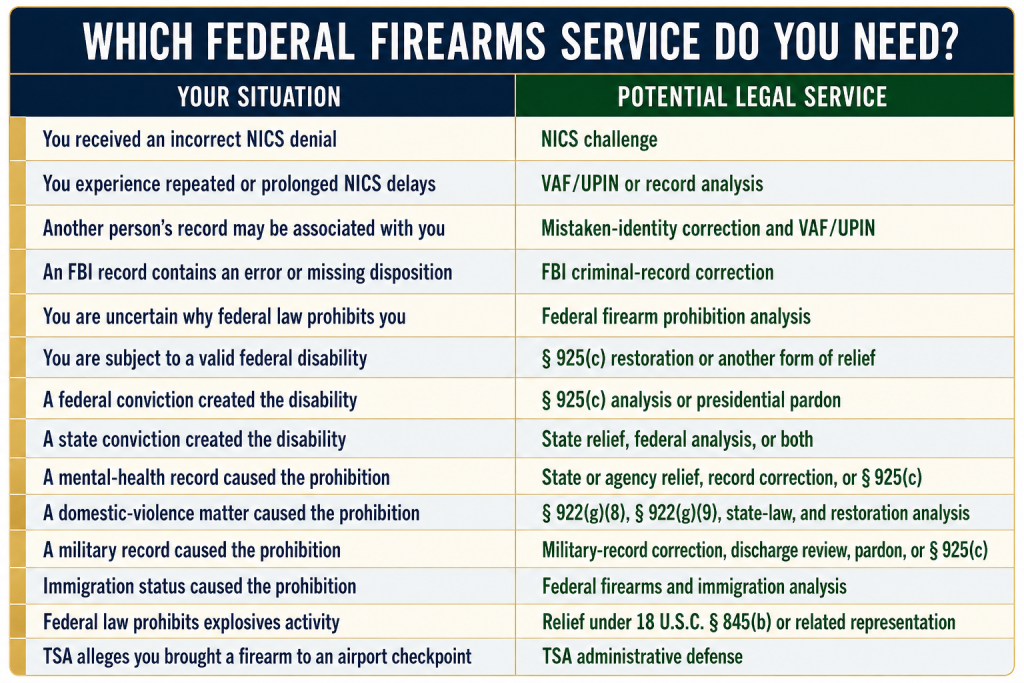
Our attorneys review the available records before recommending a course of action. We do not assume that every denial requires an appeal or that every prohibition requires a restoration application.
Federal Firearm Rights Restoration Under § 925(c)
The Department of Justice has established a new process through which eligible individuals may seek relief from qualifying federal firearm disabilities under 18 U.S.C. § 925(c).
This process may be relevant to individuals prohibited because of:
- A federal or state felony conviction;
- A qualifying misdemeanor crime of domestic violence;
- A qualifying protection order;
- A mental-health adjudication or commitment;
- A dishonorable discharge;
- A qualifying court-martial conviction;
- An immigration-related status;
- Unlawful use of or addiction to a controlled substance; or
- Another disability arising under 18 U.S.C. § 922(g).
The ability to apply does not mean relief is automatic. DOJ evaluates whether the applicant has established that the circumstances surrounding the disability, together with the applicant’s record and reputation, demonstrate that the applicant is not likely to act in a manner dangerous to public safety and that granting relief would not be contrary to the public interest.
DOJ may examine the complete history, including underlying conduct, arrests, dismissed charges, supervision history, mental-health and substance-use information, military records, protection orders, community reputation, rehabilitation, and any other information bearing on public safety.
Our federal firearm rights restoration lawyers help clients evaluate eligibility, identify presumptions against relief, obtain historical records, develop rehabilitation evidence, prepare sworn references, complete the application, and respond to DOJ inquiries.
Applicants who are uncertain whether they qualify can review our detailed explanation of federal firearm rights restoration eligibility.
Experience Developed Before the Public Portal Opened
National Security Law Firm began preparing and submitting federal firearm rights restoration matters before DOJ finalized its rule and opened the public application portal. That early work gave our attorneys practical experience evaluating eligibility, reconstructing historical records, developing rehabilitation evidence, preparing character references, and adapting pending matters to an evolving federal process.
The firm continues to represent clients with pre-portal matters as DOJ implements its formal procedures. No prior submission guarantees approval, priority, or a particular decision timeline.
Learn more about NSLF’s approach to federal firearm rights restoration.
NICS Denials and Firearm-Related Challenges
A NICS denial does not necessarily mean the FBI’s conclusion is correct.
A denial may result from:
- Mistaken identity;
- Another person’s criminal record;
- An arrest without a reported final disposition;
- A conviction classified incorrectly;
- An expunged, vacated, or set-aside record that was not properly updated;
- Incomplete state reporting;
- A mental-health or immigration record;
- A restoration order unavailable to NICS; or
- A valid federal prohibition.
The FBI’s administrative process allows a denied individual to request the reason for the denial and challenge an inaccurate decision. The process may identify the prohibiting category, the agency holding the relevant record, and the documents needed to contest the denial.
Our NICS appeal lawyers help clients obtain and analyze the relevant information, identify the source of the denial, secure supporting records, and pursue the appropriate administrative challenge.
A NICS challenge is not the same as federal firearm rights restoration. A challenge argues that the denial was incorrect or that the underlying record should no longer prohibit the transaction. Section 925(c), by contrast, asks DOJ to grant discretionary relief from a valid federal disability.
Repeated NICS Delays
A delayed NICS response differs from a denial. The FBI does not process a conventional denial challenge while the transaction remains in delayed status.
A delay may result from:
- A common name;
- Similar identifying information;
- An incomplete criminal record;
- A missing court disposition;
- A potentially prohibiting record requiring further review;
- Identity theft;
- Inconsistent information across databases; or
- A record that cannot be resolved within the initial review period.
Federal law’s three-business-day rule does not guarantee that a dealer will transfer the firearm. Dealers may decline to complete a transaction without a final “proceed” response, and separate state laws may impose additional restrictions.
Our guide explaining what a delayed firearm background check means discusses the possible causes, the three-business-day rule, dealer discretion, and options for repeated delays.
Clients seeking legal-remedy information can also review whether it is possible to challenge or address a prolonged NICS delay.
Voluntary Appeal File and UPIN Applications
The FBI’s Voluntary Appeal File allows eligible individuals to provide information that may help NICS distinguish them from another person or resolve recurring record questions.
If the FBI approves the application, it issues a Unique Personal Identification Number, commonly called a UPIN. The individual can provide the UPIN during future firearm transactions.
A UPIN may help when repeated delays or denials arise from:
- A common or similar name;
- Identity confusion;
- Records that repeatedly require additional research;
- Prior erroneous denials; or
- Information that cannot be efficiently matched during an ordinary background check.
A UPIN does not restore firearm rights, erase a conviction, or guarantee a “proceed” response. It helps the FBI associate the person with information maintained in the Voluntary Appeal File.
Our VAF and UPIN lawyers help clients determine whether the process fits the problem, collect supporting documentation, submit fingerprints and records, and address recurring identity or record issues.
NSLF has also handled a matter in which the firm corrected a mistaken-identity firearm problem and helped the client secure a UPIN. Prior results depend on their particular facts and do not guarantee a similar outcome.
FBI Firearm Record Corrections
A NICS challenge cannot always be resolved solely by communicating with the FBI. The underlying error may originate with a court, state criminal-history repository, law-enforcement agency, military component, or another source agency.
Common problems include:
- Missing final dispositions;
- Incorrect conviction information;
- Charges reported as unresolved;
- Expungements or vacaturs not transmitted;
- Identity information associated with the wrong person;
- Offenses classified incorrectly;
- Incomplete restoration records; or
- Conflicts between state and federal databases.
Our FBI firearm record correction lawyers help clients obtain the relevant history, identify the source of the error, secure certified records, pursue correction with the appropriate agency, and coordinate the correction with a NICS challenge when necessary.
Individuals who want to understand the broader correction process can review our guide to challenging an inaccurate FBI Identity History Summary.
Federal Firearm Prohibition Analysis
Not every person knows why they are prohibited. Others assume they remain prohibited when state relief, expungement, a pardon, a corrected record, or another legal event may have changed the analysis.
Federal law prohibits multiple categories of people from possessing firearms or ammunition. The legal question may depend on:
- The exact offense of conviction;
- The maximum possible sentence;
- The underlying conduct;
- Restoration of civil rights;
- Remaining state restrictions;
- A protection order’s terms and current status;
- The qualifying relationship in a domestic-violence case;
- A mental-health adjudication or commitment;
- Military discharge characterization;
- Immigration status;
- Controlled-substance use; or
- Whether the record itself is accurate.
Our federal firearm prohibition lawyers analyze the actual record and route clients toward the legal process capable of addressing the problem.
No one should possess or attempt to acquire a firearm based solely on an assumption that a prohibition has ended. Federal firearm violations can carry serious criminal consequences.
Federal Gun Rights After a Felony Conviction
A felony conviction does not present the same legal issue in every case.
The analysis may depend on whether the conviction was federal or state, the maximum possible punishment, whether civil rights were restored, whether the conviction was expunged or set aside, the restrictions retained by the jurisdiction, and whether another independent federal prohibition exists.
Potential remedies may include:
- Relief under § 925(c);
- A presidential pardon;
- A state pardon;
- Expungement or set-aside;
- Restoration of civil rights;
- State firearm relief; or
- Record correction.
Our guide explaining how federal gun rights may be restored after a felony conviction compares the available pathways.
For applicants whose underlying convictions did not involve violence, our attorneys also address the specific considerations affecting federal firearm restoration after a nonviolent felony.
Presidential Pardons and Federal Firearm Rights
A full presidential pardon may remove legal disabilities resulting solely from a federal conviction. It does not necessarily eliminate a separate prohibition arising from another conviction, current status, state law, or unrelated conduct.
A federal pardon petition ordinarily requires a detailed presentation addressing the offense, acceptance of responsibility, rehabilitation, post-conviction conduct, reputation, reasons for seeking clemency, and the public interest.
NSLF’s presidential pardon lawyers represent clients nationwide in clemency matters involving federal convictions.
Our guide discussing whether a pardon restores firearm rights explains why the result depends on the source of the prohibition and whether any independent restriction remains.
Expungements and State Restoration Orders
An expungement, set-aside, restoration of civil rights, or state pardon may affect the federal treatment of a state conviction. But the name placed on the order does not determine its federal effect.
The analysis may require reviewing:
- The law of the convicting jurisdiction;
- The precise language of the order;
- Which civil rights were restored;
- Whether firearm restrictions remain;
- Whether the conviction is still treated as a predicate under federal law;
- Whether state records were updated; and
- Whether NICS received the relevant disposition.
Our guide answering whether an expungement restores firearm rights explains why state relief must be evaluated under both state and federal law.
The interaction is addressed more broadly in our comparison of federal and state gun rights restoration.
Mental-Health Firearm Prohibitions
A qualifying mental-health adjudication or commitment can create a federal firearm prohibition under § 922(g)(4).
The legal analysis may require reviewing:
- The original petition;
- The adjudication or commitment order;
- The nature of the proceeding;
- Whether the proceeding satisfies the federal definition;
- Discharge or competency records;
- Current treatment information;
- Professional evaluations;
- State relief programs;
- Federal agency relief; and
- NICS reporting.
Voluntary counseling or treatment does not automatically create a federal firearm disability. The actual proceeding and legal record must be examined.
Our mental-health firearm rights restoration lawyers evaluate whether state relief, agency relief, record correction, or a federal § 925(c) application may be appropriate.
Domestic-Violence Convictions and Protection Orders
Federal law separately addresses qualifying domestic-violence protection orders and misdemeanor crimes of domestic violence.
These cases may turn on:
- Whether a protection order remains active;
- Whether the respondent received the required notice and opportunity to participate;
- The findings and prohibitions contained in the order;
- Whether the criminal offense qualifies under federal law;
- The relationship between the parties;
- Whether the conviction involved the required force or threatened use of a weapon;
- The sentence-completion date;
- Later arrests or events;
- State restrictions; and
- Presumptions applicable to a § 925(c) application.
Our domestic-violence gun rights restoration lawyers evaluate the federal prohibition, underlying record, potential waiting period, state law, and available relief.
Veterans, Military Discharges and Court-Martial Convictions
Military records can create federal firearm consequences that ordinary civilian criminal-history analyses fail to capture.
Relevant issues may include:
- A dishonorable discharge;
- A qualifying general court-martial conviction;
- A dismissal of an officer;
- Military mental-health records;
- VA-related reporting;
- An inaccurate or incomplete military record;
- A discharge characterization;
- A pending correction proceeding; or
- A separate civilian conviction.
Potential remedies may include a discharge review, correction of military records, appellate action, pardon, NICS or FBI record correction, mental-health relief, or § 925(c).
NSLF’s combined military and federal practices allow our attorneys to evaluate those options together. Learn more about veterans’ firearm rights after a military discharge, court-martial, or VA action.
Noncitizens, Green Card Holders and Visa Holders
Federal firearm law treats noncitizens differently depending on their immigration status and the circumstances of possession or acquisition.
Lawful permanent residents are generally treated differently from individuals admitted under nonimmigrant visas or those unlawfully present in the United States. Statutory exceptions may apply in limited circumstances, but state law can impose additional restrictions.
A firearm issue may also affect an immigration case, admissibility, removability, naturalization, or another federal benefit.
Our guide explaining when noncitizens and green card holders may own or purchase firearms addresses the intersection of federal firearms and immigration law.
Federal Explosives Prohibitions and Relief
Federal law separately restricts certain individuals from shipping, transporting, receiving, or possessing explosives.
Section 842(i) identifies prohibited categories. Section 845(b) provides a potential relief mechanism for qualifying applicants.
Explosives matters may affect:
- Employment;
- Mining and construction work;
- Federal and state licensing;
- Business operations;
- Military or government contracting;
- Access to explosive materials; and
- Professional reputation.
Our federal explosives relief from disabilities lawyers help qualifying individuals and businesses evaluate and pursue relief under the correct statutory process.
Readers seeking a broader explanation can review who is prohibited from possessing explosives under 18 U.S.C. § 842(i).
TSA Firearm Violations at Airports
Bringing a firearm or ammunition to an airport security checkpoint can result in more than an inconvenient delay.
Potential consequences may include:
- A TSA civil penalty;
- Law-enforcement referral;
- State or local criminal charges;
- Firearm seizure;
- Effects on TSA PreCheck or other trusted-traveler benefits;
- Employment consequences;
- Security-clearance concerns; and
- Professional or licensing consequences.
The appropriate response depends on the location, firearm, ammunition, manner of storage, traveler’s knowledge, applicable state law, and surrounding circumstances.
Our TSA firearm violation lawyers represent clients facing notices of violation, civil penalties, and related airport firearm matters.
Why Choose National Security Law Firm?
Federal firearms problems rarely exist in isolation. A criminal record may intersect with state restoration law. A military discharge may require correction before a federal application makes sense. A mental-health record may implicate both state relief and NICS. An immigration-based prohibition may affect more than firearm possession.
NSLF brings those disciplines together within a nationwide federal practice.
Clients choose our firm because we offer:
- A federal firearms practice led by former United States Attorney Dak Kees;
- Experience developed before the § 925(c) public portal opened;
- Nationwide representation in federal matters;
- Attorneys experienced in federal administrative law, military law, pardons, immigration, NICS, record correction, and security clearances;
- Detailed review before recommending a legal process;
- Strategic coordination when more than one remedy may be necessary;
- Defined scopes of representation;
- Transparent flat fees; and
- A 4.9-star rating across 298 Google reviews.
Those reviews reflect the firm’s work across its nationwide federal practices and the qualities clients expect in consequential matters: responsiveness, professionalism, preparation, communication, and candid advice.
We do not force every client into the same process. We identify the problem first and then determine which legal mechanism is capable of addressing it.
How Much Does a Federal Firearms Lawyer Cost?
National Security Law Firm uses defined flat fees for many federal firearms services so that clients understand the legal fee and scope before representation begins.
Fees generally range from $2,500 to $7,500, depending on the service and the complexity of the matter.
For example:
- NICS denial challenges generally begin at $2,500;
- Federal firearm rights restoration matters under § 925(c) generally cost $5,000;
- Certain complex § 925(c) matters may cost $7,500; and
- Other firearm, record-correction, pardon, explosives, military, immigration, or litigation matters are quoted according to their specific scope.
Government fees and third-party expenses may be separate. These can include fingerprints, certified records, criminal-history reports, professional evaluations, expert expenses, and court costs.
The firm confirms the scope, flat fee, anticipated outside expenses, and excluded services before the engagement begins.
Frequently Asked Questions About Federal Firearms Matters
What type of federal firearms lawyer do I need?
That depends on whether you face an inaccurate NICS denial, repeated delays, a record error, a valid federal prohibition, a military or mental-health record, an immigration issue, or another agency action. The first step is diagnosing the source of the problem.
Is a NICS challenge the same as gun rights restoration?
No. A NICS challenge contests an incorrect denial or record. Restoration asks the government to relieve a person from a valid firearm disability.
Will a UPIN restore my firearm rights?
No. A UPIN may help NICS distinguish you from another person or resolve recurring record questions. It does not remove a valid legal prohibition.
Does an expungement automatically restore gun rights?
No. The result depends on state law, the specific order, the rights restored, restrictions retained, and federal treatment of the conviction.
Does a presidential pardon restore firearm rights?
A full presidential pardon may remove a disability resulting solely from the pardoned federal conviction. It does not necessarily eliminate an independent state or federal prohibition.
Can federal relief override state firearm law?
No. Federal relief does not automatically remove an independent state or tribal firearm restriction.
Can a prohibited person possess a firearm while applying for relief?
No. Filing an application or challenge does not suspend an existing prohibition.
Can NSLF represent clients in every state?
NSLF represents clients nationwide in federal matters. A separate state proceeding may require state-specific analysis, local counsel, or a separate engagement.
Can a federal firearms lawyer guarantee an approval or successful appeal?
No. The result depends on the law, records, facts, evidence, and agency decision. No lawyer can guarantee an outcome or government timeline.
How do I know which process is correct?
An attorney should determine why you are prohibited or being denied, whether the record is accurate, what federal and state laws apply, and which remedy can address the problem.
Speak With a Federal Firearms Lawyer
A federal firearm problem should not be approached by selecting the first form that appears relevant.
Before taking action, you need to understand:
- Why the government believes you are prohibited;
- Whether the underlying record is accurate;
- Whether the problem is federal, state, or both;
- Whether you need a NICS challenge, VAF/UPIN, record correction, pardon, restoration application, or another proceeding;
- Whether applying now could create unnecessary risk;
- Which records and supporting evidence are required; and
- What the proposed representation will—and will not—include.
National Security Law Firm helps clients answer those questions and pursue the legal process appropriate to the actual problem.
Our nationwide federal firearms practice is led by former United States Attorney Dak Kees. Flat fees for federal firearms matters generally range from $2,500 to $7,500, depending on the service and complexity.
Do not guess about why you were denied or prohibited. Identify the actual record, the governing law, and the remedy capable of fixing the problem.
Contact National Security Law Firm today to schedule a confidential consultation with our federal firearms team.
Schedule a Free Confidential Consultation
This page provides general legal information and does not constitute legal advice. The appropriate strategy, scope, fee, and potential outcome depend on the individual facts, governing federal and state law, available records, and current agency procedures. No attorney can guarantee a particular outcome or decision timeline.
AUTHOR AND REVIEW INFORMATION
Attorney reviewer: Dak Kees, former United States Attorney
Last legally reviewed: August 2026
PRIMARY GOVERNMENT RESOURCES
- DOJ Federal Firearm Rights Restoration Program
- DOJ guidance identifying who may apply for federal firearm rights restoration
- FBI guidance for requesting the reason for and challenging a NICS denial
- FBI Voluntary Appeal File application guidance
- ATF information concerning federal prohibited-person categories