
Challenge the TSA Decision—and Protect the Career That Depends on Your TWIC
A TWIC denial or invalidation can prevent you from entering the secure facilities where you work. But a TSA determination may not be the end of the process.
National Security Law Firm represents maritime and transportation workers nationwide in:
- TWIC appeals based on inaccurate records or incorrect TSA determinations;
- TWIC waivers involving eligible disqualifying conditions;
- Combined appeal-and-waiver strategies; and
- Immediate TWIC invalidations and prior unsuccessful submissions.
We identify why TSA denied your credential, determine which process applies, obtain the necessary records, and build the strongest documented submission available under your circumstances.
Schedule My Free TWIC Consultation →
Free • Confidential • No Obligation to Hire the Firm
Choose a convenient time online. An attorney will call you at the number you provide.
TWIC Matters Handled Since 2016 • Hundreds of TSA Credential Cases • Nationwide Representation • $2,495 Flat Fee for Qualifying Initial Matters
What Is a TWIC Appeal?
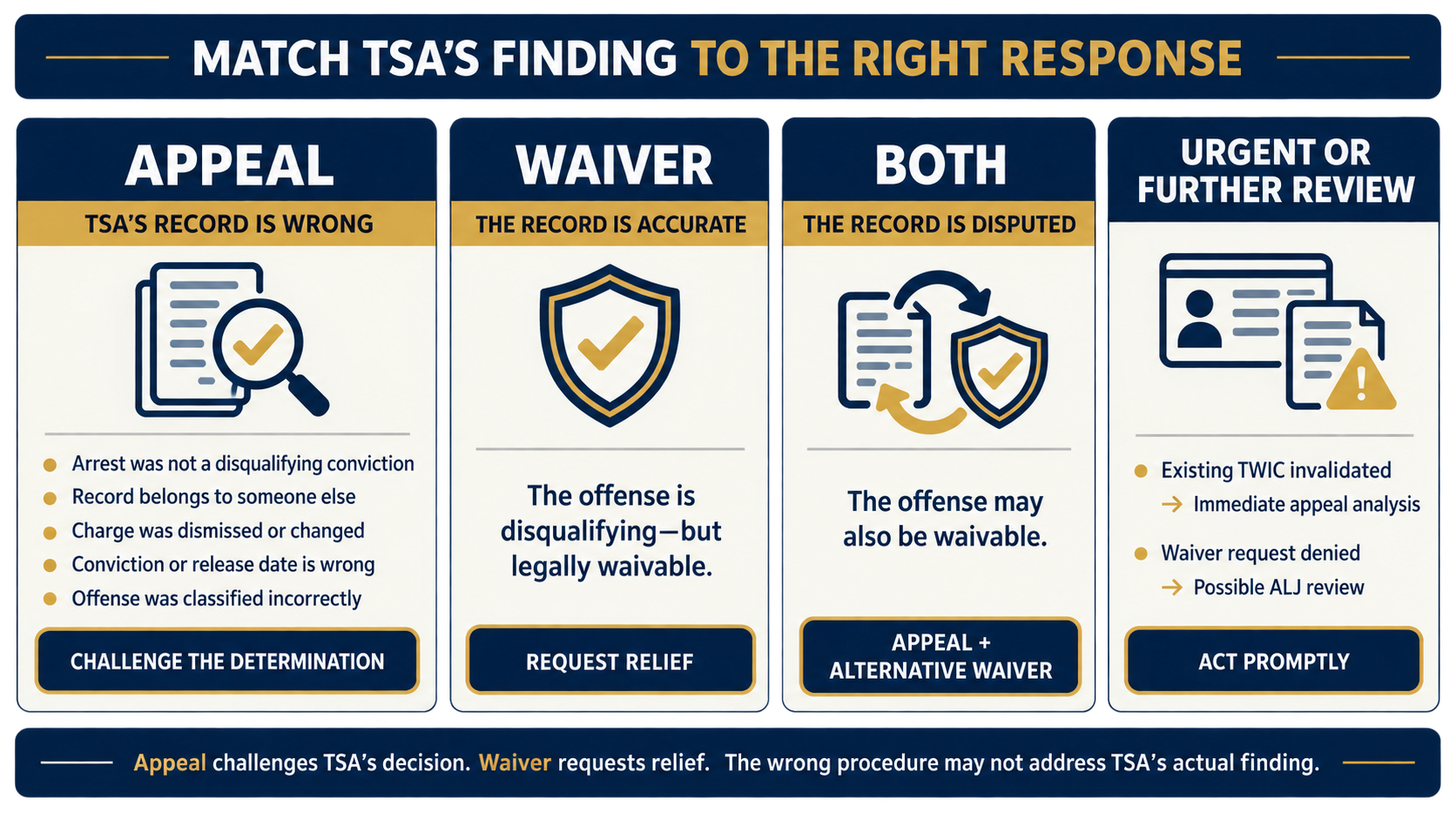
A TWIC appeal challenges TSA’s Initial Determination of Threat Assessment.
Under 49 C.F.R. § 1515.5, a TWIC applicant may appeal a determination based on a purported disqualifying criminal conviction, immigration status, or lack of mental capacity by asserting that the applicant meets TSA’s eligibility standards.
A successful appeal may show that:
- The identified record does not belong to the applicant.
- The applicant was arrested but never convicted.
- The charge was dismissed or nolle prossed.
- The applicant was acquitted.
- The conviction was reversed or vacated.
- The disposition was incorrectly or incompletely reported.
- The offense was a misdemeanor rather than a disqualifying felony.
- The conviction occurred outside the applicable interim-disqualification period.
- The applicant’s release from incarceration occurred outside the applicable period.
- The state offense is not comparable to the federal disqualifying category TSA identified.
- TSA incorrectly classified a simple possession offense as possession with intent to distribute.
- An outstanding warrant or indictment has been resolved.
- The applicant satisfies TSA’s immigration-status requirements.
- The applicant does not lack mental capacity within TSA’s regulatory definition.
The regulations permit an applicant to initiate an appeal by submitting a written reply, requesting the materials on which TSA relied, or requesting an extension in accordance with the regulation. When appropriate, requesting TSA’s supporting materials can preserve the appeal and provide time to understand the government’s reasoning before submitting a complete response.
Our separate guide to appealing for a TWIC card explains the appeal process in greater detail.
What Is a TWIC Waiver?
A TWIC waiver asks TSA to grant the credential despite an accurately reported disqualifying condition.
Under 49 C.F.R. § 1515.7, TSA may grant a waiver when the applicant demonstrates that the applicant does not pose a security threat. TSA may consider:
- The circumstances of the disqualifying act or offense
- Restitution made by the applicant
- Federal or state mitigation remedies
- Relevant court records
- Official medical-release documents, when applicable
- Other evidence showing that the applicant does not pose a security threat
The regulation’s final category is broad. It allows an applicant to present a documented account of rehabilitation, responsibility, stability, and present-day reliability.
A persuasive waiver request must do more than say that the applicant has changed. It should prove that change through credible, organized, and independently verifiable evidence.
Who May Be Eligible for a TWIC Waiver?
TSA’s regulations divide disqualifying criminal offenses into permanent and interim categories. However, the word “permanent” does not mean that every offense in that category is nonwaivable.
Under 49 C.F.R. § 1515.7, TSA may consider a waiver for:
- Permanent disqualifying offenses listed in 49 C.F.R. § 1572.103(a)(5) through (a)(12)
- Interim disqualifying offenses listed in § 1572.103(b)
- Certain applicants with Temporary Protected Status
- Certain applicants who fall within TSA’s mental-capacity standard
This means that some serious convictions—including certain offenses classified as permanently disqualifying—may still be eligible for a waiver.
Waiver eligibility is not the same as waiver approval. TSA retains discretion and evaluates the applicant’s circumstances and supporting evidence. The strength of the presentation therefore matters.
Which TWIC Offenses Are Not Waivable?
The regulations do not authorize criminal-offense waivers for the first four permanent disqualifying categories listed in 49 C.F.R. § 1572.103(a):
- Espionage or conspiracy to commit espionage
- Sedition or conspiracy to commit sedition
- Treason or conspiracy to commit treason
- A federal crime of terrorism, a comparable state offense, or conspiracy to commit such an offense
Attempts to commit the crimes in the first four categories are also addressed separately in the permanent-offense provisions. Because the waiver regulation only extends criminal-offense waiver eligibility to § 1572.103(a)(5) through (a)(12) and the interim offenses in subsection (b), the precise statute and theory of conviction must be reviewed carefully.
This page does not reproduce every disqualifying offense or every possible comparison between state and federal law. The analysis should be based on the actual statute, judgment, charging document, and disposition—not merely the shorthand description appearing on a background check.
How Do the Seven-Year and Five-Year Rules Work?
The seven-year and five-year periods apply to interim disqualifying felonies, not to every criminal offense.
An interim offense is disqualifying when either:
- The applicant was convicted or found not guilty by reason of insanity within seven years of the TWIC application; or
- The applicant was incarcerated for the offense and released within five years of the application.
These are alternative tests. A conviction may be more than seven years old but still fall within the interim period if the applicant was released from incarceration less than five years before applying.
The calculation may become complicated when the case involves:
- Multiple convictions
- Concurrent or consecutive sentences
- Resentencing
- Probation or parole violations
- Pretrial detention
- Halfway-house placement
- Work release
- A later correction to the judgment
- Unclear or incomplete release records
Probation is not automatically the same as incarceration, but the actual sentencing and custody records must be examined before reaching a conclusion.
What If TSA Identified an Arrest Without a Disposition?
An arrest alone is not the same as a conviction. Nevertheless, an incomplete criminal-history record can cause TSA to question whether an arrest resulted in a disqualifying conviction.
Under 49 C.F.R. § 1572.103(d), TSA may require written proof that an arrest did not result in a conviction for the disqualifying offense. The applicant generally must provide that proof within 60 days after the service date of TSA’s notice.
The appropriate evidence may include:
- A certified final disposition
- A judgment of acquittal
- A dismissal order
- A prosecutor’s certification
- A docket sheet showing the final outcome
- A court clerk’s letter confirming that no case or conviction exists
- A corrected state or FBI criminal-history record
If an old file has been destroyed or archived, the response may require records from several sources. National Security Law Firm identifies the appropriate records and works to obtain them as part of qualifying representation.
What Evidence Strengthens a TWIC Waiver?
A good waiver package connects the applicant’s evidence directly to TSA’s task: deciding whether the person presently poses a security threat.
Depending on the case, we may develop and submit:
Official Criminal and Court Records
These may include charging documents, plea agreements, judgments, sentencing records, proof of release, probation or parole records, restitution records, and evidence showing that all court-ordered obligations were completed.
Evidence Explaining the Offense
TSA considers the circumstances of the disqualifying act. The explanation must be candid, accurate, and consistent with the official record.
The goal is not to minimize serious conduct or rewrite history. The goal is to provide necessary context, demonstrate insight, and show why the past conduct does not reflect the applicant’s current reliability.
Rehabilitation and Treatment Evidence
When relevant, this may include:
- Substance-use treatment
- Mental-health treatment
- Counseling
- Anger-management programming
- Educational programs
- Vocational training
- Reentry programming
- Recovery support
- Medical records or provider letters
Employment History
Stable and responsible employment can demonstrate reliability. We may use employment records, evaluations, licenses, certifications, awards, or letters from supervisors and coworkers.
Character and Community Evidence
Strong support letters should contain specific, firsthand information. Generic letters saying that the applicant is “a good person” are less useful than detailed accounts of the applicant’s conduct, responsibilities, and changes over time.
Evidence of Responsibility and Stability
Relevant materials may document family responsibilities, community involvement, military service, financial stability, volunteer work, professional accomplishments, or a sustained period without further misconduct.
The Applicant’s Personal Statement
The personal statement is often one of the most important parts of the submission. It should acknowledge the facts accurately, demonstrate insight, explain rehabilitation, and show why TSA can rely on the applicant today.
Our lawyers help develop and edit the statement so that it is truthful, persuasive, and consistent with the official record.
Why the First TWIC Submission Matters
Applicants sometimes plan to submit a brief explanation first and save their strongest evidence for later. That can be a serious mistake.
Under 49 C.F.R. § 1515.11, an applicant whose waiver is denied may request review by a TSA Administrative Law Judge. But in a waiver-denial review, the ALJ generally may consider only the evidence and information that the applicant previously presented to TSA in the waiver request.
If the applicant has new evidence, the regulations contemplate filing a new waiver request rather than adding the evidence to the existing ALJ review. That can cause delay and procedural complications.
The first waiver package should therefore be prepared as though another decision-maker may eventually review the same record. It should be complete, logically organized, well-supported, and built to withstand scrutiny.
Can TSA Invalidate a TWIC After Issuing It?
Yes. Receiving a TWIC does not necessarily end TSA’s security review.
TSA uses recurrent vetting and may identify new criminal-history, terrorism-related, immigration, or other security information after a credential has been issued. In qualifying circumstances, TSA may issue an Initial Determination of Threat Assessment and immediately invalidate the TWIC.
An immediate invalidation can prevent a worker from accessing a secure maritime facility while the administrative process remains pending. The regulations permit an appeal, but the practical consequences may begin before the appeal is decided.
If you receive an immediate invalidation notice, send us every page of the notice as soon as possible. We will evaluate:
- Why TSA invalidated the credential
- Whether the underlying information is accurate
- Whether the matter calls for an appeal, waiver, or both
- What records must be obtained
- What deadline applies
- Whether the adverse information creates additional licensing or employment issues
What Happens After TSA Denies a TWIC Waiver?
A waiver denial may be eligible for review by a TSA Administrative Law Judge under 49 C.F.R. § 1515.11.
The request for review generally must be filed no later than 30 calendar days after service of TSA’s waiver-denial decision. The request must identify the issues for review and include the waiver request, the materials submitted to TSA, and TSA’s decision.
The applicant may ask for an in-person hearing, although a hearing is not automatic. If the ALJ issues an adverse decision, either party may request review by the TSA Final Decision Maker within 30 calendar days.
A final agency order may potentially be reviewed in the appropriate federal court of appeals under 49 U.S.C. § 46110.
ALJ proceedings, hearings, Final Decision Maker review, and federal-court litigation are advanced stages. They are evaluated separately and are not included in our $2,495 initial-stage fee unless a written engagement agreement expressly states otherwise.
How Our TWIC Lawyers Handle Your Case
We have built our TWIC service for workers who want the firm to take responsibility for the legal and records process.
1. We Review the Entire TSA Letter
We identify the type of determination, asserted basis, relevant deadlines, and available administrative remedies.
2. We Determine the Correct Strategy
We decide whether the case calls for an appeal, a waiver, or both. We also identify whether another credential or agency may be affected.
3. We Obtain the Necessary Records
Our team tracks down the relevant court and disposition records. You do not have to determine which courthouse, clerk, archive, prosecutor, or corrections agency possesses every document.
4. We Analyze the Offense Under Federal Law
The name assigned to an offense under state law does not necessarily establish how TSA should classify it. We examine the statute, elements, disposition, sentence, dates, and federal regulatory category.
5. We Develop the Supporting Evidence
We identify the employment, treatment, rehabilitation, character, and mitigation evidence needed to present the strongest available case.
6. We Prepare the Submission
We draft the legal argument, develop the applicant’s statement when appropriate, organize the exhibits, and submit the appeal or waiver package to TSA.
7. We Manage the Covered TSA Process
We track the matter, communicate with TSA as appropriate, and address ordinary requests for additional information within the scope of the engagement.
How Long Does a TWIC Appeal or Waiver Take?
There is no single processing time for every TWIC case.
Under the regulations, TSA ordinarily acts within specified 60-day periods at several stages, but those periods may be extended for good cause. Actual timing may also depend on:
- Whether the applicant requests TSA’s supporting materials
- How long courts or agencies take to produce records
- Whether a criminal-history record must be corrected
- Whether TSA requests additional information
- The complexity of the offense analysis
- Whether the applicant pursues an appeal before requesting a waiver
- TSA’s current processing workload
- Whether advanced administrative review becomes necessary
A case may take several months. More complicated matters can take longer. We cannot control TSA’s processing time, but we can prevent avoidable delay by identifying the correct records and preparing a complete submission.
Do You Have to Hire a TWIC Lawyer?
No. Federal law does not require a lawyer to submit a TWIC appeal or waiver.
Some applicants can handle a straightforward correction themselves. For example, a lawyer may be unnecessary if TSA has identified a dismissed charge and the applicant already has a clear certified dismissal order that directly resolves the issue.
Legal representation may be more valuable when:
- Your employment depends on obtaining or retaining the TWIC.
- TSA identified a felony conviction.
- You are uncertain whether the offense is waivable.
- The record is inaccurate or incomplete.
- The conviction occurred in another state or many years ago.
- TSA classified the offense under a category that may not match the statute.
- You have multiple arrests or convictions.
- You need a waiver supported by rehabilitation evidence.
- TSA immediately invalidated an existing TWIC.
- The case may proceed to ALJ or Final Decision Maker review.
- The same criminal history may affect an HME or Merchant Mariner Credential.
Hiring a lawyer does not change the facts or guarantee TSA approval. It provides legal analysis, record development, structured advocacy, and professional management of a process that may affect your livelihood.
Our Flat Fee for TWIC Appeals and Waivers
For qualifying cases at the initial TSA appeal or waiver stage, National Security Law Firm charges a flat legal fee of $2,495.
The covered service generally includes:
- Attorney review of the TSA letter
- Identification of deadlines and available remedies
- Appeal-versus-waiver analysis
- Legal research concerning the disqualifying condition
- Identification and procurement of ordinary court records
- Review of criminal-history and disposition documents
- Development of a personalized evidence plan
- Assistance with supporting and character letters
- Development and editing of the applicant’s personal statement
- Preparation of the legal appeal, waiver, or combined submission
- Organization of exhibits
- Submission to TSA
- Case tracking through the covered initial administrative stage
- Ordinary TSA follow-up within the scope of the engagement
- Copies of the completed submission and decision
The exact scope is governed by the written engagement agreement. Unusual third-party expenses, extensive record-reconstruction projects, ALJ review, hearings, TSA Final Decision Maker appeals, and judicial-review proceedings may require a separate agreement and fee.
For information about government enrollment charges and legal costs, see our guide to TWIC card costs, TSA fees, and lawyer fees.
Financing Is Available
Eligible clients may use Pay Later by Affirm to divide the legal fee into monthly payments.
Available terms and financing decisions are determined by the financing provider. Checking available options does not change TSA’s deadline, so applicants should avoid waiting until the response period is about to expire.
Our Written Refund Guarantee for Qualifying TWIC Cases
National Security Law Firm offers a written refund guarantee in qualifying TWIC appeal and waiver matters because we carefully screen cases before accepting them and have achieved strong results for the workers we represent.
The refund guarantee is not a promise or guarantee that TSA will approve the application, grant a waiver, withdraw its determination, or issue a TWIC. TSA alone controls the government’s decision, and no lawyer can ethically guarantee a particular agency result.
Instead, when the guarantee applies, our written engagement agreement identifies the result covered and the circumstances under which National Security Law Firm will refund the covered $2,495 legal fee if that result is not achieved.
The guarantee:
- Applies only when expressly included in the signed engagement agreement
- Covers the legal fee identified in that agreement
- Is subject to stated terms, exclusions, and client responsibilities
- Does not promise or control TSA’s decision
- Does not necessarily include third-party expenses or advanced administrative proceedings
We do not accept every case for guaranteed representation. Before accepting a matter, we review the TSA letter, offense, records, procedural stage, timing, and known facts. If we do not believe we can responsibly offer the service or guarantee, we will not represent that the case is covered.
Why Choose National Security Law Firm as Your TWIC Law Firm?
We Have Handled TWIC Cases Since 2016
TWIC appeals and waivers have been part of our federal administrative practice for more than a decade. We are not learning TSA’s procedures through your case.
We Have Represented Applicants in Hundreds of TSA Credential Matters
Our experience includes appeals, waivers, record disputes, immediate invalidations, serious criminal histories, and matters involving incomplete or complicated court records.
We Do the Work for You
We do not simply provide a template and instruct you to locate every document yourself. Our team identifies the records, works to obtain them, analyzes the legal issue, develops the evidence, and prepares the submission.
We Understand the Difference Between a Criminal Record and a Federal Disqualification
TSA eligibility cannot always be determined from the title of a charge. We compare the actual offense and disposition with the governing federal statutes and regulations.
We Practice Nationwide
TWIC security threat assessments are governed by federal law. We represent maritime workers across the United States through a streamlined electronic process.
We Know How TSA Evaluates These Matters
Since 2016, we have communicated with TSA in the ordinary course of representing TWIC and HME applicants. This does not give the firm special access or influence over TSA, but it gives us substantial practical experience preparing the information TSA uses to adjudicate these cases.
We Build the Record With Later Review in Mind
Because later ALJ review may be restricted to the evidence previously submitted, we treat the initial waiver package as the critical administrative record it is.
Representative TWIC Case Results
Our experience includes obtaining favorable outcomes for clients with serious and complicated criminal histories.
Examples include:
- A TWIC denial overturned for a client charged with weapons offenses
- A TWIC waiver granted for a client convicted of possessing a controlled dangerous substance for sale
- A successful appeal resulting in approval of a Transportation Worker Identification Credential
- A TWIC appeal filed after TSA issued an adverse determination
- A TWIC waiver application prepared for a client with a conspiracy-to-distribute conviction
These examples illustrate the types of matters the firm has handled. Past results do not guarantee a similar outcome, and every TWIC case depends on its facts, evidence, procedural history, and applicable law.
Frequently Asked Questions About TWIC Appeals and Waivers
Can a felon get a TWIC card?
Yes, in many circumstances. Not every felony is disqualifying, interim offenses are subject to time limitations, and many—but not all—permanent disqualifying offenses may be waived. The answer depends on the exact offense, disposition, dates, sentence, and current procedural status.
Are misdemeanors disqualifying for a TWIC?
The criminal-offense provisions in 49 C.F.R. § 1572.103 identify specified felonies. However, the name or degree assigned by a state is not always the end of the analysis. TSA may also act based on warrants, indictments, immigration status, mental capacity, terrorism-related information, or other security assessments.
Is simple drug possession a disqualifying offense?
The interim list includes distribution, possession with intent to distribute, and importation of a controlled substance. It does not list simple possession as a standalone disqualifying offense. The court records must establish what the person was actually convicted of rather than what an incomplete background report suggests.
Can I get a TWIC if my conviction was expunged?
Possibly. The effect of an expungement, set-aside, dismissal, pardon, or other post-conviction relief depends on the specific order and how federal law treats the disposition. Do not assume that every state expungement automatically removes the conviction for TSA purposes.
Can I appeal if the seven-year or five-year period has expired?
Potentially. If TSA identified an interim offense that no longer falls within either applicable period, an appeal may establish that the conviction is no longer disqualifying. The conviction and release dates must be documented accurately.
Can I request a waiver before TSA issues a Final Determination?
Yes. Under 49 C.F.R. § 1515.7, an applicant may request a waiver during the application process or may first pursue some or all of the appeal process. A waiver request must generally be submitted no later than 60 days after service of the Final Determination.
What happens if I miss the 60-day appeal deadline?
The Initial Determination may become a Final Determination. TSA may grant an extension for good cause under the regulation, including in some circumstances after a deadline has expired, but an extension is discretionary. You should not rely on receiving one.
Will I have to appear in court?
Most initial TWIC appeals and waivers are handled through written submissions to TSA. They are administrative matters, not ordinary court cases. If TSA denies a waiver, a later request for ALJ review may include a request for a hearing. Federal-court review is a separate, advanced stage.
Does hiring NSLF guarantee that I will receive a TWIC?
No. TSA controls the decision. Qualifying cases may receive a written refund guarantee covering the legal fee, but the guarantee does not promise TSA approval and applies only according to the signed engagement agreement.
What should I send National Security Law Firm?
Send the complete TSA letter, including all pages, instructions, and attachments. If available, also send any criminal-history report, court records, prior TSA correspondence, and documentation showing when you received the letter.
Send Us Your TSA Letter for Attorney Review
A TWIC denial or invalidation can threaten your job, income, and access to the maritime industry. You do not have to determine the correct procedure, locate decades-old court records, and build the submission by yourself.
National Security Law Firm has handled TWIC appeals and waivers since 2016. We represent maritime workers nationwide, have handled hundreds of TSA credential matters, and manage the records, legal analysis, evidence development, and submission process for our clients.
For qualifying initial-stage TWIC appeals and waivers, our flat legal fee is $2,495. Financing may be available, and qualifying accepted matters may include a written refund guarantee subject to the precise terms of the engagement agreement.
Schedule My Free TWIC Consultation →
Free • Confidential • No Obligation to Hire the Firm
Choose a convenient time online. An attorney will call you at the number you provide.
TWIC Matters Handled Since 2016 • Hundreds of TSA Credential Cases • Nationwide Representation • $2,495 Flat Fee for Qualifying Initial Matters
★★★★★ 4.9 Stars From 300+ Google Reviews
Official TWIC Resources
- TSA: Transportation Worker Identification Credential
- 46 U.S.C. § 70105—Transportation Security Cards
- 49 C.F.R. Part 1572—Credentialing and Security Threat Assessments
- 49 C.F.R. § 1572.21—TWIC Security Threat Assessment Procedures
- 49 C.F.R. § 1572.103—Disqualifying Criminal Offenses
- 49 C.F.R. § 1572.105—Immigration-Status Standards
- 49 C.F.R. § 1572.107—Other Security-Threat Analyses
- 49 C.F.R. § 1572.109—Mental-Capacity Standards
- 49 C.F.R. § 1515.5—Appeal of an Initial Determination
- 49 C.F.R. § 1515.7—Waiver Procedures
- 49 C.F.R. § 1515.9—Appeals Based on Other Analyses
- 49 C.F.R. § 1515.11—Administrative Law Judge and TSA Final Decision Maker Review
Author: Katherine O’Brien, Esq., Founder, National Security Law Firm
Attorney Reviewed: August 25, 2026
This page provides general information and is not legal advice. Viewing this page or contacting the firm does not create an attorney-client relationship. Past results do not guarantee future outcomes. Any fee, scope of representation, financing arrangement, or refund guarantee is governed exclusively by a signed written engagement agreement.