
What Guideline E Actually Means in Plain English
Guideline E is the part of the security clearance system that evaluates personal conduct.
In plain English, it asks:
👉 Can the government trust this person’s honesty, judgment, reliability, candor, and willingness to follow rules?
That sounds simple.
But Guideline E is one of the most dangerous and frequently misunderstood security clearance guidelines because it is not limited to one type of conduct.
It can involve:
- false statements
- omissions
- lack of candor
- lying on the SF-86
- incomplete disclosures
- inconsistent interview answers
- refusal to cooperate with investigators
- failure to follow rules or reporting requirements
- workplace misconduct
- conduct showing poor judgment
- hidden behavior that creates vulnerability
- or a pattern of unreliable or irresponsible conduct
At its core, Guideline E is the trustworthiness guideline.
It is not always about the underlying issue itself.
It is often about how the applicant handled the issue.
That distinction is critical.
A financial problem may be fixable.
Drug use may be mitigable.
Foreign contacts may be explainable.
A criminal charge may have context.
But if the applicant lies, omits, minimizes, changes the story, or gives inconsistent answers, the case may become much harder to win.
Because now the government is no longer evaluating only the original issue.
It is evaluating:
👉 whether the applicant can be trusted at all.
At National Security Law Firm, our security clearance lawyers include former adjudicators, former government attorneys, military lawyers, and national security insiders who understand how Guideline E is actually applied in real clearance decisions.
That insider perspective matters because many applicants think Guideline E is about whether they are a “good person.”
It is not.
Guideline E is about whether the record supports trust.
Adjudicators evaluate:
- what you disclosed
- what you omitted
- when you corrected it
- whether your explanation is consistent
- whether the omission appears intentional
- whether your conduct shows judgment
- and whether the government can rely on your future answers
In other words:
👉 the issue is not just what happened.
👉 the issue is what your response says about your honesty, judgment, and reliability going forward.
Quick Answer: Can Personal Conduct Affect Your Security Clearance?
Yes.
Personal conduct can absolutely affect your security clearance.
Guideline E concerns can result in:
- clearance delay
- additional investigation
- a Letter of Interrogatory
- a Statement of Reasons
- suspension
- denial
- or revocation
Common Guideline E issues include:
- lying on the SF-86
- omitting arrests, drug use, debts, foreign contacts, terminations, or other required information
- giving inconsistent answers during a security clearance interview
- failing to cooperate with investigators
- refusing to answer required questions
- making false statements during a polygraph or interview
- violating workplace or security rules
- hiding conduct that creates vulnerability
- or showing a pattern of poor judgment
But this is the critical point:
👉 Guideline E is often more dangerous than the underlying issue.
Why?
Because many underlying issues can be mitigated.
But once the government believes you were dishonest, evasive, or lacked candor, the entire case changes.
To understand how Guideline E fits into the broader clearance decision framework, review the
👉 Security Clearance Adjudicative Guidelines
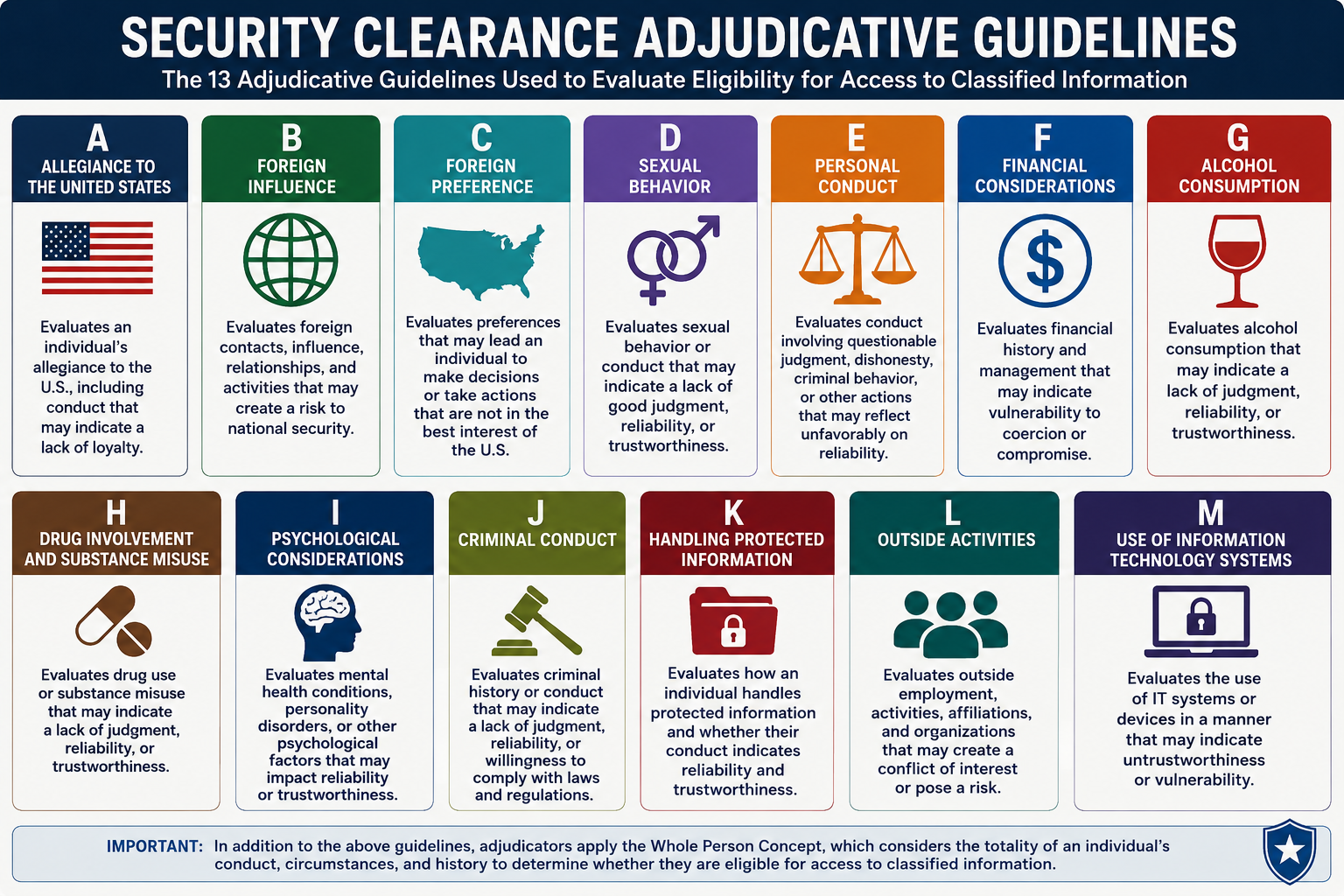
Why Guideline E Is Often the Most Dangerous Clearance Guideline
Guideline E is dangerous because it can attach to almost any other clearance issue.
It often appears when the government believes an applicant failed to handle another problem honestly.
For example:
A person with past marijuana use may be able to mitigate the drug issue.
But if they denied the use on the SF-86 and later admitted it during a polygraph, the case becomes a Guideline E problem.
A person with debt may be able to mitigate financial concerns.
But if they concealed debts, failed to disclose a judgment, or gave inconsistent explanations, the case becomes a Guideline E problem.
A person with foreign contacts may be able to explain those relationships.
But if they omitted a foreign girlfriend, foreign family member, or repeated foreign contact, the case becomes a Guideline E problem.
A person with a criminal record may be able to explain an old arrest.
But if they failed to disclose it because they thought it was “expunged,” “too old,” or “not important,” the case may become a Guideline E problem.
This is why Guideline E is so serious.
It can transform a manageable case into a credibility case.
And credibility cases are much harder.
Because once the adjudicator begins asking:
👉 “Can I trust this applicant?”
the burden becomes much heavier.
Why Guideline E Cases Feel Like an Attack on Your Character
Guideline E cases feel different from many other clearance cases.
If the government raises a financial concern, the issue is debt.
If the government raises a drug concern, the issue is substance use.
If the government raises a foreign influence concern, the issue is foreign leverage.
But Guideline E feels more personal.
It feels like the government is saying:
👉 “You are dishonest.”
That is why applicants often panic.
They think:
- “I did not mean to lie.”
- “I misunderstood the question.”
- “I forgot.”
- “I thought expunged records did not count.”
- “My recruiter told me not to disclose it.”
- “I answered the best I could.”
- “I was embarrassed and froze.”
- “I corrected it as soon as I realized.”
Those explanations may be true.
But they have to be handled carefully.
Because adjudicators are not evaluating emotional intent alone.
They are evaluating whether the explanation is:
- credible
- consistent
- supported by the record
- plausible under the circumstances
- and sufficient to restore trust
This is where many applicants make the case worse.
They over-explain.
They become defensive.
They blame others.
They change the story.
They add unnecessary details.
They try to minimize obvious problems.
And suddenly, the record looks less trustworthy than before.
Guideline E cases require discipline.
The goal is not to sound wounded.
The goal is to rebuild trust in the record.
Why the Insider Perspective Matters in Guideline E Cases
Most online information about Guideline E says the same basic thing:
👉 be honest.
That is true.
But it is not enough.
The harder question is:
👉 How do adjudicators decide whether an omission, mistake, or inconsistent answer was actually dishonest?
That is where insider perspective matters.
At National Security Law Firm, we approach Guideline E cases from the perspective of the decision-maker.
Our attorneys understand how adjudicators evaluate:
- intent
- materiality
- timing
- pattern
- correction
- consistency
- credibility
- and future reliability
For example, adjudicators may ask:
- Was the omitted information important?
- Did the omission benefit the applicant?
- Was the issue obvious or obscure?
- Did the applicant correct it before or after discovery?
- Did the explanation stay consistent?
- Are there multiple omissions?
- Does the applicant understand why the issue matters?
- Can approval be defended despite the credibility concern?
That last question is critical.
Because in security clearance cases, the issue is not only whether the applicant has an explanation.
The issue is whether the adjudicator can rely on that explanation.
This is why Guideline E cases are won or lost on record control.
Not volume.
Not emotion.
Not generic apology.
👉 Credibility has to be rebuilt carefully.
What This Guide Will Help You Understand
If you are dealing with a Guideline E concern—or worried that one may arise—this guide will explain:
- what personal conduct actually means
- why lack of candor destroys otherwise winnable clearance cases
- how SF-86 lies and omissions are evaluated
- when “I forgot” works and when it fails
- how innocent interview answers become Guideline E problems
- why correcting the record early matters
- what mitigation actually works
- where applicants accidentally make the record worse
- and how successful cases are built around credibility, consistency, and defensibility
Most importantly, this guide will help you understand how the government views honesty and personal conduct from a security-risk perspective.
Because until you understand that:
👉 you may be trying to explain a mistake while the government is evaluating whether it can trust you with national security information.
That mismatch is where many Guideline E cases begin to fail.
When Guideline E Actually Comes Up in Real Cases
Guideline E issues usually arise when the government believes:
👉 the applicant was not fully honest, candid, reliable, or forthcoming during the security clearance process—or engaged in conduct suggesting poor judgment or unreliability.
Sometimes the issue involves an obvious lie.
More often, the issue begins with:
- omissions
- incomplete answers
- inconsistent explanations
- misunderstanding of disclosure obligations
- or attempts to “simplify” embarrassing information
That is why many applicants are shocked when Guideline E appears.
They often think:
👉 “I didn’t intentionally lie.”
But intentional deception is not always required for the government to raise concern.
What matters is whether the record creates doubt about:
👉 honesty, judgment, trustworthiness, or willingness to comply with security obligations.
Below are some of the most common ways Guideline E appears in real cases.
SF-86 Lies or False Statements
This is one of the most common Guideline E triggers.
The SF-86 is not just a form.
👉 It is the first credibility document in your security clearance case.
Applicants often create problems by:
- denying drug use
- omitting arrests
- failing to disclose terminations
- hiding foreign contacts
- concealing debt
- minimizing counseling history
- or answering “no” when the truthful answer was “yes”
Some applicants intentionally lie.
Others:
- misunderstand the question
- panic
- think the issue is too minor
- believe expunged matters do not count
- or rely on terrible advice from recruiters or coworkers
Regardless of intent, the issue becomes:
👉 whether the government now trusts the applicant’s disclosures.
For deeper analysis, review:
👉 Can You Lose Your Security Clearance for Lying on the SF-86?
Omissions on the SF-86
Omissions are one of the most dangerous categories under Guideline E.
Because adjudicators often view omissions differently than applicants do.
Applicants frequently think:
- “I forgot.”
- “It was too old.”
- “I didn’t think it counted.”
- “I thought expunged records disappeared.”
- “I wasn’t trying to hide it.”
Sometimes those explanations work.
Sometimes they do not.
Adjudicators often evaluate:
- whether the omitted issue was significant
- whether the applicant benefited from omission
- whether the omission appears strategic
- whether the issue was easy to remember
- whether multiple omissions exist
- and whether the applicant corrected the problem voluntarily
One omission may be explainable.
A pattern of omissions becomes much harder.
For deeper analysis, review:
👉 Can You Lose Your Security Clearance for Omitting Information?
Lack of Candor During Interviews
Many Guideline E cases do not begin on the SF-86.
They begin during:
👉 the subject interview.
Applicants often damage their cases during interviews by:
- minimizing conduct
- changing timelines
- trying to sound “better”
- giving guesses instead of accurate answers
- or becoming defensive under pressure
This creates one of the most dangerous problems in clearance law:
👉 lack of candor.
Lack of candor does not always require a proven lie.
It often means the adjudicator believes the applicant was:
- evasive
- incomplete
- misleading
- strategically vague
- or insufficiently forthcoming
And once adjudicators begin questioning candor:
👉 the entire file changes.
For deeper analysis, review:
👉 Lack of Candor: Why Disclosure Failures Matter More Than the Underlying Issue
👉 Lack of Candor: Why This Destroys Clearance Cases (Guideline E)
Inconsistent Answers Between Forms and Interviews
This is another extremely common Guideline E problem.
Investigators routinely compare:
- SF-86 answers
- subject interview statements
- polygraph admissions
- financial records
- travel records
- law enforcement documents
- and prior disclosures
Applicants often unintentionally create inconsistency by:
- estimating dates incorrectly
- minimizing frequency of conduct
- forgetting earlier disclosures
- or trying to “clarify” too aggressively
Once inconsistencies appear, investigators begin asking:
👉 “Which version is true?”
And once the file contains multiple competing explanations:
👉 credibility risk increases rapidly.
For deeper analysis, review:
👉 How Innocent Interview Answers Turn Into Guideline E Problems
Refusal to Cooperate With the Clearance Process
Refusal to cooperate is another major Guideline E issue.
Examples include:
- refusing to answer investigator questions
- refusing required polygraphs
- withholding requested records
- failing to complete forms
- or obstructing investigation efforts
The government views security clearances as:
👉 a privilege requiring full cooperation.
Applicants sometimes mistakenly assume:
👉 “I can simply refuse to answer.”
Legally, you may refuse.
But adjudicators may interpret refusal as:
👉 evidence the applicant is concealing something.
This can become extremely damaging.
Violation of Workplace or Security Rules
Guideline E also applies to conduct suggesting poor judgment or unwillingness to follow rules.
Examples may include:
- timecard fraud
- misuse of government equipment
- workplace dishonesty
- unauthorized conduct
- failure to follow reporting requirements
- or repeated policy violations
Even when the underlying conduct is not criminal, adjudicators may still ask:
👉 “Does this reflect unreliable judgment?”
That is the real concern.
Association With Others Engaged in Misconduct
Some Guideline E cases involve the applicant’s association with individuals engaged in criminal or improper activity.
Examples include:
- knowingly associating with criminal actors
- helping others conceal misconduct
- participating in dishonest schemes
- or remaining closely tied to individuals creating security concerns
The issue is usually not guilt by association alone.
The issue is:
👉 what the association suggests about the applicant’s judgment and reliability.
Correcting the Record Too Late
Timing matters enormously in Guideline E.
Applicants who voluntarily correct mistakes before discovery often receive much better treatment than applicants who:
👉 “correct” the issue only after investigators already discovered it.
This is one reason adjudicators pay close attention to:
- when the correction occurred
- why the applicant corrected it
- and whether the correction appears voluntary or reactive
Late correction may still help.
But the strategic value is often very different.
The Guideline E Statute (Full Text)
The full statutory language for Guideline E can be reviewed here:
👉 Guideline E — Personal Conduct (Full Text)
The regulation explains:
- what types of conduct raise concern
- how adjudicators evaluate honesty and reliability
- and what mitigating conditions may apply
But reading the statute alone is not enough.
Because Guideline E cases are rarely decided based solely on:
👉 the existence of a mistake.
They are decided based on:
- intent
- credibility
- consistency
- correction timing
- pattern
- and whether the adjudicator believes the applicant can be trusted going forward
That is why two applicants with similar underlying conduct may receive completely different outcomes.
👉 The difference is often not the original issue.
👉 It is how the applicant handled it afterward.
What the Government Is Actually Worried About
To truly understand Guideline E, you have to understand the government’s core concern.
The government is not simply trying to catch people making mistakes.
It is evaluating:
👉 whether the applicant’s conduct creates doubt about trustworthiness and future reliability.
That concern generally falls into several categories.
1. Honesty and Candor
This is the heart of Guideline E.
The government wants to know:
👉 Can this person be trusted to tell the truth when handling classified responsibilities?
This is why lies, omissions, and inconsistent disclosures are treated so seriously.
2. Judgment
Guideline E is also heavily focused on judgment.
Adjudicators evaluate whether conduct suggests:
- carelessness
- irresponsibility
- poor decision-making
- or disregard for obligations
The issue is often not the mistake itself.
It is:
👉 what the mistake says about future reliability.
3. Willingness to Follow Rules
Clearance holders are expected to comply with:
- reporting obligations
- investigative requirements
- security rules
- and government procedures
Applicants who appear unwilling to cooperate or comply may create major concern.
4. Vulnerability and Concealment
Hidden conduct creates security risk.
Adjudicators worry that applicants hiding information may become:
👉 vulnerable to coercion or future deception.
This is why concealment itself is so dangerous.
5. Future Trustworthiness
Ultimately, Guideline E is predictive.
The government is asking:
👉 “Can this person be trusted going forward?”
That is the question driving nearly every Guideline E decision.
How Adjudicators Actually Evaluate Guideline E Cases
This is where insider perspective matters most.
Adjudicators do not evaluate Guideline E mechanically.
They do not simply ask:
👉 “Did the applicant make a mistake?”
They ask:
👉 “What does this conduct tell me about the applicant’s future trustworthiness, reliability, judgment, and candor?”
That distinction is critical.
Because many Guideline E cases are not really about the original conduct.
They are about:
👉 whether the applicant can still be trusted after the conduct occurred.
Adjudicators often evaluate several core questions.
Was the Conduct Intentional?
Intent matters enormously.
Adjudicators often distinguish between:
- deliberate falsification
- negligent omission
- misunderstanding
- memory failure
- panic-driven minimization
- and honest mistake
But applicants often misunderstand something important:
👉 “I didn’t intend to deceive” is not always enough by itself.
Adjudicators also evaluate:
- whether the explanation is believable
- whether the omission benefited the applicant
- whether the conduct was obvious or difficult to forget
- and whether the correction occurred voluntarily
For example:
Forgetting a minor detail from decades ago may look very different than:
👉 forgetting a recent arrest, drug use issue, termination, or foreign contact.
Was the Information Material?
Materiality is another major issue.
Adjudicators often ask:
👉 “Would this information have mattered to the investigation or adjudication?”
Some omissions appear minor.
Others involve issues central to security-risk analysis.
Examples of highly material issues may include:
- drug use
- arrests
- foreign contacts
- foreign travel
- employment terminations
- mental-health history
- financial problems
- security violations
The more important the omitted information appears:
👉 the more serious the Guideline E concern usually becomes.
Did the Applicant Correct the Problem Voluntarily?
This is one of the most important factors in Guideline E cases.
Applicants who voluntarily correct mistakes before discovery often receive much more favorable treatment than applicants who:
👉 only corrected the issue after investigators already uncovered it.
Adjudicators often evaluate:
- how quickly the correction occurred
- whether it appears proactive or reactive
- and whether the applicant corrected all related issues consistently
This is why timing matters so much.
Was There a Pattern?
One isolated mistake may be manageable.
Multiple inconsistencies become much more dangerous.
Adjudicators often evaluate whether the applicant shows:
- repeated omissions
- repeated dishonesty
- repeated policy violations
- repeated “forgetfulness”
- or repeated inconsistent explanations
Patterns matter because they suggest:
👉 the issue may reflect ongoing reliability problems rather than isolated human error.
Does the Applicant Understand Why the Issue Matters?
This is one of the most overlooked factors in Guideline E.
Applicants often say:
👉 “I didn’t think it mattered.”
Or:
👉 “I didn’t think they needed to know.”
Or:
👉 “I thought it was too minor.”
But adjudicators may interpret those explanations as:
👉 lack of judgment or lack of understanding of security obligations.
This is why strong mitigation often requires demonstrating:
👉 insight into why the issue created concern.
Can Approval Be Defended?
This is one of the most important insider concepts in all clearance law.
Adjudicators constantly ask themselves:
👉 “Could I defend approving this applicant later if this file were reviewed?”
That question drives many Guideline E outcomes.
If the file feels:
- credible
- corrected
- stable
- and explainable
approval becomes much more likely.
If the file feels:
- evasive
- inconsistent
- incomplete
- or difficult to trust
approval becomes much harder.
The Lack of Candor Problem
This is one of the most important sections in all of Guideline E.
Many applicants believe:
👉 the original conduct is the main issue.
Often it is not.
The real problem becomes:
👉 lack of candor.
Lack of candor is one of the most dangerous phrases in the security clearance system.
Because it signals to adjudicators that the applicant may not be:
- fully honest
- fully forthcoming
- or fully trustworthy
And unlike some other issues, lack of candor directly attacks the foundation of clearance eligibility itself.
What “Lack of Candor” Actually Means
Applicants often think lack of candor means:
👉 “being caught in a direct lie.”
Sometimes it does.
But often it means something broader.
Adjudicators may allege lack of candor where the applicant appears:
- evasive
- incomplete
- strategically vague
- misleading
- minimizing
- inconsistent
- or selectively truthful
This is why applicants sometimes feel shocked when Guideline E appears.
They may think:
👉 “I technically answered the question.”
But adjudicators may still believe:
👉 the applicant intentionally avoided full disclosure.
That distinction is critical.
Why Lack of Candor Is Often Worse Than the Underlying Conduct
This is one of the most important realities in clearance law.
Many underlying problems are mitigable.
Examples:
- drug use
- debt
- foreign contacts
- old arrests
- counseling history
- workplace discipline
But if the applicant lies or omits information about those issues:
👉 the case changes completely.
Because now the government is not just evaluating the underlying issue.
It is evaluating:
👉 whether the applicant can be trusted to tell the truth at all.
This is why many adjudicators say:
👉 “The lie is worse than the conduct.”
For deeper analysis, review:
👉 Lack of Candor: Why Disclosure Failures Matter More Than the Underlying Issue
👉 Lack of Candor: Why This Destroys Clearance Cases (Guideline E)
The SF-86 Lie and Omission Problem
The SF-86 is one of the biggest sources of Guideline E allegations.
Applicants often create problems because they:
- panic
- try to simplify disclosures
- misunderstand the questions
- or attempt to avoid embarrassment
But investigators compare SF-86 answers against:
- interviews
- records
- databases
- references
- law enforcement documents
- travel history
- and polygraph admissions
This is why inconsistencies are so dangerous.
Examples of common Guideline E triggers include:
- denying marijuana use then admitting it later
- omitting a foreign romantic relationship
- failing to disclose an arrest because it was “expunged”
- hiding financial problems
- omitting employment terminations
- failing to disclose counseling or treatment
- minimizing frequency of problematic conduct
For deeper analysis, review:
👉 Can You Lose Your Security Clearance for Lying on the SF-86?
👉 Can You Lose Your Security Clearance for Omitting Information?
How Innocent Interview Answers Turn Into Guideline E Problems
Many Guideline E cases become worse during:
👉 subject interviews.
Applicants often unintentionally damage their cases by:
- guessing at timelines
- trying to sound better
- minimizing embarrassing details
- giving inconsistent estimates
- over-explaining
- or changing answers under stress
Examples include:
- “I think it was only once.”
- “I don’t really remember.”
- “Maybe it happened more than that.”
- “Actually, now that I think about it…”
Those kinds of shifting explanations create enormous credibility problems.
Investigators often interpret inconsistency as:
👉 possible dishonesty.
For deeper analysis, review:
👉 How Innocent Interview Answers Turn Into Guideline E Problems
The “I Forgot” Problem
This is one of the most common and misunderstood Guideline E issues.
Applicants frequently say:
👉 “I forgot.”
Sometimes that explanation works.
Sometimes it does not.
Adjudicators often evaluate:
- how important the omitted issue was
- how recent it was
- whether the applicant benefited from omission
- whether multiple “forgotten” issues exist
- whether the issue was objectively memorable
- and whether the explanation remains consistent
For example:
Forgetting a minor address from years ago may look very different than:
👉 forgetting a recent arrest, drug use history, or foreign relationship.
This is why:
👉 context matters enormously.
The “Paper Risk” Problem in Guideline E Cases
This is one of the most important concepts in all security clearance law.
Even where the underlying conduct may be manageable…
👉 the way it appears in the record can still create denial risk.
This is what we call:
👉 paper risk.
Examples include:
- inconsistent timelines
- contradictory disclosures
- shifting explanations
- incomplete corrections
- vague interview answers
- defensive written responses
- emotional over-explanations
Once the file begins to feel:
- evasive
- unstable
- incomplete
- or difficult to trust
👉 adjudicators become uncomfortable approving it.
That discomfort matters enormously.
Because adjudicators constantly ask themselves:
👉 “Can I defend approving this file later?”
If the answer becomes uncertain:
👉 the case becomes much harder to win.
What Strong Guideline E Mitigation Actually Looks Like
Strong Guideline E mitigation is not built around emotional apology.
It is built around:
👉 rebuilding trust in the record.
That distinction is critical.
Because adjudicators are not simply evaluating whether the applicant feels remorse.
They are evaluating:
👉 whether they can trust the applicant going forward.
Strong mitigation often includes several recurring themes.
Early and Voluntary Correction
This is one of the strongest mitigation factors available.
Applicants who correct mistakes:
- before discovery
- early in the process
- and consistently
often receive significantly more favorable treatment than applicants who:
👉 only “correct” the issue after investigators already discovered it.
Adjudicators often interpret early correction as evidence of:
- honesty
- responsibility
- and willingness to comply with security obligations
Timing matters enormously here.
A Plausible and Consistent Explanation
Strong mitigation usually requires an explanation that:
- makes sense
- stays consistent
- matches the surrounding facts
- and does not continue evolving over time
Applicants often mistakenly believe:
👉 “The more explanation I give, the better.”
That is not always true.
Too much explanation often creates:
- contradictions
- unnecessary details
- expanded investigation
- or shifting narratives
The strongest Guideline E explanations are often:
👉 disciplined, focused, and strategically clear.
No Pattern of Dishonesty
One isolated mistake is usually easier to mitigate than:
👉 repeated credibility problems.
Strong cases often demonstrate:
- long-term reliable conduct
- otherwise strong disclosures
- no history of deception
- and stable professional history
Adjudicators are heavily influenced by whether the issue appears:
👉 isolated
or
👉 part of a larger pattern.
Understanding Why the Issue Matters
This is one of the most important mitigation concepts in Guideline E.
Adjudicators often want to see that the applicant:
- understands why the omission or inconsistency created concern
- takes the process seriously
- and recognizes the importance of complete candor in national security matters
This does not mean exaggerated self-condemnation.
It means:
👉 mature insight into the significance of the issue.
Strong Whole-Person Evidence
Guideline E cases are heavily influenced by:
👉 the Whole Person Concept.
Adjudicators may consider:
- military service
- federal service
- performance evaluations
- professional achievements
- character references
- stability
- rehabilitation
- and evidence of otherwise trustworthy behavior
This is especially important where the omission or mistake appears:
👉 inconsistent with the applicant’s broader life history.
What Weak Guideline E Mitigation Looks Like
Weak mitigation usually shares one common theme:
👉 it makes the applicant look less trustworthy instead of more trustworthy.
Applicants often damage their cases by saying things like:
- “Everyone lies on the SF-86.”
- “I didn’t think it mattered.”
- “I forgot everything.”
- “The investigator misunderstood.”
- “It wasn’t a big deal.”
- “I only changed the answer because I was nervous.”
Those explanations often fail because adjudicators may interpret them as:
👉 continued minimization or lack of accountability.
Over-Explaining Is One of the Most Dangerous Mistakes
This is especially true in Guideline E cases.
Applicants often panic and begin:
- adding unnecessary detail
- changing timelines
- revising prior explanations
- or volunteering unrelated information
This creates one of the biggest dangers in clearance law:
👉 expanding inconsistency.
Once explanations begin evolving repeatedly:
👉 adjudicators often begin doubting the entire record.
This is why strategic restraint matters.
The strongest responses are often:
👉 precise, consistent, and carefully controlled.
Correcting the Record Only After Discovery
This is another common problem.
Applicants sometimes attempt correction only after:
- investigators confront them
- polygraphs expose inconsistencies
- records contradict disclosures
- or references reveal omitted information
Late correction can still help.
But adjudicators often distinguish between:
👉 proactive honesty
and
👉 reactive damage control.
That distinction matters enormously.
Blaming Everyone Else
Applicants sometimes blame:
- recruiters
- security officers
- spouses
- investigators
- employers
- or confusing forms
Sometimes those explanations contain truth.
But if the applicant appears unwilling to accept any responsibility at all:
👉 mitigation weakens significantly.
Strong mitigation generally requires some level of:
👉 ownership and accountability.
Advanced Strategy: How to Respond to a Guideline E Concern
Guideline E cases require more strategic discipline than almost any other guideline.
Because once credibility begins collapsing:
👉 the entire file becomes harder to defend.
This is why the response strategy matters so much.
Strategy Shift #1: Stabilize the Record Immediately
One of the first priorities is:
👉 stopping the record from becoming more inconsistent.
Applicants often worsen cases by:
- continuing to revise details
- making emotional explanations
- or trying to “clarify” things repeatedly
The stronger strategy is usually:
👉 establish a consistent factual narrative early and preserve it carefully.
Strategy Shift #2: Distinguish Mistake From Deception
This is one of the most important strategic distinctions in Guideline E.
Not every omission is intentional deception.
But adjudicators need a credible explanation for why the omission occurred.
Strong cases often clarify:
- misunderstanding
- confusion
- timing
- memory limitations
- or other non-deceptive explanations
while still maintaining accountability.
The goal is not:
👉 “I did nothing wrong.”
The goal is:
👉 “This does not reflect intentional dishonesty or future unreliability.”
Strategy Shift #3: Avoid Emotional Overreaction
Applicants frequently panic because Guideline E feels personal.
That panic often causes:
- over-explaining
- contradictions
- emotional defensiveness
- or impulsive corrections
But adjudicators frequently evaluate:
- professionalism
- calmness
- consistency
- and judgment under pressure
This is why emotional escalation can quietly damage the file.
Strategy Shift #4: Preserve Credibility Above Everything Else
This is the most important strategic rule in Guideline E.
Once credibility collapses:
👉 almost every other issue becomes harder to mitigate.
This means applicants should avoid:
- guessing
- exaggerating
- minimizing
- changing timelines casually
- or making speculative statements under stress
Strong cases are built around:
👉 controlled, stable, credible explanations.
Strategy Shift #5: Focus on Future Trustworthiness
Ultimately, Guideline E cases are predictive.
The adjudicator is asking:
👉 “Can I trust this person going forward?”
That means strong mitigation focuses heavily on:
- current reliability
- corrected behavior
- stable future compliance
- and why the issue is unlikely to recur
Illustrative Guideline E Case Scenarios
The examples below are hypothetical scenarios based on common fact patterns seen in security clearance cases. They are designed to show how adjudicators typically evaluate Guideline E concerns—not to predict outcomes in any specific case.
Scenario 1 — Omitted Expunged Arrest (Potentially Mitigable)
An applicant fails to disclose an expunged misdemeanor arrest from years earlier because they believed expunged records “did not count.”
The applicant:
- corrects the issue voluntarily
- provides a consistent explanation
- has no other disclosure issues
- and demonstrates strong reliability otherwise
👉 Likely Outcome: Often mitigable
Why this may work:
The issue appears to involve misunderstanding rather than intentional deception.
Scenario 2 — Denied Drug Use, Admitted During Polygraph (High Risk)
An applicant denies marijuana use on the SF-86 but later admits prior use during a polygraph.
The applicant then changes timelines multiple times afterward.
👉 Likely Outcome: Significant Guideline E concern
Why this creates concern:
The inconsistency and evolving explanation create major credibility problems.
Scenario 3 — Forgotten Foreign Contact Corrected Early (Often Mitigable)
An applicant realizes after SF-86 submission that a foreign romantic relationship should have been disclosed.
The applicant immediately updates the record before investigators discover the omission.
👉 Likely Outcome: Often manageable
Why this helps:
Voluntary early correction strongly supports mitigation.
Scenario 4 — Omission Corrected Only After Discovery (More Difficult)
An applicant fails to disclose prior financial issues and only admits them after investigators produce records.
👉 Likely Outcome: Harder mitigation
Why this creates concern:
The correction appears reactive rather than voluntary.
Scenario 5 — “I Forgot” Pattern Across Multiple Issues (High Risk)
An applicant repeatedly claims to have “forgotten”:
- drug use
- foreign contacts
- and a prior termination
👉 Likely Outcome: Significant credibility concern
Why this fails:
The repeated omissions begin to look intentional rather than accidental.
Scenario 6 — Honest but Poorly Worded Interview Answers (Fact-Specific)
An applicant gives inconsistent date estimates during a stressful interview but quickly clarifies the issue consistently afterward.
👉 Likely Outcome: Depends heavily on consistency and correction timing
Why this may be manageable:
Not all inconsistency equals intentional deception.
Scenario 7 — Refusal to Cooperate With Investigation (Severe Risk)
An applicant refuses to answer key investigator questions without later clarification or cooperation.
👉 Likely Outcome: Severe Guideline E concern
Why this creates concern:
The government may interpret refusal as concealment or unreliability.
Scenario 8 — Self-Reporting Before Discovery (Strong Mitigation)
An applicant realizes a disclosure error and proactively self-reports before any investigation issue arises.
👉 Likely Outcome: Strong mitigation factor
Why this helps:
Voluntary honesty strongly supports future trustworthiness.
What Actually Gets Guideline E Cases Approved
Successful Guideline E cases usually share several characteristics.
The applicant typically:
- corrects issues early
- maintains consistent explanations
- demonstrates credible misunderstanding rather than intentional deception
- shows strong overall reliability
- avoids emotional overreaction
- and demonstrates insight into why the issue mattered
Most importantly:
👉 the adjudicator ultimately believes the applicant can be trusted going forward.
That is the real issue in Guideline E.
Not perfection.
👉 future trustworthiness.
What Causes Guideline E Denials
Guideline E denials usually stem from one core conclusion:
👉 the adjudicator no longer trusts the applicant’s honesty, reliability, judgment, or future candor.
That loss of trust may result from:
- intentional falsification
- material omissions
- repeated inconsistencies
- lack of candor
- refusal to cooperate
- reactive rather than voluntary correction
- repeated disclosure failures
- dishonesty during interviews or polygraphs
- or a broader pattern of unreliable conduct
This is one of the most important realities of Guideline E:
👉 the denial often happens because the adjudicator concludes the applicant cannot be trusted going forward—not because of the original conduct alone.
Where Guideline E Cases Collapse
Most Guideline E cases do not collapse at the beginning.
They collapse during escalation.
This is one of the most important concepts to understand.
Stage 1 — Underlying Issue Exists
Examples:
- prior drug use
- foreign contact
- debt
- arrest
- workplace discipline
- or counseling history
At this stage:
👉 the underlying issue may still be manageable.
Stage 2 — Applicant Minimizes or Omits the Issue
The applicant:
- leaves it off the SF-86
- answers vaguely
- underreports details
- or assumes it “doesn’t matter”
This is where the danger begins.
Stage 3 — Records or Investigators Contradict the Disclosure
Investigators uncover:
- documents
- references
- polygraph admissions
- travel records
- law enforcement records
- or contradictory statements
Now the issue becomes:
👉 “Why was this not disclosed accurately?”
Stage 4 — Explanations Begin Shifting
The applicant:
- changes timelines
- revises details
- adds explanations
- or attempts to “clarify” repeatedly
This creates escalating credibility concern.
Stage 5 — Lack of Candor Allegation Appears
The case now shifts from:
👉 the underlying issue
to:
👉 whether the applicant intentionally concealed information or lacks candor.
At this point:
👉 mitigation becomes much harder.
Stage 6 — The Entire File Becomes a Trustworthiness Problem
Now adjudicators begin questioning:
- future reliability
- future disclosures
- judgment
- willingness to cooperate
- and overall trustworthiness
This is where many Guideline E cases ultimately fail.
How Guideline E Interacts With Other Guidelines
Guideline E overlaps with almost every major clearance guideline.
That is one reason it is so dangerous.
Many cases that begin under another guideline evolve into:
👉 Guideline E credibility cases.
Guideline F — Financial Considerations
Debt itself may be manageable.
But:
- hiding debt
- omitting judgments
- concealing collections
- or lying about finances
often creates:
👉 Guideline E concerns.
See:
👉 Guideline F — Financial Considerations
Guideline H — Drug Involvement
Past drug use may often be mitigable.
But denying use on the SF-86 and later admitting it during a polygraph creates major Guideline E risk.
See:
👉 Guideline H — Drug Involvement and Substance Misuse
Guideline B — Foreign Influence
Foreign family or contacts may be explainable.
But omitting them often creates a Guideline E problem that becomes more serious than the relationship itself.
See:
👉 Guideline B — Foreign Influence
Guideline C — Foreign Preference
Dual citizenship or foreign passport use may be manageable.
But inconsistent explanations about those issues can create overlapping Guideline E concerns.
See:
👉 Guideline C — Foreign Preference
Guideline M — Misuse of Information Technology Systems
Browser history, pornography, or workplace-computer issues often become much worse when applicants:
- delete evidence
- minimize conduct
- or give inconsistent technical explanations
See:
👉 Guideline M — Misuse of Information Technology Systems
Guideline J — Criminal Conduct
Criminal conduct may sometimes be mitigable.
But false statements surrounding the conduct often create additional Guideline E exposure.
See:
👉 Guideline J — Criminal Conduct
👉 Once Guideline E overlaps with multiple guidelines, the mitigation burden becomes significantly heavier.
How Guideline E Appears Throughout the Clearance Process
Guideline E concerns can emerge at nearly every stage of the security clearance process.
Many applicants mistakenly assume:
👉 “If I explain it once, the issue goes away.”
That is not how the system works.
Credibility concerns often follow applicants throughout:
- the SF-86 process
- the background investigation
- subject interviews
- polygraphs
- LOIs
- SORs
- hearings
- and future reinvestigations
This is why early record control matters so much.
The SF-86 Stage
Many Guideline E cases begin during completion of the:
👉 SF-86 Security Clearance Form
This is where applicants disclose:
- arrests
- drug use
- foreign contacts
- debt
- terminations
- counseling
- and other potentially sensitive information
The SF-86 becomes:
👉 the foundation of the investigative record.
If disclosures are:
- incomplete
- vague
- misleading
- or inconsistent
those problems often follow the applicant through the entire clearance process.
The Investigation Stage
During the:
👉 security clearance investigation
investigators compare disclosures against:
- records
- references
- databases
- travel history
- financial information
- law enforcement documents
- and interview statements
Applicants are often surprised by how thoroughly inconsistencies are analyzed.
The Subject Interview
The:
👉 security clearance subject interview
is one of the most dangerous stages for Guideline E cases.
Applicants frequently create problems by:
- guessing
- minimizing
- revising timelines
- over-explaining
- or trying to sound “better”
This is where many innocent-seeming statements quietly become:
👉 credibility problems.
The Polygraph Stage
Many Guideline E issues emerge during:
- lifestyle polygraphs
- CI polygraphs
- or follow-up examinations
Applicants often panic and:
- disclose contradictory information
- revise prior answers
- exaggerate or minimize conduct
- or create inconsistent timelines under stress
Those admissions often become permanent parts of the record.
The LOI Stage
If concerns remain unresolved, applicants may receive a:
👉 Letter of Interrogatory (LOI)
At this stage, the government is often attempting to:
- clarify inconsistencies
- evaluate candor
- lock in explanations
- and determine whether the issue is escalating
Poorly handled LOI responses frequently become:
👉 the blueprint for later allegations.
The SOR Stage
If unresolved concerns remain, the applicant may receive a:
At this stage:
👉 the issue has hardened into a formal trustworthiness concern.
This is where:
- mitigation
- credibility
- correction timing
- consistency
- and strategic framing
become absolutely critical.
The Hearing and Appeal Stage
Some Guideline E cases proceed to:
- DOHA hearings
- written appeals
- or agency review boards
At this stage, adjudicators and judges often focus heavily on:
- whether the omission or false statement was intentional
- whether the applicant corrected the issue voluntarily
- whether explanations remained stable
- and whether the applicant can be trusted going forward
This is why:
👉 shifting explanations late in the process are so dangerous.
Learn more in:
👉 Security Clearance Hearings and DOHA Appeals
Related Guideline E Resources
For deeper analysis of the most common Guideline E issues, review:
👉 Can You Lose Your Security Clearance for Lying on the SF-86?
👉 Can You Lose Your Security Clearance for Omitting Information?
👉 Lack of Candor: Why Disclosure Failures Matter More Than the Underlying Issue
👉 How Innocent Interview Answers Turn Into Guideline E Problems
👉 Lack of Candor: Why This Destroys Clearance Cases (Guideline E)
👉 How to Mitigate a Guideline E Personal Conduct Concern
What Actually Wins Guideline E Cases
Most applicants think Guideline E cases are won by proving:
👉 “I’m a good person.”
That is not how adjudicators typically approach these cases.
What actually wins Guideline E cases is:
👉 rebuilding trust in the record.
That means the strongest cases usually involve applicants who:
- correct problems early
- maintain consistent explanations
- avoid emotional overreaction
- demonstrate credible misunderstanding rather than intentional deception
- show strong overall reliability
- and convince the adjudicator that future disclosures can be trusted
This is one of the most important realities of Guideline E:
👉 the issue is rarely perfection.
The issue is:
👉 whether the adjudicator believes the applicant is trustworthy going forward.
Decision Language Explained (What These Terms Actually Mean)
Guideline E cases contain terminology that sounds vague or intimidating.
Understanding these phrases gives you a major strategic advantage.
“Personal Conduct”
This is a broad category covering behavior that raises concern about:
- honesty
- reliability
- trustworthiness
- judgment
- or willingness to follow rules
It often overlaps with many other guidelines.
“Lack of Candor”
This is one of the most dangerous phrases in clearance law.
It usually means the adjudicator believes the applicant was:
- evasive
- incomplete
- misleading
- strategically vague
- or insufficiently forthcoming
Lack of candor does not always require a direct proven lie.
“Falsification”
This usually refers to:
👉 knowingly making false statements or intentionally concealing material information.
Intent matters enormously here.
“Omission”
An omission means information was left out.
The key adjudicative question is usually:
👉 was the omission intentional, negligent, or understandable?
“Material Information”
Material information is information important to the security clearance process.
Examples often include:
- drug use
- arrests
- foreign contacts
- debt
- counseling
- or employment problems
The more important the issue appears:
👉 the more serious the omission usually becomes.
“Refusal to Cooperate”
This refers to unwillingness to participate honestly and fully in the clearance process.
Examples may include:
- refusing required interviews
- withholding records
- refusing polygraphs where required
- or obstructing investigation efforts
“Unresolved Concern”
This phrase drives many denials.
It means:
👉 the issue still creates doubt in the adjudicator’s mind.
“Clearly Consistent With National Security”
This is the actual approval standard.
It means:
👉 the adjudicator feels comfortable defending approval if the file is reviewed later.
If that comfort does not exist:
👉 approval usually does not happen.
Frequently Asked Questions About Guideline E
Can one lie cost me my security clearance?
Yes.
A single intentional lie—especially on the SF-86 or during an investigation—can result in denial or revocation.
However, context, correction timing, and mitigation still matter enormously.
What if I forgot something on the SF-86?
That depends on:
- what was omitted
- how important it was
- whether the omission appears intentional
- and whether you corrected it voluntarily
Some “forgetting” explanations are credible.
Others are not.
Is an omission the same as lying?
Not always.
But adjudicators may still view omissions as evidence of dishonesty if they believe the omission was intentional or strategically beneficial.
Can I fix an SF-86 after submission?
Often yes.
Early correction is usually much better than waiting for investigators to discover the issue.
What if I corrected the issue before they found it?
That can be a very strong mitigation factor.
Voluntary correction often significantly improves the case.
What if I misunderstood the question?
Misunderstanding can sometimes mitigate a Guideline E issue.
But the explanation must remain:
- plausible
- consistent
- and supported by surrounding facts
What if my recruiter told me not to disclose something?
This issue appears frequently.
Recruiter advice does not automatically excuse the omission.
But it may become part of the mitigation analysis if the explanation is credible and supported.
Can lack of candor be mitigated?
Sometimes yes.
But lack-of-candor cases are among the hardest clearance cases because they directly affect trustworthiness analysis.
Is Guideline E worse than the underlying issue?
Often yes.
Many underlying issues are manageable.
But dishonesty or concealment surrounding those issues frequently becomes the more serious problem.
Why National Security Law Firm
Most law firms approach Guideline E cases by focusing only on whether the applicant technically lied.
That is not enough.
At National Security Law Firm, our security clearance lawyers understand that Guideline E cases are really about:
👉 trust, credibility, judgment, and whether the record supports future reliance.
Our team includes:
- former adjudicators and federal insiders
- military and national security attorneys
- attorneys experienced in high-risk clearance matters involving SF-86 omissions, lack of candor allegations, interview inconsistencies, and credibility collapse
We do not simply help clients “explain mistakes.”
We build records designed to make approval:
👉 understandable
👉 defensible
👉 and strategically supportable
Complex cases are reviewed through our internal
👉 Attorney Review Board
This means:
- multiple experienced attorneys review the file
- mitigation strategies are stress-tested before submission
- weaknesses are identified early
- and the case is approached through the same layered institutional lens used by the government
Most clients come to us after receiving advice focused only on apology or explanation.
But Guideline E cases are not won through apology alone.
👉 They are won through credibility restoration, disciplined record control, strategic correction, and future trustworthiness.
You can read what clients say about working with our team in our
👉 4.9-star Google reviews
Related Statutes and Guidance
Return to the full statute list in the
👉 Security Clearance Statutes and Regulations
Or explore how these rules are applied in real cases in the
👉 Security Clearance Lawyers Resource Center
If you want to go beyond the rule itself and understand how to actually win under Guideline E—how adjudicators evaluate lies, omissions, lack of candor, and credibility problems—review:
👉 How to Mitigate a Guideline E Personal Conduct Concern
You should also review:
👉 How to Win a Security Clearance Case Using Proven Mitigation and Record-Control Strategies
Speak With a Security Clearance Lawyer Before the Record Hardens
If Guideline E concerns are developing in your case, the most important question is not:
👉 “Did I make a mistake?”
It is:
👉 “Does the government still trust my honesty, judgment, and future disclosures—and how do we strategically rebuild that trust?”
Because once credibility concerns are documented:
👉 they are reused
👉 re-evaluated
👉 and often expanded into broader reliability concerns across the clearance system
The earlier the issue is strategically addressed, the better the chance of preventing escalation into:
- an LOI
- an SOR
- suspension
- denial
- or revocation
If you want to evaluate your situation before the record hardens against you, you can:
👉 schedule a confidential consultation with a security clearance lawyer
The Record Controls the Case.
SECURITY CLEARANCE DENIED OR REVOKED
If you are appealing a security clearance determination, it is imperative that you obtain experienced legal representation. Doing so will provide you with the best opportunity to obtain or maintain your clearance.
Click Here For a No Obligation, Always Confidential Consultation