An inaccurate federal criminal-history record can follow you far beyond the courthouse. A missing disposition, incorrect charge, duplicate arrest, or failure to report an expungement can affect employment, professional licensing, immigration proceedings, security clearances, government benefits, and firearm transactions.
But identifying an error is only the beginning. The correct solution depends on where the inaccurate information is stored and how it is being used.
An FBI Identity History Summary challenge corrects information appearing on your fingerprint-based federal criminal-history record. It is not the same as challenging a firearm denial through the National Instant Criminal Background Check System, correcting a state or local record, applying for the Voluntary Appeal File, or seeking restoration of firearm rights under 18 U.S.C. § 925(c).
This guide explains the differences and helps you identify the process that may apply.
What Is an FBI Identity History Summary?
An FBI Identity History Summary—sometimes called an FBI criminal-history report, FBI background check, or “rap sheet”—is a fingerprint-based compilation of criminal-history information submitted to the FBI by federal, state, local, tribal, and certain foreign authorities.
Depending on the information submitted, an Identity History Summary may include:
- Arrest dates and arresting agencies;
- Fingerprint-submission information;
- Criminal charges;
- Court dispositions;
- Sentences;
- Corrections or updates submitted by contributing agencies; and
- Certain federal employment, naturalization, or military-service fingerprint submissions.
An Identity History Summary is not necessarily a complete record of every interaction a person has ever had with law enforcement. It reflects the information that participating agencies submitted to the FBI and associated with the individual through fingerprints.
That distinction matters. The FBI generally does not create the underlying state or local criminal-history information. It maintains information supplied by the agency responsible for the arrest, prosecution, court proceeding, or state criminal-history repository.
An FBI Identity History Summary Is Not Every Type of Background Check
People frequently use “FBI background check” to describe several different systems. They are not interchangeable.
An FBI Identity History Summary is different from:
- A commercial background report prepared for an employer or landlord;
- A state criminal-history report;
- A county-court docket search;
- A NICS firearm background check;
- A security-clearance investigation;
- An immigration background investigation;
- A sex-offender registry search;
- A warrant check; and
- A professional-licensing background investigation.
Correcting an FBI Identity History Summary does not necessarily correct every database or private background report in which the same information appears. Each system may obtain information from a different source and may require its own dispute or correction process.
Common Errors on FBI Criminal-History Reports
Criminal-history systems depend on information moving accurately among police departments, courts, prosecutors, state repositories, and the FBI. Errors and omissions can occur when one part of that reporting chain fails.
Common problems include:
- An arrest appears without the final court disposition;
- A dismissed charge appears pending;
- A misdemeanor is incorrectly described as a felony;
- A conviction is associated with the wrong statutory provision;
- The reported sentence is inaccurate or incomplete;
- The same arrest appears more than once;
- A charge reduction is missing;
- An acquittal or dismissal was never reported;
- An expungement, sealing order, set-aside, or pardon was not transmitted;
- A post-conviction order was entered but not connected to the original fingerprint submission;
- Information belonging to another person appears in the record;
- An alias, date of birth, or identifying number is inaccurate; or
- One agency corrected its internal record, but the correction did not reach the FBI.
An entry appearing on an FBI report does not necessarily mean that the FBI itself made the original mistake. The issue may have originated with the arresting agency, court, state identification bureau, or another contributing authority.
How to Obtain Your FBI Identity History Summary
Before disputing an FBI record, obtain a current copy and identify precisely what is inaccurate or incomplete.
The FBI requires fingerprint-based identification before releasing an Identity History Summary. A report may be requested electronically through the FBI’s Identity History Summary process or by following the FBI’s mail-submission instructions.
After receiving the report, compare every entry against the underlying official records, including:
- Charging documents;
- Judgments;
- Certified dispositions;
- Sentencing records;
- Dismissal orders;
- Expungement or sealing orders;
- Pardon certificates;
- Civil-rights restoration documents; and
- Correspondence from record-maintaining agencies.
Do not assume that an unfamiliar entry is necessarily an error. Older records often use abbreviated charge descriptions or statutes that have since been repealed or renumbered. The underlying court and agency records should be reviewed before determining what must be challenged.
Your Right to Challenge an Inaccurate FBI Record
Federal regulations permit an individual to challenge the accuracy or completeness of an FBI Identity History Summary. Under 28 C.F.R. § 16.34, a person may explain the alleged error and submit supporting documentation.
According to the FBI, a challenge should clearly identify the information believed to be inaccurate or incomplete and include available evidence supporting the requested correction. The FBI reports that Identity History Summary challenges are generally processed in the order received and currently average approximately 45 days, although individual matters may take longer.
There is no FBI fee for challenging the accuracy or completeness of an Identity History Summary. Obtaining fingerprints, certified court records, or other supporting materials may involve separate expenses.
Evidence That May Support an FBI Record Challenge
A successful challenge generally requires more than a statement that the record is wrong. The supporting evidence should identify the specific entry and establish what the official record should say.
Depending on the problem, relevant evidence may include:
- A certified court disposition;
- A judgment of acquittal;
- A dismissal or nolle prosequi order;
- A corrected judgment;
- An expungement or sealing order;
- A pardon certificate;
- A set-aside or vacatur order;
- A civil-rights restoration document;
- A letter from the arresting agency;
- A corrected state criminal-history report;
- A prosecutor’s certification;
- A court clerk’s certification that no record can be located;
- Documentation establishing that two entries concern the same incident;
- An identity-theft report; or
- Fingerprints establishing that the disputed record belongs to another person.
The submission should connect each document to a particular entry. Sending a large collection of unexplained records can make it harder for the reviewing agency to identify the correction being requested.
How to Submit an FBI Identity History Summary Challenge
The challenge should identify:
- The applicant’s full name and identifying information;
- The entry being challenged;
- What the entry currently reports;
- Why that information is inaccurate or incomplete;
- What the corrected entry should report;
- The agency that originated the information, if known; and
- The documents supporting the requested correction.
The FBI permits challenges through its electronic system and by mail. Current instructions should be confirmed through the FBI’s Identity History Summary frequently asked questions before submission.
A well-organized challenge may present each issue separately:
- Entry challenged: Arrest dated March 4, 2010;
- Current FBI information: Disposition unavailable;
- Requested correction: Charge dismissed on September 12, 2010;
- Supporting evidence: Certified dismissal order attached as Exhibit A; and
- Contributing agency: Identified state repository or arresting agency.
This structure allows the FBI and contributing agency to understand exactly what is being disputed.
What Happens After an Identity History Summary Challenge?
The FBI reviews the challenge and may contact the agency that submitted or maintains the disputed information.
The contributing agency may then:
- Confirm that the existing information is accurate;
- Supply a missing disposition;
- Correct the charge or sentence;
- Confirm an expungement or sealing order;
- Remove or modify an entry;
- Explain that additional documentation is needed; or
- Advise that it lacks sufficient records to verify the requested change.
When the appropriate agency validates a correction, the FBI can update the Identity History Summary. The person submitting the challenge should receive notice of the outcome.
After a correction is confirmed, it may be prudent to obtain a new Identity History Summary and verify that the revised information appears correctly.
When You Must Correct the Record at Its Source
An FBI challenge does not give the FBI authority to rewrite a state court’s judgment or decide that an accurate state record should be expunged.
If the source agency’s record is itself inaccurate, the problem may need to be corrected first through:
- The court that entered the disposition;
- The arresting police department;
- The prosecutor’s office;
- A state identification bureau;
- A state police criminal-records division;
- A military records authority; or
- Another agency responsible for the original information.
The FBI maintains a State Identification Bureau directory identifying the principal criminal-history repository for each state.
A source-agency correction may be particularly important when:
- The state repository continues to report a conviction after expungement;
- A court disposition was never transmitted;
- The FBI asks the contributing agency to validate a document;
- The state’s record contains the same error as the FBI report;
- An old arrest cannot be matched to its final disposition; or
- An agency has failed to connect a correction to the original fingerprint submission.
Sometimes the most effective approach is parallel: challenge the FBI entry while also asking the source agency to correct its own record and transmit the update.
FBI Identity History Summary Challenge vs. NICS Challenge
An Identity History Summary challenge and a NICS challenge address different records and different harms.
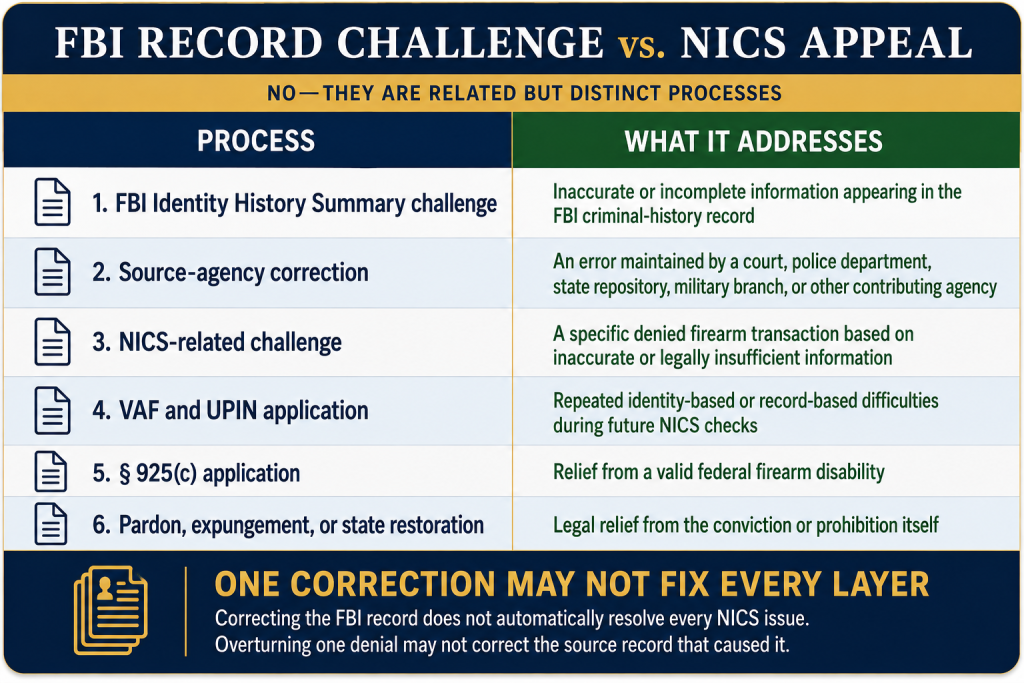
A person may need more than one process. For example, a NICS denial may reveal that an expunged conviction remains on an FBI criminal-history report. The person may need to challenge the denied transaction, correct the source record, and update the Identity History Summary.
When to File a NICS Challenge
A NICS challenge applies when a firearm transaction receives a formal “denied” response and the individual believes the denial is incorrect.
The NICS challenge process can:
- Identify the reason for the denial;
- Identify the agency possessing the potentially prohibiting information;
- Allow submission of court orders or other corrective documents;
- Trigger additional FBI research; and
- Result in the denial being sustained, overturned, or left unresolved.
The FBI states that only transactions with a denied status may be challenged through this process. A transaction that remains delayed generally cannot be challenged as a denial.
A NICS challenge normally requires the NICS Transaction Number or State Transaction Number associated with the denied transaction. Fingerprints and supporting documentation are strongly encouraged because they can help resolve identity and record-matching issues.
The FBI’s preferred submission method is its electronic NICS challenge process. The FBI states that it will respond to a denial challenge within 60 calendar days with a final status or notice that the matter remains unresolved.
Someone who received a firearm denial should review our guide to challenging a wrongful NICS denial rather than relying solely on an Identity History Summary challenge.
When a VAF and UPIN May Help
The Voluntary Appeal File is intended for people who are legally eligible to possess firearms but repeatedly experience extended delays or erroneous denials because available records do not immediately establish their eligibility.
A VAF application authorizes the FBI to retain information that might otherwise be unavailable during future NICS checks. If the application is approved, the FBI issues a Voluntary Appeal File Personal Identification Number, commonly called a UPIN.
A VAF and UPIN may be helpful when:
- The person has a common name similar to someone who is prohibited;
- A record requires recurring clarification;
- An old arrest lacks readily accessible disposition information;
- A prior denial was overturned but the same confusion may recur;
- An expungement or restoration document must repeatedly be located; or
- Identity or record-matching problems cause extended delays.
A UPIN does not expunge a record, correct an inaccurate court judgment, restore firearm rights, or exempt someone from future background checks. It also does not guarantee an immediate “proceed” response.
Our guide to VAF and UPIN applications for recurring NICS problems explains how the process works and who may benefit.
When § 925(c) May Be the Correct Process
A record challenge is appropriate when the information is inaccurate or incomplete. It is not a method for escaping the legal effect of an accurate disqualifying record.
If the record is correct and the individual remains prohibited under federal law, the appropriate remedy may be an application for federal firearm rights restoration under 18 U.S.C. § 925(c).
The Department of Justice’s Federal Firearm Rights Restoration program is administered by the Office of the Pardon Attorney. It provides a discretionary process through which individuals prohibited under 18 U.S.C. § 922(g) may seek relief from an existing federal firearm disability.
Section 925(c) is fundamentally different from a record correction:
- A record correction argues that the government’s information is wrong or incomplete.
- A NICS challenge argues that a specific firearm denial was erroneous.
- A § 925(c) application accepts that a federal prohibition currently exists but asks the Attorney General to restore the applicant’s federal firearm rights.
An applicant seeking relief must address public safety, the public interest, the circumstances underlying the disability, and the applicant’s record and reputation. The process may also involve presumptive disqualifiers, required records, fingerprints, and character references.
Read our comprehensive guide to federal firearm rights restoration under § 925(c) for the eligibility standards and application process.
An Expungement Does Not Automatically Correct Every Federal System
An expungement may change the legal status or availability of a record under state law, but it does not necessarily cause every federal or private database to update automatically.
Several separate questions must be considered:
- Did the court enter a legally valid expungement or sealing order?
- Does the order cover the precise arrest or conviction appearing on the FBI report?
- Did the court serve the order on the required agencies?
- Did the state repository process the order?
- Did the state transmit the correction to the FBI?
- Did the FBI connect the update to the original fingerprint submission?
- Does the relief eliminate the relevant federal firearm disability?
- Does another independent prohibition remain?
The fact that an expunged record still appears does not necessarily mean the court order is invalid. It may mean that an agency did not receive, match, process, or transmit the update correctly.
Conversely, removing an entry from an Identity History Summary does not necessarily establish that the person may lawfully possess a firearm. Firearm eligibility requires a separate analysis of federal and applicable state law.
How to Determine Which Process You Need
The following guide provides a useful starting point:
| Your situation | Process that may apply |
|---|---|
| Your FBI report lists the wrong charge or disposition | Identity History Summary challenge |
| An expunged case still appears on the FBI report | Source-agency correction, FBI challenge, or both |
| A state criminal-history report is wrong | State or source-agency correction |
| A firearm purchase was formally denied | NICS challenge |
| NICS correctly identified a valid federal prohibition | § 925(c), pardon, state relief, or another substantive remedy |
| You repeatedly experience delays because of identity confusion | VAF and UPIN |
| A prior NICS denial was overturned but problems continue | VAF and UPIN |
| A private employment report is wrong | Dispute with the reporting company and possibly the source agency |
| You do not know what record is causing the problem | Obtain the relevant FBI, state, court, or NICS records before selecting a remedy |
When several databases contain related information, correcting only one may not solve the entire problem.
When Professional Record-Correction Assistance May Be Appropriate
Some record problems can be addressed by submitting a straightforward certified disposition. Others require coordination among multiple courts, law-enforcement agencies, state repositories, and federal databases.
Professional assistance may be particularly useful when:
- The error has caused a firearm denial;
- Multiple agencies maintain conflicting versions of the record;
- A state says it completed a correction but the FBI report remains unchanged;
- The relevant case is decades old;
- The court or police department cannot locate the underlying file;
- An expungement order does not identify the record in the same way the FBI does;
- The FBI requests validation from an unresponsive contributing agency;
- The correction affects employment, licensing, immigration, or a security clearance; or
- It is unclear whether the problem is an inaccurate record or a legally valid prohibition.
National Security Law Firm’s FBI firearm record correction lawyers help clients identify the controlling record, obtain supporting documentation, coordinate with contributing agencies, and pursue the appropriate federal correction process.
Frequently Asked Questions About Inaccurate FBI Background Checks
Can the FBI correct a state court record?
No. The FBI may update the information it maintains after the appropriate source agency confirms the correction. It cannot change the underlying judgment entered by a state court.
Does the FBI charge a fee to challenge an Identity History Summary?
The FBI does not charge a fee for the challenge itself. There may be separate costs for obtaining the original report, fingerprints, certified court records, or professional assistance.
How long does an FBI Identity History Summary challenge take?
The FBI currently reports an average response time of approximately 45 days after receiving the challenge. Older records, multiple jurisdictions, or delays by contributing agencies may extend the process.
Will the FBI remove an expunged state case automatically?
Not necessarily. The state or submitting agency ordinarily must process the order and transmit or validate the appropriate update. A separate challenge may be needed if the correction does not reach the FBI.
Can I use an Identity History Summary challenge to overturn a NICS denial?
Not by itself. A formal NICS denial should generally be challenged through the NICS challenge process. If the denial resulted from an inaccurate Identity History Summary or source record, both processes may be necessary.
Will correcting my FBI report restore my firearm rights?
Only if the problem was inaccurate information and no valid federal or state prohibition remains. Correcting a record is different from restoring rights that have been legally lost.
Should I apply for a UPIN instead of correcting the record?
A VAF and UPIN may help with recurring delays or identity confusion, but they are not substitutes for correcting a materially inaccurate record.
Can § 925(c) correct an inaccurate FBI record?
No. Section 925(c) is a discretionary rights-restoration process for someone subject to a valid federal firearm prohibition. An inaccurate record should be corrected through the FBI, the source agency, a NICS challenge, or a combination of those processes.
Start by Identifying the Record That Is Actually Wrong
The most important step is selecting the correct process.
An FBI Identity History Summary challenge cannot replace a NICS challenge. A UPIN cannot restore firearm rights. Section 925(c) cannot correct an inaccurate conviction record. And the FBI cannot rewrite an erroneous state-court judgment without action by the responsible state or local authority.
Start by obtaining the relevant reports and identifying:
- What information appears;
- Which agency originated it;
- Why it is inaccurate;
- What official documents establish the correct information; and
- Which government system must be updated.
If inaccurate FBI or source-agency records are affecting a firearm transaction, employment opportunity, license, security clearance, or other federal matter, consult with our federal record-correction team about the process that may apply.
Schedule a consultation with National Security Law Firm to have the relevant records and potential remedies evaluated.
This article provides general information and is not legal advice. The correct process depends on the records involved, the originating agency, and the purpose for which the information is being used. Government procedures and processing times may change.