You answered the questions, completed the background check, and expected to leave with your firearm. Instead, the dealer told you that NICS denied the transaction—often without explaining why.
Now you may be wondering whether you are actually prohibited, whether the FBI confused you with someone else, and whether attempting another purchase could make the situation worse.
A NICS denial does not necessarily mean that you are legally prohibited from possessing firearms. The system may be relying on an incomplete disposition, an inaccurate criminal-history record, a conviction that was expunged or pardoned, a protection order that has expired, or information belonging to someone with a similar name.
But a denial should never be ignored or treated casually. Federal law requires the FBI to report denied NICS transactions to the appropriate law-enforcement authorities, and attempting to purchase or possess a firearm while prohibited can create serious criminal exposure.
National Security Law Firm’s nationwide NICS appeal lawyers investigate the legal and factual basis for firearm denials, obtain the underlying records, correct inaccurate information, and pursue the appropriate FBI or state challenge.
NICS appeal representation at NSLF generally begins at $2,500, depending on the records and issues involved.
Schedule a confidential consultation with our NICS appeal lawyers or call (202) 600-4996 to find out what caused your denial and what should happen next.
What Does a NICS Denial Mean?
The National Instant Criminal Background Check System, commonly called NICS, checks information submitted during a firearm transaction against federal and state records that may prohibit a person from receiving a firearm.
A “denied” response means the FBI or a state point-of-contact agency identified you as a descriptive match to a record or other information that appears to prohibit the firearm transfer.
That is an administrative determination—not a judicial finding that the information is complete, current, or legally correct.
NICS background checks ordinarily compare identifying information such as:
- Name;
- Date of birth;
- Sex;
- Race;
- State of residence;
- Social Security number, if voluntarily provided; and
- Other identifying descriptors.
The initial NICS check is not based on a fingerprint comparison. That is one reason mistaken-identity denials can occur.
A denial may reflect a valid prohibition, an inaccurate record, an incomplete record, or a correct record that has been interpreted incorrectly.
Why Are People Wrongfully Denied by NICS?
Government databases contain millions of records collected from courts, law-enforcement agencies, mental-health reporting authorities, military departments, immigration systems, and state criminal-history repositories.
Those records are not always complete or synchronized.
Common causes of potentially wrongful NICS denials include:
- Another person with a similar name or date of birth;
- A missing dismissal or acquittal;
- A deferred case incorrectly reported as a conviction;
- A felony charge that was reduced to a nonprohibiting offense;
- An incomplete sentencing record;
- A conviction for an offense that was not punishable by more than one year;
- A state misdemeanor incorrectly treated as a federal felony;
- An expungement, set-aside, pardon, or restoration order that was never transmitted;
- A protection order that expired or did not satisfy federal requirements;
- Incorrect information about the relationship involved in a domestic-violence case;
- A mental-health record that does not qualify under federal law;
- A record attributed to the wrong person;
- A military record that is incomplete or incorrectly classified;
- State relief that has not been reflected in the federal system; or
- An agency’s failure to enter the final disposition of an old case.
The correct response depends on whether the problem is with the FBI’s interpretation, the source record itself, or an actual legal prohibition requiring a separate remedy.
What Should You Do Immediately After a NICS Denial?
Do not guess about why you were denied.
Take these steps:
- Ask the firearm dealer for your NICS Transaction Number, known as the NTN.
- If a state agency processed the background check, request the State Transaction Number, known as the STN.
- Confirm whether the transaction was actually denied or remains delayed.
- Preserve the date, dealer information, and any NICS Resolution Card you received.
- Do not repeatedly attempt additional purchases while the issue remains unresolved.
- Do not contact courts or agencies with admissions or speculative explanations before understanding the legal issue.
- Request the official reason for the denial.
- Consult a federal firearms lawyer if the record or prohibition is unclear.
The NTN or STN connects the challenge to the specific denied transaction. If you did not receive it, contact the federal firearms licensee that initiated the background check.
How Do You Find Out Why NICS Denied You?
The FBI allows a denied person to request the prohibiting category that supported the denial.
The request can be initiated through the FBI’s electronic NICS challenge portal. You will generally need:
- Your email address;
- The state where the transaction occurred;
- Your NTN or STN;
- Your identifying information; and
- Access to the link and PIN sent by the FBI.
The reason response usually identifies a category, such as a felony conviction, domestic-violence conviction, mental-health prohibition, protection order, or another federal or state restriction.
It may not provide every underlying document or explain whether the record was legally applied correctly.
The FBI states that it will provide the reason for a denial within five business days after receiving a proper request. Privacy restrictions generally prevent the FBI from simply disclosing the reason by telephone or ordinary email without identity verification.
Once the category is known, the next step is determining which agency holds the information and whether it is accurate.
What Is a NICS Appeal or Firearm-Related Challenge?
People commonly call the process a “NICS appeal.” The FBI generally refers to it as a NICS-related challenge or firearm-related challenge.
A challenge asks the FBI or responsible state agency to reconsider a denied transaction because the prohibiting information is inaccurate, incomplete, outdated, belongs to someone else, or does not legally support the denial.
The challenge process can:
- Identify the specific category supporting the denial;
- Identify the court, agency, or repository holding the record;
- Permit submission of fingerprints;
- Permit submission of certified court and government records;
- Provide evidence that rights were restored;
- Trigger additional FBI research;
- Result in the denial being sustained or overturned; or
- Reveal that the underlying record must first be corrected by its source agency.
A NICS challenge is not an application asking the FBI to forgive a valid prohibition. The FBI cannot restore firearm rights through the challenge process. The purpose is to establish that the denial was wrong or that the information supporting it is no longer legally effective.
What Evidence Can Support a NICS Challenge?
The correct evidence depends on the reason for the denial.
Supporting materials may include:
- Certified charging documents;
- A judgment or final disposition;
- A dismissal or acquittal;
- A plea agreement;
- Sentencing records;
- Proof that an offense was not punishable by more than one year;
- Proof of sentence completion;
- An expungement or set-aside order;
- A pardon warrant;
- A civil-rights restoration certificate;
- An order terminating a protection order;
- Evidence addressing the relationship element in a domestic-violence case;
- Mental-health adjudication or commitment records;
- An order granting mental-health relief from disability;
- Military court and discharge records;
- Immigration-status documentation;
- Fingerprints establishing mistaken identity;
- Correspondence from the record-holding agency; and
- An updated criminal-history report.
Documents should be complete, legible, and obtained from an authoritative source. An unofficial docket printout may help identify the issue but may not be sufficient to resolve it.
The FBI may validate submitted records with the court or agency that created them.
How Long Does a NICS Appeal Take?
The FBI states that it must respond to a denial challenge within 60 calendar days.
That response may:
- Overturn the denial;
- Sustain the denial; or
- Advise that the matter remains unresolved.
A 60-day response requirement does not guarantee that every underlying record problem will be fully corrected within 60 days. Some matters require separate work with a court, state police repository, military department, mental-health authority, or other source agency.
The timeline can be affected by:
- Missing historical records;
- The responsiveness of the source agency;
- Whether fingerprints are needed;
- Inconsistent records among multiple databases;
- The number of jurisdictions involved;
- Complex questions under state law;
- Multiple possible prohibitions; and
- The need to obtain certified documents.
A properly prepared initial submission can reduce avoidable delay, but no attorney can promise when the FBI or a state agency will complete its review.
What Happens If the FBI Sustains the Denial?
A sustained denial means the FBI continues to identify a federal or state prohibition or court-ordered firearm restriction after reviewing the challenge.
The FBI’s response should identify the prohibiting category and the agency holding the relevant record, when available.
A sustained denial does not always mean that the underlying record is correct. It may mean the FBI is relying on information that has not yet been corrected by the court or source agency.
The next step may be to:
- Obtain the source record;
- Challenge the accuracy of that record with the responsible agency;
- Obtain a missing disposition;
- Correct an FBI or state criminal-history report;
- Seek an amended court order;
- Establish that a conviction does not qualify as a federal predicate;
- Obtain expungement, pardon, or restoration relief;
- Apply under § 925(c);
- Pursue judicial review; or
- Confirm that the person remains legally prohibited.
If corrected documentation later refutes the denial, the FBI permits the person to initiate a new challenge and submit the new evidence.
Can You File a Federal Lawsuit Over a Wrongful NICS Denial?
Federal law permits an aggrieved person to seek judicial relief under 18 U.S.C. § 925A when NICS erroneously denies a firearm transfer or fails to correct inaccurate records.
A federal court may order the government to correct its records or approve the transfer if the person proves that the denial was legally erroneous.
Litigation is not necessary in every case. The FBI encourages people to use the available administrative challenge process first, and many denials can be resolved through records and agency communication.
Federal litigation may become appropriate when:
- The administrative challenge does not resolve the error;
- The government continues relying on a legally insufficient record;
- The dispute turns on a contested legal interpretation;
- Agencies fail to correct verified inaccuracies; or
- The client needs judicial relief that the administrative process cannot provide.
NSLF evaluates the administrative record and available evidence before advising whether further legal action should be considered.
What If a State Agency Denied the Transaction?
Some states act as full or partial points of contact for NICS transactions. In those states, a state agency may conduct or complete the background check and issue the denial.
If a state point-of-contact agency denied the transaction, that agency may possess information unavailable to the FBI. The FBI therefore encourages denied individuals to contact the state agency before or while pursuing an FBI challenge.
A state denial may involve:
- A federal prohibition;
- A separate state-law prohibition;
- A state permit or licensing requirement;
- A court order;
- A record held only in the state repository; or
- A combination of state and federal restrictions.
The proper procedure varies by state. An effective challenge must address the agency that actually made the decision and the law it applied.
What Is the Difference Between a NICS Denial and a NICS Delay?
A denial and a delay are not the same.
A denial means the system identified information that appears to prohibit the transfer.
A delay means NICS needs additional time to determine whether the transaction may proceed. The FBI may be waiting for a court disposition, comparing identifying information, or seeking records from another agency.
The FBI does not process denial challenges for transactions that remain in delayed status.
Under federal law, if NICS has not issued a determination within three business days, a federal firearms licensee may sometimes lawfully transfer the firearm unless state law forbids the transfer. The dealer is not federally required to complete the transfer and may choose to wait for a final response. Other federal requirements and extended review periods may also apply to particular transactions.
A person experiencing a delay should not describe it as a denial or use the denial-challenge process unless NICS changes the transaction to denied.
Learn more about what a delayed firearm background check means and whether a prolonged NICS delay can be challenged.
Can Mistaken Identity Cause a NICS Denial?
Yes. The FBI confirms that the initial NICS check is based on names and other descriptive information rather than fingerprint comparison.
A person may be confused with someone who has:
- The same or a similar name;
- A similar date of birth;
- Comparable physical descriptors;
- A shared family name;
- A criminal record under an alias; or
- Inaccurate identifying information associated with a government record.
Fingerprints can help establish that the denied purchaser is not the person associated with the prohibiting record.
Our attorneys have handled matters in which identity confusion caused repeated firearm problems. Read how NSLF cleared a client’s mistaken-identity firearm record and secured a UPIN.
What If the Criminal Record Is Wrong or Incomplete?
A NICS challenge may reveal that the FBI accurately reproduced what a court or state repository reported—but the source record itself is incomplete or wrong.
Examples include:
- The arrest appears without a disposition;
- A dismissed charge remains coded as pending;
- A conviction is associated with the wrong grade of offense;
- A sentence is incorrectly reported;
- An expungement was never transmitted;
- A restoration order is missing;
- A case belonging to another person appears on your record; or
- Two different cases have been combined.
The source agency generally must correct its own record before the FBI can make a permanent correction.
That process may involve:
- Obtaining an FBI Identity History Summary;
- Obtaining the state criminal-history report;
- Comparing those reports with the court file;
- Identifying the precise discrepancy;
- Requesting correction from the court or reporting agency;
- Ensuring the corrected disposition reaches the state repository;
- Submitting the corrected information to the FBI; and
- Reopening or supplementing the NICS challenge.
Our FBI firearm record-correction lawyers handle matters in which the denial cannot be fixed until the government record itself is repaired.
What If My Conviction Was Expunged, Pardoned or Set Aside?
An expungement, pardon, set-aside, or restoration of civil rights may affect whether a conviction remains a federal firearm disqualifier. But the existence of an order does not automatically answer the question.
The analysis may depend on:
- The jurisdiction where the conviction occurred;
- The statutory authority for the relief;
- Whether the order completely nullified the conviction;
- Which civil rights were restored;
- Whether firearm restrictions remained;
- The language of 18 U.S.C. § 921(a)(20);
- Special rules for domestic-violence misdemeanors;
- Other convictions or prohibiting statuses; and
- Whether federal and state databases were updated.
Do not assume that sealed means restored or that a state order necessarily eliminates every federal restriction.
Our related guides explain whether an expungement restores gun rights and when a pardon may restore firearm rights.
What If the NICS Denial Is Legally Correct?
A valid prohibition cannot be overturned merely because the person has lived responsibly or believes the restriction is unfair.
If the denial is legally correct, the appropriate remedy may be:
- Federal firearm rights restoration under 18 U.S.C. § 925(c);
- A presidential or gubernatorial pardon;
- Expungement or set-aside relief;
- Restoration of civil rights;
- State mental-health relief from disability;
- Termination or modification of a qualifying court order;
- Military-record relief;
- A change in immigration or other prohibiting status; or
- Separate state firearm-rights restoration.
DOJ now administers a formal federal firearm rights restoration process under § 925(c). That process is different from a NICS challenge.
A NICS challenge asks the government to correct a denial that was wrong. A § 925(c) application asks the Attorney General to grant relief from a valid federal firearm disability.
Our gun-rights remedy-selection guide can help distinguish among these options.
What Is the Voluntary Appeal File?
The FBI’s Voluntary Appeal File, or VAF, is designed for people who experience repeated NICS problems and want the FBI to maintain information that may help distinguish them from prohibiting records or clarify their lawful status.
An approved VAF applicant receives a unique identification number commonly called a UPIN.
A VAF application may be useful for:
- Repeated mistaken-identity delays;
- A common name associated with another person’s record;
- Records that are difficult to retrieve during every transaction;
- A prior denial that was overturned;
- An old record that repeatedly requires additional research; or
- A recurring question that supporting documents can resolve.
A UPIN does not exempt a buyer from future NICS checks. It does not bypass the background-check system, guarantee an approval, or prevent a new prohibition from being considered.
Instead, it gives NICS a way to associate the purchaser with information retained in the VAF that may assist future review.
Our attorneys prepare VAF and UPIN applications for repeated NICS problems.
Should You File a NICS Challenge or Apply for a UPIN?
The answer depends on what happened.
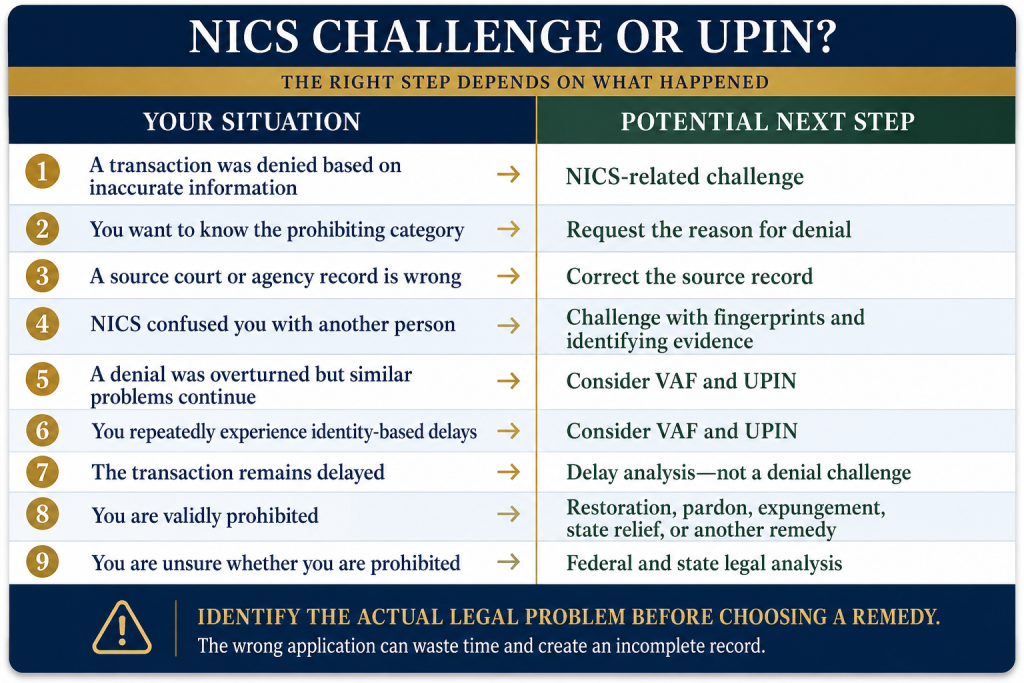
Filing the wrong application can waste time and create an incomplete record. NSLF begins by identifying the actual legal problem before recommending a remedy.
How National Security Law Firm Handles a NICS Appeal
Our representation is tailored to the reason for the denial and the records involved.
Depending on the case, NSLF may:
- Obtain the NTN or STN and available denial information;
- Request the official prohibiting category;
- Obtain authorization for the FBI to communicate with counsel;
- Analyze potential federal and state prohibitions;
- Obtain an FBI Identity History Summary;
- Order state criminal-history records;
- Retrieve certified court dispositions;
- Compare the source documents with the government databases;
- Obtain fingerprints for mistaken-identity issues;
- Contact courts and source agencies about inaccurate records;
- Prepare and submit the NICS challenge;
- Provide legal and documentary support for overturning the denial;
- Monitor the challenge;
- Respond to FBI requests;
- Evaluate the final determination;
- Prepare a VAF or UPIN application when appropriate;
- Advise whether § 925(c), a pardon, or state relief is needed; and
- Evaluate further administrative or judicial options.
The goal is not merely to send documents to the FBI. It is to identify precisely why the denial occurred and pursue the remedy capable of resolving it.
Why Choose NSLF as Your NICS Appeal Law Firm?
NICS matters often cross several practice areas at once. A single denial can involve federal firearms law, state criminal law, military records, immigration status, mental-health records, domestic-violence law, pardons, expungements, and administrative record correction.
NSLF brings those disciplines together.
Our federal firearms practice is led by former United States Attorney Duane “DAK” Kees. As a former chief federal law-enforcement officer and Army Judge Advocate, DAK understands how federal agencies evaluate criminal records, legal disabilities, public safety, and documentary proof.
Our team offers:
- Nationwide federal firearms representation;
- Experience with NICS challenges, VAF applications, UPINs, pardons, and § 925(c);
- Detailed record reconstruction;
- Integrated military and federal administrative experience;
- Careful federal-versus-state analysis;
- Transparent scopes of representation;
- Defined flat fees; and
- Client service reflected in 4.9 stars across 298 Google reviews.
Learn more about why clients choose National Security Law Firm for federal firearm matters.
How Much Does a NICS Appeal Lawyer Cost?
NSLF’s flat fees for NICS appeal representation generally begin at $2,500.
The final fee depends on factors such as:
- Whether the reason for denial is already known;
- The number of relevant arrests or convictions;
- Whether the court records are available;
- Whether a state point-of-contact agency is involved;
- Whether fingerprints are needed;
- Whether the source record must be corrected;
- The number of courts or agencies involved;
- Whether state-law analysis is required;
- Whether a VAF application is included; and
- Whether the matter involves a valid prohibition requiring separate relief.
After reviewing the matter, NSLF provides a written scope of representation and a clearly defined flat fee.
Legal financing may be available through NSLF’s financing program, subject to the financing provider’s terms and approval.
Frequently Asked Questions About NICS Appeals
How do I appeal a NICS denial?
Obtain the NTN or STN from the firearm dealer, request the official reason through the FBI’s electronic portal, and submit a NICS-related challenge with the records establishing why the denial is wrong.
How quickly will the FBI tell me why I was denied?
The FBI states that it must provide the prohibiting category within five business days after receiving a proper request for the reason.
How long does a NICS challenge take?
The FBI must respond within 60 calendar days by sustaining or overturning the denial or advising that the challenge remains unresolved. Correcting an underlying source record may take longer.
Can I challenge a delayed NICS transaction?
Not through the FBI’s denial-challenge process. The FBI accepts challenges only for denied transactions, not transactions that remain delayed.
Does a denial mean I committed a crime?
Not necessarily. A denial is an administrative decision that a firearm transfer cannot proceed. However, the FBI reports denied transactions to law enforcement, and attempting to acquire or possess a firearm while knowingly prohibited can create criminal exposure.
Can I try buying a firearm again from another dealer?
Doing so does not correct the first denial and can create additional complications. Determine why the initial transaction was denied before attempting another purchase.
Do I need fingerprints for a NICS challenge?
Fingerprints are not always mandatory, but the FBI encourages them in denial challenges and they can be particularly important in mistaken-identity cases.
What if my arrest never resulted in a conviction?
An arrest alone does not automatically establish every federal firearm prohibition. The missing or incorrect disposition may need to be obtained and submitted to NICS or corrected with the source agency.
What if my conviction was expunged?
The effect depends on the jurisdiction, type of relief, remaining restrictions, and federal law. Some expungements eliminate a federal predicate; others merely restrict public access to the record.
What if my rights were restored by the state?
State relief may or may not eliminate the federal prohibition. The restoration order and applicable state and federal laws must be reviewed.
Will a UPIN guarantee immediate approval?
No. A UPIN does not bypass NICS or guarantee approval. It allows NICS to access information retained in the VAF that may help resolve recurring questions.
Can an attorney communicate with the FBI for me?
Yes, after the client provides a signed authorization meeting the FBI’s requirements.
What if the FBI refuses to overturn the denial?
The next step may involve correcting the source record, submitting a new challenge with additional evidence, seeking restoration relief, or evaluating a civil action under 18 U.S.C. § 925A.
Can NSLF help if a state agency issued the denial?
Yes. We can determine whether the challenge should be directed to the state point-of-contact agency, the FBI, or both.
Can NSLF represent me anywhere in the United States?
NSLF represents clients nationwide in federal NICS and firearm matters. State-law components are evaluated individually based on the jurisdiction and scope required.
Do Not Let an Unexplained NICS Denial Define Your Rights
A NICS denial may be caused by one missing disposition, one incorrect database entry, or another person’s record. It may also reveal a genuine legal prohibition that requires a completely different remedy.
The critical first step is finding out which one applies to you.
National Security Law Firm will investigate the denial, obtain the relevant records, explain your legal status, and pursue the procedure suited to the actual problem. You will not be left trying to interpret a government category or assemble decades-old records without a strategy.
NICS appeal representation generally begins at $2,500.
Schedule your confidential consultation with NSLF or call (202) 600-4996 to begin reviewing your denial.
This page provides general legal information and is not legal advice. Firearm eligibility depends on the complete facts and all applicable federal, state, tribal, and local laws. Do not acquire or possess a firearm unless you have confirmed that you are legally permitted to do so. Past results do not predict future outcomes. This website is an attorney advertisement.