
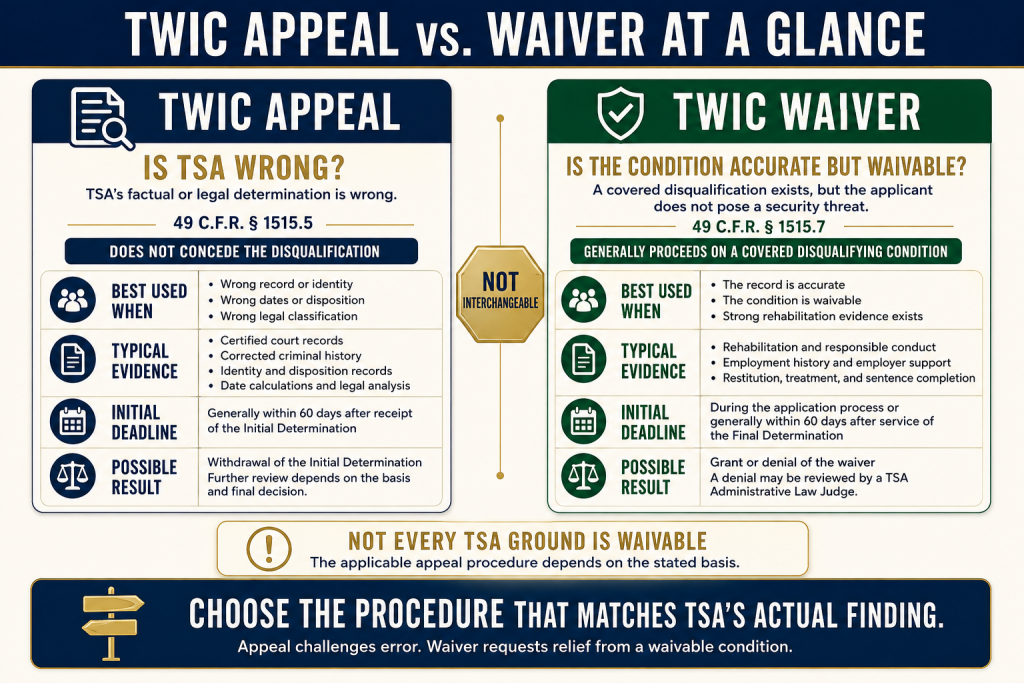
A TWIC appeal argues that TSA’s determination is factually or legally wrong. A TWIC waiver generally accepts that a waivable disqualification exists but asks TSA to find that you do not pose a security threat.
The simplest way to distinguish them is:
- Appeal: “TSA should not have disqualified me.”
- Waiver: “The disqualification is accurate, but TSA should grant relief.”
- Both: “TSA is wrong, but if TSA disagrees, I qualify for a waiver.”
Choosing the wrong procedure can waste limited time, produce an incomplete record, or appear to concede a disputed issue. The correct strategy depends on the exact TSA notice, criminal statute, disposition, dates, immigration or mental-capacity issue, and available evidence.
You generally must initiate an ordinary appeal within 60 days after receiving TSA’s Initial Determination of Threat Assessment. A waiver may be requested during the application process, after pursuing some or all of an appeal, or generally no later than 60 days after service of a Final Determination.
National Security Law Firm represents TWIC applicants nationwide in appeals and waivers. We have handled TSA credential matters since 2016 and have represented applicants in hundreds of cases.
Our flat legal fee for qualifying initial-stage TWIC appeal or waiver representation is $2,495. We review the TSA notice, obtain ordinary court records, determine the appropriate procedure, develop the evidence, prepare the submission, and manage the matter through the covered TSA stage.
Schedule a free consultation or call (202) 600-4996.
When Should You File a TWIC Appeal?
A TWIC appeal is appropriate when you assert that you satisfy TSA’s security-threat-assessment standards and that TSA made a factual or legal mistake.
Common appeal grounds include:
- The criminal record belongs to another person.
- TSA treated an arrest as a conviction.
- The record does not show that the charge was dismissed.
- The applicant was acquitted.
- A felony charge was reduced to a misdemeanor.
- The conviction was reversed or vacated.
- A pardon affects TSA’s treatment of the conviction.
- TSA used the wrong conviction date.
- TSA used the wrong release-from-incarceration date.
- An interim offense falls outside the applicable seven-year and five-year periods.
- The state offense does not match the federal category TSA identified.
- TSA characterized simple drug possession as distribution or possession with intent to distribute.
- A warrant was recalled or resolved.
- An indictment was dismissed.
- Immigration documentation is accurate but missing from TSA’s records.
- The alleged mental-capacity determination does not meet the regulatory standard.
The appeal should directly address the basis stated in TSA’s notice. Evidence of good character alone ordinarily does not prove that TSA’s criminal-history or legal determination was wrong.
For the complete procedure, review our guide on how to appeal a TWIC card denial.
When Should You Request a TWIC Waiver?
A TWIC waiver is appropriate when:
- The disqualifying condition is accurately reported;
- The condition falls within TSA’s waiver authority; and
- The applicant can demonstrate that the applicant does not pose a security threat.
Under 49 C.F.R. § 1515.7, waiver eligibility extends to:
- Permanent offenses listed in § 1572.103(a)(5) through (a)(12);
- Interim offenses under § 1572.103(b);
- Certain temporary-protected-status cases under § 1572.105; and
- Certain mental-capacity cases under § 1572.109.
A waiver submission may rely on:
- The circumstances surrounding the offense;
- The applicant’s acceptance of responsibility;
- The amount of time that has passed;
- Completion of incarceration, probation, or parole;
- Payment of restitution;
- Stable employment;
- Safety-sensitive work experience;
- Employer recommendations;
- Education and vocational training;
- Substance-use treatment, when relevant;
- Evidence of sobriety;
- Counseling or medical documentation, when relevant;
- Community involvement;
- Family responsibilities; and
- Sustained law-abiding conduct.
A waiver is not granted merely because the applicant needs a TWIC for work. Employment consequences are important, but the submission must address TSA’s security-threat standard.
For a complete discussion, visit our TWIC waiver and appeal lawyer page and our guide explaining how to submit a TWIC waiver request.
Which TWIC Offenses Can Be Waived?
TSA divides criminal disqualifications into permanent and interim categories.
Some Permanent Offenses Are Not Waivable
The completed offenses and conspiracies identified in § 1572.103(a)(1) through (a)(4) generally fall outside TSA’s waiver authority. These categories include:
- Espionage;
- Sedition;
- Treason; and
- A federal crime of terrorism or comparable state offense.
The precise text of the regulation should be reviewed because attempts are classified separately under § 1572.103(a)(11), which falls within the waiver provisions.
Other Permanent Offenses May Be Waived
Permanent offenses listed in § 1572.103(a)(5) through (a)(12) do not age out, but TSA may grant a waiver.
These include specified offenses involving:
- Transportation security incidents;
- Improper transportation of hazardous materials;
- Certain explosives offenses;
- Murder;
- Threats involving explosives or dangerous devices;
- RICO violations involving listed predicate offenses;
- Conspiracy to commit certain permanent offenses; and
- Attempts to commit listed permanent offenses.
Interim Offenses May Be Waived
Interim offenses under § 1572.103(b) are potentially waivable. They also cease to disqualify an applicant after both applicable timing tests have expired.
An interim offense is disqualifying if either:
- The applicant was convicted or found not guilty by reason of insanity within seven years before the TWIC application; or
- The applicant was released from incarceration for that offense within five years before the application.
The applicant must be outside both periods before the offense ages out.
For the complete classifications, review our TWIC card disqualifying-offenses guide.
Examples of TWIC Appeal Cases
TSA Reports an Arrest as a Conviction
TSA identifies a felony assault conviction, but the certified disposition shows that the charge was dismissed.
The appropriate response is an appeal because the applicant disputes the existence of the conviction.
The Felony Charge Was Reduced to a Misdemeanor
The applicant was originally charged with a felony weapons offense but was convicted only of a state misdemeanor.
Because TSA’s criminal-offense list generally identifies specified felonies, official proof of the amended charge and misdemeanor judgment may support an appeal.
The Offense Is Outside the Interim Periods
TSA identifies an interim offense, but the certified records show that the conviction occurred more than seven years before the application and the applicant was released from incarceration more than five years before the application.
That is an appeal because the applicant asserts that the offense no longer falls within the applicable disqualification period.
TSA Misclassifies a Drug Conviction
A criminal-history report broadly labels a case as a drug offense, but the judgment establishes misdemeanor simple possession. TSA’s interim list includes distribution, possession with intent to distribute, and importation; it does not separately list simple possession.
The applicant may need an appeal supported by the charging instrument, judgment, and state statute.
Examples of TWIC Waiver Cases
An Accurate Distribution Conviction
The applicant has an accurately reported felony distribution conviction within the interim period. The offense is waivable, and the applicant has completed the sentence, maintained sobriety, worked steadily, and developed a strong safety record.
That is principally a waiver case.
An Old Permanent but Waivable Offense
The applicant has an accurately reported permanent offense within § 1572.103(a)(5) through (a)(12). The conviction does not expire merely because it is decades old.
The applicant may need a waiver supported by substantial evidence of rehabilitation and lack of security risk.
A Qualifying Mental-Capacity Determination
The applicant has a mental-capacity determination covered by § 1572.109 but now possesses official medical or judicial documentation supporting restoration.
Depending on the facts, a waiver may be appropriate. If TSA’s information is factually wrong or the underlying event does not meet the regulatory definition, an appeal may be the better remedy.
When Should You Pursue Both an Appeal and a Waiver?
Some cases present a legitimate basis for both remedies.
The applicant may argue:
TSA’s determination is legally or factually wrong. If TSA nevertheless concludes that the condition is disqualifying, the applicant alternatively requests a waiver because the condition is waivable and the applicant does not pose a security threat.
Potential mixed cases include:
- The applicant disputes whether a state conviction matches TSA’s category but is eligible for a waiver if TSA rejects that argument.
- One offense is incorrectly reported, while another accurately reported offense requires a waiver.
- TSA used an incorrect release date, but the applicant requests a waiver if TSA maintains that the interim period remains open.
- The applicant disputes whether a vacatur eliminates the conviction but alternatively presents rehabilitation evidence.
- TSA mischaracterized aspects of the offense even though some form of waivable conviction exists.
Alternative arguments should be explicit and carefully separated:
- State the appeal position without conceding the disputed fact or legal conclusion.
- Explain that the waiver is requested only in the alternative.
- Identify precisely what is and is not admitted.
- Present the evidence relevant to each remedy in an organized manner.
- Request the appropriate result under either analysis.
A poorly drafted combined submission may blur the arguments or appear to admit the very determination being challenged.
When Should You Appeal First and Seek a Waiver Later?
An applicant may first pursue an appeal and request a waiver if the appeal fails.
Under § 1515.7, an applicant may request a waiver:
- During the application process;
- After pursuing some or all of the appeal process; or
- Generally no later than 60 days after service of the Final Determination of Threat Assessment.
A sequential strategy may make sense when:
- The appeal has a strong legal or factual basis;
- The applicant wants to avoid conceding a disputed disqualification;
- The waiver record will require substantial additional development;
- The offense’s waiver classification is uncertain; or
- The applicant wants TSA to decide the legal issue first.
However, waiting can prolong the credentialing process. It can also create another deadline and a separate stage of representation.
A combined or alternative filing may be more efficient when:
- The applicant’s employment is at immediate risk;
- The factual or legal appeal presents uncertainty;
- The condition is clearly waivable;
- The rehabilitation evidence is already complete; or
- Multiple grounds require different remedies.
The correct sequence depends on the notice, evidence, deadline, and practical consequences.
What Records Support an Appeal?
An appeal may require:
- Government-issued identification;
- A fingerprint comparison;
- Charging documents;
- Certified judgments;
- Dismissal or nolle prosequi orders;
- Judgments of acquittal;
- Amended charges;
- Sentencing records;
- Corrections records proving release dates;
- Warrant-recall orders;
- Orders dismissing indictments;
- Appellate mandates;
- Vacatur orders;
- Pardons;
- Corrected FBI Identity History Summaries;
- Corrected state criminal-history records;
- Immigration documentation;
- Judicial or medical records; and
- Court clerk certifications.
The goal is to prove the correct identity, disposition, classification, dates, or legal effect of the underlying record.
What Evidence Supports a Waiver?
A waiver may include:
- A detailed applicant declaration;
- Certified court and sentencing records;
- Proof of sentence completion;
- Probation or parole discharge records;
- Proof of restitution;
- Employment records;
- Employer and supervisor letters;
- Evidence of safe performance in sensitive positions;
- Commercial-driving records, when relevant;
- Education and training certificates;
- Substance-use treatment records, when relevant;
- Proof of sobriety;
- Counseling or medical documentation;
- Community-service records;
- Character references;
- Evidence of family responsibilities; and
- Documentation of long-term law-abiding conduct.
Character letters should provide specific, credible observations. Generic praise carries less weight than concrete evidence showing trustworthiness, judgment, reliability, and rehabilitation.
What Is the Deadline for a TWIC Appeal?
Under 49 C.F.R. § 1515.5, an applicant generally must initiate an appeal within 60 days after receiving TSA’s Initial Determination.
The applicant can ordinarily initiate the appeal by:
- Submitting a written reply;
- Requesting the releasable materials on which TSA relied; or
- Requesting an extension for good cause.
A timely request for TSA’s materials generally allows the applicant to submit the complete written reply within 60 days after TSA serves its response to that request.
If the applicant does not timely initiate an appeal, the Initial Determination ordinarily becomes a Final Determination of Threat Assessment.
What Is the Deadline for a TWIC Waiver?
Under § 1515.7, an applicant may request a waiver at any time during the application process but generally no later than 60 days after service of TSA’s Final Determination of Threat Assessment.
This deadline is different from the initial appeal deadline.
Do not assume that requesting a waiver automatically preserves an appeal argument or that requesting an appeal automatically preserves the later waiver deadline. Each procedure should be identified and calendared separately.
TSA may grant an extension for good cause, but an applicant should not rely on discretionary relief from a missed deadline.
Should You Request TSA’s Underlying Materials?
A request for TSA’s releasable materials can be valuable when you cannot determine whether the case calls for an appeal, waiver, or both.
Request the materials when:
- You do not recognize the alleged case;
- TSA’s offense description is vague;
- The dates appear incorrect;
- Several records could have triggered the notice;
- TSA’s regulatory classification is unclear; or
- You need to determine which government record contains the problem.
The materials may reveal that:
- TSA has an incomplete disposition;
- The underlying report contains an identity mismatch;
- TSA relied on a correct but waivable offense;
- More than one ground requires a response; or
- The case involves a different security-analysis procedure.
TSA will not disclose classified information and may withhold other legally protected information.
What Happens If TSA Denies the Appeal?
After reviewing an ordinary appeal, TSA may withdraw its Initial Determination or issue a Final Determination of Threat Assessment.
If TSA denies the appeal:
- The applicant may still request a waiver if the condition is waivable and the waiver deadline remains open.
- A Final Determination under § 1515.5 is treated as a final TSA order for purposes of judicial review under 49 U.S.C. § 46110.
- Administrative Law Judge review is not automatically available after every ordinary appeal denial.
The applicant should review the precise decision before selecting the next remedy.
What Happens If TSA Denies the Waiver?
A waiver denial under § 1515.7 may be reviewed by a TSA Administrative Law Judge under § 1515.11.
The applicant generally must request ALJ review within 30 calendar days after service of the waiver denial.
ALJ review is ordinarily limited to the evidence and information previously submitted in the waiver request. If the applicant has new evidence, the regulation requires a new waiver request, and the pending ALJ review will be dismissed.
This closed-record rule is one reason the initial waiver submission should be developed thoroughly.
For more information, review our guide to Administrative Law Judge review after a TSA waiver denial.
What If TSA Immediately Revoked the TWIC?
TSA may issue an Initial Determination of Threat Assessment and Immediate Revocation if it concludes that the holder does not satisfy the security-threat standards and may pose an imminent threat.
The holder may appeal the immediate revocation under the applicable procedures. However, filing an appeal ordinarily does not reactivate the TWIC while the case is pending.
The holder should not use the invalidated card for unescorted access. Immediate-revocation cases require prompt coordination with the employer, maritime facility, and—when applicable—the Coast Guard.
Read our guide explaining TSA’s immediate revocation of a TWIC or hazardous materials endorsement.
Common Mistakes When Choosing Between an Appeal and Waiver
Avoid:
- Filing a waiver when the record is actually wrong;
- Treating rehabilitation as proof that TSA misidentified the conviction;
- Filing an appeal that admits the disqualification but includes only character evidence;
- Assuming every permanent offense can be waived;
- Missing the appeal deadline while gathering waiver evidence;
- Requesting a waiver without understanding what the request concedes;
- Failing to address separate grounds in the TSA notice;
- Relying on a commercial background report instead of official dispositions;
- Ignoring the difference between the conviction date and release date;
- Submitting inconsistent accounts of the offense;
- Waiting until after a waiver denial to develop essential evidence; or
- Assuming that filing either procedure automatically restores an invalidated TWIC.
The strongest submission identifies the correct procedural vehicle before deciding what evidence to collect.
What Does National Security Law Firm Do?
For qualifying matters, National Security Law Firm can:
- Review every page of TSA’s notice;
- Identify the procedural stage and deadline;
- Determine whether to request TSA’s materials;
- Analyze whether the record is factually accurate;
- Determine whether the condition is legally disqualifying;
- Evaluate waiver eligibility;
- Recommend an appeal, waiver, or coordinated alternative strategy;
- Obtain ordinary court and disposition records;
- Calculate the seven-year and five-year periods;
- Analyze state and federal offense classifications;
- Develop rehabilitation and security-risk evidence;
- Prepare the legal submission;
- Organize and label exhibits;
- Submit the response to TSA; and
- Manage the matter through the covered initial stage.
We have handled TWIC and HME matters since 2016 and have represented applicants in hundreds of TSA credential cases nationwide. Our experience does not provide special influence over TSA. It helps us identify the records, legal issues, procedural decisions, and evidentiary gaps that matter.
How Much Does a TWIC Appeal or Waiver Lawyer Cost?
National Security Law Firm charges a flat legal fee of $2,495 for qualifying initial-stage TWIC appeal or waiver representation.
The covered service generally includes the legal analysis, ordinary court-record procurement, evidence development, preparation, submission, and matter management described in the written engagement agreement.
Unless expressly included, the fee does not cover:
- Unusual third-party expenses;
- Extensive litigation to correct a source record;
- An expungement or post-conviction proceeding;
- A separate waiver filed after completion of an appeal;
- Administrative Law Judge review;
- TSA Final Decision Maker review;
- Federal-court litigation;
- A Coast Guard proceeding;
- An employment matter; or
- An unrelated state licensing matter.
If an applicant needs both a sequential appeal and a later waiver, the engagement agreement will identify which stage is covered and whether a separate fee applies.
Eligible clients may use Pay Later by Affirm to divide the legal fee into monthly payments. Financing availability and terms are determined by the financing provider.
Financing and the Written Refund Guarantee
National Security Law Firm offers a written refund guarantee in certain qualifying accepted TWIC matters.
The refund guarantee does not promise that TSA will approve an appeal, grant a waiver, or issue a TWIC. TSA controls the government decision, and no attorney can ethically guarantee a particular outcome.
When the guarantee applies, the signed engagement agreement identifies:
- The covered procedure;
- The covered result;
- The client’s responsibilities;
- Applicable exclusions; and
- The circumstances under which NSLF will refund the covered $2,495 legal fee.
The guarantee:
- Applies only when expressly included in the signed engagement agreement;
- Covers only the legal fee identified in the agreement;
- Is subject to all written conditions and exclusions;
- Does not control TSA’s decision; and
- Does not necessarily cover third-party expenses, a second proceeding, or advanced review.
We do not accept every case for guaranteed representation. We first review the TSA notice, procedural stage, alleged disqualification, deadlines, available records, and known facts.
Frequently Asked Questions
Is a TWIC appeal the same as a waiver?
No. An appeal argues that TSA’s determination is wrong. A waiver generally accepts a covered disqualifying condition and asks TSA to find that the applicant does not pose a security threat.
Should I appeal if I was never convicted?
Generally, yes. If TSA relied on an arrest or charge that did not result in a disqualifying conviction, the response should dispute the determination and provide official proof of the disposition.
Should I seek a waiver if my conviction is accurate?
Potentially. The offense must fall within TSA’s waiver authority, and the applicant should present evidence demonstrating rehabilitation and lack of security risk.
Can I appeal based only on rehabilitation?
Rehabilitation generally supports a waiver rather than an appeal. An appeal should identify a factual or legal error in TSA’s determination.
Can I request a waiver while disputing the conviction?
Potentially. The applicant may appeal while requesting a waiver in the alternative. The submission should preserve the appeal position and state clearly that the waiver request is conditional.
Do all felony convictions require a waiver?
No. A felony is not automatically disqualifying merely because it is a felony. TSA’s regulations identify particular offense categories. Some felonies are not listed, some are interim, and some are permanently disqualifying.
Can a misdemeanor require a TWIC waiver?
TSA’s criminal-offense list generally identifies specified felonies. A state misdemeanor ordinarily is not a criminal disqualifier under that list. However, the exact statute, disposition, warrant status, immigration information, and other TSA concerns still matter.
Does an old conviction require an appeal or waiver?
It depends. An interim offense may have aged out if both timing periods have expired, which may support an appeal. A permanent offense does not age out, although some permanent offenses are waivable.
Should I request TSA’s records before choosing?
Often, yes. TSA’s releasable materials may clarify the offense, dates, source record, and regulatory category. A timely request can also initiate the appeal process under § 1515.5.
Can I seek a waiver after losing the appeal?
Potentially. Section 1515.7 allows an applicant to request a waiver after pursuing some or all of the appeal procedure, generally no later than 60 days after service of the Final Determination.
Can I appeal a waiver denial?
You may request review by a TSA Administrative Law Judge under § 1515.11, generally within 30 calendar days after service. The ALJ ordinarily may consider only the evidence previously submitted to TSA with the waiver request.
Does filing an appeal or waiver keep my TWIC active?
Not necessarily. If TSA immediately invalidated the TWIC, filing a response ordinarily does not restore it while the matter is pending.
Can NSLF guarantee whether TSA will approve my case?
No. TSA controls its decision. Any written refund guarantee applies only to qualifying accepted matters under the precise terms of the engagement agreement.
Find Out Whether You Need a TWIC Appeal, Waiver, or Both
The correct response begins with the complete TSA notice—not assumptions about the offense or a generic appeal template.
National Security Law Firm can review:
- TSA’s stated basis;
- The criminal statute and disposition;
- Conviction and release dates;
- Whether the condition is waivable;
- Whether TSA’s records are incomplete or incorrect;
- The available rehabilitation evidence; and
- The deadlines for each potential remedy.
Our flat legal fee for qualifying initial-stage TWIC appeal or waiver representation is $2,495. Financing may be available, and certain accepted cases may qualify for a written refund guarantee under the engagement agreement.
Schedule a free consultation or call (202) 600-4996.
Official TWIC Appeal and Waiver Resources
- TSA: Transportation Worker Identification Credential
- 49 C.F.R. Part 1515—TSA Appeal and Waiver Procedures
- 49 C.F.R. § 1515.5—Appeal of an Initial Determination
- 49 C.F.R. § 1515.7—Waiver Procedures
- 49 C.F.R. § 1515.9—Appeals Based on Other Security Analyses
- 49 C.F.R. § 1515.11—Administrative Law Judge and TSA Final Decision Maker Review
- 49 C.F.R. § 1572.103—Disqualifying Criminal Offenses
- 49 C.F.R. § 1572.105—Immigration Standards
- 49 C.F.R. § 1572.109—Mental-Capacity Standards
- 49 C.F.R. § 1570.3—Definitions, Including “Convicted”
Author: Katherine O’Brien, Esq., Founder, National Security Law Firm
Attorney Reviewed: August 26, 2026
This page provides general information and is not legal advice. Viewing this page or contacting the firm does not create an attorney-client relationship. Past results do not guarantee future outcomes. This website is an attorney advertisement. Any fee, scope of representation, financing arrangement, or refund guarantee is governed exclusively by a signed written engagement agreement.