
If TSA denied your TWIC or hazardous materials endorsement waiver, the denial is not necessarily the end of the case. Under 49 C.F.R. § 1515.11, you may request review by a TSA Administrative Law Judge.
You generally must act within 30 calendar days after TSA serves the waiver-denial decision.
This is an advanced administrative proceeding—not another opportunity to start the waiver application from scratch. The Administrative Law Judge ordinarily may consider only the evidence and information previously submitted to TSA with the original waiver request. If critical rehabilitation evidence was omitted from that submission, the regulations may require a new waiver request instead of ALJ review.
The request for review must:
- Be timely filed;
- Clearly identify the issues for the ALJ;
- Include the complete original waiver request and supporting materials;
- Include TSA’s waiver-denial decision; and
- State whether the applicant requests an in-person hearing.
National Security Law Firm represents TWIC and HME applicants nationwide in TSA waiver matters and advanced administrative review. We have handled TSA credential cases since 2016 and have represented applicants in hundreds of matters.
ALJ review is outside our $2,495 initial-stage appeal or waiver fee. We quote a separate flat or staged fee after reviewing the complete administrative record, TSA’s denial, the deadline, and whether a hearing is appropriate.
Schedule an urgent free consultation or call (202) 600-4996. When contacting the firm, provide TSA’s denial, the complete waiver submission, and the date the decision was served.
Who Can Request Review Under 49 C.F.R. § 1515.11?
Section 1515.11 applies to several categories of TSA decisions, including:
- A TSA decision denying a waiver requested under 49 C.F.R. § 1515.7;
- A Final Determination of Threat Assessment issued to a TWIC or HME applicant after an appeal involving terrorism-related, intelligence, or other security analyses under § 1515.9; and
- Certain final determinations involving air-cargo workers.
This page focuses on ALJ review after TSA denies a TWIC or HME waiver.
A waiver-denial case typically involves an applicant who acknowledges—or proceeds on the assumption—that a covered disqualifying condition exists but argues that TSA should nevertheless find that the applicant does not pose a security threat.
Waiver eligibility under § 1515.7 extends to:
- Permanent disqualifying offenses listed in § 1572.103(a)(5) through (a)(12);
- Interim disqualifying offenses under § 1572.103(b);
- Certain applicants with temporary protected status under § 1572.105; and
- Certain applicants affected by the mental-capacity standards in § 1572.109.
Not every TWIC or HME disqualification is waivable. A denial involving a nonwaivable condition generally cannot be converted into a viable waiver case through ALJ review.
Is ALJ Review Available After Every TSA Denial?
No. The nature of TSA’s decision controls the review process.
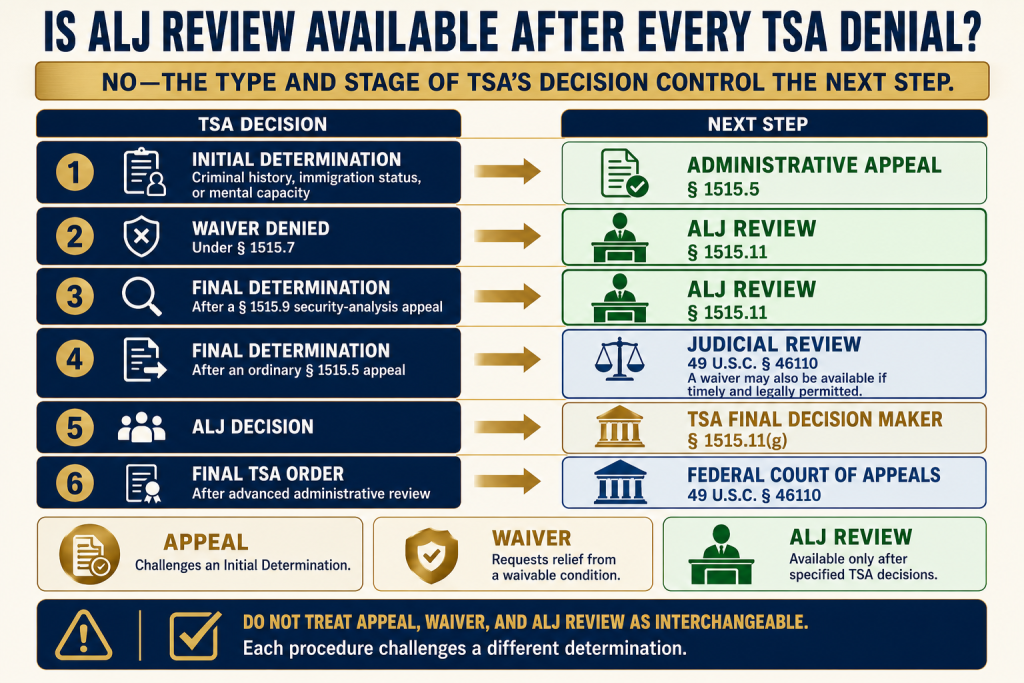
A person who received a TWIC denial letter should not assume that the words “appeal,” “waiver,” and “ALJ review” describe interchangeable procedures. Each challenges a different kind of determination.
If you are uncertain about the procedural stage, review our guide explaining what to do after a TSA Preliminary or Initial Determination of Ineligibility.
The 30-Calendar-Day Deadline
Under 49 C.F.R. § 1515.11(b), an applicant must request ALJ review no later than 30 calendar days from the date TSA serves the waiver-denial decision.
This is not a 30-business-day deadline.
Immediately record:
- The date printed on TSA’s decision;
- The stated date of service;
- The date you received the decision;
- The postmark or electronic-transmission date;
- The deadline identified in the notice; and
- Any delivery confirmation.
Preserve the envelope and every page of the decision. Do not assume that asking TSA an informal question, requesting reconsideration, or contacting an attorney automatically extends the filing deadline.
If the applicant fails to seek review within 30 calendar days, TSA’s determination becomes final with respect to the parties.
Can the Deadline Be Extended?
The ALJ may grant an extension for good cause.
A request should be:
- In writing;
- Filed within a reasonable time before the deadline;
- Specific about the deadline to be extended;
- Supported by an explanation of why additional time is necessary; and
- Accompanied by available documentation.
The regulation also permits a late extension request explaining why the failure to file on time was excusable. Whether the ALJ accepts that explanation is discretionary.
Do not assume an extension will be granted. Continue preparing the request for review while any extension request remains pending.
What Must Be Filed to Request ALJ Review?
A request for ALJ review of a waiver denial must clearly state the issues the applicant wants the ALJ to consider.
It also must include:
- The applicant’s complete waiver request.
- Every exhibit and supporting material provided to TSA with that waiver request.
- TSA’s written decision denying the waiver.
- A statement identifying each issue presented for review.
- A request for an in-person hearing, if the applicant seeks one.
The current regulation directs applicants to file requests with:
ALJ Docketing Center
U.S. Coast Guard
40 S. Gay Street, Room 412
Baltimore, Maryland 21202-4022
ATTN: Hearing Docket Clerk
Applicants should follow the current instructions in TSA’s denial notice and confirm the applicable filing method and address before submission.
Keep:
- A complete copy of the filing;
- Proof of mailing or delivery;
- Tracking information;
- Any docketing confirmation;
- A copy of everything served on TSA; and
- A detailed timeline of all filing and service dates.
The Issues Must Be Clearly Stated
A strong request for review does more than state that TSA made an unfair decision. It identifies specific errors in the waiver denial and ties those errors to the administrative record and governing regulations.
Potential issues may include whether TSA:
- Failed to consider material rehabilitation evidence;
- Misstated or overlooked evidence in the waiver record;
- Treated the underlying conduct as more serious than the official records establish;
- Ignored the amount of time since the offense;
- Failed to address evidence of stable employment and responsible conduct;
- Mischaracterized sentence completion, restitution, treatment, or supervision history;
- Relied on factual assumptions contradicted by the record;
- Applied the wrong regulatory standard;
- Failed to explain how the evidence supported its security-threat conclusion; or
- Reached a decision unsupported by substantial evidence in the administrative record.
Each issue should identify:
- The finding being challenged;
- The evidence already in the waiver record;
- The governing legal standard;
- The asserted error; and
- The relief requested.
The applicant should not simply rewrite the original waiver narrative. ALJ review should focus on why TSA’s denial cannot be sustained on the record that was before it.
The No-New-Evidence Rule
The most important limitation in a waiver-denial review is the closed-record rule.
Under § 1515.11(b)(1)(i):
- The request for ALJ review may not include evidence or information that was not presented to TSA in the original waiver request.
- The ALJ may consider only the evidence or information that was previously submitted to TSA.
- If the applicant has new evidence or information, the applicant must file a new waiver request under § 1515.7.
- Filing a new waiver request based on new evidence causes the pending ALJ review of the earlier denial to be dismissed.
This creates a critical strategic choice.
Evidence Already Submitted to TSA
If TSA overlooked, misunderstood, or improperly weighed evidence already in the administrative record, ALJ review may be appropriate.
Examples include:
- TSA stated that the applicant provided no employer support, but several employer letters were exhibits.
- TSA treated restitution as unpaid even though proof of payment was submitted.
- TSA failed to address documented treatment and years of sobriety.
- TSA misstated the offense circumstances established by the certified record.
- TSA discounted sustained employment or safety evidence without adequate explanation.
Evidence Not Previously Submitted
If the strongest information is genuinely new, ALJ review may not be the correct vehicle.
Examples include:
- A new employer letter obtained after the waiver denial;
- Newly completed treatment;
- A recent expungement, pardon, or vacatur;
- Newly paid restitution;
- New psychological or substance-use evaluations;
- New proof of sentence completion;
- Recent community-service evidence; or
- A court record that was never included in the first waiver submission.
The applicant may need to file a new waiver request and accept dismissal of the pending ALJ matter. That decision should be made only after comparing the strength of the existing record, the importance of the new evidence, credential and employment consequences, and timing.
Why the Initial Waiver Record Matters So Much
The closed-record rule is why a TWIC or HME waiver should be developed comprehensively at the initial stage.
A strong initial waiver may include:
- Certified records describing the offense and sentence;
- A candid explanation of the underlying conduct;
- Evidence of accountability;
- Proof that incarceration, probation, or parole was completed;
- Proof of restitution and financial obligations;
- Employment records;
- Employer and supervisor recommendations;
- Safety-sensitive work history;
- Commercial-driving history, where relevant;
- Education and vocational training;
- Substance-use treatment and sobriety evidence, where relevant;
- Mental-health treatment or medical releases, where relevant;
- Family and community responsibilities;
- Evidence of rehabilitation;
- Evidence of sustained law-abiding conduct; and
- A legal explanation connecting the evidence to TSA’s security-threat standard.
A favorable fact that exists but was never submitted may be unavailable during ALJ review. The record should therefore be built with potential later review in mind from the beginning.
For more information, review our TWIC waiver and appeal lawyer page or our guidance about an HME waiver after a hazmat endorsement denial.
Can the Applicant Request an In-Person Hearing?
Yes. The applicant may request an in-person hearing as part of the request for ALJ review.
A hearing is not automatic. The ALJ decides whether an in-person hearing is warranted by considering factors that include:
- The credibility of evidence or information submitted in the waiver request; and
- Whether TSA’s waiver denial complied with the governing regulations in 49 C.F.R. Parts 1515 and 1572.
The hearing request should explain why live proceedings would materially assist the ALJ.
Potential reasons may include:
- A material credibility issue;
- A need to examine how TSA characterized evidence;
- A dispute that would benefit from testimony concerning evidence already in the record;
- A need to cross-examine a witness, if permitted; or
- A substantial procedural issue concerning TSA’s decision.
A hearing should not be requested merely because the applicant wants another opportunity to tell the story. Oral testimony remains limited to evidence or information previously presented to TSA.
If the ALJ grants the hearing request, the hearing generally begins within 60 calendar days after receipt of the request, absent good cause for a different schedule.
Where Is the Hearing Held?
Under § 1515.11(e), the hearing ordinarily is held at TSA Headquarters.
A party may request an alternate location. The ALJ may select another location for good cause.
The possibility of an alternate location does not mean the applicant can select any preferred city. The ALJ controls the hearing location.
The hearing’s format, schedule, prehearing submissions, witness procedures, and deadlines are governed by the ALJ’s orders. Deadlines established by the ALJ during the proceeding are not subject to the general extension provision in § 1515.11(c).
Discovery Is Limited
An ALJ hearing under § 1515.11 is expressly described as a limited discovery proceeding.
It is not ordinary federal civil litigation. The parties should not expect broad interrogatories, depositions, document requests, or extensive pretrial discovery as a matter of right.
Where applicable and upon request, TSA may provide an unclassified summary of classified evidence on which it relied.
However:
- TSA will not disclose classified information to the applicant or the applicant’s attorney;
- TSA may withhold other information protected from disclosure by law or regulation; and
- The ALJ may review classified information outside the applicant’s presence and without disclosure to counsel.
The ALJ must possess the security clearance necessary to review classified or otherwise protected information.
These limitations can make the precise formulation of legal and record-based objections especially important.
Testimony, Evidence, and Cross-Examination
If a hearing is granted, the applicant may, as permitted by the ALJ:
- Present oral testimony;
- Rely on documentary evidence already in the record;
- Use demonstrative evidence;
- Submit rebuttal evidence; and
- Conduct cross-examination.
Oral testimony is limited to the evidence or information that was presented to TSA in the original waiver request. It cannot be used to introduce a materially new rehabilitation case.
The Federal Rules of Evidence may guide the ALJ but are not binding.
The ALJ may:
- Administer oaths and affirmations;
- Examine witnesses;
- Regulate the course of the hearing;
- Hold conferences;
- Rule on procedural motions and requests; and
- Issue a decision.
If the applicant fails to appear for a scheduled hearing, the ALJ may enter a default judgment.
A verbatim transcript is prepared. A party may request a copy at that party’s expense. Classified or protected information may be redacted from the transcript.
How Does the ALJ Treat Classified Information?
The ALJ may review classified evidence ex parte and in camera—outside the presence of the applicant and applicant’s counsel.
The ALJ may rely on classified information if it appears material and relevant.
When applicable and requested, TSA may provide the applicant with an unclassified summary of classified evidence. TSA nevertheless retains authority to protect classified information and other material not subject to disclosure.
This means the applicant may not receive every fact or source available to the government. Counsel may need to challenge the legal sufficiency of TSA’s decision based on the disclosed record, any available unclassified summary, and the procedural safeguards required by the regulations.
What Is the Substantial-Evidence Standard?
Section 1515.11 states that the standard of proof is substantial evidence on the record.
Substantial evidence generally means enough relevant evidence that a reasonable decision-maker could accept it as supporting the conclusion. It requires more than speculation, but it is not the same as proof beyond a reasonable doubt or even necessarily a preponderance of the evidence.
In practical terms, the proceeding should focus on whether the administrative record provides substantial support for TSA’s determination that the applicant did not establish eligibility for a waiver.
Potential arguments may address whether:
- TSA’s critical findings are supported by evidence;
- TSA ignored significant contrary evidence;
- The decision rests on an inaccurate description of the record;
- The agency applied the wrong regulatory framework;
- The decision reflects a rational evaluation of the waiver factors; and
- TSA’s conclusion logically follows from the evidence it cited.
The parties may submit proposed findings of fact and conclusions of law for the ALJ’s consideration.
When Does the ALJ Issue a Decision?
The administrative record closes after the certified transcript and all authorized documents and materials have been submitted.
The ALJ then generally issues an unclassified written decision within 30 calendar days after the record closes and serves it on the parties. The ALJ may also issue a classified decision to TSA when appropriate.
In a waiver-denial case, the ALJ may:
- Uphold TSA’s denial; or
- Reverse TSA’s denial.
Unless either party requests further review by the TSA Final Decision Maker:
- If the ALJ upholds the denial, TSA issues a Final Order Denying a Waiver.
- If the ALJ reverses the denial, TSA issues a Final Order granting the waiver.
When a waiver is granted:
- For an HME, TSA sends a Determination of No Security Threat to the licensing state.
- For a TWIC applicant who is a mariner, TSA sends a Determination of No Security Threat to the Coast Guard.
- The remaining credentialing or state-licensing steps must still be completed.
An ALJ ruling in the applicant’s favor does not necessarily mean that the physical credential or state endorsement becomes usable immediately. Confirm completion of all TSA, state, Coast Guard, enrollment, and issuance requirements before relying on it.
TSA Final Decision Maker Review
Either the applicant or TSA may request review of the ALJ’s decision by the TSA Final Decision Maker.
The request must generally be served within 30 calendar days after service of the ALJ’s decision.
The request must:
- Be in writing;
- Be served on the other party; and
- Address only whether the ALJ’s decision is supported by substantial evidence on the record.
The opposing party generally may file a response within 30 calendar days after receiving the request.
The TSA Final Decision Maker receives:
- The certified hearing transcript;
- All unclassified materials in the administrative record; and
- Any classified materials previously submitted by TSA.
The Final Decision Maker generally issues an unclassified decision:
- Within 60 calendar days after receiving the request;
- Within 30 calendar days after receiving the opposing party’s response; or
- Within a longer period if required.
The Final Decision Maker may also issue a classified opinion to TSA.
The Final Decision Maker’s decision is a final agency order.
What Happens If the Final Decision Maker Reverses the Waiver Denial?
If the TSA Final Decision Maker reverses the denial, TSA grants the waiver.
For an HME applicant, TSA sends a Determination of No Security Threat to the applicant and licensing state.
For a TWIC applicant, TSA sends a Determination of No Security Threat to the applicant and the Coast Guard.
The applicant still may need to complete remaining state, Coast Guard, enrollment, card-production, or issuance requirements.
A favorable TSA waiver decision also does not automatically eliminate an unrelated commercial-driver disqualification under state law or 49 C.F.R. § 383.51.
Federal Court of Appeals Review
A person may seek judicial review of a final order of the TSA Final Decision Maker under 49 U.S.C. § 46110.
The petition for review generally may be filed in:
- The United States Court of Appeals for the District of Columbia Circuit; or
- The federal court of appeals for the circuit in which the applicant resides or has a principal place of business.
Section 46110 generally requires the petition to be filed within 60 days after the final order is issued. A court may allow a later petition only if reasonable grounds justify the delay.
Federal appellate review is not a new trial. The court ordinarily reviews the administrative record and the legality of the final agency action.
Potential issues may include whether:
- TSA acted arbitrarily or contrary to law;
- The final decision is supported by the administrative record;
- The agency followed its regulations;
- The applicant received the process required by law; or
- TSA exceeded its statutory or regulatory authority.
Federal-court litigation is a separate advanced stage requiring independent evaluation, admission or counsel in the appropriate circuit, and a separate engagement agreement.
Does a Pending ALJ Review Restore the TWIC or HME?
Ordinarily, no.
Requesting ALJ review does not automatically:
- Reinstate a TWIC;
- Restore unescorted access to secure maritime areas;
- Require a state to restore an HME;
- Reinstate a Merchant Mariner Credential;
- Prevent an employer from reassigning the worker; or
- Guarantee continued employment.
If the worker’s credential was immediately revoked, it generally remains invalid while review is pending unless the responsible government agency takes affirmative action.
Applicants should preserve all employer, state, TSA, and Coast Guard communications and consider whether temporary reassignment, leave, union procedures, or other employment protections may be available.
Should You Seek ALJ Review or File a New Waiver?
The answer depends primarily on the administrative record.
ALJ Review May Be Appropriate When:
- The original waiver record was complete;
- TSA overlooked or misstated important evidence;
- The denial rests on an incorrect reading of materials already submitted;
- TSA did not apply the governing regulatory factors properly;
- The existing record strongly supports rehabilitation and lack of security risk; or
- A hearing could resolve credibility or procedural issues based on the existing record.
A New Waiver May Be More Appropriate When:
- Important rehabilitation evidence was omitted;
- Necessary court records were never submitted;
- Restitution or sentence-completion proof is new;
- Treatment or sobriety evidence developed after the first filing;
- A new employer or supervisor recommendation materially changes the case;
- The applicant obtained a pardon, vacatur, or other relief after denial; or
- The original submission was too incomplete to support meaningful record-based review.
Filing a new waiver based on new evidence results in dismissal of the pending ALJ review. The applicant should assess this choice before filing either proceeding.
What Does National Security Law Firm Do in an ALJ Review?
For qualifying matters, our advanced-stage work may include:
- Reviewing TSA’s waiver-denial decision;
- Reconstructing and indexing the complete administrative record;
- Confirming the 30-calendar-day deadline;
- Identifying whether the matter qualifies for § 1515.11 review;
- Determining whether ALJ review or a new waiver is the stronger procedure;
- Identifying reviewable legal, factual, and procedural errors;
- Preparing the request for ALJ review;
- Clearly stating the issues presented;
- Filing and serving the request;
- Requesting an in-person hearing when strategically appropriate;
- Preparing procedural motions and prehearing submissions;
- Developing examination and cross-examination strategy;
- Preparing witnesses to testify within the existing record;
- Drafting proposed findings of fact and conclusions of law;
- Reviewing the ALJ’s decision;
- Advising whether to seek TSA Final Decision Maker review; and
- Preserving issues for potential federal judicial review.
We have handled TWIC and HME matters since 2016 and have represented applicants in hundreds of TSA credential cases. Our experience does not provide special access to or influence over TSA or its adjudicators. It helps us identify the record, procedural posture, evidentiary limitations, and legal issues that matter at each stage.
How Much Does TSA ALJ Representation Cost?
ALJ review is advanced representation and is not included in National Security Law Firm’s $2,495 flat fee for qualifying initial-stage TWIC or HME appeal or waiver representation.
The fee for an ALJ matter is quoted separately after we review:
- TSA’s denial;
- The complete original waiver request;
- Every exhibit submitted to TSA;
- The filing deadline;
- The number and complexity of the issues;
- Whether classified or protected information may be involved;
- Whether an in-person hearing should be requested;
- The expected motion and witness practice; and
- Whether representation may extend to TSA Final Decision Maker review.
The written engagement agreement will identify the fee, covered stage, included work, expenses, and exclusions.
Unless expressly included, ALJ representation does not cover:
- Preparing and filing a new waiver request;
- TSA Final Decision Maker review;
- Federal court of appeals litigation;
- A Coast Guard proceeding;
- A state CDL or HME matter;
- An employment or union proceeding;
- Post-conviction relief; or
- Unusual travel, transcript, expert, or third-party expenses.
Eligible clients may be able to use Pay Later by Affirm. Financing availability and terms are determined by the financing provider.
The written refund guarantee offered in certain qualifying initial-stage TWIC and HME matters does not automatically apply to ALJ, Final Decision Maker, or federal-court representation. Any guarantee exists only if expressly stated in the advanced-stage engagement agreement.
Frequently Asked Questions About TSA Waiver Denials
How long do I have to appeal a denied TWIC or HME waiver?
You generally must request ALJ review within 30 calendar days after TSA serves the waiver-denial decision. Preserve the envelope and delivery information and follow the instructions in the denial.
Is a waiver denial immediately reviewable in federal court?
A denial under § 1515.7 is not itself the final TSA order contemplated by 49 U.S.C. § 46110. The applicant ordinarily must first pursue the review process under § 1515.11. Judicial review becomes available after a final agency order.
Can I submit new rehabilitation evidence to the ALJ?
No. The ALJ generally may consider only evidence and information previously submitted to TSA with the waiver request. If you have new evidence, the regulation requires a new waiver request, and the pending ALJ review will be dismissed.
Can I testify about facts not included in my waiver?
Oral testimony is limited to evidence or information already presented to TSA. A hearing cannot be used to add a materially new rehabilitation case.
Is an in-person hearing automatic?
No. The applicant may request one, but the ALJ determines whether it is warranted. Relevant considerations include credibility issues and whether TSA’s waiver denial complied with the governing regulations.
Can I cross-examine TSA witnesses?
The regulation permits cross-examination as allowed by the ALJ. The ALJ controls the witnesses, scope, and conduct of the proceeding.
Do the Federal Rules of Evidence apply?
They may guide the ALJ, but they are not binding.
Will I see classified information TSA relied on?
Not necessarily. TSA does not disclose classified information to the applicant or counsel. When applicable and requested, TSA may provide an unclassified summary. The ALJ may review classified evidence ex parte and in camera.
What happens if I miss the ALJ hearing?
The ALJ may issue a default judgment if the applicant fails to appear.
How quickly does the ALJ decide?
The ALJ generally issues a written decision within 30 calendar days after the administrative record closes. The date the hearing ends is not necessarily the date the record closes.
Can TSA appeal if the ALJ rules for me?
Yes. Either party may request review by the TSA Final Decision Maker within 30 calendar days after service of the ALJ’s decision.
Can I appeal if the ALJ rules against me?
Yes. You may request TSA Final Decision Maker review within the same 30-calendar-day period. The issue on further review is whether the ALJ’s decision is supported by substantial evidence on the record.
Does winning before the ALJ immediately restore my credential?
Not necessarily. Unless further review is requested, TSA must issue the appropriate final order and communicate the favorable determination to the relevant state or Coast Guard. Additional credentialing or licensing steps may remain.
Can NSLF guarantee reversal of my TSA waiver denial?
No. The ALJ, TSA Final Decision Maker, and federal courts control their decisions. Past results do not guarantee a particular outcome.
Request an Urgent Review of Your TSA Waiver Denial
A waiver denial creates a short deadline and a difficult strategic choice. Before requesting ALJ review, determine whether the existing administrative record is strong enough to support a closed-record challenge—or whether material new evidence makes a new waiver request the better procedure.
National Security Law Firm represents TWIC and HME applicants nationwide in advanced TSA proceedings. ALJ representation is separately priced after review of the complete record.
When contacting the firm, provide:
- TSA’s complete waiver-denial decision;
- The envelope or proof of electronic service;
- The date the decision was served and received;
- The original waiver request;
- Every exhibit submitted with the waiver;
- Any TSA request for additional information;
- Your response to that request; and
- Any new evidence obtained after the waiver was filed, identified separately.
Schedule an urgent free consultation or call (202) 600-4996.
Official TSA ALJ Review Resources
- 49 C.F.R. § 1515.7—TSA Waiver Procedures
- 49 C.F.R. § 1515.9—Appeals Based on Other Security Analyses
- 49 C.F.R. § 1515.11—Review by an Administrative Law Judge and TSA Final Decision Maker
- 49 C.F.R. Part 1572—Credentialing and Security-Threat Assessments
- 49 U.S.C. § 46110—Judicial Review
- TSA: Transportation Worker Identification Credential
- TSA: HAZMAT Endorsement
Author: Katherine O’Brien, Esq., Founder, National Security Law Firm
Attorney Reviewed: August 26, 2026
This page provides general information and is not legal advice. Viewing this page or contacting the firm does not create an attorney-client relationship. Past results do not guarantee future outcomes. This website is an attorney advertisement. Any fee, scope of representation, financing arrangement, or refund guarantee is governed exclusively by a signed written engagement agreement.