
Your Clearance Has Been Denied or Revoked. Your Appeal Window May Already Be Running.
If the Defense Counterintelligence and Security Agency (DCSA) or another Department of Defense adjudication authority denied or revoked your security-clearance eligibility and notified you of appeal rights, your case may now be appealable to the Personnel Security Appeals Board associated with your military service or DoD component.
Depending on your notice and the procedure governing your case, you may be able to:
- submit a written appeal directly to the appropriate PSAB; or
- request a personal appearance before the Defense Office of Hearings and Appeals (DOHA)—the Department office that conducts the hearing and issues a written recommendation to your component’s PSAB.
In either route, the PSAB—not DCSA and not the DOHA judge—makes the final administrative appeal decision.
This is not simply another opportunity to repeat your explanation. The adjudicative record, your response to the Statement of Reasons, the adverse determination, your appeal arguments, supporting evidence, and—when applicable—the DOHA judge’s findings and recommendation can all affect the result.
National Security Law Firm represents service members and DoD civilian employees nationwide in PSAB appeals and DOHA personal appearances. We evaluate the complete record, identify what the government still considers unresolved, develop the evidence of mitigation, and present a coordinated case designed for the officials who will actually decide the appeal.
Former Federal Clearance Judge · Former Government Adjudicators · Direct DOHA Experience · Former GS-15 Intelligence Counsel · Experienced Hearing Counsel · Attorney Review Board
★★★★★ 4.9 Stars From 300+ Google Reviews
Investigation · Personnel Security · Adjudication · DOHA · Hearings · Appeals
Deadlines can begin when you receive the adverse notice. Send us the complete notice, attachments, and prior response as soon as possible.
What Happens Next?
- The notice identifies the concerns that remain unresolved. The appeal should answer the determination the government actually made—not simply repeat the earlier response.
- You may have to choose an appeal route. Depending on the notice, that may be a direct written appeal to the PSAB or a personal appearance conducted by the Defense Office of Hearings and Appeals (DOHA)—the Department office that conducts the hearing and recommends an outcome to the component PSAB.
- The PSAB makes the final administrative appeal decision. The existing record, any new evidence properly submitted, and the quality and consistency of the appeal can all matter.
Have NSLF Review Your Notice and Appeal Options
Important 2026 Update: DCSA Personal Appearances Were Suspended
On February 6, 2026, the Department’s General Counsel directed DCSA to suspend its personal-appearance hearing functions and refer cases to DOHA for further processing. The memorandum also directed review of cases previously decided through DCSA’s own personal-appearance process.
This matters because older guidance, archived webpages, and even documents issued during the transition may describe a DCSA personal appearance before a senior adjudicator. That description may no longer reflect the procedure governing your case.
If your notice mentions a DCSA personal appearance, a DOHA personal appearance, a direct PSAB appeal, or an adverse decision issued through the former DCSA process, do not assume that an older online explanation controls. The language of your notice, subsequent correspondence, current Department guidance, and the status of your individual case must be reviewed together.
Read the February 6, 2026 General Counsel memorandum
What Is a Personnel Security Appeals Board?
A Personnel Security Appeals Board, commonly called a PSAB, is the component-level board that makes the final administrative decision on qualifying appeals from denials or revocations of national-security eligibility for military personnel and DoD civilian employees.
Under the Department’s personnel-security procedures, a PSAB generally consists of three senior members. Each member reviews the appeal independently, the board considers the unmitigated adjudicative-guideline issues identified in the adverse determination, and the appeal is decided by majority vote.
The PSAB may consider:
- the government’s adjudicative file;
- the original Statement of Reasons or Letter of Intent;
- your response and supporting evidence;
- the Letter of Denial or Letter of Revocation;
- the written appeal and additional relevant information;
- command information or recommendations, when part of the record; and
- the findings and recommendation of a DOHA administrative judge, if you elected a personal appearance.
Although the PSAB conducts a fresh review of the unresolved guideline issues, the appeal does not erase the existing record. Earlier omissions, unsupported assertions, conflicting dates, and credibility problems can follow the case forward.
Who Uses the PSAB Appeal Process?
The PSAB process most commonly applies to:
- active-duty service members;
- members of the Reserve and National Guard when covered by the applicable personnel-security process;
- Department of Defense civilian employees;
- certain applicants or personnel processed under a DoD component’s authority; and
- some matters involving access to Sensitive Compartmented Information or other component-controlled eligibility, depending on the governing authority.
PSABs may exist under the Departments of the Army, Navy, and Air Force and under certain DoD and intelligence components. The correct appellate authority depends on who made the determination, the individual’s status, the type of eligibility or access involved, and the appeal rights stated in the notice.
This process should not be confused with the ordinary industrial-security process used for most contractor collateral-clearance cases. Contractor cases under the National Industrial Security Program generally proceed through DOHA’s industrial-security hearing and Appeal Board structure rather than a military-service PSAB. Certain contractor SCI or component-specific matters may follow a different route, so status and jurisdiction must be confirmed before an appeal is filed.
How Do You Know Whether You Have a PSAB Appeal?
Look for a written notice stating that your national-security eligibility has been denied or revoked and explaining a right to appeal. Depending on the component and stage, the document may be called:
- a Letter of Denial;
- a Letter of Revocation;
- a Letter of Determination;
- a final unfavorable eligibility determination;
- a notice of appeal rights; or
- another component-specific title.
The notice may include or be accompanied by a Notice of Intent to Appeal. It may ask you to elect between a direct written appeal and a personal appearance.
An SOR alone does not necessarily mean that the PSAB appeal stage has begun. A Statement of Reasons ordinarily identifies the government’s security concerns and gives the individual an opportunity to respond before the adverse determination that triggers the appeal process.
If you are uncertain, review the final pages and every attachment for:
- the decision being taken;
- the authority issuing it;
- your deadline;
- where the response must be submitted;
- whether an intent-to-appeal form must be returned first;
- whether you may choose a written appeal or personal appearance; and
- whether the action concerns eligibility, access, assignment to sensitive duties, employment, SCI, or another status.
Learn about responding to a Security Clearance Statement of Reasons
Written PSAB Appeal or DOHA Personal Appearance?
This can be the most consequential strategic choice in the appeal.
Option 1: Direct Written Appeal to the PSAB
In a direct appeal, the PSAB decides the case from the adjudicative file, the written legal argument, and the supporting evidence submitted with the appeal.
A written appeal may be appropriate when:
- the decisive facts can be established through documents;
- the record contains a legal, procedural, or evidentiary error that can be explained clearly in writing;
- credibility is not the central unresolved issue;
- the mitigation is objective and well documented;
- testimony would add little to the existing evidence; or
- appearing personally would create unnecessary risk.
A strong direct appeal does more than attach favorable documents. It should identify every unresolved concern, explain why the existing determination should be reversed, connect the evidence to the applicable mitigating conditions, address harmful facts directly, and show why the record now supports eligibility.
★★★★★ “I cannot say enough about my experience with National Security Law Firm in handling my security clearance appeal. My case was fairly complex and involved addressing multiple character-based concerns, which can be difficult to effectively present on paper.
The team did an outstanding job drafting a thorough and compelling appeal that accurately reflected both the facts and my professional record. As a result, my clearance was reinstated within one month of submission, which, according to my leadership and administrative team, was one of the fastest reinstatements they had seen.
If you are dealing with a security clearance issue, I highly recommend National Security Law Firm. Their expertise, professionalism, and attention to detail made a significant difference in my case, and they were absolutely worth the investment.”
— J.B., Google Review
This review describes one client’s experience. Past results do not guarantee a similar outcome.
Option 2: Personal Appearance Before a DOHA Administrative Judge
The Defense Office of Hearings and Appeals (DOHA)—the Department office that conducts the personal appearance and sends a written recommendation to the PSAB—assigns an administrative judge to hear the case.
At the personal appearance, the appellant may be represented by counsel, make an oral presentation, submit relevant documents, and present witnesses. The appellant must also answer questions from the judge and, when participating, DOHA counsel. A verbatim transcript becomes part of the record.
The DOHA judge conducts a fresh review of the unresolved adjudicative-guideline issues and recommends whether the denial or revocation should be sustained or overturned. The recommendation and the complete record then go to the appropriate PSAB, which makes the final decision.
A personal appearance may be valuable when:
- credibility is central to the case;
- the decision-maker needs to evaluate the appellant directly;
- important facts require explanation rather than documents alone;
- witnesses can establish rehabilitation, reliability, changed circumstances, or other mitigation;
- the government’s characterization of the evidence requires focused rebuttal; or
- the record would benefit from live development and clarification.
But a hearing is not automatically the stronger route. Testimony creates a transcript. Inconsistent answers, unnecessary admissions, speculation, defensiveness, and explanations that conflict with the earlier record can make the case worse. The decision should follow a careful assessment of the existing file—not a general preference for speaking instead of writing.
★★★★★ “I am so thankful I hired National Security Law Firm to represent me in my case. I would not have achieved a favorable outcome this week without Sean’s zealous representation. I was very nervous about my hearing and didn’t know what to expect, but Sean reassured me at every step of the way. He told me he would spend as much time as I needed to make me feel comfortable about testifying. He has immense expertise in the matter and was able to guide me in collecting the right evidence to support my case. He was always quick to answer any questions I had, whether by phone or email. I couldn’t have asked for a better person to represent me. Thank you, Sean, and everyone at the law firm for making my dream come true!”
— S.T., Google Review
This review describes one client’s experience. Past results do not guarantee a similar outcome.
Learn what happens at a security-clearance hearing
Compare a written PSAB appeal with a DOHA personal appearance
Written Appeal Versus Personal Appearance: The Practical Difference
| Direct written PSAB appeal | DOHA personal appearance |
|---|---|
| The PSAB reviews the case on the written record. | A DOHA administrative judge conducts the appearance and develops a hearing record. |
| Legal argument and documentary evidence carry the presentation. | Testimony, questioning, witnesses, exhibits, and credibility may become central. |
| There is no live opportunity to answer questions. | The appellant answers questions, and testimony is transcribed. |
| The PSAB makes the final decision. | DOHA recommends; the PSAB makes the final decision. |
| Often suited to document-driven mitigation or identifiable errors. | Often suited to cases in which credible testimony can materially resolve disputed facts. |
The right choice depends on the allegations, the existing SOR response, the quality of the documentary record, the appellant’s credibility and ability to testify, and the governing notice.
What Does the PSAB Review?
The PSAB does not decide whether you are a good person or whether your career deserves to continue. It decides whether granting or continuing national-security eligibility is clearly consistent with the interests of national security.
The board examines the unresolved issues identified under the national adjudicative guidelines. Depending on the case, those issues may involve:
- allegiance to the United States;
- foreign influence or foreign preference;
- sexual behavior;
- personal conduct and candor;
- financial considerations;
- alcohol consumption;
- drug involvement and substance misuse;
- psychological conditions;
- criminal conduct;
- handling protected information;
- outside activities; or
- use of information technology.
The analysis is forward-looking. The board is assessing present and future risk, including:
- what actually happened;
- whether the record is complete and reliable;
- whether the appellant has accepted responsibility where appropriate;
- whether the conduct is likely to recur;
- whether the underlying circumstances have changed;
- whether rehabilitation or corrective action is established;
- whether outside pressure, coercion, exploitation, or divided interests remain; and
- whether the evidence resolves the government’s concern rather than merely explaining it.
Can You Submit New Evidence in a PSAB Appeal?
Often, yes—but the governing notice and procedural route control.
Department procedures for a direct written appeal contemplate additional relevant information that may bear on the case. At a DOHA personal appearance, the appellant may submit relevant documents and present witnesses. If the PSAB obtains and proposes to consider material information outside the adjudicative record and appeal materials, the individual generally must be given an opportunity to review and rebut it.
Potentially useful evidence may include:
- updated financial records and proof of sustained payments;
- tax filings, installment agreements, or evidence correcting filing problems;
- treatment, counseling, evaluation, or rehabilitation records;
- testing records and evidence of sustained abstinence;
- employment, performance, and disciplinary records;
- declarations from supervisors, commanders, colleagues, counselors, or other knowledgeable witnesses;
- evidence concerning foreign contacts, interests, travel, or family circumstances;
- proof that inaccurate investigative information should be corrected;
- contemporaneous communications or records that establish the timeline;
- policies, training records, or technical evidence relevant to information-security allegations; and
- evidence showing changed circumstances and a reduced likelihood of recurrence.
More evidence is not automatically better. Every proposed exhibit should be evaluated for authenticity, relevance, consistency, and possible unintended consequences. A favorable document that introduces a new contradiction can weaken the entire appeal.
Why the Original SOR Response Still Controls So Much of the Appeal
The appeal record ordinarily includes the original SOR or LOI, the individual’s response, the rebuttal evidence, and the adverse determination. That means the PSAB may compare every new assertion against what was said earlier.
The original response can affect:
- which facts are treated as admitted, denied, or unexplained;
- whether the chronology remains consistent;
- whether the individual appeared candid from the beginning;
- whether mitigation was documented or merely promised;
- whether later evidence reflects genuine change or litigation-driven correction; and
- whether the appeal addresses the government’s stated reason for remaining unconvinced.
A PSAB appeal should therefore begin with a record audit. Counsel should identify what the government alleged, what the individual previously said, what evidence was submitted, what the adverse decision found insufficient, and what can now be established without creating new credibility problems.
The appeal is not a blank page. The record controls the case.
PSAB Appeal Deadlines: Your Notice Controls
These appeals can involve more than one deadline.
The Department’s published manual describes a short period for returning a Notice of Intent to Appeal and a separate period for submitting a direct written appeal. It also describes limited extension authority in certain circumstances. Component procedures, transition guidance, the delivery date, and the language of the individual notice may affect what must be filed and when.
Do not calculate your deadline from a general webpage. Do not assume that requesting records, seeking counsel, deployment, leave, or discussing the matter with a security manager automatically stops the clock.
Immediately preserve:
- the notice and every attachment;
- the envelope or electronic-delivery record;
- the date and method of receipt;
- any signed acknowledgement;
- the Notice of Intent to Appeal;
- communications with the security office or adjudication authority; and
- any extension request and written response.
If additional time is needed, request it through the correct channel as early as possible and obtain written confirmation. Never assume an extension has been granted.
PSAB Appeals Differ Across the Military Services and DoD Components
The governing principles may be shared, but the routing, terminology, forms, and responsible offices can differ.
Army PSAB Appeals
The Army PSAB serves as the final appellate authority for qualifying Army military and civilian security-clearance and SCI eligibility appeals. Army materials describe two routes: a direct written appeal to the Army PSAB or a personal appearance before a DOHA administrative judge who makes a recommendation to the PSAB.
Army notices may use terms such as Letter of Determination and Notice of Intent to Appeal. The actual documents issued in the case control.
Air Force and Space Force PSAB Appeals
The Department of the Air Force uses a Personnel Security Appeal Board to make final determinations on qualifying appeals of unfavorable national-security eligibility decisions. Air Force and Space Force cases may involve service-specific routing through security channels and the Air Force Review Boards Agency or other designated offices.
The correct procedure should be confirmed from the current notice and governing Department of the Air Force guidance.
Navy and Marine Corps PSAB Appeals
Navy and Marine Corps personnel may fall within the Department of the Navy PSAB structure. Routing and terminology may differ based on status, command, type of eligibility, and the authority responsible for the determination.
The individual’s notice should be reviewed before relying on Army or Air Force forms or procedures.
DoD Agencies and Intelligence Components
Certain DoD agencies and intelligence components may maintain their own PSAB authority or use another designated board. Matters involving DIA, NSA, NGA, NRO, SCI, Special Access Programs, or component-specific access may present jurisdictional and procedural issues beyond a standard collateral-clearance appeal.
An eligibility determination, an access decision, a suitability or fitness decision, and an employment action are not necessarily the same thing. Winning a PSAB appeal concerning clearance eligibility may not automatically reverse a separate decision involving access, assignment, removal, or employment. Each action and available review procedure should be identified at the outset.
How a PSAB Appeal Differs From a Contractor DOHA Appeal
The term “DOHA appeal” can describe two materially different processes.
Military Members and DoD Civilians
For a qualifying military or DoD civilian personal appearance, the Defense Office of Hearings and Appeals (DOHA)—the Department office that conducts the appearance—assigns an administrative judge who develops the record and issues a recommendation. The component PSAB makes the final appeal decision.
Most DoD Contractors Under the Industrial-Security Program
In most collateral-clearance cases involving defense-contractor personnel under the National Industrial Security Program, a DOHA administrative judge issues the written clearance decision after the hearing. An appeal generally goes to the DOHA Appeal Board, which reviews the judge’s decision under its appellate standards. There is ordinarily no military-service PSAB making the final decision in that industrial case.
This distinction affects:
- who decides the case;
- whether the judge’s decision is final or recommendatory;
- the role of Department Counsel;
- the applicable procedural directive;
- the appellate standard;
- the permissible arguments and evidence; and
- the deadlines and filing route.
Before preparing anything, confirm whether the case is a component PSAB matter, a DOHA industrial-security case, an intelligence-component proceeding, or another agency-specific process.
Learn about contractor DOHA representation
What a PSAB Security Clearance Appeal Lawyer Should Develop
A persuasive appeal must answer the decision the government actually made.
1. The Governing Route and Complete Record
Counsel identifies the correct board, deadline, filing channel, available method of appeal, and relationship between eligibility, access, employment, SCI, or other component-specific determinations. The legal team then organizes the SOR, response, exhibits, investigative material, adverse decision, and later developments into one reliable chronology.
2. Issue-by-Issue Legal Argument
Each unresolved adjudicative-guideline concern should be addressed separately. The appeal should identify factual errors, unsupported inferences, overlooked evidence, applicable mitigating conditions, and the reasons the complete record supports reversal.
3. Objective Mitigation Evidence
The case should not depend solely on assurances that the conduct will not recur. Effective mitigation is usually supported by records, sustained conduct, credible third-party evidence, rehabilitation, changed circumstances, or other proof that reduces the prospective security risk.
4. Credibility and Record Consistency
Every significant statement should be compared against the SF-86, investigative interviews, prior written responses, supporting documents, and proposed testimony. Apparent inconsistencies should be identified and addressed before the government uses them to question candor or reliability.
5. The Written Appeal or Hearing Presentation
For a direct appeal, counsel develops the brief, evidentiary structure, declarations, and submission package. For a personal appearance, counsel also prepares the appellant and witnesses, develops direct examination, anticipates questions, organizes exhibits, and protects the credibility of the record under scrutiny.
Why National Security Law Firm for a PSAB Appeal?
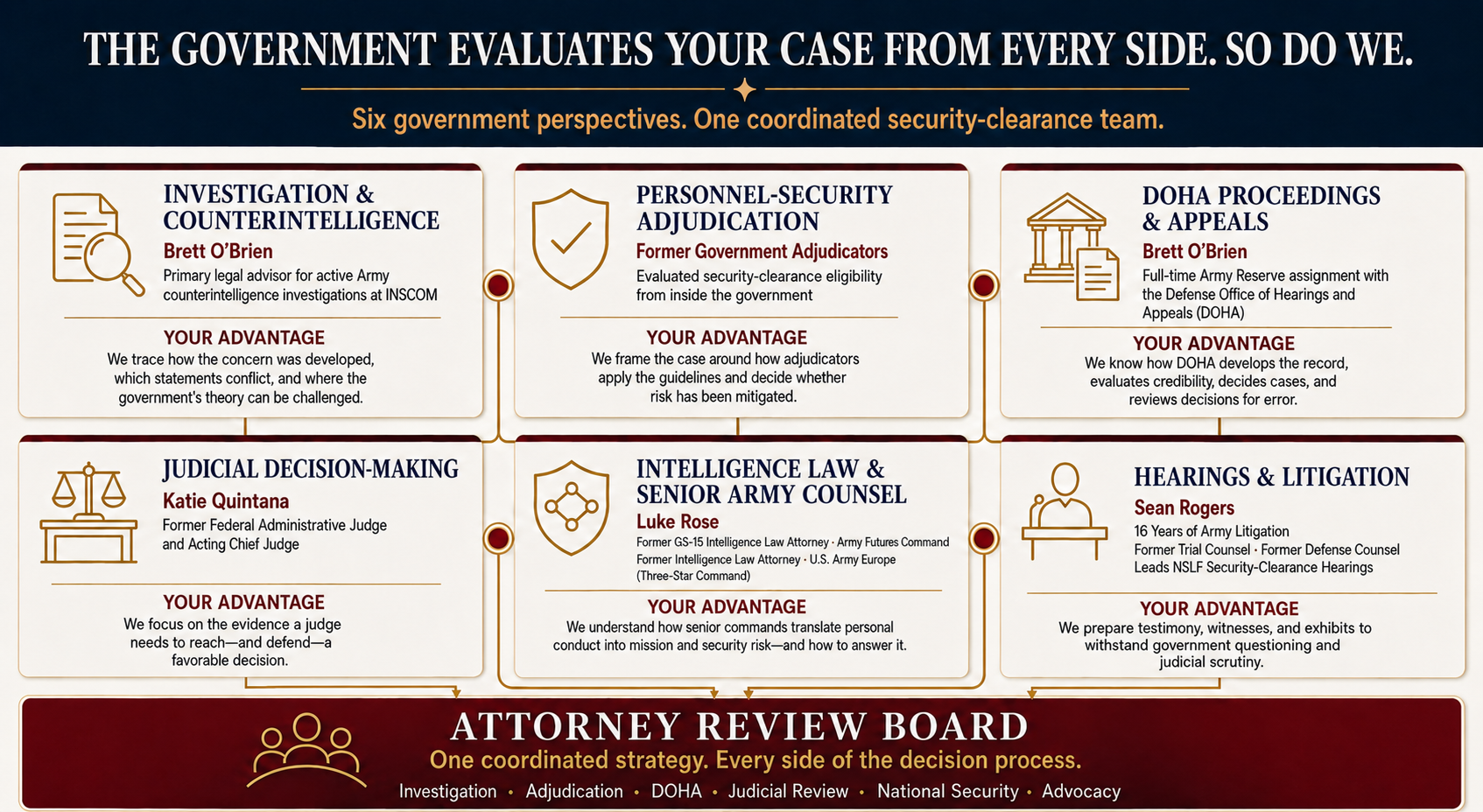
The government evaluates a clearance case from multiple perspectives: investigation, counterintelligence, personnel-security adjudication, legal review, judicial analysis, and—when a personal appearance is elected—testimony and contested presentation.
NSLF brings those perspectives together in one coordinated security-clearance practice.
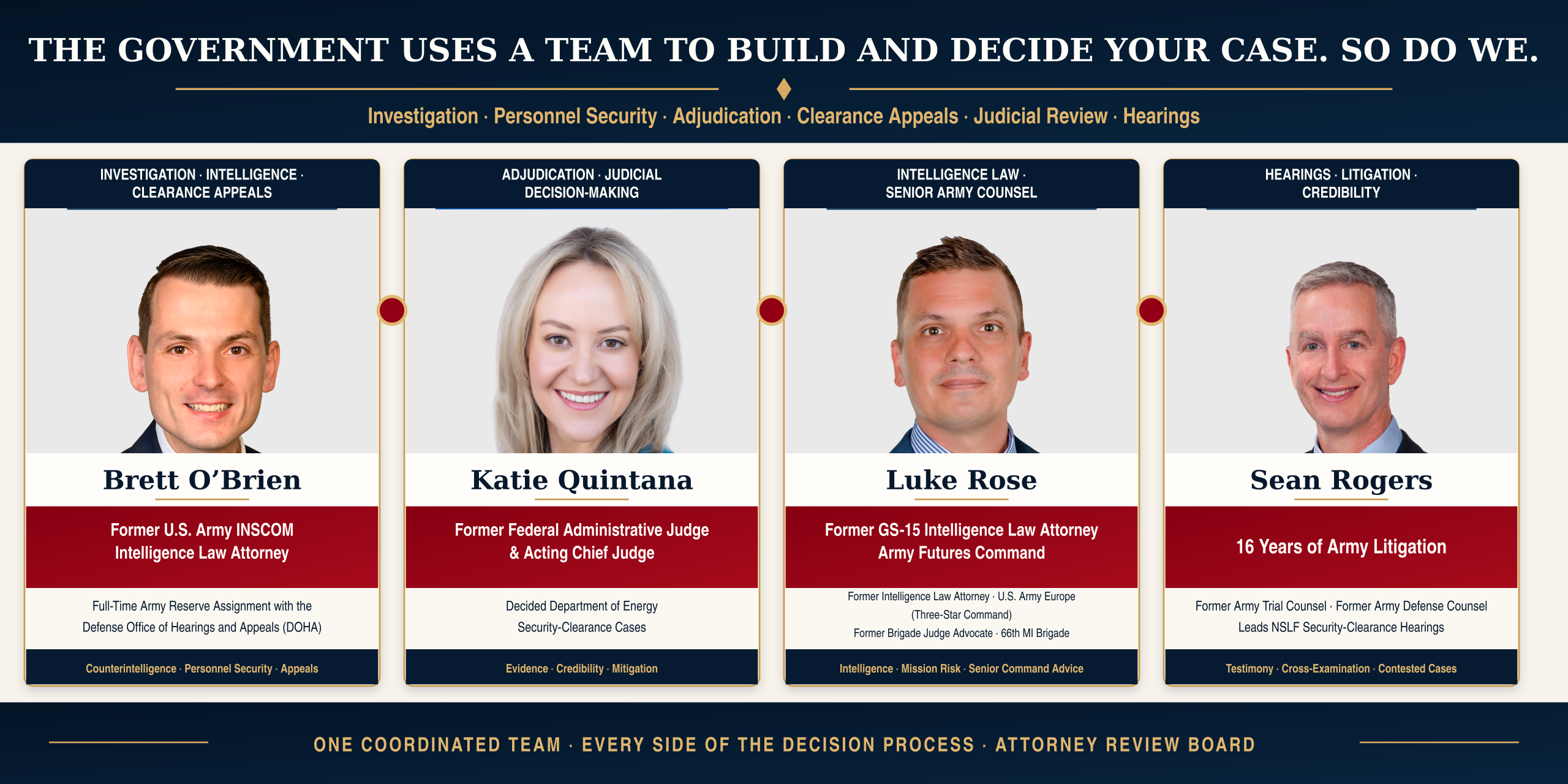
- Investigation and counterintelligence: Brett O’Brien served as the primary legal advisor for active Army counterintelligence investigations while assigned to U.S. Army Intelligence and Security Command. That experience helps the team examine how concerns were developed, what investigators may have been testing, and where the record may contain gaps or unsupported assumptions.
- Personnel-security adjudication: NSLF includes attorneys with experience evaluating security-clearance concerns from inside the government. That perspective helps the team test whether the evidence actually resolves the adjudicators’ concerns about judgment, reliability, candor, recurrence, and mitigation.
- Direct DOHA experience: Brett served on a full-time Army Reserve assignment with the Defense Office of Hearings and Appeals (DOHA)—the Department office now responsible for conducting personal appearances and making recommendations to component PSABs. That experience provides insight into the office through which the hearing record and recommendation are developed.
- Federal clearance judging: Katie Quintana served as a federal Administrative Judge and Acting Chief Judge deciding Department of Energy security-clearance cases. She brings the decision-maker’s perspective to questions of evidence, credibility, mitigation, and whether a favorable conclusion can be supported and defended.
- Intelligence law and senior-command risk: Luke Rose served as a GS-15 Intelligence Law Attorney for Army Futures Command and as an Intelligence Law Attorney for U.S. Army Europe when it was a three-star command. He understands how senior commands translate individual conduct into mission, access, and national-security risk.
- Hearings and contested credibility: Sean Rogers has 16 years of Army litigation experience as trial counsel and defense counsel and leads NSLF’s security-clearance hearing work. He prepares appellants, witnesses, exhibits, and testimony for the questioning and credibility analysis that occur in contested proceedings.
What this means for the client: NSLF can evaluate not only what happened, but how investigators developed it, how adjudicators interpret it, how a judge may test it, how senior national-security counsel may characterize the risk, and how the evidence and testimony will withstand scrutiny.
One Lead Attorney, Supported by a Coordinated Review Structure
Your matter is led by an assigned attorney who remains responsible for the strategy, communication, and work on your case. When the scope and complexity warrant it, that attorney can draw on NSLF’s broader security-clearance team and Attorney Review Board for additional analysis.
The purpose is not to add lawyers for appearance. It is to test the case from the perspectives that matter:
- What will an adjudicator still view as unresolved?
- What evidence would a former judge expect to see?
- Where might a government lawyer challenge the argument?
- Can the appellant testify consistently with the existing record?
- Does the mitigation resolve future risk or merely explain past conduct?
That coordinated review is designed to identify weaknesses before the appeal reaches the government’s decision-makers.
★★★★★ “Words cannot express the gratitude I feel for the assistance that Mr. O’Brien and his team have provided me. Recently, I had to appeal a revocation of my security clearance and so I scheduled a consultation with Mr. O’Brien. After having talked to two attorneys prior, Mr. O’Brien impressed me the most, not only with his knowledge but also with the compassion he shared for my particular situation. My decision was made on the spot to retain National Security Law Firm for my case. Over the last few months I have worked with Janet Schnell, who assisted with obtaining necessary information for my appeal, and Luke Rose, who finalized the masterpiece. All communications were professional and Janet was always available to answer any and all questions that I had during the process. I can happily say that my appeal was approved and I could not have done it without them. If you’re looking for assistance, National Security Law Firm should be your number one choice!”
— S., Google Review
This review describes one client’s experience. Past results do not guarantee a similar outcome.
See how the NSLF Attorney Review Board works
Read a PSAB case result involving a DOHA hearing
What PSAB Appeal Representation May Include
The scope depends on the procedural route and the needs of the case. Representation may include:
- determining the correct appellate authority and deadline;
- reviewing the Letter of Denial, Letter of Revocation, or other adverse notice;
- auditing the SOR response and complete adjudicative record;
- identifying factual, legal, procedural, and evidentiary weaknesses in the determination;
- developing an issue-by-issue mitigation plan;
- obtaining and organizing supporting documentation;
- preparing declarations and witness evidence;
- drafting and submitting the direct written PSAB appeal;
- advising whether a DOHA personal appearance is strategically appropriate;
- preparing the appellant and witnesses for testimony;
- organizing exhibits and the hearing presentation;
- representing the appellant at the personal appearance when included in the engagement; and
- advising on related clearance, access, military-career, or federal-employment consequences within the agreed scope.
No lawyer can guarantee that a PSAB will reverse a denial or revocation. The objective is to present the strongest accurate, supportable, and procedurally appropriate record available.
PSAB Appeal Lawyer Cost and Financing
The cost depends primarily on:
- whether the matter is a direct written appeal or a DOHA personal appearance;
- the number and seriousness of the adjudicative issues;
- the size and condition of the existing record;
- whether the prior SOR response created factual or credibility problems;
- the amount of new evidence that must be developed;
- the number of witnesses and complexity of hearing preparation; and
- whether related eligibility, access, employment, or military actions must also be evaluated.
After reviewing the notice and basic case information, NSLF can explain the proposed scope and fee before representation begins.
View information about security-clearance lawyer costs
Learn how security-clearance financing works
Frequently Asked Questions About PSAB Appeals
What does PSAB stand for?
PSAB stands for Personnel Security Appeals Board. It is the component-level board that makes the final administrative decision in qualifying military and DoD civilian appeals from denials or revocations of national-security eligibility.
Is the PSAB part of DOHA?
No. The Defense Office of Hearings and Appeals (DOHA)—the Department office that conducts a personal appearance and issues a recommendation—is separate from the component PSAB. If a personal appearance is elected, the DOHA judge recommends an outcome; the PSAB makes the final decision.
Is a PSAB appeal the same as a DOHA contractor appeal?
No. In most industrial-security cases involving DoD contractors, a DOHA administrative judge decides the case and the DOHA Appeal Board reviews qualifying appeals. In a military or DoD civilian personal-appearance case, the DOHA judge generally makes a recommendation to the appropriate component PSAB.
Can I appeal directly to the PSAB without a hearing?
Often, yes. Department procedures contemplate a direct written appeal to the applicable PSAB. Your individual notice controls whether that option is available and how it must be elected and filed.
Can I request a hearing instead of submitting a written appeal?
The applicable procedure may allow a personal appearance before a DOHA administrative judge. This is not simply an informal meeting: documents, witnesses, questioning, credibility, and a verbatim transcript may become part of the record. The judge then issues a recommendation to the PSAB.
Which option gives me a better chance of winning?
Neither route is universally better. A personal appearance may help when credible testimony can resolve disputed facts, while a written appeal may be safer and more effective when the case turns on documents, legal error, or objective mitigation. The existing record must be evaluated before choosing.
Can I submit new evidence with my appeal?
Often, yes. A direct written appeal may include additional relevant information, and a DOHA personal appearance may include documents and witnesses. The notice, applicable procedure, evidentiary value, and consistency of the proposed material must all be considered.
Will the PSAB reconsider every allegation from the beginning?
The PSAB conducts a fresh review of the unresolved adjudicative-guideline issues identified in the adverse determination, but it considers the existing adjudicative record. The prior SOR response, exhibits, admissions, inconsistencies, and credibility findings do not disappear.
What happens if the PSAB receives new information from the government?
Under the Department’s published procedures, if the PSAB obtains information outside the existing record and appeal materials that it needs to decide the case, the individual generally must receive that information and a reasonable opportunity to rebut it before it is considered.
Is the PSAB’s decision final?
The PSAB’s decision ordinarily concludes the Department’s administrative appeal process for the eligibility determination. Separate remedies or later reconsideration may exist in limited circumstances, but they are not substitutes for a timely and complete appeal.
Can I request reconsideration after losing a PSAB appeal?
Department procedures describe a component-supported reconsideration process after the required period has passed. Reconsideration is not simply another personal appeal and is not granted based on the passage of time alone. It ordinarily requires component support, an operational need, and evidence that the original concerns have been resolved or sufficiently mitigated.
Will winning my PSAB appeal automatically restore my job or access?
Not necessarily. Clearance eligibility, actual access to classified information, assignment to sensitive duties, SCI or program access, and employment status can involve separate authorities. The consequences and any related remedies should be evaluated individually.
Do I need a PSAB appeal lawyer?
You may represent yourself, but the stakes and procedural complexity are substantial. Counsel can identify the controlling process, protect filing deadlines, audit the existing record, develop legally relevant mitigation, prepare the written appeal or hearing presentation, and identify credibility problems before they become part of the final record.
Does NSLF represent clients nationwide?
Yes. National Security Law Firm represents military members and federal employees nationwide in federal administrative and security-clearance matters, subject to the facts, jurisdiction, and agreed scope of each representation.
Official PSAB and DOHA Resources
- DoD Manual 5200.02: Procedures for the DoD Personnel Security Program
- DOHA Personal Appearance Program
- February 6, 2026 General Counsel Memorandum Concerning DCSA Personal Appearances
- Army Personnel Security Appeals Board
- Air Force Review Boards Agency
- Executive Order 12968: Access to Classified Information
Official materials provide general guidance. Your notice and current component instructions control the procedure and deadline in your individual matter.
Speak With a PSAB Security Clearance Appeal Lawyer
By the PSAB stage, the government has already reviewed your response and concluded that one or more security concerns remain unresolved. Your appeal must identify why that conclusion should change and support the answer with a coherent, credible, and properly developed record.
National Security Law Firm represents service members and DoD civilians in direct PSAB appeals and DOHA personal appearances nationwide.
To help us evaluate the matter, send:
- the complete Letter of Denial, Letter of Revocation, or adverse determination;
- every attachment and appeal form;
- the original Statement of Reasons or Letter of Intent;
- your complete response and supporting exhibits;
- the date and method by which you received the decision; and
- any subsequent communication from DCSA, DOHA, your security office, command, or DoD component.
The Record Controls the Case.
Attorney review: Katherine O’Brien
Last updated: September 4, 2026
All case results depend on the facts and governing procedures of the individual matter. Past results do not guarantee a similar outcome. This page provides general information and is not legal advice. Viewing this page or contacting the firm does not create an attorney-client relationship. This website is attorney advertising.