
A Final Denial or Revocation May Not Be the End—but Reconsideration Is Not a Personal Right
A final security-clearance denial, revocation, or unsuccessful appeal can close the immediate administrative case. In some Department of Defense matters, however, an employing DoD component may later ask the adjudication authority to reconsider the unfavorable eligibility determination.
That possibility is narrow and commonly misunderstood.
Under current DoD guidance, reconsideration ordinarily becomes available only after at least one year has passed from the denial or revocation—or, if the individual appealed, one year from the final appeal determination. The individual does not personally file or compel the request. The request must be supported and submitted through the employing component’s security office to meet a DoD operational need, and the individual generally must have been selected or tentatively selected for a national-security position.
Waiting one year is therefore only the first threshold. It does not guarantee sponsorship, reconsideration, or restored eligibility.
National Security Law Firm helps military members, DoD civilians, and other eligible personnel determine whether reconsideration is procedurally available, assess what the final decision left unresolved, and develop evidence showing that the underlying conditions have been rectified or sufficiently mitigated. We can help prepare the individual and the record, but we cannot create an operational need, require an employer or component to sponsor the request, or force the government to reconsider or grant eligibility.
Former Federal Clearance Judge · Former Government Adjudicators · Direct DOHA Experience · Former GS-15 Intelligence Counsel · Experienced Hearing Counsel · Attorney Review Board
★★★★★ 4.9 Stars From 300+ Google Reviews
Final Decision · Waiting Period · Remediation · Component Support · Reconsideration
Find Out Whether Reconsideration Is Available
For an initial review, send the final denial, revocation, or appeal decision; the date it was issued; your current employment or military status; and any communication from a security office about sponsorship or reconsideration.
The Three Questions That Control Whether Reconsideration Is Realistic
1. Has the Required Period Passed?
The one-year period is generally measured from the denial or revocation decision. If the individual pursued an appeal, it is generally measured from the final appeal determination instead.
2. Will an Employing Component Support and Submit the Request?
The individual’s desire to regain eligibility is not enough. Under DoD procedures, the employing component must have an operational need, the individual must be selected or tentatively selected for a national-security position, and the request must include explicit component support.
3. Can the Record Prove That the Original Concerns Have Changed?
The request must include evidence that the circumstances or conditions behind the denial or revocation have been rectified or sufficiently mitigated. Passage of time helps only when the intervening conduct and documentation establish a meaningful change.
Ask NSLF to Evaluate These Three Thresholds
What Is Security Clearance Reconsideration?
Reconsideration is a limited process through which a DoD component asks the appropriate adjudication authority to reassess an unfavorable national-security eligibility determination after the required period has passed and the conditions for a request are satisfied.
It is not:
- an automatic second appeal;
- a personal petition that a former clearance holder can require DCSA to process;
- a right created merely by waiting one year;
- proof that the original denial or revocation has been reopened;
- a guarantee that a new investigation will be initiated;
- automatic restoration of employment, access, assignment, or SCI eligibility; or
- a substitute for filing a timely appeal when appeal rights are still available.
The current DCSA Trust Decision guidance states that, one year after a final denial or revocation—or one year after a final appeal determination—an individual’s employer may request reconsideration, supported by documentation showing that the conditions leading to the unfavorable decision have been resolved or mitigated.
The more detailed DoD Manual 5200.02 adds critical conditions: the request must be forwarded and recommended by officials of the employing component, come from the security office, address an operational need, concern an individual selected or tentatively selected for a national-security position, and include explicit component support.
Your status, notice, component, time away from DoD, and current government instructions must be reviewed before deciding which procedure applies.
Who May Be Considered Under the DoD Reconsideration Process?
The process may apply to certain:
- active-duty service members;
- Reserve or National Guard members within a covered DoD process;
- current DoD civilian employees;
- former personnel reentering or seeking a qualifying position under a DoD component’s authority; and
- other individuals whose unfavorable eligibility determination and current sponsorship fit the governing DoD procedure.
But status matters. DoD Manual 5200.02 states that individuals who ended their DoD affiliation for 24 months or more after an unfavorable national-security determination are not handled through that reconsideration process when attempting to reaffiliate; instead, they are submitted for a new investigation. It also directs NISP contractor reconsideration matters to the separate industrial-security framework.
That means two people with similar clearance histories may need different paths:
- one may be eligible for component-supported reconsideration;
- another may require a new investigation after reaffiliation;
- a contractor may fall under the industrial-security process;
- an individual with an unexpired appeal deadline may need to appeal now; and
- a person challenging a suitability, fitness, access, employment, or SCI decision may need a different remedy altogether.
The correct first question is not simply, “Has one year passed?” It is, “What action was taken, under whose authority, and what process applies to this person now?”
When Does the One-Year Period Begin?
Under the published DoD procedure, the year is generally counted:
- from the date of the denial or revocation decision by the adjudication facility; or
- if the individual elected to appeal, from the date of the final appeal determination.
The clock ordinarily does not begin merely because:
- access was suspended;
- an incident was reported;
- an investigation began;
- an SOR or Letter of Intent was issued;
- the person submitted an SOR response;
- the person stopped working in a cleared position; or
- an employer removed the person from a contract.
Those events may matter, but they are not necessarily the operative denial, revocation, or final appeal determination.
To identify the correct date, review the complete written decision, any appeal election, and the final appeal result. If an appeal deadline remains open, do not let the possibility of future reconsideration distract from a current right that may expire.
Learn about current security-clearance appeal options
One Year Is a Minimum—not a Promise
DoD guidance expressly says that passage of time alone is insufficient. Some concerns may be too recent or serious after one year, and a longer period may be needed to establish rehabilitation, changed circumstances, or a reliable track record.
Consider the difference:
- Time passed: “The incident happened more than a year ago.”
- Mitigation developed: “Since the incident, the underlying condition changed, corrective steps were completed, the improved conduct was sustained, and independent records verify the change.”
The second proposition addresses future security risk. The first only identifies age.
A productive waiting period should be used to resolve the specific conditions that drove the decision, preserve proof of the changes, and avoid new conduct that reinforces the original concern.
Who Actually Requests Reconsideration?
The employing organization or DoD component—not the individual—must initiate the qualifying request through the appropriate security channel.
Under DoD Manual 5200.02, the request must generally:
- be forwarded and recommended by officials of the employing component;
- come from the component’s security office;
- meet a DoD operational need;
- concern an individual selected or tentatively selected for a national-security position;
- contain an explicit statement of component support; and
- include evidence showing that the conditions causing the denial or revocation have been resolved.
An attorney may help the individual analyze the prior decision, build the supporting evidence, prepare a coherent explanation, and coordinate within the authorized scope. But an attorney cannot replace the employing component, invent an operational requirement, or obligate a security office to submit the request.
This distinction should be stated plainly because it affects who should retain counsel and when. A person with no sponsoring organization, no prospective national-security position, and no component willing to support a request may benefit from strategic advice about future readiness—but may not yet have a request that can be filed.
What If You Do Not Currently Have a Sponsoring Employer or Component?
You generally cannot convert reconsideration into a self-filed petition simply because no organization will sponsor you.
Depending on your history and status, the practical path may involve:
- determining whether you fall under reconsideration or a new-investigation process;
- applying for positions for which an employer or component can lawfully establish a need for eligibility;
- accurately disclosing the prior denial or revocation when required;
- using the intervening period to create documented mitigation;
- obtaining the prior adjudicative and investigative records; and
- preparing to explain the history consistently when a security office evaluates sponsorship.
NSLF cannot promise that an employer will select you, that a component will support reconsideration, or that a clearance requirement will be created for you. We can help you avoid presenting a premature, incomplete, or inconsistent case if a valid sponsorship path develops.
What Must Change Before Reconsideration?
The answer depends on the findings that remained unmitigated in the final decision. The evidence should respond to those findings—not merely show that the person has had a generally good year.
Financial Considerations
Useful evidence may include filed tax returns, completed payment arrangements, current account records, dispute results, budgets, counseling, proof of responsible financial conduct, and a documented explanation of the circumstances that caused the problem.
Alcohol or Drug Involvement
The record may require evaluation or treatment records, testing, support-program participation, abstinence evidence, relapse-prevention measures, changes in environment or associations, and a sustained record consistent with the claimed reform.
Criminal or Personal Conduct
Potential evidence may include final court records, completion of all requirements, counseling, training, compliance, changed circumstances, candor about the conduct, and a reliable period without recurrence.
Foreign Influence or Foreign Activities
The analysis may require updated information about contacts, obligations, property, finances, travel, passports, benefits, relationships, and any change reducing the risk of pressure, coercion, exploitation, or conflicting interests.
Psychological Conditions
Relevant evidence may include appropriate professional evaluation, treatment compliance, prognosis, stability, and evidence addressing the functional security concern without stigmatizing lawful mental-health care.
Protected Information or Information Technology
Evidence may need to address intent, scope, training, remediation, technical controls, compliance since the incident, judgment, and why recurrence is unlikely.
Candor and Record Consistency
An otherwise strong package can be undermined if the new explanation conflicts with the SF-86, investigative interviews, SOR response, exhibits, hearing testimony, or final decision. Before submission, the proposed account should be checked against the complete historical record.
Read why the existing clearance record continues to control the case
A Reconsideration Request Must Be Complete Before It Is Submitted
This is one of the most important differences between reconsideration and a developing appeal.
DoD Manual 5200.02 states that, after the security office submits the component’s reconsideration request, supplemental information will not be accepted or considered unless the adjudication facility requests it. If more information is requested, it must be supplied within the specified time.
That makes front-end preparation critical. Before the component submits, the record should be checked for:
- every reason the original decision remained unfavorable;
- missing documents or unresolved factual gaps;
- dates and assertions that conflict with the prior record;
- mitigation that is claimed but not independently supported;
- records that inadvertently create a new concern;
- unexplained periods or apparent recurrences;
- the component’s required support and operational-need language; and
- whether a new investigation, rather than reconsideration, is the proper mechanism.
Submitting too soon can waste the strongest opportunity to show meaningful change.
The Reconsideration Readiness Audit
NSLF approaches these matters as a readiness problem, not merely a writing assignment. Before anyone assembles a request, the team looks for five things.
1. Decision Anatomy
We identify the exact findings, disputed facts, credibility conclusions, and mitigation gaps that produced the final denial or revocation. General favorable information cannot cure an issue the package never directly addresses.
2. The Change Ledger
We separate what has truly changed since the decision from what has merely aged. Each claimed change should have a date, an explanation, and supporting proof.
3. Evidence-Gap Analysis
We test whether the documents prove resolution, rehabilitation, and reduced future risk—or simply repeat the applicant’s assurances. Weak links are identified before the package enters a channel that may not accept later supplementation.
4. Sponsorship Pathway
We determine who would need to support and route the request, whether there is a qualifying position and operational need, and whether the individual’s current affiliation points instead toward a new investigation or another process.
5. Consistency Control
We compare the new presentation with the SF-86, investigative materials, SOR, prior response, appeal record, and final findings so that the renewed case does not create avoidable candor or credibility problems.
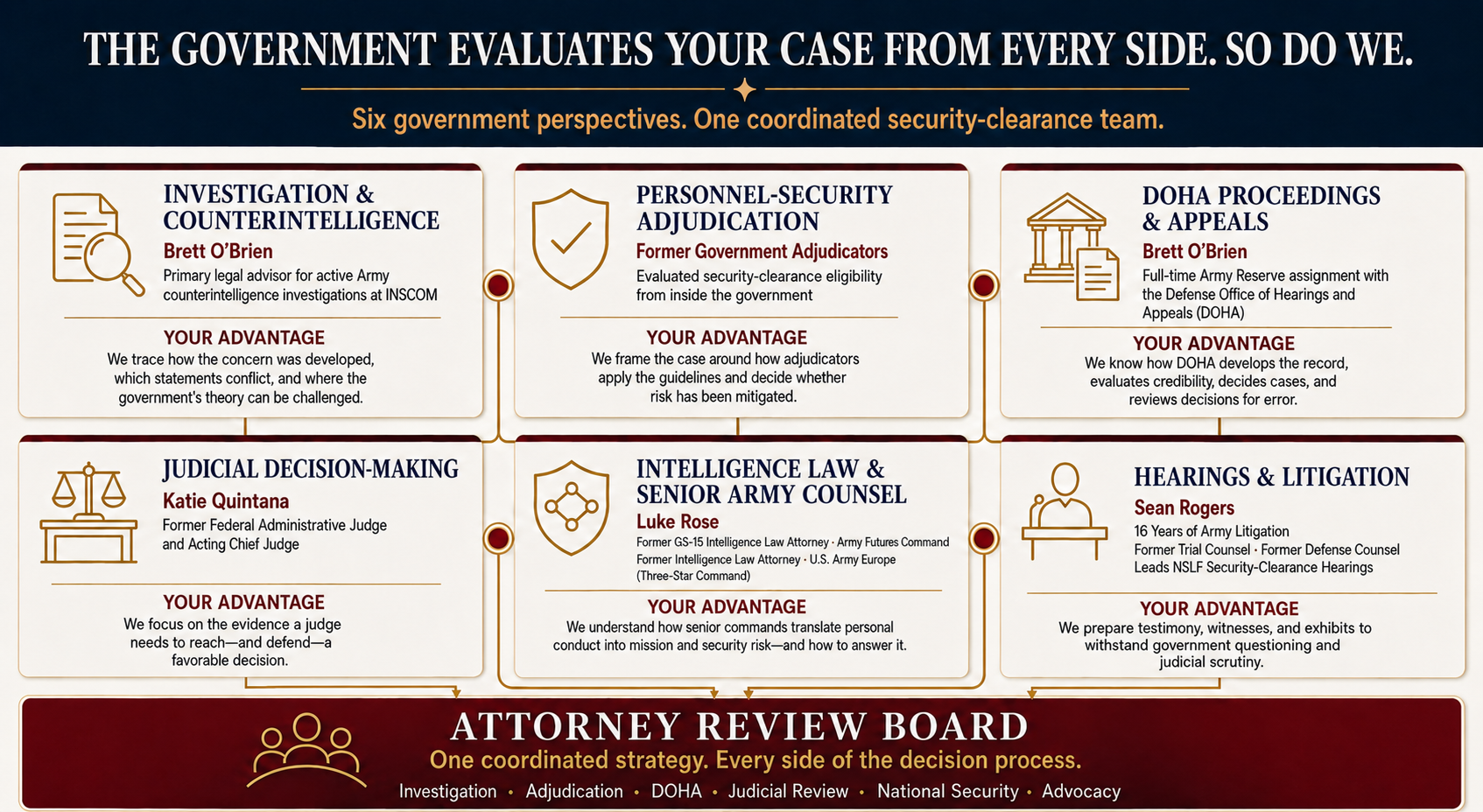
This is how the “built like the government” message applies to reconsideration: the government will examine the prior decision, security need, sponsorship, adjudicative concerns, documentary proof, and the reliability of the renewed record. The preparation should be organized around those same decision points.
How National Security Law Firm Can Help
Depending on the client’s posture and the agreed scope, representation may include:
- determining whether reconsideration, appeal, reapplication, or a new investigation is the correct route;
- identifying the correct one-year start date;
- reviewing the final denial, revocation, or appeal decision;
- obtaining and organizing relevant adjudicative records;
- mapping each unresolved concern to the applicable evidence of change or mitigation;
- developing a remediation plan during the waiting period;
- evaluating whether the individual’s present affiliation and prospective position satisfy the procedural thresholds;
- preparing declarations, chronologies, explanations, and supporting exhibits;
- reviewing the package for candor and consistency with the historical record;
- helping the client communicate accurately with an authorized security office or employing component; and
- advising on related clearance, access, military-career, or federal-employment issues within the engagement.
What NSLF cannot do is equally important. We cannot personally submit a component request where the governing procedure assigns that role to the security office. We cannot compel an organization to select or sponsor an individual, establish an operational need, reopen the original decision, or guarantee that reconsideration or eligibility will be granted.
★★★★★ “I remember the gut-wrenching feeling I experienced when I was denied a second time for my secret clearance. On my third attempt, I reapplied with representation from National Security Law Firm and won. Brett O’Brien and Luke Rose never guaranteed victory, but they gave me confidence that I had the right legal team for the job.”
— Gerald Smith, Google Review (excerpt, shortened for length)
This review describes one client’s reapplication experience, not a promise about reconsideration or any future result. Past results do not guarantee a similar outcome.
A Team That Can Evaluate the Old Record and the New One
Reconsideration asks whether the conditions behind a final adverse decision have genuinely changed. That requires more than polishing a personal statement. The renewed record must withstand the same kinds of scrutiny that produced the original result.
NSLF’s security-clearance team includes attorneys who have served as a federal administrative judge deciding Department of Energy clearance cases, government adjudicators, counsel within DOHA, a GS-15 intelligence law attorney at Army Futures Command, intelligence counsel to U.S. Army Europe when it was a three-star command, counsel for Army counterintelligence investigations, and Army trial and defense counsel with 16 years of litigation experience.
The assigned lawyer can draw on those perspectives through NSLF’s Attorney Review Board when the matter warrants broader review. The purpose is practical: identify what a government adjudicator is likely to view as unresolved, what a former judge would expect the proof to establish, what an agency lawyer may challenge, and whether the new record tells one accurate and defensible story.
Learn how the NSLF Attorney Review Board works

Reconsideration, Appeal, and a New Investigation Are Different
| Process | When it generally applies | Who initiates it | Central question |
|---|---|---|---|
| Administrative appeal | Appeal rights remain after a denial or revocation | The individual follows the notice and governing appeal procedure | Should the adverse determination be reversed on the permitted record and arguments? |
| DoD reconsideration | The final decision is at least one year old and the component-supported requirements are satisfied | The employing component’s security office | Have the original conditions been rectified or sufficiently mitigated, and does the component have an operational need? |
| New investigation | Required by the applicable rule, including certain reaffiliations after a lengthy break or when the investigation is out of scope | An authorized sponsoring organization | Does a current investigation and adjudication support eligibility now? |
| NISP contractor process | The person is covered by the industrial-security program | The authorized employer/security channel under the applicable industrial procedure | What reconsideration or reapplication mechanism applies under DoDD 5220.6 and current instructions? |
Do not select a process based only on the name used in an online article. The person’s status, sponsor, final decision, break in service, investigation history, and current notice control.
What Happens After the Component Submits?
The adjudication facility reviews the component’s documentation and decides whether the circumstances or conditions have been rectified or sufficiently mitigated to warrant a favorable reconsideration determination.
Important limits remain:
- the request itself does not reopen or change the original denial or revocation;
- the adjudication authority may grant or deny reconsideration based on the submitted documentation;
- additional material generally will not be accepted unless the adjudication facility requests it;
- a denied component request does not carry the same due-process rights as the original adverse eligibility action; and
- even a favorable eligibility result does not necessarily restore a former position, compel employment, or grant access to classified information.
Eligibility and access are distinct. A government authority determines eligibility; access is granted only when the employing organization has the need and authorizes access. Employment, assignment, suitability, fitness, SCI, and program access may involve separate decisions.
What If More Than Two Years Have Passed?
Additional procedural issues may arise as time and affiliation change.
DoD Manual 5200.02 states that when two years or more have passed, the component determines what checks or investigations are required to support reconsideration. It also states that a new national-security investigation must be conducted when there has been a two-year break in service or the last investigation is out of scope.
That does not mean every two-year-old case follows one identical path. It means the component must examine whether reconsideration remains the proper mechanism and what current investigative support is required.
Provide counsel and the security office with:
- the date of the original denial or revocation;
- the date and result of any appeal;
- the date your DoD affiliation ended, if applicable;
- your current and proposed employer or component;
- the position for which you were selected or tentatively selected;
- the level and type of eligibility required; and
- the date and scope of the most recent investigation, if known.
Security Clearance Reconsideration Lawyer Cost and Financing
The fee depends on the posture and amount of work required. Relevant factors include:
- whether counsel is providing an eligibility assessment, remediation plan, or full record-development work;
- the number and seriousness of the unresolved adjudicative concerns;
- the size and condition of the prior SOR, appeal, and investigative record;
- whether the individual has a qualifying sponsor and prospective position;
- how much evidence must be obtained, corrected, or developed;
- whether a new investigation or separate employment matter must also be evaluated; and
- the urgency of communications with the security office or employing component.
After reviewing the final decision and basic sponsorship facts, NSLF can identify the appropriate scope and explain the fee before representation begins. If no valid filing route presently exists, the client should be told that directly rather than sold a submission that cannot be made.
View security-clearance lawyer cost information
Learn about financing and payment plans
Frequently Asked Questions About Security Clearance Reconsideration
Can I personally request security clearance reconsideration from DCSA?
Ordinarily, no. Current DCSA guidance says an individual’s employer may request reconsideration after the required period. DoD procedures require the qualifying request to be supported by the employing component and submitted through its security office. Reconsideration is not a personal right or entitlement.
Can a lawyer file the reconsideration request for me?
An attorney can help evaluate eligibility for the process and prepare the supporting record, but cannot replace the employing component or security office where the governing procedure requires that office to submit the request.
How long must I wait after a clearance denial or revocation?
The published DoD rule generally requires at least one year from the denial or revocation. If you appealed, the year is generally counted from the final appeal determination. Your documents, status, and current component instructions should be reviewed before relying on a date.
Does one year automatically make me eligible for reconsideration?
No. One year is a minimum threshold. Passage of time alone is insufficient. A qualifying request also requires component support, an operational need, a selection or tentative selection for a national-security position, and evidence that the original concerns have been resolved or sufficiently mitigated.
Do I need a job offer or cleared position?
DoD Manual 5200.02 states that the individual must be selected or tentatively selected for a national-security position and that the request must meet an operational need of the component. A personal wish to regain eligibility is not enough.
What if an employer refuses to sponsor reconsideration?
An individual generally cannot force the employer or component to submit a request. Counsel can assess whether another lawful process applies and help the person prepare for a future sponsorship opportunity, but cannot create a government operational need or compel organizational support.
Is reconsideration the same as appealing the original decision?
No. An appeal challenges the adverse determination under the available appellate procedure and deadline. Reconsideration is a later, component-supported process focused on whether the conditions behind the final decision have been rectified or sufficiently mitigated. It does not reopen the original decision merely because a request is submitted.
Should I skip my appeal and seek reconsideration next year?
Not without case-specific advice. Appeal rights may expire quickly, and reconsideration is not guaranteed to become available. It generally requires later organizational support and an operational need. If an appeal deadline is open, have the notice reviewed immediately.
What evidence should support reconsideration?
The evidence must respond to the specific reasons for the denial or revocation. Depending on the case, that may include financial records, tax compliance, treatment or testing, court documents, counseling, evidence of sustained changed conduct, updated foreign-interest information, employment records, declarations, and other objective proof of mitigation.
Can I send more evidence after the request is filed?
DoD procedures state that, once the security office submits the component request, supplemental information generally will not be accepted or considered unless the adjudication facility requests it. That is why the package should be complete before submission.
What if I have been separated from DoD for two years or more?
The DoD manual states that individuals reaffiliating after terminating DoD affiliation for 24 months or more following an unfavorable determination are submitted for a new investigation rather than handled through that reconsideration process. Current status and component instructions should be confirmed.
Does a favorable reconsideration restore my old job?
Not necessarily. Clearance eligibility, access to classified information, employment, assignment, suitability, fitness, SCI access, and program access may be controlled by different authorities. A favorable eligibility decision does not automatically compel reinstatement or access.
What happens if the reconsideration request is denied?
Under the published DoD procedure, denial of a component’s reconsideration request does not carry the same due-process protections as the original denial or revocation. The available next steps depend on the reason, the person’s status, and whether a later new investigation or another process is authorized.
Do the same rules apply to defense contractors?
Not always. The DoD manual directs NISP contractor cases to DoDD 5220.6. Contractor reapplication or reconsideration procedures can differ from military and DoD-component reconsideration. Confirm jurisdiction before preparing a package.
Can NSLF guarantee that my eligibility will be restored?
No. No attorney can guarantee sponsorship, reconsideration, or a favorable eligibility result. NSLF’s role is to identify the correct process and develop the strongest accurate and supportable record available within the agreed scope.
Official Security Clearance Reconsideration Resources
- DCSA Trust Decision (Adjudications): Reconsideration Guidance
- DoD Manual 5200.02: Procedures for the DoD Personnel Security Program
- DoD Directive 5220.6: Defense Industrial Personnel Security Clearance Review Program
- Executive Order 12968: Access to Classified Information
- DCSA Privacy, Civil Liberties, and FOIA Program
Official materials provide general guidance. The final decision, current status, governing authority, and instructions from the employing component or security office control the available process in an individual matter.
Speak With a Security Clearance Reconsideration Lawyer
The best time to evaluate reconsideration is before a component submits an incomplete request—and, in many cases, before the one-year period has elapsed. The waiting period can be used to identify what remained unmitigated, correct the underlying condition, build a reliable track record, and preserve the proof the adjudication authority will expect.
To help NSLF evaluate your situation, provide:
- the complete final denial or revocation;
- the final appeal decision, if you appealed;
- the original SOR or Letter of Intent;
- your response and all exhibits;
- the date your DoD affiliation ended, if applicable;
- your current employer, component, or military status;
- any tentative selection or offer for a national-security position;
- communications from the security office about sponsorship; and
- documentation of changes since the final decision.
A Year Passing Does Not Rebuild the Record. Evidence Does.
Attorney review: Katherine O’Brien
Legal disclaimer: This page provides general information and does not create an attorney-client relationship. Security-clearance procedures can change and may differ by status, component, program, and governing authority. The individual’s current notice and official instructions control.