
If CBP seized your vehicle, Rolex, jewelry, electronics, imported merchandise, prescription medication, or international package, you are not alone.
U.S. Customs and Border Protection (“CBP”) regularly seizes property at:
- airports
- border crossings
- international mail facilities
- cargo inspection sites
- ports of entry
Many people are shocked when the government seizes property even though:
- the item was lawfully purchased
- no criminal charges are filed
- they were unaware of import restrictions
- they believed the item complied with customs requirements
What surprises many individuals is that customs seizures often proceed through administrative forfeiture systems separate from criminal prosecutions.
That means CBP may seize property even when:
- no arrest occurs
- the owner disputes the allegations
- the property itself is not inherently illegal
- the government never files criminal charges
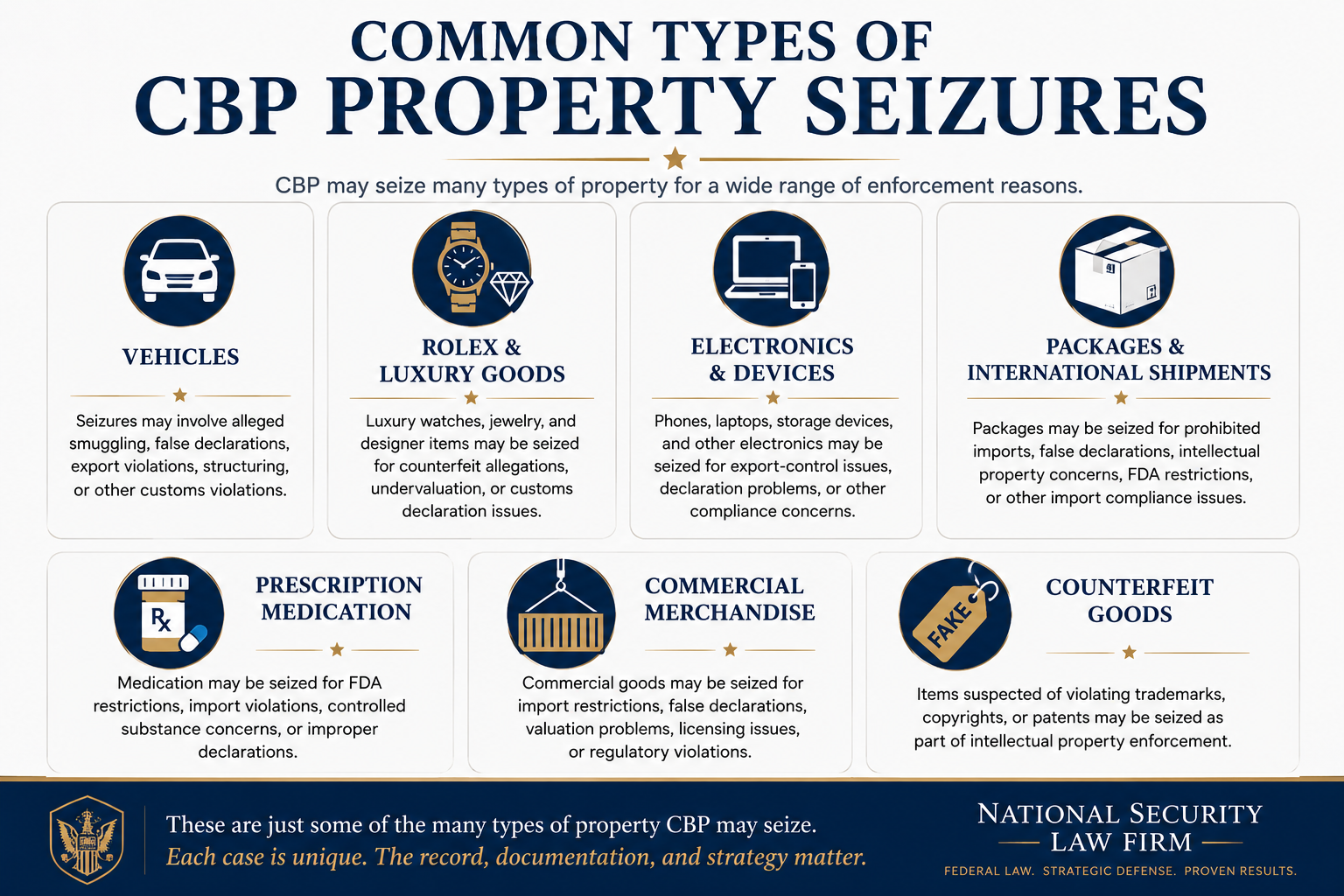
Why Property Seizure Cases Are Often More Complicated Than People Expect
Many people initially assume a customs seizure is simply a dispute over the item itself.
In reality, CBP property seizures often involve broader concerns relating to:
- customs declarations
- import restrictions
- counterfeit allegations
- export-control issues
- FDA compliance
- intellectual property enforcement
- suspicious documentation
- reporting violations
- broader federal scrutiny
Depending on the circumstances, the government may evaluate:
- purchase records
- shipping documentation
- ownership history
- import declarations
- electronic communications
- travel history
- business records
- explanations provided during inspection
As a result, many property seizure matters become heavily documentation-driven and credibility-driven long before formal litigation ever begins.
Different Types of Property Seizures Create Different Risks
Not all customs seizure cases are the same.
For example:
- vehicle seizure matters may involve transportation or concealment allegations
- luxury goods seizures often involve counterfeit or declaration issues
- electronics seizures may raise export-control or technology concerns
- commercial merchandise seizures may involve broader import compliance issues
- prescription medication seizures frequently involve FDA or border restrictions
- international package seizures may involve customs declarations, prohibited imports, or intellectual property concerns
That is one reason why different categories of property seizures often require very different strategic approaches.
The Administrative Record Often Shapes the Outcome
One of the most important realities in customs property seizure cases is that the administrative record developed early in the process often shapes how the government evaluates the matter moving forward.
The first:
- explanations
- petitions
- ownership records
- receipts
- shipping documentation
- procedural decisions
may later influence: - mitigation decisions
- settlement discussions
- litigation strategy
- future federal scrutiny
- related investigations
That is why National Security Law Firm repeatedly emphasizes:
the record controls the case.
Property Seizure Cases May Create Broader Federal Consequences
Many people assume a customs seizure affects only the property itself.
In reality, certain property seizure matters may later intersect with broader federal systems involving:
- immigration
- security clearances
- federal employment
- contractor eligibility
- export licensing
- TSA credentials
- future border inspections
- parallel investigations
Federal agencies often evaluate these matters collectively rather than in isolation.
That broader institutional overlap is one reason why customs property seizure matters frequently require careful strategic analysis from the outset.
Nationwide Customs Property Seizure Representation
National Security Law Firm represents clients nationwide in customs seizure matters involving:
- vehicle seizures
- luxury goods seizures
- Rolex and jewelry seizures
- counterfeit merchandise allegations
- electronics and device seizures
- prescription medication seizures
- international package seizures
- imported merchandise seizures
- commercial shipment enforcement actions
The sections below explain:
- why CBP seizes property
- what happens after a seizure occurs
- how administrative forfeiture proceedings operate
- how different types of property seizures are evaluated
- what strategic mistakes often hurt recovery efforts
- how individuals and businesses may attempt to recover seized property from the federal government
For broader discussion of customs forfeiture proceedings generally, visit the firm’s main Customs Seizure Lawyers Resource Hub page.
Why CBP Seizes Property at Airports, Borders, and Ports of Entry
CBP seizes property for many different reasons, and the government’s concerns often extend far beyond the item itself.
Many people assume Customs only seizes obviously illegal property.
In reality, CBP regularly seizes:
- vehicles
- luxury goods
- jewelry
- electronics
- prescription medication
- imported merchandise
- international packages
even when the owner believed the property was lawful.
What surprises many individuals is that customs seizure cases frequently involve administrative enforcement systems rather than traditional criminal prosecutions.
That means property may be seized even when:
- no arrest occurs
- no criminal charges are filed
- the owner disputes the allegations
- the item was legally purchased
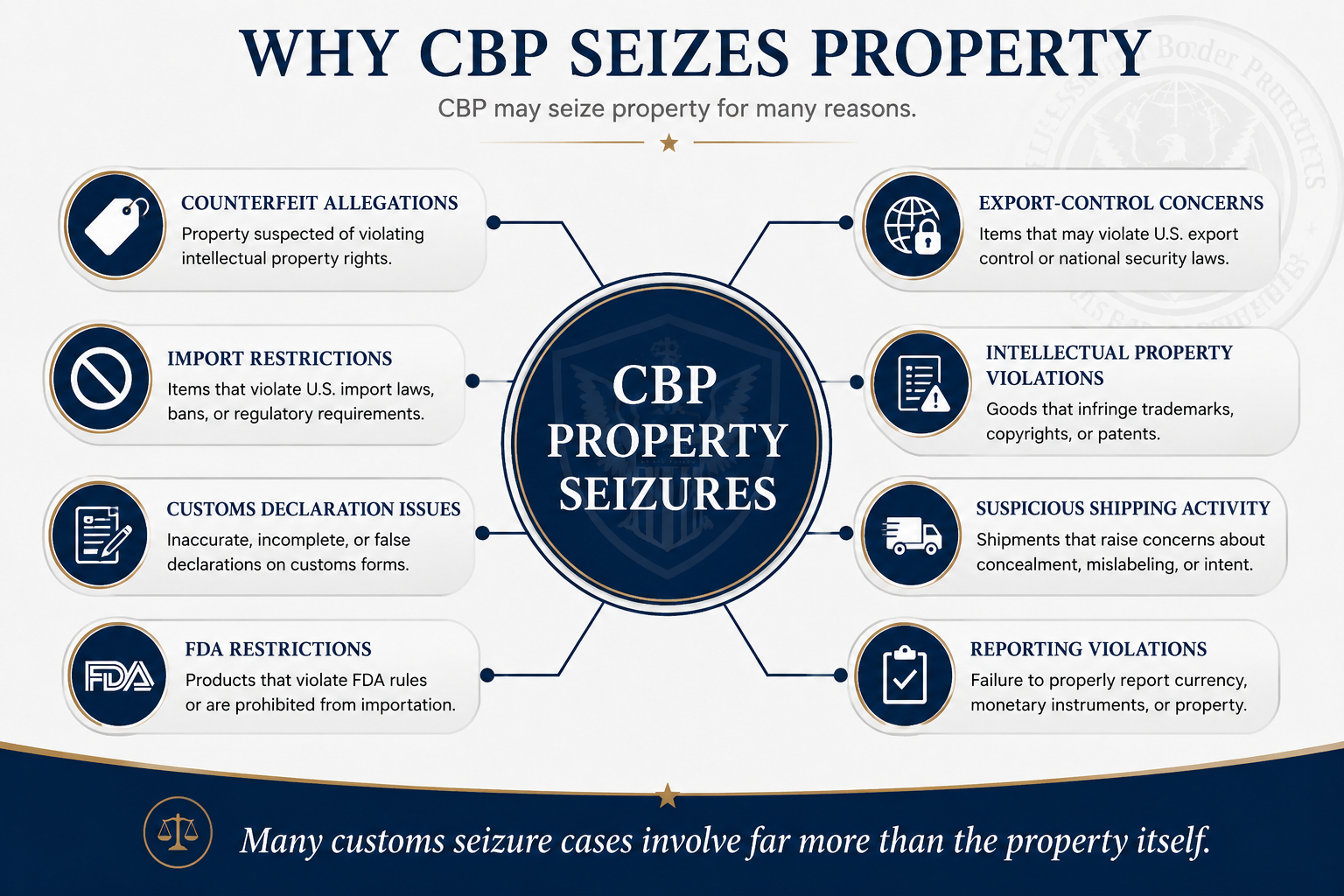
Administrative Seizures vs. Criminal Charges
One of the most misunderstood aspects of customs seizure law is the distinction between administrative forfeiture and criminal prosecution.
In many situations, CBP focuses on whether the property allegedly violated:
- customs laws
- import restrictions
- reporting requirements
- intellectual property protections
- export-control regulations
- FDA rules
- declaration requirements
The government may pursue forfeiture even when prosecutors never file criminal charges.
That is one reason why many people are confused when valuable property remains seized despite the absence of a criminal case.
Why CBP Sometimes Seizes Legitimate Property
Many customs seizure matters involve property that was lawfully purchased or owned.
For example, seizures may arise from allegations involving:
- counterfeit merchandise
- improper customs declarations
- import restrictions
- undervaluation of goods
- export-control concerns
- documentation discrepancies
- prohibited imports
- undeclared property
In some situations, individuals genuinely do not realize the item may trigger customs scrutiny.
This frequently occurs in cases involving:
- luxury watches
- designer handbags
- prescription medication
- electronics
- international online purchases
- imported commercial products
Additional discussion appears in CBP Seized My Rolex, Jewelry, or Luxury Goods and Customs Seized My Package: What Are My Rights?.
The Government Often Evaluates More Than the Property Itself
Another important reality is that CBP often evaluates far more than the item that was seized.
Depending on the circumstances, investigators may review:
- shipping records
- customs declarations
- ownership documentation
- purchase records
- travel history
- electronic communications
- import/export activity
- explanations provided during inspection
In some situations, the government may also evaluate whether broader concerns exist involving:
- counterfeit trafficking
- customs fraud
- export-control violations
- commercial import compliance
- suspicious shipping activity
- broader federal investigations
That is one reason why many customs property seizure cases become heavily documentation-driven and credibility-driven long before formal litigation begins.
Different Categories of Property Seizures Create Different Strategic Issues
Different types of seizures often create very different legal and strategic concerns.
For example:
- vehicle seizures may involve concealment or transportation allegations
- luxury goods seizures often involve counterfeit or declaration issues
- electronics seizures may raise export-control concerns
- imported merchandise cases frequently involve customs compliance disputes
- prescription medication seizures may involve FDA restrictions
- package seizures often involve international shipping and import issues
As a result, the strongest strategy frequently depends on:
- the type of property seized
- the government’s stated basis for forfeiture
- the available documentation
- whether broader federal implications may exist
- the procedural posture of the case
Customs Property Seizure Cases Often Become Strategic Administrative Proceedings
Many people initially view a customs seizure as a simple dispute over ownership of property.
In practice, however, these matters often become highly strategic administrative proceedings involving:
- credibility
- consistency
- procedural positioning
- documentation quality
- mitigation evidence
- broader federal consequences
That is why National Security Law Firm repeatedly emphasizes:
the record controls the case.
Understanding why CBP seized the property is important because many customs forfeiture matters are ultimately shaped less by dramatic courtroom litigation and more by administrative strategy, documentation, credibility, and procedural positioning developed early in the process.
Vehicle Seizures and Transportation-Related Cases
Vehicle seizures are among the most serious and financially disruptive types of customs forfeiture matters handled by CBP.
Many people are shocked to learn that the government may seize a vehicle even when:
- no criminal charges are filed
- the owner was not driving the vehicle
- the vehicle itself was lawfully purchased
- the underlying allegations remain disputed
In many situations, CBP alleges that the vehicle was used to:
- transport undeclared currency
- carry prohibited merchandise
- facilitate customs violations
- conceal property
- support smuggling activity
- evade federal reporting requirements
That is one reason why vehicle seizure matters often become far more complicated than people initially expect.
Why Vehicle Seizures Often Become Strategically Significant
Unlike many other customs seizures, vehicle forfeiture cases frequently create immediate practical consequences affecting:
- transportation
- employment
- business operations
- family responsibilities
- commercial activity
For some individuals and businesses, the vehicle itself may be substantially more important than the underlying monetary value involved in the forfeiture proceeding.
That practical pressure often causes people to react emotionally immediately after the seizure occurs.
In reality, however, vehicle seizure cases are frequently shaped by:
- procedural strategy
- ownership documentation
- credibility
- mitigation evidence
- consistency of explanations
- broader federal concerns
Owner vs. Driver Issues
One of the most misunderstood aspects of CBP vehicle seizures is that the owner and driver are not always the same person.
In some situations:
- a family member was using the vehicle
- the owner claims they were unaware of the alleged conduct
- multiple individuals had access to the vehicle
- the vehicle was being used commercially
Those circumstances may create highly fact-specific disputes involving:
- ownership
- knowledge
- authorization
- control of the vehicle
- surrounding circumstances
The government often evaluates far more than simply who held legal title.
Why Concealment Allegations Become Serious
Many vehicle seizure matters involve allegations concerning:
- hidden compartments
- concealed currency
- undeclared merchandise
- suspicious transportation activity
- reporting violations
Once concealment concerns arise, the case frequently receives heightened scrutiny because CBP and related agencies may associate concealment with:
- bulk cash smuggling
- narcotics activity
- customs fraud
- organized criminal conduct
- broader financial investigations
That does not necessarily mean criminal charges will follow.
However, concealment-related allegations often significantly affect:
- credibility assessments
- mitigation opportunities
- administrative posture
- litigation risk
- broader federal scrutiny
Vehicle Seizure Cases Often Involve More Than the Vehicle Itself
Another important issue is that vehicle seizure matters may sometimes create broader federal implications involving:
- immigration matters
- security clearances
- contractor eligibility
- federal employment
- future border inspections
- parallel investigations
Federal agencies often evaluate these matters collectively rather than in isolation.
That broader overlap is one reason why vehicle forfeiture matters frequently require strategic analysis extending beyond simply recovering the vehicle itself.
Strong Documentation and Early Strategy Often Matter
Many successful vehicle seizure resolutions are heavily influenced by:
- ownership documentation
- consistency of explanations
- procedural positioning
- mitigation evidence
- careful administrative strategy
- disciplined communication
That is why National Security Law Firm repeatedly emphasizes:
the record controls the case.
Additional discussion of vehicle-related customs forfeiture strategy appears in CBP Vehicle Seizure Lawyers.
Luxury Goods, Jewelry, and Rolex Seizures
Luxury goods seizures are one of the fastest-growing areas of CBP enforcement.
Many travelers are shocked when Customs seizes:
- Rolex watches
- designer handbags
- jewelry
- luxury apparel
- collectible items
- high-end accessories
during international travel or after international shipments arrive in the United States.
In many situations, individuals insist:
- the items were lawfully purchased
- they were unaware of customs restrictions
- they did not believe the property violated any law
- they had no idea the items could be seized
What surprises many people is that CBP luxury goods seizures often involve far more than simply whether the item is “real” or “fake.”
Counterfeit Allegations vs. Customs Declaration Issues
Some luxury goods seizures involve allegations that the merchandise is counterfeit or violates intellectual property protections.
Others involve:
- undervaluation allegations
- customs declaration disputes
- import documentation issues
- undeclared purchases
- shipping irregularities
- export-control concerns
In many situations, the government evaluates:
- receipts
- shipping records
- authenticity documentation
- customs declarations
- ownership history
- explanations provided during inspection
That is one reason why luxury goods seizure matters frequently become heavily documentation-driven and credibility-driven administrative proceedings.
Why CBP Aggressively Targets Luxury Goods
Luxury goods receive heightened scrutiny because CBP and related agencies often associate these items with:
- counterfeit trafficking
- customs fraud
- intellectual property violations
- undervaluation schemes
- suspicious import activity
As a result, seizures involving:
- Rolex watches
- designer handbags
- luxury jewelry
- collectible fashion items
frequently receive significantly more investigative attention than many travelers initially expect.
Even when the owner believes the item was purchased legitimately, the government may still pursue administrative forfeiture if investigators believe:
- the item is counterfeit
- declarations were inaccurate
- import rules were violated
- supporting documentation appears inconsistent
Why Documentation Often Becomes Critical
Strong documentation frequently becomes one of the most important issues in luxury goods seizure cases.
Depending on the circumstances, the government may evaluate:
- purchase receipts
- authenticity records
- appraisal documentation
- customs declarations
- shipping invoices
- payment records
- ownership history
- travel documentation
In many situations, weak or inconsistent documentation may substantially complicate:
- mitigation efforts
- credibility assessments
- negotiation posture
- recovery strategy
That is especially true where the government believes:
- declarations changed over time
- receipts appear inconsistent
- authenticity is disputed
- ownership records are unclear
Luxury Goods Seizures Often Become Credibility Cases
Many travelers initially assume the case will focus only on whether the item itself is lawful.
In practice, however, CBP often evaluates much broader issues involving:
- credibility
- consistency
- documentation quality
- import compliance
- procedural positioning
Statements made during:
- inspections
- customs declarations
- administrative petitions
- later submissions
may all become part of the administrative record.
That is one reason why many luxury goods seizure cases are shaped heavily by the quality of the record developed early in the process.
Luxury Goods Cases May Create Broader Federal Consequences
Another important issue is that certain luxury goods seizures may sometimes create broader federal concerns involving:
- customs fraud allegations
- import compliance investigations
- business import activity
- future border scrutiny
- parallel federal investigations
Federal agencies often evaluate these matters collectively across multiple administrative systems.
That broader overlap is one reason why luxury goods seizure matters frequently require strategic analysis extending beyond simply recovering the seized property.
Strategic Administrative Positioning Often Matters Early
Many successful luxury goods seizure resolutions are heavily influenced by:
- documentation quality
- credibility
- consistency
- mitigation evidence
- procedural strategy
- careful administrative positioning
That is why National Security Law Firm repeatedly emphasizes:
the record controls the case.
Additional discussion of these issues appears in CBP Seized My Rolex, Jewelry, or Luxury Goods and Counterfeit Goods Seized by CBP: What Happens Next?
Counterfeit Merchandise Seizures
Counterfeit merchandise seizures are one of the most aggressively enforced areas of CBP customs enforcement.
Every year, Customs seizes large quantities of allegedly counterfeit:
- luxury goods
- designer handbags
- watches
- apparel
- electronics
- accessories
- cosmetics
- collectible merchandise
Many people are surprised to learn that counterfeit seizure cases arise not only from large commercial import operations, but also from:
- personal travel purchases
- online shopping
- international package shipments
- small resale activity
- gifts or personal imports
In some situations, individuals genuinely believe the merchandise was authentic when it was purchased.
Why CBP Aggressively Targets Counterfeit Goods
CBP works closely with:
- trademark holders
- intellectual property investigators
- federal enforcement agencies
- international trade authorities
to identify allegedly counterfeit merchandise entering the United States.
The government often views counterfeit imports as more than simple customs violations.
Depending on the circumstances, investigators may associate counterfeit goods with:
- intellectual property violations
- customs fraud
- organized import operations
- commercial trafficking
- broader import compliance concerns
That is one reason why counterfeit merchandise seizures frequently receive significant enforcement attention even when the underlying shipment appears relatively small.
Personal Purchases vs. Commercial Import Activity
Not all counterfeit seizure cases are treated the same way.
In some situations, CBP may view the matter as:
- an isolated personal import
- an individual travel-related issue
- a small non-commercial purchase
In others, the government may suspect:
- resale activity
- repeated import behavior
- commercial trafficking
- organized import operations
- broader customs fraud concerns
That distinction often affects:
- the level of scrutiny
- mitigation opportunities
- investigative intensity
- broader federal exposure
In many situations, investigators evaluate not only the merchandise itself, but also:
- shipping records
- purchase history
- import patterns
- electronic communications
- payment records
- customs declarations
- explanations provided during inspection
Why Documentation and Credibility Matter
Counterfeit seizure matters often become heavily documentation-driven and credibility-driven administrative proceedings.
The government may evaluate:
- purchase receipts
- authenticity documentation
- payment history
- import records
- customs declarations
- ownership explanations
- prior import activity
Weak or inconsistent documentation may significantly complicate:
- mitigation efforts
- negotiation posture
- administrative resolution
- credibility assessments
This becomes especially important where:
- declarations appear inconsistent
- ownership history is unclear
- the explanations evolve over time
- the government believes the merchandise was intentionally misrepresented
Counterfeit Seizures Often Create Broader Concerns
Another important issue is that counterfeit-related allegations may sometimes create broader federal consequences involving:
- customs fraud concerns
- import compliance investigations
- business licensing issues
- future border scrutiny
- commercial import activity
- parallel federal investigations
Federal agencies often evaluate import credibility across multiple administrative systems.
That broader overlap is one reason why counterfeit merchandise seizure cases frequently require strategic analysis extending beyond simply recovering the seized items.
Many Counterfeit Cases Are Resolved Administratively
In many situations, counterfeit seizure matters proceed through administrative forfeiture systems rather than criminal court proceedings.
That means the case is often shaped heavily by:
- procedural positioning
- mitigation evidence
- documentation quality
- credibility
- administrative strategy
- consistency of the record
That is why National Security Law Firm repeatedly emphasizes:
the record controls the case.
Additional discussion of these issues appears in Counterfeit Goods Seized by CBP: What Happens Next?
Electronics, Devices, and Technology Seizures
CBP increasingly seizes electronics, devices, and technology-related property during:
- airport inspections
- border crossings
- international shipments
- import/export reviews
- cargo examinations
These cases often involve:
- laptops
- phones
- tablets
- computer hardware
- storage devices
- communications equipment
- technology components
- export-controlled electronics
Many travelers and businesses are surprised when electronics are seized even though the devices themselves appear lawful.
In reality, technology-related seizures often involve broader concerns relating to:
- export controls
- import restrictions
- customs declarations
- intellectual property issues
- suspicious electronic activity
- national security concerns
- documentation discrepancies
Why CBP Closely Scrutinizes Electronics
Electronics and technology devices often receive heightened scrutiny because they may contain:
- controlled technology
- export-restricted components
- sensitive data
- intellectual property concerns
- evidence relevant to broader investigations
In some situations, the government’s concerns focus less on the physical device itself and more on:
- the information stored on the device
- where the device was being transported
- who was receiving the technology
- whether export restrictions may apply
- whether customs declarations were accurate
That broader institutional focus is one reason why electronics seizure matters can become significantly more complicated than people initially expect.
Device Searches and Federal Scrutiny
Many travelers are surprised by the extent of CBP’s authority at the border regarding electronic devices.
Depending on the circumstances, officers may review:
- phones
- laptops
- tablets
- storage devices
- communications equipment
Investigators may also evaluate:
- electronic communications
- travel history
- business activity
- shipping records
- export documentation
- customs declarations
In some cases, electronics seizures may overlap with:
- export-control investigations
- intellectual property concerns
- customs fraud allegations
- broader federal inquiries
That does not automatically mean criminal charges will follow.
However, electronics seizure matters frequently create broader strategic concerns involving:
- future travel scrutiny
- export compliance
- contractor eligibility
- security clearances
- parallel investigations
Export-Control Concerns Often Change the Nature of the Case
Some technology-related seizures involve allegations concerning:
- export-controlled components
- restricted technology transfers
- sanctioned destinations
- unauthorized exports
- dual-use technology
- licensing issues
These matters may become especially sensitive where:
- government contractors are involved
- international business activity exists
- national security industries are implicated
- advanced technology is involved
In those situations, customs seizure matters may quickly intersect with broader federal regulatory systems involving:
- export-control enforcement
- contractor compliance
- federal investigations
- national security concerns
That broader overlap is one reason why technology-related seizure matters often require strategic analysis extending far beyond the immediate property seizure itself.
Documentation and Consistency Often Become Critical
Electronics seizure matters frequently become heavily documentation-driven and credibility-driven.
Depending on the circumstances, the government may evaluate:
- shipping records
- invoices
- export documentation
- licensing materials
- ownership records
- customs declarations
- explanations provided during inspection
Inconsistent explanations or weak documentation may substantially complicate:
- mitigation efforts
- administrative resolution
- credibility assessments
- negotiation posture
That is why National Security Law Firm repeatedly emphasizes:
the record controls the case.
Additional discussion of these issues appears in Customs Seized My Electronics or Devices.
Imported Merchandise and Commercial Shipments
Commercial merchandise seizures often operate very differently from individual traveler seizures.
While some customs seizure matters involve personal property or airport inspections, imported merchandise cases frequently involve broader compliance and regulatory concerns affecting:
- importers
- distributors
- manufacturers
- online sellers
- wholesalers
- commercial shipping operations
In many situations, CBP’s focus extends far beyond the shipment itself.
Why Imported Merchandise Gets Seized
CBP may seize imported merchandise for many different reasons, including allegations involving:
- improper customs declarations
- undervaluation
- tariff evasion
- counterfeit merchandise
- prohibited imports
- FDA restrictions
- export-control concerns
- customs fraud
- documentation discrepancies
Many businesses are surprised to learn that merchandise may be seized even where:
- the goods were lawfully purchased
- the company believed the shipment complied with customs rules
- no criminal charges are filed
- the importer relied on third parties or customs brokers
What initially appears to be a simple shipping issue may quickly evolve into a much broader customs compliance matter.
Commercial Shipments Often Receive Broader Regulatory Scrutiny
In many imported merchandise cases, the government evaluates more than the shipment itself.
CBP may review:
- import history
- customs declarations
- invoices
- country-of-origin records
- tariff classifications
- shipping records
- internal compliance procedures
- communications with suppliers or brokers
Depending on the circumstances, investigators may also evaluate whether:
- the issues appear isolated
- the documentation was intentionally misleading
- broader import compliance concerns exist
- prior customs issues occurred
- additional agencies should become involved
That broader institutional review often surprises businesses that initially view the matter as a routine shipping dispute.
Why Documentation Becomes Critically Important
Imported merchandise seizure matters frequently become heavily document-driven administrative proceedings.
The government often evaluates whether:
- invoices are accurate
- declarations are consistent
- classifications were properly used
- supporting documentation aligns with the shipment
- ownership and sourcing records are reliable
In many situations, weak or inconsistent documentation may substantially complicate:
- mitigation efforts
- administrative negotiations
- credibility assessments
- procedural positioning
This becomes especially important where:
- multiple shipments are involved
- commercial import activity is ongoing
- customs declarations evolved over time
- CBP believes broader compliance concerns exist
Commercial Seizure Matters Often Involve More Than Customs Alone
Many imported merchandise seizure cases intersect with broader federal regulatory systems involving:
- FDA compliance
- export-control restrictions
- intellectual property enforcement
- sanctions-related concerns
- contractor compliance
- customs fraud investigations
Depending on the industry involved, the matter may also create broader concerns affecting:
- federal contracting
- licensing
- import privileges
- future customs scrutiny
- commercial operations
- parallel investigations
Federal agencies often evaluate these matters collectively rather than in isolation.
That broader overlap is one reason why commercial customs seizure matters frequently require strategic analysis extending beyond simply recovering the seized merchandise.
Many Commercial Seizure Cases Are Won Through Administrative Strategy
Many businesses initially assume the case will ultimately depend on courtroom litigation.
In reality, imported merchandise seizure matters are often heavily shaped by:
- documentation quality
- procedural positioning
- mitigation evidence
- compliance history
- credibility
- administrative strategy
That is why National Security Law Firm repeatedly emphasizes:
the record controls the case.
Additional discussion of these issues appears in Customs Seized My Imported Merchandise.
Prescription Medication and Restricted Items
Prescription medication seizures are one of the most confusing and emotionally charged types of customs enforcement matters.
Many travelers are genuinely shocked when CBP seizes medication they believed was:
- lawfully prescribed
- medically necessary
- properly packaged
- legal in the United States
In many situations, individuals do not realize that international transportation of medication may trigger:
- FDA restrictions
- customs import rules
- controlled substance regulations
- declaration requirements
- documentation issues
That is one reason why prescription medication seizures frequently arise even where the traveler had no criminal intent.
Why Legitimate Medication May Still Be Seized
Many people assume:
“If I have a prescription, Customs cannot take the medication.”
In reality, CBP and related agencies often evaluate:
- the type of medication
- quantity being transported
- country of origin
- prescription documentation
- labeling
- import restrictions
- controlled substance status
- whether the medication complies with FDA rules
Some medications that are lawful in other countries may still trigger scrutiny or restrictions when transported into the United States.
In other situations, issues arise because:
- the medication was not declared
- documentation appears incomplete
- the quantity appears excessive
- packaging raises concerns
- the medication is restricted or controlled
Border Medication Cases Often Become Documentation Cases
Prescription medication seizure matters frequently become heavily documentation-driven administrative proceedings.
The government may evaluate:
- prescriptions
- physician documentation
- pharmacy records
- packaging
- import declarations
- travel history
- explanations provided during inspection
Weak or inconsistent documentation may substantially complicate:
- mitigation efforts
- administrative resolution
- credibility assessments
- procedural strategy
That is especially true where the government believes:
- the medication was improperly imported
- declarations were inaccurate
- controlled substances may be involved
- the explanations changed over time
Some Medication Seizures Create Broader Federal Concerns
Depending on the medication and surrounding allegations, certain seizure matters may create broader federal implications involving:
- immigration issues
- future border scrutiny
- TSA concerns
- federal employment
- security clearances
- licensing issues
- parallel investigations
Federal agencies often evaluate these matters across overlapping administrative systems.
That broader institutional overlap is one reason why medication seizure cases may require strategic analysis extending beyond simply recovering the seized items.
Why Early Statements and Documentation Matter
Many travelers attempt to immediately explain the situation after the medication is seized.
In practice, however, these cases often become highly credibility-driven and documentation-driven very quickly.
CBP and related agencies may later compare:
- inspection statements
- prescriptions
- travel records
- import documentation
- petition submissions
- later explanations
Even relatively small inconsistencies may become important if investigators believe:
- explanations evolved later
- documentation conflicts with earlier statements
- the overall record appears unreliable
That is one reason why disciplined communication and careful administrative positioning often become critically important early in the process.
Medication Seizure Cases Often Require Strategic Administrative Analysis
Many prescription medication seizure matters are ultimately shaped less by dramatic courtroom litigation and more by:
- documentation quality
- procedural strategy
- credibility
- mitigation positioning
- consistency of the record
- administrative timing
That is why National Security Law Firm repeatedly emphasizes:
the record controls the case.
Additional discussion of these issues appears in CBP Seized Prescription Medication at the Border.
Package Seizures and International Shipments
International package seizures have become increasingly common as CBP expands enforcement involving:
- online purchases
- international shipping
- imported merchandise
- electronics
- luxury goods
- prescription medication
- supplements
- commercial shipments
Many people are surprised when they receive notice that Customs seized a package they ordered online or expected to receive through international mail.
In some situations, individuals genuinely believed:
- the item was legal
- the shipment complied with customs requirements
- the product could lawfully enter the United States
- the issue would simply result in a delay rather than seizure
In reality, international package seizures frequently trigger formal administrative forfeiture proceedings.
Why Customs Seizes International Packages
CBP may seize packages for many different reasons involving:
- prohibited imports
- counterfeit allegations
- FDA restrictions
- customs declaration issues
- intellectual property concerns
- export-control restrictions
- undeclared merchandise
- import compliance problems
In many situations, the issue is not simply the item itself, but whether:
- the shipment was properly declared
- import restrictions apply
- the documentation appears accurate
- the government believes broader enforcement concerns exist
That is one reason why seemingly ordinary online purchases may unexpectedly trigger customs scrutiny.
Online Purchases Frequently Create Customs Problems
International e-commerce has dramatically increased the number of package seizure cases involving:
- luxury goods
- electronics
- prescription medication
- supplements
- collectible merchandise
- designer products
- technology items
Many consumers do not realize that products sold online may:
- violate import restrictions
- trigger counterfeit concerns
- involve inaccurate customs declarations
- create FDA compliance issues
- raise export-control concerns
In some situations, the buyer may have no idea the shipment was improperly declared or potentially prohibited.
What Happens After a Package Is Seized
After a package is seized, CBP generally transfers the matter into the administrative forfeiture process.
The government often issues a Notice of Seizure explaining:
- what was seized
- why the property is allegedly subject to forfeiture
- what deadlines apply
- what procedural options exist
Many people mistakenly assume:
- the package will automatically be returned
- the issue is temporary
- no response is required
- the seizure only affects the shipment itself
In reality, package seizure matters may sometimes create broader concerns involving:
- import compliance
- future customs scrutiny
- commercial activity
- intellectual property issues
- broader federal investigations
Package Seizure Cases Often Become Documentation and Credibility Cases
Many package seizure matters ultimately become heavily:
- documentation-driven
- credibility-driven
- procedure-driven
The government may evaluate:
- purchase records
- shipping documentation
- customs declarations
- payment records
- import history
- electronic communications
- explanations provided during inspection or administrative proceedings
Weak or inconsistent documentation may significantly complicate:
- mitigation efforts
- administrative negotiations
- procedural strategy
- credibility assessments
That is especially true where:
- the package contents are disputed
- counterfeit allegations exist
- import restrictions apply
- declarations appear inconsistent
Package Seizures May Involve Broader Federal Consequences
Some international package seizure matters may intersect with broader federal systems involving:
- import compliance
- export-control concerns
- intellectual property investigations
- future border scrutiny
- commercial import activity
- parallel investigations
Federal agencies often evaluate these matters collectively rather than in isolation.
That broader overlap is one reason why package seizure matters frequently require strategic analysis extending beyond simply recovering the shipment itself.
Strategic Administrative Positioning Often Matters Early
Many successful package seizure resolutions are heavily influenced by:
- documentation quality
- credibility
- consistency
- procedural positioning
- mitigation evidence
- administrative strategy
That is why National Security Law Firm repeatedly emphasizes:
the record controls the case.
Additional discussion of these issues appears in Customs Seized My Package: What Are My Rights?
What Happens After CBP Seizes Property?
After CBP seizes a vehicle, package, luxury item, electronics, merchandise, or other property, the matter typically enters a federal administrative forfeiture process governed by strict procedural rules and deadlines.
Many people assume the seizure itself is the main event.
In reality, some of the most important strategic decisions often occur in the days and weeks immediately following the seizure.
The Government Begins Building the Administrative Record Immediately
After the seizure occurs, CBP officers generally begin documenting:
- the circumstances of the seizure
- statements made during inspection
- customs declarations
- shipping or ownership records
- supporting evidence gathered during the encounter
Depending on the type of property involved, the government may also review:
- invoices
- purchase records
- import documentation
- electronic communications
- travel history
- business records
- prior import activity
- export-control concerns
What surprises many people is how quickly these matters often become heavily:
- documentation-driven
- credibility-driven
- procedure-driven
The government frequently evaluates not only the seized property itself, but whether the overall record appears:
- consistent
- plausible
- reliable
- properly documented
The Matter Typically Moves to CBP’s FP&F Office
After the seizure occurs, the case is generally transferred to CBP’s Fines, Penalties, and Forfeitures (“FP&F”) office.
FP&F handles administrative forfeiture proceedings and reviews requests seeking the return of seized property.
At some point after the seizure, the government usually issues a formal Notice of Seizure and Information to Claimants explaining:
- what property was seized
- why the government believes forfeiture applies
- what deadlines govern the case
- what procedural options exist
- how the claimant may contest forfeiture
Additional discussion of these procedures appears in CBP Notice of Seizure Letter Explained: What To Do Next.
Why Procedural Decisions Matter
One of the most important parts of the forfeiture process is the Election of Proceedings stage.
At this point, claimants may need to decide whether to:
- pursue administrative resolution
- submit a petition for remission or mitigation
- negotiate an Offer in Compromise
- force judicial forfeiture proceedings
- abandon the property
Many people underestimate how significantly these procedural decisions may affect:
- litigation posture
- recovery opportunities
- mitigation strategy
- negotiation leverage
- broader federal consequences
That is one reason why procedural choices should rarely be made emotionally or without understanding the government’s likely concerns.
Why Deadlines Become Critically Important
Customs forfeiture proceedings are heavily deadline-driven.
Missing deadlines may:
- reduce procedural rights
- weaken leverage
- limit recovery opportunities
- result in administrative forfeiture of the property
Many individuals delay action because they:
- assume the matter will resolve informally
- believe no response is necessary without criminal charges
- feel overwhelmed by the procedural paperwork
- do not understand the significance of the notice
In practice, however, delay itself may create significant strategic problems.
Property Seizure Cases Often Become Strategic Administrative Proceedings
Many people initially view a customs seizure as simply a dispute over ownership of property.
In reality, these matters often become highly strategic administrative proceedings involving:
- credibility
- documentation
- procedural positioning
- mitigation evidence
- consistency of explanations
- broader federal implications
That is why National Security Law Firm repeatedly emphasizes:
the record controls the case.
Many customs property seizure matters are ultimately shaped less by dramatic courtroom litigation and more by:
- early procedural decisions
- disciplined communication
- documentation quality
- administrative strategy
- careful record development
Understanding what happens after CBP seizes property is important because the procedural and strategic decisions made shortly after the seizure frequently shape the direction of the case long before formal litigation ever begins.
Why Property Seizure Cases Often Become Credibility and Documentation Cases
Many people assume customs property seizure cases are decided primarily by whether the item itself was lawful.
In reality, CBP often evaluates something much broader:
whether the overall record appears credible, consistent, and properly documented.
That is one reason why many property seizure matters become heavily:
- documentation-driven
- credibility-driven
- procedure-driven
long before formal litigation ever begins.
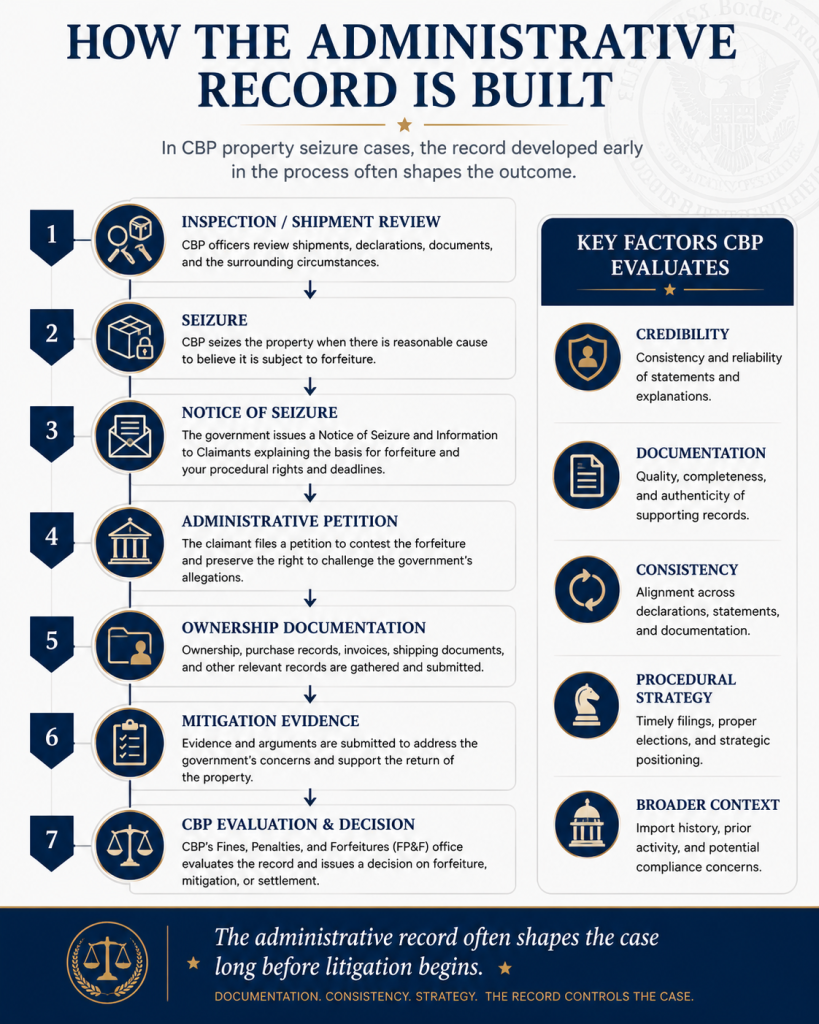
The Government Often Evaluates More Than the Property Itself
In many customs seizure cases, CBP does not focus solely on the seized item.
Instead, investigators may evaluate:
- purchase records
- shipping documentation
- customs declarations
- ownership history
- payment records
- electronic communications
- import/export activity
- explanations provided during inspection
Depending on the circumstances, the government may also evaluate whether:
- the declarations were accurate
- documentation appears internally consistent
- explanations evolved over time
- broader import or export concerns exist
- the surrounding circumstances appear suspicious
That broader institutional review often surprises people who initially believe the dispute concerns only the property itself.
Why Documentation Frequently Becomes Critical
Strong documentation often becomes one of the most important factors in customs property seizure matters.
Depending on the type of property involved, useful records may include:
- receipts
- invoices
- authenticity documentation
- shipping records
- import paperwork
- ownership records
- payment history
- licensing materials
- business documentation
In many situations, the government evaluates whether the records:
- support the explanations provided
- appear internally consistent
- align with customs declarations
- strengthen mitigation arguments
- resolve suspicious circumstances
Weak or inconsistent documentation may significantly complicate:
- administrative negotiations
- mitigation opportunities
- procedural strategy
- credibility assessments
Why Consistency Matters So Much
One of the most important realities in customs forfeiture proceedings is that federal agencies often compare:
- inspection statements
- customs declarations
- shipping records
- petition submissions
- ownership explanations
- later litigation positions
Even relatively small inconsistencies may become significant if investigators believe:
- explanations changed over time
- documentation conflicts with earlier statements
- the narrative was reconstructed later
- the overall record appears unreliable
That does not necessarily mean the individual acted unlawfully.
However, credibility concerns may substantially affect:
- mitigation decisions
- settlement posture
- procedural leverage
- future litigation strategy
Why Early Statements Matter
Many individuals understandably attempt to immediately explain the situation after the seizure occurs.
In practice, however, people sometimes unintentionally damage their position by:
- overexplaining facts
- making unsupported claims
- speculating about missing information
- changing explanations later
- responding emotionally rather than strategically
What initially feels like cooperation may later create:
- credibility concerns
- documentation conflicts
- procedural complications
- additional scrutiny
That is especially true where:
- ownership is disputed
- declarations appear inconsistent
- counterfeit allegations exist
- import restrictions apply
- export-control concerns are raised
Additional discussion of these issues appears in Why Early Statements to CBP Can Destroy Your Case.
The Administrative Record Often Shapes the Outcome
One of the most important realities in customs property seizure matters is that the administrative record developed early in the process often shapes how the government evaluates the case moving forward.
The first:
- explanations
- petitions
- supporting documentation
- procedural decisions
- mitigation submissions
may later influence: - settlement posture
- administrative review
- litigation strategy
- broader federal scrutiny
That is why National Security Law Firm repeatedly emphasizes:
the record controls the case.
Many customs property seizure cases are ultimately shaped less by dramatic courtroom litigation and more by:
- credibility
- consistency
- documentation quality
- procedural strategy
- administrative positioning
- disciplined communication
Understanding how CBP evaluates credibility and documentation is important because many customs forfeiture matters are heavily influenced by the quality of the administrative record developed early in the process.
Why National Security Law Firm Is Different in Property Seizure Cases
Many law firms approach customs property seizure matters as isolated disputes over merchandise, vehicles, or packages.
National Security Law Firm approaches these matters differently.
In many situations, property seizure cases intersect with broader federal systems involving:
- import compliance
- export controls
- federal employment
- security clearances
- contractor eligibility
- FDA restrictions
- intellectual property enforcement
- future border scrutiny
- parallel federal investigations
Federal agencies often do not evaluate these matters in isolation.
Information developed during a customs seizure matter may later appear in entirely different administrative, regulatory, or investigative contexts.
That broader institutional overlap frequently shapes how these cases should be strategically handled from the outset.
A Federal-Systems Approach to Property Seizure Matters
National Security Law Firm represents clients nationwide in:
- customs seizure matters
- export-control issues
- security clearance cases
- federal administrative proceedings
- contractor-related matters
- overlapping federal investigations
The firm’s broader federal-systems experience informs how property seizure cases are strategically evaluated from the beginning.
Rather than treating the matter as simply a dispute over a seized item, the firm focuses on:
- strategic record-building
- credibility management
- procedural leverage
- mitigation positioning
- careful administrative strategy
- long-term federal consequences
That broader perspective becomes especially important in matters involving:
- commercial imports
- export-control concerns
- counterfeit allegations
- luxury goods seizures
- electronics and technology issues
- FDA-related restrictions
- broader customs compliance concerns
Why Administrative Strategy Often Matters More Than People Realize
Many customs property seizure cases are heavily influenced by:
- documentation quality
- ownership records
- consistency of explanations
- procedural positioning
- mitigation evidence
- credibility assessments
That is one reason why National Security Law Firm repeatedly emphasizes:
the record controls the case.
The firm understands that many property seizure matters are ultimately shaped less by dramatic courtroom arguments and more by:
- disciplined communication
- administrative strategy
- procedural timing
- careful documentation
- how federal agencies evaluate credibility and compliance
This becomes especially important because early submissions may later affect:
- future import scrutiny
- contractor eligibility
- export licensing
- security clearance reviews
- federal employment issues
- broader federal investigations
More Than Just a Seized Item
Many people initially focus only on recovering the seized property itself.
However, depending on the allegations involved, customs property seizure matters may create broader federal implications extending far beyond the immediate forfeiture proceeding.
In some situations, the case may later intersect with:
- import compliance investigations
- intellectual property enforcement
- export-control concerns
- contractor responsibility issues
- future border inspections
- parallel federal investigations
Understanding those overlapping federal systems is a major part of what differentiates National Security Law Firm’s approach.
Many firms focus only on the property.
National Security Law Firm evaluates:
- the immediate forfeiture strategy
- the quality of the administrative record
- broader federal implications
- procedural leverage
- long-term institutional risk
Nationwide Customs Property Seizure Representation
National Security Law Firm represents clients nationwide in customs property seizure matters involving:
- vehicle seizures
- luxury goods seizures
- Rolex and jewelry seizures
- counterfeit merchandise allegations
- electronics and device seizures
- prescription medication seizures
- international package seizures
- commercial merchandise seizures
- import/export enforcement actions
If CBP seized your property, the procedural and strategic decisions made early in the process may significantly affect:
- recovery opportunities
- mitigation strategy
- litigation posture
- broader federal consequences
For broader discussion of customs forfeiture proceedings generally, visit the firm’s main Customs Seizure Lawyers Resource Hub page.
Frequently Asked Questions About Customs Property Seizures
Can CBP seize property even if I bought it legally?
Yes.
Many people are surprised to learn that CBP may seize property even when:
- the item was lawfully purchased
- no criminal charges are filed
- the owner believed the import was legal
- the property itself is not inherently illegal
In many situations, seizures involve:
- customs declaration issues
- import restrictions
- counterfeit allegations
- export-control concerns
- FDA compliance problems
- documentation discrepancies
Why did Customs seize my package?
International package seizures often involve allegations concerning:
- prohibited imports
- counterfeit merchandise
- customs declaration issues
- FDA restrictions
- intellectual property concerns
- import compliance problems
Many package seizure matters arise from online purchases or international shipments where the buyer did not realize the item could trigger customs scrutiny.
Additional discussion appears in Customs Seized My Package: What Are My Rights?.
Can CBP seize a Rolex or luxury watch?
Yes.
Luxury watches, jewelry, and designer goods frequently receive heightened scrutiny from CBP.
Seizures may involve:
- counterfeit allegations
- customs declaration disputes
- undervaluation concerns
- import documentation issues
- intellectual property enforcement
Additional discussion appears in CBP Seized My Rolex, Jewelry, or Luxury Goods.
What happens after CBP seizes property?
After property is seized, the matter generally enters an administrative forfeiture process handled through CBP’s Fines, Penalties, and Forfeitures (“FP&F”) office.
The government usually issues a Notice of Seizure explaining:
- why the property was seized
- what deadlines apply
- what procedural options exist
- how the claimant may contest forfeiture
Additional discussion appears in CBP Notice of Seizure Letter Explained: What To Do Next.
Can CBP seize electronics or devices?
Yes.
CBP may seize:
- phones
- laptops
- storage devices
- communications equipment
- technology components
for reasons involving: - export controls
- customs violations
- intellectual property concerns
- suspicious activity
- import/export restrictions
Additional discussion appears in Customs Seized My Electronics or Devices.
Can CBP seize prescription medication?
Yes.
Prescription medication seizures often involve:
- FDA restrictions
- import compliance issues
- declaration problems
- controlled substance concerns
- documentation issues
Many travelers are surprised when medication is seized despite having a prescription.
Additional discussion appears in CBP Seized Prescription Medication at the Border.
What if I did not know the merchandise was counterfeit?
Many counterfeit seizure cases involve individuals who claim they believed the merchandise was authentic.
However, CBP may still pursue administrative forfeiture where the government believes:
- the merchandise violates intellectual property protections
- import rules were violated
- customs declarations were inaccurate
Additional discussion appears in Counterfeit Goods Seized by CBP: What Happens Next?.
Can CBP seize a vehicle without criminal charges?
Yes.
Vehicle forfeiture proceedings may occur even where:
- no arrest occurs
- no criminal charges are filed
- the owner disputes the allegations
- the vehicle was lawfully owned
Additional discussion appears in CBP Vehicle Seizure Lawyers.
Why do documentation and consistency matter so much?
Many customs seizure matters become heavily:
- documentation-driven
- credibility-driven
- procedure-driven
CBP and related agencies frequently evaluate:
- receipts
- invoices
- ownership records
- customs declarations
- shipping documentation
- explanations provided during inspection
- consistency across submissions
That is one reason why weak or inconsistent records may significantly complicate mitigation and recovery efforts.
Can customs property seizures create broader federal consequences?
Potentially, yes.
Depending on the allegations involved, customs property seizure matters may later affect:
- import privileges
- export licensing
- contractor eligibility
- federal employment
- security clearances
- future border scrutiny
- parallel federal investigations
Federal agencies often evaluate these matters across overlapping administrative systems.
Do I need a lawyer after receiving a Notice of Seizure?
Not every customs seizure matter requires representation.
However, many cases involve:
- strict procedural deadlines
- administrative forfeiture rules
- strategic procedural decisions
- credibility issues
- documentation analysis
- broader federal consequences
- potential litigation exposure
The earlier the matter is strategically evaluated, the more options may remain available.
For broader information about customs forfeiture proceedings generally, visit the firm’s main Customs Seizure Lawyers Resource Hub page.
Transparent Pricing for Customs Seizure Matters
Many people hesitate to contact a customs seizure lawyer because they assume federal forfeiture representation will automatically become prohibitively expensive.
In reality, the appropriate fee structure often depends on:
- the type of property seized
- the complexity of the allegations
- whether litigation is likely
- the amount of documentation involved
- whether broader federal exposure exists
At National Security Law Firm, customs seizure matters are generally handled using one of two primary pricing structures.
Currency and Cash Seizure Cases
Many airport cash seizure and currency forfeiture matters are handled on a contingency fee basis.
In most situations:
- the firm’s fee typically ranges from 15% to 20% of the recovered amount
- there is generally no legal fee unless a recovery is obtained
This structure allows many individuals to pursue recovery of seized funds without paying substantial upfront legal fees while the forfeiture matter remains pending.
Property and Goods Seizure Cases
For matters involving:
- vehicles
- luxury goods
- Rolex and jewelry seizures
- electronics
- imported merchandise
- prescription medication
- commercial shipments
- international packages
National Security Law Firm generally handles cases using flat-fee structures typically ranging from approximately:
- $2,500 to $10,000
The exact fee often depends on:
- the complexity of the matter
- the value of the property
- aggravating allegations
- whether multiple agencies are involved
- the amount of documentation and administrative work required
- whether judicial litigation may become necessary
- broader federal implications surrounding the seizure
Why Strategic Representation Often Matters Early
Many customs seizure matters are heavily influenced by:
- procedural positioning
- documentation quality
- credibility
- mitigation evidence
- consistency of explanations
- administrative strategy
That is one reason why National Security Law Firm approaches customs forfeiture matters strategically from the beginning rather than treating them as routine form submissions or isolated property disputes.
To discuss pricing, strategy, and potential recovery options for your specific matter, schedule a free consultation through the firm’s Book a Free Consultation page.
Speak With a Nationwide Customs Seizure Lawyer
If CBP seized your vehicle, package, luxury goods, electronics, prescription medication, or imported merchandise, the decisions made early in the process may significantly affect:
- recovery opportunities
- mitigation strategy
- procedural leverage
- broader federal consequences
Many customs property seizure matters involve far more than simply recovering the seized item itself.
Depending on the allegations involved, these cases may later intersect with:
- import compliance investigations
- export-control concerns
- intellectual property enforcement
- federal employment issues
- contractor eligibility
- security clearances
- future border scrutiny
- parallel federal investigations
That broader federal overlap is one reason why many property seizure matters require strategic analysis from the beginning.
Strategic Representation for Customs Property Seizure Cases
National Security Law Firm represents clients nationwide in customs seizure matters involving:
- vehicle seizures
- luxury goods and Rolex seizures
- counterfeit merchandise allegations
- electronics and device seizures
- prescription medication seizures
- imported merchandise seizures
- international package seizures
- commercial shipment enforcement actions
The firm approaches these matters strategically with a focus on:
- administrative positioning
- credibility management
- procedural strategy
- mitigation opportunities
- documentation analysis
- careful record-building
- long-term federal risk evaluation
Rather than treating customs seizures as isolated property disputes, National Security Law Firm evaluates how these matters may affect broader federal systems and future government scrutiny.
Why Early Strategic Decisions Matter
Many customs seizure matters are heavily influenced by:
- early submissions
- ownership documentation
- consistency of explanations
- procedural decisions
- mitigation evidence
- administrative record development
That is why National Security Law Firm repeatedly emphasizes:
the record controls the case.
In many situations, customs property seizure matters are ultimately shaped less by dramatic courtroom litigation and more by:
- disciplined communication
- procedural positioning
- credibility assessments
- strong documentation
- strategic administrative analysis
Free Consultation for Customs Property Seizure Matters
National Security Law Firm offers nationwide representation and free consultations for customs property seizure and administrative forfeiture matters.
National Security Law Firm offers nationwide representation and free consultations for airport and border cash and property seizure matters.
The fastest and easiest way to get started is through the firm’s online booking system.
In many situations, same-day consultations are available, and the process typically takes less than a minute to schedule online.
Once booked, an attorney will personally call you at the scheduled time to discuss:
- the seizure
- procedural deadlines
- recovery strategy
- documentation issues
- broader federal implications
To schedule a consultation online, visit:
Book a Free Consultation Online
You may also contact the firm directly at:
Phone: (202) 600-4996
Additional related resources:
- CBP Vehicle Seizure Lawyers
- CBP Seized My Rolex, Jewelry, or Luxury Goods
- Counterfeit Goods Seized by CBP: What Happens Next?
- Customs Seized My Electronics or Devices
- Customs Seized My Imported Merchandise
- CBP Seized Prescription Medication at the Border
- Customs Seized My Package: What Are My Rights?
- I Didn’t Order the Package: What If CBP Seized a Shipment Sent in My Name?
- CBP Money Seizure Lawyers Hub
- CBP Notice of Seizure Letter Explained: What To Do Next
- Customs Seizure Lawyers Resource Hub