
Receiving a CBP Notice of Seizure and Information to Claimants can be overwhelming.
Many people open the letter without fully understanding:
- what it means
- how serious the situation may be
- what deadlines apply
- what options are available
- how the decisions made next may affect the case moving forward
Some individuals assume the notice is simply routine paperwork.
Others believe they can quickly explain the situation to CBP and resolve the matter informally.
In reality, the Notice of Seizure often marks the beginning of a highly strategic federal administrative forfeiture process governed by strict procedural rules and deadlines.
Why the Notice of Seizure Matters
The Notice of Seizure is one of the most important documents in many customs forfeiture cases.
In most situations, the notice explains:
- what property was seized
- why the government believes the property is subject to forfeiture
- what procedural options are available
- how long the claimant has to respond
- what happens if no action is taken
Importantly, many customs seizure matters are heavily influenced by the decisions made shortly after the notice is received.
The procedural path selected at this stage may affect:
- litigation posture
- negotiation leverage
- mitigation opportunities
- evidentiary development
- overall case strategy
That is one reason why many people unintentionally damage their position by:
- missing deadlines
- rushing to submit explanations
- choosing procedural options emotionally
- making inconsistent statements
- failing to understand broader federal consequences
The Administrative Record Begins Early
One of the most important realities in customs seizure cases is that the administrative record often begins developing immediately after the seizure occurs.
The first:
- explanations
- petitions
- supporting documentation
- financial records
- procedural decisions
submitted to the government may later influence: - mitigation analysis
- settlement discussions
- litigation strategy
- future agency scrutiny
- related federal investigations
That is why National Security Law Firm repeatedly emphasizes a central principle:
the record controls the case.
Many Notice of Seizure Cases Involve More Than Property Alone
Many people assume the notice concerns only the seized money, merchandise, vehicle, or package itself.
In reality, customs seizure matters may sometimes intersect with broader federal systems involving:
- immigration matters
- security clearances
- federal employment
- contractor eligibility
- TSA credentials
- export-control concerns
- future border scrutiny
- parallel federal investigations
Federal agencies often do not evaluate these matters in isolation.
That broader institutional overlap frequently shapes how customs seizure matters should be strategically handled from the outset.
Why Early Strategy Often Matters
Many customs forfeiture matters are ultimately shaped less by dramatic courtroom litigation and more by:
- procedural positioning
- credibility
- consistency
- mitigation evidence
- documentation quality
- disciplined communication
- strategic administrative decision-making
That is especially true after receiving a Notice of Seizure because many of the most important procedural deadlines and strategic choices begin immediately.
The sections below explain:
- what the Notice of Seizure means
- what information it contains
- how the Election of Proceedings process works
- what happens if deadlines are missed
- how administrative petitions operate
- when judicial forfeiture may become important
- what strategic mistakes often hurt customs seizure cases
Additional discussion of broader customs forfeiture strategy appears in Customs Seizure Lawyers Resource Hub.
What Is a CBP Notice of Seizure?
A CBP Notice of Seizure and Information to Claimants is the formal notice the government generally sends after Customs seizes money, merchandise, a vehicle, a package, or other property.
The notice typically means CBP has already taken the position that the property may be subject to forfeiture under federal law.
Many people are surprised to learn that this process often proceeds through administrative forfeiture systems separate from criminal court proceedings.
That means the government may issue a Notice of Seizure even when:
- no arrest occurs
- no criminal charges are filed
- the owner claims the property was lawfully obtained
- the underlying facts remain disputed
Why CBP Sends the Notice
After property is seized, the matter is typically transferred to CBP’s Fines, Penalties, and Forfeitures (“FP&F”) office.
FP&F handles administrative forfeiture proceedings and reviews requests seeking the return of seized property.
The Notice of Seizure serves several purposes.
Most importantly, it formally notifies the claimant:
- what property was seized
- why the government believes forfeiture may apply
- what procedural rights exist
- how long the claimant has to respond
- what options may be available moving forward
In many situations, this notice becomes the starting point for the most important procedural and strategic decisions in the entire case.
What Happens Before the Notice Is Issued?
Before the Notice of Seizure is sent, CBP officers generally begin documenting:
- the circumstances of the seizure
- statements made during inspection
- supporting evidence
- financial records
- travel information
- customs declarations
- investigative findings
Depending on the allegations involved, the government may also review:
- banking activity
- electronic communications
- import/export records
- business documentation
- travel history
- prior border interactions
That early investigative material often becomes part of the administrative record that later influences:
- mitigation decisions
- settlement posture
- litigation strategy
- future federal scrutiny
Why the Notice Should Be Taken Seriously
Many people mistakenly treat the Notice of Seizure as routine paperwork.
In reality, the notice often triggers:
- strict procedural deadlines
- important strategic decisions
- administrative forfeiture timelines
- Election of Proceedings choices
- potential litigation consequences
Missing deadlines or making poorly planned procedural decisions at this stage may significantly affect:
- recovery opportunities
- negotiation leverage
- litigation posture
- broader federal consequences
Additional discussion of these strategic issues appears in Election of Proceedings Form Explained and The 30-Day Deadline That Can Cost You Your Property.
What Information Is Included in the Notice?
Many people receive a CBP Notice of Seizure and immediately focus only on the fact that their money, vehicle, merchandise, or other property was taken.
However, the details contained inside the notice often become extremely important because they shape the procedural and strategic framework of the case moving forward.
In most situations, the notice identifies:
- the property seized
- the alleged legal basis for forfeiture
- the agency handling the matter
- the procedural deadlines
- the available response options
What many individuals do not initially realize is that these notices often contain the first formal explanation of how the government is framing the seizure.
The Alleged Basis for Forfeiture
One of the most important sections of the notice is the portion describing why CBP believes the property is subject to forfeiture.
Depending on the circumstances, the notice may reference allegations involving:
- currency reporting violations
- structuring
- bulk cash smuggling
- suspicious financial activity
- customs fraud
- import/export violations
- false declarations
- prohibited merchandise
- export-control concerns
In some situations, the allegations may appear broad or highly technical. In others, the language may provide only limited insight into the government’s underlying concerns.
That is one reason why many people misunderstand the seriousness or strategic implications of the notice when they first receive it.
Why the Election of Proceedings Form Matters
The notice also generally includes the Election of Proceedings form.
This document is often one of the most strategically important parts of the entire forfeiture process because it requires the claimant to decide how they want to proceed.
At this stage, many individuals do not yet fully understand:
- the evidence involved
- the government’s theory of the case
- the procedural consequences of each option
- whether broader federal exposure may exist
Nevertheless, the procedural choice selected may significantly affect:
- leverage
- timing
- litigation posture
- mitigation opportunities
- administrative strategy
Additional discussion appears in Election of Proceedings Form Explained and Petition vs Judicial Action: Which Option Is Better?.
Understanding the Deadlines
Another critically important part of the notice involves the procedural deadlines.
Customs forfeiture proceedings are heavily deadline-driven, and many people mistakenly assume they have far more time to respond than they actually do.
Depending on the procedural path selected, deadlines may affect:
- administrative petitions
- judicial forfeiture claims
- mitigation requests
- procedural rights
- negotiation opportunities
Missing deadlines may sometimes result in the property being administratively forfeited without further litigation.
That is one reason why many customs seizure cases require early strategic analysis before submissions or procedural elections are made.
Additional discussion of these timing issues appears in The 30-Day Deadline That Can Cost You Your Property.
The Notice Often Shapes the Entire Case Moving Forward
One of the most important realities in customs forfeiture matters is that the Notice of Seizure often becomes the starting point for:
- administrative record-building
- procedural positioning
- mitigation strategy
- credibility assessments
- future litigation posture
The procedural and strategic decisions made shortly after receiving the notice frequently influence how the government evaluates the matter moving forward.
That broader strategic context is one reason why the Notice of Seizure should rarely be viewed as routine paperwork or treated casually.
Why the Election of Proceedings Form Is So Important
One of the most important documents included with a CBP Notice of Seizure is the Election of Proceedings form.
At first glance, many people assume this is simply administrative paperwork.
In reality, however, the procedural option selected on this form may significantly affect:
- litigation posture
- negotiation leverage
- procedural rights
- costs
- timelines
- mitigation opportunities
- overall strategy moving forward
That is one reason why many customs seizure cases are heavily influenced by decisions made very early in the process.
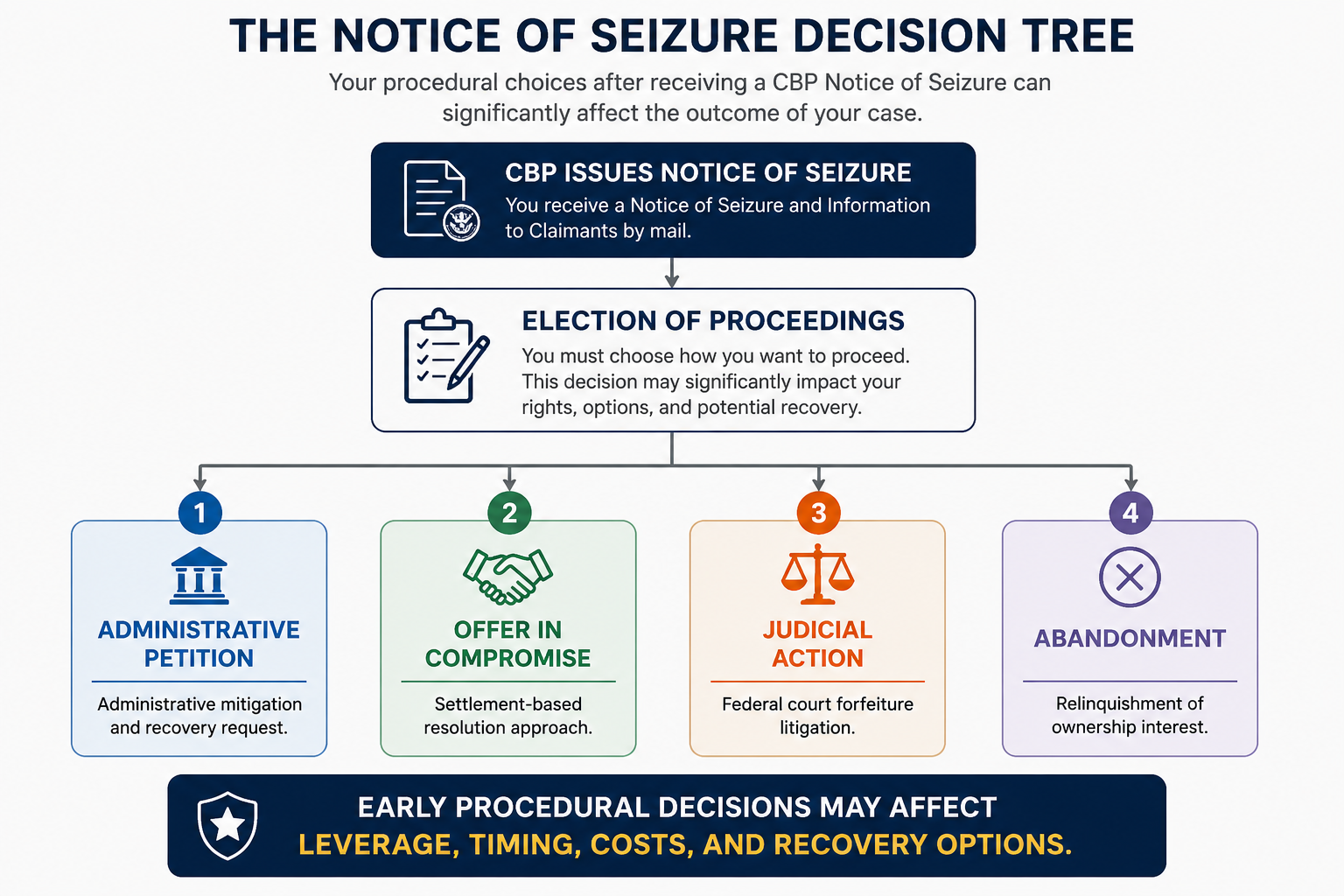
The Election of Proceedings Is Often a Strategic Decision
The Election of Proceedings form generally requires the claimant to choose how they want to proceed after the seizure.
The available options commonly include:
- filing an administrative petition for remission or mitigation
- submitting an Offer in Compromise
- abandoning the property
- forcing the government into judicial forfeiture proceedings
Many people make the mistake of quickly selecting an option before fully understanding:
- the evidence involved
- the procedural consequences
- whether broader federal exposure may exist
- how the government is likely evaluating the case
- the strengths and weaknesses of the available documentation
What initially appears to be a simple procedural choice may later affect the entire trajectory of the forfeiture matter.
Administrative Petitions vs. Judicial Litigation
In many situations, filing an administrative petition may provide the fastest and most cost-effective path toward resolving the case.
Administrative petitions often focus heavily on:
- mitigation
- documentation
- credibility
- consistency
- source-of-funds evidence
- procedural positioning
In other situations, however, judicial forfeiture proceedings may create stronger leverage or procedural protections unavailable inside the administrative process.
That strategic balance often depends heavily on:
- the facts of the seizure
- the quality of the evidence
- whether criminal exposure exists
- the amount seized
- the broader federal implications surrounding the matter
Why Many People Choose Emotionally Rather Than Strategically
One of the most common mistakes after receiving a Notice of Seizure is making procedural decisions emotionally.
For example, some individuals:
- rush into litigation out of frustration
- abandon the property too quickly
- submit poorly prepared petitions
- select procedural options without understanding the long-term implications
In practice, however, the strongest approach is often the one that best aligns with:
- the available evidence
- the procedural posture
- the credibility of the record
- broader federal risks
- long-term strategic goals
That is one reason why customs seizure matters frequently require careful analysis before procedural elections are made.
The Election of Proceedings Often Shapes the Administrative Record
Another important reality is that the procedural path selected often influences how the administrative record develops moving forward.
For example, the chosen strategy may affect:
- what submissions are made
- how mitigation is presented
- what evidence is emphasized
- how aggressively the government investigates the matter
- whether settlement discussions occur
- how future litigation develops
In many situations, the Election of Proceedings decision becomes one of the most strategically important moments in the entire forfeiture process.
Additional discussion of these issues appears in Offer in Compromise for CBP Seizures Explained.
Why Early Strategic Analysis Matters
Many customs seizure matters are ultimately shaped less by dramatic courtroom litigation and more by:
- procedural positioning
- credibility
- documentation quality
- mitigation strategy
- administrative leverage
- careful record development
That is one reason why National Security Law Firm repeatedly emphasizes:
the record controls the case.
Understanding the Election of Proceedings process is critical because the procedural decisions made shortly after receiving the Notice of Seizure frequently shape the direction of the case long before formal litigation ever begins.
Why Deadlines Become Critical After Receiving the Notice
One of the most common mistakes people make after receiving a CBP Notice of Seizure is assuming they have plenty of time to respond.
In reality, customs forfeiture proceedings are heavily deadline-driven.
Many claimants are still trying to understand:
- what the notice means
- why the property was seized
- what options are available
- whether criminal exposure exists
when important procedural deadlines are already approaching.
That is one reason why the period immediately following the notice is often one of the most strategically important phases of the entire case.
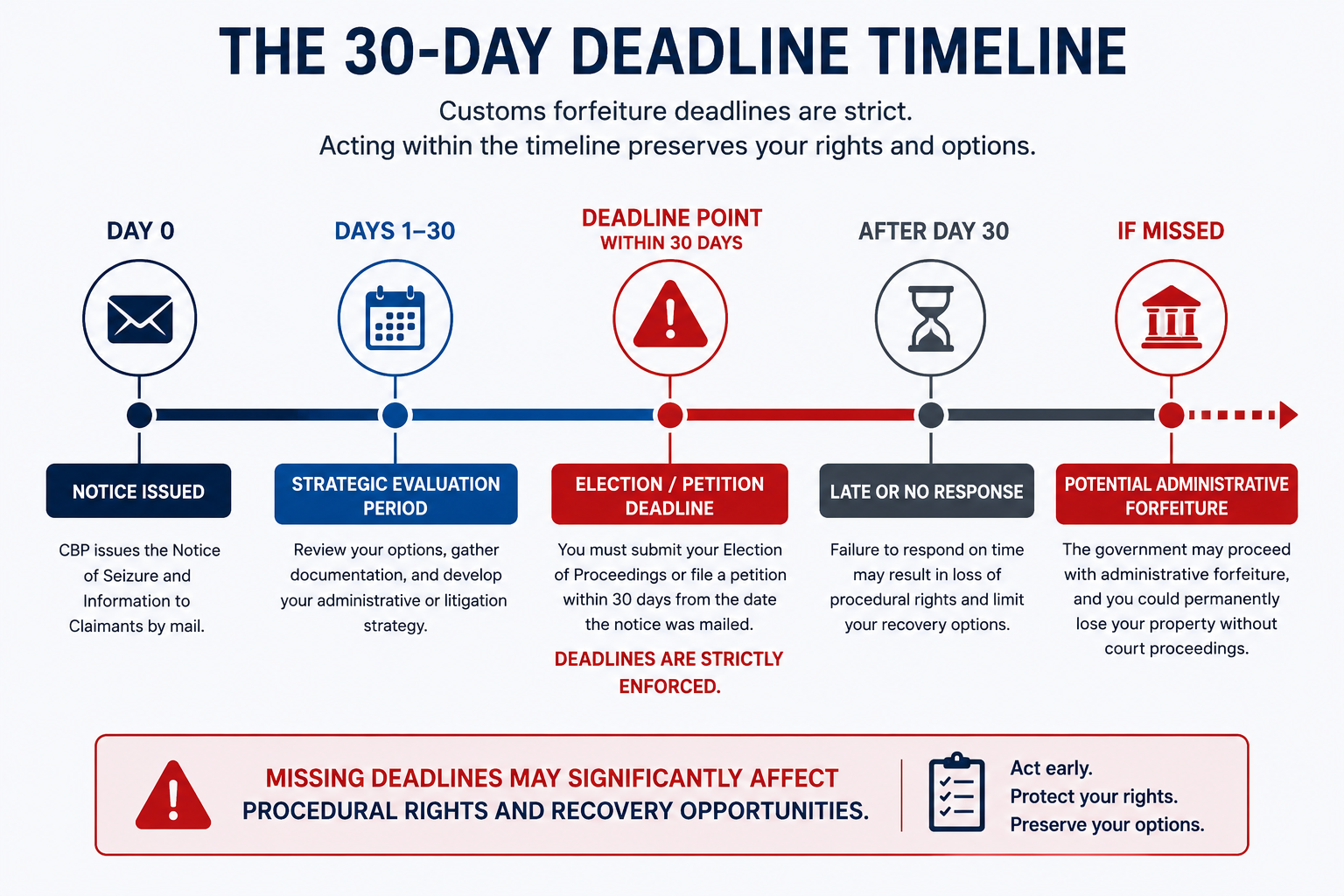
Why Missing Deadlines Can Be Extremely Dangerous
Depending on the procedural posture, missing deadlines may:
- limit procedural rights
- reduce leverage
- eliminate certain legal options
- weaken negotiation posture
- result in administrative forfeiture of the property
Many people are shocked to learn that the government may administratively forfeit seized property without formal courtroom litigation if deadlines are missed or procedural requirements are not properly followed.
That is one reason why Notice of Seizure matters should rarely be treated casually or delayed while “waiting to see what happens.”
Why People Often Wait Too Long
Many individuals delay responding because they believe:
- the matter will resolve informally
- they can explain everything later
- the government will eventually return the property automatically
- no action is necessary if no criminal charges were filed
Others become overwhelmed by:
- the procedural language in the notice
- the Election of Proceedings form
- the fear of making the wrong decision
- uncertainty regarding the government’s concerns
In practice, however, delay itself may create strategic problems.
The longer procedural decisions are postponed, the greater the risk that:
- deadlines expire
- administrative forfeiture advances
- evidence becomes harder to organize
- credibility concerns increase
- leverage diminishes
Why Early Strategic Evaluation Matters
One of the most important realities in customs seizure matters is that early strategic analysis often affects:
- procedural positioning
- mitigation opportunities
- administrative leverage
- documentation development
- future litigation posture
That does not necessarily mean rushing into immediate submissions or emotional reactions.
In many situations, the better approach involves carefully evaluating:
- the allegations in the notice
- the available documentation
- the government’s likely concerns
- the procedural options
- broader federal implications
before significant submissions are made.
Additional discussion appears in Should You Talk to CBP Before Hiring a Lawyer? and Why Early Statements to CBP Can Destroy Your Case.
Deadlines Often Shape the Entire Case
Many customs seizure matters are ultimately influenced less by dramatic courtroom litigation and more by:
- procedural timing
- administrative positioning
- credibility
- documentation quality
- mitigation strategy
- disciplined communication
That is one reason why the deadlines contained inside a Notice of Seizure often become some of the most strategically important aspects of the entire forfeiture process.
Additional discussion of procedural timing issues appears in The 30-Day Deadline That Can Cost You Your Property.
Understanding the deadlines is critical because many customs forfeiture cases are heavily shaped by decisions made in the first days and weeks after the Notice of Seizure is issued.
Why Early Statements and Submissions Matter
One of the most misunderstood aspects of customs seizure cases is how quickly the administrative record begins developing after the seizure occurs.
Many people assume they will have an opportunity later to fully explain the situation once they better understand the process.
In reality, the first:
- inspection statements
- written explanations
- procedural submissions
- supporting documents
often become some of the most important materials in the entire case.
That is especially true because CBP frequently evaluates:
- credibility
- consistency
- documentation quality
- mitigation evidence
- the plausibility of the explanations provided
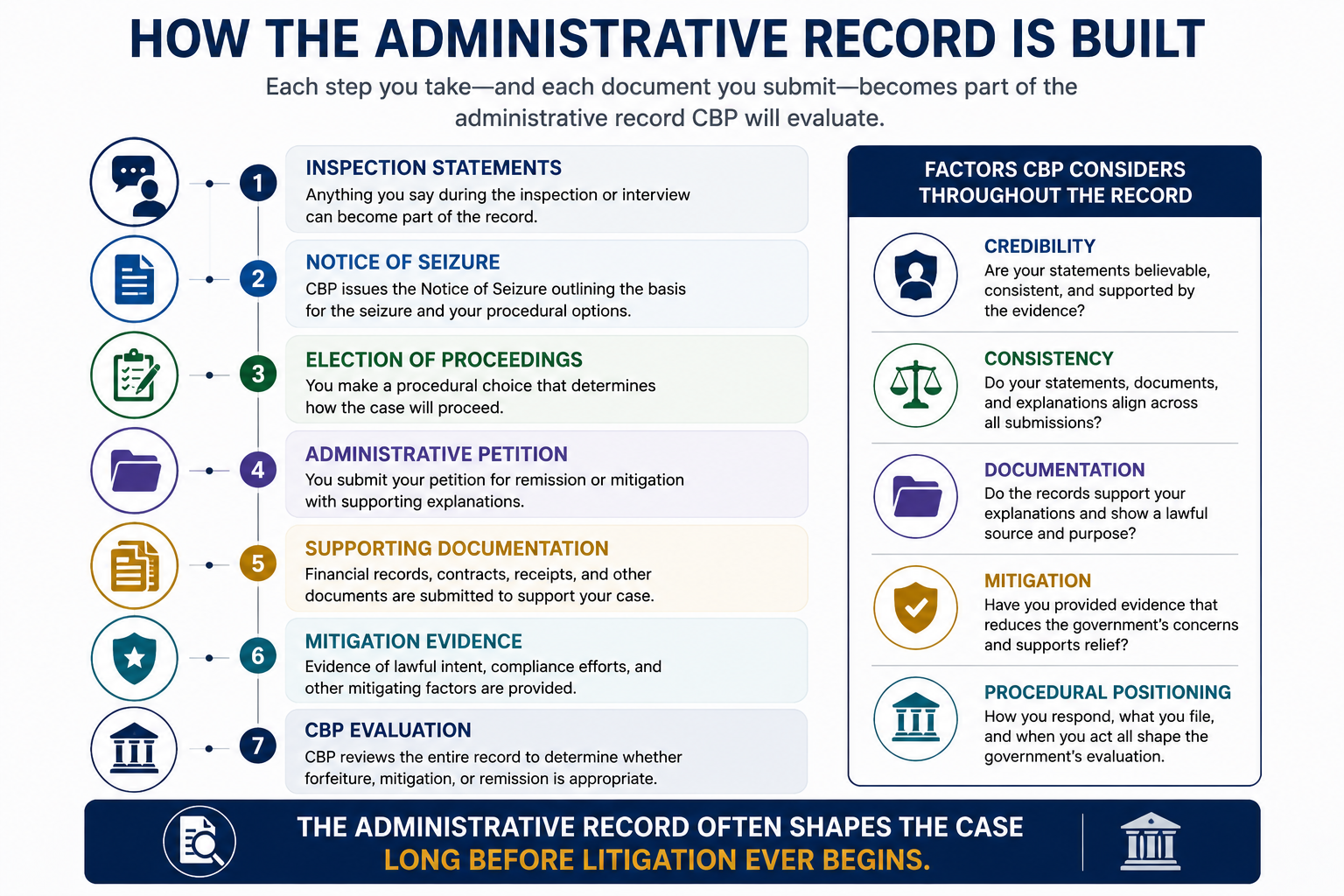
The Administrative Record Begins Earlier Than Most People Realize
In many customs seizure matters, the government begins building the administrative record almost immediately after:
- the seizure
- the airport inspection
- the border interview
- the customs declaration review
- the initial procedural submissions
Statements made during these early stages may later be compared against:
- financial records
- tax filings
- banking activity
- travel history
- electronic communications
- business records
- later petition submissions
- litigation positions
Even relatively small inconsistencies may become important if investigators believe explanations changed over time or conflict with other evidence.
Why Overexplaining Can Create Problems
Many individuals understandably attempt to “clear things up” immediately after receiving a Notice of Seizure.
In practice, however, people sometimes unintentionally weaken their position by:
- speculating about facts
- making unsupported claims
- overstating documentation
- providing inconsistent timelines
- changing explanations later
- responding emotionally rather than strategically
What initially feels like cooperation may later create:
- credibility concerns
- mitigation problems
- procedural complications
- additional investigative scrutiny
That is one reason why many customs seizure cases become highly documentation-driven and credibility-driven long before formal litigation begins.
Why Consistency Matters So Much
Federal agencies often evaluate whether the overall record appears:
- reliable
- internally consistent
- plausible
- strategically coherent
For example, CBP may later compare:
- inspection interviews
- customs declarations
- petition submissions
- financial records
- electronic evidence
- later explanations
In many situations, the government’s concerns focus less on one isolated statement and more on whether the overall narrative appears consistent over time.
That is one reason why disciplined communication and carefully prepared submissions often become critically important.
Why Early Strategy Often Shapes the Outcome
Many customs seizure matters are ultimately influenced less by dramatic courtroom arguments and more by:
- administrative positioning
- procedural strategy
- mitigation evidence
- credibility assessments
- documentation quality
- consistency of the record
That is why National Security Law Firm repeatedly emphasizes:
the record controls the case.
In some situations, carefully prepared early submissions may significantly improve:
- mitigation opportunities
- settlement posture
- negotiation leverage
- overall recovery potential
In others, poorly framed explanations or inconsistent statements may create long-term strategic problems that become difficult to reverse later.
Additional discussion of these issues appears in What Evidence Helps Win a CBP Petition?.
Customs Seizure Cases Often Require Disciplined Administrative Strategy
Many people initially view a Notice of Seizure as simply a dispute over property.
In reality, customs forfeiture proceedings frequently become strategic administrative matters involving:
- credibility
- consistency
- documentation
- mitigation
- procedural timing
- broader federal consequences
That is one reason why the first submissions and procedural decisions often shape how the government evaluates the case moving forward long before formal litigation ever occurs.
Administrative Petition vs. Judicial Litigation
One of the most important strategic decisions in many customs seizure cases is whether to pursue administrative resolution or force the government into judicial forfeiture proceedings.
Many people assume litigation is automatically the strongest option because it sounds more aggressive.
In reality, the best procedural path often depends heavily on:
- the facts of the seizure
- the quality of the evidence
- the amount and type of property involved
- whether criminal exposure exists
- the strength of the available documentation
- broader federal consequences
- the claimant’s long-term objectives
That is one reason why procedural decisions made shortly after receiving a Notice of Seizure may significantly affect the trajectory of the case moving forward.
Administrative Resolution
In many customs seizure matters, the first procedural option involves pursuing administrative resolution through a petition for remission or mitigation.
Administrative petitions generally ask the government to:
- return the property
- reduce the forfeiture
- mitigate penalties
- otherwise grant relief based on the surrounding facts and supporting evidence
In some situations, administrative resolution may provide:
- faster outcomes
- lower overall costs
- opportunities for negotiated mitigation
- more efficient recovery of property
Administrative proceedings often focus heavily on:
- documentation
- credibility
- consistency
- mitigation evidence
- source-of-funds explanations
- procedural positioning
In many cases, strong administrative strategy may significantly improve recovery opportunities before the matter escalates into prolonged litigation.
Judicial Forfeiture Proceedings
In other situations, claimants may choose to force the government into judicial forfeiture proceedings in federal court.
Judicial litigation significantly changes the posture of the case.
Instead of remaining entirely inside the administrative system, the matter may proceed into formal federal litigation involving:
- pleadings
- discovery
- evidentiary disputes
- motion practice
- settlement negotiations
- trial proceedings
In some cases, judicial litigation may create:
- stronger procedural protections
- broader evidentiary opportunities
- increased leverage
- more aggressive litigation posture
However, litigation may also substantially increase:
- costs
- timelines
- evidentiary risks
- investigative scrutiny
- broader federal exposure
That is one reason why judicial action is not automatically the strongest strategic option in every case.
Why the Best Strategy Depends on the Facts
Many customs seizure matters are highly fact-specific.
For example, some cases may involve:
- strong financial documentation
- limited investigative concerns
- favorable mitigation evidence
- minimal criminal exposure
Those matters may sometimes be well-positioned for efficient administrative resolution.
Other cases may involve:
- structuring allegations
- bulk cash smuggling concerns
- suspicious financial activity
- significant credibility disputes
- broader federal investigations
- substantial amounts of seized property
In those situations, litigation strategy and procedural leverage may become much more important.
Why Procedural Decisions Should Rarely Be Emotional
One of the most common mistakes people make after receiving a Notice of Seizure is choosing procedure emotionally rather than strategically.
For example, individuals sometimes:
- rush into litigation out of frustration
- abandon property too quickly
- file poorly prepared petitions
- choose procedural options without understanding the long-term implications
In practice, however, the strongest approach is usually the one that best aligns with:
- the available evidence
- the quality of the documentation
- the procedural posture
- broader federal risks
- long-term strategic goals
That is one reason why customs seizure cases frequently require careful strategic evaluation before procedural elections are made.
Administrative Strategy Often Shapes the Outcome Long Before Litigation
Many customs seizure matters are ultimately influenced less by dramatic courtroom arguments and more by:
- procedural positioning
- mitigation strategy
- documentation quality
- credibility
- consistency
- administrative record development
That is why National Security Law Firm repeatedly emphasizes:
the record controls the case.
Understanding the difference between administrative resolution and judicial litigation is critical because the procedural path selected shortly after receiving a Notice of Seizure may shape the direction of the forfeiture matter long before formal courtroom proceedings ever begin.
Can You Change Your Election of Proceedings Choice Later?
One of the most common questions people ask after submitting an Election of Proceedings form is whether the decision can later be changed.
The answer depends heavily on:
- the procedural posture of the case
- what filings have already been submitted
- whether deadlines have expired
- whether the government has already acted on the election
- the specific option originally selected
In some situations, procedural flexibility may still exist.
In others, the original election may significantly limit or shape the options available moving forward.
That is one reason why the Election of Proceedings decision should rarely be treated casually.
Why the Initial Election Matters So Much
Many people complete the Election of Proceedings form quickly without fully understanding:
- the government’s theory of the case
- the procedural consequences of each option
- whether broader federal exposure may exist
- how the decision may affect leverage later
What initially appears to be a simple administrative form may later influence:
- litigation posture
- procedural rights
- mitigation opportunities
- settlement strategy
- administrative leverage
- timing of the case
That is one reason why procedural choices often require strategic analysis before the form is submitted.
Administrative Petitions and Judicial Action Create Different Paths
In many situations, claimants initially pursue administrative resolution through a petition for remission or mitigation.
Later, however, they may become dissatisfied with:
- the pace of the proceedings
- the government’s position
- mitigation outcomes
- the strength of the administrative process
At that point, some individuals begin exploring whether judicial forfeiture proceedings may still be available.
Conversely, some claimants initially consider aggressive litigation but later realize:
- the costs may become substantial
- administrative mitigation may offer a more efficient resolution
- broader federal consequences may require a less confrontational approach
That is one reason why the procedural election often affects far more than simply “where the case goes.”
Why Waiting Too Long Can Create Problems
One of the biggest risks involves delay.
In many customs forfeiture matters, procedural rights are heavily tied to:
- filing deadlines
- timing requirements
- procedural compliance
- election-related rules
Once certain deadlines expire or certain procedural steps occur, changing course may become substantially more difficult.
That is especially true where:
- administrative forfeiture has advanced
- judicial deadlines have passed
- petitions have already been adjudicated
- the government has relied on the procedural election already made
Why Strategic Evaluation Should Happen Early
Many people choose procedural options emotionally immediately after the seizure occurs.
For example, individuals sometimes:
- rush into litigation out of frustration
- file administrative petitions without understanding the consequences
- delay strategic analysis until deadlines are approaching
- underestimate broader federal implications
In practice, however, the strongest procedural approach usually depends on:
- the quality of the evidence
- the available documentation
- whether criminal exposure exists
- the government’s likely concerns
- broader federal consequences
- the claimant’s long-term objectives
That is one reason why early strategic evaluation often becomes critically important before procedural elections are finalized.
Customs Seizure Cases Are Often Shaped by Early Procedure
Many customs forfeiture matters are heavily influenced by:
- procedural positioning
- credibility
- mitigation strategy
- administrative leverage
- documentation quality
- record development
That is why National Security Law Firm repeatedly emphasizes:
the record controls the case.
Understanding whether a procedural election may later be changed is important because many customs seizure cases are ultimately shaped less by dramatic courtroom litigation and more by strategic procedural decisions made early in the administrative process.
What Evidence Helps Win a CBP Petition?
One of the most important factors in many customs seizure cases is the quality of the evidence submitted to the government.
Many people assume the most important issue is simply “telling their side of the story.”
In reality, CBP often evaluates whether the overall record appears:
- credible
- consistent
- documented
- plausible
- supported by objective evidence
That is one reason why strong documentation frequently becomes far more important than emotional explanations alone.
Financial Documentation Often Becomes Central
In many airport cash seizure cases, the government closely evaluates whether the available records support the source-of-funds explanation.
Depending on the circumstances, strong supporting evidence may include:
- tax returns
- bank statements
- withdrawal records
- payroll records
- business income documentation
- contracts
- invoices
- real estate transaction records
- inheritance documentation
- proof of lawful business activity
The government frequently looks for whether the records:
- align with the explanations provided
- appear internally consistent
- support the timing of the transactions
- resolve suspicious circumstances
- strengthen mitigation arguments
Weak, incomplete, or inconsistent documentation may significantly complicate the case.
Why Consistency Matters as Much as Documentation
Strong records alone are not always enough.
In many customs seizure matters, CBP also evaluates whether:
- the explanations remain consistent over time
- the documents match prior statements
- financial activity aligns with the narrative presented
- the overall record appears reliable
That is one reason why even legitimate documentation may lose persuasive value if:
- explanations change later
- records conflict with earlier statements
- details evolve over time
- unsupported claims are made during inspection
Federal agencies often evaluate the entire record collectively rather than reviewing each piece of evidence in isolation.
Mitigation Evidence Can Also Matter
In many administrative forfeiture proceedings, mitigation evidence may significantly affect the government’s evaluation of the case.
Depending on the circumstances, mitigation evidence may include:
- lawful source-of-funds records
- compliance efforts
- corrective actions
- evidence of misunderstanding rather than concealment
- explanations supported by objective documentation
- proof of legitimate business activity
- evidence reducing broader enforcement concerns
In some situations, strong mitigation evidence may substantially improve:
- settlement posture
- mitigation opportunities
- administrative resolution prospects
Why Weak Submissions Can Create Long-Term Problems
One of the biggest mistakes people make is submitting:
- incomplete records
- unsupported narratives
- disorganized financial documentation
- inconsistent explanations
- speculative claims
In practice, weak submissions may:
- increase government skepticism
- trigger additional scrutiny
- weaken credibility
- prolong the forfeiture process
- complicate mitigation negotiations
That is one reason why many customs seizure matters require careful strategic analysis before major submissions are made.
CBP Often Evaluates More Than the Immediate Seizure
Another important issue is that evidence submitted during a customs forfeiture proceeding may later affect:
- immigration matters
- security clearance reviews
- federal employment issues
- contractor eligibility
- future border scrutiny
- parallel investigations
- export-control concerns
Federal agencies often evaluate credibility and documentation across multiple administrative systems.
That broader overlap is one reason why customs seizure cases frequently require disciplined record-building from the outset.
Strong CBP Petitions Are Often Built Strategically
Many successful customs seizure petitions are ultimately shaped less by emotional arguments and more by:
- strong documentation
- credibility
- consistency
- procedural strategy
- mitigation positioning
- disciplined administrative submissions
That is why National Security Law Firm repeatedly emphasizes:
the record controls the case.
Understanding what evidence helps win a CBP petition is critical because many customs forfeiture matters are ultimately influenced by the quality of the administrative record developed early in the process rather than dramatic courtroom litigation later.
What Happens If You Ignore a CBP Notice of Seizure?
Many people receive a CBP Notice of Seizure and initially hope the matter will simply resolve on its own.
Others delay responding because they feel overwhelmed, uncertain about their options, or afraid of making the wrong procedural decision.
In reality, ignoring a Notice of Seizure can create serious procedural consequences.
Customs forfeiture proceedings are heavily deadline-driven, and failing to respond may allow the government to move forward with administrative forfeiture of the property without further litigation.
Administrative Forfeiture Can Happen Without Court Proceedings
One of the most misunderstood aspects of customs seizure cases is that the government does not always need a full courtroom proceeding to permanently forfeit property.
In many situations, if a claimant:
- fails to respond
- misses deadlines
- does not properly contest forfeiture
the government may proceed administratively through CBP’s forfeiture system.
That means the seized money, merchandise, vehicle, or other property may ultimately be forfeited without formal judicial litigation ever occurring.
Many people are shocked to learn this after assuming:
- the government would “have to prove its case in court”
- the matter would automatically remain open indefinitely
- no action was necessary unless criminal charges were filed
Administrative forfeiture proceedings often operate very differently from traditional criminal court proceedings.
Why Delay Often Weakens the Case
Even before deadlines formally expire, delay itself may create strategic problems.
For example, waiting too long may:
- weaken negotiation leverage
- complicate documentation gathering
- increase credibility concerns
- reduce mitigation opportunities
- make procedural options more limited
- allow the administrative record to develop without strategic input
That is especially important because many customs seizure matters become heavily influenced by:
- early procedural positioning
- documentation quality
- mitigation evidence
- credibility assessments
- consistency of the record
Ignoring the Notice Does Not Necessarily Eliminate Broader Risks
Another major misconception is that ignoring the forfeiture process somehow prevents broader federal consequences.
In reality, depending on the allegations involved, customs seizure matters may still later affect:
- immigration proceedings
- Global Entry eligibility
- TSA credentials
- security clearances
- federal employment
- contractor eligibility
- future border inspections
- parallel investigations
Federal agencies often evaluate these matters collectively across multiple administrative systems.
That broader overlap is one reason why customs seizure matters frequently require strategic analysis even where the claimant initially believes the property itself may not justify litigation.
Why Early Strategic Evaluation Matters
Many people delay action because they are unsure:
- whether the case is serious
- whether litigation is necessary
- whether the property can realistically be recovered
- whether broader federal exposure exists
However, the earlier the matter is strategically evaluated, the more options may remain available.
In many situations, careful early analysis may help determine:
- whether administrative resolution makes sense
- whether litigation leverage exists
- what documentation is needed
- whether credibility concerns must be addressed
- how broader federal implications should be managed
Customs Seizure Cases Often Move Forward Whether the Claimant Participates or Not
One of the most important realities in customs forfeiture proceedings is that the administrative process generally continues moving forward even when the claimant delays responding.
That is one reason why National Security Law Firm repeatedly emphasizes:
the record controls the case.
Understanding what happens if a Notice of Seizure is ignored is critical because many customs forfeiture matters are ultimately shaped by procedural timing, administrative positioning, and early strategic decisions long before formal courtroom litigation ever begins.
Why National Security Law Firm Is Different in Notice of Seizure Cases
Many law firms treat a CBP Notice of Seizure as a simple forfeiture formality.
National Security Law Firm approaches these matters differently.
In many customs seizure cases, the Notice of Seizure becomes the starting point for:
- strategic record-building
- procedural positioning
- credibility assessments
- mitigation strategy
- broader federal risk analysis
The decisions made shortly after receiving the notice may significantly affect the direction of the case moving forward.
The Record Often Begins with the Notice
Many people assume the most important part of the case happens later in court.
In reality, customs forfeiture matters are often heavily shaped long before litigation ever begins.
The first:
- procedural elections
- petitions
- explanations
- supporting documents
- mitigation submissions
may later influence: - settlement posture
- administrative review
- litigation strategy
- future federal scrutiny
- related investigations
That is one reason why National Security Law Firm repeatedly emphasizes:
the record controls the case.
A Federal-Systems Approach to Customs Seizure Matters
National Security Law Firm represents clients nationwide in:
- customs seizure matters
- security clearance cases
- export-control issues
- federal administrative proceedings
- contractor-related matters
- overlapping federal investigations
The firm’s broader federal-systems experience informs how Notice of Seizure matters are strategically evaluated from the outset.
Many customs seizure cases intersect with broader federal systems involving:
- immigration
- security clearances
- TSA credentials
- federal employment
- contractor eligibility
- export licensing
- future border scrutiny
- parallel investigations
Federal agencies often do not evaluate these matters in isolation.
Information developed during a customs forfeiture proceeding may later appear in entirely different administrative or investigative contexts.
That broader institutional overlap frequently shapes how these matters should be strategically handled from the beginning.
Why Procedural Strategy Matters
Many people receiving a Notice of Seizure understandably focus only on recovering the property itself.
However, the procedural decisions made after the notice may also affect:
- leverage
- litigation posture
- mitigation opportunities
- credibility assessments
- long-term federal consequences
That is one reason why National Security Law Firm focuses heavily on:
- procedural strategy
- disciplined communication
- careful administrative positioning
- strong documentation
- mitigation analysis
- long-term risk management
Rather than treating the notice as routine paperwork, the firm evaluates:
- the government’s likely concerns
- the strength of the evidence
- procedural leverage
- documentation quality
- broader federal implications
- long-term institutional risk
Transparent Pricing for Customs Seizure Matters
Many people hesitate to contact a customs seizure lawyer because they assume federal forfeiture representation will automatically become prohibitively expensive.
In reality, the appropriate fee structure often depends on:
- the type of property seized
- the complexity of the allegations
- whether litigation is likely
- the amount of documentation involved
- whether broader federal exposure exists
At National Security Law Firm, customs seizure matters are generally handled using one of two primary pricing structures.
Currency and Cash Seizure Cases
Many airport cash seizure and currency forfeiture matters are handled on a contingency fee basis.
In most situations:
- the firm’s fee typically ranges from 15% to 20% of the recovered amount
- there is no legal fee unless a recovery is obtained
This structure allows many individuals to pursue recovery of seized funds without paying substantial upfront legal fees while the forfeiture matter remains pending.
Property and Goods Seizure Cases
For matters involving:
- vehicles
- luxury goods
- Rolex and jewelry seizures
- electronics
- imported merchandise
- prescription medication
- commercial shipments
- international packages
National Security Law Firm generally handles cases using flat-fee structures typically ranging from approximately:
- $2,500 to $10,000
The exact fee often depends on:
- the complexity of the matter
- the value of the property
- aggravating allegations
- whether multiple agencies are involved
- the amount of documentation and administrative work required
- whether judicial litigation may become necessary
- broader federal implications surrounding the seizure
Why Strategic Representation Often Matters Early
Many customs seizure matters are heavily influenced by:
- procedural positioning
- documentation quality
- credibility
- mitigation evidence
- consistency of explanations
- administrative strategy
That is one reason why National Security Law Firm approaches customs forfeiture matters strategically from the beginning rather than treating them as routine form submissions or isolated property disputes.
To discuss pricing, strategy, and potential recovery options for your specific matter, schedule a free consultation through the firm’s Book a Free Consultation page.
Nationwide Representation for CBP Notice of Seizure Cases
National Security Law Firm represents clients nationwide in customs seizure and administrative forfeiture matters involving:
- airport cash seizures
- border currency seizures
- commercial merchandise seizures
- import/export enforcement
- structuring allegations
- bulk cash smuggling accusations
- Notice of Seizure proceedings
- Election of Proceedings disputes
- administrative petitions
- judicial forfeiture litigation
If you received a CBP Notice of Seizure, early strategic analysis may significantly affect:
- procedural options
- mitigation opportunities
- recovery strategy
- broader federal consequences
For broader information about customs forfeiture proceedings generally, visit the firm’s main Customs Seizure Lawyers Resource Hub page.
Frequently Asked Questions About CBP Notices of Seizure
What is a CBP Notice of Seizure?
A CBP Notice of Seizure and Information to Claimants is the formal notice the government generally sends after Customs seizes money, merchandise, a vehicle, or other property.
The notice typically explains:
- what property was seized
- why the government believes forfeiture applies
- what procedural options exist
- what deadlines govern the case
- how the claimant may contest forfeiture
What happens if I ignore the Notice of Seizure?
Ignoring the notice may allow the government to proceed with administrative forfeiture of the property.
In many situations, missing deadlines or failing to properly respond may result in:
- loss of procedural rights
- reduced leverage
- forfeiture of the property without courtroom litigation
Additional discussion appears in What Happens If You Ignore a CBP Notice of Seizure?.
What is the Election of Proceedings form?
The Election of Proceedings form is a procedural document generally included with the Notice of Seizure.
It requires the claimant to choose how they want to proceed after the seizure.
The available options commonly include:
- filing an administrative petition
- submitting an Offer in Compromise
- abandoning the property
- forcing judicial forfeiture proceedings
This decision may significantly affect:
- litigation posture
- procedural leverage
- mitigation opportunities
- costs
- timelines
What is a petition for remission or mitigation?
A petition for remission or mitigation is an administrative request asking the government to:
- return the property
- reduce the forfeiture
- mitigate penalties
based on the surrounding facts and supporting evidence.
These petitions often focus heavily on:
- documentation
- mitigation evidence
- credibility
- consistency
- source-of-funds explanations
Should I choose administrative resolution or judicial litigation?
The best procedural path depends heavily on:
- the facts of the seizure
- the quality of the evidence
- whether criminal exposure exists
- the value of the property
- the available documentation
- broader federal implications
Some matters are well-positioned for administrative resolution. Others may require judicial litigation to create leverage or procedural protections.
Can I change my Election of Proceedings choice later?
Sometimes, but not always.
The answer depends on:
- the procedural posture
- whether deadlines have expired
- what filings have already occurred
- whether the government has already relied on the election made
That is one reason why procedural decisions should rarely be made casually or emotionally.
Additional discussion appears in Can You Change Your Election of Proceedings Choice Later?.
What evidence helps win a CBP petition?
Strong documentation often becomes one of the most important factors in customs seizure matters.
Depending on the circumstances, the government may evaluate:
- tax returns
- financial records
- business documentation
- contracts
- invoices
- source-of-funds evidence
- mitigation materials
- credibility and consistency of the explanations provided
Additional discussion appears in What Evidence Helps Win a CBP Petition?.
Can CBP keep property even if no criminal charges are filed?
Yes.
Many customs seizure matters proceed through civil or administrative forfeiture systems separate from criminal prosecutions.
The government may pursue forfeiture even when:
- no arrest occurs
- no indictment is filed
- no criminal charges are brought
Additional discussion appears in Can CBP Keep Your Money Even If You Were Never Charged With a Crime?.
Why do early statements matter so much?
Statements made during:
- inspections
- interviews
- administrative submissions
- petitions
may later become part of the administrative record.
CBP and related agencies frequently evaluate:
- credibility
- consistency
- documentation quality
- whether explanations evolve over time
That is one reason why many people unintentionally damage their cases by overexplaining facts or making unsupported statements early in the process.
Additional discussion appears in Why Early Statements to CBP Can Destroy Your Case.
Do I need a lawyer after receiving a Notice of Seizure?
Not every customs seizure matter requires representation.
However, many cases involve:
- strict procedural deadlines
- strategic procedural decisions
- credibility issues
- documentation analysis
- broader federal consequences
- potential litigation exposure
The earlier the matter is strategically evaluated, the more procedural and mitigation options may remain available.
For broader information about customs forfeiture proceedings generally, visit the firm’s main Customs Seizure Lawyers Resource Hub page.
Speak With a Nationwide Customs Seizure Lawyer
If you received a CBP Notice of Seizure, the decisions made in the first days and weeks after the notice is issued may significantly affect:
- procedural rights
- mitigation opportunities
- litigation posture
- recovery strategy
- broader federal consequences
Many customs forfeiture matters are shaped long before formal courtroom litigation ever begins.
In practice, the most important issues often involve:
- procedural positioning
- credibility
- documentation quality
- consistency of explanations
- mitigation strategy
- administrative record development
That is one reason why National Security Law Firm repeatedly emphasizes:
the record controls the case.
Strategic Representation for Notice of Seizure Matters
National Security Law Firm represents clients nationwide in customs seizure and administrative forfeiture matters involving:
- airport cash seizures
- commercial merchandise seizures
- border currency seizures
- structuring allegations
- bulk cash smuggling accusations
- import/export enforcement
- administrative petitions
- judicial forfeiture proceedings
- Election of Proceedings disputes
The firm approaches these matters strategically with a focus on:
- administrative leverage
- procedural strategy
- credibility management
- mitigation positioning
- careful record-building
- long-term federal risk analysis
Rather than treating the Notice of Seizure as routine paperwork, the firm evaluates how the procedural decisions made after the notice may affect:
- future litigation
- immigration matters
- security clearances
- contractor eligibility
- federal employment
- export-control concerns
- future federal scrutiny
Why Early Strategic Analysis Matters
Many people delay action after receiving a Notice of Seizure because they:
- feel overwhelmed
- do not understand the process
- assume the matter will resolve itself
- believe no action is necessary if no criminal charges were filed
In reality, customs forfeiture proceedings are heavily deadline-driven and strategically sensitive.
Early analysis may help determine:
- whether administrative resolution makes sense
- whether judicial litigation may create leverage
- what documentation may strengthen the case
- whether broader federal exposure exists
- how the government is likely evaluating the matter
Free Consultation for Customs Seizure Matters
National Security Law Firm offers nationwide representation and free consultations for CBP Notice of Seizure and customs forfeiture matters.
National Security Law Firm offers nationwide representation and free consultations for airport and border cash and property seizure matters.
The fastest and easiest way to get started is through the firm’s online booking system.
In many situations, same-day consultations are available, and the process typically takes less than a minute to schedule online.
Once booked, an attorney will personally call you at the scheduled time to discuss:
- the seizure
- procedural deadlines
- recovery strategy
- documentation issues
- broader federal implications
To schedule a consultation online, visit:
Book a Free Consultation Online
You may also contact the firm directly at:
Phone: (202) 600-4996
Additional related resources:
- Election of Proceedings Form Explained
- Petition vs Judicial Action: Which Option Is Better?
- What Happens If You Ignore a CBP Notice of Seizure?
- The 30-Day Deadline That Can Cost You Your Property
- What Evidence Helps Win a CBP Petition?
- Why Early Statements to CBP Can Destroy Your Case
- Customs Seizure Lawyers Resource Hub
- Customs Seizure Notice Deadlines: How Much Time Do You Have to Respond?
- I Received a CBP Notice of Seizure: What Does It Mean?
- Customs Seizure Letter Explained: A Line-by-Line Breakdown
- What Happens After You Receive a CBP Notice of Seizure?