
Your case was dismissed. Your conviction was expunged. Your rights were restored. The record belongs to someone else. Or the court resolved the charge decades ago—but the FBI database still does not show how the case ended.
One incomplete or inaccurate government record can continue causing firearm denials and delays long after the underlying case should have stopped affecting you.
Correcting the problem is rarely as simple as sending the FBI a court order.
The FBI may accurately display information received from a court, police department, state repository, military department, or another agency—even when that source information is incomplete or wrong. In those cases, the correction must begin with the agency that created or submitted the record before the FBI or NICS can reliably update its systems.
National Security Law Firm’s FBI firearm record correction lawyers identify where the error originated, obtain the controlling records, pursue correction with the responsible agency, and ensure that corrected information is presented through the appropriate FBI or NICS process.
If an inaccurate or incomplete record is interfering with your firearm rights, schedule a confidential consultation with our federal firearms lawyers or call (202) 600-4996.
Why an FBI Record Can Be Wrong or Incomplete
The FBI’s criminal-history systems depend heavily on information submitted by outside agencies.
Courts, police departments, prosecutors, state identification bureaus, military departments, mental-health reporting authorities, and other agencies may submit arrest and disposition information. The FBI generally did not create the underlying court record and may not have authority to independently rewrite it based solely on an individual’s explanation.
Common record problems include:
- An arrest without a final disposition;
- A dismissed charge that still appears pending;
- A conviction entered under the wrong statute;
- A felony incorrectly reported as a misdemeanor or vice versa;
- A sentence reported inaccurately;
- A plea that was later vacated or withdrawn;
- A charge reduced to a nonprohibiting offense without an updated disposition;
- An expungement or sealing order that was never transmitted;
- A pardon or civil-rights restoration that is missing from the record;
- A protection order that remains active in a database after expiration;
- A mental-health record that was submitted incorrectly;
- A military record with incomplete or inaccurate disposition information;
- A case belonging to another person;
- An incorrect name, date of birth, or identifying number;
- Duplicate records;
- Two separate cases that were combined; or
- An old paper record that was never converted into a complete electronic entry.
A missing piece of information can cause NICS to treat an unresolved question as a potential prohibition.
How an Inaccurate Record Can Affect Your Firearm Rights
The National Instant Criminal Background Check System uses information available through multiple federal and state databases to determine whether a firearm transfer may proceed.
An inaccurate or incomplete record can result in:
- A NICS denial;
- A prolonged NICS delay;
- Repeated delays during firearm purchases;
- Denial of a state firearm permit or license;
- Incorrect placement in the NICS Indices;
- Problems with a National Firearms Act application;
- Continued denials after an expungement or pardon;
- Mistaken-identity matches;
- Law-enforcement inquiries; or
- Uncertainty about whether you may lawfully possess a firearm.
A background-check problem does not always mean the FBI’s legal analysis is wrong. Sometimes the FBI is relying on an inaccurate source record. Sometimes the source record is accurate, but NICS is applying the law incorrectly. Sometimes the record is correct and the person is validly prohibited.
Each problem requires a different remedy.
What Is an FBI Identity History Summary?
An FBI Identity History Summary is commonly called an FBI criminal-history report or “rap sheet.”
It is a fingerprint-based listing of certain information submitted to and retained by the FBI in connection with arrests and, in some cases, federal employment, naturalization, or military service.
The summary may include:
- The agency that submitted the fingerprints;
- The date of arrest;
- The arrest charge;
- Available court dispositions;
- Sentencing information;
- Identifying information; and
- Other criminal-history data reported to the FBI.
Obtaining the Identity History Summary is often an important first step because it allows the individual and counsel to compare the FBI record against the actual court and agency documents.
An Identity History Summary is not the same as a NICS response. NICS consults multiple databases and may rely on information that does not appear in the individual’s Identity History Summary.
Is an FBI Record Challenge the Same as a NICS Appeal?
No. They are related but distinct processes.
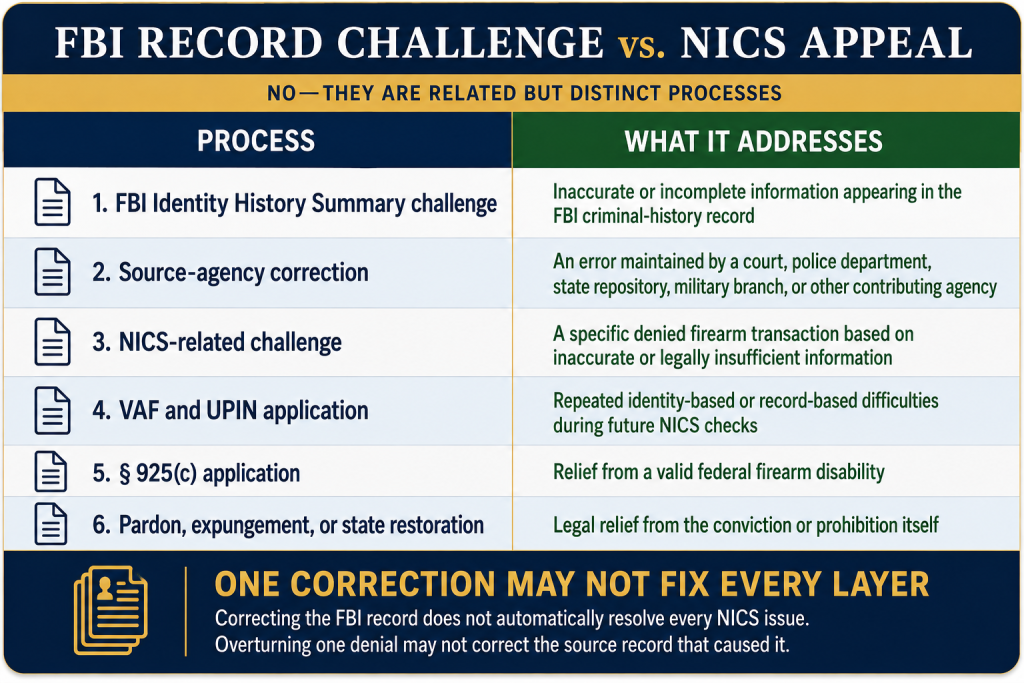
Correcting an Identity History Summary does not automatically resolve every NICS issue. Similarly, overturning one NICS denial does not necessarily correct the source record responsible for the problem.
Our attorneys determine which processes must be used and in what order.
How Do You Challenge an Inaccurate FBI Identity History Summary?
The FBI permits an individual to challenge information believed to be inaccurate or incomplete.
A proper challenge should:
- Identify the specific entry at issue.
- Explain what information is wrong or missing.
- Provide copies of available documentation supporting the requested correction.
- Identify the court or agency that maintains the source record.
- Request the appropriate change, correction, or update.
Supporting documentation may include:
- A certified final disposition;
- A dismissal order;
- A judgment of acquittal;
- A plea agreement;
- A sentencing order;
- An amended judgment;
- An expungement or sealing order;
- An order vacating a conviction;
- A pardon warrant;
- A civil-rights restoration certificate;
- A correction letter from the arresting agency;
- Fingerprint evidence;
- A military correction-board decision;
- A protection-order termination; or
- Other official records establishing the error.
The FBI does not charge a fee for challenging an Identity History Summary. The FBI currently reports an average response time of approximately 45 days, although that estimate does not include the time required to obtain records or correct information with a separate source agency.
Why Must the Source Agency Sometimes Correct the Record First?
The FBI frequently cannot alter a record merely because an individual provides a different account of what happened.
If a state court reported that a case remains pending, the FBI may require that court or the state repository to provide the missing disposition. If a police agency submitted an arrest under the wrong identity, that contributing agency may need to correct or withdraw the record.
The FBI states that a contributing agency is responsible for ensuring that information submitted to the NICS Indices is valid and accurate, maintaining the supporting documents, updating the information when necessary, and removing the entry when the prohibitor is no longer valid.
A source-agency correction may require working with:
- A clerk of court;
- A prosecutor’s office;
- A local police department;
- A sheriff’s office;
- A state identification bureau;
- State police;
- A mental-health reporting authority;
- A military department;
- A federal agency;
- A tribal authority; or
- Another agency that originated the information.
A successful correction strategy identifies who has legal and technical authority to change the record. Sending documents to an agency that cannot make the correction only causes delay.
What If the Final Court Disposition Is Missing?
Missing dispositions are among the most common criminal-history problems.
An FBI or state record may show that a person was arrested for a potentially prohibiting offense without showing that:
- The prosecutor declined the charge;
- The charge was dismissed;
- The person was acquitted;
- The offense was reduced;
- The person entered a diversion program;
- The case was resolved as a nonprohibiting misdemeanor;
- The conviction was vacated; or
- The case otherwise ended without a prohibiting conviction.
Correcting a missing disposition may require:
- Identifying the correct court and case number;
- Locating archived docket information;
- Obtaining certified court records;
- Confirming that the records match the person at issue;
- Asking the court or source agency to report the disposition;
- Updating the state criminal-history repository;
- Challenging the FBI record; and
- Submitting the corrected information through the NICS challenge process.
Old cases can be particularly difficult because files may have been destroyed, transferred to archives, or maintained only on microfilm or paper.
When official records are genuinely unavailable, alternative government documentation or a legally sufficient certification may be necessary.
What If the Court Record Is Correct but the FBI Record Is Wrong?
If the certified court record clearly establishes the correct outcome, the challenge should identify the discrepancy and provide the supporting disposition.
For example:
- The court record says “dismissed,” but the FBI record says “pending.”
- The judgment reflects a misdemeanor, but the FBI record lists a felony.
- The sentence was amended, but the original sentence remains in the system.
- The conviction was vacated, but the FBI record does not show the order.
- The offense occurred under a statute that was later corrected in the judgment.
- The case belongs to a different person.
The FBI may verify the document with the originating court or agency before updating the record.
A clear submission should explain not only what is wrong but precisely how the official record should read after correction.
What If the State Maintains the Record?
Some criminal-history information is maintained at the state level and accessed by the FBI for authorized purposes. In those situations, the FBI may not be able to make the underlying change.
Instead, the correction must be directed to the appropriate state identification bureau, state police agency, court, or other state authority.
The process may involve:
- Obtaining the state criminal-history report;
- Comparing it with the FBI Identity History Summary;
- Identifying which repository contains the error;
- Following the state’s correction procedure;
- Providing certified disposition records;
- Confirming that the state updated its system; and
- Ensuring the corrected information is available to NICS and the FBI.
Because state procedures differ, record correction often requires both federal and state analysis.
What If the Record Belongs to Someone Else?
Mistaken identity can arise when a record is associated with the wrong name, date of birth, Social Security number, or other identifying information.
It can also occur during a NICS check because the initial background check is based on biographical descriptors rather than a fingerprint comparison.
Evidence used to resolve an identity error may include:
- Fingerprints;
- Certified identity documents;
- Birth records;
- Social Security records;
- Proof of residence;
- Court records identifying the actual defendant;
- Arrest records containing physical descriptors;
- Agency correspondence acknowledging the error; or
- Documentation establishing identity theft.
An identity error should be corrected as close to its source as possible. Otherwise, the same information may continue creating problems across multiple databases.
Read how NSLF addressed a mistaken-identity firearm denial and obtained a UPIN for its client.
What If an Expungement Is Missing From the FBI Record?
An expungement order does not always cause every government database to update automatically.
The court may need to notify:
- The arresting agency;
- The prosecutor;
- The state identification bureau;
- State police;
- The FBI;
- The agency maintaining the NICS entry; and
- Other repositories identified in the order or governing statute.
For nonfederal arrest information, the FBI generally directs expungement questions to the state identification bureau where the offense occurred. Federal arrest information may be removed or updated when the submitting agency requests the change or the FBI receives an applicable federal court order.
The legal effect of an expungement is separate from the technical record update. Some orders seal public records without eliminating a federal firearm prohibition.
Before relying on an expungement, read our guide explaining whether an expungement restores gun rights.
What If a Pardon or Rights Restoration Is Not Reflected?
A pardon, set-aside, or restoration of civil rights may change whether a conviction remains disqualifying under federal law. But the relevant agencies must have sufficient information to understand what relief was granted.
A correction package may require:
- The complete pardon warrant;
- The underlying conviction records;
- The statute authorizing the relief;
- Documentation showing restoration of civil rights;
- Proof that no firearm restriction remains;
- State-law analysis;
- Correspondence with the state repository; and
- Submission through the appropriate NICS challenge.
A pardon does not resolve a separate conviction or another independent prohibition.
Our attorneys can evaluate whether a pardon restored your firearm rights before asking the FBI to update its records.
What If a Mental-Health Record Is Incorrect?
Federal law prohibits firearm possession by certain people who have been adjudicated as a mental defective or committed to a mental institution under 18 U.S.C. § 922(g)(4).
Not every diagnosis, treatment episode, emergency evaluation, voluntary admission, guardianship, fiduciary appointment, or temporary hold necessarily satisfies the federal standard.
A mental-health record correction may require reviewing:
- The original petition;
- The commitment or adjudication order;
- Hearing records;
- Whether the admission was voluntary or involuntary;
- The authority of the decision-maker;
- The procedural safeguards provided;
- The actual record submitted to NICS;
- Any later competency or relief order; and
- Available state or federal relief-from-disability procedures.
If the underlying report was inaccurate, the reporting authority may need to correct or remove it. If the record accurately reflects a valid prohibition, the client may need relief rather than record correction.
Learn more about representation by our mental-health firearm rights restoration lawyers.
What If a Domestic-Violence Record Is Incorrect?
Domestic-violence cases can create record and legal-classification problems.
A NICS entry may require analysis of:
- The exact offense of conviction;
- The use-of-force element;
- The relationship between the defendant and alleged victim;
- Whether the person had counsel;
- Whether applicable jury-trial rights were honored or waived;
- The final disposition;
- Whether the conviction was expunged, set aside, or pardoned;
- Whether civil rights were restored;
- Whether a protection order remains active; and
- Whether the order or conviction satisfies the federal definition.
A correct record does not always establish a qualifying federal prohibition. Conversely, a state offense with an innocuous title may satisfy the federal definition based on its elements and relationship.
These matters often require both record correction and legal analysis by domestic-violence gun rights restoration lawyers.
What If the Error Is in the NICS Indices?
The NICS Indices contain information submitted by federal, state, local, and tribal agencies about people believed to be prohibited from receiving firearms.
The contributing agency is responsible for:
- Ensuring that its submission is accurate;
- Maintaining supporting documentation;
- Updating the entry when necessary;
- Removing the individual when the prohibitor is no longer valid; and
- Responding to audits arising from NICS challenges.
If an entry is inaccurate or no longer valid, the correction may need to be directed to the contributing agency rather than the FBI generally.
The challenge should identify:
- The contributing agency;
- The specific entry;
- Why the stated prohibitor does not apply or no longer applies;
- The official evidence supporting correction; and
- The requested update or removal.
An attorney can use the NICS challenge process to help identify the contributing agency and develop the correction strategy.
Will Correcting an FBI Record Automatically Fix NICS?
Not necessarily.
NICS checks multiple databases. Correcting an FBI Identity History Summary may resolve one part of the problem while another state or federal record continues to trigger review.
After a correction, the client may need to:
- Confirm that the source agency updated its record;
- Obtain a new FBI Identity History Summary;
- Obtain an updated state criminal-history report;
- Submit the corrected information through a NICS challenge;
- Ask the contributing agency to update the NICS Indices;
- Apply for the Voluntary Appeal File; or
- Address a separate prohibition.
The correction process should continue until the relevant systems accurately reflect the official record—not merely until one agency sends an acknowledgment letter.
Can a UPIN Fix an Inaccurate Criminal Record?
A UPIN does not correct the underlying criminal record.
The Voluntary Appeal File allows the FBI to retain information that may help resolve recurring NICS questions. An approved applicant receives a Unique Personal Identification Number, or UPIN, to provide during future firearm transactions.
A VAF application may help after the underlying record has been clarified, particularly when repeated mistaken-identity or incomplete-record matches continue.
A UPIN does not:
- Erase a criminal record;
- Remove a valid prohibition;
- Replace source-agency correction;
- Exempt the purchaser from NICS;
- Guarantee approval; or
- Prevent consideration of new prohibiting information.
Our VAF and UPIN application lawyers can determine whether the VAF should be part of the correction strategy.
What If the Record Is Accurate and You Are Legally Prohibited?
Record correction cannot be used to remove truthful information merely because it creates an unfavorable legal result.
If the record is accurate and the prohibition remains valid, the person may need:
- Federal firearm rights restoration under § 925(c);
- A presidential or gubernatorial pardon;
- A qualifying expungement or set-aside;
- Restoration of civil rights;
- State mental-health relief from disability;
- Termination of a qualifying court order;
- Military-record relief; or
- Another federal or state remedy.
The appropriate process depends on why the person is prohibited.
Our federal firearm rights restoration lawyers help eligible clients pursue relief from valid federal disabilities under 18 U.S.C. § 925(c).
How National Security Law Firm Corrects Firearm-Related Records
Our work begins with a record map: which agency created the information, which repository maintains it, which system NICS consulted, and which authority can correct it.
Depending on the case, NSLF may:
- Obtain the FBI Identity History Summary;
- Obtain state criminal-history records;
- Request the reason for a NICS denial;
- Identify the court or agency holding the relevant record;
- Retrieve archived or certified dispositions;
- Compare court records against federal and state databases;
- Identify missing, incomplete, or inconsistent information;
- Prepare an Identity History Summary challenge;
- Pursue correction with the source agency;
- Work with state identification bureaus;
- Address an inaccurate NICS Indices entry;
- Prepare a NICS-related challenge;
- Submit fingerprints in identity-confusion cases;
- Confirm whether expungement or pardon relief is legally effective;
- Apply for a VAF and UPIN when appropriate;
- Advise whether restoration rather than correction is required; and
- Evaluate further administrative or judicial remedies.
A successful result may require more than one submission. We coordinate the sequence so that each agency receives the documentation and legal explanation it has authority to act upon.
Why Choose NSLF for an FBI Firearm Record Correction?
These cases sit at the intersection of criminal records, federal firearms law, agency procedure, and state law. A generic dispute letter is often not enough.
National Security Law Firm offers:
- Nationwide federal firearms representation;
- Experience with FBI Identity History Summaries;
- NICS denial and challenge experience;
- Source-agency record correction;
- VAF and UPIN representation;
- Federal-versus-state legal analysis;
- Integrated pardon, expungement, military, and § 925(c) practices;
- Defined scopes of representation; and
- Client service reflected in 4.9 stars across 298 Google reviews.
Our federal firearms practice is led by former United States Attorney Duane “DAK” Kees. As a former chief federal law-enforcement officer and Army Judge Advocate, DAK understands how criminal-history information is created, evaluated, and used in federal decision-making.
Read more about why clients choose NSLF for federal firearm matters.
How Much Does FBI Firearm Record Correction Cost?
The fee depends on where the error exists and how many agencies must be involved.
Factors include:
- Whether the FBI Identity History Summary has already been obtained;
- Whether a NICS denial occurred;
- The age of the underlying case;
- Availability of certified court records;
- The number of jurisdictions involved;
- Whether a state repository must be corrected;
- Whether fingerprints are required;
- Whether the matter involves mistaken identity;
- Whether an expungement, pardon, or restoration order must be analyzed;
- Whether a NICS challenge is included; and
- Whether a VAF and UPIN application is appropriate.
NSLF’s flat-fee representation for a straightforward NICS appeal generally begins at $2,500. Broader source-agency or multi-jurisdictional record-correction matters are priced after an initial record review.
Before representation begins, NSLF provides a written scope of work and defined flat fee. Legal financing may be available through a third-party provider, subject to its terms and approval.
Frequently Asked Questions About FBI Firearm Record Correction
Can the FBI correct my criminal record?
The FBI can update certain information in its Identity History Summary after reviewing an appropriate challenge. If the error originated with a court, state repository, police department, or another contributing agency, that agency may need to correct the source record first.
How do I obtain my FBI criminal record?
You can request an FBI Identity History Summary using the FBI’s designated fingerprint-based application process.
How long does an FBI Identity History Summary challenge take?
The FBI currently reports an average response time of approximately 45 days. Obtaining documents or correcting a separate source-agency record can take longer.
Does it cost money to challenge an FBI Identity History Summary?
The FBI does not charge a government fee for the challenge itself. There may be costs for fingerprints, certified records, attorney representation, and source-agency requests.
Can the FBI remove an arrest that was dismissed?
A dismissal does not always require removal of the arrest. The record should accurately reflect the final disposition. Expungement or removal depends on the governing law and the authority of the relevant court or submitting agency.
Why does my FBI record show an arrest but no outcome?
The court or state repository may never have transmitted the final disposition. The disposition may need to be obtained and reported through the appropriate agency.
Will an expungement automatically update the FBI?
Not always. The court and responsible state agencies may need to transmit the order, and the legal effect of the expungement must be analyzed separately.
Can I correct someone else’s case appearing on my record?
Yes, identity errors can be challenged. Fingerprints and official identifying documents may be necessary to prove that the record belongs to someone else.
Does correcting my FBI rap sheet automatically overturn a NICS denial?
Not necessarily. A separate NICS challenge may be required, and NICS may be relying on other databases.
Can I challenge a delayed NICS transaction?
The FBI’s denial-challenge process applies to denied transactions, not transactions that remain delayed. A prolonged delay may require a different analysis.
Can an attorney communicate directly with the FBI?
Yes, but the client must provide a signed authorization that permits the FBI to communicate with counsel about protected information.
What if the record is accurate but I completed my sentence years ago?
Completion of the sentence does not automatically remove every firearm prohibition. You may need § 925(c) restoration, a pardon, expungement, civil-rights restoration, or another remedy.
Can NSLF help with state and federal records?
Yes. We evaluate which state and federal agencies maintain the relevant information and determine which correction procedures are necessary.
Can NSLF represent clients nationwide?
Yes. NSLF represents clients nationwide in federal firearm, FBI record, and NICS matters. Any state-law component is evaluated based on the relevant jurisdiction.
Correct the Record Behind the Firearm Denial
An incomplete FBI record will rarely correct itself.
The longer an old disposition, mistaken identity, or unreported court order remains in the system, the more likely it is to affect future firearm transactions and other background checks.
National Security Law Firm will identify the source of the problem, obtain the controlling records, communicate with the agencies capable of correcting it, and pursue the appropriate FBI or NICS process.
Schedule your confidential consultation with our FBI firearm record correction lawyers or call (202) 600-4996.
We will help you determine whether your case requires a record correction, NICS challenge, VAF application, federal firearm rights restoration, or a coordinated combination of remedies.
This page provides general legal information and is not legal advice. The effect of a criminal-history record depends on the complete facts and applicable federal, state, tribal, and local law. Do not acquire or possess a firearm unless you have confirmed that no applicable prohibition remains. Past results do not predict future outcomes. This website is an attorney advertisement.