
Federal firearm rights restoration is a new practice area for many law firms. It is not new to National Security Law Firm.
NSLF began preparing and submitting federal firearm rights restoration matters more than a year before the Department of Justice finalized its rule and opened the public application portal. While the federal process was still developing, our attorneys were already evaluating potential eligibility, reconstructing historical records, analyzing federal and state prohibitions, developing rehabilitation evidence, preparing character references, and representing clients seeking relief under 18 U.S.C. § 925(c).
That early work gave us more than familiarity with the regulation. It gave us practical experience applying an evolving federal standard to real client histories.
Today, NSLF’s federal firearm rights restoration practice is led by former United States Attorney Dak Kees and supported by a nationwide federal law firm with experience in presidential pardons, military law, NICS challenges, FBI record correction, mental-health prohibitions, domestic-violence matters, immigration, security clearances, federal investigations, and other proceedings involving government trust and discretion.
We do not treat a § 925(c) application as a form to be completed. We treat it as a consequential federal case requiring investigation, legal judgment, evidentiary development, and persuasive advocacy.
When your ability to exercise a federal constitutional right depends on the quality of the record presented to DOJ, the law firm preparing that record matters.
Book a Free, Confidential Consultation
Former U.S. Attorney-Led | Nationwide Federal Representation | More Than a Year of Pre-Portal Experience | 4.9 Stars Across 298 Google Reviews
Experience Developed Before the Public Portal Opened
National Security Law Firm began preparing and submitting federal firearm rights restoration matters more than a year ago, well before DOJ finalized its rule and opened the public application portal.
That early work gave our attorneys practical experience:
- Evaluating whether a person was federally prohibited;
- Identifying the precise source of a firearm disability;
- Determining whether § 925(c) was the appropriate remedy;
- Reconstructing decades-old criminal and military records;
- Addressing missing, sealed, or destroyed documents;
- Evaluating federal and state restrictions together;
- Analyzing underlying conduct rather than relying only on an offense title;
- Developing individualized evidence of rehabilitation;
- Selecting and preparing character references;
- Reviewing sworn applicant statements;
- Responding to changes in DOJ’s developing procedures; and
- Adapting pending matters to the requirements of the final rule.
That work also allowed NSLF to establish professional relationships and direct lines of communication with the Office of the Pardon Attorney, the DOJ component that now administers the federal firearm rights restoration program.
The firm continues to represent clients in pre-portal federal firearm matters as DOJ implements its formal procedures.
Our early work matters because we have already encountered the practical problems these applications present: old convictions, missing reports, complicated sentences, overlapping prohibitions, unfavorable allegations, military records, mental-health evidence, state restoration orders, later arrests, and references who must make meaningful statements under oath.
That experience now informs every stage of our representation under DOJ’s final rule.
Led by Former United States Attorney Dak Kees
NSLF’s federal firearm rights restoration practice is led by Dak Kees, the former United States Attorney for the Western District of Arkansas.
After being nominated by the President of the United States and confirmed by the United States Senate, Dak served as the chief federal law-enforcement officer for a district encompassing 34 counties. He supervised federal prosecutors, directed complex investigations, evaluated charging decisions, and worked with federal agencies on matters involving firearms, narcotics, white-collar offenses, public corruption, national security, violent crime, and other serious federal matters.
Dak understands how federal decision-makers:
- Investigate conduct beyond the face of a conviction;
- Compare an applicant’s account with government records;
- Identify omissions and inconsistencies;
- Assess credibility;
- Evaluate witness statements;
- Weigh aggravating and mitigating information;
- Examine rehabilitation and accountability;
- Distinguish persuasive evidence from generalized praise; and
- Exercise discretion under a public-interest standard.
Those skills are central to § 925(c).
DOJ may review the circumstances that caused the prohibition, the applicant’s complete history, subsequent conduct, mental-health and substance-use information, reputation, rehabilitation, sworn references, and potential risk to public safety.
Dak brings the perspective of someone who has personally supervised federal investigations and evaluated high-stakes matters on behalf of the United States. He uses that experience to anticipate government concerns, identify weaknesses before filing, and develop a record responsive to the standard DOJ must apply.
Read more about Dak Kees’s experience in federal firearm restoration, presidential pardons, white-collar defense, and military law.
We Determine Whether § 925(c) Is the Correct Remedy
The opening of the federal application process does not mean every firearm problem should be addressed through § 925(c).
A person may instead need:
- A NICS challenge;
- FBI criminal-record correction;
- A Voluntary Appeal File and UPIN;
- A presidential pardon;
- State expungement or set-aside;
- Restoration of civil rights;
- State firearm relief;
- Mental-health relief;
- Military-record correction;
- A discharge upgrade; or
- A legal determination that no federal prohibition applies.
These remedies solve different problems.
A NICS challenge contests an inaccurate denial. A VAF and UPIN may address recurring identity or record confusion. A pardon may remove disabilities resulting from a federal conviction. State relief may alter the effect of a state conviction. Section 925(c) asks DOJ to grant discretionary relief from a qualifying federal firearm disability.
NSLF maintains a comprehensive federal firearms practice capable of evaluating the complete problem before recommending a particular process.
Our guide to choosing the correct firearm-rights remedy compares restoration, pardons, expungements, record correction, NICS challenges, and VAF/UPIN applications.
We Evaluate Eligibility and Timing Before Filing
Being permitted to submit an application is not the same as presenting a strong application.
DOJ’s final rule creates several categories of presumptions that may affect whether and when a person should apply. An applicant may face:
- A five-year presumption;
- A ten-year presumption;
- A continuing presumption based on specified conduct;
- A current status that must change before relief is realistically available;
- A prior denial affecting reapplication;
- A requirement to pursue another relief program first; or
- A separate state prohibition that federal relief will not remove.
Our attorneys begin by determining:
- Why federal law prohibits the client;
- Whether the available records are accurate;
- Whether an independent state prohibition exists;
- Whether the person can apply;
- Which presumptions may affect the case;
- When the relevant sentence was completed;
- Whether the timing is appropriate;
- Whether another remedy should be pursued first; and
- What evidence is needed to make the case credible.
Our federal firearm rights restoration eligibility guide explains the distinction between eligibility to apply and the strength of a potential application.
Applicants with recent convictions or sentences should also review how DOJ’s five-year and ten-year § 925(c) waiting periods may affect their cases.
We Reconstruct the Record DOJ Will Review
Many § 925(c) matters arise from events that occurred years or decades ago.
Applicants may no longer have the relevant documents. Courts may have archived files. Agencies may have changed systems. Police reports may be difficult to locate. Criminal-history records may omit final dispositions or describe the offense incompletely.
DOJ may nevertheless expect the applicant to address:
- Charging instruments;
- Plea agreements;
- The factual basis for a plea;
- Police and investigative reports;
- Presentence reports;
- Judgments;
- Sentence-completion records;
- Probation and parole history;
- Victim-impact information;
- Protection orders;
- Domestic-violence allegations;
- Military records;
- Mental-health adjudications;
- Treatment records;
- State restoration orders;
- Pardons or expungements;
- Prior restoration applications; and
- Subsequent arrests or adverse events.
We help clients identify which records exist, locate the appropriate custodians, request the materials, compare different versions of the history, and determine what the complete record reveals.
When records are unavailable, we document the efforts made to obtain them and evaluate whether reliable alternative evidence can establish the relevant facts.
Our guide addressing missing court or police records in a § 925(c) application explains how missing documents should be handled.
We Identify Problems Before DOJ Does
A strong federal application must be accurate, complete, and internally consistent.
DOJ may consider more than the conviction that created the prohibition. Its review may include:
- Arrests that did not result in charges;
- Charges that were dismissed;
- Conduct underlying a plea agreement;
- Protection orders;
- Allegations of threats or violence;
- Controlled-substance use;
- Mental-health treatment;
- Misconduct during supervision;
- Employment or licensing concerns;
- Statements made in earlier proceedings; and
- Information supplied by law-enforcement agencies.
Our attorneys review the record before filing and compare it with the applicant’s recollection and proposed statements.
We identify:
- Missing information;
- Inconsistent dates;
- Conflicting accounts;
- Unresolved dispositions;
- Conduct likely to concern DOJ;
- Weak explanations;
- References lacking sufficient knowledge; and
- Claims unsupported by objective evidence.
Addressing a weakness before submission gives the applicant an opportunity to gather records, provide context, correct an error, or determine that more time and evidence are needed.
We Build an Individualized Record of Rehabilitation
Rehabilitation is not established by inserting a few positive documents behind an application.
The evidence should address the applicant’s specific history, the conduct that created the prohibition, and the public-safety concerns DOJ is likely to examine.
Depending on the case, relevant evidence may include:
- A substantial period of law-abiding conduct;
- Successful completion of probation, parole, or supervision;
- Stable employment or business ownership;
- Professional advancement;
- Educational achievements;
- Military service;
- Community involvement;
- Family and caregiving responsibilities;
- Sobriety or successful treatment;
- Compliance with court orders;
- Financial responsibility;
- Professional licenses;
- Remorse and acceptance of responsibility;
- Positive community reputation;
- State restoration or expungement; and
- Evidence showing how the applicant’s judgment, conduct, and circumstances have changed.
A person whose disability arose from substance use requires a different evidentiary presentation from someone with an old financial offense. A former service member may need military and post-service records. A person with a domestic-violence history may need to address relationships, treatment, accountability, and subsequent conduct directly.
NSLF develops the record around the individual—not a generic rehabilitation checklist.
Learn more about preparing evidence for a strong § 925(c) application.
We Prepare Character References for a Sworn Federal Submission
DOJ requires three qualified character references who satisfy specific requirements and make designated statements under penalty of perjury.
These are not conventional recommendation letters.
The most effective references:
- Qualify under DOJ’s rules;
- Have known the applicant long enough to provide meaningful information;
- Understand the relevant history;
- Know the applicant’s present character and reputation;
- Can explain the basis for their opinions;
- Address the required representations honestly; and
- Provide specific information rather than generalized praise.
A person with an impressive title is not necessarily a strong reference if that person has limited knowledge of the applicant or cannot address the issues DOJ must evaluate.
Our attorneys help clients select appropriate references, explain the federal requirements, and prepare affidavits grounded in each reference’s actual knowledge.
We Understand How Pardons and Post-Conviction Relief Affect Firearm Rights
Federal firearm disabilities often overlap with pardons, expungements, state restoration orders, and restoration of civil rights.
A full presidential pardon may remove a firearm disability resulting solely from a federal conviction. A state pardon, expungement, set-aside, or restoration order may affect the federal treatment of a state conviction.
The result depends on:
- Whether the conviction was federal or state;
- The law of the convicting jurisdiction;
- The legal effect of the order;
- Which civil rights were restored;
- Whether firearm restrictions remained;
- Whether another prohibition exists; and
- Whether the relevant records were updated.
Dak also leads NSLF’s representation in presidential pardon matters involving federal convictions. That experience enables the firm to compare the potential value of a pardon and § 925(c) rather than treating firearm restoration as an isolated process.
Our attorneys have also developed focused guidance addressing whether a pardon restores firearm rights and whether an expungement restores gun rights.
We Analyze Federal and State Restrictions Together
Federal and state firearm laws operate independently.
A person may face:
- Only a federal prohibition;
- Only a state prohibition;
- Separate federal and state prohibitions; or
- An inaccurate record that makes the person appear prohibited.
Federal relief does not automatically remove an independent state restriction. State relief does not necessarily eliminate the federal effect of a conviction.
Before recommending a federal application, we evaluate:
- The source of the federal disability;
- The source of any state disability;
- The effect of state post-conviction relief;
- The restrictions retained by the state;
- The applicant’s state of residence;
- Whether separate state proceedings are required; and
- Whether local counsel should participate.
Our guide to federal versus state gun rights restoration explains why some clients require relief in more than one system.
We Bring Together the Federal Practices These Cases Require
Federal firearm restoration cases frequently involve legal issues beyond ordinary criminal law.
A veteran may have a court-martial conviction, dishonorable discharge, military mental-health record, or VA-related reporting issue. A mental-health prohibition may require state or agency relief. A domestic-violence matter may involve both a criminal conviction and a protection order. A noncitizen may face immigration and firearm consequences. A prior pardon or expungement may require separate federal analysis.
NSLF’s broader federal practice includes attorneys experienced in:
- Presidential pardons;
- Military justice;
- Discharge upgrades;
- Corrections of military records;
- NICS challenges;
- FBI record correction;
- Mental-health prohibitions;
- Domestic-violence prohibitions;
- Immigration;
- Security clearances;
- Federal employment; and
- Federal administrative proceedings.
That depth allows our attorneys to recognize related remedies and collateral consequences that may otherwise be missed.
Clients with military histories can review our representation involving veterans’ firearm rights after court-martial convictions, military discharges, and VA actions.
We also maintain dedicated practices for mental-health firearm rights restoration and domestic-violence-related firearm prohibitions.
We Provide Representation Through the Application Process
Our representation may include:
- Eligibility and remedy analysis;
- Identification of federal and state prohibitions;
- Criminal-history review;
- Evaluation of presumptions and waiting periods;
- Records collection;
- Analysis of the underlying conduct;
- Review of subsequent history;
- Rehabilitation-evidence development;
- Character-reference preparation;
- Review of sworn applicant statements;
- Preparation and organization of supporting exhibits;
- Application submission;
- Responses to DOJ inquiries; and
- Advice concerning the final decision and potential next steps.
Our current guide explains how to apply for federal firearm rights restoration under § 925(c).
The scope of each representation is confirmed in writing. Separate state proceedings, presidential pardons, expert services, judicial review, and federal litigation require an additional or separate engagement unless expressly included.
We Give Clients Candid Advice About Readiness
Sometimes the strongest legal advice is to improve the case before filing.
An applicant may need to:
- Wait for a presumption to expire;
- Complete a sentence or supervision;
- Resolve a current status;
- Correct the criminal record;
- Pursue state relief first;
- Complete treatment;
- Develop a longer period of stability;
- Obtain missing records;
- Strengthen rehabilitation evidence; or
- Address a recent adverse event.
We evaluate whether the application is ready—not simply whether the portal will accept it.
That protects clients from spending money on a process that cannot yet achieve their objective and helps ensure that the eventual application presents the strongest available record.
Trusted by Clients Nationwide
National Security Law Firm maintains a 4.9-star rating across 298 Google reviews.
Those reviews reflect the work of our attorneys and legal teams across the firm’s nationwide federal practices. Clients consistently look for the same qualities in a consequential government matter:
- Responsiveness;
- Clear communication;
- Professionalism;
- Careful preparation;
- Knowledge of federal processes;
- Candid advice;
- Respectful treatment; and
- Dependable guidance.
NSLF is structured to serve clients throughout the United States. Our attorneys, paralegals, intake professionals, and administrative staff use established systems to collect records, monitor deadlines, communicate with clients, and manage complex federal submissions remotely.
Transparent Flat Fees
National Security Law Firm charges a flat fee of $5,000 for most federal firearm rights restoration matters under 18 U.S.C. § 925(c).
Certain matters involving additional legal or factual complexity—including some applications involving domestic violence, mental-health records, military proceedings, multiple prohibitions, or extensive criminal histories—require a flat fee of $7,500.
The fee and scope are confirmed before representation begins.
Our federal firearm rights restoration pricing guide explains the fee structure, typical scope, outside costs, and services requiring a separate engagement.
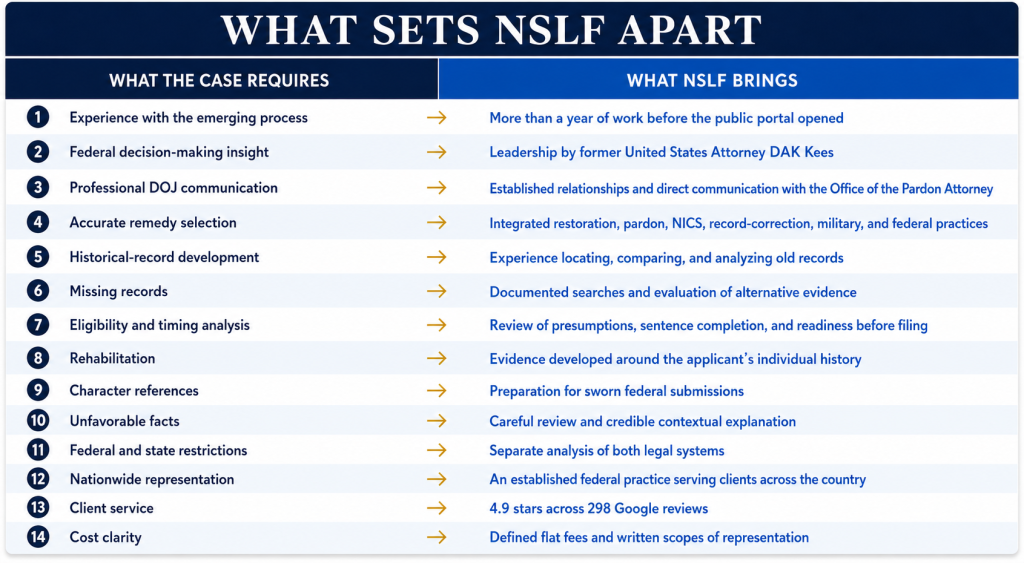
Frequently Asked Questions About Choosing NSLF
Why does pre-portal experience matter?
NSLF began working with § 925(c) matters before DOJ finalized the current process. Our attorneys gained practical experience evaluating eligibility, collecting records, developing evidence, preparing references, and adapting pending matters as DOJ’s requirements evolved.
Who leads NSLF’s federal firearm rights restoration practice?
The practice is led by Dak Kees, the former United States Attorney for the Western District of Arkansas. His experience supervising federal investigations and evaluating evidence informs the firm’s approach to public safety, credibility, mitigation, and federal discretion.
Does NSLF represent clients nationwide?
Yes. NSLF represents clients throughout the United States in federal firearm rights restoration matters. A separate state proceeding may require state-specific counsel or an additional engagement.
Does NSLF accept every person who wants to apply?
No. Our attorneys evaluate whether § 925(c) is the correct remedy, whether the timing is appropriate, and whether the available facts and evidence support moving forward.
Will NSLF help obtain the necessary records?
Yes. Our representation generally includes identifying and helping obtain the records necessary to evaluate and prepare the application.
Can NSLF handle complicated military, mental-health, or domestic-violence cases?
Yes. NSLF has federal, military, pardon, NICS, record-correction, and administrative-law experience relevant to these matters. The appropriate strategy depends on the precise record and applicable prohibitions.
Can NSLF pursue a presidential pardon instead of § 925(c)?
Yes. Dak also leads the firm’s presidential pardon practice. Our attorneys evaluate which federal remedy best fits the client’s history and objectives.
How much does representation cost?
Most § 925(c) matters involve a $5,000 flat fee. Certain complex matters require a $7,500 flat fee. Government charges and third-party expenses are separate.
Can any law firm promise that DOJ will restore my rights?
No. Every application is evaluated on its individual facts, and no law firm can promise a particular outcome or decision timeline.
Speak With NSLF About Federal Firearm Rights Restoration
The opening of the § 925(c) process creates an important opportunity. It also creates pressure to move quickly before the applicant understands the record, eligibility rules, waiting periods, and possible consequences.
Before submitting a sworn federal application, determine:
- Why federal law prohibits you;
- Whether the government’s records are accurate;
- Whether state law creates a separate restriction;
- Which DOJ presumptions may apply;
- Whether the relevant waiting period has expired;
- What unfavorable information DOJ may review;
- Whether another remedy should be pursued first;
- Which records are missing;
- Which evidence demonstrates rehabilitation; and
- Whether your application is ready for federal review.
National Security Law Firm began doing this work more than a year before DOJ finalized its rule and opened the public portal. Our practice is led by former United States Attorney Dak Kees and supported by a nationwide team experienced in the federal systems that frequently intersect with firearm rights.
We know how to investigate the history, identify the weaknesses, develop the evidence, and present the strongest accurate case the record can support.
Book a Free, Confidential Consultation to speak directly with an attorney about your potential eligibility and next steps. Online booking provides immediate confirmation, and appointment times appear automatically in your local time zone.
Prefer to call? Call National Security Law Firm at (202) 600-4996.
LEGAL DISCLAIMER
This page provides general legal information and does not constitute legal advice. Eligibility, strategy, fees, and potential outcomes depend on the individual facts, applicable federal and state law, available records, and current DOJ procedures. Every application is evaluated on its individual facts, and no law firm can promise a particular outcome or decision timeline.
AUTHOR AND REVIEW INFORMATION
Attorney reviewer: Dak Kees, former United States Attorney
Last legally reviewed: August 2026
PRIMARY GOVERNMENT RESOURCES