A Transportation Security Administration decision can put your livelihood at risk. If TSA has denied, revoked, or invalidated your Transportation Worker Identification Credential (TWIC) or Hazardous Materials Endorsement (HME) eligibility, the next step depends on why TSA acted and whether the information in its records is correct.
You may need an appeal, a waiver, or both. In more advanced cases, you may need review by a TSA Administrative Law Judge or the TSA Final Decision Maker.
National Security Law Firm represents transportation workers nationwide in TSA security threat assessment matters. We have handled TWIC and HME cases since 2016, have represented applicants in hundreds of matters, and regularly communicate with TSA in the ordinary course of those adjudications.
For qualifying initial TSA appeals and waiver matters, our flat legal fee is $2,495. We obtain the necessary records, analyze the applicable federal rules, prepare the legal and factual submission, and manage the matter through TSA’s initial administrative process.
Received a TSA letter? Send us your TSA letter for attorney review.
We Handle TSA Appeals and Waivers Nationwide
Our TSA credential practice includes:
- TWIC appeals and waiver requests
- Hazardous Materials Endorsement appeals and waivers
- Preliminary Determinations of Ineligibility
- Initial Determinations of Threat Assessment
- Final Determinations of Threat Assessment
- Immediate TWIC or HME invalidation
- Criminal-history record errors
- Misidentified or incomplete criminal cases
- Disputes over whether an offense is disqualifying
- Immigration-status determinations, when accepted by the firm
- Mental-capacity determinations, when accepted by the firm
- Appeals based on TSA’s “other analyses”
- Waiver-denial review before a TSA Administrative Law Judge
- Review by the TSA Final Decision Maker
Although TWIC and HME cases involve comparable TSA security threat assessments, they are not identical. An HME applicant must also satisfy state commercial driver’s license requirements and applicable Federal Motor Carrier Safety Administration rules.
What Should You Do After Receiving a TSA Letter?
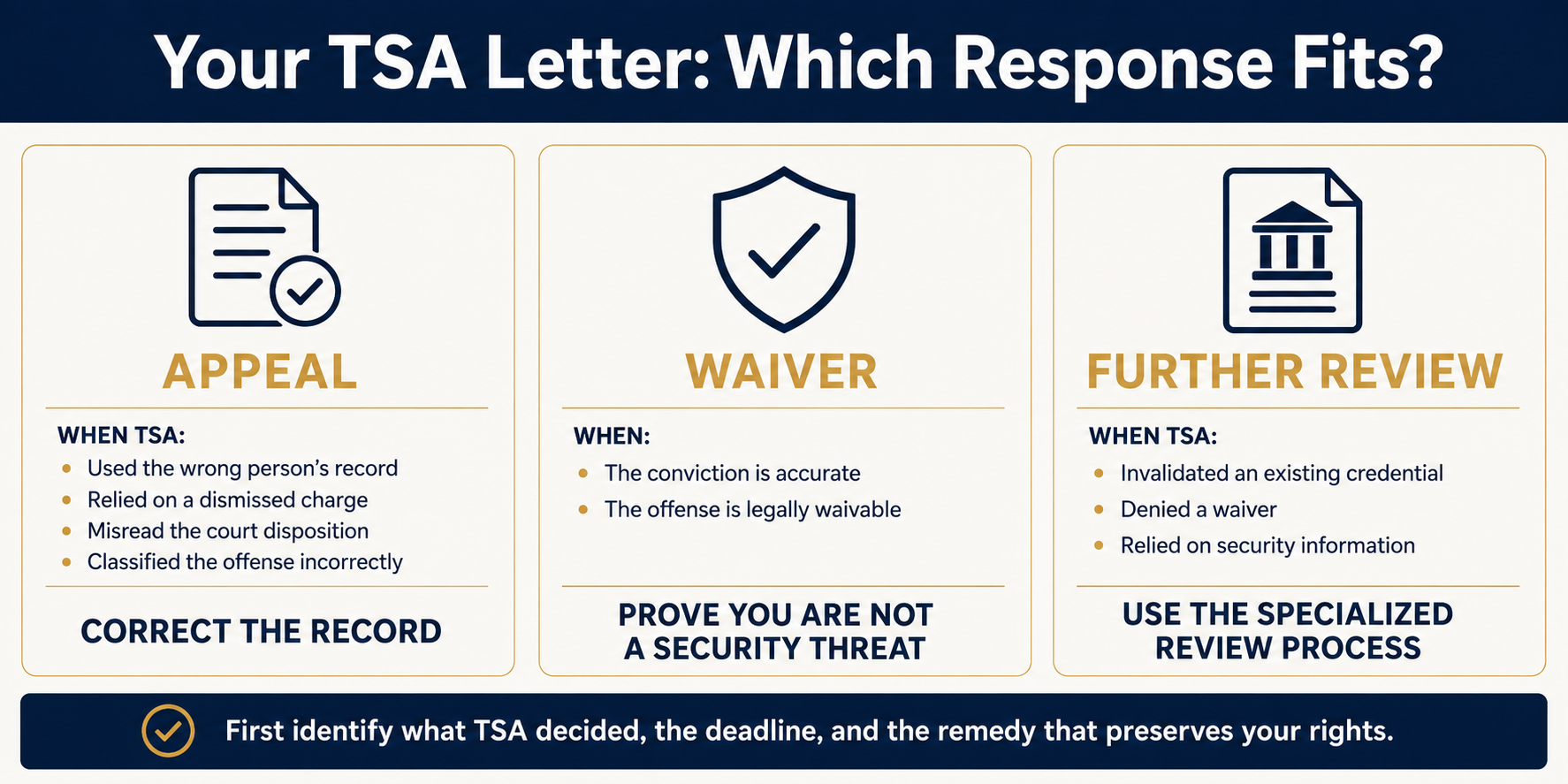
Do not assume that every adverse TSA letter calls for the same response. The correct procedure depends on the type of letter, the basis for TSA’s decision, and whether the government’s information is accurate.
If you recently received a letter, read our guide explaining what to do after a TSA Preliminary Determination of Ineligibility.
TWIC Appeals and Waivers
A TWIC is required for many workers who need unescorted access to secure areas of federally regulated maritime facilities and vessels. TSA conducts a security threat assessment before determining whether an applicant is eligible.
A criminal history does not automatically mean that a person is permanently ineligible. TSA’s regulations distinguish among:
- Permanently disqualifying offenses
- Interim disqualifying offenses
- Offenses that may support a waiver
- Offenses that are not listed as disqualifying
- Pending indictments or findings of not guilty by reason of insanity
- Immigration, mental-capacity, and other security-related determinations
If TSA’s information is wrong, an applicant may need an appeal. If TSA’s information is correct but the disqualification is waivable, the applicant may need a waiver demonstrating rehabilitation, responsibility, and why granting the credential would not pose a security threat.
Our guide to appealing for a TWIC card explains the basic difference between challenging TSA’s facts and asking TSA to exercise its waiver authority.
HME Appeals and Waivers
A driver seeking a Hazardous Materials Endorsement must complete TSA’s security threat assessment in addition to satisfying the CDL requirements imposed by the driver’s licensing state.
TSA may find an applicant ineligible based on a disqualifying criminal offense, immigration status, a mental-capacity determination, or other security-related information. The applicant may be able to dispute the finding, request a waiver, or pursue both forms of relief.
Not every felony prevents a driver from receiving an HME. Eligibility depends on the precise offense, the date of conviction or release from incarceration, whether the applicant remains under indictment, how the offense is classified under federal regulations, and whether TSA permits a waiver.
Our detailed guide, Can a Felon Get a Hazmat Endorsement?, explains how the federal disqualification rules affect drivers with criminal histories.
An HME appeal also does not override an independent state or federal CDL disqualification. We therefore examine both TSA’s security threat assessment and the separate licensing issue when both may affect the driver.
The Difference Between a TSA Appeal and a Waiver
The words “appeal” and “waiver” are sometimes used interchangeably, but they involve different legal arguments.
A TSA Appeal Challenges the Determination
An appeal generally argues that TSA’s adverse determination is factually or legally incorrect. Examples include:
- The criminal record belongs to someone else.
- The charge was dismissed.
- The applicant was acquitted.
- The conviction was overturned.
- The court records were incomplete or incorrectly reported.
- TSA used the wrong conviction or release date.
- The offense does not match a disqualifying offense listed in the regulations.
- The applicant has lawful immigration status that TSA did not recognize.
- TSA relied on outdated or incorrect mental-capacity information.
A strong appeal does more than tell TSA that its decision is wrong. It identifies the disputed finding, supplies reliable records, applies the governing law, and clearly explains the relief requested.
A TSA Waiver Accepts the Record but Requests Relief
A waiver ordinarily applies when the disqualifying event is accurately reported but TSA has authority to grant relief.
The waiver request should present a documented case that the applicant no longer poses the risk associated with the underlying disqualification. Depending on the facts, relevant evidence may include:
- The age and circumstances of the offense
- The applicant’s conduct since the offense
- Completion of probation, parole, or supervised release
- Treatment, education, or rehabilitation
- Employment history
- Professional qualifications
- Community involvement
- Family responsibilities
- Letters from employers, supervisors, counselors, or community members
- Evidence of candor and personal responsibility
- The consequences that continued ineligibility will have on the applicant’s career
A waiver is not simply a request for sympathy. It is an evidence-based submission directed to TSA’s regulatory authority and security concerns.
Read our TWIC waiver request FAQs for more information about assembling and presenting a waiver case.
Can You Appeal and Request a Waiver at the Same Time?
In an appropriate case, yes.
For example, an applicant may argue that the offense is not disqualifying because it does not satisfy the elements of the federal offense identified by TSA. The applicant may also request a waiver in the alternative in case TSA rejects that legal argument.
This approach can preserve multiple paths to relief, but it must be handled carefully. A poorly written alternative argument can appear inconsistent or may unnecessarily concede a disputed fact.
We determine whether an appeal, waiver, or combined submission best fits the record before preparing the response.
What Is an Immediate Revocation or Invalidation?
TSA may immediately invalidate an existing TWIC or HME determination in circumstances identified by the federal regulations. An immediate invalidation can be especially disruptive because the worker may lose access or eligibility before completing the ordinary administrative process.
The notice should identify the applicable procedure and explain the opportunity to respond. These cases require prompt attention because the worker may be unable to perform essential job duties while the credential remains invalid.
If TSA has invalidated your credential, send us the complete letter—not only the first page—so we can identify the stated basis, the governing procedure, and the response deadline.
Criminal-Record Errors Are More Common Than Many Applicants Realize
An FBI or state criminal-history record may omit the final disposition of a charge. Similar names and identifying information can cause mismatches. Court systems may use abbreviations that do not clearly show whether a matter was dismissed, reduced, vacated, or resolved under a diversionary program.
Even when the basic record is correct, TSA may need additional documents to determine:
- The exact statute of conviction
- The elements of the offense
- Whether the conviction matches a federal disqualifying category
- The date of conviction
- The date the applicant was released from incarceration
- Whether a pending charge remains active
- Whether a later court order changed the disposition
That is why we do not rely solely on an applicant’s memory or a commercial background report. We identify and obtain the records needed to establish the legally relevant facts.
Immigration and Mental-Capacity Determinations
TSA’s security threat assessment is not limited to criminal convictions. The regulations also contain immigration-status and mental-capacity eligibility standards.
These cases may require different evidence from an ordinary criminal-history appeal. Immigration-related matters may turn on the applicant’s precise status and current federal documentation. Mental-capacity matters may involve court records, restoration orders, medical information, or evidence that the reported condition does not satisfy TSA’s regulatory standard.
National Security Law Firm reviews immigration and mental-capacity TSA matters on a case-by-case basis. Acceptance depends on the type of determination, the available records, and whether the firm can provide effective representation within the applicable deadline.
Administrative Law Judge and TSA Final Decision Maker Review
An adverse initial decision is not always the end of the administrative process.
Under 49 C.F.R. § 1515.11, certain applicants may request review by a TSA Administrative Law Judge after TSA denies a waiver or issues a qualifying Final Determination of Threat Assessment. The deadline may be substantially shorter than the deadline at the initial TSA stage.
ALJ review is not an opportunity to rebuild the case from the beginning. The record developed before TSA can limit what the applicant may present later. This makes it important to submit the strongest available evidence during the initial appeal or waiver process.
Depending on the case, the administrative process may include:
- A request for review by a TSA Administrative Law Judge.
- Written briefs addressing the disputed issues.
- A hearing if the applicable procedure permits or requires one.
- An initial decision from the ALJ.
- An appeal to the TSA Final Decision Maker.
- Potential judicial review in the appropriate federal court of appeals under 49 U.S.C. § 46110.
Representation beyond the initial TSA appeal or waiver—including ALJ proceedings, hearings, Final Decision Maker review, and federal-court litigation—is separately evaluated and quoted.
Why the First Submission Matters
Applicants sometimes send TSA a short personal explanation and plan to provide additional evidence if TSA says no. That approach can create serious problems.
A later reviewing official may focus on the record already presented to TSA. Missing court documents, unsupported factual claims, inconsistent explanations, or an incomplete rehabilitation record may be difficult to correct after an adverse decision.
The initial submission should be treated as a formal legal filing. It should:
- Identify the precise decision being challenged
- Meet the applicable deadline
- Address each stated ground for ineligibility
- Include reliable supporting records
- Distinguish disputed facts from waiver evidence
- Apply the correct statutes and regulations
- Explain exactly what action TSA is being asked to take
- Preserve issues that may matter during later review
What Our $2,495 TSA Representation Includes
For qualifying matters at the initial TSA appeal or waiver stage, National Security Law Firm charges a flat, all-inclusive legal fee of $2,495.
Our representation generally includes:
- Attorney review of the complete TSA notice
- Analysis of the applicable disqualification
- Identification of the correct appeal or waiver procedure
- A customized records plan
- Obtaining necessary court and disposition records
- Reviewing criminal-history documents
- Legal research concerning the offense and TSA regulations
- Preparing the appeal, waiver, or combined submission
- Organizing supporting exhibits
- Drafting the applicant’s personal statement when appropriate
- Guidance concerning supporting letters and rehabilitation evidence
- Submission to TSA
- Tracking the matter through the covered initial administrative stage
- Responding to ordinary TSA correspondence within the agreed scope
- Providing the client with copies of the completed submission
The fee covers the legal services stated in the engagement agreement. Unusual third-party expenses, extensive litigation, ALJ proceedings, hearings, Final Decision Maker appeals, or federal-court review are not included unless expressly stated and may require a separate agreement.
Payment-plan options may be available. For more details about the separate government and legal costs involved in these matters, see our guides to TWIC card costs and lawyer fees and Hazmat endorsement costs and appeal lawyer fees.
Our Refund Guarantee for Qualifying Cases
We offer a written refund guarantee in qualifying TWIC and HME matters because we carefully evaluate cases before accepting them and have achieved strong results for the applicants we represent.
The guarantee is not a promise that TSA will approve an appeal, grant a waiver, or issue a credential. No lawyer controls TSA, and legal and ethical rules do not permit an attorney to guarantee a government decision.
Instead, when the guarantee applies, the written engagement agreement specifies the circumstances under which National Security Law Firm will refund the covered $2,495 legal fee if the agreed result is not achieved. The precise terms, scope, exclusions, and client responsibilities are stated in that agreement.
We do not accept every case. Before offering guaranteed representation, we review the TSA notice, the nature of the disqualification, the procedural posture, and the known facts. A matter is not covered by a guarantee unless the firm confirms that coverage in writing.
Why Transportation Workers Choose National Security Law Firm
More Than a Decade Handling TSA Credential Matters
National Security Law Firm has handled TWIC and HME appeals and waivers since 2016. TSA credential work is an established part of our nationwide federal administrative practice—not an occasional addition to a general criminal practice.
Hundreds of Matters Handled
We have represented applicants in hundreds of TSA credential matters. That experience helps us recognize recurring record problems, identify the documents TSA is likely to need, and distinguish an appeal case from a waiver case.
We Handle the Records Process
Clients should not have to determine which courthouse possesses a decades-old file or decipher an incomplete criminal-history report by themselves. We identify the relevant records and work to obtain them as part of the covered representation.
Legal Analysis of the Actual Offense
A label on a background check does not always answer whether an offense is disqualifying. We compare the statute, disposition, sentence, dates, and available court records with TSA’s governing federal standards.
Nationwide Representation
These are federal administrative matters. We represent applicants throughout the United States without requiring them to travel to our office for the initial TSA process.
Documented Experience With Difficult Cases
Our prior matters include obtaining relief for applicants with serious and complicated criminal histories. Examples include:
- A TWIC denial overturned for a client charged with weapons offenses
- A TWIC waiver granted for a client convicted of possessing a controlled dangerous substance for sale
- A successful TWIC case resulting in credential approval
- A waiver application prepared for a client with a conspiracy-to-distribute conviction
Past results do not guarantee a similar outcome. Every TSA determination depends on its own facts, records, procedural history, and applicable law.
When You May Not Need a TSA Appeal Lawyer
Not every TWIC or HME applicant needs legal representation.
You may be able to respond without counsel when:
- TSA requests a simple document that you already possess.
- The record contains an obvious clerical error that can be corrected easily.
- You have no adverse TSA determination and only need routine enrollment information.
- Your issue concerns an ordinary CDL test, training requirement, fingerprint appointment, or state licensing fee.
- You need to replace an expired or lost card and have no eligibility problem.
Legal representation becomes more valuable when the case involves a disqualifying offense, incomplete court records, a disputed statutory classification, an old conviction, multiple criminal matters, immediate invalidation, a waiver request, or the possibility of advanced administrative review.
TSA Credential Appeals and Related Federal Matters
This page addresses TSA security threat assessment appeals and waivers involving TWIC and HME eligibility.
Related credentials may be governed by different agencies and procedures. Mariners facing Coast Guard credential action should review our Merchant Mariner Credential defense practice. Airport workers dealing with access-badge problems can read about SIDA badge denial and revocation matters.
A person may face more than one credential problem arising from the same event. For example, a criminal case could affect a TWIC, an HME, a Merchant Mariner Credential, or airport access. Each agency’s governing standard and deadline must be analyzed separately.
Frequently Asked Questions About TSA Appeals and Waivers
How long do I have to respond to TSA?
The deadline depends on the type of notice and the stage of the case. Some initial appeal and waiver procedures provide 60 days, while certain ALJ review requests must be filed within 30 calendar days. Do not calculate the deadline from memory or from a general website. Review the instructions in your specific TSA letter immediately.
Should I appeal or request a waiver?
Appeal when TSA’s facts or legal conclusion are wrong. Request a waiver when the disqualifying information is accurate but TSA has authority to grant relief. Some cases justify both arguments.
Can an expungement or pardon help?
Possibly, but the effect depends on the type of relief, the underlying offense, and TSA’s federal definitions. A state’s treatment of a conviction does not always determine how a federal agency must treat it. The actual court order and governing law should be reviewed before making a claim to TSA.
Can I submit an ordinary background check?
A commercial background report may help identify a problem, but TSA may require official court, law-enforcement, or agency records. Certified dispositions and complete docket materials are often more persuasive than a commercial report.
Does the $2,495 fee include court records?
The flat fee includes our work identifying and obtaining the ordinary court records needed for a qualifying initial TSA matter. The engagement agreement explains the precise scope and whether any unusual third-party expense is excluded.
Does hiring a lawyer guarantee approval?
No. TSA makes the decision, and no attorney can ethically promise a specific government result. Qualifying cases may receive a written refund guarantee covering the legal fee, but that financial commitment is not a guarantee of approval.
Do you represent applicants outside your home state?
Yes. National Security Law Firm represents TSA credential applicants nationwide because TWIC and HME security threat assessments are administered under federal law.
What should I send for an attorney review?
Send the complete TSA letter, including every page and attachment. If available, also provide the criminal-history record, court documents, prior TSA correspondence, and the date you received the notice.
Send Us Your TSA Letter for Attorney Review
A TSA letter can affect your job, income, and ability to remain in the transportation industry. The strongest response begins with identifying the correct procedure, obtaining the correct records, and building the administrative record before the deadline expires.
National Security Law Firm has represented TWIC and HME applicants since 2016. For qualifying initial matters, we offer nationwide representation for a flat $2,495 legal fee, handle the records and submission process for you, and may provide a written refund guarantee subject to the terms of the engagement agreement.
Official Resources
- TSA: Transportation Worker Identification Credential
- TSA: Hazardous Materials Endorsement
- 49 C.F.R. Part 1572—Credentialing and Security Threat Assessments
- 49 C.F.R. § 1572.103—Disqualifying Criminal Offenses
- 49 C.F.R. Part 1515—Appeal and Waiver Procedures
- 49 C.F.R. § 1515.5—Appeal of an Initial Determination
- 49 C.F.R. § 1515.7—Waiver Procedures
- 49 C.F.R. § 1515.9—Appeals Based on Other Analyses
- 49 C.F.R. § 1515.11—Administrative Law Judge Review
- 46 U.S.C. § 70105—Transportation Security Cards
- 49 U.S.C. § 5103a—Security Background Checks for Hazmat Drivers
Author: Katherine O’Brien, Esq., Founder, National Security Law Firm
Attorney Reviewed: August 25, 2026
This page provides general information and is not legal advice. Viewing this page or contacting the firm does not create an attorney-client relationship. Past results do not guarantee future outcomes. Any fee, scope of representation, payment plan, or refund guarantee is governed exclusively by a signed written engagement agreement.