
A hazardous materials endorsement can open the door to better-paying driving positions, specialized routes, and additional career opportunities. But the total cost of obtaining an HME is not limited to one application fee.
Depending on your circumstances and state, the overall expense may include:
- TSA’s security threat assessment fee;
- State application and endorsement fees;
- Entry-Level Driver Training;
- The state knowledge test;
- CDL renewal or replacement fees; and
- Legal representation if TSA determines that you may be ineligible.
The most important distinction is between the ordinary cost of applying for an HME and the cost of challenging a TSA determination. Most drivers do not need a lawyer to complete a routine application. Legal representation becomes valuable when TSA relies on a criminal record, warrant, indictment, immigration issue, mental-capacity determination, or other security concern to delay, deny, or revoke the endorsement.
As of August 2026, TSA charges most new and renewing HME applicants $85.25 for the federal security threat assessment. A qualifying applicant who holds a valid Transportation Worker Identification Credential may be eligible for a reduced $41 fee if the applicant’s licensing state participates in TSA’s comparability program.
State, testing, and training expenses are separate and vary considerably.
If TSA issues an adverse determination, National Security Law Firm charges a flat legal fee of $2,495 for eligible HME appeal or waiver representation. We have handled TWIC and HME matters since 2016 and have represented hundreds of workers nationwide. In the cases we accept, we do the work for the client—from obtaining records and analyzing the alleged disqualification to developing the evidence, preparing the legal arguments, and submitting the complete case to TSA.
Qualifying engagements are backed by our written money-back guarantee. This does not mean that we guarantee or control TSA’s decision. No lawyer can promise how a federal agency will rule. The guarantee means that if NSLF accepts a qualifying case under the written guarantee and does not obtain the result expressly covered by the engagement agreement, the firm will refund the client’s $2,495 legal fee according to those terms.
How Much Does a Hazmat Endorsement Cost?
There is no single nationwide total because the HME process includes both federal and state components.
A typical applicant may encounter the following expenses:
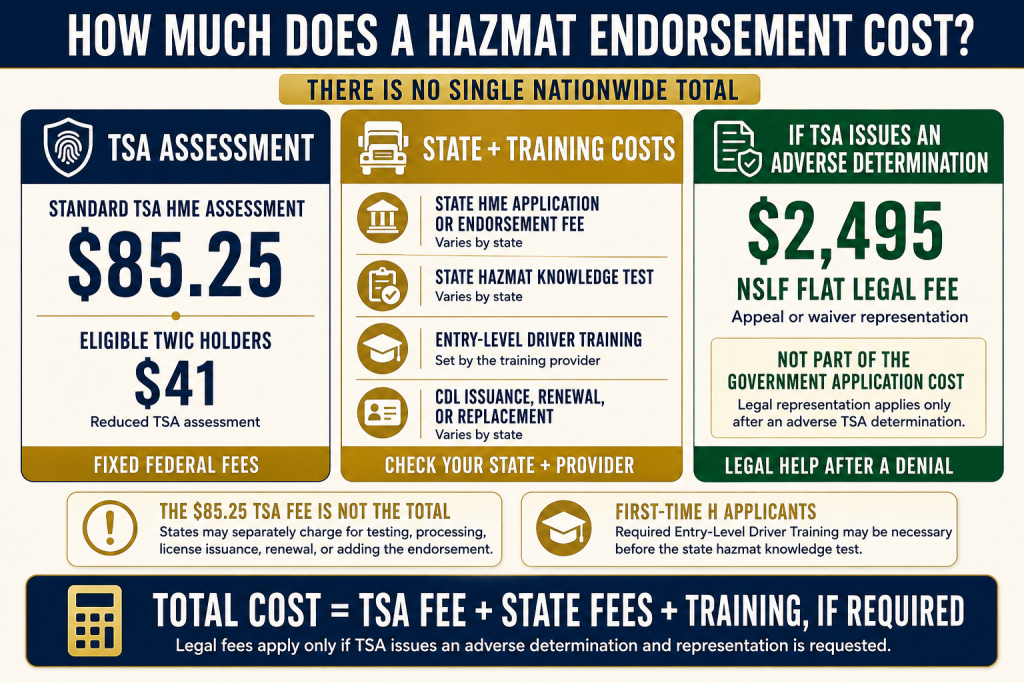
The $85.25 TSA fee is not the complete cost of adding the endorsement to your CDL. Your state may separately charge for testing, processing, issuing a new license, renewing your CDL, or adding the endorsement.
First-time H endorsement applicants may also need to complete required Entry-Level Driver Training before taking the state-administered hazmat knowledge test.
What Does the $85.25 TSA Fee Cover?
Before a state may issue, renew, or transfer a hazardous materials endorsement, TSA must conduct a security threat assessment.
The federal fee supports the costs associated with:
- Collecting the applicant’s information;
- Processing fingerprints;
- Conducting the FBI criminal-history check;
- Conducting TSA’s security threat assessment; and
- Administering the HME enrollment process.
Federal regulations divide the assessment cost into components that include the information-collection fee, threat-assessment fee, and FBI fee. The current total charged by TSA’s enrollment provider is $85.25 for a standard new or renewal application.
TSA periodically reviews and may change these fees. Applicants should confirm the current amount through the official TSA HME program page before applying.
Who Qualifies for the Reduced $41 HME Fee?
Some drivers who already hold a valid TWIC may qualify for a reduced HME enrollment fee of $41.
TSA considers the security threat assessment conducted for a TWIC comparable to the assessment used for an HME. A qualifying applicant may therefore avoid paying for a completely duplicative assessment.
The reduced fee generally requires:
- A valid TWIC;
- A commercial driver’s license issued by a state that supports comparability; and
- Satisfaction of TSA’s enrollment and identity-verification requirements.
Not every state processes comparable assessments in the same way. Drivers should use TSA’s official reduced-fee eligibility tool before assuming that the $41 rate applies.
The reverse arrangement may also provide a reduced fee in some circumstances: a driver who holds a qualifying HME may be eligible for a reduced fee when applying for a TWIC. Drivers who need both credentials should therefore consider the order in which they apply and review TSA’s current comparability rules.
Are State Fees Included in the TSA Fee?
No. TSA’s security threat assessment fee and the state’s licensing fees are separate.
Your state may charge for:
- The HME application;
- The hazmat knowledge test;
- Retaking a failed test;
- Adding the endorsement to an existing CDL;
- Issuing a replacement CDL;
- Renewing the CDL;
- Fingerprinting or administrative processing, depending on the state’s procedure; and
- Other state-specific requirements.
Federal regulations expressly permit states to collect additional fees from HME applicants. Because those amounts and procedures vary, applicants should consult their state driver-licensing agency for the current total.
A website quoting one universal “hazmat endorsement price” without discussing state variation is incomplete. The final amount depends on where your CDL was issued, whether you are applying for the first time or renewing, whether a new physical license must be produced, and whether training is required.
Do You Have to Pay for Hazmat Training?
First-time H endorsement applicants are generally subject to the Federal Motor Carrier Safety Administration’s Entry-Level Driver Training requirements.
A driver seeking an H endorsement for the first time must ordinarily complete the required hazmat theory training through a provider listed in FMCSA’s Training Provider Registry before the state administers the hazmat knowledge test.
FMCSA establishes the minimum training requirements but does not establish one national price. Each registered provider determines what it charges.
Training costs may depend on:
- Whether the program is online or in person;
- The provider;
- The amount of instructional support;
- Whether practice tests or supplemental materials are included;
- Whether the employer pays for the training; and
- Whether the driver purchases the training as part of a broader CDL program.
Drivers can verify whether a provider is registered through the FMCSA Training Provider Registry.
Some applicants are exempt or were grandfathered based on when they previously obtained the endorsement or satisfied applicable requirements. A driver should verify eligibility before paying for a course that may not be necessary.
Is the Hazmat Knowledge Test a Separate Cost?
Usually, yes. The hazmat knowledge test is administered through the state licensing agency, not TSA’s enrollment provider.
The TSA assessment and the knowledge test answer different questions:
- TSA’s security threat assessment determines whether the applicant poses a security threat under federal credentialing standards.
- The state knowledge test determines whether the applicant possesses the required knowledge to transport hazardous materials safely.
- The state CDL process determines whether the driver satisfies the jurisdiction’s licensing requirements.
Passing the knowledge test does not guarantee TSA approval. Likewise, receiving a favorable TSA determination does not excuse the driver from required training, testing, or other CDL qualifications.
Does an Employer Ever Pay the HME Costs?
Some employers pay or reimburse:
- TSA’s assessment fee;
- Training expenses;
- State testing fees;
- CDL replacement costs; or
- Renewal costs.
Federal regulations permit an employer to pay the TSA assessment fee on behalf of an applicant. Whether an employer will do so is a matter of company policy or an employment agreement.
Drivers should ask whether reimbursement is:
- Available before incurring the expense;
- Conditioned on passing the assessment or knowledge test;
- Conditioned on remaining employed for a particular period;
- Treated as taxable compensation; or
- Required to be repaid if the employee leaves.
Even when an employer pays the routine application costs, it may not pay the expense of an individual appeal or waiver arising from the applicant’s personal criminal history.
How Much Does a Hazmat Endorsement Appeal or Waiver Lawyer Cost?
National Security Law Firm charges a flat legal fee of $2,495 for eligible HME appeal or waiver representation.
This legal fee is separate from:
- TSA’s enrollment fee;
- State licensing and testing fees;
- Training-provider charges; and
- Other third-party expenses outside the engagement.
We use a flat fee because a driver facing a TSA determination should know the legal cost before deciding whether to proceed. The client does not receive a series of hourly bills for routine communications, legal research, drafting, or work included within the agreed scope.
The engagement agreement identifies precisely what is covered. Proceedings beyond the initial TSA appeal or waiver—such as administrative law judge review, TSA Final Decision Maker review, or federal appellate litigation—are not included unless the written agreement expressly says otherwise.
What Does NSLF’s $2,495 Legal Fee Include?
NSLF does not merely provide a template or tell the client what to send. We develop and prepare the case.
Depending on the facts and the scope of the engagement, our work may include:
- Reviewing the TSA determination and all enclosures;
- Identifying each stated ground for ineligibility;
- Determining whether the driver needs an appeal, a waiver, or both;
- Requesting the releasable materials TSA relied upon when appropriate;
- Locating and obtaining relevant court records;
- Obtaining judgments, dispositions, charging documents, sentencing materials, and records showing sentence completion;
- Obtaining probation, parole, or release information;
- Researching the underlying federal, state, or military offense;
- Determining whether the offense actually falls within a TSA disqualifying category;
- Calculating the seven-year conviction and five-year release periods;
- Identifying incomplete or inaccurate criminal-history information;
- Evaluating the effect of dismissals, amended charges, pardons, expungements, or vacated convictions;
- Helping the client obtain persuasive character and employment evidence;
- Developing documentation of rehabilitation, treatment, education, training, community involvement, and present reliability;
- Preparing or assisting with the client’s personal statement;
- Drafting the factual and legal arguments;
- Organizing the supporting evidence;
- Preparing and submitting the complete appeal or waiver package;
- Responding to covered requests from TSA; and
- Keeping the client informed during the process.
The exact work depends on the reason TSA identified. An appeal based on a missing dismissal requires different evidence from a discretionary waiver involving a recent felony conviction.
Our HME appeal and waiver lawyers begin by identifying the actual legal and factual problem. We do not assume every applicant needs the same response.
Why Would Someone Pay a Lawyer if TSA Allows Self-Representation?
You are not legally required to hire a lawyer to submit an HME appeal or waiver.
Some matters are straightforward. For example, an applicant may be able to resolve a clear record error by obtaining and submitting a certified dismissal. We do not believe every person who receives a TSA letter necessarily needs paid representation, and we do not accept every case.
Legal assistance becomes more valuable when:
- The offense classification is disputed;
- The court record is old, incomplete, or difficult to locate;
- TSA appears to have treated a misdemeanor as a felony;
- Several charges or convictions are involved;
- The applicant’s conviction or release dates are unclear;
- A state offense does not map neatly onto TSA’s federal categories;
- The applicant needs a discretionary waiver;
- TSA identifies multiple grounds for ineligibility;
- The endorsement has been immediately revoked;
- The applicant’s current job or pending offer depends on the HME;
- The applicant may face a separate state or FMCSA problem; or
- The case may require further administrative review.
The first submission can be especially important. If TSA denies a waiver and the applicant seeks review before an administrative law judge under 49 C.F.R. § 1515.11, the ALJ generally may consider only evidence that was previously submitted to TSA with the waiver request.
A driver who submits an incomplete waiver may not be able to add missing evidence during that review. New evidence can require a new waiver request and dismissal of the pending ALJ proceeding.
That is why our representation focuses on developing a complete administrative record—not simply sending TSA a short letter.
What Is the Difference Between an HME Appeal and a Waiver?
An appeal and a waiver are different forms of relief.
An HME appeal challenges TSA’s determination
An appeal may be appropriate when:
- The criminal record belongs to someone else;
- The charge was dismissed;
- The applicant was acquitted;
- The offense was a misdemeanor rather than a felony;
- TSA relied on an arrest without a disposition;
- The conviction was overturned or vacated;
- A pardon or qualifying record-clearing order changed the legal status of the conviction;
- The offense does not match a listed TSA disqualification;
- The applicable conviction or incarceration period has expired;
- TSA relied on incorrect immigration information; or
- Another underlying record is incomplete or inaccurate.
An appeal argues that the applicant satisfies TSA’s standards and that the adverse determination should be withdrawn.
An HME waiver asks TSA for discretionary relief
A waiver may be necessary when a waivable disqualification genuinely applies.
The applicant must persuade TSA that, despite the disqualifying condition, the person does not pose a security threat warranting denial of the endorsement.
Under 49 C.F.R. § 1515.7, TSA may consider:
- The circumstances surrounding the act or offense;
- Restitution;
- Federal or state mitigation remedies;
- Relevant court or official medical-release records; and
- Other evidence showing that the applicant does not pose a security threat.
That final category permits a developed presentation addressing the applicant’s conduct since the offense, employment history, treatment, sobriety, training, character, safety record, family responsibilities, community involvement, and other evidence of rehabilitation and present reliability.
Some applicants should pursue both forms of relief: an appeal arguing that TSA’s determination is wrong and, alternatively, a waiver if TSA disagrees.
Our TSA appeal lawyers evaluate the stated grounds before recommending a strategy.
What Happens if You Receive a TSA Ineligibility Letter?
Do not ignore the letter, and do not assume that TSA’s preliminary conclusion is final.
If you receive a Preliminary Determination of Ineligibility from TSA, preserve:
- The complete letter;
- Every enclosure;
- The envelope or delivery information;
- Any state notice relating to the endorsement;
- Your TSA enrollment information; and
- Records relating to the offense or other concern TSA identified.
The letter should explain the basis for TSA’s determination and the available procedures. The applicable regulations generally provide 60 days to initiate an appeal from an Initial Determination by submitting a written reply, requesting TSA’s materials, or requesting an extension.
Waiver timing is different. A waiver may be requested during the application process and generally no later than 60 days after service of the Final Determination of Threat Assessment.
Because the correct deadline depends on the type and procedural posture of the letter, applicants should not rely solely on a general internet summary. Read the specific notice carefully.
How Does the NSLF Money-Back Guarantee Work?
NSLF does not guarantee that TSA will approve an HME, grant a waiver, or withdraw an adverse determination. TSA is an independent federal agency, and no lawyer can ethically promise how it will decide a particular case.
Our money-back guarantee is a guarantee of the legal fee in qualifying engagements—not a guarantee of TSA’s decision.
We have represented applicants in TWIC and HME matters since 2016—more than a decade—and have handled hundreds of cases nationwide. Our experience includes obtaining records from courts across the country, analyzing state and federal offenses, correcting incomplete background information, preparing rehabilitation evidence, and communicating with TSA throughout the adjudication process.
Because of that experience and our record of success, we are willing to place our fee at risk in qualifying cases. But we do not accept every matter, and not every case qualifies for guaranteed representation.
When NSLF accepts a qualifying case under its written guarantee:
- The engagement agreement identifies the result covered by the guarantee.
- The client pays the $2,495 legal fee.
- NSLF provides the representation included in the written scope.
- If NSLF does not obtain the result expressly covered by the guarantee, the firm refunds the $2,495 legal fee according to the engagement terms.
The guarantee does not apply beyond its written terms and should not be understood as a promise, prediction, or assurance of any government decision. Past results also do not guarantee a similar result in a future case.
Why Choose National Security Law Firm?
NSLF has handled TWIC and HME appeals and waivers since 2016. This is a longstanding federal credentialing practice, not a service added without an established history.
Our experience includes:
- Hundreds of TWIC and HME matters;
- Nationwide representation;
- Direct experience presenting appeals and waivers to TSA;
- Criminal-record analysis across numerous jurisdictions;
- Obtaining difficult or incomplete court records;
- Identifying when TSA relied on an arrest rather than a conviction;
- Correcting situations in which a misdemeanor was treated as a felony;
- Calculating interim disqualification periods;
- Building documented rehabilitation cases;
- Responding when a client’s job or offer depends on the credential; and
- Published, fact-specific examples of successful representation.
For example, NSLF overturned a TWIC denial after TSA relied on misdemeanor weapons offenses and obtained a TWIC waiver for a client with a felony controlled-substance conviction.
Those matters involved TWIC rather than HME, but TSA applies substantially the same federal criminal-disqualification and waiver regulations to both credentials. Every case remains dependent on its own facts, records, legal issues, and evidence.
Most importantly, we do the work for our clients. We do not sell a form, provide a generic checklist, or leave the driver to locate decades-old records and determine how state criminal law fits federal TSA regulations.
Frequently Asked Questions About Hazmat Endorsement Costs
What is the current TSA fee for a hazmat endorsement?
As of August 2026, TSA’s standard HME enrollment fee for new and renewing applicants is $85.25.
How much is the reduced HME fee for a TWIC holder?
The reduced rate is currently $41. The applicant must hold a valid TWIC and be licensed in a state that participates in the comparability process.
Is the state’s hazmat endorsement fee included?
No. States may impose separate application, testing, endorsement, renewal, and license-production fees.
Is hazmat training included in the TSA fee?
No. Required Entry-Level Driver Training is provided by an FMCSA-registered training provider. The provider determines the training cost.
Does everyone need Entry-Level Driver Training?
The federal ELDT requirements generally apply to drivers seeking an H endorsement for the first time. Exceptions and grandfathering rules may apply.
Does paying the TSA fee guarantee approval?
No. The fee pays for enrollment and the security threat assessment. It does not guarantee a favorable determination.
Will TSA refund the assessment fee if I am denied?
Applicants should review the current terms provided during enrollment. NSLF’s legal-fee guarantee is separate from any TSA enrollment fee and does not require TSA to refund government charges.
How much does NSLF charge for an HME appeal or waiver?
NSLF charges a flat legal fee of $2,495 for eligible HME appeal or waiver representation.
Does the $2,495 include obtaining my court records?
Obtaining and developing the records necessary for the TSA submission is part of the work NSLF performs within the agreed scope. The engagement agreement will identify the precise services and any outside expenses.
Does NSLF guarantee that TSA will approve me?
No. NSLF does not guarantee or control TSA’s decision. Qualifying engagements may include a written money-back guarantee of the $2,495 legal fee if NSLF does not obtain the specific result covered by the engagement agreement.
Does every case qualify for the money-back guarantee?
No. NSLF reviews each matter before accepting it. We do not accept every case, and not every case qualifies for guaranteed representation.
Can I apply for both a TWIC and an HME?
Yes, if you otherwise qualify. TSA considers the security threat assessments comparable, and applicants may qualify for a reduced enrollment fee when applying for the second credential under applicable comparability rules. Learn more about the relationship between TWIC and hazardous materials endorsement requirements.
Do I need a lawyer for an ordinary HME application?
Usually not. Most applicants with no known eligibility issue can complete the regular enrollment, training, testing, and state-licensing process without legal representation. A lawyer may become important when TSA issues an adverse determination, the record is inaccurate, a genuine disqualification applies, or the driver’s livelihood depends on a complete and persuasive response.
Denied an HME? Let Us Handle the Appeal or Waiver
The cost of an HME denial can be much greater than the government filing fee. It can mean losing a job offer, being removed from specialized routes, accepting lower-paying work, or losing an endorsement required for an existing position.
If TSA has questioned your eligibility, you do not have to identify the correct records, interpret the federal regulations, and prepare the response alone.
National Security Law Firm charges a flat legal fee of $2,495 for eligible HME appeal or waiver representation. We review the TSA letter, determine whether the matter requires an appeal, waiver, or both, obtain the necessary records, develop the evidence, prepare the legal submission, and handle the process covered by the engagement.
Qualifying matters are backed by our written money-back guarantee of the legal fee. We do not guarantee TSA’s decision, and not every case is accepted or eligible. The precise scope and guarantee are stated in the written engagement agreement.
Send us the complete TSA letter so we can evaluate the stated basis, the applicable deadline, and the available path forward.
Official Resources
- TSA Hazardous Materials Endorsement Program
- Official HME Enrollment Portal
- Check Eligibility for the Reduced HME Fee
- TSA Enrollment Center Locator
- FMCSA Entry-Level Driver Training Requirements
- FMCSA Training Provider Registry
- 49 C.F.R. Part 1572—Credentialing and Security Threat Assessments
- 49 C.F.R. § 1572.405—Collection of HME Assessment Fees
- 49 C.F.R. Part 1515—TSA Appeal and Waiver Procedures
- 49 C.F.R. § 1515.7—TSA Waiver Procedures
This page provides general information and is not legal advice. HME fees and procedures may change, and state charges vary. Review current TSA, FMCSA, and state requirements before applying. Past results do not guarantee a similar outcome. An attorney-client relationship is not created unless and until National Security Law Firm accepts the matter and both the client and firm sign a written engagement agreement.
By Katherine O’Brien, Esq.
Attorney and Founder, National Security Law Firm
Last reviewed: August 25, 2026