
If TSA denied your Hazardous Materials Endorsement because it relied on inaccurate criminal records, an incorrect disposition, outdated immigration information, or a mistaken interpretation of federal law, you may be able to challenge the decision through an HME appeal.
You generally must act within 60 days after receiving TSA’s Initial Determination of Threat Assessment. Under 49 C.F.R. § 1515.5, an applicant can initiate an appeal by:
- Submitting a written reply disputing TSA’s determination;
- Requesting copies of the releasable materials on which TSA relied; or
- Requesting an extension under the regulation.
An HME appeal challenges TSA’s federal security threat determination. It is not necessarily an appeal of every state CDL decision or Federal Motor Carrier Safety Administration disqualification that may affect your driving privileges.
National Security Law Firm represents commercial drivers nationwide in HME appeals and waivers. We have handled HME and TWIC matters since 2016 and have represented applicants in hundreds of TSA credential cases.
For qualifying initial-stage HME appeals, our flat legal fee is $2,495. We review the TSA notice, obtain necessary court and corrections records, analyze the alleged disqualification, prepare the appeal, and manage the case through the covered TSA stage.
Schedule a free consultation or call (202) 600-4996.
Who Denied Your Hazmat Endorsement: TSA or the State?
An HME matter involves two different levels of government.
TSA Makes the Federal Security Threat Determination
TSA conducts the security threat assessment and decides whether the applicant meets the federal standards in 49 C.F.R. Part 1572.
TSA may issue an adverse determination based on:
- A purportedly disqualifying criminal conviction
- An unresolved arrest
- A want, warrant, or indictment
- Immigration status
- A mental-capacity determination
- Terrorism-related or other security information
- Information discovered after a prior favorable determination
The State Controls the Endorsement
The state licensing agency issues, renews, transfers, denies, or revokes the HME on the driver’s commercial driver’s license.
Under 49 C.F.R. § 1572.13, a state may not issue or renew an HME unless TSA sends the state a Determination of No Security Threat. If TSA sends the state a Final Determination of Threat Assessment, the state must deny or revoke the endorsement.
This distinction matters because the appropriate response depends on the agency responsible for the problem.
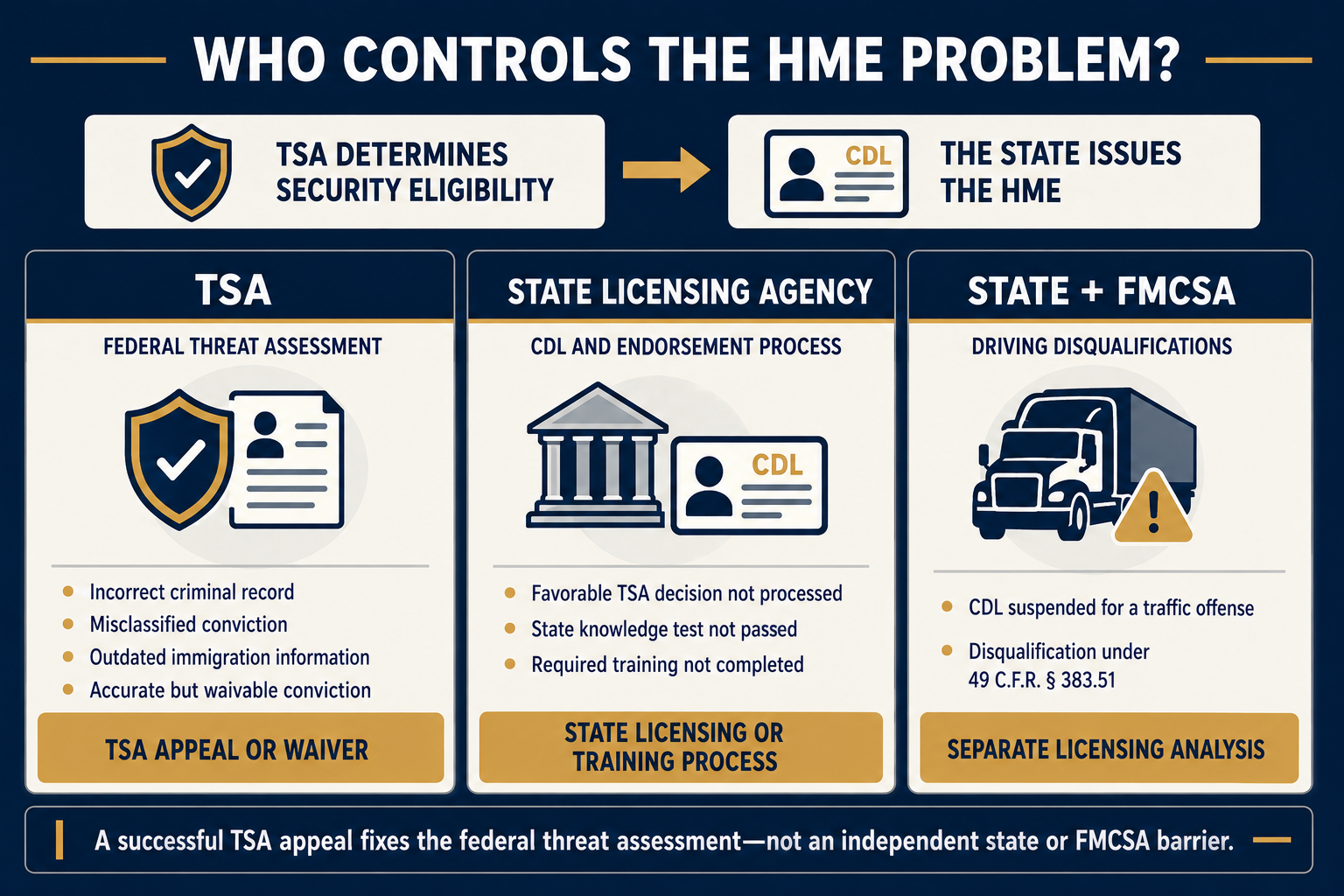
A successful TSA appeal resolves the federal threat-assessment issue. It does not automatically cure an independent state licensing or FMCSA problem.
When Is an HME Appeal the Correct Remedy?
An appeal is appropriate when TSA’s facts or legal conclusion are wrong.
Examples include:
- The criminal record belongs to someone else.
- TSA treated an arrest as a conviction.
- The background record does not show the final disposition.
- The charge was dismissed or nolle prossed.
- The applicant was acquitted.
- A felony charge was reduced to a misdemeanor.
- The conviction was reversed, vacated, or otherwise altered.
- A pardon affects TSA’s treatment of the conviction.
- The offense does not match the federal disqualifying category TSA identified.
- TSA relied on the wrong conviction date.
- TSA relied on the wrong release-from-incarceration date.
- An interim offense falls outside both applicable time periods.
- A warrant was recalled or resolved.
- An indictment or felony complaint was dismissed.
- TSA relied on inaccurate or outdated immigration information.
- TSA incorrectly concluded that the applicant lacks mental capacity under the federal standard.
If the disqualifying information is substantially correct, an HME waiver may be the appropriate remedy. In some cases, the driver should appeal and request a waiver in the alternative.
For legal representation involving either procedure, review our HME appeal and waiver lawyer page.
What Is the Difference Between an HME Appeal and a Waiver?
An appeal and a waiver make different arguments.
An HME Appeal Disputes TSA’s Determination
An appeal asserts that the applicant meets the federal security threat assessment standards.
For example:
TSA identified a felony drug-distribution conviction, but the certified judgment establishes that the driver was convicted only of misdemeanor simple possession.
That is primarily an appeal because the driver disputes the existence of the disqualifying conviction.
An HME Waiver Requests Discretionary Relief
A waiver generally accepts that a disqualifying condition exists but asks TSA to find that the driver does not presently pose a security threat.
A waiver may rely on:
- The circumstances of the offense
- Time elapsed
- Restitution
- Sentence completion
- Treatment
- Rehabilitation
- Commercial-driving history
- Employment stability
- Professional training
- Character evidence
- Other proof of present reliability
Some Drivers Should Pursue Both
A driver may dispute TSA’s legal classification while requesting a waiver in the alternative. The arguments must be drafted carefully so that the waiver does not unnecessarily concede a disputed fact or legal issue.
What Notice Does the Driver Receive?
When TSA initially concludes that an HME applicant does not satisfy the federal standards because of a criminal conviction, immigration status, or mental-capacity determination, TSA serves the applicant with an Initial Determination of Threat Assessment.
The notice should identify the basis for the determination and explain the applicable response procedure.
Read every page of the notice and identify:
- The date of the letter
- The date you received it
- The type of determination
- The criminal offense or other condition identified
- The jurisdiction and dates listed
- Whether TSA directed immediate revocation
- The submission instructions
- The appeal deadline
- The process for requesting TSA’s materials
The title of the notice matters. An Initial Determination, Final Determination, waiver denial, and Initial Determination with Immediate Revocation may involve different consequences and procedures.
If you are unsure what TSA sent, read our guide explaining what to do after receiving a TSA Preliminary or Initial Determination of Ineligibility.
What Notice Does the State Receive?
TSA and the state licensing agency exchange information about the outcome of the federal threat assessment.
If the applicant does not timely initiate an appeal, the Initial Determination ordinarily becomes a Final Determination. In an HME matter, TSA serves the Final Determination on the applicant and the licensing state.
If TSA issues a Final Determination after reviewing an appeal, TSA also serves it on the state. The state must then deny or revoke the HME.
Under 49 C.F.R. § 1572.13, within 15 days after receiving TSA’s Determination of No Security Threat or Final Determination of Threat Assessment, the state generally must:
- Update the driver’s permanent record;
- Record the security threat assessment result;
- Record issuance or denial of the HME;
- Record the new expiration date when applicable;
- Notify the Commercial Driver’s License Information System operator; and
- Deny or revoke the HME if TSA issued a Final Determination.
The driver should keep copies of TSA’s decision and follow up with the state after a favorable result. Administrative delays or mismatched records can prevent the state system from reflecting TSA’s decision immediately.
Step 1: Identify the Precise Reason for TSA’s Decision
Do not assume that every HME denial results from a conviction.
TSA’s determination may involve:
- A disqualifying criminal conviction
- An arrest without a reported disposition
- A pending indictment
- An open warrant
- Immigration status
- Mental capacity
- Other security analyses
- A separate FMCSA disqualification
The type of determination controls the evidence and procedure needed.
An appeal focused on criminal-record errors will not resolve an immigration-documentation problem. Likewise, a rehabilitation statement does not correct an inaccurate conviction record.
Step 2: Consider Requesting TSA’s Releasable Materials
Under 49 C.F.R. § 1515.5, an HME applicant may request copies of the releasable materials on which TSA relied.
A timely request can:
- Initiate the appeal;
- Help establish what information TSA used;
- Reveal an identity mismatch or incomplete disposition;
- Clarify which dates TSA relied on; and
- Allow the driver to prepare a more focused written reply.
TSA does not disclose classified information and may withhold other information protected by law.
After TSA serves its response to a timely materials request, the regulation generally provides an additional 60-day period for the applicant’s written reply.
Requesting TSA’s materials should not delay efforts to obtain court and agency records. Archived criminal files and corrections records can take substantial time to locate.
Step 3: Check the Criminal Record for Errors
Criminal-history records may be incomplete or inaccurate because:
- The disposition was never reported.
- A dismissal is missing.
- The felony was reduced to a misdemeanor.
- A warrant was recalled but remains in a database.
- An indictment was dismissed.
- The conviction date is incorrect.
- The release date is incorrect.
- A vacatur or appellate reversal was not reported.
- The case belongs to another person.
- The record uses an imprecise offense description.
- State and FBI records do not match.
A commercial background report is not necessarily reliable proof of the final disposition. The appeal may require records directly from the court, prosecutor, arresting agency, corrections department, state repository, or FBI.
Arrests Without Final Dispositions
An arrest does not automatically establish a disqualifying conviction.
Under 49 C.F.R. § 1572.103(d), if a fingerprint-based check shows an arrest for a listed offense but does not show the disposition, TSA may require written proof that the arrest did not result in a disqualifying conviction.
The driver generally must provide that proof within 60 days after service of TSA’s notification.
Potential evidence includes:
- A certified dismissal
- A nolle prosequi order
- A judgment of acquittal
- A certified docket
- A prosecutor’s certification
- A court clerk’s letter
- A corrected criminal-history report
- Another official disposition record
If the file has been destroyed, several official sources may need to be combined to establish the outcome.
Misdemeanors and Amended Charges
The criminal-offense provisions in 49 C.F.R. § 1572.103 identify specified felonies. An arrest or original felony charge does not establish that the driver was ultimately convicted of a disqualifying felony.
The appeal should document:
- The original charge
- The amended charge
- The statute of conviction
- The degree of the offense
- The judgment
- The final disposition
- Whether the offense matches the federal category TSA identified
A state’s shorthand description may not answer the federal legal question. The statute, elements, charging language, plea, and judgment may all require analysis.
Simple Drug Possession
TSA’s interim-offense list includes distribution, possession with intent to distribute, and importation of a controlled substance. It does not separately identify simple possession as a disqualifying offense.
A record using only a generic “drug offense” description may therefore require the judgment, charging document, and applicable statute to establish whether the conviction was for simple possession or a listed trafficking offense.
Step 4: Resolve Indictments and Warrants
Under 49 C.F.R. § 1572.103(c), an applicant who is wanted or under indictment for a listed felony is disqualified until the want or warrant is released or the indictment is dismissed.
The appeal should not simply state that the case is old or inactive. It should document the present legal status.
Relevant records may include:
- An order recalling or quashing the warrant
- A dismissal of the indictment
- A prosecutor’s certification
- A certified docket showing resolution
- A disposition establishing that the case ended without a disqualifying conviction
- A court record showing that TSA matched the wrong person
An HME appeal cannot itself recall a state warrant or dismiss a criminal indictment. The underlying criminal matter may need to be resolved in the issuing jurisdiction before TSA can withdraw the determination.
Step 5: Calculate the Seven-Year and Five-Year Periods
The seven-year and five-year limitations apply to interim disqualifying offenses.
An interim offense is disqualifying if either:
- The applicant was convicted or found not guilty by reason of insanity within seven years of the HME application; or
- The applicant was incarcerated for the offense and released within five years of the application.
These are alternative tests. A driver whose conviction is more than seven years old may remain within the disqualification period if released from incarceration less than five years before applying.
The analysis may require:
- The HME application date
- The conviction date
- The sentence
- Whether the applicant was incarcerated for that offense
- The release-from-incarceration date
- Parole or probation violation records
- Resentencing records
- Clarification of work release or halfway-house placement
- Separate calculations for multiple offenses
The date probation ended is not automatically the release-from-incarceration date. Use official court and corrections records.
Step 6: Review TSA’s Legal Classification
Even when the criminal record is accurate, TSA’s legal conclusion may be disputed.
State criminal statutes do not always use the same terms or elements as TSA’s federal categories. The appeal may require comparison of:
- The criminal statute in effect at the time
- The offense elements
- The charging language
- The plea or verdict
- The final judgment
- The conduct established in the case
- TSA’s identified regulatory category
- Federal authority concerning comparability
The appeal should explain why the actual conviction does not satisfy the federal category identified in the TSA notice.
This page does not reproduce the complete list of disqualifying offenses. For a focused discussion of felony eligibility, read Can a Felon Get a Hazmat Endorsement?.
Step 7: Address Immigration Documentation Errors
TSA’s HME security threat assessment includes immigration-status requirements under 49 C.F.R. § 1572.105.
The regulation recognizes specified categories, including U.S. nationals, lawful permanent residents, refugees, asylees, certain nonimmigrants, and other expressly identified applicants. Not every visa, pending immigration application, or employment authorization document independently establishes HME eligibility.
An immigration-based HME appeal may require:
- A U.S. passport or other citizenship evidence
- A Certificate of Naturalization or Citizenship
- A permanent resident card
- An I-94 record
- Refugee or asylum documentation
- Evidence of qualifying nonimmigrant status
- Employment-authorization records
- USCIS approval notices
- Corrected immigration records
- Evidence resolving a removal order or database error
- An explanation of how the documented status satisfies § 1572.105
The evidence must establish the applicant’s current qualifying status—not merely that the applicant once held that status.
Applicants in removal proceedings or subject to a removal order face additional restrictions under the regulation. Immigration-based HME matters should be reviewed individually before a response is submitted.
Step 8: Determine Whether 49 C.F.R. § 383.51 Creates a Separate Problem
An HME applicant may face two different federal issues:
- TSA’s security threat assessment under Part 1572; and
- A commercial-driving disqualification under 49 C.F.R. § 383.51.
Section 383.51 imposes disqualification periods for certain major offenses and serious traffic violations. Depending on the circumstances, these can include impaired driving, leaving an accident scene, using a vehicle to commit certain felonies, driving while disqualified, and other specified violations.
Under 49 C.F.R. § 1572.5(c), if records indicate that an applicant committed an offense that would disqualify the applicant from operating a commercial motor vehicle under § 383.51, TSA will not issue a Determination of No Security Threat until the state or FMCSA determines that the applicant is not disqualified.
This means that winning the TSA criminal-record issue may not be enough. The state or FMCSA issue may need to be resolved separately.
A TSA appeal does not automatically:
- Reinstate a suspended CDL
- End an FMCSA disqualification
- Satisfy state reinstatement requirements
- Restore medical qualification
- Satisfy HME testing or training requirements
- Require an employer to return the driver to work
Before filing, determine which government decision is actually blocking the endorsement.
Step 9: Prepare the Written HME Appeal
A persuasive TSA hazmat appeal ordinarily includes:
- Identification of the applicant and TSA determination
- A clear statement that the applicant is appealing
- Identification of each disputed finding
- A concise factual history
- The governing federal standard
- Analysis of the criminal record, immigration status, or other disputed issue
- Reliable supporting documents
- An organized exhibit index
- A clear request for withdrawal of the Initial Determination
The appeal should resolve TSA’s stated concern directly. It should not rely on an emotional explanation when the dispute turns on a certified disposition, corrections record, immigration document, or statutory analysis.
Avoid:
- Relying only on a commercial background report
- Submitting inconsistent dates
- Assuming that a dismissed charge automatically appears correctly in federal databases
- Discussing rehabilitation when the issue is a factual record error
- Requesting a waiver without understanding what the request concedes
- Ignoring a separate § 383.51 disqualification
- Waiting until the final days to request records
- Sending original documents without preserving copies
- Failing to keep proof of submission
How Do You Initiate an HME Appeal?
Under 49 C.F.R. § 1515.5, an applicant generally initiates an appeal within the applicable 60-day period by:
- Submitting a written reply;
- Requesting the releasable materials on which TSA relied; or
- Requesting an extension of time under the regulation.
Follow the submission instructions in the TSA notice. Keep:
- A complete copy of the notice
- A copy of everything submitted
- Proof of transmission or delivery
- Any confirmation number
- TSA’s subsequent correspondence
- A timeline showing receipt and submission dates
Do not assume that contacting the state licensing agency initiates the federal TSA appeal. The appeal must be submitted through the procedure stated in TSA’s notice.
Can TSA Extend the Appeal Deadline?
Under 49 C.F.R. § 1515.5(f), TSA may grant an extension for good cause.
A timely extension request should:
- Be in writing
- Identify the applicable deadline
- Explain why additional time is needed
- Describe the records or evidence being pursued
- Document efforts already made
- Request a specific extension period
- Be received within a reasonable time before the deadline
The regulation also allows TSA to consider a late request that explains why the failure to file on time was excusable. Approval is discretionary.
Possible grounds may include delayed archived records, an agency’s failure to respond, hospitalization, lack of timely service, or another documented circumstance beyond the applicant’s reasonable control.
Do not stop preparing the appeal while waiting for an extension decision.
What Happens After the HME Appeal Is Submitted?
After reviewing the written reply and supporting records, TSA may:
- Request additional information;
- Withdraw the Initial Determination; or
- Issue a Final Determination of Threat Assessment.
TSA ordinarily acts within 60 days after receiving the applicant’s reply, although the regulation permits TSA to extend its time for good cause.
If TSA Withdraws the Initial Determination
If TSA concludes that the applicant does not pose a security threat, it withdraws the Initial Determination. TSA can then provide the favorable threat-assessment result necessary for the state to continue the HME process.
The driver must still satisfy all remaining state and federal requirements.
If TSA Issues a Final Determination
If TSA rejects the appeal, it serves the Final Determination on the driver and the state licensing agency. The state must deny or revoke the HME.
A Final Determination after an ordinary appeal under § 1515.5 constitutes a final TSA order for purposes of judicial review under 49 U.S.C. § 46110. If the identified condition is waivable, the applicant may also consider a waiver request within the applicable deadline.
If TSA Requests More Information
Review the request carefully and answer it by the stated deadline. Determine whether TSA is asking for:
- A certified disposition
- Proof of release
- An immigration document
- A corrected record
- Clarification of an inconsistency
- Evidence resolving an indictment or warrant
- Another official record
If the requested document is unavailable, explain why, document the efforts made, and provide the best available substitute evidence.
What Happens to an Existing Hazmat Endorsement?
The answer depends on the type of notice, the endorsement’s expiration date, and the driver’s circumstances.
Ordinary Initial Determination During Renewal
An ordinary Initial Determination does not necessarily have the same immediate effect as a notice expressly directing immediate revocation. However, a state cannot renew an HME without receiving TSA’s Determination of No Security Threat.
A driver should not assume that filing an appeal automatically extends or preserves the endorsement. Confirm the endorsement’s status with the state and follow the instructions in the TSA and state notices.
Immediate Revocation
If TSA determines that the driver presents an immediate threat to transportation security, national security, or a terrorism concern, TSA may issue an Initial Determination and Immediate Revocation. The state must revoke the HME immediately.
The driver may appeal under § 1515.5, but the endorsement may remain revoked while the administrative process is pending.
Driver’s Continuing Surrender Responsibilities
Under 49 C.F.R. § 1572.11, an HME holder has continuing responsibilities and may be required to surrender the endorsement to the state within 24 hours after specified events, including certain convictions, warrants, indictments, mental-capacity determinations, loss of qualifying status, or immigration violations.
Failure to surrender when required may result in immediate revocation or civil penalties.
Because the consequences depend on the event and notice, obtain individualized advice rather than assuming that continued hazmat driving is permitted during the appeal.
HME Appeals During Renewal
An HME holder must undergo another TSA security threat assessment as part of renewal.
Under 49 C.F.R. § 1572.13, the state generally must notify the driver at least 60 days before the HME expires. The notice should inform the driver that the assessment may be initiated after receiving the notice but should begin no later than 60 days before expiration.
If TSA has not issued a Determination of No Security Threat or Final Determination before the endorsement expires, the issuing state may extend the HME expiration date for 90 days. Any additional extension requires advance TSA approval.
The regulation permits an extension; it does not guarantee that the state will automatically grant one. Drivers should begin renewal early and confirm their state’s process.
If an adverse determination is issued during renewal:
- Identify whether the existing HME remains valid.
- Confirm the expiration date.
- Ask whether the state has granted an extension.
- Initiate the TSA appeal on time.
- Determine whether new criminal, immigration, or other information caused the decision.
- Do not assume that a pending appeal independently authorizes hazmat transportation.
HME Appeals During a Transfer Between States
Under 49 C.F.R. § 1572.13(e), when a driver transfers an existing HME from one state to another, the second state generally does not require a new TSA assessment until the renewal period established by the original state expires, subject to a maximum of five years.
The driver must still satisfy the receiving state’s CDL transfer requirements.
A transfer problem may arise because:
- The receiving state cannot confirm the existing assessment.
- The assessment or HME has expired.
- State records do not match.
- TSA identified new adverse information.
- The driver is independently disqualified.
- The receiving state requires additional documentation or testing.
Before filing a federal appeal, determine whether TSA actually issued an adverse threat determination or whether the problem is an administrative transfer issue with the state.
Can You Request a Waiver After TSA Denies the Appeal?
Potentially, if TSA has authority to waive the identified condition.
Under 49 C.F.R. § 1515.7, an HME applicant may request a waiver during the application process, after pursuing some or all of the appeal procedures, or no later than 60 days after service of the Final Determination.
A waiver asks TSA to find that the driver does not pose a security threat despite an otherwise disqualifying condition. It relies on evidence such as:
- The circumstances of the offense
- Time elapsed
- Restitution
- Sentence completion
- Treatment
- Rehabilitation
- Employment history
- Commercial-driving safety
- Training
- Character references
- Present reliability
Not every condition is waivable. The exact regulatory category must be reviewed before relying on a waiver as an alternative.
Is ALJ Review Available After an HME Appeal?
Not after every type of HME appeal.
For an ordinary criminal-conviction, immigration-status, or mental-capacity appeal under 49 C.F.R. § 1515.5, TSA’s Final Determination is treated as a final order for judicial-review purposes. An applicant with a waivable condition may separately pursue a waiver.
If TSA later denies a waiver under § 1515.7, the applicant may request review by a TSA Administrative Law Judge under § 1515.11, generally within 30 calendar days after service of the waiver denial.
Different procedures apply to determinations based on other security analyses under § 1515.9. Those matters may also qualify for ALJ review.
Advanced administrative review and federal-court litigation are separately evaluated and are not included in the initial HME appeal fee unless expressly stated in the engagement agreement.
Do You Need a Lawyer for a Hazmat Endorsement Appeal?
No. Federal law does not require an attorney for an initial HME appeal.
A driver may be able to correct a straightforward error without counsel when the problem is obvious and the driver already possesses a certified document conclusively resolving it.
Legal representation may be more valuable when:
- Your employment depends on the HME.
- The criminal record is incomplete.
- The offense classification is disputed.
- The conviction is from another state or is decades old.
- Multiple convictions are involved.
- TSA used an incorrect release date.
- A warrant or indictment must be resolved.
- Immigration documentation is disputed.
- You may need both an appeal and waiver.
- TSA directed immediate revocation.
- A separate FMCSA or state disqualification may exist.
- The matter may proceed to advanced review.
An attorney cannot change established facts or guarantee a government decision. Experienced representation can provide offense analysis, record procurement, procedural strategy, professional drafting, and management of a process directly affecting the driver’s livelihood.
What Does National Security Law Firm Do for an HME Appeal?
For qualifying matters, our work generally includes:
- Reviewing the complete TSA notice
- Identifying deadlines and procedural options
- Determining whether the issue belongs to TSA, the state, FMCSA, or more than one authority
- Distinguishing an appeal from a waiver
- Requesting TSA’s releasable materials when appropriate
- Obtaining ordinary court and corrections records
- Reviewing criminal-history information
- Calculating conviction and release periods
- Analyzing the offense under TSA’s federal standards
- Reviewing relevant immigration documentation
- Identifying possible § 383.51 complications
- Preparing the written legal appeal
- Organizing the supporting exhibits
- Submitting the appeal to TSA
- Tracking the matter through the covered initial stage
- Responding to ordinary TSA requests within the agreed scope
We have handled HME and TWIC matters since 2016. We do not simply give the driver a form and require the driver to locate and interpret every record alone.
How Much Does an HME Appeal Lawyer Cost?
National Security Law Firm charges a flat legal fee of $2,495 for qualifying initial-stage HME appeal or waiver representation.
The covered service generally includes the legal analysis, ordinary court-record procurement, evidence development, drafting, submission, and case management described in the written engagement agreement.
Unless expressly included, the fee does not cover:
- Unusual third-party expenses
- Litigation to recall a warrant or dismiss an indictment
- Criminal post-conviction proceedings
- Immigration proceedings
- State CDL hearings
- FMCSA proceedings
- Medical-certification issues
- State testing or training requirements
- Employer disputes
- A later Administrative Law Judge proceeding
- TSA Final Decision Maker review
- Federal-court litigation
The precise scope is governed by the signed engagement agreement.
For more information about government charges, state fees, testing and training expenses, and representation costs, review our guide to Hazmat endorsement costs and appeal lawyer fees.
Financing and the Written Refund Guarantee
Eligible clients may use Pay Later by Affirm to divide the legal fee into monthly payments. Financing terms are determined by the provider.
National Security Law Firm also offers a written refund guarantee in qualifying accepted HME matters.
The refund guarantee is not a promise that TSA will approve the appeal, grant a waiver, issue a Determination of No Security Threat, or cause the state to issue an HME. TSA and the state control those government decisions.
When the guarantee applies, the signed engagement agreement identifies the covered result and the circumstances under which National Security Law Firm will refund the covered $2,495 legal fee if that result is not achieved.
The guarantee:
- Applies only when expressly included in the signed engagement agreement
- Covers only the legal fee identified in that agreement
- Is subject to stated terms, exclusions, and client responsibilities
- Does not control or guarantee TSA’s or the state’s decision
- Does not necessarily cover third-party expenses or advanced proceedings
- Does not cover a separate state, FMCSA, immigration, testing, medical, or employment issue unless expressly stated
We do not accept every case for guaranteed representation. We first review the TSA notice, underlying records, procedural stage, deadlines, and any separate licensing issue.
Frequently Asked Questions About HME Appeals
How long do I have to appeal a denied Hazmat Endorsement?
An applicant generally must initiate the TSA appeal within 60 days after receiving the Initial Determination. Follow the deadline and instructions in your specific notice.
Does filing an appeal keep my existing HME valid?
Not necessarily. The answer depends on the type of TSA notice, the endorsement’s expiration date, whether TSA ordered immediate revocation, whether the state granted an extension, and the driver’s continuing surrender obligations.
Can my state overturn TSA’s decision?
No. The state cannot issue or renew an HME without a favorable TSA threat determination. Factual or legal errors in TSA’s determination must be addressed through the TSA process.
Can TSA overturn a state CDL suspension?
No. A TSA appeal addresses the security threat assessment. It does not automatically reverse an independent state CDL suspension or FMCSA disqualification.
Can I appeal an open warrant?
An appeal may establish that the warrant belongs to someone else or has already been recalled. If the warrant remains active, the underlying court matter may need to be resolved before TSA can find the driver eligible.
Can I appeal if an indictment was dismissed?
Yes. Submit official proof showing that the indictment was dismissed and the current disposition of the case.
Can I appeal based on rehabilitation?
Rehabilitation generally supports a waiver, not an appeal. An appeal disputes TSA’s facts or legal conclusion.
Can I appeal an immigration-status denial?
Yes, if you actually satisfy TSA’s immigration-status standard and can document the qualifying status. Not every visa, EAD, or pending application satisfies the regulation.
What if I already hold a TWIC?
TSA considers the TWIC and HME threat assessments comparable, but holding a TWIC does not automatically place an HME on a CDL or resolve an independent state or FMCSA disqualification. Current enrollment and comparability procedures should be confirmed.
Will TSA decide within 60 days?
The regulation ordinarily provides a 60-day period after TSA receives the applicant’s written reply, but TSA may extend its time for good cause. Actual processing times vary.
Does NSLF guarantee that I will receive an HME?
No. Qualifying accepted cases may include a written refund guarantee covering the legal fee under the engagement agreement. That contractual refund protection does not promise or control a TSA or state result.
Schedule a Free Consultation About Your HME Appeal
A denied Hazmat Endorsement can affect your job, income, and commercial-driving career. The first step is determining whether TSA relied on incorrect information, whether the condition is waivable, and whether a separate state or FMCSA disqualification must also be addressed.
National Security Law Firm has handled HME and TWIC matters since 2016 and has represented applicants in hundreds of TSA credential cases. For qualifying initial-stage matters, our flat legal fee is $2,495. We obtain ordinary court records, analyze the alleged disqualification, prepare the submission, and manage the covered TSA process.
Financing may be available, and qualifying accepted cases may include a written refund guarantee subject to the precise terms of the engagement agreement.
Schedule a free consultation or call (202) 600-4996.
Official HME Appeal Resources
- TSA: Hazardous Materials Endorsement Threat Assessment Program
- 49 U.S.C. § 5103a—Security Background Checks for Hazmat Drivers
- 49 C.F.R. Part 1515—TSA Appeal and Waiver Procedures
- 49 C.F.R. § 1515.5—Appeal of an Initial Determination
- 49 C.F.R. § 1515.7—Waiver Procedures
- 49 C.F.R. § 1515.9—Appeals Based on Other Security Analyses
- 49 C.F.R. § 1515.11—Administrative Law Judge and TSA Final Decision Maker Review
- 49 C.F.R. § 1572.5—Security Threat Assessment Standards
- 49 C.F.R. § 1572.11—HME Applicant Responsibilities
- 49 C.F.R. § 1572.13—State Responsibilities for HME Issuance
- 49 C.F.R. § 1572.103—Disqualifying Criminal Offenses
- 49 C.F.R. § 1572.105—Immigration-Status Requirements
- 49 C.F.R. § 383.51—FMCSA Driver Disqualifications
Author: Katherine O’Brien, Esq., Founder, National Security Law Firm
Attorney Reviewed: August 26, 2026
This page provides general information and is not legal advice. Viewing this page or contacting the firm does not create an attorney-client relationship. Past results do not guarantee future outcomes. Any fee, scope of representation, financing arrangement, or refund guarantee is governed exclusively by a signed written engagement agreement.