
If CBP seized your cash at an airport, border crossing, or international checkpoint, you are not alone.
Airport currency seizures have become one of the most aggressive and heavily enforced areas of federal forfeiture activity. Every year, U.S. Customs and Border Protection (“CBP”) seizes millions of dollars from travelers during international departures, arrivals, and border inspections.
Many people are shocked when the government seizes cash even though:
- the money was lawfully earned
- no drugs were found
- no criminal charges are filed
- they intended to use the funds for legitimate purposes
What surprises many travelers is that carrying large amounts of cash is not itself illegal.
However, transporting currency internationally can trigger federal reporting requirements, increased scrutiny, and civil forfeiture proceedings that operate separately from criminal prosecutions.
In many cases, CBP seizure matters quickly become highly strategic administrative proceedings focused on:
- credibility
- consistency
- financial documentation
- reporting compliance
- travel history
- electronic evidence
- mitigation
- the overall plausibility of the explanations provided
That is one reason why early statements and procedural decisions often become critically important.
Why Airport Cash Seizure Cases Are Often More Complicated Than People Expect
Many travelers initially believe they can simply explain where the money came from and quickly recover the funds.
In reality, CBP money seizure cases often involve:
- federal reporting laws
- structuring allegations
- bulk cash smuggling accusations
- suspicious financial activity reviews
- administrative forfeiture proceedings
- overlapping federal investigations
In some situations, the government may evaluate:
- banking records
- deposit history
- withdrawal activity
- tax filings
- electronic communications
- travel patterns
- customs declarations
- prior statements made during inspection
These cases are frequently documentation-driven and credibility-driven long before formal litigation ever begins.
As a result, many individuals unintentionally damage their own cases by:
- overexplaining facts
- making inconsistent statements
- submitting unsupported narratives
- responding emotionally rather than strategically
- missing deadlines
- misunderstanding the Election of Proceedings process
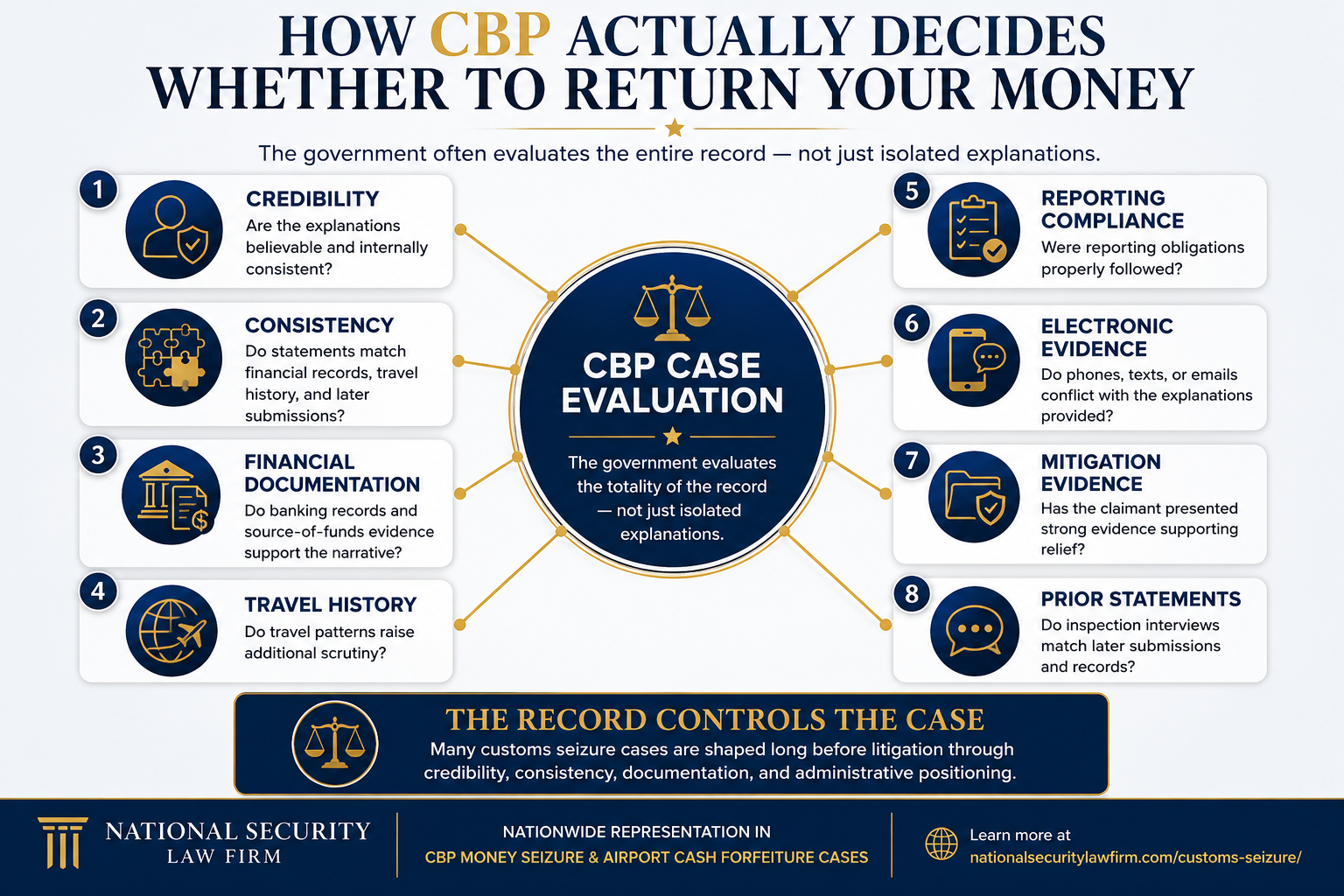
The Record Often Determines the Outcome
One of the most important realities in airport cash seizure cases is that the administrative record developed early in the process often shapes how the government views the case moving forward.
The first:
- explanations
- inspection statements
- petitions
- supporting documents
- financial records
submitted to the government may later influence: - mitigation decisions
- settlement posture
- litigation strategy
- related federal investigations
- future agency scrutiny
That is why National Security Law Firm repeatedly emphasizes a central principle:
the record controls the case.
Additional discussion of these strategic issues appears in How to Win a CBP Currency Seizure Case and Why Early Statements to CBP Can Destroy Your Case.
CBP Cash Seizure Cases Can Involve Broader Federal Consequences
Many people assume a currency seizure only affects the seized money itself.
In reality, airport cash seizure cases may sometimes intersect with broader federal systems involving:
- immigration matters
- Global Entry eligibility
- TSA credentials
- security clearances
- federal employment
- contractor eligibility
- future border inspections
- parallel federal investigations
Federal agencies often do not evaluate these matters in isolation.
That broader institutional overlap is one reason why CBP money seizure cases frequently require careful strategic analysis from the beginning.
Nationwide CBP Money Seizure Representation
National Security Law Firm represents clients nationwide in CBP money seizure and airport currency forfeiture matters involving:
- airport cash seizures
- currency reporting allegations
- structuring accusations
- bulk cash smuggling allegations
- administrative forfeiture proceedings
- international travel-related seizures
- border cash seizures
- suspicious financial activity allegations
In many airport cash seizure matters, the firm handles cases on a contingency fee basis, meaning:
- the firm typically charges 15% to 20% of the recovered amount
- there is no legal fee unless a recovery is obtained
The sections below explain:
- why CBP seizes money
- what happens after a seizure occurs
- how airport cash forfeiture cases work
- how administrative petitions and judicial proceedings operate
- what strategic mistakes often hurt recovery efforts
- how individuals may attempt to recover seized currency from the federal government
More detailed discussion of airport seizure procedures appears in What Happens When CBP Seizes Your Cash at the Airport?
Why CBP Seizes Cash at Airports and Border Crossings
CBP seizes cash in a wide range of situations involving international travel, border crossings, and airport inspections.
Many people assume the government only seizes money connected to obvious criminal conduct.
In reality, airport cash seizures often arise from a much broader set of concerns involving:
- reporting violations
- suspicious travel patterns
- financial inconsistencies
- structuring allegations
- concealed currency
- bulk cash smuggling concerns
- documentation issues
- suspicious explanations regarding the source or intended use of funds
Importantly, many CBP currency seizure cases proceed without criminal charges.
That is why airport cash forfeiture proceedings frequently surprise travelers who believed they were doing nothing illegal.
Carrying Cash Is Not Illegal
One of the most misunderstood aspects of airport money seizure cases is that carrying large amounts of cash is not itself unlawful.
People may legally travel with substantial amounts of currency.
However, transporting money internationally can trigger federal reporting requirements and heightened scrutiny from CBP officers.
Federal law generally requires travelers transporting more than $10,000 into or out of the United States to properly report the currency using FinCEN Form 105.
Failure to comply with those reporting requirements may result in seizure of the funds even when:
- the money was lawfully earned
- no drugs were involved
- no criminal charges are filed
- the traveler intended to use the money for legitimate purposes
Additional discussion of these reporting obligations appears in Traveling With More Than $10,000: What You Need to Know Before Crossing the Border.
Why CBP Views Large Amounts of Cash as Suspicious
CBP officers are specifically trained to identify indicators they associate with:
- money laundering
- structuring
- narcotics trafficking
- bulk cash smuggling
- tax evasion
- suspicious financial activity
- organized criminal activity
As a result, the government often evaluates much more than whether someone filed the proper reporting forms.
In many cases, CBP may examine:
- how the currency was packaged
- whether the cash was concealed
- travel history
- banking activity
- electronic communications
- tax records
- business documentation
- explanations regarding the source and intended use of the funds
What surprises many people is that the government frequently evaluates the “totality of circumstances” rather than relying on one isolated fact.
For example, individually lawful facts may collectively appear suspicious to investigators when viewed together.
How Airport Cash Seizures Usually Begin
Many airport cash seizure cases begin during:
- secondary inspection
- outbound international travel screening
- customs declarations
- baggage examinations
- border questioning
- currency reporting reviews
In some situations, CBP officers discover large amounts of cash during routine screening procedures.
In others, the government may already have concerns based on:
- travel patterns
- intelligence information
- prior border crossings
- inconsistent declarations
- electronic screening systems
- suspicious financial activity reports
Once currency is identified, officers often begin asking questions regarding:
- where the money came from
- who owns it
- how it was earned
- where it is going
- what it will be used for
- whether reporting forms were completed
At that point, the situation may quickly become highly documentation-driven and credibility-driven.
Why Statements Made During Inspection Matter
One of the most important realities in airport currency seizure cases is that statements made during inspection frequently become part of the administrative record.
CBP officers may later compare:
- inspection interviews
- customs declarations
- financial records
- tax returns
- text messages
- petition submissions
- later explanations
- litigation positions
Even relatively small inconsistencies may become important if the government believes the explanations changed over time or conflict with other evidence.
That is why many individuals unintentionally damage their position by attempting to “explain everything” immediately without fully understanding:
- the government’s concerns
- the evidence already gathered
- the procedural posture
- potential criminal implications
- broader federal consequences
Additional discussion of these strategic issues appears in Why Early Statements to CBP Can Destroy Your Case.
Airport Cash Seizure Cases Often Expand Beyond Reporting Issues
Although many airport currency seizures initially involve reporting concerns, some matters later expand into broader investigations involving:
- structuring allegations
- suspicious financial activity
- business records
- tax issues
- source-of-funds questions
- parallel federal investigations
Depending on the circumstances, the case may also affect:
- Global Entry eligibility
- TSA credentials
- immigration matters
- security clearances
- federal employment
- contractor eligibility
- future border inspections
Federal agencies often evaluate these matters collectively rather than in isolation.
Understanding why CBP seized the money is only the beginning. In many cases, the more important issue becomes how the government evaluates credibility, documentation, and strategic positioning after the seizure occurs.
What Happens After CBP Seizes Your Money?
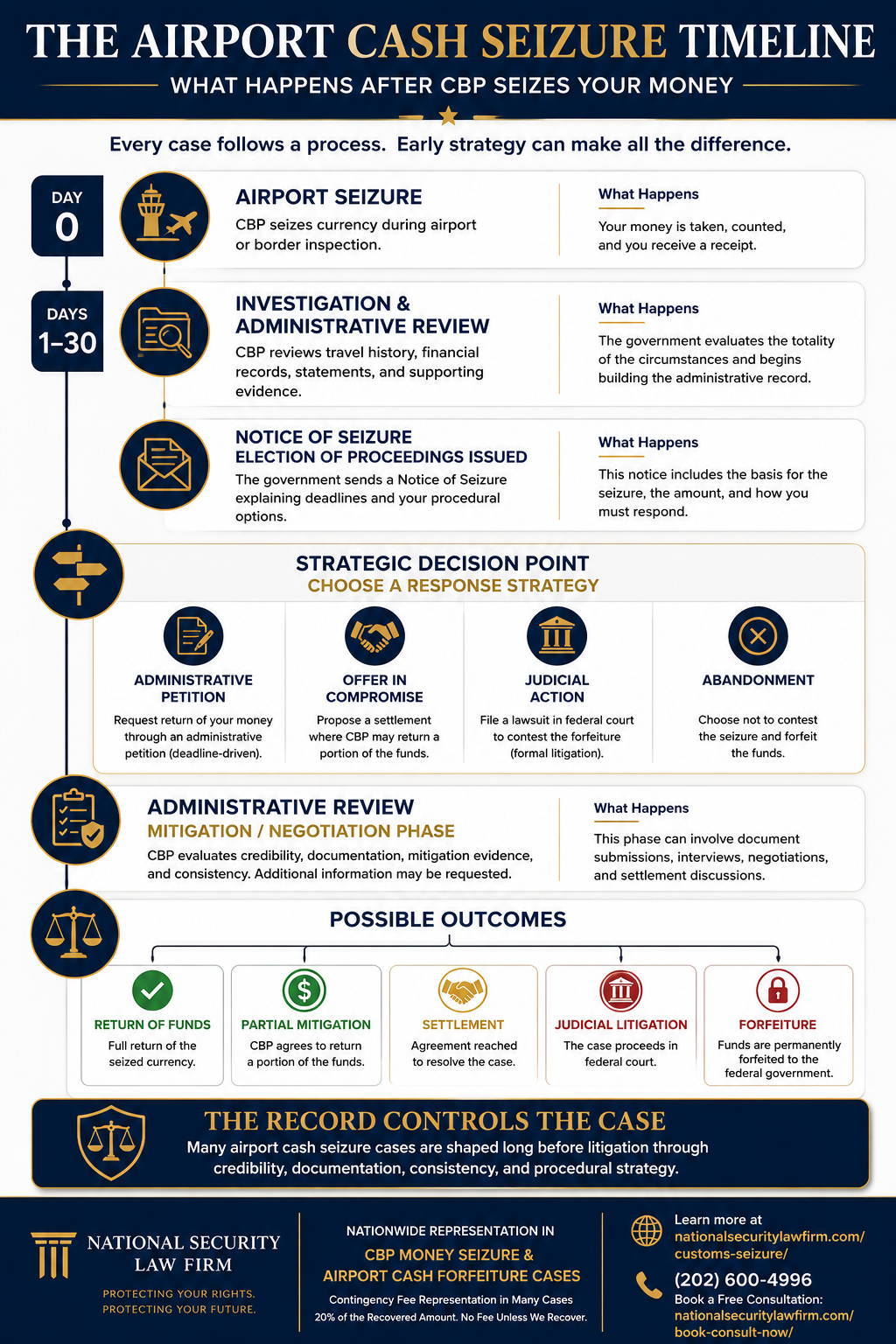
After CBP seizes currency at an airport or border crossing, the case typically enters a federal administrative forfeiture process governed by strict deadlines and procedural rules.
Many travelers assume the seizure itself is the primary issue.
In reality, some of the most important strategic decisions often occur in the days and weeks immediately following the seizure.
The Government Begins Building the Case Immediately
After the seizure occurs, CBP officers generally begin documenting:
- the amount of currency seized
- where the money was found
- statements made during inspection
- customs declarations
- travel information
- supporting evidence gathered during the encounter
Depending on the circumstances, the government may also review:
- banking records
- tax filings
- electronic devices
- text messages
- travel history
- business records
- financial activity
- prior border crossings
In many airport cash seizure matters, investigators are not evaluating just one isolated issue.
Instead, they may attempt to determine:
- whether reporting requirements were violated
- whether the money appears connected to suspicious activity
- whether the explanations provided are consistent
- whether the surrounding circumstances create broader enforcement concerns
That is one reason why airport currency seizure cases often become highly credibility-driven and documentation-driven very early in the process.
The Case Usually Moves to CBP’s FP&F Office
After the seizure, the matter is typically transferred to a CBP department known as Fines, Penalties, and Forfeitures (“FP&F”).
FP&F handles administrative forfeiture proceedings and reviews requests seeking the return of seized money.
At some point after the seizure, the government generally issues a formal Notice of Seizure and Information to Claimants.
This document is extremely important because it explains:
- the amount seized
- the alleged legal basis for forfeiture
- procedural deadlines
- available response options
- how to contest the seizure
Additional discussion of these notices appears in CBP Notice of Seizure Letter Explained: What To Do Next.
Why the Election of Proceedings Form Matters
One of the most important documents included with the notice is often the Election of Proceedings form.
This form generally requires the claimant to choose how they want to proceed.
The available options often include:
- filing an administrative petition
- submitting an Offer in Compromise
- abandoning the funds
- forcing the government into judicial forfeiture proceedings
Many travelers underestimate how significantly this procedural decision may affect:
- leverage
- timelines
- litigation posture
- evidentiary development
- settlement opportunities
- overall strategy
More detailed discussion appears in Election of Proceedings Form Explained and Petition vs Judicial Action: Which Option Is Better?
Why Deadlines Become Critical
One of the most common mistakes people make after a money seizure is assuming they have plenty of time to respond.
In reality, airport cash forfeiture proceedings are heavily deadline-driven.
Missing procedural deadlines may result in the government administratively forfeiting the seized funds without further litigation.
Early strategic evaluation often becomes extremely important before:
- submissions are made
- procedural rights expire
- explanations become locked into the record
Additional discussion of these timing issues appears in The 30-Day Deadline That Can Cost You Your Property.
Why Early Statements Can Shape the Entire Case
Many people attempt to “clear things up” immediately after receiving a seizure notice.
Unfortunately, poorly prepared explanations, unsupported claims, inconsistent statements, or unnecessary admissions can significantly weaken:
- credibility
- mitigation arguments
- negotiation posture
- future litigation strategy
This becomes especially important because CBP and related agencies may later compare:
- inspection interviews
- customs declarations
- financial records
- tax returns
- electronic communications
- petition submissions
- later explanations
Even relatively small inconsistencies may become important if the government believes the narrative changed over time.
Thus, airport cash seizure matters often require strategic analysis before substantial explanations or submissions are provided.
Additional discussion of these issues appears in Why Early Statements to CBP Can Destroy Your Case.
Airport Cash Seizures Can Create Broader Federal Consequences
Many travelers initially assume the case involves only the seized money itself.
In reality, airport currency seizure matters may sometimes intersect with broader federal systems involving:
- immigration matters
- Global Entry eligibility
- TSA credentials
- security clearances
- federal employment
- contractor eligibility
- future border inspections
- parallel federal investigations
Federal agencies often do not evaluate these matters in isolation.
Information developed during a CBP money seizure matter may later appear in entirely different administrative or investigative contexts.
That broader federal overlap is one reason why airport cash seizure cases frequently require far more strategic analysis than people initially realize.
Understanding what happens after the seizure is critical because many CBP money seizure matters are shaped less by dramatic courtroom litigation and more by early procedural decisions, administrative positioning, credibility assessments, and record development.
Airport Cash Seizure Cases Often Become Credibility Cases
Many people assume airport cash seizure cases are decided primarily by whether the money was legally earned.
In reality, CBP often evaluates something much broader:
whether the overall record appears credible, consistent, and reliable.
That is one reason why airport currency seizure matters frequently become credibility-driven administrative proceedings long before formal litigation ever begins.
The Government Often Evaluates the “Totality of Circumstances”
In many airport cash seizure cases, CBP does not rely on one isolated fact alone.
Instead, officers and investigators may evaluate the “totality of circumstances,” including:
- statements made during inspection
- customs declarations
- banking activity
- travel history
- tax records
- electronic communications
- source-of-funds documentation
- business records
- the plausibility of the explanations provided
What surprises many travelers is that individually lawful facts may collectively appear suspicious to investigators when viewed together.
For example:
- carrying cash is not illegal
- international travel is not illegal
- cash-intensive businesses are not illegal
However, CBP may still view certain combinations of facts as indicators of:
- structuring
- suspicious financial activity
- money laundering concerns
- reporting violations
- bulk cash smuggling
- broader criminal activity
Why Consistency Matters So Much
One of the most important factors in many airport money seizure cases is consistency.
CBP officers may later compare:
- inspection interviews
- written declarations
- petition submissions
- banking records
- tax returns
- travel records
- electronic evidence
- later litigation positions
Even relatively small inconsistencies can become significant if investigators believe:
- explanations evolved over time
- details changed after the seizure
- supporting documentation conflicts with earlier statements
- the narrative was reconstructed later
That does not necessarily mean the traveler acted unlawfully.
However, credibility concerns may substantially affect:
- mitigation decisions
- settlement discussions
- agency posture
- administrative review
- future litigation strategy
Why Early Statements Become So Important
Many individuals understandably attempt to “clear things up” immediately after the seizure occurs.
In practice, however, airport cash seizure cases often become strategically complicated very quickly.
People sometimes unintentionally damage their cases by:
- overexplaining facts
- speculating about missing information
- making inconsistent statements
- providing unsupported narratives
- submitting incomplete documentation
- responding emotionally rather than strategically
This is especially risky when the individual does not yet fully understand:
- the government’s concerns
- the evidence already gathered
- the procedural posture
- whether broader investigations may exist
- the long-term federal implications of the case
The Administrative Record Often Shapes the Outcome
One of the most important realities in airport currency seizure matters is that the administrative record developed early in the process often shapes how the government views the case moving forward.
The first:
- explanations
- financial records
- supporting documentation
- mitigation submissions
- procedural decisions
may later influence: - settlement posture
- mitigation opportunities
- litigation strategy
- credibility assessments
- related federal investigations
That is why National Security Law Firm repeatedly emphasizes a central principle:
the record controls the case.
Why Documentation Often Becomes Critical
Strong documentation frequently plays a major role in airport cash seizure matters.
Depending on the facts involved, the government may evaluate:
- tax returns
- business records
- bank statements
- withdrawal history
- accounting records
- contracts
- invoices
- inheritance records
- real estate transactions
- proof of legitimate business activity
In some cases, strong documentation may significantly improve mitigation and recovery opportunities.
In others, weak or inconsistent documentation may increase government skepticism and prolong the forfeiture process.
Airport Cash Seizures Often Involve More Than Just Money
Many people initially assume the case involves only the seized currency itself.
In reality, airport money seizure matters may sometimes create broader federal consequences involving:
- immigration matters
- Global Entry eligibility
- TSA credentials
- security clearances
- federal employment
- contractor eligibility
- future border inspections
- parallel federal investigations
Federal agencies often evaluate credibility and consistency across multiple administrative systems.
That broader institutional overlap is one reason why airport cash seizure cases frequently require strategic analysis extending beyond the immediate forfeiture issue itself.
Understanding how CBP evaluates credibility, consistency, and documentation is critical because many airport currency seizure cases are ultimately shaped less by dramatic courtroom arguments and more by administrative positioning, procedural strategy, and the quality of the record developed early in the process.
Structuring Allegations and Financial Scrutiny
One of the most misunderstood aspects of airport cash seizure cases involves allegations of “structuring.”
Many travelers are shocked when CBP seizes currency not because the money itself was allegedly illegal, but because the government believes certain financial activity appears suspicious.
In some situations, structuring allegations become one of the central issues driving the forfeiture case.
What Is Structuring?
Structuring generally refers to financial activity the government believes was designed to avoid federal reporting requirements.
Most commonly, structuring allegations involve:
- repeated cash deposits
- patterned withdrawals
- transactions under reporting thresholds
- unusual banking behavior
- fragmented financial activity
- suspicious cash movement patterns
Importantly, structuring allegations are often highly fact-specific.
Many people accused of structuring never intended to violate federal law and may not even realize the government views their financial activity as suspicious.
However, once structuring concerns arise, they can significantly affect how CBP and other federal agencies evaluate:
- credibility
- source-of-funds explanations
- financial documentation
- mitigation requests
- overall forfeiture risk
Why Structuring Allegations Become Serious Quickly
Structuring allegations frequently attract heightened federal scrutiny because they are often associated with:
- money laundering concerns
- narcotics investigations
- tax issues
- financial crimes
- concealed income
- suspicious financial activity
As a result, airport cash seizure cases involving alleged structuring sometimes expand beyond the initial seizure itself.
In certain situations, investigators may review:
- bank statements
- deposit histories
- withdrawal activity
- cash-intensive businesses
- casino transactions
- wire transfers
- tax filings
- business records
- electronic communications
What surprises many individuals is that structuring allegations may become significant even when:
- no criminal charges are filed
- the money was lawfully earned
- no drugs are involved
- the traveler believes the transactions were legitimate
That is because CBP and related agencies often evaluate whether the overall financial activity appears consistent, documented, and credible.
Why Financial Documentation Matters
Strong financial documentation often becomes critically important in structuring-related seizure matters.
Depending on the facts involved, the government may evaluate:
- tax returns
- business income records
- payroll records
- contracts
- invoices
- bank withdrawal slips
- real estate transactions
- inheritance documentation
- proof of legitimate business activity
In many cases, the quality and consistency of the documentation heavily influence:
- mitigation opportunities
- negotiation posture
- credibility assessments
- forfeiture strategy
- litigation positioning
Weak, incomplete, or inconsistent documentation may significantly complicate the case.
Why Early Explanations Can Create Problems
One of the most common mistakes people make in structuring-related seizure matters is attempting to immediately “explain” complicated financial activity without fully understanding:
- the government’s concerns
- the banking records involved
- the procedural posture
- potential criminal implications
- how the explanations may later be evaluated
People sometimes unintentionally damage their position by:
- speculating about transactions
- providing inconsistent explanations
- overstating documentation
- making unsupported claims
- changing explanations later
- responding emotionally rather than strategically
Because CBP and related agencies often compare:
- inspection statements
- petition submissions
- banking records
- tax filings
- electronic evidence
- later litigation positions
even relatively small inconsistencies can become significant.
Structuring Allegations Often Affect More Than the Seized Money
Another important issue is that structuring-related allegations may create broader federal consequences extending beyond the immediate forfeiture proceeding.
Depending on the circumstances, these matters may later intersect with:
- IRS investigations
- immigration matters
- security clearance reviews
- federal employment issues
- contractor eligibility
- banking scrutiny
- future border inspections
- broader financial investigations
Federal systems often evaluate financial credibility across multiple administrative and investigative contexts.
That broader overlap is one reason why structuring-related airport cash seizure cases frequently require strategic analysis extending beyond the seizure itself.
Structuring Cases Often Become Highly Strategic
Many structuring-related customs seizure matters ultimately turn less on dramatic courtroom arguments and more on:
- documentation quality
- credibility
- consistency
- procedural strategy
- mitigation positioning
- administrative record development
In some situations, a carefully prepared administrative strategy may substantially improve recovery opportunities.
In others, litigation posture and broader federal exposure may require a far more aggressive or coordinated defense approach.
Understanding how structuring allegations develop is important because many airport cash seizure cases are heavily influenced by how the government interprets financial activity, documentation, and credibility long before formal litigation ever begins.
Bulk Cash Smuggling Cases
Bulk cash smuggling allegations are among the most serious types of airport currency seizure matters handled by CBP.
These cases generally arise when the government believes someone intentionally concealed currency during international travel or attempted to evade federal reporting requirements.
In many situations, bulk cash smuggling allegations dramatically increase the stakes because they may create:
- parallel criminal exposure
- broader financial investigations
- enhanced federal scrutiny
- long-term federal consequences extending beyond the seizure itself
What Is Bulk Cash Smuggling?
Federal law prohibits knowingly concealing more than $10,000 in currency or monetary instruments while transporting or attempting to transport the funds into or out of the United States with the intent to evade federal reporting requirements.
Importantly, these cases often focus heavily on:
- concealment
- intent
- reporting behavior
- surrounding circumstances
- credibility
As a result, bulk cash smuggling allegations frequently involve far more than simply carrying large amounts of money.
What CBP Often Looks for in These Cases
In many bulk cash smuggling investigations, CBP officers and related agencies may evaluate:
- hidden compartments
- concealed packaging
- false declarations
- inconsistent explanations
- suspicious travel activity
- undeclared currency
- electronic evidence
- financial records
- text messages
- travel itineraries
The government may also examine:
- where the money allegedly came from
- why the currency was being transported
- how the funds were packaged
- whether the traveler attempted to conceal the cash
- whether the explanations provided appear consistent and credible
Even when the money itself was lawfully earned, concealment-related allegations can significantly affect how the government evaluates the case moving forward.
Why Bulk Cash Smuggling Cases Often Become More Aggressive
Bulk cash smuggling allegations frequently trigger broader investigative attention because the government often associates these cases with:
- money laundering concerns
- narcotics trafficking
- organized criminal activity
- tax violations
- suspicious financial conduct
- broader financial crimes
As a result, airport cash seizure matters involving alleged concealment sometimes expand beyond the initial forfeiture proceeding into larger federal investigations.
Depending on the circumstances, agencies may review:
- banking records
- tax filings
- business records
- electronic communications
- travel history
- prior border crossings
- financial transactions
- source-of-funds documentation
In some situations, multiple agencies may become involved, including:
- Homeland Security Investigations (“HSI”)
- IRS investigators
- DEA task forces
- financial crime investigators
- federal prosecutors
Why Intent Often Becomes a Central Issue
One of the most heavily disputed issues in many bulk cash smuggling cases involves intent.
The government generally attempts to prove not only that currency was concealed, but that the traveler intended to evade federal reporting requirements.
That distinction can become extremely important.
For example, travelers sometimes:
- misunderstand reporting requirements
- improperly store cash during travel
- make inconsistent statements during stressful inspections
- fail to appreciate how concealment may appear to investigators
In practice, however, once CBP believes concealment was intentional, the case often becomes substantially more difficult and strategically sensitive.
Why Early Statements Can Become Extremely Risky
Many individuals attempt to immediately explain the situation after the money is discovered.
Unfortunately, bulk cash smuggling cases are often highly credibility-driven and evidence-driven from the very beginning.
Statements made during inspection may later be compared against:
- customs declarations
- banking records
- electronic evidence
- travel records
- tax filings
- petition submissions
- later litigation positions
Even relatively small inconsistencies can become important if the government believes explanations evolved after the seizure occurred.
Individuals sometimes unintentionally damage their position by:
- speculating about facts
- overstating documentation
- making inconsistent explanations
- minimizing concealment issues
- responding emotionally rather than strategically
Bulk Cash Smuggling Cases Often Involve Broader Federal Consequences
Many travelers initially focus only on recovering the seized funds.
However, bulk cash smuggling allegations may also create broader federal consequences involving:
- immigration matters
- Global Entry eligibility
- TSA credentials
- security clearances
- federal employment
- contractor eligibility
- future border scrutiny
- parallel criminal investigations
Federal agencies often evaluate these matters collectively across multiple administrative and investigative systems.
That broader overlap is one reason why bulk cash smuggling cases frequently require strategic analysis extending far beyond the immediate forfeiture proceeding itself.
Bulk Cash Smuggling Cases Often Require Highly Strategic Defense Planning
Many of these cases ultimately turn less on dramatic courtroom moments and more on:
- credibility
- consistency
- documentation quality
- procedural strategy
- mitigation positioning
- administrative record development
- evaluation of broader federal exposure
In some situations, carefully structured administrative resolution may substantially improve the outcome.
In others, the level of investigative scrutiny and potential criminal exposure may require a significantly more aggressive and coordinated litigation strategy.
Understanding how CBP and related agencies evaluate alleged bulk cash smuggling is critical because these cases often become some of the most aggressively scrutinized and strategically sensitive airport money seizure matters in the federal system.
How to Get Seized Cash Back From CBP
One of the first questions most people ask after an airport cash seizure is simple:
how do you actually get the money back?
The answer depends heavily on:
- why CBP seized the currency
- the evidence involved
- the procedural posture
- whether criminal exposure exists
- the quality of the available documentation
- the statements already made
- the overall credibility of the record
Many people assume there is a simple form or quick explanation that automatically results in the return of the funds.
In reality, CBP money seizure cases are often highly strategic administrative proceedings where:
- documentation
- consistency
- procedural decisions
- mitigation evidence
- credibility
frequently shape the outcome.
Administrative Petitions Are Often the First Major Step
In many airport cash seizure cases, the primary path toward recovery initially involves filing an administrative petition for remission or mitigation.
A petition essentially asks the government to:
- return the seized money
- reduce the forfeiture
- mitigate penalties
- otherwise grant relief based on the facts and supporting evidence
Many people underestimate how important these petitions become.
In practice, the petition often forms the foundation of the administrative record that later influences:
- mitigation decisions
- settlement posture
- litigation strategy
- future agency review
- related federal investigations
That is one reason why generic or poorly prepared submissions can create significant long-term problems.
Strong Documentation Often Becomes Critical
One of the most important factors in many CBP money seizure cases is documentation.
Depending on the circumstances, the government may evaluate:
- tax returns
- bank statements
- withdrawal records
- business income records
- contracts
- invoices
- payroll records
- inheritance documentation
- real estate transactions
- proof of lawful business activity
The government frequently evaluates whether the documentation:
- supports the explanations provided
- appears internally consistent
- aligns with financial activity
- resolves suspicious circumstances
- strengthens mitigation arguments
In many cases, strong documentation may substantially improve recovery opportunities.
Weak, incomplete, or inconsistent records may significantly complicate the case.
Why Consistency Matters
Consistency is often one of the most important factors in airport cash seizure proceedings.
CBP and related agencies may later compare:
- inspection interviews
- customs declarations
- banking records
- petition submissions
- tax records
- electronic communications
- later explanations
- litigation positions
Even relatively small inconsistencies can become significant if investigators believe explanations evolved after the seizure occurred.
That is one reason why many individuals unintentionally weaken their position by:
- overexplaining facts
- speculating about transactions
- changing explanations later
- making unsupported claims
- responding emotionally during inspection
Administrative Resolution vs. Litigation
In some situations, a carefully prepared administrative strategy may result in:
- full return of the funds
- partial mitigation
- negotiated resolution
- reduced forfeiture exposure
In other cases, administrative proceedings may not provide an acceptable outcome.
At that point, some claimants choose to force the government into judicial forfeiture proceedings in federal court.
Judicial litigation may sometimes create:
- stronger procedural protections
- greater leverage
- evidentiary opportunities
- broader discovery rights
However, litigation may also substantially increase:
- costs
- timelines
- evidentiary risks
- investigative scrutiny
That is why deciding between administrative resolution and litigation often requires careful strategic analysis rather than emotional decision-making.
Additional discussion appears in Petition vs Judicial Action: Which Option Is Better?.
Why Many Airport Cash Seizure Cases Are Won Early
One of the most misunderstood realities in CBP money seizure matters is that many successful outcomes are shaped very early in the process.
In many situations, the most important factors become:
- the quality of the documentation
- credibility of the explanations
- procedural positioning
- mitigation strategy
- consistency of the record
- disciplined communication with the government
That is one reason why National Security Law Firm repeatedly emphasizes:
the record controls the case.
Many airport cash seizure matters are ultimately resolved not through dramatic courtroom arguments, but through careful administrative strategy, strong documentation, and disciplined record-building from the outset.
Why Airport Currency Seizure Cases Require Strategic Analysis
Every CBP money seizure case is different.
The best strategy often depends heavily on:
- the source of the funds
- whether reporting requirements were triggered
- the evidence gathered during inspection
- whether structuring allegations exist
- whether broader investigations may be underway
- the procedural posture of the case
- the claimant’s broader federal or professional concerns
Some matters may be well-positioned for efficient administrative resolution.
Others may require:
- aggressive litigation strategy
- coordinated federal defense planning
- extensive documentation development
- careful management of overlapping federal consequences
Understanding how seized cash is actually recovered is important because many airport currency seizure cases are heavily influenced by early procedural decisions, administrative strategy, documentation quality, and credibility long before formal litigation ever begins.
Can CBP Keep Your Money Even If You Were Never Charged With a Crime?
Yes.
One of the most misunderstood aspects of airport cash seizure cases is that CBP may seize and pursue forfeiture of currency even when:
- no criminal charges are filed
- no arrest occurs
- the money was allegedly lawfully earned
- the traveler was never convicted of a crime
Many people are shocked to learn this because they assume the government cannot keep property without first proving criminal wrongdoing in court.
In reality, many airport money seizure cases proceed through civil or administrative forfeiture systems that operate separately from criminal prosecutions.
Civil Forfeiture vs. Criminal Prosecution
In a criminal case, the government typically prosecutes a person for violating criminal law.
In a civil or administrative forfeiture case, however, the government focuses on the property itself.
That distinction is extremely important.
In many airport cash seizure matters, CBP alleges that the money is connected to:
- reporting violations
- structuring
- bulk cash smuggling
- suspicious financial activity
- money laundering concerns
- other federal forfeiture theories
The government may pursue forfeiture even when:
- prosecutors decline criminal charges
- no indictment is filed
- the traveler is never arrested
- the evidence is insufficient for criminal prosecution
For that reason, many travelers are confused when their money remains seized despite the absence of a criminal case.
Why the Government May Still Pursue Forfeiture
Many people assume:
“No charges means the government has to give the money back.”
That is not necessarily how administrative forfeiture systems operate.
In many cases, the government evaluates:
- reporting compliance
- credibility
- financial documentation
- suspicious circumstances
- inconsistencies in explanations
- source-of-funds evidence
- mitigation factors
CBP and related agencies often examine whether the overall circumstances surrounding the money appear legitimate, documented, and credible.
As a result, airport cash seizure cases frequently become heavily:
- documentation-driven
- credibility-driven
- procedure-driven
rather than purely criminal matters.
Why This Surprises So Many Travelers
Many airport money seizure cases involve individuals who:
- own legitimate businesses
- regularly handle cash
- travel internationally for lawful reasons
- were carrying lawfully earned funds
- were never accused of violent or drug-related crimes
However, the government may still pursue forfeiture if investigators believe:
- reporting rules were violated
- the financial activity appears suspicious
- the explanations are inconsistent
- the money was concealed
- the surrounding circumstances raise enforcement concerns
That is one reason why airport cash seizure cases often feel confusing and unfair to many travelers.
The Government Often Evaluates the Entire Record
In many forfeiture proceedings, CBP does not focus on one isolated issue alone.
Instead, investigators may evaluate:
- inspection statements
- customs declarations
- banking records
- tax returns
- electronic communications
- travel history
- business records
- source-of-funds documentation
- mitigation evidence
Even relatively small inconsistencies can become important if the government believes:
- explanations changed over time
- supporting documentation conflicts with prior statements
- the overall record appears unreliable
This is one reason why early procedural decisions and strategic submissions often become critically important.
Why Early Statements Can Affect the Outcome
Many people attempt to immediately “clear things up” after the seizure occurs.
In practice, however, airport cash seizure matters often become strategically sensitive very quickly.
Individuals sometimes unintentionally weaken their position by:
- overexplaining facts
- speculating about transactions
- making inconsistent statements
- providing unsupported narratives
- responding emotionally during inspection
Because CBP may later compare:
- inspection interviews
- petition submissions
- financial records
- electronic evidence
- litigation positions
the administrative record developed early in the process often significantly affects the case moving forward.
Airport Cash Seizure Cases May Create Broader Federal Consequences
Another important issue is that airport money seizure matters may sometimes create broader federal implications extending beyond the forfeiture case itself.
Depending on the allegations involved, the matter may later affect:
- immigration proceedings
- Global Entry eligibility
- TSA credentials
- security clearances
- federal employment
- contractor eligibility
- future border scrutiny
- parallel investigations
Federal agencies often evaluate these matters collectively across multiple systems.
That broader overlap is one reason why airport cash seizure matters frequently require strategic analysis extending beyond simply recovering the seized funds.
Getting the Money Back Often Requires Strategic Administrative Action
Even when no criminal charges are filed, recovering seized currency often still requires:
- careful procedural strategy
- strong documentation
- mitigation evidence
- credibility management
- disciplined administrative submissions
In some situations, a carefully prepared administrative petition may substantially improve the chances of recovery.
In others, judicial forfeiture proceedings may become necessary to challenge the government’s position.
Understanding that CBP may pursue forfeiture without criminal charges is critical because many airport money seizure cases are ultimately shaped by administrative strategy, documentation quality, credibility assessments, and procedural positioning rather than criminal prosecution alone.
How Long Does It Take To Get Seized Cash Back From CBP?
One of the most common questions people ask after an airport cash seizure is:
“How long will it take to get my money back?”
Unfortunately, there is no single answer.
Some CBP money seizure matters resolve within a few months. Others may take substantially longer depending on:
- the complexity of the case
- the amount seized
- the procedural path selected
- whether multiple federal agencies are involved
- whether litigation becomes necessary
- the quality of the supporting documentation
- whether broader investigations exist
Many travelers are surprised by how slowly federal forfeiture proceedings can sometimes move.
Administrative Cases Often Move Faster Than Litigation
In many airport cash seizure matters, the initial effort to recover the funds occurs through the administrative forfeiture process.
This usually involves:
- receiving the Notice of Seizure
- selecting a procedural option
- filing an administrative petition
- submitting supporting documentation
- negotiating with the government regarding mitigation or return of the funds
In some situations, carefully prepared administrative petitions may result in relatively efficient resolution.
However, even administrative cases may take time because CBP often reviews:
- financial documentation
- source-of-funds evidence
- banking records
- mitigation materials
- investigative reports
- travel history
- supporting explanations
If the government believes additional investigation is necessary, the timeline may expand substantially.
Why Some Airport Cash Seizure Cases Take Longer
Certain issues frequently increase the length and complexity of forfeiture proceedings.
For example, cases involving:
- structuring allegations
- bulk cash smuggling concerns
- suspicious financial activity
- concealed currency
- inconsistent explanations
- incomplete documentation
- business-related financial records
- parallel criminal investigations
often take longer to resolve.
Similarly, if multiple agencies become involved, the process may slow considerably.
In some matters, CBP may coordinate with:
- Homeland Security Investigations (“HSI”)
- IRS investigators
- DEA task forces
- financial crime investigators
- federal prosecutors
That broader institutional review may significantly extend the timeline.
Documentation Problems Frequently Cause Delays
One of the biggest causes of delay in airport cash seizure cases involves weak or incomplete documentation.
In many situations, the government may request:
- tax returns
- bank records
- business records
- withdrawal history
- contracts
- invoices
- proof of lawful income
- source-of-funds documentation
If the records are incomplete, inconsistent, or difficult to verify, the forfeiture process may become substantially longer.
Thus, strong documentation and careful administrative positioning often become critically important early in the case.
Judicial Forfeiture Cases Usually Take Longer
If the matter proceeds into federal court through judicial forfeiture proceedings, the timeline may expand significantly.
Judicial litigation may involve:
- pleadings
- discovery
- evidentiary disputes
- motion practice
- settlement negotiations
- trial preparation
While judicial proceedings may sometimes create stronger leverage or procedural protections, they also frequently increase:
- costs
- complexity
- investigation time
- overall duration of the case
Some judicial forfeiture matters may continue for a year or longer depending on:
- the complexity of the evidence
- the number of agencies involved
- whether related criminal investigations exist
- the litigation posture of the parties
Why Early Strategy Can Affect Timing
One of the most overlooked aspects of airport cash seizure matters is that early strategic decisions often influence how efficiently the case progresses.
Poorly prepared submissions, inconsistent explanations, procedural mistakes, or weak documentation may:
- delay review
- trigger additional scrutiny
- weaken negotiation posture
- prolong investigations
- complicate mitigation discussions
By contrast, strong early administrative strategy may sometimes:
- narrow disputes
- improve credibility
- streamline negotiations
- strengthen mitigation opportunities
- improve procedural leverage
That is one reason why many successful airport cash seizure resolutions are heavily influenced by the quality of the administrative record developed early in the process.
Why Delays Can Create Broader Problems
Extended forfeiture proceedings may create substantial practical and financial pressure.
Depending on the circumstances, delays may affect:
- business operations
- travel plans
- financial obligations
- immigration matters
- contractor eligibility
- security clearances
- future border interactions
That broader impact is one reason why airport cash seizure cases often require strategic analysis extending beyond simply recovering the seized funds.
Every CBP Money Seizure Case Moves Differently
No two airport cash seizure matters are identical.
The timeline often depends heavily on:
- the government’s theory of the case
- the quality of the supporting documentation
- whether credibility concerns exist
- whether criminal exposure is present
- the procedural posture
- the strategic decisions made early in the process
Understanding the potential timeline is important because many airport currency seizure matters involve not only recovering the funds, but also managing broader federal risks, administrative strategy, and long-term consequences moving forward.
The Biggest Mistakes People Make After CBP Seizes Their Money
Many airport cash seizure cases become substantially more difficult because of mistakes made in the hours, days, and weeks immediately following the seizure.
People understandably feel pressure to act quickly after CBP takes their money.
However, reacting emotionally or attempting to “fix the problem” without understanding how federal forfeiture systems operate can unintentionally create serious strategic problems.
In many situations, the government begins evaluating:
- credibility
- consistency
- financial documentation
- mitigation evidence
- procedural posture
almost immediately after the seizure occurs.
Thus, relatively small mistakes early in the process may significantly affect:
- settlement posture
- mitigation opportunities
- litigation strategy
- future credibility assessments
- broader federal consequences
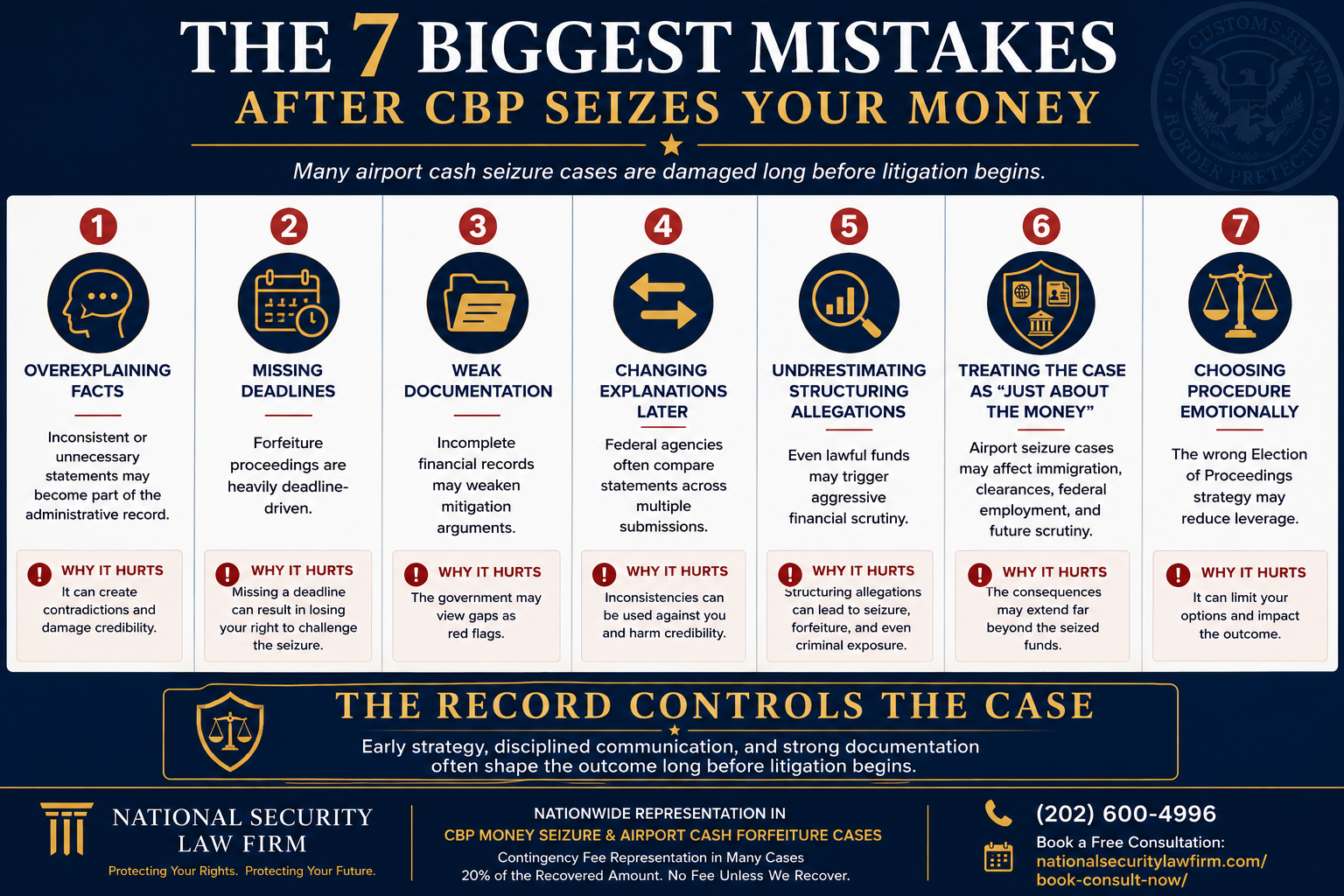
Mistake #1: Overexplaining the Situation
One of the most common mistakes people make is attempting to explain everything immediately.
Many travelers believe:
“If I just tell them exactly what happened, they’ll give the money back.”
In practice, airport cash seizure matters are often highly documentation-driven and credibility-driven.
People sometimes unintentionally damage their position by:
- speculating about transactions
- making inconsistent explanations
- overstating documentation
- guessing about financial details
- changing explanations later
- responding emotionally during inspection
CBP and related agencies may later compare:
- inspection interviews
- customs declarations
- banking records
- tax filings
- petition submissions
- electronic communications
- later litigation positions
Even relatively small inconsistencies can become important if investigators believe the narrative evolved after the seizure occurred.
Mistake #2: Assuming No Criminal Charges Means the Case Is Weak
Many travelers incorrectly assume:
“If I wasn’t arrested, the government must eventually return the money.”
In reality, many airport cash seizure cases proceed through administrative forfeiture systems that operate separately from criminal prosecutions.
CBP may continue pursuing forfeiture even when:
- no criminal charges are filed
- no arrest occurs
- the money was lawfully earned
- prosecutors decline criminal prosecution
That is one reason why administrative strategy often remains critically important even in non-criminal cases.
Additional discussion appears in Can CBP Keep Your Money Even If You Were Never Charged With a Crime?.
Mistake #3: Missing Deadlines
Airport cash forfeiture proceedings are heavily deadline-driven.
Many people underestimate how quickly procedural deadlines may arise after receiving a Notice of Seizure.
Missing deadlines may:
- limit procedural rights
- weaken leverage
- eliminate certain defenses
- result in administrative forfeiture of the funds
This becomes especially dangerous when individuals wait too long before evaluating:
- the Election of Proceedings options
- administrative petition strategy
- potential litigation posture
- documentation requirements
Additional discussion appears in The 30-Day Deadline That Can Cost You Your Property.
Mistake #4: Providing Weak or Incomplete Documentation
Strong documentation often becomes one of the most important factors in airport cash seizure cases.
However, many individuals submit:
- incomplete financial records
- inconsistent explanations
- unsupported narratives
- disorganized documentation
- records that conflict with prior statements
In many cases, the government evaluates whether the documentation:
- supports the source-of-funds explanation
- appears internally consistent
- aligns with banking activity
- resolves suspicious circumstances
- strengthens mitigation arguments
Weak documentation may substantially increase government skepticism and prolong the forfeiture process.
Mistake #5: Underestimating Structuring or Financial Scrutiny Issues
Many travelers fail to appreciate how aggressively the government may investigate:
- structuring allegations
- deposit patterns
- cash-intensive businesses
- suspicious banking activity
- tax filings
- financial inconsistencies
People sometimes assume:
“The money was legal, so none of this matters.”
In practice, however, airport cash seizure matters often involve much broader scrutiny concerning:
- financial activity
- documentation
- credibility
- consistency
- source-of-funds evidence
Additional discussion appears in CBP Seized My Cash for Structuring: What Does That Mean?.
Mistake #6: Treating the Seizure as an Isolated Problem
Another major mistake is assuming the case affects only the seized money itself.
Depending on the allegations involved, airport cash seizure matters may later intersect with:
- immigration proceedings
- Global Entry eligibility
- TSA credentials
- security clearances
- federal employment
- contractor eligibility
- future border inspections
- parallel federal investigations
Federal systems often evaluate credibility and financial concerns across multiple administrative contexts.
That broader overlap is one reason why airport cash seizure matters frequently require strategic analysis extending beyond simply recovering the funds.
Mistake #7: Choosing Procedure Based on Emotion Rather Than Strategy
Many people make procedural decisions emotionally after the seizure occurs.
For example, individuals sometimes:
- rush into litigation
- quickly abandon the funds
- submit poorly prepared petitions
- choose procedural options without understanding the consequences
In reality, the best strategy often depends heavily on:
- the evidence involved
- the quality of the documentation
- the amount seized
- whether criminal exposure exists
- broader federal implications
- procedural leverage
- long-term risk management
Additional discussion appears in Petition vs Judicial Action: Which Option Is Better?.
Airport Cash Seizure Cases Are Often Won or Lost Early
One of the most important realities in airport currency seizure matters is that many outcomes are heavily influenced by decisions made very early in the process.
Successful resolutions often depend on:
- disciplined communication
- strong documentation
- procedural strategy
- credibility management
- mitigation positioning
- careful administrative record development
That is why National Security Law Firm repeatedly emphasizes:
the record controls the case.
Understanding the most common mistakes after a seizure is important because many airport cash forfeiture matters are ultimately shaped less by dramatic courtroom litigation and more by credibility, consistency, documentation, and strategic decision-making from the outset.
Why Early Statements to CBP Can Destroy Your Case
One of the most common and damaging mistakes people make after an airport cash seizure is assuming they can quickly “talk their way out of it.”
In reality, statements made during:
- airport inspections
- border questioning
- secondary screening
- administrative petitions
- early communications with the government
often become some of the most important evidence in the entire case.
Many airport money seizure matters ultimately become heavily:
- credibility-driven
- consistency-driven
- documentation-driven
long before formal litigation ever begins.
That is one reason why early statements can significantly affect the trajectory of the case moving forward.
Why People Often Talk Too Much During Airport Seizures
Airport cash seizures are stressful.
Many travelers become:
- nervous
- overwhelmed
- confused about reporting requirements
- afraid of criminal exposure
- eager to “clear things up”
As a result, people sometimes:
- speculate about facts
- guess at financial details
- overexplain transactions
- provide inconsistent timelines
- make statements without reviewing documentation
- change explanations later
- respond emotionally rather than strategically
What initially feels like “helping explain the situation” may later create substantial credibility problems.
CBP Often Compares Statements Against Other Evidence
One of the most important realities in airport money seizure cases is that CBP and related agencies frequently compare statements against:
- customs declarations
- banking records
- tax filings
- electronic communications
- travel history
- business records
- petition submissions
- later litigation positions
Even relatively small inconsistencies can become significant if investigators believe:
- explanations evolved over time
- facts changed after the seizure
- documentation conflicts with earlier statements
- the narrative appears reconstructed later
In many cases, the government’s concerns focus less on one isolated inconsistency and more on whether the overall record appears:
- reliable
- plausible
- consistent
- strategically coherent
Why Airport Currency Cases Often Become Credibility Cases
Many travelers believe the most important issue is simply proving the money was legally earned.
While lawful source-of-funds evidence is often important, airport cash seizure matters frequently become broader evaluations of:
- credibility
- consistency
- reporting compliance
- financial documentation
- surrounding circumstances
- mitigation
- procedural behavior
That is one reason why early statements can become so important.
Statements made during airport inspections may later influence:
- mitigation decisions
- settlement posture
- administrative review
- litigation strategy
- future agency scrutiny
- related federal investigations
In many situations, the administrative record created early in the case heavily shapes how the government views the matter moving forward.
Why Overexplaining Can Become Dangerous
One of the most common mistakes people make is overexplaining.
For example, individuals sometimes:
- provide unnecessary details
- speculate about banking activity
- guess about transaction histories
- make unsupported claims
- attempt to answer questions they do not fully understand
- exaggerate documentation that later cannot be produced
Once statements become part of the administrative record, they may later become difficult to:
- clarify
- correct
- reconcile
- contextualize
That is especially true when:
- financial records tell a different story
- documentation appears incomplete
- later explanations evolve
- additional agencies become involved
Structuring and Financial Activity Cases Are Especially Sensitive
Early statements become particularly risky in matters involving:
- structuring allegations
- suspicious financial activity
- bulk cash smuggling concerns
- cash-intensive businesses
- unexplained banking patterns
- source-of-funds disputes
In these cases, investigators often examine:
- deposit history
- withdrawal activity
- business records
- tax returns
- financial consistency
- electronic communications
People sometimes unintentionally create additional problems by making financial explanations before fully understanding:
- the banking records involved
- the government’s concerns
- how the transactions may appear to investigators
Airport Seizure Statements May Affect More Than the Forfeiture Case
Another important issue is that statements made during airport cash seizure matters may later affect:
- immigration proceedings
- Global Entry eligibility
- TSA credentials
- security clearance reviews
- federal employment matters
- contractor eligibility
- future border inspections
- parallel federal investigations
Federal systems often evaluate credibility across multiple administrative contexts.
That broader institutional overlap is one reason why airport cash seizure matters frequently require strategic analysis extending beyond simply recovering the seized funds.
Why Strategic Communication Matters
This does not mean individuals should never provide explanations or documentation.
In many cases, carefully prepared administrative submissions and mitigation evidence may significantly improve recovery opportunities.
However, the timing, framing, consistency, and strategic positioning of those submissions often matter tremendously.
Successful airport cash seizure strategies frequently involve:
- disciplined communication
- strong documentation
- procedural strategy
- careful record development
- mitigation positioning
- consistency across all submissions
That is one reason why National Security Law Firm repeatedly emphasizes:
the record controls the case.
Understanding how early statements may affect a CBP money seizure case is critical because many airport currency forfeiture matters are ultimately shaped less by dramatic courtroom arguments and more by credibility, documentation, consistency, and administrative positioning developed early in the process.
Why National Security Law Firm Is Different in CBP Money Seizure Cases
Many law firms approach airport cash seizure cases as isolated forfeiture disputes focused only on recovering the money.
National Security Law Firm approaches these matters differently.
In many situations, CBP money seizure cases intersect with broader federal systems involving:
- immigration
- Global Entry eligibility
- TSA credentials
- security clearances
- federal employment
- contractor eligibility
- export-control concerns
- parallel federal investigations
- future border scrutiny
Federal systems often do not operate in isolation.
Information developed during an airport currency seizure matter may later appear in entirely different administrative, regulatory, or investigative contexts. That broader institutional overlap frequently shapes how these cases should be strategically handled from the outset.
A Federal-Systems Approach to Airport Cash Seizure Cases
National Security Law Firm represents clients nationwide in:
- customs seizure matters
- security clearance cases
- export-control issues
- federal administrative proceedings
- contractor-related matters
- overlapping federal investigations
The firm’s broader federal-systems experience informs how CBP money seizure cases are strategically evaluated from the beginning.
Rather than viewing the case as simply a dispute over seized currency, the firm focuses on:
- strategic record-building
- credibility management
- procedural leverage
- mitigation positioning
- coordinated administrative strategy
- long-term federal consequences
That broader perspective becomes especially important in airport seizure matters involving:
- structuring allegations
- suspicious financial activity
- bulk cash smuggling concerns
- contractor issues
- immigration implications
- security clearance exposure
- broader financial scrutiny
Why Strategic Record-Building Matters
Many airport cash seizure matters are heavily influenced by:
- early inspection statements
- financial documentation
- consistency of explanations
- mitigation evidence
- procedural positioning
- credibility assessments
That is one reason why National Security Law Firm repeatedly emphasizes:
the record controls the case.
The firm understands that many CBP money seizure matters are ultimately shaped less by dramatic courtroom arguments and more by:
- disciplined communication
- administrative strategy
- careful documentation
- procedural leverage
- how federal agencies evaluate credibility and risk
This becomes especially important because early submissions may later influence:
- immigration proceedings
- security clearance reviews
- contractor responsibility determinations
- federal hiring decisions
- export licensing
- future federal scrutiny
More Than Just a Currency Seizure Case
Many travelers initially focus only on recovering the seized funds.
However, depending on the circumstances, airport cash seizure matters may create broader federal implications extending far beyond the forfeiture proceeding itself.
In some situations, the case may later intersect with:
- security clearance reviews
- Global Entry eligibility
- TSA credential matters
- contractor eligibility
- export-control issues
- immigration concerns
- future border inspections
- parallel federal investigations
Understanding those overlapping federal systems is a major part of what differentiates National Security Law Firm’s approach.
Many firms focus only on the immediate seizure itself.
National Security Law Firm evaluates:
- the immediate forfeiture strategy
- the quality of the administrative record
- procedural positioning
- broader federal implications
- long-term institutional risk
Nationwide CBP Money Seizure Representation
National Security Law Firm represents clients nationwide in airport cash seizure and CBP currency forfeiture matters involving:
- airport currency seizures
- border cash seizures
- failure-to-report allegations
- structuring accusations
- bulk cash smuggling allegations
- suspicious financial activity claims
- administrative forfeiture proceedings
- judicial forfeiture litigation
In many airport cash seizure matters, the firm handles cases on a contingency fee basis, meaning:
- the firm typically charges 15% to 20% of the recovered amount
- there is no legal fee unless a recovery is obtained
If CBP seized your money during international travel, early strategic decisions may significantly affect:
- recovery opportunities
- mitigation
- litigation posture
- broader federal consequences
For broader information about customs forfeiture proceedings and CBP seizure matters generally, visit the firm’s main Customs Seizure Lawyers Resource Hub page.
Frequently Asked Questions About CBP Money Seizures
Can CBP seize legally earned cash?
Yes.
One of the most misunderstood aspects of airport currency seizure cases is that CBP may seize money even when the funds were lawfully earned.
In many situations, the government’s concerns involve:
- reporting violations
- suspicious financial activity
- structuring allegations
- inconsistent explanations
- bulk cash smuggling concerns
- credibility issues
rather than direct evidence that the money itself was illegally obtained.
Is carrying large amounts of cash illegal?
No.
Carrying large amounts of cash is not itself illegal.
However, travelers transporting more than $10,000 internationally are generally required to report the currency using FinCEN Form 105. Failure to comply with federal reporting requirements may result in seizure of the funds.
Additional discussion appears in Traveling With More Than $10,000: What You Need to Know Before Crossing the Border.
Can CBP seize money without charging someone with a crime?
Yes.
Many airport cash seizure cases proceed through civil or administrative forfeiture systems separate from criminal prosecutions.
The government may pursue forfeiture even when:
- no arrest occurs
- no indictment is filed
- no criminal charges are brought
- prosecutors decline criminal prosecution
Additional discussion appears in Can CBP Keep Your Money Even If You Were Never Charged With a Crime?.
What is FinCEN Form 105?
FinCEN Form 105 is the federal form generally used to report transportation of more than $10,000 into or out of the United States.
Failure to properly report currency may trigger:
- seizure of the funds
- administrative forfeiture proceedings
- increased federal scrutiny
- additional questioning during international travel
What happens after CBP seizes money at the airport?
After the seizure occurs, the matter typically enters an administrative forfeiture process handled by CBP’s Fines, Penalties, and Forfeitures (“FP&F”) office.
The government generally issues a Notice of Seizure explaining:
- the basis for forfeiture
- procedural deadlines
- available response options
- how to contest the seizure
Additional discussion appears in What Happens After CBP Seizes Your Money?.
What is the Election of Proceedings form?
The Election of Proceedings form is a document often included with the Notice of Seizure requiring the claimant to choose how to proceed.
The available options may include:
- filing an administrative petition
- submitting an Offer in Compromise
- abandoning the funds
- forcing judicial forfeiture proceedings
This decision may significantly affect:
- leverage
- costs
- timelines
- litigation posture
- procedural strategy
Additional discussion appears in Election of Proceedings Form Explained.
What is structuring?
Structuring generally refers to financial activity the government believes was designed to avoid federal reporting requirements.
Structuring allegations may involve:
- repeated cash deposits
- unusual withdrawal patterns
- fragmented transactions
- suspicious banking behavior
- inconsistent financial documentation
Importantly, many people accused of structuring are never criminally charged.
Additional discussion appears in CBP Seized My Cash for Structuring: What Does That Mean?.
What is bulk cash smuggling?
Bulk cash smuggling generally involves allegations that someone intentionally concealed currency during international travel to evade federal reporting requirements.
These cases often receive heightened scrutiny because they may create:
- parallel criminal exposure
- broader financial investigations
- increased federal attention
Additional discussion appears in Bulk Cash Smuggling Explained: What CBP Must Prove.
How long does it take to get seized cash back?
The timeline varies substantially depending on:
- the complexity of the case
- the amount seized
- the quality of the documentation
- whether litigation becomes necessary
- whether multiple agencies are involved
- the procedural posture
Some administrative matters resolve within months. Others may take significantly longer.
Additional discussion appears in How Long Does It Take To Get Seized Cash Back From CBP?.
Can airport cash seizures affect immigration or security clearances?
Potentially, yes.
Depending on the allegations involved, airport cash seizure matters may later affect:
- immigration proceedings
- Global Entry eligibility
- TSA credentials
- security clearances
- federal employment
- contractor eligibility
- future border inspections
Federal agencies often evaluate these matters across overlapping administrative systems.
Should I talk to CBP after a seizure?
That depends heavily on:
- the allegations involved
- the evidence already gathered
- whether criminal exposure exists
- the procedural posture
- broader federal implications
Many people unintentionally damage their cases by:
- overexplaining facts
- making inconsistent statements
- speculating about transactions
- providing unsupported narratives
Can I get my seized money back?
Potentially, yes.
Many airport cash seizure matters are resolved through:
- administrative petitions
- mitigation agreements
- negotiated settlements
- judicial forfeiture litigation
- strategic procedural challenges
The best strategy depends heavily on:
- the facts of the seizure
- the available documentation
- credibility issues
- the procedural posture
- broader federal implications
Do I need a lawyer for a CBP money seizure case?
Not every airport cash seizure matter requires representation.
However, many cases involve:
- strict procedural deadlines
- administrative forfeiture rules
- structuring allegations
- financial documentation issues
- credibility concerns
- overlapping federal consequences
- potential litigation exposure
The earlier the case is strategically evaluated, the more options may remain available.
For broader information about customs forfeiture proceedings generally, visit the firm’s main Customs Seizure Lawyers Resource Hub page.
Speak With a Nationwide CBP Money Seizure Lawyer
If CBP seized your cash at an airport, border crossing, or international checkpoint, the decisions made early in the process may significantly affect:
- recovery opportunities
- mitigation strategy
- litigation posture
- broader federal consequences
Many airport currency seizure cases involve far more than simply recovering the seized funds.
Depending on the allegations involved, these matters may create broader concerns involving:
- immigration status
- Global Entry eligibility
- TSA credentials
- security clearances
- federal employment
- contractor eligibility
- future border inspections
- parallel federal investigations
That is one reason why airport cash seizure cases often require careful strategic analysis from the very beginning.
Strategic Airport Cash Seizure Representation
National Security Law Firm represents clients nationwide in CBP money seizure and airport currency forfeiture matters involving:
- airport cash seizures
- border currency seizures
- failure-to-report allegations
- structuring accusations
- bulk cash smuggling allegations
- suspicious financial activity claims
- administrative forfeiture proceedings
- judicial forfeiture litigation
The firm approaches these matters strategically with a focus on:
- administrative positioning
- credibility management
- procedural leverage
- mitigation opportunities
- strong record development
- long-term federal risk analysis
Rather than treating airport currency seizures as isolated forfeiture disputes, National Security Law Firm evaluates how these matters may intersect with broader federal systems and future government scrutiny.
Contingency Fee Representation in Many Cash Seizure Cases
In many airport cash seizure matters, National Security Law Firm handles cases on a contingency fee basis.
In most situations:
- the firm charges 15% to 20% of the recovered amount
- there is no legal fee unless a recovery is obtained
This structure allows many individuals to pursue recovery of seized funds without paying substantial upfront legal fees while the forfeiture matter remains pending.
Why Early Strategic Decisions Matter
Many CBP money seizure matters are heavily influenced by:
- early statements
- documentation quality
- consistency of explanations
- procedural decisions
- mitigation strategy
- administrative record development
That is one reason why National Security Law Firm repeatedly emphasizes:
the record controls the case.
In many situations, airport cash seizure cases are ultimately shaped less by dramatic courtroom litigation and more by:
- disciplined communication
- procedural strategy
- credibility assessments
- strong documentation
- careful administrative positioning
Free Consultation for Airport Cash Seizure Matters
If CBP seized your money during international travel, National Security Law Firm offers nationwide representation and free consultations for airport cash seizure and administrative forfeiture matters.
National Security Law Firm offers nationwide representation and free consultations for airport and border cash and property seizure matters.
The fastest and easiest way to get started is through the firm’s online booking system.
In many situations, same-day consultations are available, and the process typically takes less than a minute to schedule online.
Once booked, an attorney will personally call you at the scheduled time to discuss:
- the seizure
- procedural deadlines
- recovery strategy
- documentation issues
- broader federal implications
To schedule a consultation online, visit:
Book a Free Consultation Online
You may also contact the firm directly at:
Phone: (202) 600-4996
Additional related resources:
- What Happens When CBP Seizes Your Cash at the Airport?
- Traveling With More Than $10,000: What You Need to Know Before Crossing the Border
- CBP Seized My Cash for Structuring: What Does That Mean?
- Bulk Cash Smuggling Explained: What CBP Must Prove
- How to Win a CBP Currency Seizure Case
- Why Early Statements to CBP Can Destroy Your Case
- Customs Seizure Lawyers Resource Hub