Most Travelers Focus on the Wrong Question

If your Global Entry application was denied or your membership was revoked, there is a good chance you have asked yourself one of the following questions:

Why did this happen to me? Was this fair? Why was someone else approved when I was denied? I was never convicted of anything — how can they deny me?

Those are understandable questions. Unfortunately, they are often not the questions that determine the outcome of a Global Entry appeal.

The most successful appeals begin by understanding how CBP is likely evaluating the case. And that starts with recognizing that Global Entry is not a rewards program, a convenience program, or a character contest. It is a risk-based Trusted Traveler Program under 8 CFR § 235.12. That distinction changes everything.

Book a free consultation | Take the free appeal assessment


Global Entry Appeals Strategy – Table of Contents

Understanding How CBP Evaluates Global Entry Appeals

One of the biggest mistakes travelers make is assuming that CBP is trying to determine whether they are a good person. That is not really the question. CBP is generally trying to determine whether the traveler should be considered a low-risk traveler for purposes of Trusted Traveler Program participation.

A traveler can be honest, hardworking, successful, and well respected — and still face a Global Entry denial. Likewise, a traveler may have a prior criminal issue and still be approved. The outcome often depends less on whether an incident occurred and more on how the government interprets that incident within the broader context of the applicant’s history.


The Low-Risk Traveler Standard

If there is one concept you should understand before filing a Global Entry appeal, it is this: Global Entry decisions are about risk.

The government’s central question is usually: Does this person present a sufficiently low risk to justify Trusted Traveler Program membership?

Everything else tends to flow from that question. This is why Global Entry cases sometimes produce outcomes that seem confusing on the surface.

Example 1: A traveler has a dismissed criminal charge from fifteen years ago. No further incidents occurred. The traveler has maintained stable employment, raised a family, traveled internationally without issue, and has otherwise demonstrated responsibility.

Example 2: A traveler with no criminal convictions but a recent customs violation involving undeclared items at the border.

Even though the second traveler has no criminal record, CBP may view the customs issue as highly relevant because Trusted Traveler Programs depend heavily on compliance and trust. Global Entry decisions are usually based on perceived risk rather than a simple checklist of convictions and non-convictions.


Why Understanding Risk Matters

Most lawyers approach Global Entry denials like criminal cases or immigration cases.

Global Entry cases are different.

They are fundamentally risk-assessment cases.

The government’s question is not simply:

What happened?

It is:

Why does this traveler present a risk?

National Security Law Firm’s Global Entry practice was built by Brett O’Brien, a former Army intelligence law attorney who conducted and reviewed Security Threat Assessments for the government.

That background helps us focus on the same question CBP is asking:

Why should this traveler be trusted today?


Why Some People With Worse Records Get Approved

This is one of the most common complaints we hear: “I know someone who had a worse record than me and got approved.”

That may be true — but there are usually facts you cannot see. How old was the incident? Was it isolated? Were there multiple incidents? Did the person disclose everything? Were there customs issues? Were there association concerns? Was rehabilitation documented? What supporting records were provided?

Two cases that look similar on the surface can be dramatically different once the details are examined. One of the biggest mistakes applicants make is comparing themselves to someone else’s outcome without knowing the full story. Top 5 Mistakes People Make on Global Entry Appeals.


Why Some People With Clean Records Get Denied

A person may have no convictions, no arrests, and no obvious criminal history — and still receive a denial. The answer is that criminal history is only one part of the picture. Other issues that frequently trigger denials include:

Customs Violations — undeclared goods, agricultural products, currency-reporting issues, or other customs-related concerns.

Application Disclosure Issues — failing to disclose information, even unintentionally.

Association Concerns — family members, travel companions, addresses, or organizations that create concern.

Immigration Issues — certain immigration-related matters may affect eligibility.

Government Record Issues — incomplete, inaccurate, or misunderstood records sometimes play a role.

This is why a “clean record” does not automatically guarantee approval. The question remains: why does CBP believe this traveler may not qualify as low risk? Guide to unexplained Global Entry denials.


The Totality of the Circumstances

Another concept that appears repeatedly in Global Entry cases is the idea of evaluating the entire picture rather than a single fact. A traveler is rarely approved or denied based on one issue alone. Instead, the government often considers:

Criminal history · Customs history · Immigration history · Travel history · Professional background · Military service · Government vetting history · Community involvement · Application accuracy · Mitigation evidence

This is why appeals built around a single talking point often struggle. A strong appeal addresses the broader picture. Global Entry Appeal Defenses, Strategies, and Hacks.


The Most Important Question in Every Appeal

Many applicants spend months asking: why was I denied? That is an important question. But once you understand the likely reason, a more important question emerges:

Why should CBP still consider me a low-risk traveler?

The strongest appeals answer that question directly. They do not simply explain what happened. They explain why what happened does not justify denial or revocation today. That distinction is where many successful appeals are won. How to maximize the chances of your Global Entry appeal | Unlocking the Gates: A Guide to Winning Your Global Entry Appeal


What Makes a Strong Global Entry Appeal?

Once you understand how CBP is likely evaluating your case, the next question becomes: what actually makes an appeal persuasive?

Many travelers assume the answer is a powerful personal story, a lengthy explanation, a lawyer-written brief, or a favorable court outcome. Those things can help — but they are not usually the most important factors.

The strongest appeals generally share several characteristics regardless of whether the issue involves a criminal recordcustoms violationmarijuana-related incidentassociation concern, or unexplained denial.

Book a free consultation | Take the free appeal assessment


Success Factor #1: The Incident Is Old

Time is one of the strongest forms of mitigation. The longer a traveler goes without additional problems, the easier it becomes to argue that an old incident no longer reflects current risk.

  • Example A: One misdemeanor offense from fifteen years ago. No subsequent incidents. Stable employment. International travel without issues. Strong community involvement.
  • Example B: The exact same offense six months ago.

The passage of time often allows applicants to demonstrate maturity, stability, rehabilitation, and long-term compliance. Time alone does not guarantee success — but it is often one of the most persuasive facts in an appeal.


Success Factor #2: The Incident Was Isolated

Patterns matter. A single mistake is often viewed differently than repeated conduct.

Examples of isolated incidents include one DUI, one dismissed charge, one customs violation, or one airport incident.

Examples of patterns include multiple arrests, multiple customs penalties, repeated disclosure issues, or repeated alcohol-related incidents.

The more isolated the event, the easier it becomes to argue that it does not accurately reflect the traveler’s overall risk profile.


Success Factor #3: Strong Supporting Documentation

This may be the most important success factor of all. Many travelers focus almost entirely on what they plan to say. The reality is that documentation often matters more than explanations.

Instead of saying “the charge was dismissed” — provide ☑ the dismissal order.
Instead of saying “I completed probation” — provide ☑ documentation proving completion.
Instead of saying “the customs issue was resolved” — provide ☑ resolution records.

The record controls the case. The stronger the documentation, the stronger the appeal. Global Entry Appeal Document Checklist


Success Factor #4: Strong Mitigation Evidence

Mitigation is often what separates a good appeal from a great one. Mitigation helps answer the question: why should this issue not control the outcome today?

Professional Achievement — promotions, leadership positions, business ownership, professional licenses.
Educational Achievement — degrees, certifications, academic honors.
Community Involvement — volunteer work, charity work, board memberships, community leadership.
Personal Stability — long-term employment, family responsibilities, consistent residence history.

The strongest appeals typically show who the traveler is today — not simply who they were when the incident occurred. How to maximize the chances of your Global Entry appeal.


Success Factor #5: Candor

Many applicants underestimate the importance of honesty. In some cases, the underlying incident is less damaging than the perception that the applicant was not candid. Examples include failing to disclose an arrest, omitting a customs incident, or forgetting a prior charge. When mistakes occur, strong appeals usually address them directly. Trying to avoid the issue often creates a larger problem than the issue itself.


Success Factor #6: Rehabilitation

Rehabilitation is particularly important in cases involving criminal historyalcohol-related incidents, and drug-related incidents. Examples of rehabilitation evidence include:

☑ Treatment completion
☑ Counseling
☑ Sobriety documentation
☑ Community service
☑ Professional achievements
☑ Long-term compliance

The goal is to demonstrate growth, responsibility, and reduced risk.


Success Factor #7: Reference Letters

Reference letters can be extremely valuable when done correctly. Strong reference letters generally come from employers, supervisors, military officers, professional colleagues, attorneys, and community leaders. The best letters are specific — discussing character, trustworthiness, responsibility, professionalism, and compliance with rules. Generic letters tend to carry less weight. Detailed letters written by credible individuals often carry significantly more value.


Success Factor #8: Government Vetting History

In some cases, prior government trust can be helpful evidence. Examples include military service, security clearances, government employment, and government contracting. These factors do not guarantee approval, but they may help demonstrate a history of responsibility and successful vetting. Global Entry Appeal Defenses, Strategies, and Hacks.


Success Factor #9: Correcting Government Errors

Some of the strongest appeals are built around inaccurate records. Examples include incorrect criminal history, wrong dispositions, address associations, misidentification, and incomplete records.

When the government’s information is wrong, correcting the record through FOIA often becomes the strongest strategy available. The appeal may succeed not because the traveler changed — but because the facts were clarified.


Success Factor #10: Addressing Risk Directly

This is where many appeals succeed or fail.

Weak appeals focus on: why the traveler deserves Global Entry.

Strong appeals focus on: why the traveler should still be considered low risk.

Those are not the same thing. The strongest appeals connect every piece of evidence back to the government’s underlying concern: Why does this incident not indicate current risk? Why should the traveler still be trusted? Why is approval or reinstatement appropriate today?

When an appeal answers those questions effectively, it becomes much more persuasive. Unlocking the Gates: A Guide to Winning Your Global Entry Appeal.


What Success Factors Matter Most?

There is no universal formula. Every case is different. However, the factors that appear most often in successful appeals include:

  1. The issue is old
  2. The issue was isolated
  3. Strong records exist
  4. Strong mitigation exists
  5. The traveler has demonstrated responsibility since the incident
  6. The appeal identifies the actual concern
  7. The appeal directly addresses risk

Those themes appear again and again in successful appeals. The next question is equally important: what makes an appeal weak? Because many appeals fail for entirely avoidable reasons. Top 5 Mistakes People Make on Global Entry Appeals.


What Makes a Weak Global Entry Appeal?

Understanding what strengthens an appeal is only half the battle. The other half is understanding what weakens one.

Many Global Entry appeals fail for completely avoidable reasons. The problem is not always the underlying incident. In many cases, the problem is how the appeal is prepared. Some of the weakest appeals involve travelers who actually have decent facts but present them poorly. Others involve travelers who spend pages discussing issues that have little to do with the government’s actual concern.

The good news is that many of these mistakes can be avoided once you understand what CBP is likely looking for.

Book a free consultation | Take the free appeal assessment


Weak Appeal #1: Focusing on Fairness Instead of Risk

This is probably the most common mistake. The appeal becomes an argument about why the denial was unfair: “This isn’t right.” “I don’t deserve this.” “Other people have done worse things.” “My friend got approved.”

While those feelings may be understandable, they rarely address the government’s concern. Global Entry appeals are generally not about fairness — they are about risk. The stronger question is: why does this incident not indicate that I am a current risk? Strong appeals answer that question. Weak appeals argue about fairness. What makes a good or bad Global Entry appeal case?


Weak Appeal #2: Minimizing the Incident

Another common mistake is trying to convince CBP that the incident was insignificant: “It was only a misdemeanor.” “It was only one DUI.” “It was only a customs violation.” “It was only a small amount.”

The problem is that CBP already knows what happened. Minimizing the issue often makes it appear that the traveler does not fully appreciate the concern. A stronger approach is to acknowledge the issue, explain the context, and demonstrate why it does not indicate current risk. Acceptance is often more persuasive than minimization.


Weak Appeal #3: Guessing at the Reason for the Denial

This happens constantly. A traveler assumes “I was denied because of my old arrest” when the reality may be a customs issue, an application omission, an association concern, or a government record problem.

If the appeal addresses the wrong issue, it is difficult for it to succeed. This is why identifying the actual concern is often one of the most important parts of the process — sometimes requiring record gathering, investigation, court records, FOIA requests, or additional analysis. You cannot effectively solve a problem you have not identified. Guide to unexplained Global Entry denials.


Weak Appeal #4: Missing Documentation

Many appeals rely almost entirely on unsupported statements. “The case was dismissed” without including ☒ the dismissal order“I completed probation” without including ☒ proof of completion.

The strongest appeals are generally supported by documentation. This is especially true in cases involving criminal historycustoms violationsimmigration issuesexpungements, and rehabilitation. The government’s understanding of the case should not be left entirely to assumption. Global Entry Appeal Document Checklist ⚠️ remove link until URL confirmed


Weak Appeal #5: Emotional Arguments

Global Entry denials are frustrating — and understandably so. Unfortunately, emotional appeals are often less effective than factual ones. Examples include long complaints about CBP, personal attacks, accusations, and emotional narratives with little supporting evidence.

Strong appeals tend to be professional, organized, evidence-based, and focused on the issue. The goal is persuasion — not venting.


Weak Appeal #6: Ignoring Mitigation

Some travelers spend all their time explaining the incident and very little time explaining what happened afterward. That is a mistake. Mitigation is often where appeals are won. Examples include professional success, education, military service, community involvement, rehabilitation, and long-term compliance.

The appeal should not simply explain the problem. It should explain why the problem does not define the traveler today. How to maximize the chances of your Global Entry appeal.


Weak Appeal #7: Generic Reference Letters

Reference letters can be valuable. Bad ones usually sound like this: “John is a good person.” “Jane is trustworthy.” Those statements are too generic.

Strong reference letters provide specifics — how long the writer has known the traveler, examples of responsibility, professional accomplishments, international travel needs, and personal observations about character. Specificity creates credibility. Generic praise rarely does.


Weak Appeal #8: Treating the Appeal Like a Criminal Appeal

Many applicants focus entirely on whether they were legally guilty. CBP may be focused on something different. The appeal is not necessarily about proving innocence — it is usually about demonstrating low-risk traveler status. Those are related concepts but not identical ones. The strongest appeals understand the distinction. Global Entry Appeal Strategy & Winning.


Weak Appeal #9: Filing Too Quickly

Some travelers submit an appeal immediately after receiving the denial — before gathering records, understanding the issue, evaluating mitigation, or considering FOIA. Fast is not always better. A complete appeal is usually more valuable than an immediate one. This does not mean you should wait indefinitely — it means you should understand the issue before responding.


Weak Appeal #10: Ignoring Government Errors

Some travelers assume the government must be right. Others assume it must be wrong. The better approach is: verify.

Government records are not always perfect. Possible issues include incorrect criminal history, incomplete dispositions, misidentification, address associations, and outdated information. When errors exist, correcting them through FOIA often becomes one of the strongest appeal strategies available.


The Five Biggest Appeal Mistakes

If we had to identify the five mistakes that cause the most damage:

  1. Appealing Before Understanding the Issue — you cannot address a concern you have not identified
  2. Failing to Gather Records — unsupported statements rarely carry the same weight as documentation
  3. Ignoring Mitigation — the appeal should show who you are today, not just explain what happened
  4. Submitting Generic Evidence — specificity creates credibility; generic statements rarely do
  5. Focusing on Fairness Instead of Risk — the appeal must answer CBP’s actual question

Those five mistakes appear repeatedly in unsuccessful appeals. The good news is that all five are avoidable.

Global Entry Appeal Defenses, Strategies, and Hacks | Unlocking the Gates: A Guide to Winning Your Global Entry Appeal


What Makes a Good or Bad Case for a Global Entry Appeal?

One of the first questions many travelers ask is: “Do I actually have a chance?”

It is a reasonable question. Unfortunately, it is impossible to answer without understanding the specific facts of the case. No attorney can honestly look at a single fact — such as a DUI, a dismissed charge, or a customs violation — and immediately tell you whether your appeal will succeed. Global Entry cases are rarely that simple.

Instead, successful appeals are usually evaluated based on the totality of the circumstances: what happened, when it happened, whether it was isolated, whether it was resolved, what documentation exists, what mitigation exists, whether the government’s records are accurate, and what has happened since.

The purpose of this page is not to tell you whether you will win or lose. The purpose is to help you understand what tends to make cases stronger and what tends to make them more difficult.

Take the free appeal assessment | Book a free consultation


Strong Cases

Generally speaking, stronger cases tend to involve one or more of the following factors.

The Incident Is Old

Time is often one of the strongest forms of mitigation. An isolated incident from fifteen years ago is usually viewed differently than an incident from six months ago — particularly when no similar incidents occurred afterward and the traveler demonstrated responsibility and stability since the event.

Example: A single misdemeanor offense from 2008 followed by fifteen years of clean conduct.

The Incident Was Isolated

CBP often evaluates patterns differently than one-time events. Examples of isolated events: one DUI, one dismissed charge, one customs violation, one airport incident. Examples of patterns: multiple arrests, multiple customs penalties, repeated disclosure problems, recurring alcohol-related issues.

Strong Documentation Exists

Some appeals are supported by ☑ certified court records, ☑ dismissal orders, ☑ expungement records, ☑ customs records, ☑ employment documentation, ☑ reference letters, and ☑ professional records. Others are supported by little more than the applicant’s memory. A strong record allows the reviewer to understand what actually happened rather than relying on assumptions. Global Entry Appeal Document Checklist

The Traveler Has Significant Mitigation

Mitigation often transforms a moderate case into a strong case. Examples include long-term employment, professional success, business ownership, military service, security clearance history, volunteer work, community involvement, and educational achievements. These facts help answer an important question: who is this person today? How to maximize the chances of your Global Entry appeal.

The Government Records Appear Wrong

Some of the strongest cases involve inaccuracies — incorrect criminal-history information, wrong dispositions, misidentification, address associations, or incomplete records. When the government’s information is incorrect, correcting the record through FOIA often becomes the central focus of the appeal.


Moderate Cases

Many cases fall somewhere in the middle — neither obviously strong nor obviously weak. Examples may include a recent isolated incident, limited documentation where facts may be favorable but important records are missing, some mitigation that exists but is not substantial, or a partial understanding of the denial reason. These cases often require careful development — the quality of the appeal can make a significant difference.


Difficult Cases

“Difficult” does not mean impossible. It simply means the case presents additional challenges.

Recent Serious Criminal Conduct — a recent criminal incident is generally harder to overcome than an older one, especially when little time has passed.

Active Criminal Charges — cases involving pending charges are often more challenging because the underlying situation has not yet been resolved.

Multiple Similar Incidents — patterns are often harder to explain than isolated events. Examples include multiple DUIs, multiple customs violations, repeated arrests, or repeated disclosure issues.

Repeated Customs Problems — because Global Entry depends heavily on compliance and trust, repeated customs-related issues often create additional concerns.

Minimal Supporting Documentation — even potentially strong cases become difficult when records are unavailable or incomplete.

No Mitigation — an appeal that focuses entirely on the incident without demonstrating growth, stability, or rehabilitation is often weaker than one that provides a broader picture.


What About Dismissed Charges?

Dismissed charges often fall between strong and moderate cases. Many applicants assume “the case was dismissed, so I should automatically qualify.” The reality is more nuanced. A dismissal is generally helpful — but the appeal still needs to explain what happened, why the charge was dismissed, and why the incident does not indicate current risk. The stronger the supporting records, the stronger these cases tend to be.


What About Expunged Records?

Expungement is often valuable mitigation evidence, but it is not a guarantee of approval. Strong expungement cases typically involve passage of time, clean conduct since the incident, strong documentation, and additional mitigation evidence. The appeal should focus not only on the expungement itself but also on why the traveler should be trusted today. Should you disclose expunged records?


What About Customs Violations?

Customs violation cases vary dramatically — ranging from a simple declaration mistake to a much more serious compliance issue. The specific facts often matter more than the category itself. Questions that frequently matter include: was the issue intentional, was it resolved, has it happened again, and what documentation exists? Strong customs appeals usually provide detailed records and context. Global Entry Revoked for Customs Violation.


What About Marijuana Cases?

Marijuana-related cases are among the most common Global Entry issues we see. The strength of these cases often depends on what happened, when it happened, whether travel was involved, whether customs was involved, and whether there have been similar incidents since. The details matter enormously — two marijuana cases that appear similar at first glance can have very different strengths once the facts are examined.


Can a Weak Case Become Stronger?

Absolutely. Many cases become stronger over time. Examples include additional years without incidents, expungement, new employment history, educational achievements, community involvement, new supporting records, and stronger mitigation evidence. This is one reason why timing can matter — sometimes the strongest strategy is not simply filing immediately, but building a stronger record first.


The Most Important Takeaway

Many travelers focus entirely on the incident. The strongest appeals focus on the traveler. The question is rarely did something bad happen? The question is usually: does this incident justify denying or revoking Trusted Traveler status today? The stronger the evidence supporting a favorable answer to that question, the stronger the appeal tends to become. Global Entry Appeal Defenses, Strategies, and Hacks | Unlocking the Gates: A Guide to Winning Your Global Entry Appeal


Why Filing a Global Entry Appeal Is Often Worth It

One of the most common questions travelers ask after receiving a denial or revocation is: “Is it even worth appealing?”

The answer depends on the facts. Some appeals are strong. Some are difficult. Some require additional investigation before a meaningful answer can be given. But one thing is clear: many travelers give up far too early.

In fact, one of the biggest misconceptions about Global Entry is that a denial automatically means the decision can never be changed. That simply is not true.

Book a free consultation | Take the free appeal assessment


Global Entry Appeals Are Not Just a Formality

Many travelers assume appeals never work.

According to a 2024 Government Accountability Office report, the CBP Ombudsman reviewed more than 76,000 reconsideration requests between FY 2020 and Q2 FY 2023.

Approximately 39% resulted in a favorable outcome, including approvals, reinstatements, or being allowed to continue the enrollment process.

This does not predict the outcome of any individual appeal.

However, it demonstrates that reconsideration is a real process and that decisions can change when new information is presented.


The Biggest Mistake: Assuming the Decision Is Final

Many applicants receive a denial and immediately assume: “The government has already made up its mind.”

In reality, CBP created a reconsideration process because mistakes happen, records are incomplete, circumstances change, and additional information can matter. The Government Accountability Office reported that approximately 39% of reconsideration requests result in approval or reinstatement. That does not mean every appeal will succeed — but it does mean that a denial is not necessarily the end of the story.


Many Denials Are Based on Incomplete Information

One of the most surprising things we see is how often applicants do not realize what information the government is actually relying on. Examples include missing court dispositions, old arrests without final outcomes, incomplete criminal-history records, customs incidents lacking contextexpungements that were never explainedaddress or association concerns, and application misunderstandings.

In some cases, the denial may make sense once the underlying issue is identified. In others, the appeal process becomes the first opportunity to provide the missing context.


The Government Often Sees Only Part of the Story

A criminal record may show an arrest, a charge, or a conviction. What it often does not show is rehabilitation, career success, community involvement, military service, educational achievements, family responsibilities, or the passage of time.

Similarly, a customs violation may show the incident — but not the explanation, resolution, corrective actions, or subsequent compliance. One of the primary purposes of an appeal is to fill in those gaps. What makes a strong Global Entry appeal?


Some Appeals Succeed Because the Records Were Wrong

Not every denial is based on bad facts. Sometimes it is based on bad information. Examples include incorrect criminal records, wrong dispositions, address associations, misidentification, and incomplete government databases.

In these cases, the appeal may be less about explaining conduct and more about correcting the record. That is one reason why records gathering and FOIA can be so important.


Some Appeals Succeed Because Circumstances Have Changed

Even when the government’s original concern was legitimate, circumstances often evolve. Examples include expungement of a record, completion of probation, completion of treatment, additional years without incidents, professional advancement, military service, and community involvement. A case that was weak five years ago may look very different today.


Many Travelers Focus on the Wrong Question

After a denial, most people ask: “Was the government right?” A more productive question is: “What concern was the government trying to address?”

Understanding that concern is often the first step toward determining whether an appeal is worthwhile. A dismissed charge may not be the issue — the issue may be lack of documentation, application disclosure concerns, or missing context. Likewise, a customs violation may not automatically doom a case — the question is whether the facts suggest ongoing risk.


Appeals Are Often About More Than Convenience

Many people view Global Entry as simply a way to avoid long customs lines. For some travelers, that is true. For others — frequent international travelers, business owners, executives, consultants, government contractors, attorneys, and professionals with extensive international travel obligations — the loss of Global Entry may create significant delays, lost productivity, increased travel burdens, and missed opportunities. That is one reason many travelers decide that pursuing an appeal is worthwhile.


Even Difficult Cases Can Benefit From an Evaluation

Not every case is strong. Not every appeal should be filed. But even difficult cases often benefit from a careful evaluation. A proper evaluation may reveal missing records, available mitigation, government record problems, additional options, and reapplication opportunities. The only way to determine whether an appeal is worthwhile is to understand the facts first.


When Filing an Appeal May Make Sense

An appeal may be worth considering when:

☑ The denial reason is known and can be addressed — How to appeal a Global Entry denial
☑ Important records were not previously provided — Document Checklist
☑ Government records appear inaccurate
☑ Significant mitigation exists
☑ The traveler has maintained a strong record since the incident
☑ The denial appears inconsistent with the available evidence
☑ Global Entry is important professionally or personally


When Additional Investigation May Be Needed First

Sometimes the better first step is not an appeal — it is figuring out what happened. Examples include:

☑ Unexplained denials
☑ Unknown government concerns
☑ Potential record errors — FOIA for Global Entry denials
☑ Association-based concerns
☑ Cases where the traveler genuinely does not know why they were denied

In these situations, records gathering, FOIA, or additional analysis may be more important than immediately filing an appeal.


The Real Question Is Not “Will I Win?”

No honest attorney can tell you whether you will win. The better question is: “Do I have information, records, evidence, or mitigation that could change how the government views my case?” That is often the question that determines whether an appeal is worth pursuing. What makes a good or bad Global Entry appeal case?


Why Some Travelers Hire National Security Law Firm

Most Global Entry lawyers have never conducted a Security Threat Assessment.

Most have never worked inside a government risk-evaluation process.

Global Entry appeals are fundamentally risk-assessment cases.

Our approach starts by asking:

Why does the government believe this traveler is a risk?

That question drives everything else:

  • record gathering
  • mitigation
  • strategy
  • appeal drafting

In addition:

✔ More than 1,000 Global Entry and Trusted Traveler Program matters handled

✔ We help obtain records when clients do not have them

✔ Flat fee pricing

✔ Approved or Reinstated — or Your Legal Fee Back

Flat Fee: $2,995 | Approved or Reinstated — or Your Legal Fee Back

Learn More:


Advanced Global Entry Appeal Strategies

How Strong Appeals Are Actually Built

Most articles about Global Entry appeals explain where to file, how long it takes, and what documents to submit. That information is important. But it does not answer the question many travelers really care about: what actually makes an appeal persuasive?

The answer is strategy. Not tricks. Not shortcuts. Real strategy.

The strongest appeals are not simply collections of documents. They are carefully constructed explanations that identify the government’s concern and then systematically address it. This page explains how that process works.

Book a free consultation | Take the free appeal assessment


Strategy #1: Determine the Actual Issue Before Doing Anything Else

This is the single most important strategy in the entire appeal process.

Many travelers assume they know why they were denied. Often they do not. The traveler believes “I was denied because of my old arrest” — but the actual issue may be an application disclosure problem, a customs incident, a travel-related concern, an address association, or an entirely different record.

One of the fastest ways to weaken an appeal is to spend ten pages addressing the wrong issue. Before preparing an appeal, ask: what specific concern is the government likely trying to address?


Strategy #2: Think Like the Reviewer

Applicants think like applicants. The reviewer thinks like a risk assessor.

Applicants often ask: was this fair? Did I deserve this? Why me? The reviewer is usually asking: what risk does this person present?

A traveler may spend pages explaining why a criminal charge was unfair. The reviewer may be wondering: what evidence shows that this traveler is low risk today? The strongest appeals focus on the questions the reviewer is actually asking. Global Entry Appeal Strategy — how CBP evaluates cases.


Strategy #3: Build the Record Before Writing the Argument

Many people do the opposite — they begin writing immediately. That is usually backwards.

The strongest appeals often begin with records gathering: court dispositionsdismissal ordersexpungement recordscustoms records, immigration records, employment documentation, and reference letters. Only after the record is assembled does the argument begin.

The record controls the case. The argument should grow out of the evidence — not the other way around. Global Entry Appeal Document Checklist


Strategy #4: Address Risk Directly

Many appeals explain what happened, why it happened, and why the traveler is upset — but never answer: why should CBP still consider this person low risk?

The strongest appeals connect every important fact back to risk:

The common theme is always: why does this issue not indicate current risk?


Strategy #5: Focus on Current Risk, Not Historical Conduct

One of the biggest mistakes applicants make is treating the appeal like a history lesson. They spend pages describing what happened, why it happened, and who was involved — and very little time explaining: why should I be trusted today?

The government already knows the incident occurred. The stronger question is: what has happened since? This is where mitigation becomes critical. How to maximize the chances of your Global Entry appeal.


Strategy #6: Use Mitigation the Right Way

Many travelers misunderstand mitigation. Mitigation is not simply listing positive facts — mitigation should explain why those facts matter.

Weak mitigation: I graduated from college.

Strong mitigation: Since the incident, I completed my degree, built a successful career, maintained a clean record, and traveled internationally without incident for ten years.

The difference is context. The strongest mitigation helps explain why the incident no longer reflects the traveler’s current risk profile. What makes strong mitigation evidence.


Strategy #7: Do Not Overlook Professional and Government Vetting History

Some of the strongest evidence in a Global Entry appeal may have nothing to do with the incident itself. Examples include security clearances, government employment, military service, government contracting, and professional licenses. These facts do not guarantee approval — but they can help demonstrate trustworthiness, responsibility, prior government vetting, and reliability. When relevant, they should not be ignored.

Prior Government Trust Matters. If the federal government has previously trusted you with:

  • a security clearance
  • military responsibilities
  • sensitive employment

that does not guarantee approval.

But it may help demonstrate a history of responsibility and successful vetting.


Strategy #8: Reference Letters Should Fill Gaps

The best reference letters do something more useful than expressing admiration — they help answer questions the records cannot answer.

An employer letter explains international travel requirements. A military officer letter discusses trustworthiness and responsibility. A community leader letter provides context regarding character and community involvement. Strong letters provide information. Weak letters provide compliments. What makes strong reference letters in a Global Entry appeal.


Strategy #9: Correct Government Errors Aggressively

Some appeals are won because the government had the wrong information. Examples include wrong criminal-history records, incorrect dispositions, address associations, misidentification, and incomplete records.

In those situations, the goal is no longer mitigation — the goal is correction. Correcting inaccurate records is often one of the strongest strategies available. How FOIA helps identify government errors.


Strategy #10: Know When FOIA Helps

Many travelers either ignore FOIA completely or assume every case requires it. Both approaches are mistakes.

FOIA is most useful when the denial reason is unclear, records appear inaccurate, important information is missing, or additional investigation is necessary. FOIA is a tool — not a strategy by itself. The question is whether the information obtained is likely to improve the appeal. When to submit a FOIA request.


Strategy #11: Do Not Build the Appeal Around Convenience

Many travelers focus heavily on how useful Global Entry is — long customs lines, frequent travel, lost productivity. Those facts are helpful. But they should not be the centerpiece of the appeal. The government generally cares far more about risk than convenience. The strongest appeals address risk first and travel impact second.


Strategy #12: The Best Appeals Tell a Story

Not a dramatic story. A logical story. A story that answers: what happened? Why did it happen? What happened afterward? Why should the traveler be trusted today? The stronger the answers to those questions, the stronger the appeal tends to become. Global Entry Appeal Defenses, Strategies, and Hacks | Unlocking the Gates: A Guide to Winning Your Global Entry Appeal


The Single Most Important Strategy

If we had to reduce the entire appeal process to one sentence, it would be this:

Stop arguing about the incident and start explaining why the incident does not indicate current risk.

That shift alone often changes the quality of an appeal dramatically. Many travelers spend all of their time trying to prove the incident should not matter. The strongest appeals explain why the traveler should still be trusted despite it.


Appeal Strategy FAQs

What Is the Strongest Global Entry Appeal Argument?

There is no single argument that wins every case. The biggest mistake travelers make is looking for a magic phrase or secret strategy that guarantees approval. The strongest appeal argument is usually the one that directly addresses the government’s actual concern.

For example: a criminal-history case may focus on rehabilitation, passage of time, and lack of recurrence. A customs violation case may focus on compliance, resolution, and the isolated nature of the incident. An unexplained denial may focus on identifying and correcting inaccurate records.

Strong appeals are rarely built around generic arguments — they are built around the specific facts of the case. What makes a good or bad Global Entry appeal case?


Does Military Service Help?

Often. Military service can be valuable because it demonstrates responsibility, discipline, government trust, successful vetting, and service to the country. Military records, awards, evaluations, and service history may all be relevant. Military service does not guarantee approval — but it can be persuasive mitigation evidence when combined with a strong overall record.


Does a Security Clearance Help?

Sometimes. Many travelers assume a security clearance automatically guarantees Global Entry approval. It does not — the two systems serve different purposes. However, a current or prior security clearance may help demonstrate government trust, reliability, successful vetting, and professional responsibility. A security clearance is generally most useful when it forms part of a broader mitigation story.


Do Reference Letters Really Matter?

Often, yes. Reference letters help provide information that government records cannot. A criminal-history record may show an arrest, a conviction, or a dismissal — a reference letter may show character, professionalism, responsibility, growth, and reliability. The strongest letters are specific. The weakest letters are generic. Quality almost always matters more than quantity.


How Many Reference Letters Should I Submit?

There is no perfect number. In many cases, three to seven strong letters are sufficient. A detailed letter from a credible source is usually worth more than ten generic letters. The goal is not to overwhelm the reviewer — the goal is to provide meaningful evidence that supports the appeal. What makes a strong Global Entry appeal?


Does an Expungement Help?

Yes — but it is not a guarantee. An expungement often helps demonstrate passage of time, compliance with court requirements, rehabilitation, and a favorable legal outcome. However, Global Entry decisions involve more than whether a record was expunged. The appeal still needs to explain why the underlying issue does not indicate current risk. Global Entry denied after expungement.


Should I Explain My Entire Life Story?

Usually not. Many applicants submit lengthy narratives containing large amounts of information that have little connection to the denial. The strongest appeals are focused and answer four questions: what happened, why did it happen, what happened afterward, and why should the traveler be trusted today? Everything else should support those points. Top 5 Mistakes People Make on Global Entry Appeals.


What If Government Records Are Wrong?

This is one of the strongest appeal themes available. Examples include incorrect criminal history, wrong dispositions, misidentification, address associations, and incomplete records.

When government records are inaccurate, the focus often shifts from mitigation to correction. The strongest strategy may simply be proving that the information being relied upon is wrong. How FOIA helps identify inaccurate records.


What If I Do Not Know Why I Was Denied?

This is extremely common. When the reason is unclear, the focus often becomes investigation. Possible next steps may include reviewing records, gathering court documents, evaluating customs history, analyzing travel history, and considering FOIA. Before an appeal can be successful, the issue usually needs to be identified. My Global Entry was denied for no reason — what should I do?


Should I Mention My Family?

Sometimes. Family information can be useful when it helps demonstrate stability, responsibility, long-term commitments, and community ties. However, family information should generally support the overall appeal strategy rather than become its focus.


Should I Discuss How Much I Travel?

Yes — but with perspective. Travel needs can help explain why Global Entry matters. However, they should usually be secondary. The government is generally more interested in why should this traveler be trusted? than why is Global Entry convenient? Risk usually matters more than convenience.


What If My Appeal Was Already Denied?

A denied appeal does not automatically mean all options are exhausted. The first question should be: why did the appeal fail? Potential next steps may include obtaining additional records, pursuing FOIA, correcting inaccurate information, gathering stronger mitigation evidence, or reapplying later. A second attempt should generally be built around new information — not simply a repeat of the original submission. What to do when your Global Entry appeal is denied.


Why Most Travelers Misunderstand Their Own Case

One of the most surprising things about Global Entry appeals is how often travelers focus on the wrong issue. Most applicants have never seen the records the government reviewed. Most have never worked inside a risk-based vetting process. As a result, several common myths tend to appear again and again.


Myth #1: “I Was Never Convicted, So I Should Be Approved.”

Not necessarily. Global Entry decisions are not limited to convictions. The government may consider arrestscustoms incidentsapplication disclosuresassociation concerns, and other risk-related factors. The absence of a conviction is helpful — it is not always dispositive.


Myth #2: “My Expungement Guarantees Approval.”

Expungement can be powerful mitigation. But it is not an automatic approval ticket. The appeal still needs to explain why the underlying issue does not justify denial or revocation today.


Myth #3: “My Friend Got Approved With the Same Issue.”

Probably not exactly the same. There are almost always facts you cannot see — different documentation, different timing, different travel history, different customs history, different mitigation. Two cases that look similar on the surface are often very different underneath. What makes a good or bad Global Entry appeal case?


Myth #4: “CBP Must Have Made a Mistake.”

Sometimes — but not always. The better approach is: verify. Gather records. Understand the issue. Then decide what happened. FOIA can help identify what information CBP relied on.


Myth #5: “I Should Focus on Why I Deserve Global Entry.”

Many appeals focus on fairness, convenience, and travel burdens. Those topics matter — but they are rarely the central issue. The stronger question is: why should CBP consider this traveler low risk? The strongest appeals answer that question directly. Global Entry Appeal Defenses, Strategies, and Hacks.


The Real Secret to Winning a Global Entry Appeal

There is no secret form. No secret phrase. No secret government contact. The closest thing to a secret is this:

Successful appeals focus on the government’s concern — not the traveler’s frustration.

Once you understand that concept, the entire process starts to make much more sense — and it becomes much easier to identify what records, evidence, and arguments are most likely to help your case. How to maximize the chances of your Global Entry appeal | Why filing a Global Entry appeal is worth it

Book a free consultation | Take the free appeal assessment


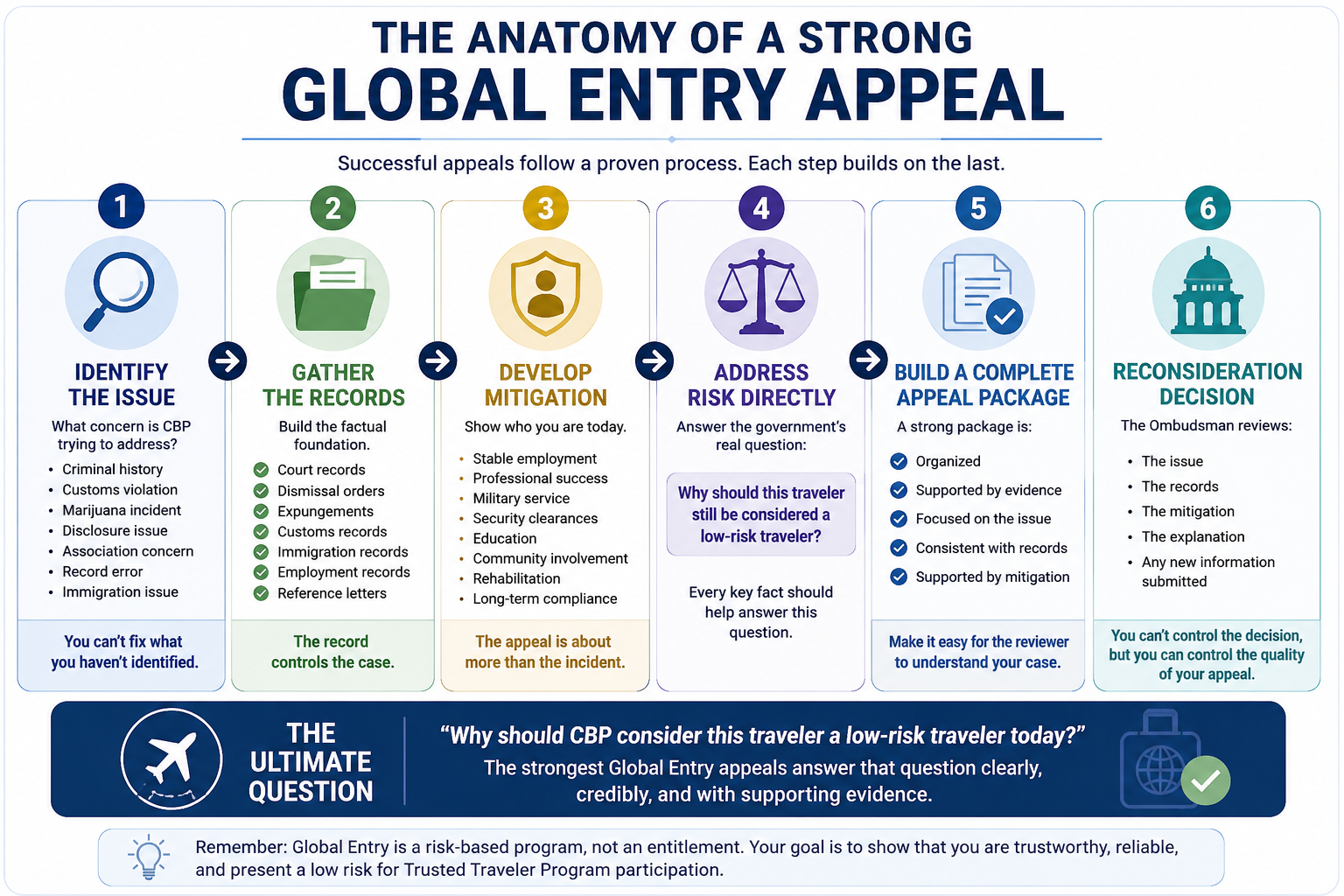
Putting It All Together: How Successful Global Entry Appeals Are Built

By now, you have probably noticed a pattern. Successful Global Entry appeals rarely depend on a single fact. They are usually the result of multiple factors working together.

A strong appeal often looks something like this:


Step 1: Identify the Actual Issue

Before anything else, determine why the denial or revocation occurred. The strongest appeals address the government’s real concern — not a guessed concern. How to identify why you were denied.


Step 2: Gather the Record

Obtain the documents that tell the story accurately. Examples may include:

The record controls the case. Global Entry Appeal Document Checklist ⚠️ remove link until URL confirmed


Step 3: Develop Mitigation

The appeal should explain not only what happened, but why the incident does not reflect who the traveler is today. This is where rehabilitation, professional success, military service, education, community involvement, and family responsibilities often become important. What makes strong mitigation evidence.


Step 4: Address Risk Directly

The strongest appeals answer the government’s central question: why should this traveler still be considered low risk? Everything in the appeal should help answer that question. How CBP evaluates risk | What makes a good or bad Global Entry appeal case?


Step 5: Present a Complete Package

Strong appeals are generally organized, supported by records, professionally written, focused on the actual issue, and consistent with the evidence. The goal is not simply to explain the denial — the goal is to make it easy for the reviewer to understand why approval or reinstatement is appropriate. What NSLF builds in a complete appeal package.


The Good News

Many travelers assume that once they receive a denial or revocation, the outcome is predetermined. That is not always true.

People are denied because of old arrestsdismissed chargesexpunged recordscustoms violationsmarijuana-related incidentsassociation concerns, and government record problems every day — and some of those travelers ultimately obtain approval or reinstatement.

The difference is often not the incident itself. The difference is the quality of the response. The stronger the records, the stronger the mitigation, and the stronger the explanation, the stronger the appeal tends to become.


Thinking About Hiring a Lawyer?

Not every Global Entry denial or revocation requires legal representation. Some travelers can successfully handle straightforward issues on their own. Do you need a lawyer for a Global Entry appeal?

More complicated situations may benefit from legal assistance, particularly when the case involves criminal historycustoms violationsmarijuana-related incidentsassociation concernsunexplained denials, government record errors, or prior unsuccessful appeals.

National Security Law Firm has handled more than 1,000 Global Entry and Trusted Traveler Program appeal matters since 2017. Our attorney-led appeal process may include case assessment, records gathering, FOIA strategy, mitigation development, attorney-drafted appeal arguments, exhibit preparation, and submission guidance.

Flat Fee: $2,995 | Approved or Reinstated — or Your Legal Fee Back

Learn More:


Ready to Take the Next Step?

Whether you are trying to understand a denial, evaluate a revocation, determine whether FOIA is necessary, or decide whether an appeal is worth pursuing, we can help you assess your options.

Book a Free Consultation
An NSLF attorney will review your situation, discuss the likely issue, explain whether records may be needed, and provide an honest assessment of your options. In most cases, same-day availability is offered and your attorney calls you at the time you schedule.

Take the Free Appeal Assessment
Not ready to schedule a consultation? Our free appeal assessment can help identify potential issues and determine whether a Global Entry appeal may be worth pursuing.