
What Are You Actually Paying For?
One of the most common misconceptions about is that hiring a lawyer means paying someone to write a letter. From the outside, it may appear that a Global Entry appeal is simply a matter of drafting a few pages, submitting them to the government, and waiting for a decision.
In our experience, successful appeals are rarely that simple. Most involve far more than writing. They involve identifying the government’s concern, gathering records, evaluating risk, developing mitigation, organizing evidence, and building a complete appeal package designed to address the specific issue that led to the .
That is why one of the first questions we encourage travelers to ask is not: how long is the appeal letter? The better question is: what work is being done to support the appeal?
|
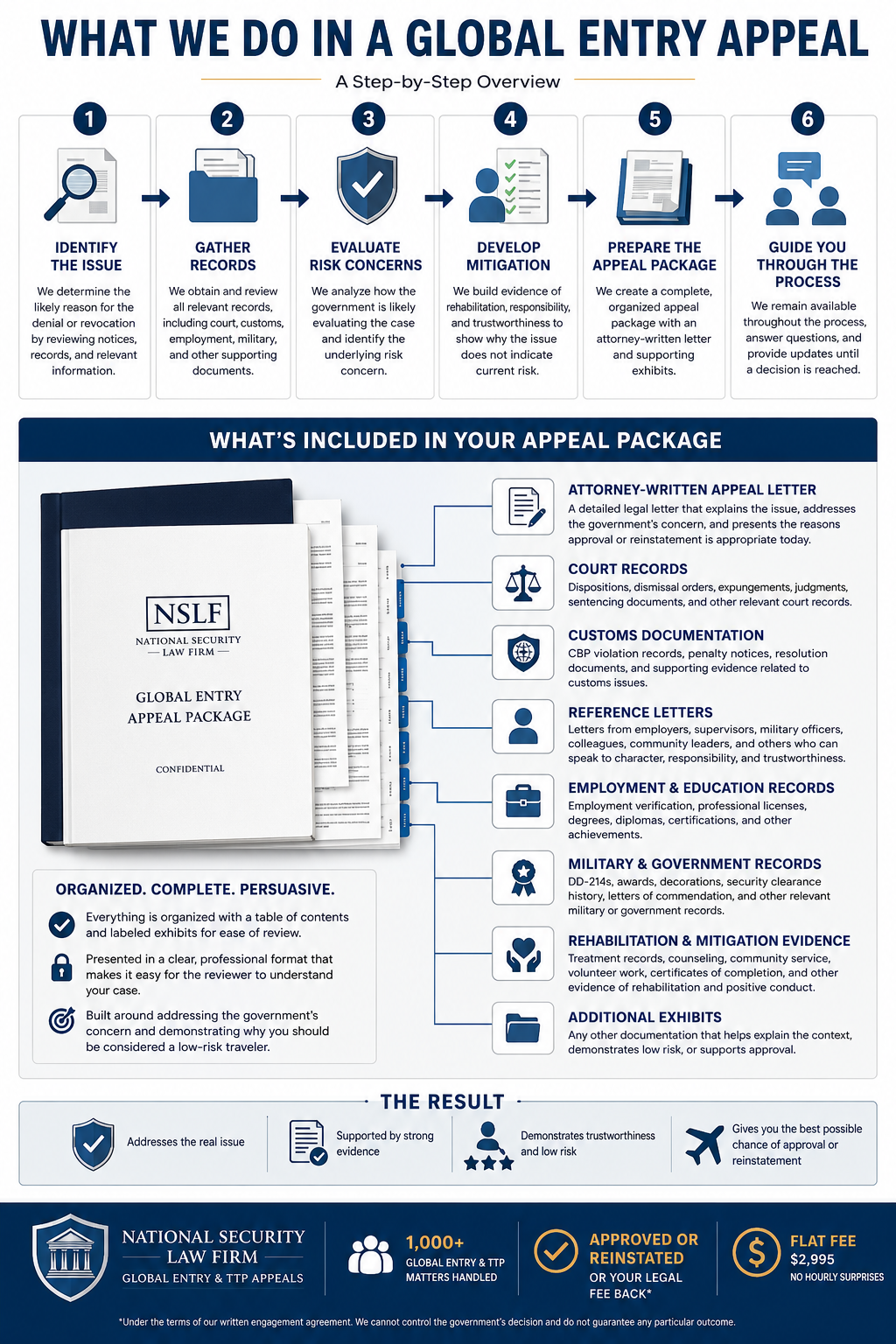
What We Do in a Global Entry Appeal – Table of Contents
What Most Travelers Think They Are Paying For
When people first contact us, they often assume a Global Entry lawyer is being hired to do one thing: write a letter. That assumption is understandable — the final product often includes an attorney-written appeal. But focusing only on the appeal letter is a little like focusing only on the cover of a book. The letter is important. However, much of the value comes from the work that happens before the letter is ever written.
What We Are Actually Building
A successful Global Entry appeal is usually built from several components working together:
Identifying the Issue — what concern is the government actually evaluating?
Gathering Records — what documents support the case?
Evaluating Risk — why does the government believe this traveler may not qualify as a under ?
Developing Mitigation — what evidence demonstrates trustworthiness, responsibility, and rehabilitation?
Preparing the Appeal Package — how do we present the strongest possible case?
The appeal letter is only one piece of that process.
Why This Matters
One of the biggest mistakes applicants make is assuming they already know why they were denied. A traveler may believe I was denied because of an old arrest — but the actual issue may be a , an , an , a , or something entirely different.
If the wrong issue is addressed, even a well-written appeal can struggle. That is why identifying the government’s actual concern is often the most important step in the entire process.
Global Entry Appeals Are Fundamentally Risk-Assessment Cases
Many people assume the government is asking: what happened? In reality, the more important question is often: why does the government believe this traveler may not qualify as a low-risk traveler?
Those are very different questions. A person can have an , a , an , or a prior — and still be approved. Likewise, a traveler with no criminal convictions may still be denied.
The issue is often not the incident itself. The issue is how the government evaluates risk. This is one reason we spend significant time trying to understand the government’s concern before developing a strategy. Because once the concern is identified, the appeal can be built around addressing that concern directly. .
Step 1: We Identify the Likely Issue
Every Global Entry appeal begins with a simple question: why was this traveler denied or revoked?
Sometimes the answer is obvious. Sometimes it is not. Our first objective is determining what issue is likely driving the decision. That may involve reviewing the denial notice, , , prior travel history, existing documentation, and .
Without understanding the issue, it is difficult to build an effective appeal. Everything else in the process depends on getting this step right.
Step 5: We Prepare the Appeal Package
This is the part most people think they are hiring a lawyer to do. In reality, this is the stage that comes after the issue has been identified, the records have been gathered, and the mitigation has been developed. The appeal package is the final product — it is where everything comes together. And it is only as strong as the work that came before it.
The Appeal Letter Is Only One Part of the Package
One of the biggest misconceptions about is that success depends on writing a persuasive letter. The letter matters — but the strongest appeals are rarely won because someone wrote a better letter. They are won because the appeal package presents a complete, well-supported explanation that addresses the government’s concern. The letter is simply the framework that ties everything together. .
What a Typical Appeal Package May Include
Every case is different. However, many appeal packages include some combination of:
Attorney-Written Appeal Letter — the written explanation that presents the case.
— dispositions, , , and other relevant records.
— when customs-related issues are involved.
Reference Letters — supporting statements from individuals who know the traveler. .
Employment Documentation — evidence of professional responsibility and stability.
Educational Records — degrees, certifications, and training records.
Military Records — DD-214s, awards, decorations, and related records. .
Rehabilitation Evidence — treatment records, counseling records, completion certificates, and other supporting materials.
Additional Exhibits — any documentation that helps explain why approval or reinstatement is appropriate.
.
How We Build the Appeal Letter
The appeal letter is not simply a summary of what happened — its purpose is to organize the evidence and explain why the government should reconsider the decision. A strong appeal letter typically addresses what happened, why it happened, what happened afterward, and most importantly: why the traveler should still be considered a under . The strongest letters are supported by evidence — not assumptions, not emotions, not unsupported explanations.
Organization Matters
One of the most overlooked aspects of an appeal package is organization. Imagine reviewing hundreds of appeals. Package A: random records, no structure, no supporting explanation. Package B: organized exhibits, clear explanations, supporting documentation, professional presentation. The information may be identical — the experience of reviewing it is not. A well-organized package makes it easier for the reviewer to understand the case. That matters.
We Build the Package Around the Government’s Concern
Once we understand the likely issue, the relevant records, and the available mitigation, we can build the package around the concern we are actually trying to address:
— the package may emphasize passage of time, rehabilitation, and clean conduct since the incident.
— the package may emphasize resolution, compliance, and lack of recurrence.
Record-Error Cases — the package may focus heavily on .
Different issues require different strategies. .
How Large Is a Typical Appeal Package?
There is no standard length. The focus is not on creating the longest package possible — the focus is on creating the strongest package possible. More pages do not automatically create a stronger appeal. Relevant evidence does. .
What the Reviewer Ultimately Sees
At the end of the process, the reviewer is not evaluating a , a , a , or a in isolation. The reviewer is evaluating the complete package. The appeal package becomes the vehicle through which the traveler explains: why should I still be considered a low-risk traveler? Everything we include should help answer that question.
The Goal of This Step
The purpose of the appeal package is not simply to explain what happened. The purpose is to present a complete, organized, evidence-based explanation of why approval or reinstatement is appropriate today. Once the package is submitted, the process moves into the final phase: guiding the client through the and helping them understand what happens next.
Step 6: We Guide You Through the Process
One of the most overlooked aspects of a is what happens after the appeal package is submitted. Many travelers assume the process looks like: submit appeal → receive decision. Sometimes it does. Often it is not quite that simple.
Setting Realistic Expectations
One of the first things we discuss with clients is timing. Global Entry appeals are government processes, and timelines are largely outside of anyone’s control. No lawyer can force the government to issue a decision by a particular date. What we can do is help clients understand what stage the case is in, what typically happens next, what potential outcomes may exist, and what additional information may be requested.
Understanding the process often reduces a great deal of frustration and uncertainty.
Monitoring the Case
Once an appeal is submitted, we continue monitoring the matter and advising the client regarding any developments that occur — including requests for additional information, questions regarding records, clarification requests, updates, and appeal decisions. Our objective is to ensure that clients understand what is happening and what it means at each stage.
Helping Clients Evaluate New Information
Sometimes new information surfaces after an appeal is submitted — newly obtained records, additional mitigation evidence, updated court documents, or corrected information. When appropriate, we help evaluate whether that information is likely to affect the overall strategy.
Guidance Through Approval and Reinstatement
Many people think the case ends when approval is granted. Not necessarily. Questions often arise regarding , enrollment, reinstatement procedures, , and . We frequently help clients understand what to expect after a successful outcome and how to avoid future problems.
The Process Does Not End With the Letter
Our goal is not simply to submit paperwork. The goal is to help clients navigate the process from beginning to end and understand what is happening at each stage.
What We Are Ultimately Trying to Accomplish
Each step in the process builds upon the one before it — identify the issue, gather the records, evaluate the government’s concern, develop mitigation, build the appeal package, and guide the client through the process. Every step is designed to answer a single question: why should this traveler still be considered a under ? That question drives nearly every aspect of a Global Entry appeal.
What Makes Our Approach Different?
Many Global Entry lawyers focus primarily on the incident. We focus on the government’s concern. Most Global Entry denials are not really about a , a , a , or a . They are about . Understanding that difference shapes the way we approach every case — the records we gather, the mitigation we develop, the evidence we prioritize, and the arguments we make.
Because the goal is not simply explaining what happened. The goal is explaining why approval or reinstatement is appropriate today.
Why Travelers Hire National Security Law Firm
Not every requires legal representation. Some travelers are able to identify the issue, gather the records, and prepare an appeal on their own. Others decide they want assistance because they are facing questions such as: why was I actually denied, what records matter, do I need FOIA, what evidence should I submit, is this a strong case or a weak case, and what does the government appear to be concerned about?
Those are often the reasons people contact us — not because they need someone to fill out a form, but because they need help understanding the issue and developing a strategy.
Global Entry Appeals Are Fundamentally Risk-Assessment Cases
Most people view a as a , a , an immigration issue, or a travel issue. Sometimes it is. But underneath all of those categories is a larger question: why does the government believe this traveler may not qualify as a under ?
That is ultimately what CBP is trying to evaluate — and that is the question we focus on when developing an appeal. The strongest appeals are rarely built around what happened? They are usually built around why should this traveler still be trusted today? .
More Than 1,000 Global Entry and Trusted Traveler Program Matters
One advantage of handling a large volume of Global Entry and Trusted Traveler Program matters is pattern recognition. Over time, you begin seeing the same issues repeatedly: , , , , , , , and . Every case is different — but experience often helps identify issues more quickly and develop strategies that address the government’s actual concern.
We Help Obtain Records Clients Do Not Have
Many travelers contact us because they know there is a problem but do not have the records needed to understand it — , missing dispositions, , supporting documentation, or mitigation evidence. Part of our process involves identifying which records matter and determining how to obtain them. Because a strong appeal is generally built on evidence — not assumptions.
We Focus on Building the Record
One of the biggest misconceptions about Global Entry appeals is that success comes from writing a persuasive letter. In our experience, the stronger differentiator is often the record itself. The appeal package is only as strong as the evidence supporting it. That is why we spend significant time on records, documentation, mitigation, supporting evidence, and organization. The appeal letter ties those pieces together — but the foundation is usually the record. .
Flat-Fee Representation
Global Entry appeals are handled on a flat-fee basis — currently $2,995. The purpose of a flat fee is to provide clarity and predictability. Clients know what they are paying before the representation begins. There are no hourly billing surprises.
Related Resource:
Approved or Reinstated — or Your Legal Fee Back
If National Security Law Firm accepts your matter for full Global Entry or Trusted Traveler Program appeal representation and the appeal is not successful, we refund your legal fee under the written terms of the engagement agreement. We cannot control the government’s decision — no attorney can. What we can do is stand behind the work we perform.
Related Resource:
We Do Not Accept Every Case
Not every Global Entry matter is a good fit for representation. In some situations the issue may already be obvious, legal representation may not provide significant value, or the facts may not support the strategy being requested. When that occurs, we try to be honest about it. We believe realistic expectations are important.
Related Resource:
The Bottom Line
If you hire National Security Law Firm, you are not hiring someone to simply write a letter. You are hiring a team that helps identify the issue, gather the records, evaluate the government’s concern, develop mitigation, build the appeal package, and guide you through the process.
Because successful Global Entry appeals are rarely built around a single argument. They are usually built around a complete, well-supported explanation of why the traveler should still be considered a . And that is what we spend our time helping clients develop.
|
Frequently Asked Questions
Do I Need to Gather All My Records Before Hiring You?
No. Many clients do not have all of their records when they contact us. Part of our process involves determining which records matter and helping obtain them when appropriate. .
What If I Do Not Know Why I Was Denied?
That is common. Many denial notices provide very little useful information. Part of the initial evaluation involves determining the and whether additional investigation or records may be necessary. .
Do You File FOIA Requests?
When appropriate — not every case requires . If additional information is needed to understand the government’s concern, we may discuss whether FOIA is likely to be helpful.
How Large Is a Typical Appeal Package?
There is no standard size. Some appeals are relatively straightforward. Others involve substantial records and supporting documentation. Our focus is not on creating the longest package possible — our focus is on building the strongest package possible. .
Ready to Take the Next Step?
If you are trying to determine whether a Global Entry appeal makes sense, we encourage you to schedule a consultation. We can discuss the likely issue, potential records, , and whether legal representation is likely to add value.
|
Related Resources: