Curious if you’re eligible for Global Entry?
Don’t guess—find out instantly!
Wondering if you can fight your Global Entry denial or revocation? Take our quick assessment to see!

The Real Timeline for Global Entry Denials and Revocations
If your Global Entry application was denied or your membership was revoked, one of the first questions you probably have is: how long will the appeal process take?
The honest answer is that there is no fixed timeline. Some appeals move quickly. Others take months. Understanding the process can help set realistic expectations and avoid unnecessary delays. For a complete overview of the appeal process itself, see .
|
Quick Answer: How Long Does a Global Entry Appeal Take?
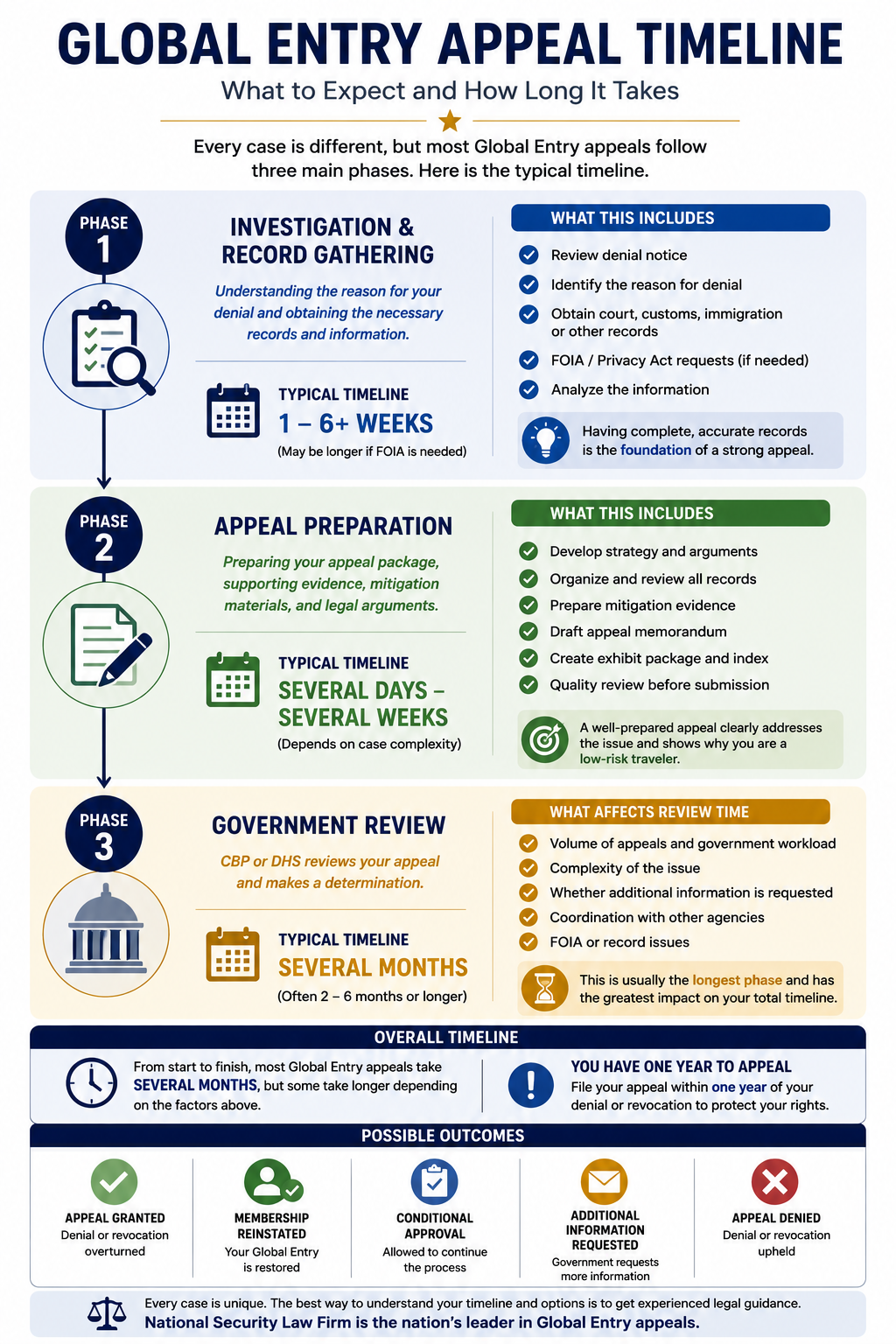
Most take several months from start to finish. However, there is no guaranteed processing timeline. The total timeframe often depends on three separate phases:
- Phase 1: Investigation and Record Gathering — understanding why the denial or revocation occurred and obtaining necessary records
- Phase 2: Appeal Preparation — preparing the appeal package, supporting documentation, mitigation evidence, and legal argument
- Phase 3: Government Review — CBP or DHS reviews the appeal and makes a determination
The longest part of the process is usually the government’s review.
Phase 1: Investigation and Record Gathering
Before a strong appeal can be submitted, the underlying issue must be identified. Some cases are straightforward. Others involve:
- Potential government record errors
In many cases, supporting records are needed before the appeal can be prepared properly. These may include court dispositions, dismissal orders, expungement records, criminal-history records, customs records, immigration records, or .
Typical timeline:
- Simple cases: 1–2 weeks
- Moderately complex cases: 2–6 weeks
- Cases requiring extensive records or FOIA: several weeks to several months
The goal is not speed. The goal is understanding what actually caused the denial before building the appeal.
Phase 2: Appeal Preparation
Once the necessary records have been gathered, the appeal package can be prepared. This stage is often more important than many travelers realize. The strongest appeals usually include a clear explanation of the issue, supporting records, mitigation evidence, legal and factual argument, organized exhibits, and documentation supporting low-risk traveler status.
Typical timeline:
- Straightforward cases: several days to two weeks
- More complex cases: several weeks
A strong appeal is rarely rushed.
Phase 3: Government Review
After submission, the appeal enters the government’s review process. This is usually the longest phase. The amount of time required depends on:
Government Workload
Processing times vary depending on the number of pending appeals and agency resources. The Government Accountability Office reported that the CBP Ombudsman reviewed more than 76,000 reconsideration requests from fiscal year 2020 through Q2 fiscal year 2023 — reflecting the scale of the queue.
Complexity of the Issue
Cases involving , , , or unclear government records often require more review.
Additional Information Requests
In some situations, the government may request clarification or additional records before making a final decision.
Agency Coordination
Certain matters require review by multiple government components.
Typical timeline: Many appeals take several months after submission. Some are resolved sooner. Others take considerably longer.
Can a Lawyer Expedite a Global Entry Appeal?
This is one of the most common misconceptions about Global Entry appeals. The reality is simple:
No lawyer can force CBP to review your appeal faster. No attorney can move your case to the front of the line or guarantee an expedited decision.
What a lawyer can do is identify the issue more quickly, gather records efficiently, avoid common mistakes, and prepare a complete appeal package that reduces the likelihood of requests for additional information. A complete, organized appeal often moves through the process more smoothly than an incomplete submission. .
Example Timelines
These examples are illustrative only. Every case is different.
Example 1:
- Week 1: Case review
- Weeks 2–4: Court records obtained
- Weeks 4–6: Appeal prepared and submitted
- Months 2–6: Government review
Example 2:
- Week 1: Case review
- Week 2: Supporting records gathered
- Week 3: Appeal submitted
- Months 2–5: Government review
Example 3:
- Week 1: Case review
- Months 1–4:
- Months 4–5: Appeal preparation
- Months 5–10: Government review
Common Causes of Delay
Waiting Too Long to Start
Some travelers spend months trying to figure out the denial before taking action. Starting the evaluation process promptly avoids that lost time. .
Missing Records
, customs records, and supporting documentation often take time to obtain. Starting the record-gathering process early reduces delays later.
Vague Denial Reasons
frequently require additional investigation before the appeal can be properly constructed.
FOIA Requests
can be extremely valuable, but it can add significant time to the process. .
Incomplete Appeals
Appeals that fail to address the actual issue may require additional follow-up or clarification from CBP.
You Have One Year to Appeal
One timeline that does matter is the appeal window. Travelers generally have one year from the denial or revocation to pursue reconsideration.
Waiting too long can create unnecessary complications and may limit your options. That is why it is usually wise to evaluate your situation shortly after receiving the .
What Happens After the Appeal Is Submitted?
Several outcomes are possible:
- Appeal Granted — the denial or revocation is overturned.
- Membership Reinstated — a previously approved member regains Trusted Traveler Program status
- Conditional Approval — the traveler is allowed to continue the enrollment process
- Additional Information Requested — the government requests further records or clarification
- Appeal Denied — the denial or revocation remains in place.
A successful result does not always mean immediate full approval. Depending on the circumstances, success may mean reinstatement, conditional approval, or being allowed to continue the enrollment process.
Should You Handle This Yourself or Hire a Lawyer?
Not every Global Entry denial, revocation, or appeal requires legal representation.
Some travelers can successfully handle straightforward issues on their own, particularly when the reason for the denial is clear and supporting records are easy to obtain.
More complicated situations may benefit from legal assistance, especially when the case involves:
- Inaccurate government records
- Prior unsuccessful appeals
National Security Law Firm has handled more than 1,000 Global Entry and Trusted Traveler Program appeal matters since 2017. Our may include:
- Case assessment
- Records gathering
- Mitigation development
- Attorney-drafted appeal arguments
- Exhibit preparation
- Submission guidance
Flat Fee: $2,995
Approved or Reinstated — or Your Legal Fee Back
If National Security Law Firm accepts your matter for full Global Entry/TTP appeal representation and the appeal is not successful, we refund your legal fee under the written terms of the engagement agreement.
Related Resources:
Frequently Asked Questions
How long does a Global Entry appeal take?
Most appeals take several months, although timelines vary considerably from case to case.
Can a lawyer expedite my appeal?
No. Lawyers cannot force CBP or DHS to review an appeal faster. What a lawyer can do is prepare a complete submission that avoids delays caused by missing information. .
Do FOIA requests delay appeals?
Sometimes. In some cases the information obtained through makes the additional time worthwhile. .
Should I appeal immediately?
Not always. Some cases benefit from gathering records and before the appeal is submitted.
What if I do not know why I was denied?
You may need additional investigation, records gathering, or a before preparing the appeal. .
What if my appeal is denied?
A first denial does not close all options. .
Talk to a Global Entry Appeal Lawyer
If your Global Entry application was denied or your membership was revoked, understanding the timeline is only part of the equation. The more important question is whether the appeal is being built on the right records, evidence, and strategy.
NSLF has been handling since 2017 — over 1,000 cases across every denial category. Our team includes former CBP and TSA attorneys and our founding attorney conducted Security Threat Assessments for U.S. Army counterintelligence. Every case we accept comes with a full money-back guarantee: if we are not successful, your $2,995 legal fee is refunded in full.
An NSLF attorney will review your situation, discuss likely timelines, explain whether additional records may be needed, and give you an honest assessment of your options.
Prefer to start on your own? Our free assessment can help you identify potential issues and determine whether an appeal is worth pursuing.
Related pages:
The information on this page is provided for general informational purposes and does not constitute legal advice. to discuss your specific situation.