
Your Testimony Will Become Part of the Record the PSAB Uses to Decide Your Appeal
If a Department of Defense adjudication authority denied or revoked your security-clearance eligibility and your notice allows a personal appearance, the Defense Office of Hearings and Appeals (DOHA)—the Department office that conducts the personal appearance—may assign an administrative judge to hear your case.
The DOHA judge does not make the final appeal decision in this process. The judge conducts the proceeding, evaluates the unresolved security concerns, develops a written record, and issues a recommended decision to the Personnel Security Appeals Board (PSAB) associated with your military service or DoD component. The component PSAB makes the final administrative appeal decision.
A personal appearance gives you an opportunity to present documents, call witnesses, explain disputed facts, and answer questions. It also creates risk. Your testimony is recorded in a verbatim transcript. Inconsistencies, unnecessary admissions, speculation, defensiveness, or explanations that conflict with the SF-86, investigative interviews, or your earlier Statement of Reasons response may follow the case to the PSAB.
National Security Law Firm represents military members and DoD civilian employees nationwide in DOHA personal appearances. We develop the evidence, prepare the appellant and witnesses, anticipate government and judicial questioning, and present a coordinated case designed for both stages of the process: the DOHA recommendation and the PSAB’s final review.
Former Federal Clearance Judge · Former Government Adjudicators · Direct DOHA Experience · Former GS-15 Intelligence Counsel · 16 Years of Army Litigation · Attorney Review Board
★★★★★ 4.9 Stars From 300+ Google Reviews
Investigation · Personnel Security · Adjudication · DOHA · Hearings · Appeals
Your notice controls your rights and deadlines. Send the complete notice, prior SOR response, and every attachment as soon as possible.
The Short Answer: What Happens in This Process?
- An adjudication authority denies or revokes eligibility and provides appeal rights. The notice identifies the security concerns that remain unresolved and explains the available route and deadline.
- DOHA conducts the personal appearance. A DOHA administrative judge hears testimony, receives relevant evidence, permits witnesses, asks questions, and develops a verbatim record.
- The DOHA judge issues a recommendation. The judge makes findings and recommends whether the denial or revocation should be sustained or overturned.
- The component PSAB makes the final decision. The PSAB reviews the adjudicative file, hearing record, submitted evidence, and DOHA recommendation before issuing the final administrative appeal determination.
The hearing therefore must be prepared for two audiences. The presentation must withstand questioning in front of the DOHA judge and leave the PSAB with a coherent, credible record supporting reversal.
Have NSLF Review Your Notice and Hearing Record
Important 2026 Update: DCSA Personal-Appearance Functions Were Suspended
On February 6, 2026, the Department’s General Counsel directed the Defense Counterintelligence and Security Agency (DCSA) to suspend its personal-appearance hearing functions and refer affected cases to DOHA for further processing. The memorandum also declared decisions based on DCSA’s own personal-appearance proceedings void and directed further review of those matters.
This matters because older DCSA webpages, archived explanations, and even documents issued during the transition may describe a personal appearance before a DCSA senior adjudicator. That description may no longer reflect the procedure governing your case.
If your notice or correspondence refers to a DCSA personal appearance, a senior-adjudicator appearance, referral to DOHA, or an appearance already conducted under the former DCSA program, the complete procedural history should be reviewed. Do not assume an older webpage controls. Your current notice, later correspondence, governing component procedure, and the February 2026 directive must be considered together.
Read the February 6, 2026 General Counsel memorandum
Read NSLF’s explanation of the 2026 DCSA personal-appearance change
Is This the Right Page for Your Case?
This page addresses DOHA personal appearances generally used by:
- active-duty military members;
- Reserve and National Guard personnel when covered by the applicable DoD process;
- Department of Defense civilian employees; and
- certain other individuals whose component appeal rights provide for a personal appearance followed by PSAB review.
Your notice may refer to:
- a Letter of Denial;
- a Letter of Revocation;
- a Letter of Determination;
- an unfavorable national-security eligibility determination;
- a Notice of Intent to Appeal;
- an election between a direct written appeal and a personal appearance;
- referral to DOHA for a personal appearance; or
- review by an Army, Air Force, Space Force, Navy, Marine Corps, or other component PSAB.
This is generally not the same process used for most employees of defense contractors under the National Industrial Security Program. In a typical contractor DOHA case, the DOHA administrative judge decides the case after the hearing, subject to review by the DOHA Appeal Board. In the military and DoD civilian personal-appearance process addressed here, the DOHA judge recommends and the component PSAB decides.
Learn about contractor DOHA hearings
Learn about PSAB security-clearance appeals
Review all security-clearance appeal services
What Is a DOHA Personal Appearance?
A DOHA personal appearance is a formal opportunity for an eligible military member or DoD civilian to challenge an unfavorable security-clearance determination through live presentation before a DOHA administrative judge.
Under the Department’s published procedures:
- the appellant may be represented by counsel at the appellant’s expense;
- the appellant may make an oral presentation;
- the appellant must answer questions from the judge and, when participating, DOHA counsel;
- the appellant and DOHA counsel may submit relevant documents;
- witnesses may be presented and cross-examined;
- a verbatim transcript is produced; and
- the administrative judge conducts a fresh review of the unresolved adjudicative-guideline issues and sends a written recommendation to the component PSAB.
The personal appearance is not merely a conversation with someone who wants to hear your side. It is the creation of an evidentiary record. What is said, what is omitted, what the documents establish, how witnesses perform, and whether the testimony remains consistent with the earlier record can all influence the judge’s recommendation and the PSAB’s final decision.
DOHA Recommends. The PSAB Decides.
This distinction should guide the entire strategy.
What the DOHA Judge Does
The administrative judge:
- reviews the unresolved concerns stated in the Letter of Denial or Letter of Revocation;
- receives relevant documents and witness testimony;
- questions the appellant and may question witnesses;
- evaluates the factual record, credibility, and claimed mitigation;
- makes findings and applies the national-security standard; and
- issues a written recommendation to sustain or overturn the denial or revocation.
What the Component PSAB Does
The Personnel Security Appeals Board:
- reviews the adjudicative file;
- considers the transcript and evidence developed at the personal appearance;
- considers the DOHA judge’s findings and recommendation;
- independently reviews the unresolved adjudicative-guideline issues; and
- issues the final administrative appeal decision by majority vote.
The DOHA recommendation can be highly important, but it is still a recommendation. The hearing strategy should not focus only on persuading the judge in the room. It should create a record that remains persuasive when reviewed later by PSAB members who did not personally observe the testimony.
What Happens Before, During, and After the Personal Appearance?
Before the Appearance
DOHA receives the appeal election and adjudicative file and assigns the matter to an administrative judge. The hearing is then scheduled under the governing procedure and case-specific instructions.
Before the proceeding, the defense should:
- obtain and organize the complete adjudicative record;
- compare the denial or revocation letter with the original SOR and response;
- identify every unresolved guideline concern;
- determine what facts are admitted, disputed, incomplete, or potentially inconsistent;
- develop documents and witnesses that establish mitigation;
- decide which issues require testimony and which are better proved through records;
- prepare the appellant for direct presentation and difficult questioning; and
- ensure that the proposed testimony is accurate and consistent with the existing record.
During the Appearance
The appellant may present relevant evidence and witnesses and make an oral presentation. The judge may ask direct, detailed questions. DOHA counsel, when participating, may also question the appellant and witnesses and present evidence.
The proceeding is transcribed. There may be no practical way to retract a damaging answer once it becomes part of the record. Careful preparation is designed to help the appellant answer truthfully, directly, and consistently—not to memorize scripted testimony.
After the Appearance
The record may close at the end of the proceeding or remain open for authorized post-hearing submissions. The DOHA judge then issues a written recommendation addressing the unresolved concerns. The recommendation, transcript, adjudicative file, and submitted evidence are forwarded to the appropriate PSAB.
The PSAB—not the DOHA judge—then makes the final administrative appeal decision.
Why Testimony Can Help—or Hurt—a Security-Clearance Appeal
The value of a personal appearance is the opportunity to put context, judgment, rehabilitation, and credibility before a decision-maker. The danger is that live testimony can expose or create problems that do not appear clearly in the written file.
A hearing may help when:
- credibility is central to the adverse determination;
- important facts cannot be established adequately through documents alone;
- the appellant can explain context without contradicting the record;
- reliable witnesses can establish changed circumstances, rehabilitation, responsibility, or present reliability;
- the government’s interpretation of events depends on disputed inferences; or
- direct questioning may clarify a misunderstanding that remained unresolved on paper.
A hearing may create additional risk when:
- the appellant’s current account differs from the SF-86, investigative interview, or SOR response;
- the appellant minimizes documented conduct or shifts blame;
- explanations are speculative, overly broad, or evasive;
- a proposed witness lacks personal knowledge or introduces harmful information;
- documents and testimony do not establish the same chronology;
- the appellant volunteers facts beyond the question asked; or
- the appearance emphasizes hardship and career consequences without resolving the national-security concern.
Preparation is not coaching someone to give a preferred answer. It is the disciplined process of finding the truthful answer, testing it against the record, identifying likely questions, and determining whether the evidence actually resolves the government’s prospective risk analysis.
★★★★★ “It has been a long journey fighting my case. The attorneys at National Security Law Firm were helpful, supportive, understanding, and responsive throughout the process. I had to appear in person before a hearing board, and the outcome was in my favor. I definitely could not have done this on my own. This firm deserves more than five stars.”
— N.W., Google Review (excerpt; lightly edited for grammar and length)
This review describes one client’s experience. Past results do not guarantee a similar outcome.
Talk With a Security-Clearance Hearing Lawyer
The Original Record Still Controls the Hearing
A personal appearance does not erase the earlier record. The DOHA judge and PSAB may compare the hearing testimony with:
- the SF-86 and later security questionnaires;
- investigative interviews and written statements;
- incident reports and agency records;
- the Statement of Reasons or Letter of Intent;
- the appellant’s original response;
- documents previously submitted;
- the Letter of Denial or Letter of Revocation; and
- later explanations, exhibits, and witness testimony.
That comparison may determine whether the appellant appears candid and reliable. A new explanation may be accurate, but if it differs from an earlier statement, the reason for the difference must be understood and addressed. Ignoring the inconsistency rarely makes it disappear.
The case should begin with a record audit:
- What did the government allege?
- What did the appellant admit, deny, or fail to address?
- What evidence was previously provided?
- Why did the adjudication authority remain unconvinced?
- What testimony and evidence can now resolve that concern without creating a new one?
Learn why the record controls a security-clearance case
Learn about responding to a Statement of Reasons
What Evidence Can Matter at a DOHA Personal Appearance?
The strongest evidence depends on the guideline concerns and the reason the earlier response failed. Potential evidence may include:
- financial records showing sustained payments, resolved delinquencies, budgeting, tax compliance, or changed circumstances;
- treatment, counseling, evaluation, rehabilitation, or aftercare records;
- drug or alcohol testing and evidence of sustained abstinence;
- employment, performance, training, and disciplinary records;
- declarations or testimony from commanders, supervisors, colleagues, counselors, treatment providers, family members, or other knowledgeable witnesses;
- records establishing the timing, nature, and handling of foreign contacts, interests, travel, or obligations;
- contemporaneous communications or official records correcting disputed facts;
- evidence of self-reporting, cooperation, corrective action, or compliance;
- technical, policy, or training evidence relevant to protected-information or information-technology allegations; and
- evidence showing maturity, changed behavior, rehabilitation, reduced vulnerability, and a low likelihood of recurrence.
Volume is not the objective. Every exhibit should have a job. The evidence should establish a disputed fact, satisfy a mitigating condition, corroborate the appellant’s testimony, or show why the future security risk has been reduced.
A favorable-looking document can hurt if it creates a new inconsistency. Counsel should review proposed exhibits for authenticity, relevance, foundation, completeness, and unintended consequences before they become part of the record.
Learn what evidence can strengthen a security-clearance hearing
Choosing and Preparing Witnesses
The Department’s published procedures permit relevant witness testimony and cross-examination. But the number of witnesses matters less than the quality of their knowledge.
A useful witness generally:
- has personal knowledge of the facts or changed circumstances;
- can offer concrete examples rather than conclusions;
- understands the relevant conduct and does not appear misled about it;
- can explain what the witness observed over a meaningful period;
- is prepared to answer difficult questions truthfully; and
- supports rather than contradicts the documentary record and appellant’s testimony.
A supervisor who can describe years of reliable performance may be more persuasive than several character witnesses who know little about the underlying issue. A treatment provider may help establish progress but may also open questions about diagnosis, prognosis, compliance, or relapse risk. A family member may offer valuable firsthand knowledge but may be viewed as biased.
Witness preparation should clarify the witness’s role, personal knowledge, likely questions, and evidentiary value. It should never involve shaping or rehearsing untruthful testimony.
How NSLF Prepares a DOHA Personal-Appearance Case
1. Confirm the Procedure and Deadline
We review the notice, appellant’s status, service or component, type of eligibility or access, election requirements, and current instructions. The notice controls. A military or DoD civilian personal appearance should not be confused with a contractor DOHA hearing or another agency’s appeal process.
2. Reconstruct the Government’s Case
We organize the SF-86, investigative materials, SOR or LOI, response, exhibits, adverse determination, and later developments into one chronology. We identify the facts the government accepted, the issues it rejected, and the risk it still believes remains.
3. Build Issue-Specific Mitigation
We connect each concern to the applicable adjudicative guideline and develop evidence directed to the actual reason the prior response failed. The focus is not simply on explaining past conduct. It is on showing why the concern no longer presents an unacceptable future risk.
4. Test Credibility and Consistency
We compare proposed testimony with the existing record, identify likely areas of questioning, and address apparent inconsistencies before the hearing. The goal is accurate, direct, supportable testimony that remains credible when read later in transcript form.
5. Prepare the Appellant and Witnesses
We conduct substantive preparation focused on difficult facts, likely judicial questions, government challenges, evidentiary foundations, and the discipline required during a transcribed proceeding.
6. Present a Record Built for the Judge and the PSAB
We organize the presentation, testimony, witnesses, exhibits, and legal theory so the DOHA judge can support a favorable recommendation and the PSAB can support a favorable final determination.
Learn how to prepare for a security-clearance hearing
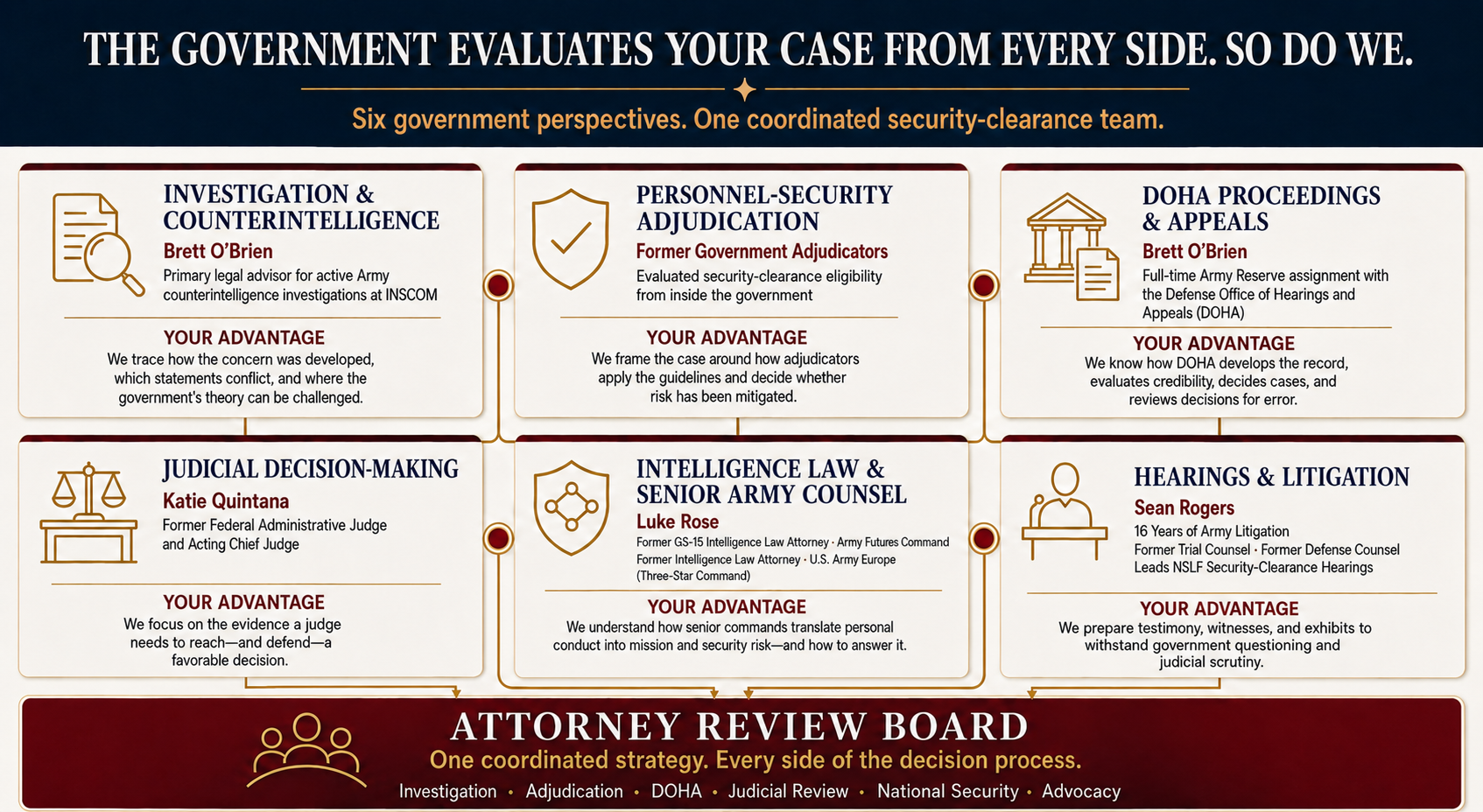
The Government Evaluates Your Case From Every Side. So Do We.
The government’s case may have passed through investigators, counterintelligence personnel, adjudicators, agency counsel, a DOHA administrative judge, and ultimately a component PSAB. A hearing strategy should account for every one of those perspectives.
NSLF brings them together in one coordinated security-clearance practice:
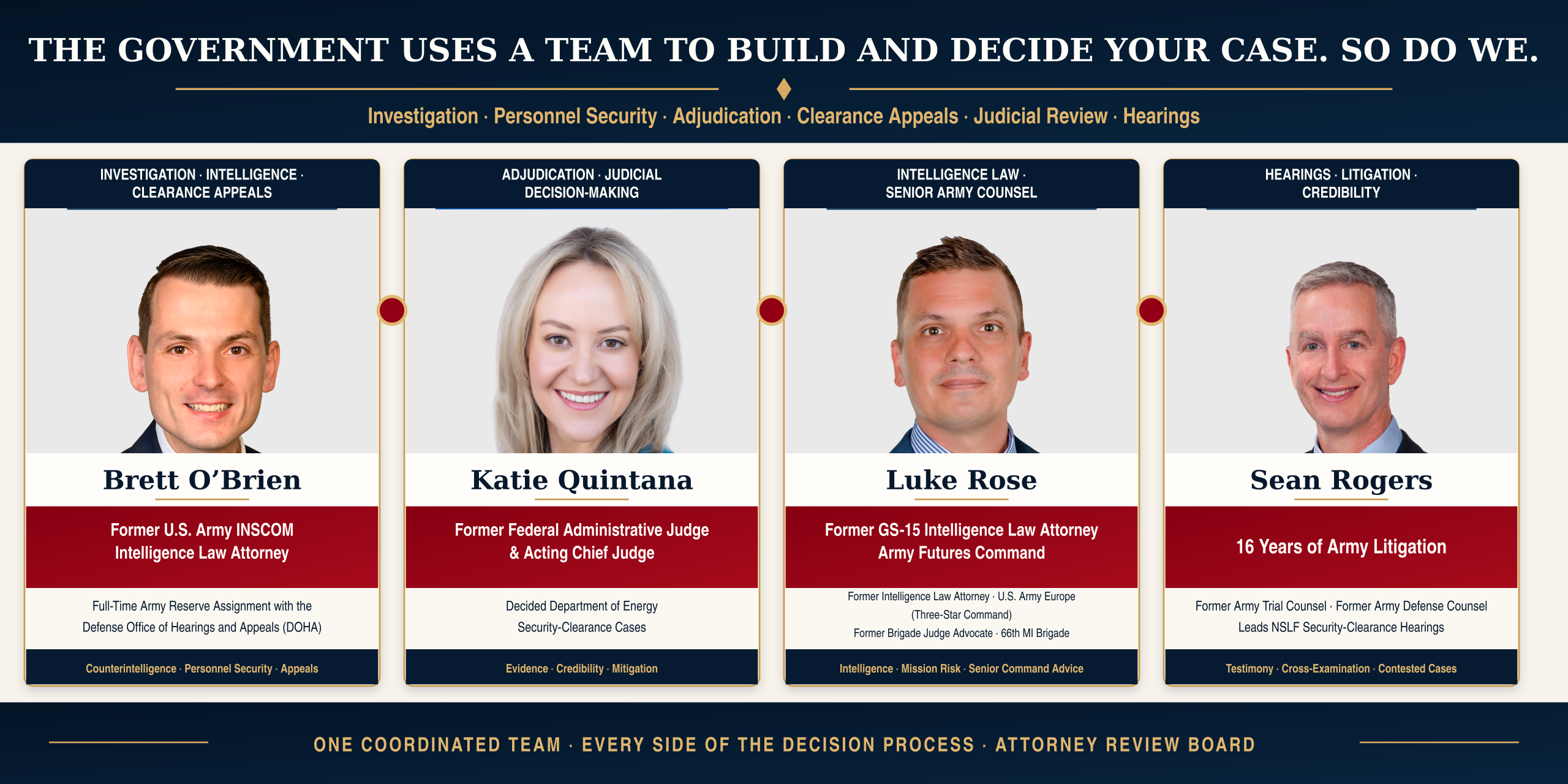
- Investigation and counterintelligence: Brett O’Brien served as the primary legal advisor for active Army counterintelligence investigations while assigned to U.S. Army Intelligence and Security Command. That experience helps the team examine how concerns were developed, what investigators may have been testing, and where the record may contain gaps or unsupported assumptions.
- Personnel-security adjudication: NSLF includes attorneys with experience evaluating security-clearance eligibility from inside the government. That perspective helps the team identify what adjudicators may still view as unresolved about candor, judgment, reliability, recurrence, and mitigation.
- Direct DOHA experience: Brett served on a full-time Army Reserve assignment inside the Defense Office of Hearings and Appeals (DOHA)—the Department office that conducts the personal appearance and recommends an outcome to the component PSAB. That experience gives the team direct familiarity with the office through which the hearing record is developed.
- Judicial decision-making: Katie Quintana served as a federal Administrative Judge and Acting Chief Judge deciding Department of Energy security-clearance cases. She brings a decision-maker’s perspective to evidence, credibility, mitigation, and whether the record can support and defend a favorable conclusion.
- Intelligence law and senior-command risk: Luke Rose served as a GS-15 Intelligence Law Attorney for Army Futures Command and as an Intelligence Law Attorney for U.S. Army Europe when it was a three-star command. He understands how senior commands translate personal conduct into mission, access, and national-security risk.
- Hearings and contested credibility: Sean Rogers has 16 years of Army litigation experience as trial counsel and defense counsel and leads NSLF’s security-clearance hearing work. He prepares appellants, witnesses, exhibits, and testimony for judicial questioning and contested presentation.
Why it matters: We can test the case the way the government will—from the origin of the concern through adjudication, testimony, judicial recommendation, and final PSAB review. That helps expose weak facts, unsupported assumptions, missing evidence, and credibility problems before they become part of the final hearing record.
One Lead Hearing Lawyer, Supported by a Coordinated Review Structure
Your case is led by an assigned attorney responsible for the strategy, communication, preparation, and representation included in the engagement. When the scope and complexity warrant it, that attorney can draw on NSLF’s broader security-clearance team and Attorney Review Board for additional analysis.
The purpose is practical. Before the personal appearance, the case may need to be tested through several questions:
- What remains unresolved from the adjudicator’s perspective?
- What evidence would a former clearance judge expect to see?
- Where might the administrative judge press for a more direct answer?
- Which witness can prove a fact rather than merely praise the appellant?
- Can every important answer be reconciled with the SF-86, investigation, and SOR response?
- Does the evidence resolve prospective security risk or merely describe why the past conduct occurred?
- Will the transcript remain persuasive when the PSAB reviews it later?
That review structure is designed to identify weaknesses while there is still time to address them.
★★★★★ “Attending my final appeal hearing was nerve-wracking, especially with Sean Rogers representing me. Sean is a true professional. I thought I could tell my story on my own, but I couldn’t have been more wrong. He masterfully articulated my truth in a way I never could.
Cara and Janet were always there, keeping me focused and offering support. Luke crafted my initial appeal with a clarity I couldn’t have achieved. Brett’s no-nonsense approach kept me grounded, and Sean’s expertise in navigating the complexities of the government’s language was invaluable. After a year and a month, I’ve been cleared and I’m back at work.”
— P.A., Google Review (excerpt)
This review describes one client’s experience. Past results do not guarantee a similar outcome.
See how the NSLF Attorney Review Board works
Read a PSAB case result involving a DOHA hearing
Ask NSLF to Review Your Hearing Strategy
What DOHA Personal-Appearance Representation May Include
The scope depends on the notice, record, issues, deadline, and agreed representation. It may include:
- confirming the governing appeal route and filing requirements;
- reviewing the Letter of Denial, Letter of Revocation, Notice of Intent to Appeal, and all attachments;
- auditing the original SOR response and adjudicative record;
- requesting or reviewing government records when available within the case schedule;
- identifying factual, legal, evidentiary, and procedural weaknesses in the adverse determination;
- developing an issue-by-issue mitigation plan;
- identifying, collecting, and organizing supporting documents;
- selecting and preparing relevant witnesses;
- preparing the appellant for direct presentation and difficult questioning;
- reconciling the proposed testimony with prior statements and records;
- preparing exhibits, witness examinations, legal argument, and hearing presentation;
- representing the appellant at the DOHA personal appearance when included in the engagement;
- preparing authorized post-hearing submissions when appropriate and included; and
- advising on related eligibility, access, military-career, or federal-employment consequences within the agreed scope.
No attorney can guarantee a favorable recommendation or PSAB decision. The goal is to build the strongest accurate, credible, and procedurally appropriate record available.
Should You Choose a Personal Appearance or a Direct Written PSAB Appeal?
Neither route is always better.
| Direct written PSAB appeal | DOHA personal appearance |
|---|---|
| The PSAB decides on the written record and submitted appeal materials. | A DOHA judge develops an additional hearing record and issues a recommendation. |
| No live testimony or questioning. | The appellant answers questions and testimony is transcribed. |
| Legal argument and documents carry the presentation. | Testimony, credibility, witnesses, exhibits, and questioning may become central. |
| May be preferable when objective records establish the mitigation or error. | May be preferable when credible testimony can resolve disputed facts or context. |
| Avoids the risk of harmful live testimony. | Creates the opportunity—and risk—of live testimony. |
| The PSAB makes the final decision. | The PSAB still makes the final decision. |
The choice should follow an assessment of the unresolved allegations, quality of the documents, credibility issues, witness value, earlier response, and appellant’s ability to testify consistently under questioning.
Compare a written PSAB appeal with a DOHA personal appearance
Where Are DOHA Personal Appearances Conducted?
The Department’s published manual provides that personal appearances may be conducted at a DOHA site, at or near the appellant’s duty station, or by video teleconference, depending on location and arrangements. Individuals serving outside the contiguous United States are generally handled by video teleconference at a suitable location at or near the duty station.
Current scheduling instructions from DOHA and the component control. The format can affect preparation, exhibit handling, witness logistics, technology, and how testimony is presented. Confirm the appearance location and platform from the official scheduling notice rather than relying on general website information.
Deadlines: The Notice Controls
The right to request a personal appearance may depend on returning an appeal-election form or Notice of Intent to Appeal within a short period. Separate deadlines may apply to documents, witness information, exhibits, or other submissions.
Do not calculate the deadline from a general webpage. Do not assume that requesting records, consulting counsel, deployment, leave, or speaking with a security manager automatically stops the clock.
Preserve immediately:
- the complete adverse notice and every attachment;
- the envelope or electronic-delivery record;
- the date and method of receipt;
- any signed acknowledgement;
- the appeal-election form or Notice of Intent to Appeal;
- all correspondence from DCSA, DOHA, the security office, command, or component;
- the scheduling order or hearing notice; and
- any extension request and written response.
If more time is needed, request it through the proper channel as early as possible and obtain written confirmation. Never assume an extension has been granted.
DOHA Personal Appearance Lawyer Cost and Financing
The cost of representation depends on factors including:
- the number and seriousness of the unresolved guideline issues;
- the size and condition of the adjudicative record;
- whether the prior SOR response created factual or credibility problems;
- the amount of new evidence that must be developed;
- the number and location of witnesses;
- the anticipated length and format of the appearance;
- the extent of appellant and witness preparation required;
- whether post-hearing work is included; and
- whether related eligibility, access, employment, or military actions must also be evaluated.
After reviewing the notice and essential case materials, NSLF can explain the proposed scope and fee before representation begins. The engagement agreement should identify what is and is not included.
View information about security-clearance lawyer costs
Learn how security-clearance financing works
Frequently Asked Questions About DOHA Personal Appearances
Is a DOHA personal appearance a hearing?
It is a formal proceeding before a DOHA administrative judge involving evidence, questioning, potential witnesses, and a verbatim transcript. It may be called a personal appearance rather than an industrial-security hearing because the judge’s role is different: the judge recommends an outcome to the component PSAB rather than issuing the final appeal decision.
Does the DOHA judge decide whether I keep my clearance?
Not in the military or DoD civilian personal-appearance process addressed on this page. The DOHA judge issues a written recommendation. The appropriate component PSAB makes the final administrative appeal decision.
Is this the same as a contractor DOHA hearing?
No. In most industrial-security cases involving defense-contractor personnel, a DOHA administrative judge issues the clearance decision and the DOHA Appeal Board reviews qualifying appeals. In this process, the DOHA judge recommends and the military or DoD component PSAB decides.
Can the judge ask me questions?
Yes. The Department’s published procedures require the appellant to respond to questions from the administrative judge and, when participating, DOHA counsel. Preparation should anticipate difficult questions about the underlying conduct, prior statements, mitigation, and likelihood of recurrence.
Can I bring witnesses?
The procedures allow relevant witnesses. A witness should have personal knowledge that helps establish, refute, explain, or mitigate a disputed matter. Witnesses may be questioned and cross-examined, so their testimony should be selected and prepared carefully.
Can I submit new documents?
The appellant and DOHA counsel may submit relevant documents concerning whether the denial or revocation should be overturned. The scheduling notice and judge’s instructions govern timing and submission. Each document should be reviewed for relevance, authenticity, consistency, and possible unintended consequences.
Will there be a transcript?
Yes. The Department’s published manual calls for a verbatim transcript. That transcript becomes part of the record considered with the judge’s recommendation and other appeal materials.
Is the hearing in person or virtual?
Depending on the case and location, it may occur at a DOHA site, at or near a duty station, or by video teleconference. Follow the official scheduling instructions for your case.
Can I simply tell the judge my side of the story?
You may explain the facts, but an effective presentation must do more than tell a sympathetic story. It should address each unresolved adjudicative concern, remain consistent with the earlier record, and establish why the prospective national-security risk has been resolved or sufficiently mitigated.
What if my prior SOR response was weak or incomplete?
The personal appearance may provide an opportunity to develop additional evidence and explanation, but the prior response remains part of the record. Counsel should identify omissions, unsupported assertions, and inconsistencies and determine how they can be addressed truthfully without creating new credibility concerns.
Is a personal appearance always better than a written appeal?
No. A personal appearance may be valuable when testimony can resolve credibility or disputed facts. A direct written appeal may be safer when documents establish the mitigation or when live testimony would create unnecessary risk. The existing record should be evaluated before the election is made.
What happens after the DOHA judge recommends a favorable result?
The recommendation and record go to the component PSAB. A favorable recommendation is important, but the PSAB remains responsible for the final administrative appeal determination.
What happens if the DOHA judge recommends against me?
The recommendation and record still proceed to the component PSAB, which makes the final decision. The available opportunity for additional submission or response, if any, depends on the governing procedure and instructions in the individual case.
Does a favorable PSAB decision automatically restore my job or access?
Not necessarily. Security-clearance eligibility, actual access to classified information, assignment to sensitive duties, SCI or program access, and employment status may involve separate authorities. Those consequences and remedies should be evaluated individually.
Does NSLF represent clients nationwide?
Yes. National Security Law Firm represents military members and federal employees nationwide in federal administrative and security-clearance matters, subject to the facts, jurisdiction, and agreed scope of each representation.
Official DOHA and PSAB Resources
- DOHA Personal Appearance Program
- DoD Manual 5200.02: Procedures for the DoD Personnel Security Program
- February 6, 2026 General Counsel Memorandum Concerning DCSA Personal Appearances
- Army Personnel Security Appeals Board
- Air Force Review Boards Agency
- Executive Order 12968: Access to Classified Information
Official materials provide general guidance. Your notice, scheduling instructions, later correspondence, and current component procedures control your individual matter.
Speak With a DOHA Personal Appearance Lawyer
By the personal-appearance stage, an adjudication authority has already reviewed your earlier response and concluded that one or more security concerns remain unresolved. The hearing must show why that conclusion should change while protecting the credibility and consistency of the record the PSAB will ultimately review.
National Security Law Firm represents military members and DoD civilians in DOHA personal appearances nationwide.
To help us evaluate the matter, send:
- the complete Letter of Denial, Letter of Revocation, or adverse determination;
- every attachment and appeal-election form;
- the original Statement of Reasons or Letter of Intent;
- your complete response and supporting exhibits;
- the date and method by which you received the decision;
- any DOHA referral, scheduling notice, or order; and
- all later communication from DCSA, DOHA, your security office, command, or DoD component.
Your Testimony Becomes the Record. Prepare It for Every Decision-Maker Who Will Review It.
Attorney review: Katherine O’Brien
Last updated: September 4, 2026
All case results depend on the facts and governing procedures of the individual matter. Past results do not guarantee a similar outcome. This page provides general information and is not legal advice. Viewing this page or contacting the firm does not create an attorney-client relationship. This website is attorney advertising.