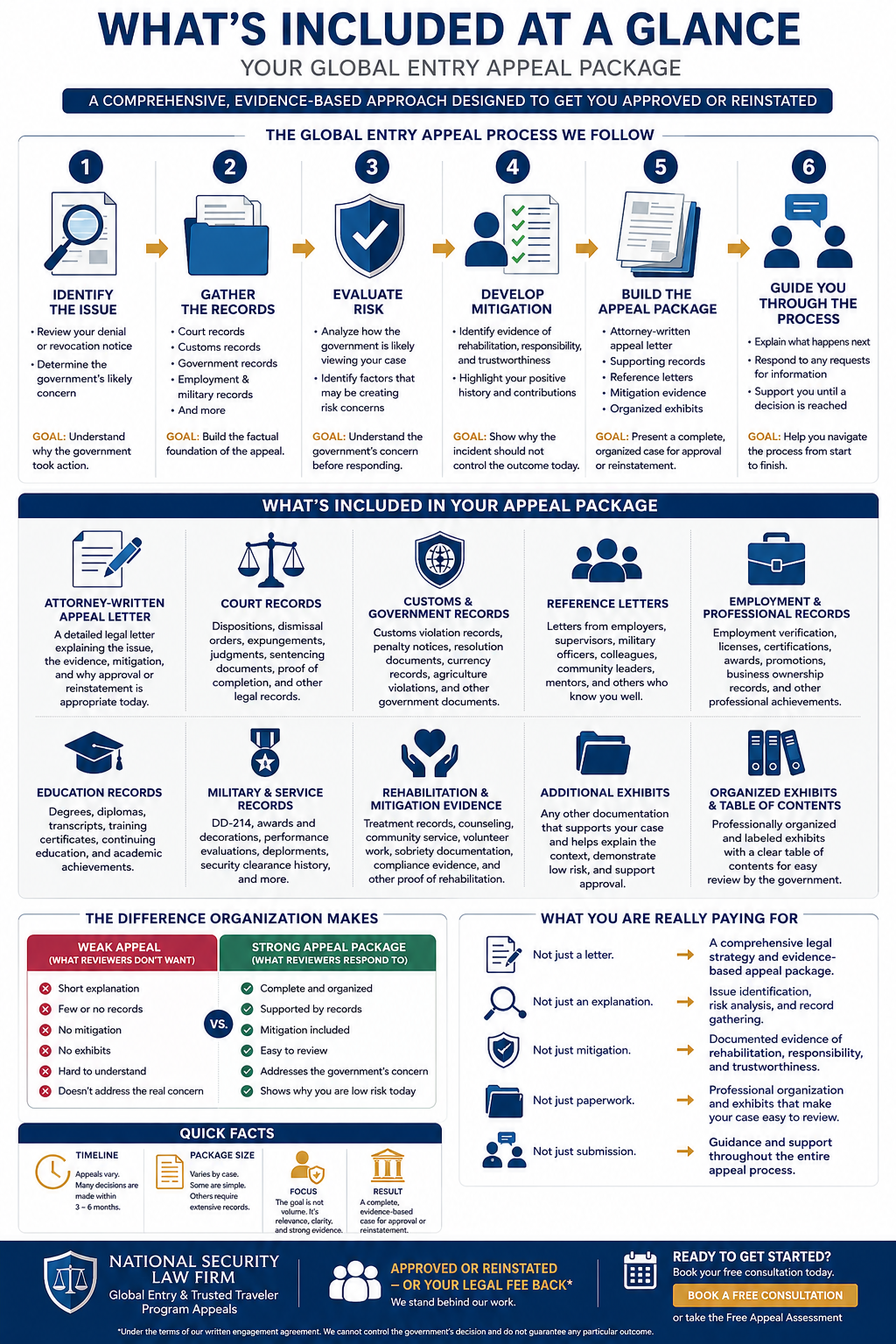
What Does a Professional Global Entry Appeal Actually Look Like?

One of the most common questions we receive is: what am I actually getting for $2,995? It is a fair question. Many travelers assume that hiring a Global Entry lawyer means paying someone to write a letter and submit it to the government. In reality, the appeal letter is often only a small part of the overall package.

Most successful Global Entry appeals are built on records, evidence, mitigation, organization, and strategy. The appeal letter ties those pieces together — but the strength of the appeal usually comes from the work that happens before the letter is ever written.

This page provides an example of what a professionally prepared Global Entry appeal package may include and explains how the various pieces work together.

Book a free consultation | Take the free appeal assessment


Important Disclaimer

Every Global Entry case is different. Some appeals require relatively little supporting documentation. Others involve substantial records, exhibits, and mitigation evidence. The examples below are intended to help illustrate the types of materials that may be included in a Global Entry appeal package. They are not intended to represent every case or guarantee any particular outcome.


The Anatomy of a Global Entry Appeal Package

Most professionally prepared appeal packages contain several different components working together:

→ Attorney-Written Appeal Letter
→ Court Records and Supporting Documentation
→ Customs or Government Records
→ Reference Letters
→ Employment and Professional Records
→ Military and Government Service Records
→ Rehabilitation and Mitigation Evidence
→ Organized Exhibits and Supporting Materials

The exact contents vary from case to case. However, most strong appeals are built around the same basic concept: identify the government’s concern and support the response with evidence. Global Entry Appeal Document Checklist.


How Large Is a Typical Appeal Package?

One of the biggest misconceptions about Global Entry appeals is that they consist of a short letter and a few attachments.

That is not how many professionally prepared appeals are structured.

In many cases, the appeal package includes:

Attorney-Written Appeal Letter

Typically 7–10 pages.

Supporting Exhibits

Often 20–50 pages of supporting records and documentation.

Examples may include:

  • Court records
  • Dispositions
  • Expungement orders
  • Customs records
  • Reference letters
  • Employment documentation
  • Military records
  • Mitigation evidence

The exact size varies depending on the facts.

Some cases require much less documentation.

Others require substantially more.

The goal is not creating the largest package possible.

The goal is creating the strongest package possible.


Why the Package Matters

Imagine two travelers with the exact same underlying issue.

Appeal Package #1: A short explanation, few supporting records, no mitigation, no exhibits.

Appeal Package #2: Attorney-written appeal, supporting records, reference letters, employment documentation, mitigation evidence, organized exhibits.

The underlying issue is identical. The information being presented to the government is not. That difference often matters — because Global Entry appeals are rarely decided solely on the incident itself. They are often influenced by the quality of the information submitted in response to that incident. Top 5 Mistakes People Make on Global Entry Appeals.


What the Government Is Really Evaluating

One of the biggest misconceptions about Global Entry appeals is that the government is focused exclusively on what happened. In reality, the more important question is often: why should this traveler still be considered a low-risk traveler under 8 CFR § 235.12?

That is the central theme running through most appeal packages. Each document included in the package should help answer that question. The goal is not simply to explain the denial — the goal is to demonstrate why approval or reinstatement is appropriate today. What makes a good or bad Global Entry appeal case?


Section 1: Attorney-Written Appeal Letter

The appeal letter is usually the centerpiece of the package. In many cases, the attorney-written appeal itself is 7–10 pages long and supported by dozens of pages of exhibits, records, and mitigation evidence. The purpose of the letter is not simply to tell the traveler’s story—it is to organize the evidence, explain the issue, and present the reasons why the government should reconsider its decision.

A strong appeal letter typically addresses:

What Happened — the relevant facts and circumstances.
Why It Happened — the context surrounding the issue when appropriate.
What Happened Afterward — evidence of rehabilitation, compliance, and mitigation.
Why the Traveler Should Still Be Considered Low Risk — the central question in most Global Entry appeals.

The strongest appeal letters are supported by records and evidence — not assumptions, not emotions, not unsupported explanations. The letter is important. But it is only one part of the overall package. What We Do in a Global Entry Appeal.


Section 2: Court Records and Legal Documentation

When a Global Entry denial involves criminal history, one of the most important parts of the appeal package is often the supporting legal documentation. Many travelers believe the government simply wants an explanation. In reality, the government often wants records.

A traveler may state “the charge was dismissed” — helpful, but a dismissal order is usually much more persuasive. Likewise, a traveler may explain “the record was expunged” — but the actual expungement order often carries far greater weight. This is one reason we spend significant time gathering and organizing court records when they are relevant to the case.


Common Court Records Included in Appeal Packages

Court Dispositions — records showing the final outcome of a case.

Dismissal Orders — documentation confirming that charges were dismissed.

Expungement Orders — proof that a record was expunged or sealed. Should you disclose expunged records during the Global Entry application process?

Judgments of Conviction — when applicable, records showing the official outcome of a case.

Sentencing Documents — documents relating to probation, fines, community service, or other requirements.

Diversion Program Records — evidence of successful participation in diversion or alternative disposition programs.

Proof of Completion — records demonstrating successful completion of probation, community service, treatment programs, and other court-ordered obligations.

Global Entry Appeal Document Checklist — court records section.


Why These Records Matter

One of the most common problems we encounter is incomplete information. A government database may show an arrest — but not the dismissal. Or it may show a charge — but not the expungement. Without the supporting records, the reviewer may not have the complete picture. The purpose of including court records is often to ensure that the facts are presented accurately and completely. How FOIA can help identify incomplete government database records.


Sometimes the Records Are Better Than the Applicant Thinks

Travelers often focus on the arrest or charge because that is what they remember. But once we obtain the court records, we sometimes discover facts that strengthen the appeal — favorable dispositions, reduced charges, successful diversion programs, expungements, and long-term compliance. The actual records frequently tell a more complete story than the applicant initially realizes. Global Entry Appeal Success Factors.


Sometimes the Records Reveal Problems

Occasionally the records identify issues that need to be addressed — missing dispositions, incomplete records, inaccurate information, outstanding obligations, or government database errors. When that happens, it is generally better to identify the issue before submitting the appeal rather than after.


Organization Matters

One of the advantages of a professionally prepared appeal package is organization. Instead of submitting a stack of unrelated documents, records are typically organized into exhibits that allow the reviewer to quickly understand what happened, how the case ended, and why the issue should not control the outcome today. The easier it is for the reviewer to understand the record, the stronger the overall package tends to become.


Court Records Are Often the Foundation

In many criminal-history cases, court records become the foundation upon which the rest of the appeal is built. They establish the facts, the outcome, the timeline, and the basis for mitigation. Once that foundation exists, the package can begin addressing the more important question: why should this traveler still be considered a low-risk traveler today under 8 CFR § 235.12?

That is where the next layer of the appeal package comes into play: customs records, government records, and other supporting documentation that help explain the government’s concern and the traveler’s response to it. Global Entry Appeal Strategy & Winning.


Section 3: Customs Records and Government Documentation

Not every Global Entry denial involves criminal history. In fact, many denials and revocations arise from customs-related issues, border encounters, declaration problems, or other government records that have nothing to do with a criminal conviction.

A traveler may have no criminal record, no arrests, and no convictions — and still lose Global Entry privileges. When that happens, customs records and government documentation often become some of the most important evidence in the entire appeal package.


Common Types of Customs and Government Records

Customs Violation Records — documentation relating to customs enforcement actions.

Penalty Notices — records relating to customs penalties or fines.

Resolution Documents — evidence showing how a matter was resolved.

Currency Reporting Records — documents relating to currency reporting requirements and compliance.

Agriculture Violation Records — records involving undeclared food, plants, agricultural products, or other restricted items.

Border Inspection Records — records relating to inspections, referrals, or other border interactions.

Government Correspondence — communications relating to the incident or its resolution.

Global Entry Appeal Document Checklist — customs records section.


Why These Records Matter

Many travelers focus entirely on the incident itself. The government often focuses on something different. The government may already know a customs violation occurred — the more important question may be: what happened afterward?

That is where documentation becomes important. The records may help demonstrate that the incident was isolated, the matter was resolved, the fine was paid, there have been no similar issues since, and the traveler took corrective action. Those facts often matter far more than a simple explanation. Staying compliant with Global Entry going forward.


Sometimes the Records Help Clarify the Issue

One challenge in many customs-related cases is that the traveler and the government may view the incident very differently. The traveler may remember “I forgot to declare something” while the government record characterizes the incident differently. The purpose of obtaining the records is not necessarily to agree with them — the purpose is to understand what information the government is actually relying upon. Because that information often drives the strategy. When FOIA can help identify government records in customs cases.


Context Matters

Two customs violations may appear similar on paper but look very different once the surrounding circumstances are considered. Questions that frequently matter include: was the issue intentional, was it isolated, how long ago did it occur, was the matter resolved, have there been similar incidents since, and what documentation exists? The records help answer those questions — and those answers often influence how the appeal is developed. What makes a good or bad Global Entry appeal case?


Government Records Are Not Always Perfect

Occasionally records contain incomplete information, missing context, inaccurate data, confusing descriptions, or information that requires clarification. When that happens, the appeal may focus not only on mitigation but also on correcting or clarifying the record through FOIA. Some of the strongest appeals involve identifying information that does not accurately reflect what occurred.


Building the Record Beyond the Incident

One of the biggest mistakes applicants make is assuming the appeal should focus exclusively on the customs incident itself. A stronger approach is often: explain the incident, document the resolution, demonstrate compliance since the incident, present mitigation evidence, and address the government’s concern. The customs records establish the foundation — the rest of the appeal package helps explain why the incident should not control the outcome today. Global Entry Appeal Strategy & Winning.


Why These Records Often Become Key Exhibits

In many customs-related appeals, these records become some of the most important exhibits in the package. They help establish what happened, when it happened, how it was resolved, and why approval or reinstatement is appropriate today. Once those records are assembled and organized, the next step is often presenting evidence that speaks directly to the traveler’s character, responsibility, and trustworthiness. That is where reference letters and supporting statements become particularly important. Global Entry Appeal Success Factors.


Section 4: Reference Letters and Character Evidence

Once the records have been gathered and the underlying issue has been documented, the next step is often helping the government understand something that records alone cannot show: who is this traveler today?

Court records can show what happened. Customs records can show what occurred at the border. But neither type of record tells the government much about the person’s current level of responsibility, trustworthiness, or character. Reference letters help fill that gap.


Why Reference Letters Matter

One of the most common mistakes applicants make is focusing entirely on the incident — the arrest, the charge, the customs violation, the denial — and giving very little attention to: why should this traveler still be trusted today? Reference letters often help answer that question. They provide information that government records cannot: professional reputation, personal responsibility, community involvement, reliability, integrity, and compliance with rules. When done correctly, they help present a fuller picture of the traveler. Top 5 Mistakes People Make on Global Entry Appeals.


Who Should Write Reference Letters?

Strong reference letters typically come from people who know the traveler well and can speak from personal knowledge — employers, supervisors, business partners, military officers, professional colleagues, community leaders, religious leaders, long-term friends, and mentors. The key is credibility: the writer should be able to explain why their opinion deserves consideration. Reference letter guidance — Global Entry Appeal Document Checklist.


What Makes a Strong Reference Letter?

Many applicants assume a reference letter should simply say “this is a good person.” That is usually not enough. The strongest letters tend to be specific — they explain how the writer knows the traveler, how long they have known the traveler, why they trust the traveler, examples of responsibility and reliability, professional accomplishments, community contributions, and why the writer believes the traveler should be trusted. Specific examples are often much more persuasive than general praise.


What Makes a Weak Reference Letter?

Weak letters tend to be very short, generic, lack specific examples, provide no explanation of the relationship, and reach unsupported conclusions. “John is a great person” may be true — but it provides very little information for the reviewer. A stronger letter explains why that conclusion is justified.


Quality Matters More Than Quantity

Three strong, detailed letters are often more persuasive than ten generic letters. The goal is not overwhelming the reviewer — the goal is providing meaningful information that helps support the appeal. How to maximize the chances of your Global Entry appeal.


Character Evidence Extends Beyond Letters

Reference letters are only one form of character evidence. Other examples may include professional awards, licenses and certifications, community leadership positions, volunteer activities, board memberships, professional recognition, and military awards and decorations. These records often help reinforce the same themes discussed in the reference letters. What makes strong mitigation evidence in a Global Entry appeal.


Building the Bigger Picture

Think of the appeal package as a puzzle. The records explain what happened. The reference letters and character evidence help explain who the traveler is today. Both pieces matter — because a reviewer is not simply evaluating an incident. The reviewer is evaluating a person. The more complete and accurate that picture becomes, the stronger the appeal package tends to be. What makes a good or bad Global Entry appeal case?


The Goal of This Section

Reference letters and character evidence help transform an appeal from a discussion about a past event into a discussion about a current traveler. They help demonstrate responsibility, reliability, professionalism, trustworthiness, and long-term compliance. And they often become some of the most persuasive exhibits in the entire package.

Once that foundation has been established, the next step is presenting the traveler’s broader mitigation evidence — employment history, education, military service, and other accomplishments that help explain why approval or reinstatement is appropriate today. Global Entry Appeal Strategy & Winning.


Section 5: Employment, Education, Military Service, and Other Mitigation Evidence

By the time we reach this stage of the appeal, the records have usually established what happened. The reference letters have helped explain who the traveler is today. The next step is presenting objective evidence that supports that story.

This is where mitigation evidence often becomes one of the most important parts of the entire appeal package. While a denial may focus on a single incident, the government is ultimately evaluating a complete person. The goal is to demonstrate that the incident does not accurately reflect the traveler’s current level of responsibility, reliability, or trustworthiness.


Employment History

Stable employment is often one of the strongest forms of mitigation — because long-term employment frequently demonstrates responsibility, reliability, accountability, trustworthiness, and consistency. Examples of employment-related evidence may include employment verification letters, professional licenses, industry certifications, promotions, performance awards, business ownership documentation, and employer statements regarding travel requirements. These records help demonstrate that the traveler has maintained a productive and responsible life. Global Entry Appeal Document Checklist.


Professional Achievement

In many cases, professional accomplishments help reinforce the argument that the traveler should still be considered a low-risk traveler under 8 CFR § 235.12. Examples include leadership positions, executive roles, professional recognition, industry awards, specialized credentials, government contracting experience, and positions of trust. These accomplishments do not erase past issues — however, they often help provide context regarding who the traveler is today.


Educational Achievement

Educational records are frequently overlooked — but they should not be. Education often demonstrates personal growth, long-term commitment, self-improvement, and professional development. Examples may include degrees, diplomas, professional training, continuing education, academic awards, and specialized certifications. Particularly in older cases, educational achievements can help illustrate how much has changed since the underlying incident occurred. Global Entry Appeal Success Factors.


Military Service

Military service can be especially important mitigation evidence. Examples may include DD-214, awards and decorations, leadership positions, deployment history, performance evaluations, security clearance history, and positions of trust and responsibility. Military service does not automatically guarantee approval — however, it often provides valuable evidence of responsibility, discipline, and successful government vetting. Why military service and security clearance history matter in Global Entry appeals.


Security Clearances and Government Trust

One category of mitigation that is frequently overlooked involves prior government trust — security clearances, government employment, government contracting, sensitive positions, and background investigations. These facts are often relevant because Global Entry is fundamentally a trust-based program. If the federal government has previously trusted an individual with significant responsibilities, that history may provide useful context when evaluating current risk. It is not dispositive — but it can be persuasive. What security threat assessment experience reveals about how CBP evaluates Global Entry applicants.


Community Involvement

Community involvement often helps demonstrate that the traveler contributes positively beyond work and family obligations — volunteer activities, charity work, community leadership, board memberships, professional organizations, mentorship activities, and religious organizations. These activities help present a fuller picture of the individual behind the application.


Rehabilitation Evidence

In some cases, rehabilitation becomes one of the most important categories of mitigation. This is particularly true when the denial involves criminal historyalcohol-related incidents, or drug-related incidents. Examples may include treatment programs, counseling, sobriety records, community service, compliance documentation, and a long-term clean record. The objective is not simply to discuss rehabilitation — the objective is to document it. Staying compliant with Global Entry.


Why Mitigation Often Matters More Than the Incident

Many travelers assume the appeal is about proving the incident was not serious. That is not usually the strongest strategy. The stronger strategy is often demonstrating: why the incident does not accurately reflect the traveler today. Mitigation provides evidence of growth, responsibility, maturity, and trustworthiness. In many cases, those facts become far more important than the underlying incident itself. What makes a good or bad Global Entry appeal case? | Global Entry Appeal Strategy & Winning.


Building a Complete Picture

At this point in the process, the appeal package is beginning to tell a complete story. The records explain what happened. The reference letters explain how others view the traveler. The mitigation evidence explains who the traveler is today. Together, those components help create a much more complete and persuasive picture than any single document could provide on its own.

The final step is organizing all of that information into a professional, evidence-based exhibit package that makes it easy for the reviewer to understand the case and evaluate the request for approval or reinstatement.


Section 6: Organizing the Exhibit Package

Once the records, mitigation evidence, and supporting documentation have been gathered, the final step is organization. This is one of the most overlooked parts of a Global Entry appeal. Many applicants assume that if they simply provide enough records, the reviewer will figure everything out. That is a risky assumption.

Imagine reviewing hundreds of appeals. Appeal Package A: random documents, no organization, no exhibit numbering, no explanation of why the records matter. Appeal Package B: organized exhibits, clear structure, supporting explanations, evidence grouped by topic, easy navigation. The information may be identical — the experience of reviewing it is not. Organization matters. Top 5 Mistakes People Make on Global Entry Appeals.


Why Exhibit Organization Is Important

The reviewer should not have to guess what a document is, why it was included, how it supports the appeal, or where it fits into the overall story. A professionally organized package helps the reviewer quickly understand the issue, the relevant records, the mitigation evidence, the supporting documentation, and why approval or reinstatement is appropriate. The easier it is for the reviewer to understand the case, the stronger the package tends to become.


What a Typical Exhibit Package May Include

Every appeal is different. However, many packages contain exhibits such as:

  • Exhibit A — Denial or revocation notice
  • Exhibit B — Relevant court records
  • Exhibit C — Customs records or government documentation
  • Exhibit D — Reference letters
  • Exhibit E — Employment records
  • Exhibit F — Educational records
  • Exhibit G — Military records
  • Exhibit H — Mitigation and rehabilitation evidence
  • Exhibit I — Additional supporting documentation

The specific structure depends on the facts of the case.


Building a Narrative

One of the goals of exhibit organization is to help tell a coherent story. The package should answer questions in a logical order: what happened → what do the records show → what happened afterward → what evidence supports rehabilitation or trustworthiness → why should approval or reinstatement be granted today? When the exhibits follow that progression, the appeal becomes much easier to evaluate. Global Entry Appeal Strategy & Winning.


More Documents Do Not Always Mean a Better Appeal

Some applicants assume that success comes from submitting the largest possible package. That is not necessarily true. The goal is not volume — the goal is relevance. A focused package supported by strong evidence is usually more persuasive than hundreds of pages of marginally relevant material. Every exhibit should have a purpose. Every exhibit should help answer the government’s concern.


What a Reviewer Ultimately Receives

By the time the appeal package is complete, the reviewer is no longer looking at a DUI, a customs violation, a dismissed charge, or a marijuana-related incident in isolation. Instead, the reviewer is evaluating a complete package containing the facts, the records, the mitigation, the supporting evidence, and the request for reconsideration. Global Entry appeals are rarely decided based on a single document — they are often decided based on the overall picture presented by the package.


Bringing Everything Together

At this point, the appeal package is complete. The issue has been identified. The records have been gathered. The government’s likely concern has been evaluated. The mitigation evidence has been developed. The exhibits have been organized. The final package now presents a complete, evidence-based explanation of why the traveler should still be considered a low-risk traveler under 8 CFR § 235.12. That is the work product ultimately submitted for reconsideration. What We Do in a Global Entry Appeal — the full process.


Frequently Asked Questions

Do I Need All My Records Before Hiring You?

No. Many clients hire us before they have gathered all of their records. Part of our process involves helping determine what records matter and how to obtain them. Global Entry Appeal Document Checklist.


What If I Do Not Know Why I Was Denied?

That is common. Many denial notices provide very little useful information. Our first objective is usually identifying the government’s likely concern and determining whether additional records are necessary.


Do You File FOIA Requests?

When appropriate — not every Global Entry denial requires FOIA. If additional information is needed to understand the government’s concern, we may discuss whether FOIA is likely to improve the strategy. When should you submit a FOIA request?


How Large Is a Typical Appeal Package?

There is no standard size. However, many appeal packages contain a 7–10 page attorney-written appeal supported by 20–50 pages of records, exhibits, reference letters, and mitigation evidence. Some are smaller. Some are larger. Our focus is not on creating the largest package possible. Our focus is on creating the strongest package possible.

What We Do in a Global Entry Appeal.


What Happens If My Appeal Is Not Successful?

If National Security Law Firm accepts your matter for full Global Entry or Trusted Traveler Program appeal representation and the appeal is not successful, we refund your legal fee under the written terms of the engagement agreement.

Related Resource: Approved or Reinstated — or Your Legal Fee Back


The Bottom Line

A strong Global Entry appeal is rarely built around a single argument. It is usually built around understanding the issue, gathering the records, addressing the government’s concern, developing mitigation, and presenting a complete, evidence-based package. That is what we spend our time helping clients do.

Related Resources:


Ready to Talk?

If you have been denied or revoked and want an honest assessment of your situation, schedule a free consultation. We can discuss the likely issue, whether records are needed, whether an appeal makes sense, and whether legal representation is likely to add value.

Book a Free Consultation

Take the Free Appeal Assessment