
We Do Not Stop With the Documents Initially Provided
A security-clearance notice tells you what the government is questioning. It may not tell you where the information originated, what an investigator recorded, what other agencies reported or what favorable evidence already exists in government files.
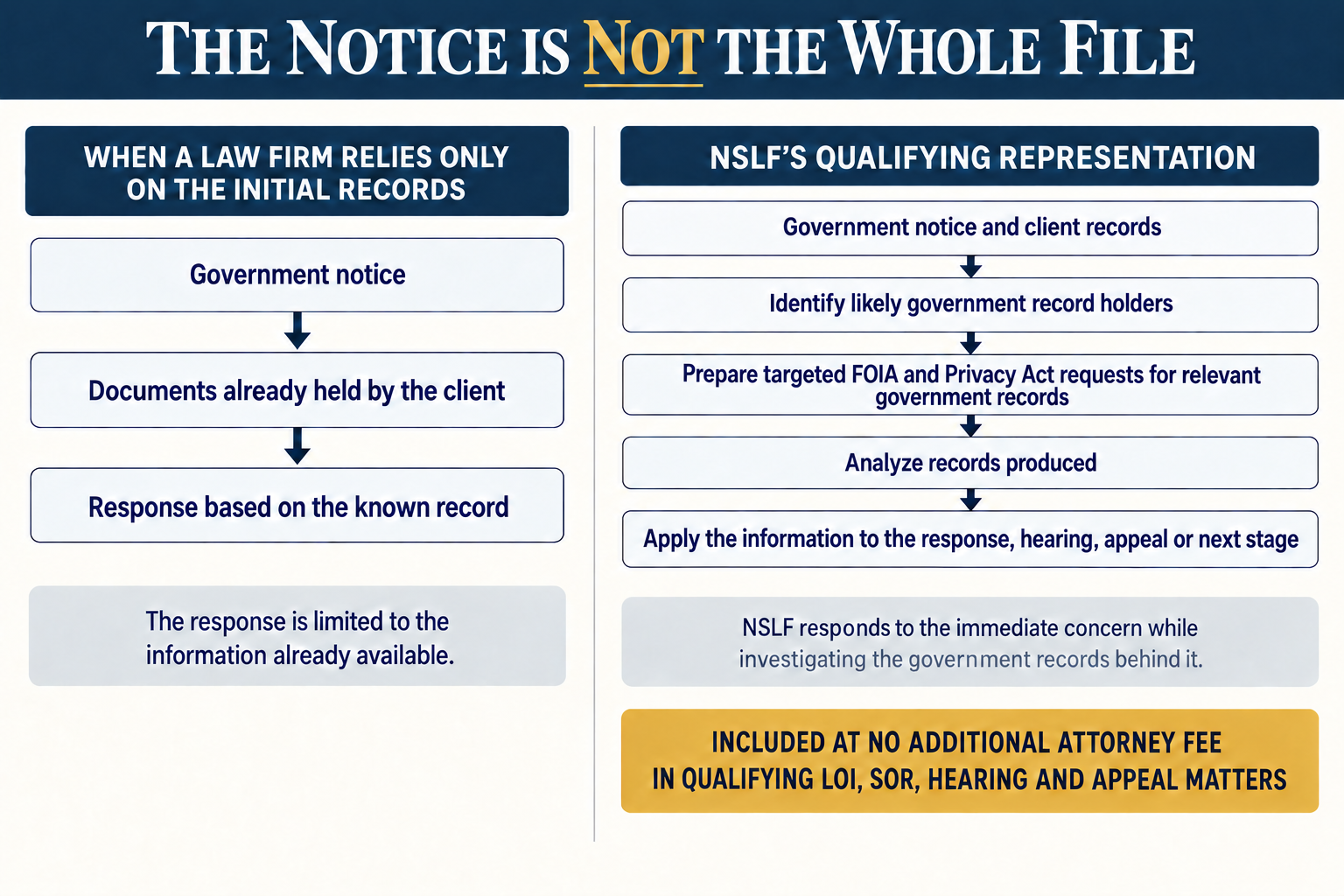
Many clearance responses are prepared using only the notice and the records the client already possesses.
NSLF goes further.
In qualifying Letter of Interrogatory, Statement of Reasons, security-clearance hearing and security-clearance appeal matters, NSLF typically prepares strategically targeted Freedom of Information Act and Privacy Act requests seeking relevant government records.
Included at No Additional Attorney Fee
This is not an optional add-on or a separate attorney charge in qualifying representations. It is part of how NSLF investigates, develops and prepares the case.
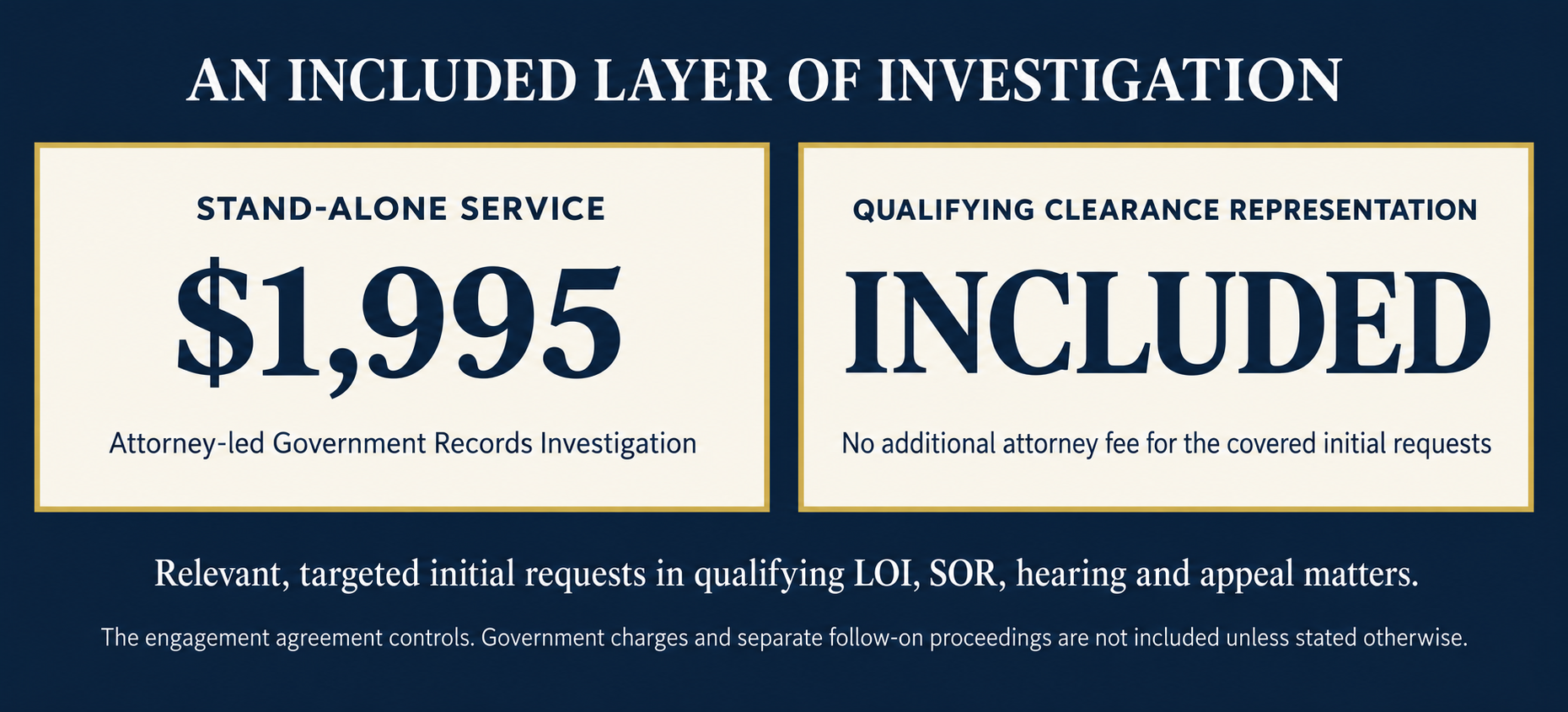
Stand-alone Government Records Investigation: $1,995
★★★★★ 4.9 Stars From 300+ Google Reviews
Former Federal Clearance Judge · Former Adjudicators · Direct DOHA Experience · Nationwide Representation
★★★★★ “Insight I Was Never Given From a Previous Firm”
“They were able to offer insight that I was never given from a previous firm. They understand their expertise and what I as a non-lawyer need to know and how best to relay that information.”
— C.H., Google review excerpt
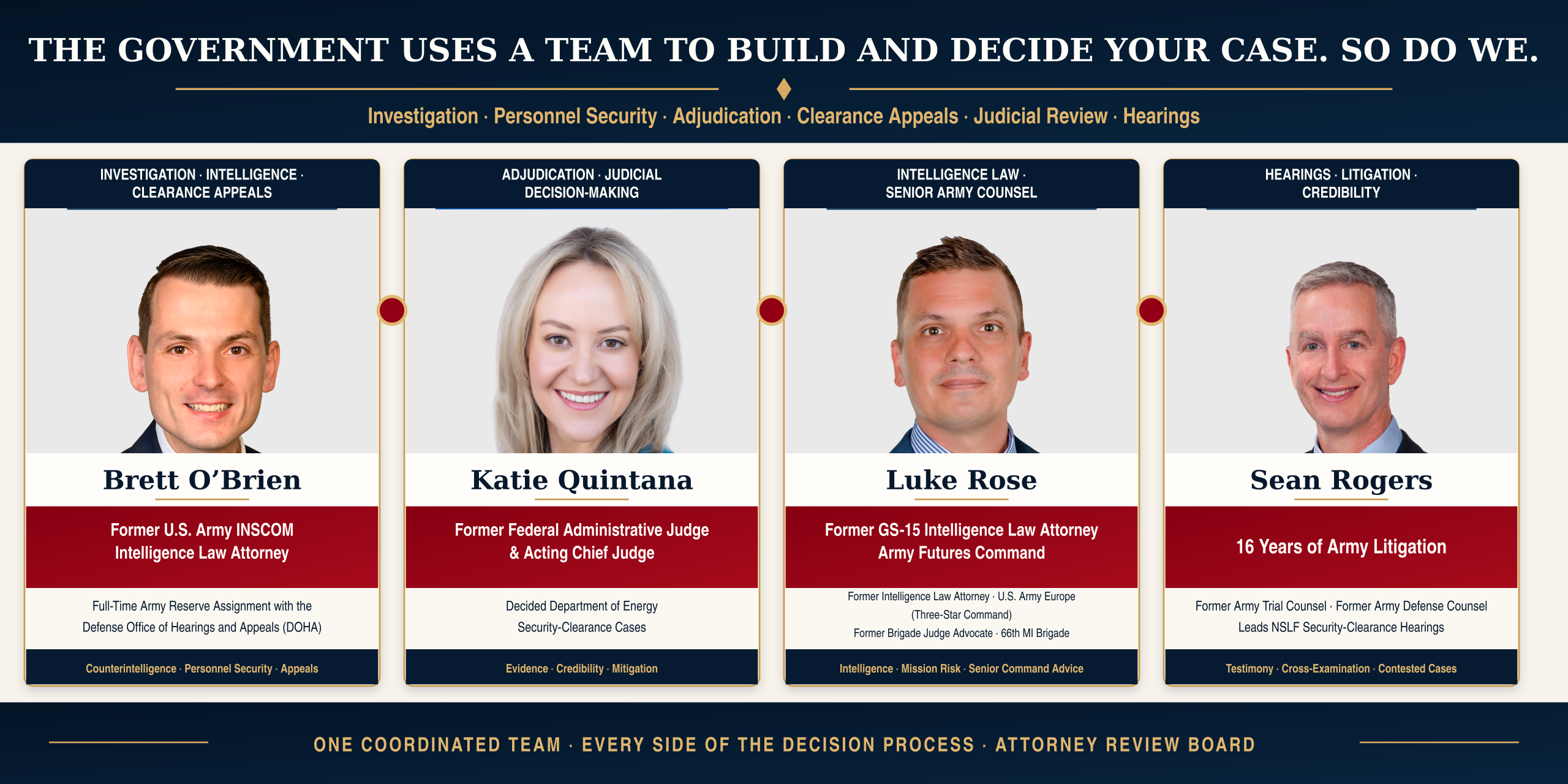
Built by Attorneys Who Understand the Government Record From Every Side
Former Federal Clearance Judge · Former Adjudicators · Experience Across Federal Investigations, Personnel Security, Agency Counsel, Hearings and Appeals
NSLF brings these perspectives together as one coordinated team. That experience helps us identify where relevant records may exist, understand why they were created and evaluate how they may be used at the next stage of a clearance case.
What Is a Government Records Investigation?
A Government Records Investigation is an attorney-led effort to identify, request and analyze federal records that may affect a security-clearance case.
It is not simply sending one general FOIA request. It is not a private investigation. And it is not a request for the government to answer legal questions.
NSLF examines the facts, allegations, agency, procedural stage and records already available. We then identify the government offices and record systems reasonably likely to contain relevant information and prepare targeted requests for those records.
When records are produced during the covered representation, our attorneys analyze them and determine how they may affect the client’s broader clearance strategy.
The value is not merely obtaining documents. The value is knowing what to request, where to look and how to use what comes back.
Why the Initial Clearance Records May Not Be Enough
A security-clearance concern can move through several parts of the government before the client receives a formal notice.
An allegation may begin with an investigator, security manager, law-enforcement agency, military command, employer or another federal office. It may then be summarized, recharacterized or combined with other information before reaching the adjudicator.
By the time the client receives an LOI, SOR, suspension or adverse decision, the notice may provide only the government’s stated concern—not every document, communication or factual source behind it.
That matters because the undisclosed records may help answer critical questions:
- Where did the allegation originate?
- What did the original source actually report?
- What did the investigator record?
- Did information change as it moved between agencies?
- Does the government possess favorable information that was not mentioned?
- Are different government records inconsistent with one another?
- Is information incomplete, outdated, duplicated or attributed to the wrong person?
- What facts may become important at a hearing or on appeal?
A lawyer cannot analyze information that no one has attempted to find.
★★★★★ “Submitting Requests I Never Would Have Known To”
“They immediately jumped to help me, submitting requests I never would have known to, and putting together a fantastic packet.”
— J.V., Google review excerpt
What Types of Records May Be Relevant?
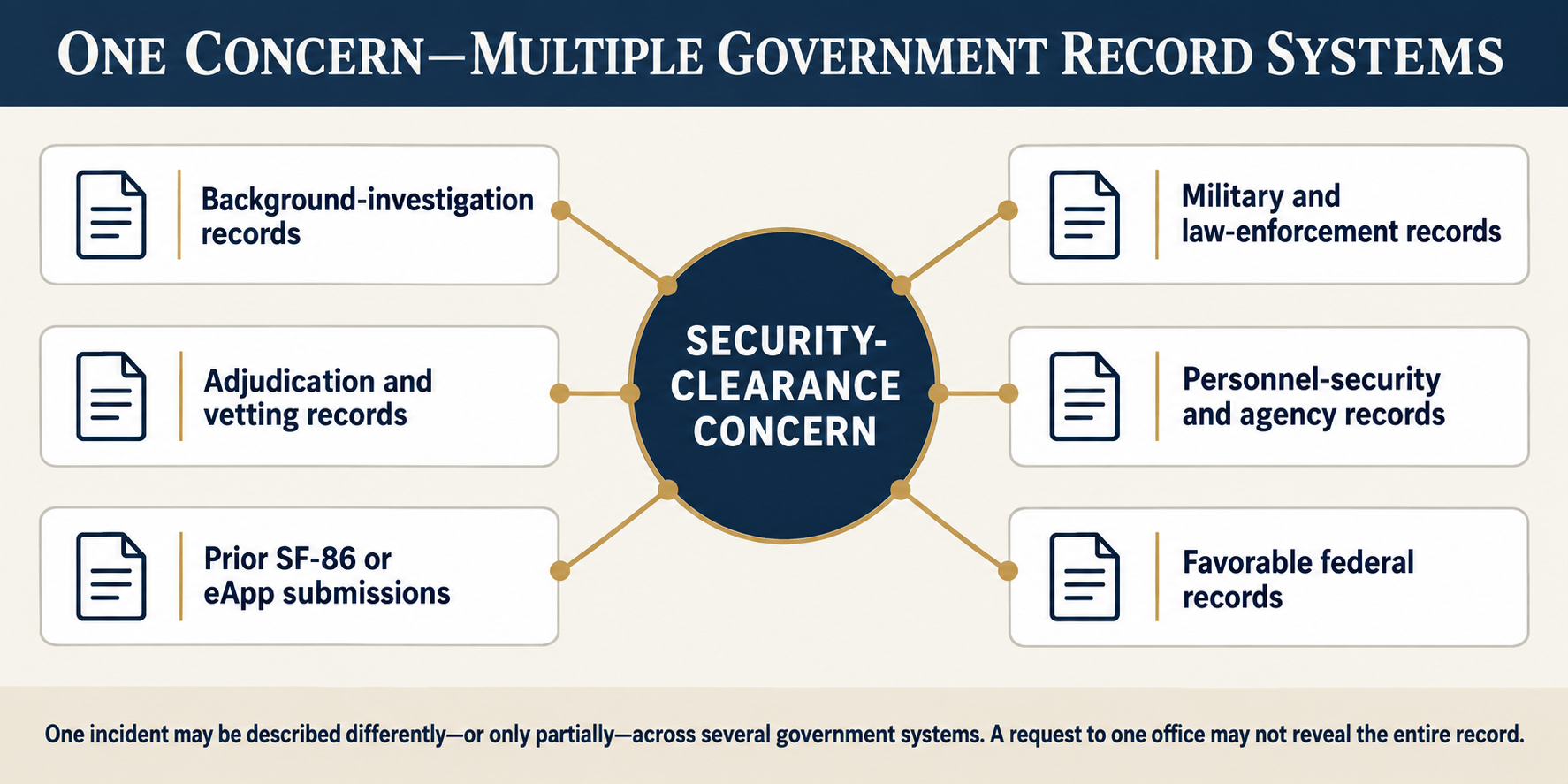
The appropriate requests depend on the client, allegations and agencies involved. Potentially relevant records may include:
Background-Investigation Records
These may contain investigative reports, interview information and other materials developed during the personnel-vetting investigation.
DCSA explains how individuals may request their background-investigation records.
Adjudication and Vetting Records
These may help show what information reached the adjudicative office, what issues were evaluated and what documents may have been maintained in connection with the eligibility determination.
DCSA provides separate instructions for requesting adjudication and vetting records.
Prior SF-86, SF-85P, SF-85, e-QIP or eApp Submissions
Earlier questionnaire answers may become important when the government is comparing disclosures made at different times.
Military and Law-Enforcement Records
Depending on the case, relevant information may exist in military investigative, command, law-enforcement, inspector general, disciplinary or counterintelligence files.
Personnel-Security and Employing-Agency Records
Security-office communications, incident reports, referrals, self-reports and personnel records may help explain how a concern arose or progressed.
Favorable Government Records
Government files may also document cooperation, candor, positive references, prior favorable findings, rehabilitation, changed circumstances or years of reliable conduct.
Not every record exists in every case, and no request guarantees that the government will locate or release a particular document.
One Records Investigation Can Protect the Client in Several Ways
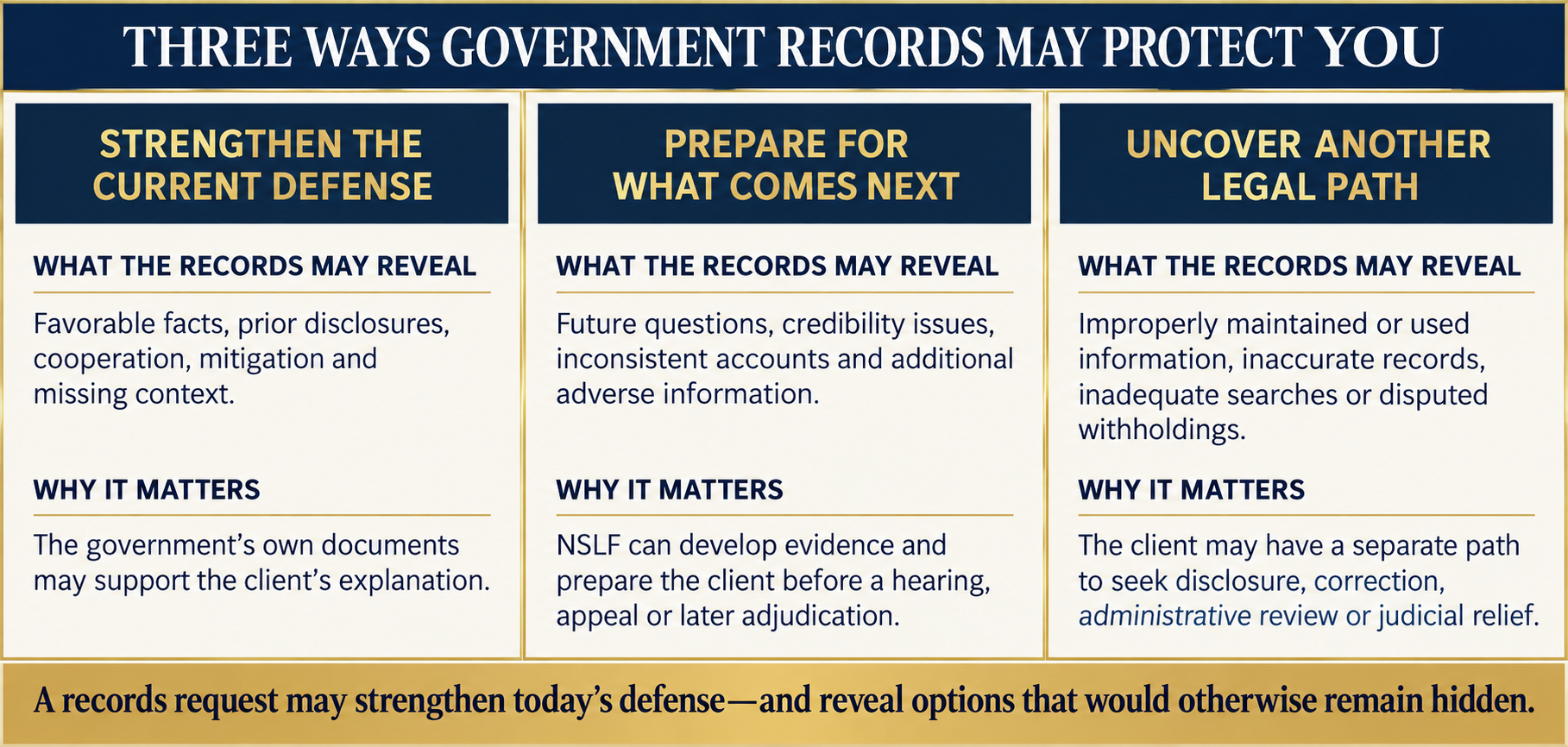
Government records are not valuable merely because they provide more information. They may give the client evidence for the current defense, prepare the legal team for later proceedings and reveal a separate government error that could not have been identified from the clearance notice alone.
1. The Records May Strengthen the Current Clearance Defense
A client can tell the government, “I disclosed that,” “I cooperated,” or “That allegation is incomplete.” But the government’s own records may provide independent documentation supporting those statements.
For example, the records may show that:
- The client previously disclosed the issue to an investigator or security officer;
- An investigator described the client as candid and cooperative;
- A supervisor or reference provided favorable information;
- The government previously considered the same conduct and reached a favorable decision;
- The client took corrective or rehabilitative action;
- An allegation omitted important mitigating context; or
- The event was less recent, frequent or serious than the notice suggests.
NSLF may be able to cite that information in a response, submit the document as supporting evidence or use it to show that the government’s characterization is incomplete.
Instead of asking the adjudicator to accept only the client’s version, we may be able to support the client with information already documented in the government’s own files.
2. The Records May Expose Errors Before They Cause Additional Harm
The records may reveal that an allegation is based on inaccurate, incomplete or inconsistent information.
For example:
- One document may contain the wrong date, amount or frequency;
- An arrest may be described as though it resulted in a conviction;
- A resolved debt may still be listed as outstanding;
- Conduct may have been attributed to the wrong person;
- A voluntary disclosure may later be described as something the government independently discovered;
- An investigator’s original notes may differ from a later agency summary; or
- Favorable facts may have disappeared as information moved from one government office to another.
Those differences can matter. A wrong date may make conduct appear more recent. A wrong dollar amount may make a financial problem appear more serious. An omitted disclosure may create a false appearance of dishonesty.
When NSLF identifies the source of the problem, we may be able to challenge the inaccurate allegation, explain why it should receive less weight, obtain corroborating evidence or evaluate whether a separate correction process is available.
3. The Records May Become Vital If the Case Advances
Government records may not arrive before the immediate LOI, SOR or appeal deadline. NSLF therefore proceeds with the immediate defense rather than waiting for the production.
But the initial response may not be the end of the case.
Records received later may become vital if the matter progresses to:
- Additional agency questioning;
- A security-clearance hearing or personal appearance;
- An appeal;
- A future adjudication or reinvestigation;
- A continuous-vetting concern;
- A request to correct an underlying government record; or
- A separate challenge involving records the government withheld.
The records may identify questions the client is likely to face, reveal evidence that should be developed, expose inconsistencies that must be reconciled or uncover additional adverse information before it becomes a surprise during testimony.
A record that arrives too late for the first response may still materially affect every stage that follows.
The Records May Also Reveal a Separate Government Wrong
Sometimes a records production does more than help explain the clearance allegations. It may reveal a potential problem with how the government obtained, maintained, disclosed, withheld or used information.
That can create legal options that were not visible from the original clearance notice.
Depending on the facts and governing law, those options may include:
- Challenging an inadequate search for responsive records;
- Administratively appealing information withheld under FOIA or the Privacy Act;
- Challenging an exemption asserted by the agency;
- Seeking amendment of an inaccurate, irrelevant, untimely or incomplete qualifying record;
- Filing a Statement of Disagreement if an amendment request is denied;
- Seeking judicial review of an access or amendment decision; or
- Evaluating another legal claim revealed by the production.
The initial records request creates a documented process. It identifies what was requested, where the request was sent, what the agency searched, what it produced and what it withheld. If information is withheld, the agency ordinarily identifies the asserted basis for withholding, allowing counsel to evaluate whether an administrative appeal or other challenge may be appropriate.
This adds a layer of accountability that does not exist when no one asks to see the underlying records.
A Records Request Revealed a Legal Issue the Clearance Notice Did Not
In a recent NSLF matter, a government-records production raised serious questions about how information had been obtained and used in connection with the revocation of a client’s security clearance.
That issue was not apparent from the clearance decision alone. It emerged only after NSLF obtained and analyzed the underlying records.
NSLF then pursued a Privacy Act request seeking amendment of a qualifying underlying record so that the client’s situation could be addressed using an accurate record. When the government did not respond, NSLF filed a federal lawsuit seeking appropriate relief.
The original records request did not automatically restore the clearance, and a Privacy Act amendment proceeding is legally distinct from a security-clearance appeal. But the production exposed a potential government wrong and opened an additional legal path that the client may never have known existed.
Without the records investigation, the information supporting that separate challenge might have remained hidden.
Why Starting the Records Process Early Matters
Submitting targeted requests during the clearance representation may:
- Produce favorable evidence for the current response;
- Reveal inaccuracies that can be challenged;
- Prevent damaging surprises at a later proceeding;
- Help counsel prepare the client’s testimony;
- Preserve consistency across future forms, interviews and adjudications;
- Identify information affecting a related military, employment or credentialing matter;
- Establish a record of what the agency produced or withheld; and
- Reveal whether a separate access, amendment or judicial remedy should be evaluated.
Not every production will be favorable, and not every error creates a separate legal claim. The value is that the client and legal team can make decisions based on a more complete understanding of the government’s record.
Important Legal Distinction
Obtaining or correcting an underlying record does not automatically change a security-clearance determination.
DCSA expressly states that its Privacy Act amendment process is not the procedure for changing an eligibility, suitability, fitness or security-clearance decision. The clearance decision must be challenged through the procedure governing that decision.
However, an inaccurate underlying record may present a separate problem. Correcting that record—or formally documenting the disagreement—may still be important to the current matter, a later proceeding or future government decisions.
Similarly, when an agency withholds requested records, the requester may have administrative appeal rights and, after satisfying the applicable procedural requirements, may be able to seek judicial review. DCSA explains its records-access and appeal process here.
★★★★★ “They Anticipated Every Angle the Government Might Raise”
“He took the time to deeply understand my background, anticipate every angle the government might raise, and help me present my case in the strongest, most honest way possible.”
— P.K. Google review excerpt
The Difference Between Collecting Records and Investigating a Case
Anyone may be able to submit a request for certain federal records. That alone is not the service NSLF provides.
NSLF’s Government Records Investigation connects the records process to the legal case:
- We review the notice and current procedural stage.
- We identify the government offices likely to possess relevant records.
- We prepare strategically targeted initial requests.
- We track the requests during the covered engagement.
- We analyze responsive records received during that engagement.
- We determine how the information may affect the clearance strategy.
The resulting information may help counsel strengthen an immediate response, prepare for testimony, preserve an issue for appeal, reconcile inconsistent statements or evaluate whether a separate records remedy should be considered.
The distinction is simple:
Some representations respond to the file already in front of the lawyer. NSLF’s qualifying representation also investigates the government records behind it.
Included in Qualifying NSLF Clearance Representation
NSLF ordinarily charges $1,995 for a stand-alone Government Records Investigation.
In qualifying NSLF matters, the service is incorporated into the broader representation at no additional attorney fee.
Included in Qualifying Matters Involving:
- Letters of Interrogatory
- Statements of Reasons
- Security-clearance hearings
- Security-clearance appeals
The qualifying service typically includes targeted initial requests selected by NSLF. The appropriate number and recipients depend on the allegations, agency, available documents and procedural posture.
What Is Included?
The covered service ordinarily includes:
- Attorney review of the client’s notice, objective and available records;
- Identification of reasonably appropriate government record holders;
- Selection of the initial FOIA, Privacy Act or combined requests;
- Drafting and submission of those requests;
- Tracking during the active covered engagement;
- Review of responsive records received during that engagement; and
- Analysis of how material records may affect the identified clearance strategy.
This is intended to be targeted legal work—not an unlimited search of every government agency or database.
What Is Not Included?
Unless the engagement agreement says otherwise, the service does not include:
- Government processing, search, duplication or production charges;
- Administrative appeals involving withheld or denied records;
- Privacy Act amendment proceedings;
- FOIA or Privacy Act litigation;
- Unlimited supplemental or follow-up requests;
- Continued tracking after the covered engagement ends; or
- Representation in a separate legal proceeding not included in the agreement.
The written engagement agreement controls the final scope, fee and duration.
Records Requests Do Not Stop Clearance Deadlines
A records request generally does not suspend an LOI, SOR, hearing or appeal deadline.
NSLF does not wait for the government to respond before protecting the client’s immediate interests. We develop the strongest response reasonably available within the controlling deadline while the records requests proceed separately.
If records arrive later, they may still become important in a hearing, appeal, future adjudication or separate records matter.
If your notice contains a deadline, follow the instructions in that notice and seek advice promptly.
Built for the Way the Government Maintains and Uses Information
Government information rarely remains in one place. Investigators collect it. Security personnel report and compare it. Adjudicators evaluate it. Agency counsel, hearing officials and appellate authorities may later review it.
NSLF’s security-clearance practice brings together experience from inside federal investigation, counterintelligence, personnel security, adjudication, agency counsel, administrative judging, military litigation, hearings and appeals.
That background helps our attorneys evaluate not only what a record says, but also:
- Why it may have been created;
- Where related records may exist;
- How an adjudicator may interpret it;
- How it may affect testimony or credibility; and
- How it may be used at the next stage of the case.
Learn more about NSLF’s coordinated Attorney Review Board.
Frequently Asked Questions
Can I Request My Own Government Records?
Yes. Individuals can request many of their own federal records without hiring an attorney. The value of NSLF’s service is the strategy: identifying what records may matter, selecting the appropriate offices, coordinating multiple requests, analyzing the production and applying the information to the clearance case.
Why Does NSLF Typically Prepare More Than One Request?
Different government offices may maintain different portions of the record. A request for background-investigation records may not produce separate adjudicative, military, law-enforcement, personnel-security or employing-agency records.
Will the Records Arrive Before My Deadline?
They may not. Government response times vary, and an active clearance deadline generally continues while a request is pending. NSLF therefore proceeds with the immediate defense under the instructions and deadline in the controlling notice rather than waiting for the records.
That does not make the records investigation any less important. If the matter progresses, records received later may become vital to preparing for a hearing, challenging an adverse decision, developing an appeal, correcting inaccurate information or addressing the issue in a future adjudication. Submitting targeted requests early increases the likelihood that this information will be available when the next stage begins.
Will the Government Release Everything?
Not necessarily. Agencies may redact or withhold exempt information, protect classified or third-party material, refer records to another office, request clarification or report that no responsive records were located.
Can NSLF Correct an Inaccurate Government Record?
In some circumstances, a qualifying underlying federal record may be subject to an amendment or correction procedure. That process is separate from requesting access to records and separate from challenging the clearance determination itself.
Is This Included With an SF-86 Review?
No. It is not included with the stand-alone SF-86 Review and Strategy service. It is included at no additional attorney fee in qualifying LOI, SOR, hearing and appeal representations.
Does a Government Records Investigation Guarantee a Better Outcome?
No. NSLF cannot guarantee that a particular record exists, will be released, will arrive before a deadline or will change the outcome. The purpose is to make the clearance strategy more informed and complete.
Do Not Let a Partial Record Define the Entire Case
The documents initially provided may be only one part of the government’s record.
NSLF responds to the immediate clearance concern while investigating the records behind it—seeking the source, context, favorable information and potential inconsistencies that may otherwise remain unseen.
In qualifying LOI, SOR, hearing and appeal matters, this additional layer of attorney work is included at no additional attorney fee.
Stand-alone Government Records Investigation: $1,995
Free consultation. No obligation. Nationwide security-clearance representation.