
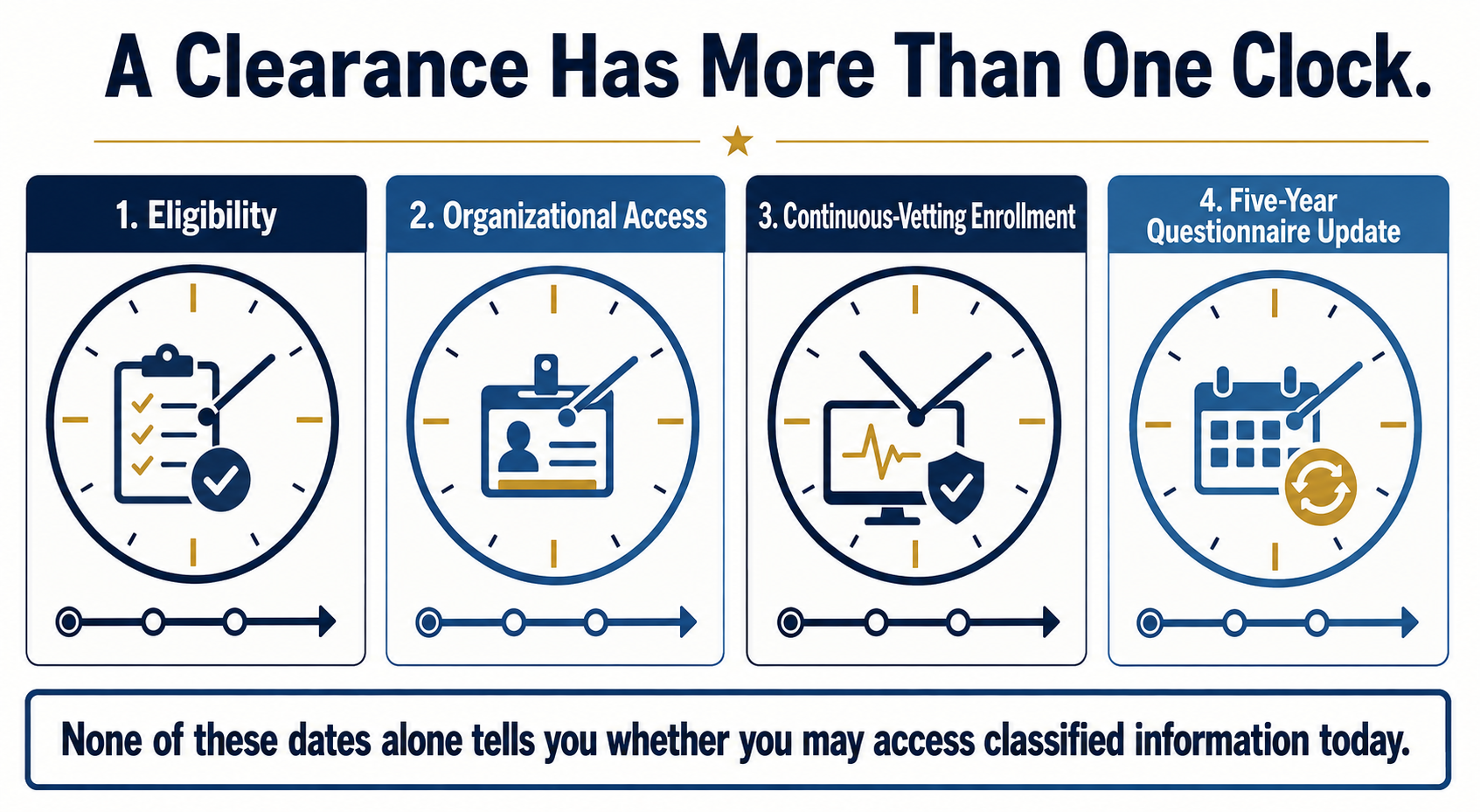
A security clearance does not necessarily expire after five or ten years merely because time has passed since the last investigation.
Under the modern personnel-vetting system, the better questions are:
- Do you still have favorable eligibility at the required level?
- Does a current agency, command or cleared employer still sponsor or affiliate you?
- Has that organization granted you access based on a present need to know?
- Are you enrolled in the applicable continuous-vetting program?
- Is your personnel-vetting questionnaire current under the rules that apply to your population?
- Has any authority suspended, denied, revoked or administratively changed your eligibility?
For many Department of Defense and cleared-contractor cases, favorable eligibility can remain in effect unless it is withdrawn, suspended, denied or revoked. Access, however, must end when the person no longer needs classified information. A job change, separation or break in service may also end access and organizational affiliation even when an eligibility record still exists.
In 2026, DCSA confirmed that National Industrial Security Program contractor personnel no longer undergo legacy periodic reinvestigations on the old schedule. Instead, they are continuously vetted and must submit an updated Personnel Vetting Questionnaire—currently the SF-86 eApp and releases—every five years, regardless of eligibility level. The five-year date is based on the PVQ date recorded in DISS. See DCSA’s May 2026 guidance.
Bottom line: time matters, but there is no single expiration date that answers every clearance question.
★★★★★ 4.9 Stars From 300+ Google Reviews
Investigation · Personnel Security · Adjudication · DOHA · Hearings · Appeals
Security-clearance duration at a glance
| Situation | What usually happens |
|---|---|
| You remain in a cleared position with continuing need for access | Eligibility and access may continue, subject to continuous vetting, required updates, self-reporting and any agency-specific requirements |
| Five years pass since your latest SF-86 or personnel-vetting questionnaire | For covered NISP contractor personnel, an updated questionnaire and releases are due; this is not the same as automatic expiration of eligibility |
| You leave the cleared job | The organization terminates access and removes or changes its affiliation; the government record may still show prior favorable eligibility |
| You transfer to another cleared employer or federal agency | The gaining organization verifies eligibility, checks reciprocity and determines whether additional processing is required |
| You remain with the same contractor but temporarily stop needing access | Access may be administratively terminated while eligibility remains, allowing access to be restored under applicable guidance if requirements are met |
| You have a long break in employment or affiliation | The gaining organization may need revalidation, a new questionnaire, updated checks or a new eligibility determination; do not assume the old clearance is immediately usable |
| You are no longer enrolled in continuous vetting | This may reflect loss of organizational affiliation rather than an adverse decision, but the status must be addressed before relying on the prior record |
| Eligibility is suspended, denied or revoked | The issue is not mere expiration; obtain the notice and determine whether response, hearing or appeal rights remain |
| Your position requires SCI or a special-access program | Collateral eligibility alone does not guarantee continuing SCI or program access; the controlling authority must approve and maintain that access |
The old “five years for Top Secret, ten years for Secret” answer is outdated
For years, security professionals commonly described clearance duration by the interval for a periodic reinvestigation:
- Top Secret: five years;
- Secret: ten years; and
- Confidential: fifteen years.
Those numbers described the legacy reinvestigation schedule. They did not mean that favorable eligibility vanished automatically at midnight on an anniversary date.
The federal government has shifted from periodic snapshots toward continuous vetting. DCSA describes continuous vetting as ongoing review of information relevant to whether a cleared person continues to meet national-security requirements. Automated checks can identify potentially relevant criminal, terrorism, financial and public-record information between questionnaire updates. See DCSA’s Continuous Vetting overview.
For covered NISP contractor personnel, DCSA’s April and May 2026 guidance is explicit:
- Legacy periodic reinvestigations will no longer be conducted;
- An updated Personnel Vetting Questionnaire or SF-86 eApp and releases must be submitted every five years;
- The five-year interval applies regardless of the person’s eligibility level; and
- DISS uses the recorded PVQ date—not the old investigation date or continuous-vetting enrollment date—to calculate the update.
That means a Secret holder and a Top Secret holder in the covered contractor population now follow the same five-year questionnaire-update interval. But submitting a new questionnaire every five years is not the same as receiving a brand-new clearance every five years.
Other agencies and personnel populations may use their own implementation procedures. Always confirm the controlling requirement with the sponsoring security office.
What actually “lasts”: eligibility, access and affiliation are different
Many inaccurate answers treat “security clearance” as one thing. In practice, at least three separate concepts matter.
Eligibility
Eligibility is the government’s determination that a person may be entrusted with access to classified information at a specified level. An authorized adjudicative authority makes that determination after evaluating an investigation and other reliable information.
A favorable eligibility entry may remain in a government personnel-security system after the person stops using it. That does not mean the person may take classified work elsewhere without further action.
Access
Access is the organization’s authorization for the person to receive classified information. It requires:
- Favorable eligibility at the necessary level;
- A current need to know;
- Organizational approval;
- Any required briefing or indoctrination; and
- An executed nondisclosure agreement.
Executive Order 12968 requires access to be terminated when an employee no longer has a need for access. See Executive Order 12968.
Therefore, a person may still have favorable eligibility in the record but no current access after leaving a project, command, agency or employer.
Affiliation or sponsorship
Affiliation connects the person to an agency, military component or cleared employer with a legitimate need to manage the record. When affiliation ends, access ordinarily ends and continuous-vetting status may change. The absence of a sponsor can also prevent the government from completing an investigation or adjudication.
This is why saying “my clearance is active” may be incomplete. The useful question is:
What eligibility is recorded, which organization currently owns or sponsors the record, and what access has that organization granted?
See How to Check Your Security Clearance Status for the correct contact and questions to ask.
Do security clearances expire?
In the DoD personnel-security context, favorable eligibility should not be treated as automatically expired merely because the underlying investigation is “out of scope.” DCSA has long instructed DoD components that personnel clearances do not simply expire on that basis.
But that statement needs several qualifications:
- Access can end immediately when the job no longer requires classified information;
- Eligibility can be suspended, denied, revoked or administratively withdrawn;
- Continuous-vetting enrollment can end when affiliation ends;
- A required questionnaire update can become overdue;
- A gaining agency can require additional processing under a permitted reciprocity exception;
- A long break in service can require revalidation or a new determination; and
- SCI and special-access approvals can end independently of collateral eligibility.
So “clearances do not expire” does not mean “once cleared, always cleared.” It means an anniversary date alone does not necessarily terminate an otherwise favorable eligibility determination.
What happens every five years under continuous vetting?
For covered NISP contractor personnel, the current five-year event is an updated personnel-vetting questionnaire, not a legacy periodic reinvestigation.
The Facility Security Officer uses the PVQ date in the Defense Information System for Security (DISS) to determine when the next submission is due. DCSA’s current guidance calls for an updated SF-86 eApp and required releases. The updated information supports continuous vetting and allows the government to maintain current data supplied directly by the individual.
The five-year update may lead to different outcomes:
- Routine processing with no change in eligibility;
- Requests to clarify or document new information;
- Additional investigative checks;
- Adjudicative review of reported or discovered conduct; or
- A formal request, incident response or due-process action if unresolved concerns arise.
Do not treat the update as a formality. Answers should be complete, accurate and consistent with prior submissions, self-reports and government records. If a current answer differs from an earlier SF-86, the record should explain the change rather than leave an adjudicator to infer concealment or inconsistency.
For help with a new or updated questionnaire, see SF-86 Security Clearance Lawyer.
Does continuous vetting make a clearance permanent?
No.
Continuous vetting changes how the government identifies and evaluates information between traditional reinvestigation dates. It does not create permanent eligibility or eliminate the holder’s responsibilities.
DCSA explains that automated checks may identify potentially relevant criminal, financial, terrorism and public-record information. Valid alerts can lead to additional investigation and adjudicative action. Depending on the facts, the government may continue eligibility, request information, suspend access or revoke eligibility.
Cleared personnel must still comply with self-reporting requirements. Reportable events can include specified foreign contacts or travel, arrests, financial problems, substance misuse, psychological conditions affecting judgment or reliability, security violations and other matters defined by the applicable rules. Procedures differ by organization, so report through the security office identified by your agency, command or employer. See DCSA’s self-reporting guidance.
Continuous vetting means continuing review—not guaranteed continuing eligibility.
What happens to your clearance when you leave your job?
Your access should end because you no longer have a need to know through that organization. The security office should debrief you when required and remove or terminate the access relationship in the applicable system.
What happens to eligibility is more nuanced.
You take another cleared job immediately
The gaining employer or agency should verify your eligibility and establish the necessary relationship. If the new position requires the same or a lower collateral level, reciprocity may permit reliance on the prior favorable determination. Additional steps may still be necessary for SCI, special-access programs, agency-specific requirements, an overdue questionnaire, unresolved information or a higher access level.
You remain employed but stop working on classified matters
For NISP contractor personnel, 32 C.F.R. § 117.10 allows a contractor to terminate access administratively when there is no current need. If the employee remains continuously employed, retains eligibility, has the required investigative basis and no new derogatory information is known, access may later be restored under cognizant security agency guidance. See 32 C.F.R. § 117.10(i).
You separate and have no new sponsor
Access ends, the former organization removes its relationship and your continuous-vetting status may eventually change. That does not necessarily mean the government made an adverse judgment. But your prior eligibility may not remain immediately usable indefinitely.
You return after a break
The new employer or agency must determine what the authoritative systems show and whether the prior eligibility can be recognized. It may need to establish affiliation, request reciprocity or revalidation, obtain an updated questionnaire, address continuous-vetting enrollment or initiate new processing.
Do not represent to an employer that you hold a currently usable clearance merely because you once had access. A more accurate description is often: “I previously held [level] eligibility and access; current status requires verification by an authorized security office.”
Is a clearance “inactive” for two years after leaving?
“Inactive clearance” is common recruiting language, but it is not a precise government status.
The frequently repeated two-year rule usually refers to circumstances in which prior eligibility may be revalidated or restored after a break in service, provided other requirements are satisfied. It is not a universal promise that every former clearance remains active for exactly 24 months or automatically disappears on day 731.
The result can depend on:
- Which agency or component granted the eligibility;
- What the authoritative system currently shows;
- Whether eligibility was favorable when affiliation ended;
- Whether there has been a break in employment or access;
- Whether continuous-vetting enrollment ended;
- Whether the questionnaire or investigation meets current requirements;
- Whether new or unresolved information exists;
- Whether the gaining position requires the same level; and
- Whether SCI, SAP or agency-specific processing is involved.
DCSA guidance addressing certain eligibility entries states that previous eligibility may be reinstated after the required official action is satisfied if there has not been a break in service longer than 24 months. That is one rule applied in a defined context—not a substitute for checking the individual record. See DCSA’s eligibility-status guidance.
The practical answer is to have the gaining security office verify the record before making employment or start-date assumptions.
Can a new employer reactivate your clearance?
A private employer cannot grant federal eligibility on its own. A cleared contractor or federal agency can sponsor the appropriate action and, when authorized, grant access after government eligibility is verified.
Depending on the record, the process may involve:
- Establishing a new affiliation or relationship in DISS or another system;
- Confirming the prior investigation and eligibility determination;
- Applying reciprocity rules;
- Reviewing continuous-vetting and questionnaire dates;
- Resolving any incident, request or administrative status;
- Obtaining any agency-specific approval; and
- Granting and documenting access based on current need to know.
A recruiter’s statement that a clearance is “active,” “current” or “expired” should be confirmed by the Facility Security Officer or agency security office.
How reciprocity affects clearance duration
Reciprocity means a gaining agency should generally recognize a qualifying prior investigation and favorable eligibility determination instead of starting over unnecessarily.
For NISP contractor personnel, 32 C.F.R. § 117.10 provides that a current eligibility determination based on an investigation meeting or exceeding the necessary scope supplies the basis for the new determination. The prior investigation generally should be used without further investigation or adjudication unless the cognizant security agency becomes aware of significant derogatory information that was not previously adjudicated.
Reciprocity can still require processing time. Permitted exceptions may include:
- A higher eligibility level;
- New, unresolved or previously unadjudicated information;
- An agency-specific requirement authorized by policy;
- An out-of-date or incomplete questionnaire requirement;
- A polygraph or program-specific requirement;
- A suitability or fitness decision separate from clearance eligibility;
- SCI or special-access approval; or
- A record that cannot be verified in the expected system.
Reciprocity does not mean one agency must grant a position, employment suitability, SCI access or special-program access merely because another agency previously granted collateral eligibility.
How long does SCI access last?
Sensitive Compartmented Information (SCI) is not a separate clearance level above Top Secret. It is a category of specially controlled intelligence information.
A person typically needs appropriate Top Secret eligibility and a favorable determination by the relevant authority, plus a current need to know and indoctrination into the compartment. SCI access can be removed when the person changes assignments or no longer needs the information even if collateral Top Secret eligibility remains favorable.
The same principle applies to Special Access Programs: program access may end independently of the person’s underlying collateral eligibility.
See What Is a TS/SCI Clearance? for the full distinction.
How long does an interim clearance last?
Interim eligibility is temporary. It allows qualifying access while the investigation and final adjudication continue. It does not become final merely because the person has worked under it for months or years.
An interim determination can end when:
- Final eligibility is granted;
- The interim is withdrawn;
- New information changes the preliminary risk assessment;
- The person no longer needs access;
- Sponsorship or affiliation ends; or
- The responsible authority takes another adjudicative action.
The absence or withdrawal of interim eligibility does not always predict the final outcome. The final decision must be based on the completed record and applicable adjudicative standards.
What statuses can prevent a prior clearance from being used?
Time is only one factor. A prior clearance may be unusable because the record reflects:
Suspension
Suspension temporarily removes access or eligibility while information is reviewed. It is not necessarily a final revocation, but the person should obtain the written notice and determine what response rights apply.
Denial or revocation
A denial or revocation is an adverse merits determination. Deadlines for a response, hearing, personal appearance or appeal may be short and differ across personnel categories.
Loss of Jurisdiction
Loss of Jurisdiction commonly arises when the person no longer has an affiliation or the government cannot continue processing. It is not automatically a merits-based denial, but it means there is no current eligibility supporting access until the responsible authority takes further action.
Eligibility Administratively Withdrawn
DCSA uses this entry in circumstances that can include loss of industrial affiliation. It does not necessarily reflect adverse information, but it means access cannot be granted until supporting eligibility is entered.
No Determination Made
This means there is no favorable eligibility determination. DCSA may use it when inadequate information or another specified condition prevents a favorable or unfavorable determination. The reason must be identified before the proper corrective action can be chosen.
Overdue or missing information
Failure to submit a requested SF-86, PVQ, release or response can cause eligibility consequences. If you did not receive the request or believe you complied, preserve proof and ask the security office to obtain the system message and deadline.
See How to Check Your Security Clearance Status for a fuller explanation of these entries.
How to determine whether your prior clearance is still usable
There is no public clearance-lookup website. Use the security office connected to your current or prospective position.
Military personnel
Contact the security officer at your duty station. If the process is tied to recruiting or accession, ask the recruiter which office owns the record.
Federal employees and applicants
Contact the agency security officer or HR representative handling the position.
DoD contractors
Ask the company Facility Security Officer to review DISS. The FSO should distinguish among eligibility, access, affiliation, investigation or PVQ date, and continuous-vetting status.
Former clearance holders
A former employer may be unable to provide a current determination after its relationship to the record ends. A new cleared sponsor is ordinarily best positioned to verify whether the prior eligibility can be recognized. You may also request investigation or adjudication records, but a records response is not a live status check.
Ask these specific questions:
What eligibility level and determination date are recorded? Is there a current affiliation? What is the continuous-vetting status and PVQ date? Is any incident, request or adjudicative action pending? What must occur before this organization can grant access?
When the passage of time can help—or hurt—a clearance case
Time does not automatically erase adverse information. But it can change how an adjudicator evaluates risk under the whole-person concept.
Time may help when the record shows:
- The conduct was isolated and has not recurred;
- The person was young or under unusual circumstances;
- Treatment, counseling, rehabilitation or financial recovery has been sustained;
- Court, tax, debt or compliance obligations have been completed;
- The person self-reported and remained candid;
- Current conduct demonstrates reliability; or
- The conditions that created the concern have changed.
Time may hurt when it reveals:
- A continuing pattern;
- Repeated failures to report;
- Unresolved delinquent debt or tax obligations;
- Inconsistent explanations across forms and interviews;
- Noncompliance with treatment or monitoring;
- Continuing foreign influence or preference concerns; or
- Failure to act after receiving government notice.
If your clearance status becomes a formal adjudicative issue, the question is not simply how old the concern is. It is what the full current record shows about judgment, candor, rehabilitation, recurrence and present risk.
When to speak with a security-clearance lawyer
You generally do not need counsel merely because five years have passed or a recruiter cannot immediately verify your record.
Legal help may be appropriate when:
- A security office says the clearance “expired” but cannot identify the actual eligibility status;
- A new employer cannot obtain reciprocity or revalidation;
- DISS shows Loss of Jurisdiction, No Determination Made or administrative withdrawal;
- Continuous-vetting information triggered an incident or adjudicative review;
- The government requests a new SF-86 or written explanation concerning potentially disqualifying facts;
- Your access or eligibility is suspended;
- You receive a Letter of Intent, Statement of Reasons or interrogatories;
- Different agencies report conflicting eligibility information;
- The record contains inaccurate information; or
- A response or appeal deadline is running.
Talk With a Security-Clearance Attorney
Time does not control the case—the record does
The modern clearance system is continuous. Agencies and cleared employers manage sponsorship and access. Investigative systems collect and update facts. Adjudicators evaluate eligibility. Continuous-vetting alerts may reopen an issue years after the original investigation. A gaining organization then decides what it must verify before granting access.
That is why NSLF does not begin with the label “expired.” We reconstruct the status chain:
- What was granted? Collateral eligibility, SCI access, program access or a position-of-trust determination?
- What changed? Employment, need to know, affiliation, continuous-vetting status or adjudicative information?
- What does the authoritative record show? Favorable eligibility, an administrative entry, unresolved action or an adverse decision?
- Who can act now? The current sponsor, gaining agency, DCSA adjudicator, military component or appellate authority?
When a genuine adjudicative problem exists, NSLF’s team can evaluate it from the perspectives used by the government itself: investigation, personnel security, adjudication, intelligence law, hearing advocacy and judicial review.
The firm’s Attorney Review Board brings together a former federal Administrative Judge and Acting Chief Judge, former government adjudicative experience, a former Army INSCOM Intelligence Law Attorney with direct DOHA experience, a former GS-15 Intelligence Law Attorney and experienced hearing counsel.
The government uses different offices to maintain, review and act on your clearance. We examine the same decision chain before deciding what your next move should be.
Meet NSLF’s Attorney Review Board
★★★★★ “After a Year and a Month, I’ve Been Cleared and I’m Back at Work.”
“I was in a desperate situation after having my security clearance suspended and then revoked. I felt lost and didn’t know where to turn. My first appeal was denied, and I almost gave up, but the team encouraged me to keep fighting. After a year and a month, I’ve been cleared and I’m back at work.”
— P.A., Security Clearance Appeal Client
Google Review
This review describes one client’s experience. Results depend on the facts, evidence, forum and governing procedure, and a similar result cannot be guaranteed.
Frequently asked questions
How long is a Secret clearance good for?
Do not rely on the old statement that a Secret clearance automatically expires after ten years. Under current continuous-vetting procedures, favorable eligibility may continue, while covered NISP contractor personnel submit an updated personnel-vetting questionnaire every five years regardless of eligibility level. Access still depends on a current sponsor and need to know.
How long is a Top Secret clearance good for?
A Top Secret eligibility determination does not necessarily terminate five years after the last investigation. Covered NISP contractor personnel now follow continuous vetting and a five-year PVQ or SF-86 update. Eligibility, access, affiliation and SCI status must be checked separately.
Do security clearances expire after five years?
Not automatically. Five years is now an important questionnaire-update interval for covered contractor personnel, but it is not a universal automatic expiration date for favorable eligibility.
Do security clearances expire after ten years?
Not merely because ten years passed. The old ten-year Secret interval came from the legacy periodic-reinvestigation system. Current status depends on eligibility, access, sponsorship, continuous vetting and applicable agency requirements.
Is my clearance active after I leave the military or federal service?
Your access ends when you no longer need classified information through that organization. Prior favorable eligibility may remain in the government record, but a new sponsor must verify whether it can be recognized or revalidated.
How long can a clearance be inactive?
“Inactive” is not a precise universal status. A two-year break is relevant in some revalidation and eligibility rules, but the authoritative record, agency, continuous-vetting status, questionnaire currency and unresolved information control.
Does my clearance remain active for two years after leaving a job?
Do not assume so. The two-year statement is shorthand for some revalidation situations, not a guarantee of continuing access or immediately usable eligibility. Ask the gaining security office to verify the record.
Can I keep a clearance without a cleared job?
You cannot keep access without a current need to know. A prior eligibility record may remain for some period, but a person cannot independently sponsor or maintain a federal clearance.
Can I pay to renew my own security clearance?
No. A federal agency, military component or cleared contractor must have a legitimate need and sponsor the required processing. Individuals cannot purchase or self-renew federal eligibility.
Does changing contractors cancel my clearance?
Not necessarily. The new cleared contractor may verify and rely on qualifying existing eligibility, but it must establish the correct relationship and grant access. Transfers can be complicated by missing affiliation, overdue updates, unresolved information or agency-specific requirements.
Does changing federal agencies require a new investigation?
Not always. Reciprocity may require the gaining agency to recognize a qualifying prior investigation and favorable determination. Additional processing may be permitted for specified exceptions, suitability, SCI, special programs or unresolved information.
What is the difference between current eligibility and current access?
Eligibility is the government’s trust determination. Access is the organization’s permission to receive classified information for a current need to know. You can have favorable eligibility without current access.
Does a completed SF-86 extend my clearance for five years?
Not by itself. The questionnaire supplies updated information. The government must process it under the applicable vetting and adjudicative rules, and eligibility remains subject to continuing review.
Will continuous vetting replace the SF-86?
No. For covered NISP contractor personnel, DCSA currently requires an updated PVQ or SF-86 eApp and releases every five years even though legacy periodic reinvestigations have ended.
Can a continuous-vetting alert revoke my clearance?
An alert does not itself establish revocation. It can prompt verification, investigation and adjudicative review. Depending on the facts and response, the government may continue, suspend or revoke eligibility.
Does favorable Top Secret eligibility mean my SCI is active?
No. SCI requires separate approval, need to know and indoctrination by the controlling authority. SCI access can end while collateral Top Secret eligibility remains.
How long does interim eligibility last?
There is no guaranteed duration. It remains temporary while final processing continues and can end through a final decision, withdrawal, loss of need, separation or other action.
What if DISS shows Loss of Jurisdiction after I left my job?
That is not automatically a denial, but it means there is no current eligibility supporting access. A new sponsor may need to request the appropriate adjudicative action. The underlying messages and case history should be reviewed.
How can I check whether my old clearance is still valid?
Ask the security office or Facility Security Officer connected to the current or prospective cleared position. Request the recorded eligibility, access, affiliation, continuous-vetting status, PVQ date and any pending action.
Can an attorney reactivate an expired clearance?
An attorney cannot grant or reactivate eligibility. Counsel may help identify the actual status, correct a record, address an unresolved issue, prepare a required submission or challenge an adverse action. Government authorities make the eligibility decision.
Official resources
- DCSA: 2026 NISP Contractor Continuous-Vetting Update
- DCSA: Continuous Vetting
- DCSA: 2026 DISS Continuous-Vetting Status Changes
- DCSA: Check Your Status
- DCSA: Report a Security Change, Concern or Threat
- 32 C.F.R. § 117.10: Personnel Security Eligibility and Access
- Executive Order 12968: Access to Classified Information
- ODNI: Security Executive Agent Policy, Including SEAD 7 Reciprocity
Get help with a clearance-status or revalidation problem
Most people do not need a lawyer simply because an old investigation date has passed. But a status question can become a legal problem when it reveals suspension, conflicting records, Loss of Jurisdiction, an unanswered government request, adverse information or a formal denial or revocation.
National Security Law Firm represents military members, federal employees, applicants and cleared contractors nationwide in security-clearance matters.