
A TS/SCI clearance is shorthand for Top Secret eligibility plus authorized access to Sensitive Compartmented Information. Top Secret is a classification and clearance-eligibility level. SCI is not a fourth or higher clearance level. It is protected intelligence held within formal access-control systems.
To receive TS/SCI access, a person ordinarily must:
- Be sponsored by a federal agency, military organization or cleared employer for a position that requires the access;
- Complete the required personnel-vetting process, usually including the SF-86 and a Tier 5 background investigation;
- Receive a favorable national-security eligibility determination;
- Have an official need to know the particular information; and
- Be approved and indoctrinated for the applicable SCI access.
A person with Top Secret eligibility does not automatically have access to SCI. A person approved for one SCI program also does not automatically receive access to every compartment, control system or classified program.
| At a glance | What it means |
|---|---|
| TS | Top Secret—the highest of the three standard national-security classification levels |
| SCI | Sensitive Compartmented Information—classified intelligence protected through additional access controls |
| TS/SCI | Common shorthand for Top Secret eligibility together with authorized SCI access |
| Sponsor required | Yes. An individual cannot independently apply for or purchase a TS/SCI clearance |
| Polygraph required. | Sometimes. It depends on the agency, position and program |
| Access to all SCI | No. Access remains limited by authorization and need to know |
★★★★★ 4.9 Stars From 300+ Google Reviews
Investigation · Personnel Security · Adjudication · DOHA · Hearings · Appeals
Do you have a current TS/SCI problem rather than a general question? National Security Law Firm advises applicants, service members, federal employees and cleared contractors at the SF-86, investigation, adjudication, Statement of Reasons and appeal stages nationwide. Discuss your situation with our team.
What Does “Top Secret” Mean?
Top Secret is the highest of the three standard classification levels established by Executive Order 13526. It applies to information whose unauthorized disclosure reasonably could be expected to cause exceptionally grave damage to national security.
That definition describes the sensitivity of the information. A Top Secret eligibility determination concerns whether a person may be trusted with information at that level when access is officially authorized.
Those concepts are related but not identical:
- Classification describes the information.
- Eligibility is the government’s favorable determination about the person.
- Access is permission to receive particular classified information for an official purpose.
Even a person with favorable Top Secret eligibility may see classified information only when the person has the required access, signs any required nondisclosure agreements, follows applicable handling rules and has a need to know.
What Is Sensitive Compartmented Information?
Sensitive Compartmented Information, or SCI, is classified intelligence concerning or derived from intelligence sources, methods or analytical processes that is handled within formal access-control systems established for its protection.
SCI is often associated with highly sensitive collection capabilities, intelligence operations and sources or methods. The exact substance of any SCI is classified; the important public-facing point is how access works.
SCI is not a standalone clearance level above Top Secret. It is a category of controlled intelligence that carries additional access requirements. That is why “TS/SCI” is useful shorthand but can be misleading when treated as the name of one universal clearance.
Is TS/SCI Higher Than Top Secret?
Not as a fourth classification level. The federal government’s standard classification levels are Confidential, Secret and Top Secret.
SCI adds access controls to protected intelligence. In practical terms, a TS/SCI position may involve more restrictive screening, handling and access requirements than a position requiring only collateral Top Secret access. But the distinction is not “Top Secret versus a higher TS/SCI classification.” It is Top Secret eligibility plus separately authorized SCI access.
Does TS/SCI Give You Access to Everything?
No. Eligibility is not a universal pass.
Access generally depends on three separate questions:
- Is the person eligible at the required level?
- Has the organization authorized the necessary SCI access?
- Does the person have a current need to know the particular information?
SCI may be divided among different control systems and compartments. A person read into one area does not automatically receive access to another. Additional approvals, briefings, nondisclosure obligations or program requirements may apply.
The same basic distinction applies to a Special Access Program, or SAP. A SAP imposes safeguarding and access requirements beyond those ordinarily required for information at the same classification level. SCI and SAP are not interchangeable terms, and approval for one does not automatically establish access to the other.
Who Needs a TS/SCI Clearance?
TS/SCI access may be required for certain positions involving intelligence, counterintelligence, cybersecurity, national defense, military operations, intelligence analysis, space operations, sensitive acquisitions or support to the Intelligence Community.
The position—not the applicant’s preference—drives the requirement. Two people with similar job titles may face different security requirements because they work for different agencies, commands, contracts or programs.
Examples may include certain:
- Intelligence analysts and collection personnel;
- Counterintelligence and security professionals;
- Cybersecurity and signals-intelligence personnel;
- Military intelligence and special-operations personnel;
- Engineers and technical professionals supporting sensitive programs;
- Federal law-enforcement or investigative personnel;
- Cleared contractors supporting Intelligence Community or Department of Defense missions; and
- Senior leaders or staff members whose duties require access to compartmented intelligence.
Can You Apply for TS/SCI on Your Own?
No. An individual cannot independently obtain a TS/SCI clearance as a personal credential.
The process begins when an authorized federal agency, military organization or cleared contractor sponsors a person for a position or assignment requiring the eligibility and access. Intelligence Community agencies commonly begin security processing after a conditional offer of employment. In the industrial-security setting, the cleared employer initiates the request through the appropriate government system.
You ordinarily do not pay the government for the investigation. A company also should not sell you a clearance independent of a qualifying position.
How Do You Get a TS/SCI Clearance?
The exact process differs by agency and program, but it commonly includes the following stages.
1. Sponsorship for a qualifying position
An agency, command or cleared employer determines that the position requires Top Secret eligibility and SCI access. The organization then initiates security processing.
2. Completion of the SF-86
The applicant completes the Questionnaire for National Security Positions, commonly called the SF-86. It requests extensive information about residences, employment, education, relatives, foreign contacts, travel, finances, police matters, drug involvement, alcohol-related conduct, psychological and emotional health, information-technology conduct and other subjects.
The SF-86 is not merely an intake form. It becomes part of a lasting government record and may be compared with earlier questionnaires, interviews, investigative results and later submissions. Complete, accurate and internally consistent disclosure matters.
If you are concerned about what must be reported—or about an answer on a prior form—review our guide to SF-86 security-clearance legal help.
3. Tier 5 background investigation
A Top Secret determination ordinarily requires a Tier 5 investigation. The government may examine records and conduct interviews to assess the applicant’s identity, citizenship, residences, education, employment, finances, criminal or civil history, foreign connections and other potentially relevant conduct.
The scope is designed to test reliability, trustworthiness, judgment, allegiance to the United States, vulnerability to coercion and willingness to comply with security rules.
4. Subject interview and other investigative activity
An investigator may interview the applicant and contact employers, coworkers, neighbors, references or others with relevant knowledge. The investigator may ask about matters disclosed on the SF-86, inconsistencies in the record or information developed from other sources.
The investigation gathers facts. It does not ordinarily decide eligibility. An adjudicator later evaluates the completed record under the applicable standards.
5. Agency-specific screening
Depending on the organization and position, additional requirements may include:
- A counterintelligence-scope or broader polygraph examination;
- Drug testing;
- A psychological or medical evaluation;
- Additional security interviews;
- Program-specific forms or disclosures; and
- Review under agency suitability, fitness or employment standards separate from clearance eligibility.
Not every TS/SCI position uses every step.
6. Adjudication
The adjudicating authority evaluates the available information under the national-security adjudicative guidelines and the whole-person concept. The issue is not whether the applicant has lived a flawless life. The issue is whether the information, considered as a whole, supports confidence that the person is willing and able to safeguard classified information and perform sensitive duties.
7. SCI access determination and indoctrination
A favorable Top Secret eligibility determination does not by itself complete SCI processing. The gaining organization must approve the relevant access based on the position and need to know. Before access begins, the person may need additional approvals, briefings, acknowledgments and formal indoctrination.
What Does a Tier 5 Investigation Examine?
The precise work performed depends on the case and applicable investigative standards. Common areas include:
| Area | What investigators may seek to verify or develop |
|---|---|
| Identity and citizenship | Identity, citizenship and supporting records |
| Residences | Where the person lived and who can verify relevant periods |
| Education | Attendance, degrees and disciplinary information when relevant |
| Employment and military service. | Work history, performance, discipline, separations and service records |
| References and associates | Information bearing on conduct, judgment and reliability |
| Foreign connections | Foreign relatives, contacts, travel, interests, benefits or obligations |
| Financial history | Credit, delinquent debt, taxes, unexplained affluence or financial pressure |
| Police and court records | Arrests, charges, dispositions and other relevant legal matters |
| Drug and alcohol conduct | Use, treatment, consequences and evidence of changed behavior |
| Security and technology conduct | Handling of protected information, security violations and misuse of systems. |
| Record consistency | Whether forms, interviews, documents and prior statements agree |
An investigator’s questions can extend beyond this summary when the record identifies an issue requiring resolution.
How Long Does a TS/SCI Clearance Take?
There is no single reliable timeline for every TS/SCI case. Processing time depends on the agency, investigation provider, current workload, position, polygraph or medical requirements and the complexity of the applicant’s history.
Official Intelligence Community recruiting pages illustrate the variation. One government-wide Intelligence Community careers page states an average of approximately nine to twelve months for its described process, while DHS Intelligence and Analysis reports an average of three to four months but warns that some cases can take as long as a year. Other agencies publish different expectations.
Factors that may lengthen processing include:
- Extensive foreign travel, residence or contacts;
- Difficulty verifying overseas activity;
- Frequent moves or job changes;
- Missing or incomplete SF-86 information;
- Financial, criminal, drug, alcohol or security concerns;
- Conflicting information requiring follow-up;
- Polygraph scheduling or unresolved testing;
- Additional agency-specific review; and
- Delays unrelated to the applicant, including investigative and adjudicative workload.
A long wait does not necessarily mean the clearance will be denied. A short process does not guarantee approval.
For ways to determine where a pending case may be in the process, see How to Check Your Security Clearance Status.
Is a Polygraph Required for TS/SCI?
Not always.
Some Intelligence Community agencies and programs require a polygraph for particular positions or for all applicants. Others do not. For example, DIA publicly describes a counterintelligence-scope polygraph as part of its process, and NRO states that all of its positions require a counterintelligence polygraph. A different agency or program may use different requirements.
The fact that one position requires TS/SCI therefore does not establish that every TS/SCI applicant must take the same polygraph.
Counterintelligence-scope versus broader polygraphs
Public descriptions generally distinguish between examinations focused on counterintelligence and security topics and broader examinations that also address additional conduct. Terminology and scope can differ by agency. The notice and instructions from the sponsoring organization control.
| Examination | General public-facing distinction |
|---|---|
| Counterintelligence-scope polygraph | Generally addresses espionage, sabotage, terrorism, unauthorized disclosure or mishandling of classified information, and related security concerns |
| Expanded or full-scope polygraph | May include counterintelligence subjects plus additional questions concerning conduct bearing on reliability, trustworthiness or suitability |
Applicants should answer questions truthfully and follow the agency’s instructions. Legal advice can help a person understand reporting duties, reconcile prior disclosures and evaluate collateral legal or clearance risks. An attorney cannot promise a particular examination result or ethically help an applicant conceal information.
What Can Disqualify You From TS/SCI?
There is no separate public list of “TS/SCI disqualifiers” that mechanically decides every case. Executive Branch agencies use the national-security adjudicative guidelines and evaluate the whole person. The guidelines address:
- Allegiance to the United States;
- Foreign influence;
- Foreign preference;
- Sexual behavior;
- Personal conduct;
- Financial considerations;
- Alcohol consumption;
- Drug involvement and substance misuse;
- Psychological conditions;
- Criminal conduct;
- Handling protected information;
- Outside activities; and
- Use of information technology.
Potentially concerning conduct does not automatically produce denial. Adjudicators may consider its seriousness, frequency, recency, surrounding circumstances, voluntariness, rehabilitation, candor, likelihood of recurrence and other evidence of mitigation.
Some facts can implicate more than one guideline. An undisclosed foreign relationship, for example, may raise both foreign-influence and personal-conduct questions. A drug incident may also raise candor, criminal-conduct or judgment concerns depending on the record.
Candor and consistency can become separate issues
Applicants sometimes focus entirely on the underlying conduct and overlook the way it was reported. An omission, minimization or inconsistent explanation may create a personal-conduct concern in addition to the original issue.
The government may compare:
- Current and prior SF-86 submissions;
- Investigative and security interviews;
- Polygraph-related disclosures;
- Employment, medical, financial, police or court records;
- Statements to supervisors or security personnel; and
- Later responses, appeals and testimony.
A rushed “correction” can make the record harder to reconcile. When a material answer may be wrong, incomplete or inconsistent, it is often wise to identify what the form asked, what the person understood, what the accurate facts are and which authorized channel should receive any clarification.
Read more about why the record controls the clearance case.
Do Foreign Contacts or Dual Citizenship Prevent TS/SCI Access?
Not automatically. DIA expressly states that dual citizens may be eligible for TS/SCI. Foreign family members, close contacts, travel, property, financial interests, benefits or citizenship ties nevertheless may require careful review.
The government may examine:
- The identity, citizenship and location of foreign contacts;
- The nature, frequency and depth of the relationship;
- Whether a foreign government could create pressure, coercion or divided obligations;
- The country involved and the relevant security environment;
- Foreign property, business, banking, pensions or benefits;
- Use of a foreign passport or exercise of citizenship rights;
- Compliance with reporting requirements; and
- Evidence that reduces the potential risk.
The analysis is fact-specific. “Foreign contact” is not synonymous with “disqualifying contact,” but incomplete disclosure or an unexplained inconsistency can turn a manageable fact pattern into a larger concern.
Can Drug Use or Marijuana Affect TS/SCI Eligibility?
Yes. Illegal drug use, misuse of prescription drugs, involvement with controlled substances and failure to follow federal law can raise concerns under the adjudicative guidelines.
Marijuana remains prohibited under federal law even when state law permits medical or recreational use. Prior use is not necessarily an automatic bar, but recent or continuing involvement—especially after applying for a cleared position, receiving security guidance or expressing an intent to stop—can be difficult to mitigate.
Adjudicators may consider frequency, recency, circumstances, treatment when applicable, changed associations, demonstrated abstinence, credibility and whether future use is unlikely. Investments or business activity connected to the marijuana industry can create separate questions.
Can Debt or Financial Problems Prevent TS/SCI Access?
Financial problems can matter because substantial unresolved obligations, unexplained affluence, tax noncompliance, compulsive gambling or repeated financial irresponsibility may raise questions about judgment, reliability or vulnerability to pressure.
The amount owed is not the only consideration. The government also may examine:
- How the debt arose;
- Whether the circumstances were outside the person’s control;
- Whether the person acted responsibly after learning of the problem;
- Whether taxes were filed and payment arrangements established;
- Whether counseling or other assistance was obtained;
- Whether the plan is realistic and documented; and
- Whether the conduct is continuing.
Paying every debt in full is not the only possible form of mitigation, and indiscriminately disputing accurate debts can undermine credibility. The goal is a truthful, documented explanation supported by responsible corrective action.
Does Mental-Health Treatment Disqualify You From TS/SCI?
Seeking mental-health care is not, by itself, a reason to deny or revoke national-security eligibility. Treatment often reflects sound judgment and a willingness to address a problem responsibly.
The relevant concern is generally whether a condition or behavior may impair judgment, reliability, stability or the ability to safeguard classified information—and what the current evidence shows. Compliance with treatment, stability, professional opinions and the absence of recurrence may be important depending on the facts.
Applicants should read each SF-86 question carefully rather than assuming that every counseling or treatment event must be reported. The form contains definitions, exceptions and time periods that matter.
Can a TS/SCI Clearance Transfer to Another Agency or Employer?
Sometimes, but not automatically in every respect.
A receiving organization may recognize an existing national-security eligibility determination through reciprocity. It still must confirm that the person has a qualifying position and need to know. The organization also may need to address investigation currency, breaks in access, unresolved information and agency- or program-specific requirements.
Most importantly, reciprocal recognition of Top Secret eligibility does not guarantee immediate access to a particular SCI compartment. The gaining organization controls its own access nomination, approval, indoctrination and any additional screening required for the position.
If a move stalls, determine what is actually pending:
- Recognition of eligibility;
- Verification of the underlying investigation;
- Agency suitability or fitness review;
- SCI nomination or access approval;
- A required polygraph, medical or psychological step;
- Program access; or
- Resolution of new or previously unadjudicated information.
Calling every delay a “clearance transfer problem” can obscure the decision that actually needs attention.
How Long Does a TS/SCI Clearance Last?
A security clearance is not best understood as a license that simply expires on a fixed date. DCSA states that security clearances do not expire. DoD personnel are subject to continuous vetting, and current policy requires updated personnel-vetting questionnaires at designated intervals.
Eligibility, access and investigation currency remain different concepts:
- Eligibility may remain reflected in the government’s personnel-security system, subject to continuing requirements and adjudicative action.
- Access can end immediately when the person leaves the position, loses the need to know or is debriefed from the program.
- Continuous vetting and updated forms allow the government to assess ongoing compliance and new information.
- A break in service or affiliation may affect whether a receiving organization can readily recognize and use the prior determination.
For a fuller explanation, see How Long Does a Security Clearance Last?.
What Happens When You Leave a TS/SCI Position?
When the official need for access ends, the person is ordinarily debriefed and access is terminated. Continuing duties remain, including protection of classified information and compliance with nondisclosure obligations.
Loss of a particular access because a project ended, funding changed or the person transferred is not necessarily an adverse clearance action. By contrast, suspension, denial or revocation based on security concerns can have different consequences and may trigger written notice or review rights.
The document and decision-maker matter. Before responding, identify whether the action concerns:
- Employment or assignment;
- Facility or system access;
- SCI access;
- A SAP or other program access;
- Interim eligibility;
- Final national-security eligibility; or
- A combination of separate decisions.
The remedy for one may not resolve the others.
Can You List TS/SCI on a Résumé?
Applicants commonly identify a clearance level or active eligibility in general terms when seeking cleared work, subject to employer and agency policy. They should not disclose classified information, operational details, sensitive assignments, codewords, compartments or information that reveals protected capabilities or associations.
When in doubt, follow the security office’s guidance. A résumé is a public or widely distributed document; it is not the place to prove access by revealing information learned through that access.
What If TS/SCI Eligibility or Access Is Delayed, Denied or Revoked?
Start by identifying the exact action. “I lost my TS/SCI” can describe several legally and procedurally different situations.
Ask:
- Who made the decision?
- Did the decision concern clearance eligibility, SCI access, suitability, fitness, employment or program access?
- Is the action interim, preliminary or final?
- What written notice was issued?
- Does the notice provide a deadline or response procedure?
- Is the person a federal employee, service member, contractor applicant or current contractor employee?
If the person receives a Letter of Intent, Statement of Reasons, denial or revocation notice, the response rights and decision-maker can depend on the person’s status and agency. Contractor cases under the National Industrial Security Program may proceed differently from military, DoD civilian or Intelligence Community matters.
Do not assume that a meeting with a supervisor, loss of a badge, denial of SCI access and revocation of collateral eligibility are the same action. Preserve the notice and attachments, record the date received and avoid missing the stated deadline while trying to determine the label.
When Can a Security-Clearance Lawyer Help?
Not everyone researching TS/SCI needs a lawyer. Legal help may be valuable when the person has a concrete risk, disputed record or time-sensitive decision, such as:
- A potentially significant SF-86 disclosure or omission;
- Conflicting prior forms or interview statements;
- A focused background-investigation interview involving serious concerns;
- Foreign contacts, foreign assets or dual-citizenship issues requiring careful documentation;
- Drug, financial, criminal, psychological, security or technology concerns;
- A polygraph disclosure that may affect clearance, employment or legal interests;
- An interim denial, suspension or access problem;
- A Letter of Intent or Statement of Reasons;
- A denial or revocation with review or appeal rights; or
- A clearance issue that overlaps with military, federal-employment or criminal proceedings.
The earlier record can shape every later stage. A response that solves only the immediate question may create a contradiction when compared with the SF-86, investigative interview, personnel record or later testimony.
A TS/SCI Problem Is Rarely Only One Problem
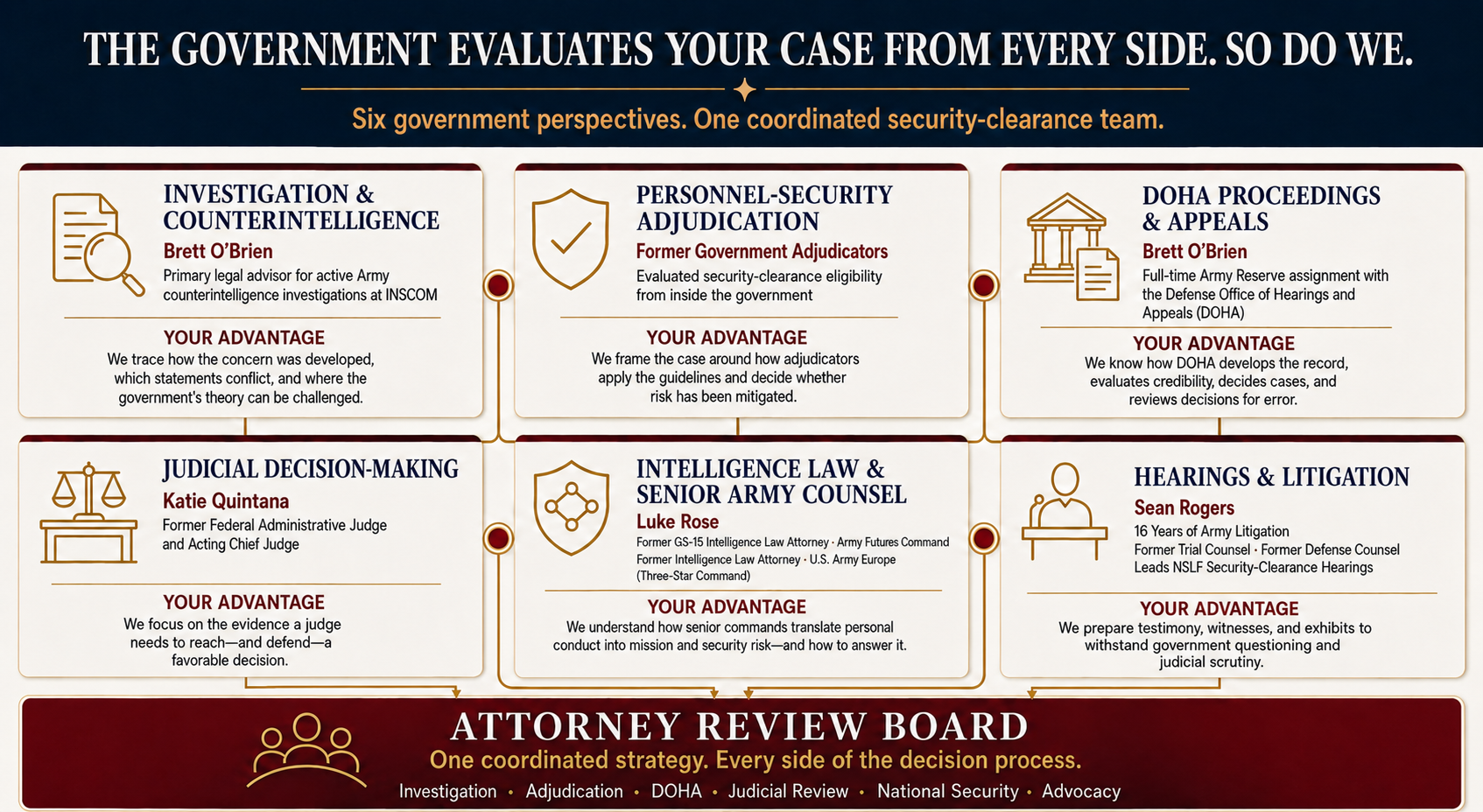
The government builds a security decision through separate functions: investigators gather facts, personnel-security professionals administer the process, adjudicators apply the guidelines, agency counsel evaluates risk and litigators test evidence and credibility when a case becomes contested.
National Security Law Firm evaluates a clearance problem through those same distinct perspectives.
Our security-clearance team includes:
- Katie Quintana, a former federal Administrative Judge and Acting Chief Judge who decided Department of Energy security-clearance cases;
- Brett O’Brien, a former U.S. Army INSCOM Intelligence Law Attorney with a full-time Army Reserve assignment at the Defense Office of Hearings and Appeals;
- Luke Rose, a former GS-15 Intelligence Law Attorney at Army Futures Command, former Intelligence Law Attorney for U.S. Army Europe and former Brigade Judge Advocate for the 66th Military Intelligence Brigade; and
- Sean Rogers, an attorney with 16 years of Army litigation experience, including service as trial counsel and defense counsel, who leads NSLF security-clearance hearings.
Through the firm’s Attorney Review Board, the team can test a case from the perspectives most likely to shape the result:
- What did the investigation actually establish?
- What eligibility or access decision is being made?
- How will an adjudicator apply the guidelines and whole-person analysis?
- Does the evidence prove mitigation rather than merely promise it?
- Can the explanation withstand credibility testing and remain consistent across the record?
The government uses a team to build and decide a security-clearance case. So do we.
What Our Lawyers Do in a TS/SCI Matter
The work depends on the stage and the decision at issue. It may include:
- Identifying the controlling agency, authority, procedure and deadline;
- Separating clearance eligibility from SCI, SAP, suitability, employment and access decisions;
- Reviewing the SF-86, prior questionnaires, interview history, notices and available records;
- Identifying inconsistencies before they become credibility findings;
- Developing corroborating documents and witness evidence;
- Applying the adjudicative guidelines and whole-person factors to the actual facts;
- Building a realistic mitigation plan;
- Preparing a written response, appeal or hearing presentation when authorized; and
- Coordinating strategy when the clearance issue overlaps with a military, employment or investigative matter.
No lawyer can guarantee eligibility, access or a particular adjudicative outcome. Effective representation means identifying the real decision, building a reliable record and presenting the strongest truthful case permitted by the governing process.
What Does Security-Clearance Representation Cost?
The cost depends on the stage, record, deadlines and work required. An SF-86 consultation is different from a full Statement of Reasons response or contested hearing.
For current information, review How Much Does a Security Clearance Lawyer Cost? and How Security Clearance Financing Works With Affirm Payment Plans.
Frequently Asked Questions About TS/SCI Clearances
What does TS/SCI stand for?
TS/SCI stands for Top Secret/Sensitive Compartmented Information. It commonly describes a person who has favorable Top Secret eligibility and has been authorized for SCI access required by the position.
Is TS/SCI a clearance level?
Not precisely. Top Secret is a clearance-eligibility and classification level. SCI is separately controlled intelligence access. “TS/SCI” is convenient shorthand for the combination.
Is TS/SCI higher than Top Secret?
SCI is not a fourth classification level above Top Secret. It adds specialized access controls. A TS/SCI position may have more restrictive requirements than a collateral Top Secret position, but that does not create a new standard classification level.
Does a Top Secret clearance include SCI?
No. Top Secret eligibility does not automatically authorize SCI access. The person also needs a qualifying position, need to know, access approval and any required indoctrination.
Can someone with TS/SCI access every compartment?
No. Access is limited to the SCI control system or compartment for which the person is authorized and has a need to know.
Do you need a polygraph for TS/SCI?
It depends on the agency, job and program. Some agencies require a counterintelligence-scope or broader polygraph; some TS/SCI positions do not.
What is the difference between a counterintelligence and full-scope polygraph?
A counterintelligence-scope examination generally focuses on national-security and counterintelligence subjects. A broader examination may include those subjects plus additional conduct questions. Terminology and scope vary, so the sponsoring agency’s instructions control.
Can I obtain TS/SCI without a job?
No. An authorized agency, military organization or cleared employer must sponsor the process for a position or assignment that requires the eligibility and access.
How long does TS/SCI processing take?
There is no universal timeline. Agency processes, workload, foreign activity, record complexity, interviews, polygraphs and other requirements can materially affect processing time.
Can a dual citizen obtain TS/SCI?
Dual citizenship is not automatically disqualifying. Foreign connections, obligations, benefits, travel and conduct are evaluated under the applicable guidelines and the whole-person concept.
Can I obtain TS/SCI if my spouse is a foreign national?
Potentially. A foreign-national spouse requires disclosure and careful assessment, but does not create an automatic denial. The government evaluates the relationship and surrounding foreign-influence risks.
Does past marijuana use automatically disqualify me?
Not necessarily. Federal illegality, recency, frequency, surrounding conduct, candor and evidence that future use is unlikely all may matter. Continuing use can present a serious concern.
Will debt prevent me from receiving TS/SCI?
Not every debt is disqualifying. The government examines why the debt arose, whether it is being handled responsibly and what the overall financial record shows.
Does counseling or mental-health treatment prevent TS/SCI access?
No. Treatment alone is not disqualifying and may demonstrate responsible judgment. The relevant analysis concerns current judgment, reliability, stability and the facts required by the SF-86 and adjudicative standards.
Can TS/SCI transfer to a new employer?
Existing Top Secret eligibility may be recognized through reciprocity, but the gaining organization must verify the position and need to know. SCI access may require a separate nomination, approval, polygraph or indoctrination.
Does TS/SCI expire after five years?
DCSA states that security clearances do not expire. Continuous vetting and periodic questionnaire updates support ongoing review. Access can end when the need to know or affiliation ends, and a break in service may affect later use of the eligibility.
Can I put TS/SCI on my résumé?
Often the general eligibility level may be identified for cleared job searches if agency and employer policy permit. Never disclose classified details, compartments, codewords, protected operations or sensitive assignments.
What should I do if I made a mistake on my SF-86?
Do not ignore it or improvise a misleading correction. Determine exactly what was asked, identify the complete facts, preserve relevant records and use the authorized reporting channel. Material omissions or inconsistent explanations may become separate concerns.
What should I do if my TS/SCI is denied or suspended?
Obtain and preserve the written notice, identify whether the action concerns eligibility or a particular access, note every deadline and determine which procedure applies to your status and agency. Do not assume every access decision carries the same appeal rights.
Official Government Resources
- Executive Order 13526—Classified National Security Information
- DCSA Investigations and Clearance Process
- DCSA Continuous Vetting
- DCSA Investigation Case Types and Forms
- Security Executive Agent Directive 4—National Security Adjudicative Guidelines
- Intelligence Community Security Clearance Process
- DIA Security Clearance Process
- NRO Security Clearance Process
- CDSE—Receive and Maintain Your National Security Eligibility
Get Advice About a TS/SCI Clearance Problem
If you are simply learning what TS/SCI means, the key distinction is straightforward: Top Secret is the eligibility level; SCI access is separately authorized according to the position, program and need to know.
If you are facing a disclosure, investigation, polygraph-related issue, access decision, Statement of Reasons, denial or revocation, the details of the record and procedure matter. National Security Law Firm represents clearance applicants and holders nationwide.
Or explore our complete security-clearance legal services.