
The short answer: ask the security office responsible for your case
There is no public website where you can enter your name or Social Security number and see your security-clearance status. In most cases, you must ask the security, human-resources or contractor official connected to the organization sponsoring your investigation or clearance.
Use this table to find the right starting point:
| Your situation | Who to contact | What to ask |
|---|---|---|
| Military member | Your security officer at your duty station; a recruiter may help with an investigation that began during accession | Whether the investigation is scheduled, open or closed; whether adjudication is pending; and what eligibility or access is recorded |
| Federal employee or applicant | The agency security officer or HR representative handling the position | Whether the case is still with the investigative service provider, is awaiting adjudication or has reached a determination |
| DoD contractor | Your company’s Facility Security Officer (FSO) | What the Defense Information System for Security (DISS) shows for investigation, eligibility, access, affiliation and continuous-vetting status |
| Other federal contractor | Your company security office and the security or HR office of the sponsoring agency | Which organization owns the case and which system contains the current status |
| Former employee, contractor or service member | The former sponsor for any current operational information; otherwise request your records from the agency that maintains them. | Whether any affiliation remains and how to obtain investigation or adjudication records |
| Person in an appeal | The agency, component, Personnel Security Appeals Board (PSAB) or Defense Office of Hearings and Appeals (DOHA) office identified in your notice | Whether the appeal was received, whether anything remains due and what procedural stage comes next |
DCSA’s current instructions follow the same structure: military members should contact their service security officer or recruiter, federal civilians should contact their agency security officer or HR representative, and DoD contractors should contact their FSO. DCSA generally discusses case information only with authorized contacts—not directly with the person under investigation. See DCSA’s official Check Your Status page.
Do not send your Social Security number, date of birth, completed SF-86 or other sensitive information through ordinary email unless your security office gives you an approved secure method.
★★★★★ 4.9 Stars From 300+ Google Reviews
Investigation · Personnel Security · Adjudication · DOHA · Hearings · Appeals
First determine which “status” you need
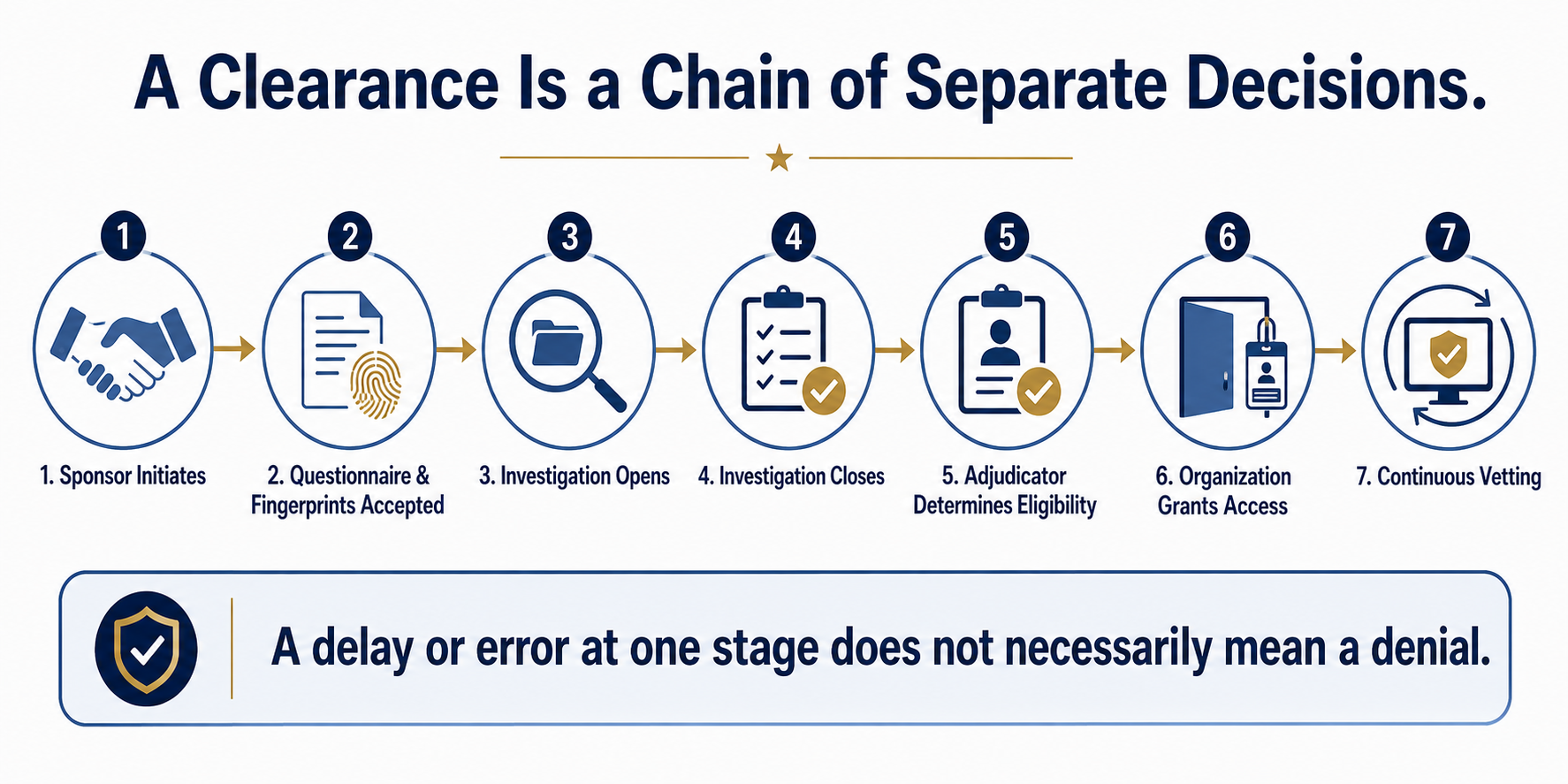
“What is the status of my clearance?” sounds like one question, but it can refer to several different decisions. A useful answer should identify the stage, the decision and the system entry—not merely say that the case is “pending.”
| Status you may be asking about | What it means | Who usually has the answer |
|---|---|---|
| Sponsorship or initiation | Whether an agency or cleared employer has initiated the personnel-vetting request | Agency security/HR office, recruiter or FSO |
| Questionnaire status | Whether your eApp or other personnel-vetting questionnaire was submitted, released or returned for correction. | The office that initiated it |
| Fingerprint status | Whether usable fingerprints were received and matched to the request | Sponsoring security office or FSO |
| Investigation status | Whether the investigation was accepted, scheduled, opened or closed | Authorized security/HR official; an FSO may view DoD contractor status in DISS |
| Adjudication status | Whether the completed investigation is awaiting or undergoing a trust or national-security decision | The responsible adjudicating authority through your security office |
| Eligibility | Whether the government has made a favorable, interim, unfavorable or other recorded determination | Security officer or FSO in the applicable system |
| Access | Whether your organization has actually granted access at a specific level | Your employer, command or agency security office |
| SCI or special-program access | Whether the relevant authority has approved and indoctrinated you for additional access | The agency or program security office |
| Continuous-vetting status | Whether an eligible person is enrolled, unenrolled or not enrolled in the applicable program | Authorized security personnel in DISS or another agency system |
| Appeal status | Whether an appeal, request for hearing or personal-appearance election was received and where it is pending | The forum or agency identified in your notice |
These statuses are related, but they are not interchangeable. An investigation can be closed while adjudication remains pending. A person can have eligibility but no present access. A person may retain an eligibility record after leaving a job but lose organizational affiliation and continuous-vetting enrollment. A favorable collateral Top Secret determination does not by itself establish current SCI access.
Can I check my security clearance online myself?
Usually, no.
The federal systems used to track personnel vetting are restricted government systems. They are designed for authorized security, human-resources and adjudication personnel—not as public self-service portals.
DISS
The Defense Information System for Security (DISS) is used within the Department of Defense and the cleared industrial community to record and manage information that can include investigations, eligibility, access, affiliations, incidents and continuous-vetting status. A DoD contractor ordinarily asks the company’s FSO to check the record. Employees do not receive personal DISS accounts merely to view their own clearance.
DCSA instructs FSOs to use DISS to check a pending investigation. See DCSA’s guidance for maintaining personnel clearances.
NBIS eApp
National Background Investigation Services (NBIS) eApp is used to complete and submit personnel-vetting questionnaires. Seeing a form in eApp—or losing access after submitting it—does not tell you whether the investigation is open, closed or adjudicated. Ask the office that initiated the questionnaire whether it was released and whether the investigation was accepted.
CVS and Scattered Castles
The Central Verification System (CVS), Scattered Castles and other agency systems are also restricted. DCSA identifies CVS, DISS and Scattered Castles as systems authorized security and HR professionals may use for status checks. If a determination is not visible in the expected system, the authorized official should contact the responsible adjudicating or clearance-granting entity. See DCSA’s status guidance for security and HR professionals.
Avoid third-party “clearance lookup” websites
No commercial website can legitimately retrieve your classified-access eligibility from DISS simply because you provide a name, date of birth or Social Security number. Do not enter sensitive identifying information into a website claiming it can perform a public clearance lookup.
How military members should check their status
Contact the security officer at your duty station. If the process began through recruiting and you have not yet reported to a duty station, ask your recruiter which security office owns the request.
Ask separately about:
- Whether the investigation request was accepted and scheduled;
- Whether the investigation is open or closed;
- Whether adjudication is pending or complete;
- The eligibility currently recorded;
- The access currently granted by the command; and
- Whether any request for information, incident, suspension or due-process notice is outstanding.
DCSA may conduct and adjudicate many DoD cases, but it generally will not discuss an individual military case directly with the member. Its official guidance says it can discuss status information only with authorized contacts from the member’s branch of service.
If you transferred commands, entered a new component or separated while the case was pending, determine whether the gaining organization has established the correct relationship to your record. A sponsorship or affiliation problem can look like an adjudicative delay even when the real problem is administrative.
How federal employees and applicants should check their status
Contact the security officer or HR representative at the agency that requested the investigation. If HR says only that the background check is “pending,” ask which stage is pending.
The agency may be tracking more than one decision:
- Whether the investigation has been completed;
- Whether the person is suitable or fit for the position;
- Whether the person is eligible to occupy a sensitive position;
- Whether the person is eligible for access to classified information;
- Whether an interim determination is available; and
- Whether onboarding or employment action may proceed.
A favorable investigation result is not itself a clearance. The investigation supplies facts; an authorized adjudicator applies the governing standards and makes the relevant determination. DCSA explains that the sponsoring agency may determine clearance and employment eligibility at the same time, but the consequences can differ depending on the position. See DCSA’s overview of the investigation and clearance process.
If you applied to more than one agency, do not assume that one agency can explain another agency’s case. Ask which agency currently owns the investigation and which agency is responsible for the determination you are awaiting.
How DoD contractors should check their status
Your Facility Security Officer is the primary contact. The FSO can review the appropriate DISS entries and, when necessary, send a customer-service request through the authorized channel.
Ask the FSO to distinguish among:
- Your current company affiliation or DISS relationship;
- Investigation status;
- Interim eligibility;
- Final eligibility;
- Access recorded by the company;
- Any incident or adjudicative action pending;
- Any request for information or new questionnaire;
- Continuous-vetting enrollment; and
- Whether reciprocity, transfer or ownership action is incomplete.
If you changed employers, confirm that the new cleared company has taken ownership or established the correct relationship in DISS. In May 2026, DCSA announced that when an individual loses the relevant Security Management Office relationship, a 45-day grace period begins; absent a new relationship, the person’s DCSA continuous-vetting status changes to “unenrolled.” DCSA also stated that this status change does not itself alter eligibility unless unresolved information requires action. See DCSA’s 2026 continuous-vetting update.
How former employees, contractors and service members can obtain information
If you are no longer affiliated with the federal government or a cleared contractor, there may be no active sponsor authorized to request operational status on your behalf. You can still request records, but a records request is not the same as a real-time status check.
DCSA maintains background-investigation records it conducted, including many records previously held by the National Background Investigations Bureau. Individuals may request their own records using the INV100 form or a compliant written request. See DCSA’s instructions for requesting your background-investigation records.
For DCSA adjudication and vetting records, DCSA provides a separate process using Form DCSA 335 or a written Privacy Act request. See DCSA’s adjudication-record request instructions.
Records can help establish what was submitted, investigated or decided. They may not show a current eligibility, access or continuous-vetting status after affiliation ended. A new agency or cleared employer usually must review the authoritative government systems and determine what action is necessary for the new position.
A message you can send to request a useful status update
Keep the first inquiry short and specific:
Hello [Security Officer/FSO/HR Representative],
I am requesting a status update on the personnel-vetting case associated with my [position, command or contract]. I submitted my questionnaire on [date], completed fingerprints on [date] and completed an interview on [date, if applicable]. Could you please confirm: (1) whether the investigation is scheduled, open or closed; (2) whether adjudication is pending or complete; (3) the current eligibility and access recorded; and (4) whether any information or action is required from me? Please let me know the approved secure method if you need sensitive identifying information.
Thank you.
Do not include your full Social Security number or attach your SF-86 to an ordinary email. Your security office can tell you how to identify the case securely.
What common investigation-status terms mean
Unacceptable or rejected
The investigative service provider found a problem with the request and did not accept it for scheduling. The sponsoring office may need to correct and resubmit the request. This is not an adjudicative denial.
Scheduled
The investigative service provider accepted the request and the investigation is open or underway. “Scheduled” does not mean every interview or record check has already occurred.
Closed
The investigative service provider completed the investigation and sent the results forward for adjudication or agency action. “Closed” does not necessarily mean that a clearance decision has been made.
DCSA uses these distinctions in its official FSO guidance.
Adjudication pending
An adjudicating authority has the completed investigation or other information and has not yet recorded a final determination. The case may be awaiting review, further information, issue resolution or another agency action.
Investigation complete—but no answer
Ask whether the case was transmitted successfully, which authority is adjudicating it and whether a request for information is outstanding. Do not assume that “complete” means “approved.”
What common DISS eligibility entries may mean
DISS terminology can be consequential, and a short label rarely tells the entire story. Ask your FSO or security officer for the exact entry, date, underlying message and any action requested.
Favorable eligibility
A favorable eligibility entry generally reflects an affirmative national-security eligibility determination at the recorded level. It does not prove that a current organization has granted access, that SCI access is active or that every agency will accept the record without additional processing.
Interim eligibility
An interim Secret or Top Secret eligibility permits access at the authorized level while the final investigation and adjudication continue, subject to the organization granting access. Interim eligibility can be withdrawn if later information changes the government’s risk assessment. The absence of interim eligibility is not automatically a final denial.
Eligibility Pending
This means eligibility has not yet been entered. It may appear while a case is being reviewed or processed. Ask whether the investigation is still open, adjudication has begun or further action is needed.
No Determination Made
This is not favorable eligibility. DCSA states that “No Determination Made” may be used when inadequate information prevents a favorable or unfavorable determination, including certain noncompliance, citizenship, access-need or suitability circumstances. A person with this entry should not be treated as cleared for access. The correct next step depends on why the entry was made. Review the message history and have the security office ask DCSA or the responsible authority what can cure it. See DCSA’s Trust Decision FAQs.
Eligibility Administratively Withdrawn
DCSA explains that this means there is no current eligibility and access should not be provided until a supporting eligibility is entered. It is often used when the person no longer has an affiliation with a cleared industrial facility and does not, by itself, reflect adverse information. The distinction matters: an administrative withdrawal is not necessarily a merits-based denial.
Loss of Jurisdiction
Loss of Jurisdiction also means there is no eligibility supporting access. It commonly appears when the person no longer has an affiliation or when required processing cannot continue. It is not automatically equivalent to a denial or revocation, but it can prevent access and complicate onboarding until a current sponsor obtains the required adjudicative action.
Action Pending
This deserves prompt clarification. It may indicate that an incident, request for information, adjudicative action or due-process matter requires attention. Ask for the exact DISS message and any written notice—not a verbal summary alone.
Denied or Revoked
Obtain the written decision and determine whether the deadline to respond, request a hearing, seek a personal appearance or appeal is still open. Different processes govern industrial contractors, military personnel, DoD civilians and other federal personnel. Start with our guide to security-clearance appeals.
Official DCSA explanations of several of these entries appear on its Interim Clearances page. Your specific notice and case history control.
Eligibility is not the same as access
This is one of the most important status distinctions.
Eligibility is the government’s determination that a person may be eligible for access to classified information at a stated level.
Access is the organization’s decision to permit the person to receive classified information after confirming eligibility, need to know and any required briefing or nondisclosure agreement.
You may therefore encounter situations such as:
- Favorable eligibility but no current access because you changed jobs;
- Active collateral access but no SCI indoctrination;
- Eligibility in one system while reciprocity or transfer remains incomplete;
- A completed investigation but no adjudicative determination;
- A suspension of access while the underlying eligibility is reviewed; or
- An eligibility record that remains visible even though there is no current sponsor.
Ask both questions: What eligibility is recorded? What access has this organization granted?
For related timing issues, see How Long Does a Security Clearance Last? and What Is a TS/SCI Clearance?.
What if your clearance has been pending for a long time?
Delay does not prove there is derogatory information. Cases can stall or take longer because of incomplete submissions, fingerprint problems, difficulty verifying residences or employment, investigative leads, agency-specific screening, adjudicative workload, reciprocity questions, sponsorship changes or unresolved requests for information.
Use this sequence:
- Confirm initiation. Was the questionnaire actually released by the sponsoring office?
- Confirm acceptance. Was the investigation accepted and scheduled, or rejected for correction?
- Identify the present stage. Is the investigation open, closed or in adjudication?
- Ask about required action. Is there a request, incident, questionnaire or document awaiting response?
- Verify sponsorship. Does the correct command, agency or company have an active relationship to the record?
- Ask who owns the next step. Is it the investigative provider, adjudicator, security office or another agency?
- Document the inquiry. Keep the date, name of the official and the answer given.
No official can guarantee a completion date merely because a case has exceeded an average. An authorized security official may be able to submit a status or research request, correct an ownership problem or confirm whether an agency-specific step remains outstanding.
When a “status problem” may need more than a status inquiry
Most status questions are administrative. Some reveal an underlying due-process or record problem. Seek the actual documents and consider legal advice if you learn that:
- Your access or eligibility has been suspended;
- DISS reflects Action Pending, Loss of Jurisdiction, No Determination Made, administrative withdrawal, denial or revocation;
- Your case stopped after you changed employers or commands;
- The government says you failed to respond to a request you never received;
- Your investigation is closed but adjudication appears stalled without explanation;
- An incident report or continuous-vetting alert is under review;
- You received a Letter of Intent, Statement of Reasons, interrogatories or another due-process notice;
- Different agencies or employers are reporting conflicting eligibility information;
- You believe the record contains inaccurate or incomplete facts;
- A suitability, fitness, credentialing or SCI decision is being described inaccurately as a clearance decision; or
- A response or appeal deadline may be running.
Do not wait for the system label to change if you already have a written notice. The notice—not a general status page—usually identifies the governing procedure, deadline and decision-maker.
Talk With a Security-Clearance Attorney
If you received a Letter of Intent or Statement of Reasons
A Letter of Intent (LOI) or Statement of Reasons (SOR) is not a routine status update. It is a formal notice that the government is considering an adverse eligibility decision and has identified security concerns requiring a response.
Preserve the entire notice, including attachments, delivery email and proof of receipt. Record the deadline exactly. Do not rely on an informal assurance that someone else will handle it.
Learn more about responding to a Statement of Reasons.
How to check the status of a security-clearance appeal
The correct contact depends on the process identified in your notice.
- Industrial contractor DOHA case: Use the filing and contact information in the Defense Office of Hearings and Appeals (DOHA) notice. DOHA is the Department office that conducts and decides most industrial-security clearance hearings. A further appeal may go to the DOHA Appeal Board.
- Military or DoD civilian PSAB appeal: Follow the component instructions. If you elected a personal appearance, DOHA may conduct the appearance and issue a recommendation, while the component Personnel Security Appeals Board makes the final administrative appeal decision.
- Other federal agency case: Contact the office or appellate authority listed in the agency notice.
Ask whether the filing was received, whether the record is complete, whether a briefing schedule or hearing date exists and whether anything is presently due. Do not send supplemental evidence without first confirming that the governing procedure allows it and how it must be submitted.
See our overview of security-clearance appeals and DOHA security-clearance cases.
What to do if the record is wrong
Start by identifying the source of the error. The correction route may differ depending on whether the problem appears in:
- Your submitted questionnaire;
- An investigator’s report;
- A credit, criminal, employment or other source record;
- An agency adjudication file;
- A DISS affiliation, access or eligibility entry; or
- A written decision or appeal record.
Do not assume that a Privacy Act amendment request will automatically change a security judgment. Correcting an objectively inaccurate record and challenging how an adjudicator weighed accurate facts are different tasks.
DCSA accepts amendment requests concerning background-investigation records and adjudication or vetting records. See DCSA’s amendment-request instructions. If an active deadline exists, do not allow a records request or amendment effort to replace a required response or appeal.
Built like the government process
The government does not treat clearance status as a single database answer. Security personnel manage sponsorship and access. Investigators develop the facts. Adjudicators evaluate eligibility. Commands, agencies and cleared employers act on the resulting determination. Specialized authorities may decide SCI access or appeals.
NSLF approaches a disputed status the same way: by identifying every responsible office, decision and record before recommending action.
Our team brings experience from the positions that shape these cases:
- A former federal Administrative Judge and Acting Chief Judge who decided Department of Energy security-clearance cases;
- Former government adjudicative experience;
- A former Army INSCOM Intelligence Law Attorney with counterintelligence-investigation experience and a full-time Army Reserve assignment at DOHA;
- A former GS-15 Intelligence Law Attorney who advised senior Army commands; and
- Hearing counsel with 16 years of Army litigation experience.
That perspective is most useful when the apparent “delay” is actually an unresolved adjudicative issue, a broken record, a lost affiliation, a conflicting determination or the beginning of formal due process.
The government uses different offices to investigate, adjudicate and control access. We trace the same chain to find where your case actually stands—and what can be done next.
Meet NSLF’s Attorney Review Board
Frequently asked questions
How do I know whether my security clearance is active?
Ask your security officer or FSO what eligibility is recorded and what access your current organization has granted. “Active” is informal shorthand and can hide important distinctions among eligibility, access, affiliation and continuous-vetting enrollment.
Can I look up my clearance with my Social Security number?
Not through a public website. Authorized government or contractor security personnel use restricted systems. Do not provide your Social Security number to a commercial clearance-lookup site.
Can I access DISS to view my own clearance?
Ordinarily, no. DISS access is role-based for authorized personnel. DoD contractor employees generally ask their FSO to review the record.
Does NBIS eApp show whether my clearance was approved?
No. eApp supports completion and submission of personnel-vetting questionnaires. It is not a personal clearance-status dashboard.
Who should a military member call?
The security officer at the member’s duty station. If the investigation began during recruiting and the member has not reported, the recruiter may identify the office responsible for the case.
Who should a federal applicant contact?
The security officer or HR representative at the agency sponsoring the position. Ask whether the investigation, adjudication or a separate suitability process is pending.
Who should a DoD contractor contact?
The company Facility Security Officer. The FSO can review DISS and use authorized DCSA support channels when necessary.
What does “investigation closed” mean?
It generally means the investigative service provider completed the investigation and sent it for adjudication or agency action. It does not necessarily mean the clearance was granted.
Is “No Determination Made” a denial?
Not necessarily, but it is not favorable eligibility. DCSA uses the entry when it cannot make a favorable or unfavorable determination in specified circumstances. The reason must be identified before the solution can be determined.
Is Loss of Jurisdiction the same as revocation?
No. It often reflects loss of affiliation or inability to continue processing rather than a final merits decision. But it means there is no current eligibility supporting access until the appropriate authority takes further action.
Does the absence of an interim clearance mean I will be denied?
No. Interim and final determinations are separate. A person may receive no interim eligibility and later receive favorable final eligibility.
Can I have eligibility but no access?
Yes. Access also requires a current need to know, organizational action and any required briefing or agreement.
How do I check SCI status?
Contact the agency or program security office responsible for the SCI nomination and indoctrination. A collateral Top Secret eligibility entry does not by itself confirm current SCI access.
What does “continuous vetting unenrolled” mean?
Under DCSA’s 2026 DISS update, “unenrolled” means the person was previously enrolled but is no longer enrolled. Loss of the relevant organizational relationship can trigger a 45-day grace period before the status changes. DCSA says eligibility is not affected solely by unenrollment unless unresolved information requires action.
Can I request my own background investigation?
Yes. DCSA provides a Privacy Act/FOIA process for requesting DCSA-held investigation records. A separate process applies to DCSA adjudication and vetting records.
Will a records request tell me my live status?
Not necessarily. Records show what was collected or decided as of particular dates. Current sponsorship, eligibility, access and continuous-vetting status may need to be confirmed through an authorized security office.
What if my FSO or agency will not explain the status?
Ask in writing for the precise stage, system entry, responsible authority and whether any action is required from you. If the response suggests suspension, adverse information, a missed request, conflicting records or an active deadline, consider legal advice.
Can an attorney make the government finish my clearance by a certain date?
No attorney can guarantee a government decision date. Counsel may be able to identify the responsible authority, clarify whether a due-process issue exists, organize a record request, address an inaccurate record or respond to a formal notice.
Should I wait for my records before answering an SOR or appeal notice?
Not if doing so would miss a deadline. Follow the notice and preserve your response or appeal rights. Records requests and amendment requests do not ordinarily pause a deadline unless the governing authority confirms that in writing.
Official resources
- DCSA: Check Your Status
- DCSA: Request the Status of an Investigation, Adjudication or Clearance
- DCSA: Investigations and Clearance Process
- DCSA: Requesting Background-Investigation Records
- DCSA: Requesting Adjudication and Vetting Records
- DCSA: Continuous Vetting
- DCSA: Trust Decision FAQs
Get help with a security-clearance status problem
You usually do not need an attorney merely to ask whether an investigation is open or closed. Legal help may become valuable when the status reveals a suspension, adverse adjudicative action, inaccurate record, Loss of Jurisdiction, missed request, conflicting determination or formal deadline.
National Security Law Firm represents military members, federal employees, applicants and cleared contractors nationwide in security-clearance matters.