
Get Ahead of a Difficult Issue Before It Becomes a Formal Clearance Case
A security-clearance investigator may be gathering information now that the government will later use to decide whether you can be trusted with access to classified information.
The investigator ordinarily does not make the final decision. But the investigator may:
- Compare your statements with your SF-86 and other records;
- Interview employers, coworkers, neighbors and references;
- Ask you to explain difficult or inconsistent information; and
- Document the facts that an adjudicator will later evaluate.
This is why early guidance matters.
National Security Law Firm helps clearance applicants and holders prepare for difficult interviews, address possible omissions, reconcile conflicting information and develop a clear, truthful and consistent record before the matter escalates.
Our team includes a former federal clearance judge, former government adjudicators, intelligence and counterintelligence counsel, and experienced hearing lawyers.
One attorney leads your case. When appropriate, that attorney can draw on the different government-side perspectives available through NSLF’s security-clearance team and Attorney Review Board.
Free · Confidential · No Obligation · Choose a Time Online · Speak Directly With an Attorney
★★★★★4.9 Stars From 300+ Google Reviews
Former Federal Clearance Judge · Former Government Adjudicators · Counterintelligence Experience · Nationwide Representation
★★★★★ “Prompt Responses and Personalized Advice”
“I received prompt responses and personalized advice that I would have never thought of.”
— K.I., Security Clearance Client · Google Review
This review describes one client’s experience. Prior results and reviews do not guarantee a similar outcome.
Do You Need a Lawyer During a Security Clearance Investigation?
Not everyone does.
You may not need a lawyer if your background is straightforward, your SF-86 is complete and accurate, and the investigator is conducting a routine interview.
You should consider speaking with a security-clearance lawyer if:
- The investigator is focusing heavily on one issue;
- You are preparing for a difficult subject interview;
- You are unsure how to explain a prior event;
- You realize that something may have been omitted or reported incorrectly;
- Your current account may conflict with a prior SF-86 or interview;
- The investigator says another source provided different information;
- You are receiving repeated follow-up questions;
- Candor, judgment or credibility may be questioned;
- The issue overlaps with an employment, military or criminal investigation; or
- You believe the matter may lead to an LOI, SOR or other adverse action.
The best time to address a problem is usually before the client has repeated an inaccurate date, adopted an unsupported explanation or created another inconsistency.
Ask an Attorney Whether You Need Help
What a Security Clearance Investigation Lawyer Does
An investigation-stage lawyer does not interfere with the government’s investigation or coach a client to conceal information.
The attorney helps the client understand the process, prepare for difficult questions and communicate truthfully and precisely.
Depending on the circumstances, NSLF may:
Review What You Previously Told the Government
We may compare your current SF-86 or eApp with available prior questionnaires, self-reports, interview information and relevant records.
The goal is to identify possible omissions, conflicting dates or explanations that may require clarification.
Identify What the Government May Be Concerned About
The investigator’s question may be about more than the underlying event.
The government may also be evaluating:
- Whether you disclosed the information when required;
- Whether your account is consistent;
- Whether you accept responsibility where appropriate;
- Whether the circumstances have changed;
- Whether the concern is likely to recur; and
- Whether your answers demonstrate present judgment and reliability.
Understanding the real concern helps the client provide an answer that is truthful, focused and responsive.
Prepare You for the Subject Interview
We can help you:
- Understand the interview process;
- Review potentially difficult disclosures;
- Organize complicated dates and events;
- Distinguish known facts from estimates;
- Identify records you should review;
- Prepare to explain legitimate inconsistencies;
- Avoid guessing or unnecessary speculation; and
- Communicate candidly without minimizing or exaggerating what happened.
This is not about memorizing a script. It is about being prepared to answer accurately and consistently.
Evaluate an Omission or Mistake
If you discover a possible error, do not ignore it—but do not rush into an improvised correction without understanding the consequences.
NSLF can help evaluate:
- What the original question required;
- Whether the prior answer was actually inaccurate;
- How and why the error occurred;
- Whether the difference is material;
- What records may clarify the facts; and
- How the issue should be addressed at the current stage.
Develop Supporting Evidence
When appropriate, we may help identify evidence showing:
- Prior disclosure;
- Candor and cooperation;
- Corrective action;
- Rehabilitation;
- Financial responsibility;
- Treatment or counseling;
- Changed circumstances;
- Employment performance;
- Military service; or
- Other favorable whole-person information.
A client’s explanation is often more persuasive when reliable documentation supports it.
Why National Security Law Firm
1. The Government Uses a Team to Evaluate Your Case. So Do We.
A clearance case may pass through several government professionals.
Investigators gather information. Personnel-security officials review the developing record. Adjudicators evaluate risk and mitigation. Agency counsel may advise the organization. If the case becomes contested, government lawyers, judges or appellate officials may examine the record again.
Each person may see the case differently.
NSLF was intentionally structured to evaluate clearance cases through those same perspectives.
One Lead Attorney. Multiple Perspectives. One Coordinated Strategy.
One attorney remains responsible for your case and communication. When the issues and engagement warrant it, that attorney can draw on NSLF’s broader security-clearance team and Attorney Review Board.
Why this matters: An explanation may sound reasonable from one perspective while raising a new concern from another. Collaborative review can identify a credibility problem, evidentiary gap or unintended inconsistency before it becomes part of the government record.
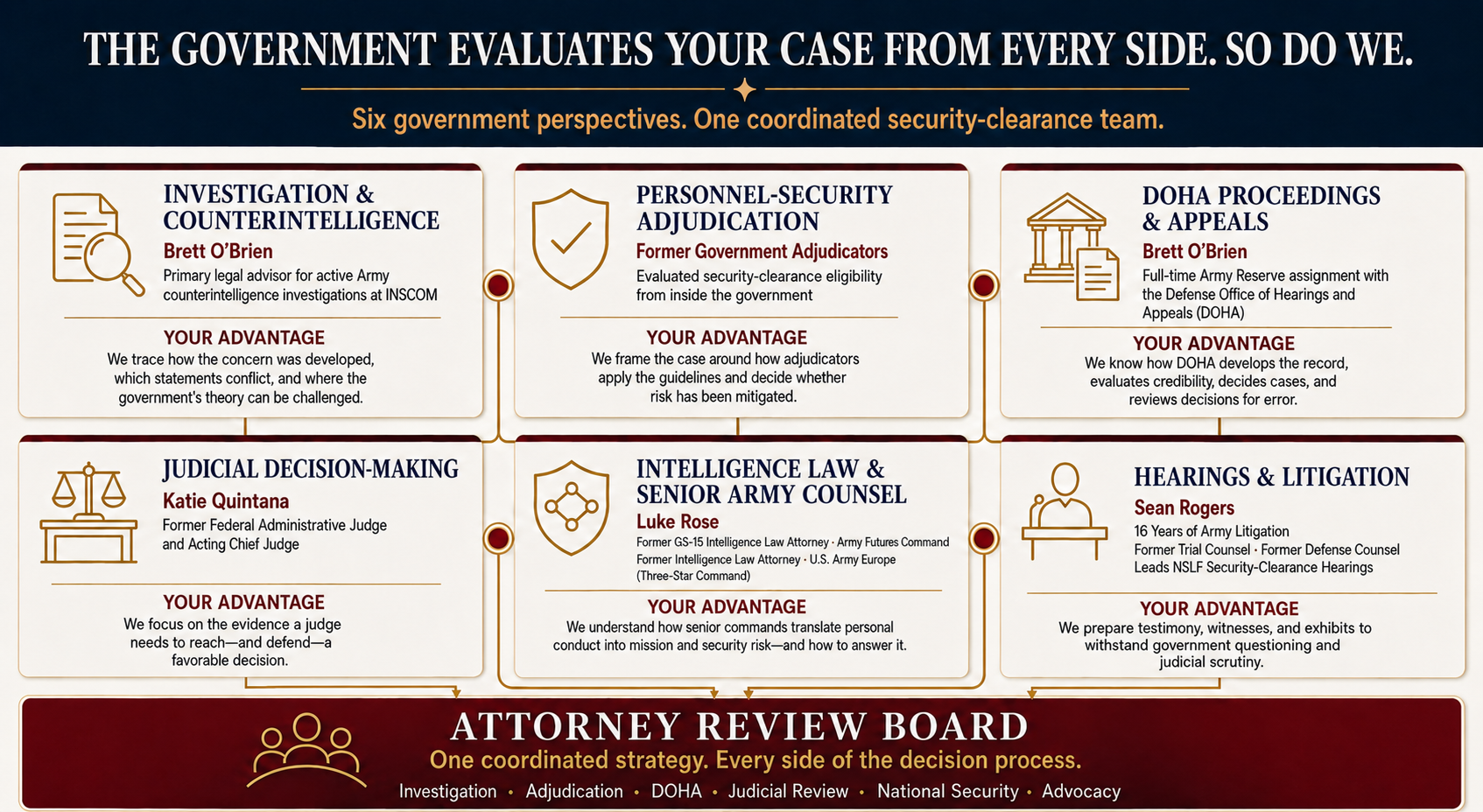
2. Our Attorneys Have Worked Inside the Systems Investigating and Deciding These Cases
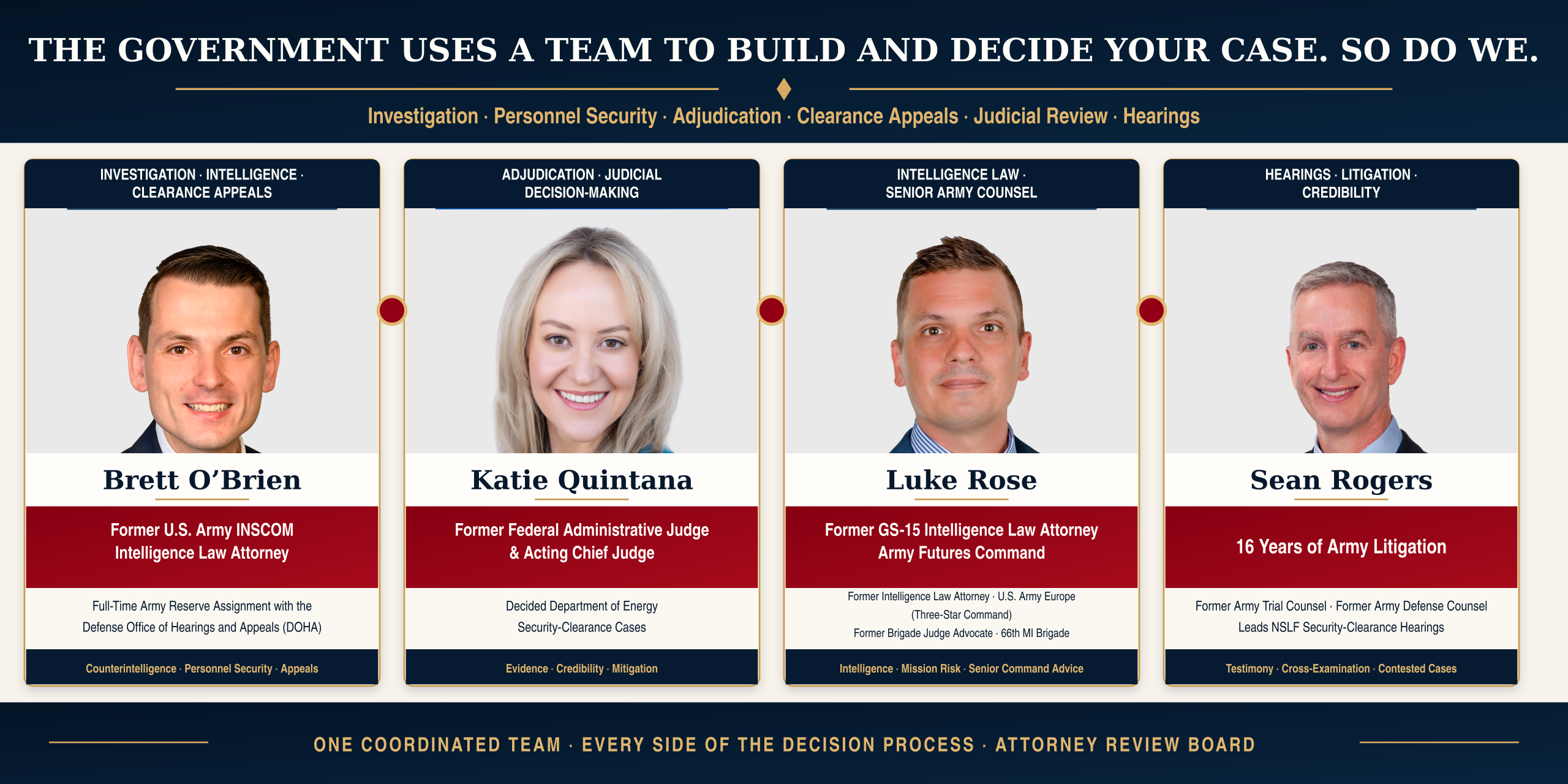
NSLF’s advantage is not simply that our lawyers have handled clearance cases. Members of our team have served in government positions directly relevant to how those cases are investigated, evaluated and decided.
Brett O’Brien: Investigation and Counterintelligence
Brett O’Brien served as an Intelligence Law Attorney for U.S. Army Intelligence and Security Command and as the primary legal adviser for active Army counterintelligence investigations.
He also completed a full-time Army Reserve assignment inside the Defense Office of Hearings and Appeals (DOHA), the Department of Defense office that conducts significant industrial-security clearance hearings and appellate review.
Why this matters during an investigation: Brett understands how investigators develop facts, compare sources and turn separate pieces of information into a potential security or credibility concern.
Katie Quintana: Former Federal Clearance Judge
Katie Quintana served as a federal Administrative Judge and Acting Chief Judge deciding Department of Energy security-clearance cases.
She evaluated government allegations, documentary evidence, client explanations, witness testimony, credibility and mitigation.
Why this matters during an investigation: Katie understands what the eventual decision-maker will need to see in the record—and why an explanation that feels sufficient to the applicant may leave an adjudicator’s real concern unanswered.
Luke Rose: Intelligence Law and Senior-Command Risk
Luke Rose served as a GS-15 Intelligence Law Attorney for Army Futures Command. He also served as an Intelligence Law Attorney for U.S. Army Europe and as Brigade Judge Advocate for the 66th Military Intelligence Brigade.
Why this matters during an investigation: Luke understands how intelligence organizations and senior commands may translate personal conduct, foreign connections or security incidents into questions about vulnerability, access, mission risk and reliability.
Sean Rogers: Litigation and Credibility
Sean Rogers brings 16 years of Army litigation experience as both trial counsel and defense counsel. He leads NSLF’s security-clearance hearing work.
Why this matters during an investigation: Statements made now may later be tested against documents, prior disclosures and sworn testimony. Sean’s litigation perspective helps identify explanations that may not withstand government questioning later.
These backgrounds do not create influence over government officials or guarantee an outcome. They give NSLF the ability to examine the case through the perspectives the client may encounter as the process moves forward.
★★★★★ “The Level of Support Never Dropped Off”
“The guidance was thoughtful, the attention to detail was excellent, and the level of support never dropped off.”
— C.F., Security Clearance Client · Google Review
This review describes one client’s experience. Prior results and reviews do not guarantee a similar outcome.
3. We Protect the Record You Are Creating Now
The official SF-86 warns that the questionnaire may be used in future investigations and eligibility determinations.
Your current answers may later be compared with:
- Prior SF-86 or eApp submissions;
- Records reviewed during the investigation;
- What employers, coworkers or references report;
- Your subject interview;
- A future Letter of Interrogatory response;
- A future Statement of Reasons response;
- Hearing testimony; and
- Information identified through continuous vetting.
That does not mean one innocent mistake will automatically cause a denial. It means consistency matters.
NSLF looks beyond whether an answer appears acceptable today. We also consider how it may be read by someone reviewing the record months or years later.
4. We Recognize When the Clearance Issue Affects Something Else
A security-clearance investigation may overlap with:
- Federal employment;
- Suitability or fitness;
- Military discipline;
- A command investigation;
- Criminal exposure;
- Immigration;
- Professional or transportation credentials; or
- Another government process.
A statement intended to resolve the clearance concern may create an admission or inconsistency elsewhere.
Because NSLF handles related federal and military matters, our clearance attorneys can recognize when another issue may need to be coordinated or separately addressed.
Why this matters: A lawyer who sees only the clearance investigation may miss how the same statement or record could affect the client in another proceeding.
Separate representation may be required, but the risk is less likely to go unnoticed.
An Additional Advantage if the Matter Escalates
If the investigation results in a qualifying Letter of Interrogatory, Statement of Reasons, hearing or appeal, NSLF does more than respond to the documents placed in front of us.
We also investigate the government records behind the concern.
Our attorney-led Government Records Investigation may uncover:
- Government records supporting the client’s explanation;
- Proof that the client previously disclosed or cooperated;
- Inaccurate dates or incomplete summaries;
- Different government accounts of the same incident; or
- Information that helps prepare for a hearing, appeal or future adjudication.
The service costs $1,995 when purchased separately. The covered initial requests are included at no additional attorney fee in qualifying LOI, SOR, hearing and appeal matters.
Records may not arrive before the current deadline. NSLF proceeds with the immediate defense while pursuing information that may help at the current or next available stage.
What Happens During a Security Clearance Investigation?
The government uses the background investigation to verify information and develop the record needed for an eligibility decision.
The Defense Counterintelligence and Security Agency explains that investigators may conduct searches involving:
- Law-enforcement agencies;
- Courts;
- Employers;
- Educational institutions;
- Creditors; and
- Other record repositories.
Investigators may contact friends, coworkers, landlords, family members, neighbors and other sources. More than one investigator may work on different portions of the case.
An investigator may also interview you to verify, expand upon or clarify information reported on your questionnaire.
The investigator submits the results through a report of investigation. The responsible government agency then uses the completed record to make the applicable suitability, fitness or security determination.
How to Handle a Security Clearance Subject Interview
Tell the Truth
Do not conceal or minimize required information because you are worried about how it will look. A difficult event may be explainable or mitigable. A false statement may create a separate concern.
Answer the Question Asked
Listen carefully. If you do not understand a question, ask the investigator to clarify it.
Do Not Guess
If you cannot remember an exact date or detail, say so. Distinguish confirmed facts from estimates and uncertainty.
Provide Relevant Context
Explain the circumstances necessary to make the answer accurate and understandable. Avoid burying the answer in unrelated information.
Do Not Speculate
Describe what you know. Do not guess what another person may have said or what an unfamiliar record may contain.
Address Known Mistakes
If you discover an omission or inaccurate answer, obtain guidance promptly. Ignoring it usually does not make the issue disappear.
Read the Security Clearance Subject Interview Guide
What Can Happen After the Investigation?
After the investigation is completed, the government may:
- Determine that the record supports eligibility;
- Request additional information;
- Conduct further investigative work;
- Issue a Letter of Interrogatory;
- Issue a Statement of Reasons;
- Provide an opportunity for a personal appearance or hearing;
- Issue an unfavorable determination with appeal rights; or
- Take separate employment, suitability, access or military action.
The available process depends on the agency, the person’s status and the governing rules.
Investigation-Stage Services and Pricing
SF-86 Review and Strategy — $950 Flat Fee
NSLF’s SF-86 Review and Strategy service includes:
- Attorney review of every disclosure;
- Unlimited attorney Q&A during the covered engagement;
- Guidance for necessary written explanations;
- Review for omissions and inconsistencies;
- Multiple reviews; and
- Subject-interview preparation.
Whether this service remains appropriate after the SF-86 has been submitted depends on the timing and work required.
Other Investigation-Stage Matters — Individually Scoped
A separate engagement may be necessary if the SF-86 has already been submitted and the client needs help with:
- A newly discovered material omission;
- Complicated investigative follow-up;
- An inconsistency with another record;
- A self-reporting issue;
- An active employment, military or criminal investigation; or
- Substantial written work outside the standard SF-86 service.
Letter of Interrogatory Response — $3,500 Flat Fee
If the government issues an LOI, NSLF offers an attorney-led process for analyzing the concern, reconstructing the record, developing evidence and preparing the covered response.
Learn About LOI Representation
Statement of Reasons Response — $5,000 Flat Fee
If the government issues an SOR, NSLF develops an allegation-by-allegation response supported by rebuttal, mitigation and whole-person evidence.
Learn About SOR Representation
Review All Security Clearance Services and Fees
★★★★★ “A Plan Forward Based on My Unique Circumstances”
“They created a plan forward based on my unique circumstances and helped me through the entire process.”
— R.R., Security Clearance Client · Google Review
This review describes one client’s experience. Prior results and reviews do not guarantee a similar outcome.
Frequently Asked Questions
Does the investigator decide whether I receive a clearance?
Ordinarily, no. The investigator collects, verifies and reports information. The responsible government agency evaluates the completed record and makes the eligibility determination.
Do I need a lawyer for a routine subject interview?
Not necessarily. Many applicants with straightforward backgrounds and accurate questionnaires complete routine interviews without legal assistance.
Legal guidance becomes more valuable when the interview involves a difficult disclosure, possible omission, conflicting account or related legal proceeding.
What if I do not remember an exact date?
Do not invent one. Explain honestly what you remember and identify any estimate or uncertainty.
What if I discover an omission on my SF-86?
Obtain guidance promptly. The appropriate response depends on the question, what you knew when you submitted the form, why the information was omitted and the current stage of the investigation.
Will correcting an error make me look dishonest?
Not necessarily. The government may consider how the error occurred, when it was discovered, whether the correction was voluntary and whether the explanation is credible.
No attorney can guarantee how a correction will be evaluated.
Can the investigator ask about information that was not on my SF-86?
Yes. The investigation may identify information through records or other sources. The investigator may ask you to verify, explain or clarify it.
Can a lawyer attend my subject interview?
That may depend on the agency, investigative provider and governing procedure. Even when counsel will not attend, an attorney may be able to help the client prepare beforehand.
Can a lawyer guarantee that my investigation will end favorably?
No. The government controls the investigation and eligibility decision. An attorney can provide guidance and representation but cannot guarantee what information will be developed or how the government will decide the matter.
Does NSLF represent clients nationwide?
Yes. NSLF evaluates security-clearance matters throughout the United States and, where permitted, for clients located overseas.
Continue Your Research
Visit the Security Clearance Resource Center for organized guidance about:
- The clearance process;
- SF-86 preparation;
- Background investigations;
- Subject interviews;
- Letters of Interrogatory;
- Statements of Reasons;
- Adjudicative guidelines;
- Hearings;
- Appeals; and
- Government records.
You may also find these pages helpful:
- Security Clearance Process
- SF-86 Review and Strategy
- Security Clearance Subject Interviews
- Security Clearance Record Control Strategy
- Security Clearance Lawyers
Get Ahead of the Issue Before It Becomes a Formal Case
You may not need a lawyer simply because the government is conducting a background investigation.
But if you are facing a difficult interview, possible omission, conflicting information or a concern that could affect your clearance and career, early legal guidance may help you avoid preventable mistakes.
With NSLF, you receive more than one lawyer’s isolated perspective.
You receive:
- One lead security-clearance attorney;
- A former federal clearance judge;
- Former government adjudicative experience;
- Intelligence and counterintelligence experience;
- Hearing and litigation experience;
- Attorney Review Board support in qualifying matters; and
- A coordinated strategy built for the federal clearance system.
Free · Confidential · No Obligation · Speak Directly With an Attorney
Attorney Drafter: Katherine O’Brien
Last Reviewed: September 8, 2026
This website is an attorney advertisement. The information on this page is general information and is not legal advice. Contacting NSLF does not create an attorney-client relationship. Do not transmit classified information. Representation begins only after NSLF accepts the matter and all engagement requirements are completed. Results depend on the facts and circumstances of each matter.