
Restoring your gun rights is rarely as simple as filing one application in one place.
A person may be prohibited under federal law, state law, or both. A state court may restore certain rights without resolving a separate federal prohibition. A pardon or expungement may affect the conviction but leave unanswered questions about firearm possession. Even after legally effective relief is granted, an incomplete court record or outdated database entry may continue to cause a NICS denial.
The result is a dangerous gap between believing your rights have been restored and knowing whether you may legally possess a firearm.
Before pursuing any remedy, you need to answer three questions:
- What event created the firearm prohibition?
- Which jurisdiction’s law controls the effect of that event?
- Will the proposed relief eliminate every applicable federal and state restriction?
National Security Law Firm helps clients nationwide analyze these overlapping laws and determine whether the appropriate path is federal firearm rights restoration under 18 U.S.C. § 925(c), a pardon, state relief, expungement, record correction, a NICS challenge, or a coordinated combination of remedies.
Schedule a federal firearms consultation or call (202) 600-4996 to have your situation evaluated.
The Critical Difference Between Federal and State Gun Laws
Federal and state firearm laws operate as separate legal systems.
Federal law contains several categories of people who may not lawfully possess or receive firearms. Those prohibitions appear primarily in 18 U.S.C. § 922(g) and may involve:
- Felony convictions
- Certain domestic-violence convictions
- Qualifying protection orders
- Unlawful use of or addiction to controlled substances
- Certain mental-health adjudications or commitments
- Particular military discharges
- Immigration status
- Fugitive status
- Renunciation of United States citizenship
- Other federally defined circumstances
States impose their own firearm restrictions, which vary considerably. State law may regulate firearm possession based on convictions, protection orders, mental-health records, probation or parole status, age, licensing requirements, waiting periods, weapon classifications, or other conditions.
You must comply with both systems. Relief under one does not automatically authorize possession under the other.
Why the Jurisdiction of the Conviction Matters
For a conviction-based prohibition, one of the first questions is whether the conviction was entered in federal court or state court.
Under 18 U.S.C. § 921(a)(20), the effect of a conviction is generally determined according to the law of the jurisdiction where the proceeding occurred. The statute also addresses convictions that have been expunged, set aside, pardoned, or followed by a restoration of civil rights.
That language is important—but applying it is not always straightforward.
A state conviction ordinarily requires an analysis of the law of the convicting state. A federal conviction generally cannot be neutralized by a state pardon, state expungement, or state restoration order. As the Department of Justice has explained, only federal relief can eliminate the federal effect of a federal conviction.
The analysis should therefore begin with the actual judgment, the offense of conviction, the maximum potential punishment, the convicting jurisdiction, and the precise relief previously granted.
When State Relief May Affect a Federal Firearm Prohibition
State relief can sometimes prevent a state conviction from continuing to qualify as a federal firearm disqualifier—but only if the relief satisfies federal law.
Depending on the state and the individual record, potentially relevant relief may include:
- A gubernatorial pardon
- Expungement
- Setting aside or vacating the conviction
- Restoration of civil rights
- A state firearm-rights restoration order
- Reduction or reclassification of the offense
- Post-conviction relief establishing that the conviction is no longer valid
The name of the remedy is not enough. The documents and governing law must be examined to determine what the relief actually accomplished.
For example, a certificate labeled “restoration of rights” may restore voting or jury-service rights while continuing to restrict firearm possession. An expungement may limit public access to a record without eliminating its federal legal effect. A pardon may forgive the offense while leaving particular state firearm restrictions intact.
The decisive question is not simply, “Did the state grant relief?” It is, “What legal effect does that relief have under both state and federal firearm law?”
Why Partial State Restoration Can Still Leave a Federal Prohibition
Federal law contains what is commonly called the “unless clause.”
Section 921(a)(20) generally excludes certain pardoned, expunged, set-aside, or civil-rights-restored convictions from the federal definition—but not when the relief expressly provides that the person may not ship, transport, possess, or receive firearms.
Partial restoration can therefore create serious problems.
If state law restores some civil rights but continues to restrict firearm possession, the original conviction may remain relevant under federal law. Even a state rule that permits certain firearms while restricting others can require careful federal analysis.
Never assume that receiving a restoration certificate, completing a sentence, regaining voting rights, or becoming eligible for a state firearm permit necessarily resolves the federal prohibition.
Why Federal Relief May Not Resolve State Restrictions
The same problem also operates in the opposite direction.
A person may obtain federal relief and still remain prohibited under state law. This can occur after:
- Relief under § 925(c)
- A presidential pardon
- Correction of a federal record
- Removal of an erroneous federal NICS entry
- A successful challenge to a federal firearm disability
Federal relief does not ordinarily override an independent state prohibition. The person must separately determine whether the law of the state where they live, possess a firearm, or intend to acquire one imposes additional restrictions.
For some clients, the correct strategy is a dual-track process: pursue federal relief while separately addressing state eligibility.
Does an Expungement Restore Gun Rights?
Sometimes—but not automatically.
“Expungement” does not have one universal meaning. In one jurisdiction, it may eliminate a conviction for particular legal purposes. In another, it may merely seal the public record. Some expungements preserve access for law-enforcement agencies or expressly leave firearm restrictions unchanged.
The analysis may depend on:
- The jurisdiction that entered the conviction
- The statute authorizing expungement
- The language of the expungement order
- Whether the conviction was vacated, dismissed, sealed, or merely hidden from public view
- Whether civil rights were restored
- Whether state firearm restrictions remain
- Whether federal law recognizes the legal effect of the relief
- Whether the relevant records were properly updated
Our guide addressing whether an expungement restores gun rights explains why clearing a record and restoring firearm eligibility are related—but legally distinct—objectives.
Does a Pardon Restore Gun Rights?
A pardon can be extremely important, but its effect depends on who issued it, which conviction it covers, and what restrictions remain.
A presidential pardon applies to federal offenses. A governor generally cannot pardon a federal conviction. Similarly, the President does not ordinarily pardon state convictions.
Even when the proper authority grants a pardon, the analysis must continue. The pardon documents, state law, federal law, and any remaining firearm restrictions must be reviewed together.
For some individuals, a pardon may provide a path to relief. For others, § 925(c) firearm rights restoration may be more appropriate. Certain cases may justify evaluating both remedies.
Learn more about when a pardon may restore firearm rights and how NSLF handles presidential pardon applications for federal convictions.
When § 925(c) May Be the Appropriate Federal Remedy
Section 925(c) provides a federal process through which an eligible person may seek relief from certain federal firearm disabilities.
The applicant must establish that the circumstances surrounding the disability, together with the applicant’s record and reputation, demonstrate that the applicant is not likely to act dangerously and that granting relief would not be contrary to the public interest.
A complete application may require:
- Eligibility and waiting-period analysis
- Certified criminal and court records
- Evidence of sentence completion
- A complete personal and criminal history
- Evidence of rehabilitation and present stability
- Sworn character references
- Explanation of unfavorable or inconsistent information
- Documentation addressing missing historical records
- Analysis of federal and state firearm restrictions
- Responses to requests for additional information
NSLF’s federal firearm rights restoration lawyers represent clients through eligibility review, record development, application preparation, filing, and post-filing proceedings.
When a NICS Challenge or Record Correction Is the Better Answer
Not every firearm denial means that you need restoration.
If you are not legally prohibited—but NICS relied on inaccurate, incomplete, outdated, or mismatched information—the correct remedy may be a NICS denial challenge or FBI firearm-record correction.
The FBI explains that its challenge process can identify the prohibiting category and the agency that possesses the underlying information. Supporting documentation may then be submitted to contest an incorrect denial.
Common record problems include:
- Missing case dispositions
- Dismissed charges still appearing as unresolved
- Expungement or pardon information not reaching the relevant database
- State restoration orders not reflected in federal records
- Incorrect offense classifications
- Duplicate or conflicting criminal-history entries
- Mistaken identity
- Records belonging to another person with similar identifying information
Restoration asks the government to relieve a valid legal prohibition. A NICS challenge or record correction argues that the prohibition does not apply, no longer applies, or was attributed to the wrong person. Choosing the wrong process can waste time without resolving the underlying problem.
When VAF and a UPIN May Help
People who repeatedly experience delays or mistaken-identity problems may benefit from the FBI’s Voluntary Appeal File.
If approved, the FBI assigns a Unique Personal Identification Number, commonly called a UPIN. The UPIN helps NICS locate information maintained in the applicant’s file during future background checks.
A UPIN does not remove a valid firearm prohibition. It is designed to reduce problems caused by incomplete records, identity confusion, or information that must repeatedly be verified.
Our VAF and UPIN lawyers can help determine whether the Voluntary Appeal File is appropriate or whether the underlying problem requires a denial challenge, record correction, or legal relief.
Which Gun Rights Remedy May Apply to Your Situation?
The following guide provides a starting point:
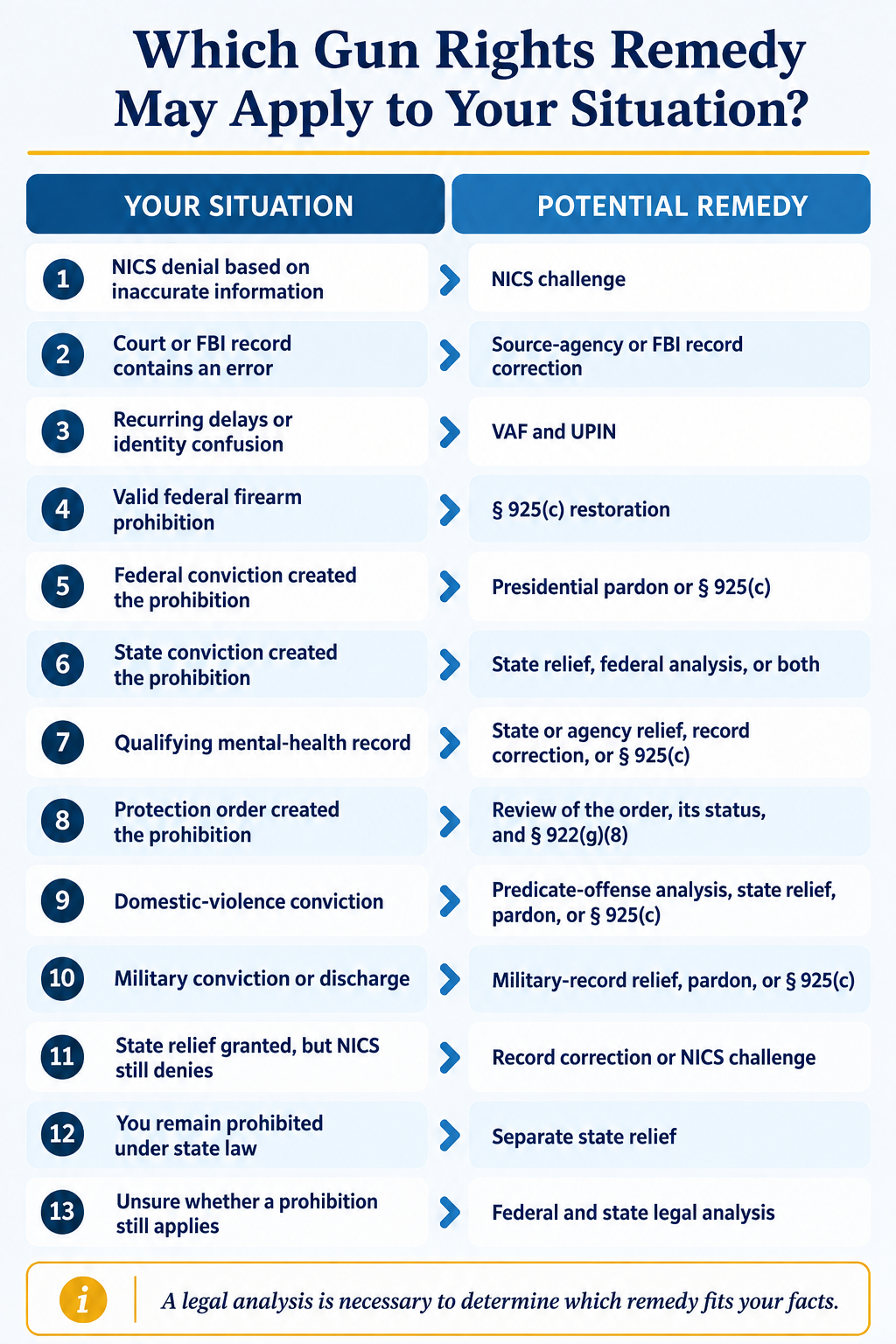
This chart is a starting point. The correct remedy depends on the governing statutes, underlying records, procedural history, and precise terms of any prior relief.
Common Mistakes That Can Leave You Prohibited
Gun-rights restoration cases often become more complicated because someone relied on the title of a document or a general statement instead of obtaining a complete legal analysis.
Common mistakes include:
- Assuming completion of probation automatically restores firearm rights
- Treating sealing and expungement as interchangeable
- Believing a state restoration order automatically controls federal law
- Assuming a presidential pardon resolves state restrictions
- Relying on a state firearm permit as proof of federal eligibility
- Filing a § 925(c) application when the actual problem is an inaccurate record
- Filing a NICS challenge when the denial is based on a valid prohibition
- Possessing a firearm before confirming that every restriction has been removed
- Failing to update the court, state repository, FBI, or NICS records after receiving relief
A wrong assumption in this area can expose a person to another denial, seizure of a firearm, loss of a license or permit, or criminal investigation.
Documents Needed to Determine Which Law Controls
A meaningful federal and state restoration analysis ordinarily begins with primary records—not recollection alone.
Depending on the case, NSLF may review:
- Charging documents
- Judgment and sentencing records
- Docket sheets
- Plea agreements
- Proof of sentence completion
- Probation or parole records
- Expungement or sealing orders
- Pardons
- Civil-rights restoration certificates
- State firearm-rights orders
- Military court-martial and discharge records
- Mental-health adjudication or commitment records
- Protection orders
- FBI Identity History Summaries
- State criminal-history reports
- NICS denial notices and transaction numbers
- Correspondence from courts or record-holding agencies
Historical files may be incomplete, archived, destroyed, or inconsistent across repositories. When records are missing, the documented search for those records and the identification of reliable alternative evidence can become part of the legal strategy.
Why Choose National Security Law Firm?
Federal and state restoration requires more than identifying a favorable statute. It requires understanding how federal decision-makers evaluate convictions, relief orders, rehabilitation, public safety, record discrepancies, and overlapping legal systems.
NSLF’s federal firearms practice is led by former United States Attorney Duane “DAK” Kees. His background in federal law enforcement and government decision-making informs the firm’s approach to complex restoration and pardon matters.
National Security Law Firm began preparing and submitting federal firearm rights restoration matters more than a year before DOJ finalized its rule and opened the public application portal. That early work gave our attorneys practical experience evaluating eligibility, reconstructing historical records, developing rehabilitation evidence, preparing character references, and adapting pending matters to an evolving federal process. It also allowed NSLF to establish professional relationships and direct communication with the Office of the Pardon Attorney, which administers the federal restoration program.
Our integrated practice allows us to evaluate more than one potential remedy. Depending on the circumstances, our attorneys can analyze:
- Federal firearm rights restoration
- Presidential pardons
- NICS denials and appeals
- FBI and source-agency record correction
- VAF and UPIN applications
- Military convictions and discharge records
- Mental-health firearm prohibitions
- Domestic-violence restrictions
- State and federal post-conviction relief
- Explosives disabilities
- Other federal firearms matters
This broader perspective matters because the best solution may not be the remedy a client initially expected.
Learn more about what distinguishes NSLF’s federal firearm rights restoration practice.
Frequently Asked Questions About Federal and State Gun Rights Restoration
If my state restored my gun rights, can I legally possess a firearm?
Not necessarily. The state relief and governing state law must be reviewed to determine whether the original conviction still qualifies as a federal firearm disqualifier. Any separate federal prohibition must also be considered.
Does completing my sentence restore my gun rights?
Usually, sentence completion alone does not answer the question. Its effect depends on the jurisdiction, the offense, the rights restored, and any continuing state or federal firearm restrictions.
Can a governor restore rights lost because of a federal conviction?
A governor generally cannot pardon or eliminate the federal effect of a federal conviction. Federal convictions ordinarily require a federal remedy.
Will a presidential pardon eliminate state firearm restrictions?
Not automatically. A presidential pardon applies to a federal offense, but independent state firearm restrictions may require separate analysis or relief.
Does expungement automatically remove a federal firearm prohibition?
No. The federal effect of an expungement depends on the law of the convicting jurisdiction, the nature of the order, and whether firearm restrictions remain.
Why am I still being denied after my rights were restored?
The legal relief may not have removed every applicable prohibition, or the relevant court, state, FBI, or NICS records may not have been properly updated. The first step is determining whether the problem is legal or record-based.
Can I use § 925(c) to remove a state firearm prohibition?
Section 925(c) addresses federal firearm disabilities. It does not ordinarily eliminate an independent state-law prohibition.
Should I file for restoration before correcting inaccurate records?
Usually, the record problem should be identified first. An application should accurately describe the relevant events, and an incorrect record may affect eligibility analysis or the government’s evaluation of the case.
Can NSLF represent me if I live outside Washington, D.C.?
Yes. NSLF represents clients nationwide in federal firearm rights restoration, presidential pardon, NICS, record-correction, military, and other federal matters. Any separate state-law work depends on the jurisdiction and scope of representation.
Find Out Which Restoration Process You Actually Need
Do not rely on the title of an expungement order, a general statement that your “rights were restored,” or the assumption that relief in one jurisdiction resolved every firearm restriction.
NSLF can evaluate the event that created the prohibition, obtain and analyze the relevant records, determine how federal and state law interact, and identify the legal remedy most likely to address the actual problem.
Schedule your confidential consultation with National Security Law Firm or call (202) 600-4996.
This page provides general information and does not constitute legal advice. Firearm laws and restoration procedures vary by jurisdiction and individual circumstances. Do not possess, receive, transport, or attempt to purchase a firearm unless qualified counsel has confirmed that you may lawfully do so.