
Curious if you’re eligible for Global Entry?
Don’t guess—find out instantly!
Wondering if you can fight your Global Entry denial or revocation? Take our quick assessment to see!
Global Entry Appeal Lawyers for Denials and Revocations
Denied or Revoked from Global Entry? We Prepare Attorney-Led Trusted Traveler Appeal Packages.
Global Entry is not just a travel convenience program. It is a federal trusted traveler program for people CBP considers pre-approved, “low-risk” travelers. To participate, an applicant must apply in advance, undergo CBP vetting, and be accepted into the program.
If your Global Entry, NEXUS, SENTRI, FAST, or other Trusted Traveler Program membership was denied, revoked, suspended, or not renewed, you may have the right to request reconsideration. But the process is discretionary, and CBP may deny or remove a traveler if it concludes the person cannot satisfy CBP that they are low risk.
At National Security Law Firm, we help clients prepare serious, evidence-based appeal and reconsideration packages for Trusted Traveler Program denials and revocations.
Our work may include records strategy, FOIA/Privacy Act analysis, review of criminal, customs, immigration, or security-related issues, mitigation evidence, reference letters, legal argument, and organized exhibits.
When your Global Entry is denied or revoked, the quality of your reconsideration package matters. NSLF has been preparing attorney-led Global Entry appeal packages since 2017 — over 1,000 cases across every denial category.
NSLF was founded by Brett O’Brien, an intelligence law attorney who served in the U.S. Army’s counterintelligence agency, where he was responsible for conducting Security Threat Assessments (STAs)— the same type of assessment CBP uses to evaluate Global Entry applicants.
Every case we take comes with a full money-back guarantee. If we do not win your appeal, your legal fee is refunded in full.
Book a free attorney consultation — in most cases same-day availability is offered, and your attorney will call you at the time you schedule.
· · · ·
Global Entry Appeals Table of Contents
A Denial Is Not Final
According to , between 3 and 5 percent of the approximately 30,000 monthly Global Entry applicants are denied. Denials and revocations stem from a wide range of issues — criminal history, customs violations, association flags, travel to designated countries, or no stated reason at all.
CBP decisions are appealable. A well-constructed appeal succeeds across a wide range of denial types, including cases involving criminal records, customs violations, and situations where CBP provided no explanation at all. The data bears this out — approximately 39% of reconsideration requests result in approval or reinstatement.
What determines the outcome is the strength of the appeal itself. A personal letter to the CBP Ombudsman is one option — and in the most straightforward cases, some people succeed that way. In most cases, however, a denial requires a formal legal brief arguing your case under the applicable regulations, supported by documented evidence. When the denial reason is vague or unstated, it often requires a to determine what is actually in your government file before an appeal can be properly constructed.
A personal letter and a legal reconsideration package are not the same thing.
Not Everyone Needs a Global Entry Lawyer
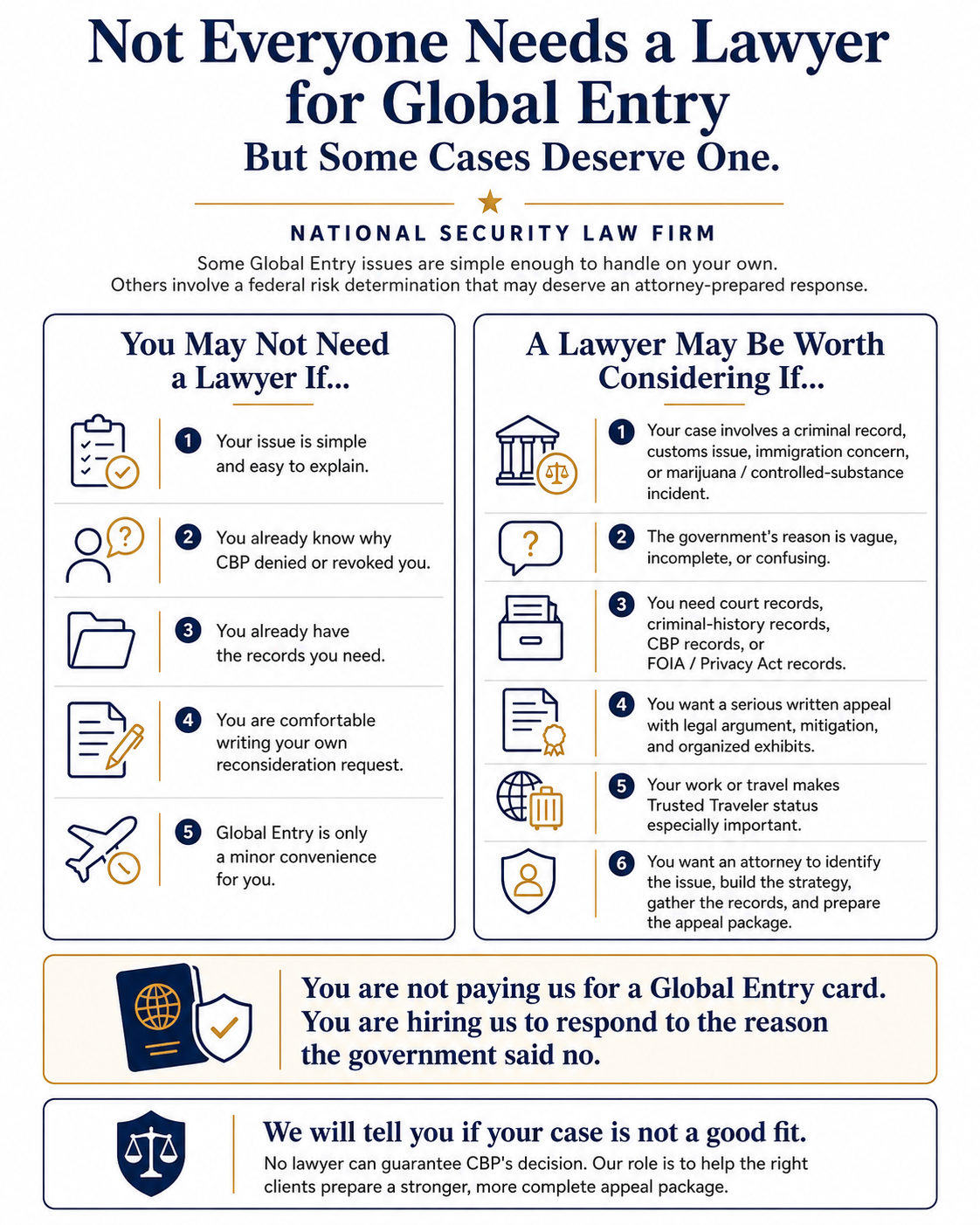
A lawyer is not necessary for every Global Entry denial. If your situation is straightforward — a missing document, a simple misunderstanding, or a minor issue with a clear explanation — you may be able to file a reconsideration request on your own. We would rather tell a prospective client that than take a case that is not a good fit.
Global Entry also matters more to some people than others. If you cross international borders regularly — for work, for family, or simply because you travel often — losing it is a real disruption. For occasional travelers who value it mainly as a convenience, the calculus may be different. Only you can weigh what it means to your travel and your life.
A lawyer is more likely to be worth it when your situation involves:
- A
- A
- A
- A vague denial reason such as “criminality,” “customs violation,” or “does not meet program eligibility” —
- A prior application answer that was
- A
- A
- A
- A professional or business need for Trusted Traveler Program benefits
A lawyer is probably not necessary when:
- The issue is simple, well-documented, and easy to explain on your own
- You rarely travel internationally and value Global Entry mainly as a convenience
- You are comfortable gathering your own records and preparing a reconsideration request
- The cost of legal representation outweighs the benefit to you personally
If you are unsure where your situation falls, the free consultation exists for exactly that reason. An NSLF attorney will give you a straight answer — including if we think you do not need us. or to start.
For a more detailed breakdown, see:
Our Background
Our Background
Why Experience in This Specific Area Matters
Since 2017, NSLF has handled more than 1,000 Global Entry and Trusted Traveler Program appeal matters involving criminal history, customs violations, association-based concerns, travel flags, revocations, and unexplained denials.
That volume matters because these cases often turn on patterns: what issue likely triggered the denial, what records are needed, what mitigation matters, and how to present the client as a low-risk traveler. An attorney handling their first or second Global Entry case is still developing that pattern recognition. Our team is not.
Brett O’Brien — Founding Attorney
Brett spent his military career conducting and reviewing for the U.S. Army’s counterintelligence agency.
An STA is not a simple background check. It is a structured government evaluation that examines a person’s full history — criminal record, financial background, foreign contacts, travel patterns, associations, and behavior — and weighs that information against a set of risk criteria to determine whether someone poses a potential threat to national security. These assessments are conducted by trained government personnel using internal frameworks and databases that are not publicly available. The results are rarely explained in detail to the subject, which is one reason Global Entry denial notices often feel vague or incomplete.
CBP applies the same type of risk assessment framework when evaluating Global Entry applicants and appeals. When your application is denied or your membership revoked, the underlying question is not whether you committed a crime — it is whether the totality of your history causes you to register as a risk under CBP’s internal criteria. Most attorneys have never seen the inside of that process.
Brett has. He did not study STAs from the outside — he conducted them, reviewed them, and understands how evaluators are trained to weigh competing factors. That experience translates directly into how NSLF analyzes a denial: what triggered the flag, how CBP likely characterized it, and what a legal argument needs to address to neutralize it. It is the difference between responding to what the denial notice says and responding to what actually drove the decision.
|
What is Global Entry?
is a CBP Trusted Traveler Program providing expedited customs clearance for pre-approved, low-risk international travelers arriving in the United States. Members use automated kiosks at rather than the standard customs line. Global Entry membership also includes TSA PreCheck at no additional cost and is valid for five years.
Applicants must be U.S. citizens, lawful permanent residents, or citizens of a . Approval requires a successful background check and an . The $120 application fee is non-refundable whether the application is approved or denied.
|
Our Legal-Fee Refund Promise
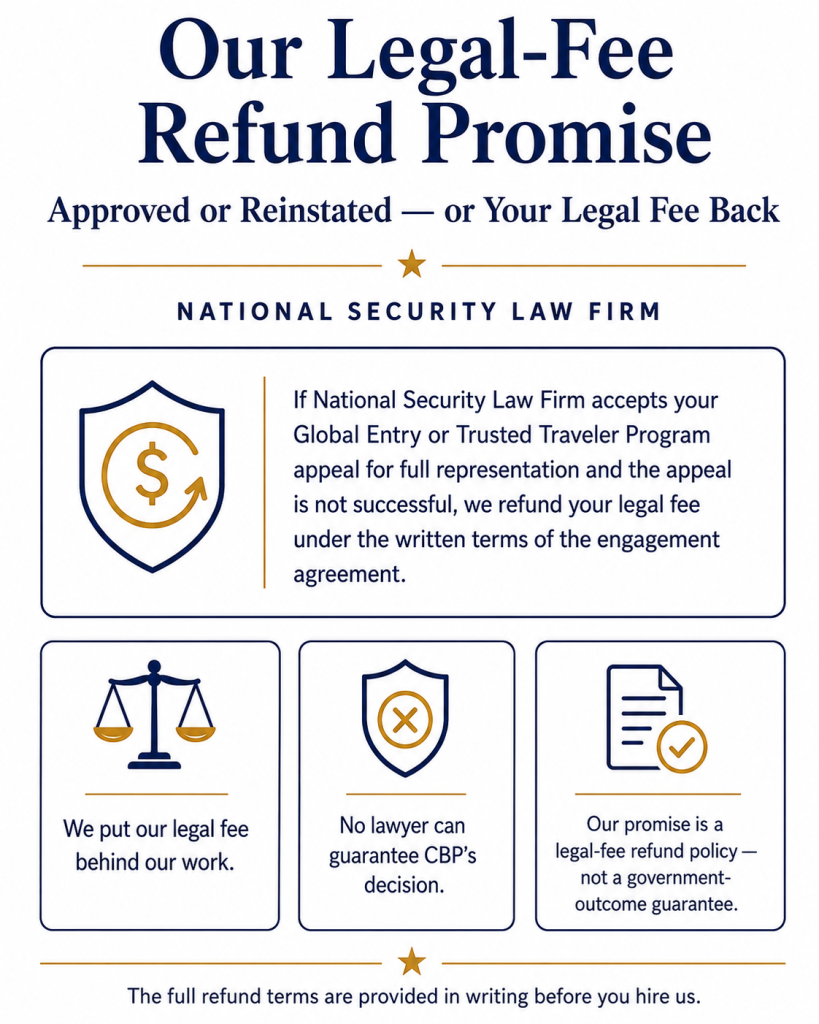
We prepare serious, attorney-led appeal packages for Global Entry and Trusted Traveler Program denials and revocations. If National Security Law Firm accepts your matter for full appeal representation and the appeal is not successful, we refund your $2,995 legal fee as set out in your written engagement agreement.
No lawyer can guarantee CBP’s decision. CBP and DHS decide whether to approve, deny, revoke, reinstate, or continue Trusted Traveler Program membership. Our promise is a legal-fee refund policy — not a guarantee that the government will reach a particular outcome.
Before taking a retainer, we evaluate your situation honestly and tell you whether we believe your appeal is likely to succeed. If we do not think it can win, we say so during the free consultation and do not charge you for that assessment. The refund policy applies to cases we accept — and it reflects our confidence in the work we build.
Why Was My Global Entry Application Denied?
CBP has broad discretion when evaluating Global Entry and other Trusted Traveler Program applications. Under , CBP may find a person ineligible if it determines that the applicant presents a potential risk for terrorism, criminality, smuggling, or is otherwise not a low-risk traveler.
Common reasons for denial include:
- — arrests, convictions, dismissed charges, expunged records, DUIs, misdemeanors, and felonies
- — undeclared items, duty failures, agricultural violations, currency reporting errors
- — connections to flagged individuals, organizations, or addresses, including family members
- — Cuba, Iran, North Korea, and other designated locations
- — failure to disclose an arrest, customs issue, or other required information
- — no reason given, database flags, misidentification, administrative errors
Many applicants are surprised to learn that a conviction is not always required. An arrest, dismissed charge, expunged matter, old incident, customs issue, or incomplete disclosure can still trigger a denial.
That does not mean every denial can be overturned. But it does mean the appeal should directly address the issue CBP likely relied on and explain, with evidence, why the applicant should still be considered a low-risk traveler.
Not sure why you were denied? or .
Why Was My Global Entry Revoked?
Global Entry membership can be revoked even after a person was previously approved and used the program for years.
CBP may remove a participant from Global Entry if CBP determines that the person engaged in disqualifying activity, provided false information, failed to follow program terms, was arrested or convicted of a crime, no longer meets eligibility criteria, or if CBP determines removal is otherwise necessary. Removal is effective immediately.
Common revocation issues include:
- — many members do not realize their membership can be affected by someone else’s conduct at the border
A revocation appeal is different from an initial denial appeal in one important respect: years of compliant membership is meaningful evidence of low-risk status and should be part of the record. However, that history alone is not enough. The must also directly address why the new or newly discovered issue does not make the traveler a current risk — not just that the traveler has used Global Entry without problems in the past.
|
Are Global Entry Appeals Ever Successful?
Yes. Appeals are not hopeless.
The Government Accountability Office reported that, from fiscal year 2020 through the second quarter of fiscal year 2023, the CBP Ombudsman reviewed 76,183 reconsideration requests. CBP sustained the denial or revocation in about 61% of those requests, but approved reconsideration in about 39%, allowing some travelers to enroll, have membership reinstated, or proceed to an interview.
That does not mean every case has a 39% chance. Outcomes depend on the specific facts, including:
- The reason for the denial or revocation
- The strength and completeness of the records submitted
- The passage of time since the underlying issue
- The applicant’s candor and disclosure
- The quality of the mitigation evidence presented
The data shows an important point: reconsideration is real, and a meaningful percentage of denials and revocations are overturned or moved forward every year.
|
Which Cases Win — An Honest Assessment
Over 1,000 cases gives a clear picture of what succeeds and what does not. We will give you a direct read on your situation during the free consultation.
Cases that tend to succeed on appeal:
- — particularly where the applicant’s overall history is strong and the incident is not reflective of current behavior
- — or based on a genuine misunderstanding of the rules, with no pattern of similar conduct
- — that can be explained and contextualized with supporting evidence
- — where a FOIA request can surface what CBP actually has on file
Cases that are more difficult:
- Recent serious felony convictions
- Active law enforcement investigations or pending criminal charges
- Repeated violations over a sustained period
- Cases where the applicant has been less than fully candid with CBP
We will tell you honestly where your case falls — including if we do not think it is strong enough to take on.
|
How Do You Appeal a Global Entry Denial or Revocation?
The official term is often redress or reconsideration, although many travelers call it an appeal.
Under , a person denied or removed from the program has two possible redress methods:
- — generally more appropriate when the issue involves repeated screening problems, misidentification, watchlist-type concerns, or broader travel redress issues
- — submitted through the online TTP system or another CBP-approved process; the most common route for Global Entry denials and revocations
These processes are discretionary. The regulation states that they do not create or confer a legal right, privilege, or benefit on the applicant or participant.
That is why the quality of the submission matters. A strong reconsideration package should:
- Identify the likely reason for the denial or revocation
- Provide the relevant records and documentation
- Address the government’s specific risk concern directly
- Present mitigation evidence in a clear, organized, and complete way
Not sure which pathway applies to your situation? See our full guide: |
What Makes a Strong Global Entry Appeal?
A strong Global Entry appeal does not just say, “I am a good person,” or “I travel a lot.”
A strong appeal answers the real question:
Why should CBP consider this person a low-risk traveler despite the issue that led to denial or revocation?
Every theme in the appeal should connect back to that question. Important themes may include:
- The incident was old — the passage of time since the underlying issue is a meaningful factor in CBP’s risk assessment
- The incident was isolated — there is no pattern of similar conduct before or since
- The traveler has had a clean record since — subsequent law-abiding conduct is evidence of current low-risk status
- The traveler complied with all requirements — court obligations, customs penalties, immigration requirements, or administrative resolutions were met in full
- The traveler disclosed the issue honestly — candor with CBP matters and should be documented
- Any omission was inadvertent and has been corrected — if a prior application answer was incomplete, the correction and explanation belong in the appeal
- — where records are wrong or incomplete, a FOIA request may be necessary to surface and correct the actual file
- The traveler has strong professional, community, or travel-related evidence — employment history, security clearances, professional licensing, and community ties are all relevant context
- The traveler understands the seriousness of Trusted Traveler Program compliance — the appeal should demonstrate that the applicant takes the program’s requirements seriously, not that they view the underlying incident as trivial
Every appeal is fact-specific. The themes above are not a checklist — they are arguments, and each one requires supporting evidence to be effective.
|
What We Do in a Global Entry/TTP Appeal
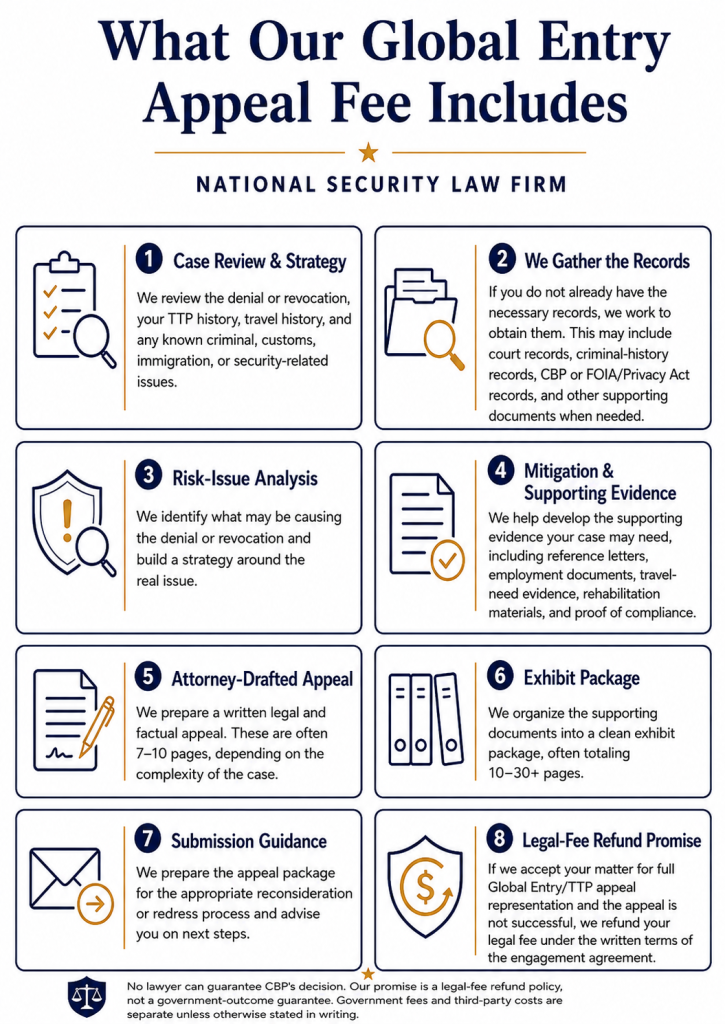
National Security Law Firm does not submit a short online explanation on your behalf. When we accept a Global Entry or Trusted Traveler Program appeal, our work typically involves the following:
1. Case Assessment
We review the denial or revocation notice, TTP account information, prior applications, and any known criminal, customs, immigration, travel, or security-related issues. We evaluate the likely basis for the denial and whether the matter is a reasonable candidate for reconsideration. We will tell you honestly if we do not think it is.
2. Records Strategy
In many cases, the denial reason is vague or incomplete.
The Government Accountability Office reported that CBP denial and revocation letters have not always given travelers enough information to understand the specific reason for the decision. CBP updated its letters in June 2024 to direct travelers to ways to seek more information, including through an enrollment center, the CBP Information Center, or FOIA.
Depending on the case, we evaluate whether FOIA/Privacy Act records, court records, FBI records, state criminal-history records, immigration records, CBP records, or other documents are needed before the appeal is constructed.
FOIA is a separate service with a separate fee. Your attorney will discuss whether one is warranted during the consultation. .
3. Document and Mitigation Checklist
We help identify and gather supporting evidence. Depending on the case, this may include:
- Certified court dispositions
- Dismissal or expungement orders
- Proof of completed probation, fines, or court obligations
- Customs or agriculture penalty records
- Immigration documents
- Employment verification and professional licensing records
- Security-clearance or suitability-related documentation, where relevant
- Reference letters
- Travel-need documentation
- Rehabilitation or compliance evidence
- Corrected records
4. Written Legal and Factual Argument
We prepare a formal legal brief under and related regulations arguing why the applicant should be considered a low-risk traveler despite the issue that led to denial or revocation. The brief addresses each disqualifying factor, presents mitigating evidence, and makes the affirmative case for reconsideration.
5. Supporting Exhibit Assembly
We organize supporting exhibits so the reviewer can understand the record quickly. Depending on the case, an appeal package may include 10 to 50 pages of exhibits — court records, disposition documents, character materials, and supporting evidence.
The point is not volume for its own sake. The point is to make the government’s review easier and more complete.
6. Submission and Next Steps
We prepare the appeal for submission through the appropriate reconsideration or redress pathway. Once submitted, we advise the client on what to expect, typical timelines, and — when the appeal is approved — how to prepare for the .
Flat fee: No hidden charges.
|
Common Global Entry Appeal Issues We Handle
CBP may consider arrests, convictions, pending charges, and outstanding warrants. A denial may occur even if the case was dismissed, expunged, old, or never resulted in jail time.
A strong appeal should include the complete disposition and explain why the criminal-history issue does not show current risk.
A dismissed charge can still create questions if the underlying arrest appears in government records. The appeal should document the final disposition and address the facts carefully — a dismissal is not the same as the record not existing.
Expungement can be helpful evidence, but it does not automatically require CBP to approve Global Entry. The appeal should explain the expungement, provide the records, and address why the underlying matter does not reflect current risk.
State legality does not resolve a federal trusted traveler issue. Marijuana or controlled-substance incidents can be especially serious when connected to border travel, customs inspection, airports, luggage, vehicles, or international travel.
A strong appeal should avoid minimizing the conduct and should focus on candor, compliance, passage of time, lack of recurrence, and why the traveler does not present a smuggling or criminality risk.
|
Customs, immigration, and agriculture violations are specifically identified as potential disqualifying factors under . An issue that seems minor to the traveler may be treated seriously by CBP.
A strong appeal should explain what happened, provide proof of resolution, show the corrective steps taken, and demonstrate future compliance.
A firearm discovered at a TSA checkpoint is a federal matter regardless of whether the traveler had a valid permit. These incidents are taken seriously and require an appeal that addresses the specific circumstances, demonstrates compliance with applicable law, and explains why the incident does not reflect a pattern of disregard for security requirements.
Immigration-related issues — including prior visa violations, overstays, removal orders, or immigration court history — can affect Global Entry eligibility. The appeal should address the specific immigration history, document its resolution, and explain why the applicant now meets the low-risk standard.
False or incomplete application information is one of the most serious issues in a Trusted Traveler Program appeal. If an applicant failed to disclose an arrest, charge, customs issue, immigration issue, or other required fact, the appeal must provide a truthful corrected record and explain why the omission was not an attempt to deceive CBP.
Some denial and revocation notices are vague. In those cases, the first step may be to identify the likely issue through available records, the TTP account, communications with CBP, or a — before the appeal is constructed.
Can You Expedite Global Entry?
There are two separate issues: vetting and interview scheduling. They are handled differently.
CBP vetting cannot be forced or guaranteed by a lawyer. Some applications require additional review, and CBP has stated that applications requiring additional review may take 12 to 24 months, depending on the program.
Once an applicant is conditionally approved, however, there may be practical ways to complete the enrollment interview sooner. Options may include:
- — conditionally approved applicants may complete their interview upon arriving at a participating airport
- Enrollment on Departure — certain conditionally approved applicants may complete enrollment before departing on international travel at participating locations
- — appointments vary by location and openings do become available
- — where available and where the applicant is eligible
- Renewal grace-period benefits — members who submit renewal applications before expiration may continue using Global Entry benefits for up to 24 months after expiration while renewal is pending
A lawyer should not promise to “expedite” CBP’s vetting decision. That timeline is controlled by CBP, not counsel. However, a lawyer may help when a delay appears tied to a legal, records, or risk issue that is holding the application — and addressing that issue directly may be what moves it forward.
|
Do You Need FOIA Before Appealing a Global Entry Denial?
Not always.
Some cases are clear enough to appeal without waiting for . Other cases are not.
A FOIA/Privacy Act request may be worth considering when:
- The denial reason is vague — the notice cites a general regulatory category without explaining what specifically triggered it
- You do not know what CBP relied on — the denial does not identify the underlying record or incident
- There may be inaccurate or incomplete government records — errors in criminal, customs, or immigration databases are more common than most people expect
- The issue involves a customs, border, immigration, or law enforcement event — these incidents generate government records that may not be fully visible to the applicant
- You previously applied and received inconsistent outcomes — an approval followed by a denial, or vice versa, often suggests something changed in the underlying record
In those situations, filing an appeal before understanding the record is essentially responding to a concern you cannot see. An appeal is strongest when it addresses the actual concern, not a guess.
FOIA can take time and may produce redacted or incomplete records. It is not always the right first step — but in the right case, it is the most important one.
FOIA is a separate service with a separate fee. Your attorney will discuss whether it is warranted during the free consultation.
|
Frequently Asked Questions
Can I appeal a Global Entry denial without a lawyer?
Yes — and in straightforward cases some people succeed writing directly to the CBP Ombudsman. If your denial involves criminal history, a security flag, an association concern, or no stated reason, the appeal may require a formal legal brief with supporting documentation and an understanding of the Security Threat Assessment framework CBP applies. .
How long does a Global Entry appeal take?
Most appeals take between 90 and 180 days from submission to a final decision. This reflects CBP’s processing timeline, not ours — the appeal itself is submitted within weeks of retaining us. .
What does the money-back guarantee cover?
If NSLF represents you and does not succeed in getting your Global Entry approved on appeal, your $2,995 legal fee is refunded in full — under the written terms of your engagement agreement. .
Can a lawyer guarantee that I will get Global Entry?
No. CBP and DHS make the decision. The Global Entry redress process is discretionary and does not create a legal right to approval or reinstatement. National Security Law Firm offers a legal-fee refund policy when we accept a matter for full appeal representation — that is a refund of our fee if we are unsuccessful, not a guarantee of a government outcome.
Are FOIA requests included in the flat fee?
No. FOIA requests are a separate service with a separate fee. Your attorney will discuss whether one is warranted during the free consultation. .
What happens on the free consultation?
An NSLF attorney calls you at the time you booked. You describe your situation, we ask questions, and we give you a straightforward assessment — including whether we think the case is worth pursuing and what it would cost. There is no obligation. .
What if my Global Entry was denied for no stated reason — or I do not know why?
CBP is not required to explain their decisions in detail, and many denial notices reference only a vague regulatory citation. If the reason is unclear, the appeal strategy may begin with reviewing available records, evaluating , and identifying the most likely basis for the decision before a full reconsideration request is submitted. Filing an appeal before understanding what triggered the denial is responding to a concern you cannot see. .
What if my first appeal was already denied?
A first denial does not close the door. Second-level options exist depending on the circumstances of your case. .
Does NSLF handle TSA PreCheck and SENTRI appeals?
Yes. We handle appeals for all CBP and TSA Trusted Traveler Programs, including TSA PreCheck, SENTRI, and NEXUS. .
What is a Security Threat Assessment and why does it matter for my appeal?
A Security Threat Assessment is the government’s internal framework for evaluating whether a traveler poses a national security risk. CBP applies STA criteria when deciding Global Entry applications and appeals, but the specific factors and how they are weighted are not publicly disclosed. NSLF’s founding attorney spent his military career conducting STAs for Army counterintelligence — that background directly informs how we analyze a denial and construct an appeal. .
Why was I denied Global Entry if I was never convicted?
CBP may consider arrests, pending charges, outstanding warrants, investigations, customs violations, immigration violations, agriculture violations, and other risk factors. A conviction is not always required. .
Does expungement guarantee Global Entry approval?
No. Expungement may be helpful evidence, but Global Entry remains discretionary. The appeal should provide the expungement record and explain why the underlying matter does not show current risk. .
What is the difference between CBP Ombudsman reconsideration and DHS TRIP?
CBP Ombudsman reconsideration is generally used to contest a Trusted Traveler Program denial or revocation. is broader and may be more appropriate when the issue involves repeated travel-screening problems, misidentification, watchlist-type concerns, or other travel redress issues.
What documents do I need for a Global Entry appeal?
Documents may include the denial or revocation notice, TTP account screenshots, court dispositions, expungement orders, customs records, immigration records, employment letters, reference letters, travel-need evidence, and any documents showing rehabilitation, compliance, or corrected records.
Official Sources for Global Entry / Trusted Traveler Program Information
Global Entry is governed by federal regulation. The information on this page draws from official CBP and DHS materials, 8 CFR § 235.12, Federal Register guidance, and GAO reporting on Trusted Traveler Program denials, revocations, and the reconsideration process.
CBP’s official program page covering membership, eligibility, fees, and the application process.
The federal regulation governing Global Entry eligibility, disqualifying factors, denial, removal, and redress.
GAO Report on Trusted Traveler Program Reconsideration
GAO’s review of CBP’s reconsideration process, including data on Ombudsman outcomes from FY2020 through Q2 FY2023.
DHS’s redress program for travelers experiencing screening difficulties, misidentification, or border-related issues.
Federal Register — Global Entry and SENTRI Fee Rule
CBP’s 2024 rule setting the $120 application fee for Global Entry and SENTRI.
Explains how conditionally approved applicants can complete enrollment at participating airports upon arrival.
Explains how certain conditionally approved applicants can complete enrollment before departing on international travel.
CBP Remote Interview Pilot
CBP’s video teleconference interview option for eligible Trusted Traveler Program members.
CBP Processing-Time Guidance
CBP’s guidance on processing timelines, including the 12–24 month range for applications requiring additional review.
Speak With a Global Entry Appeal Attorney
If your Global Entry, NEXUS, SENTRI, or other Trusted Traveler Program membership was denied, revoked, suspended, or not renewed, National Security Law Firm can help you evaluate your options.
The fastest way to speak with an attorney is to book online.
Visit our , choose a date and time, and confirm your appointment. In most cases same-day availability is offered. At the scheduled time, an NSLF attorney calls you directly — no intake forms to complete first, no waiting for a callback. The call typically runs 10 to 20 minutes. You will leave with a clear picture of whether your case is worth pursuing, what the process would involve, and what it would cost.
Thinking About Hiring a Lawyer?
Explore All Global Entry Resources
Appeals
Denials and Revocations by Issue
Program Guide
National Security Law Firm serves clients nationwide. .